Feeds:
Posts
Comments

Archive for the ‘Art’ Category

Continuing my quixotic quest to photograph dragonflies in flight, I went boldly out into the wild, armed with my trusty 100mm macro lens, and managed to capture this cool image of a dragonfly as it hovered over the water.

In previous attempts, I used longer telephoto zoom lenses, which increased the number of potential subjects but gave only mixed results. Using a shorter, fixed focal-length lens, I had to change my strategy a little and try to get closer to the subject.

I noticed this dragonfly hovering about the water to the side of the boardwalk on which I was walking. I crept as close as I could and tried to shoot as close to straight down as I could (the boardwalk was at least a foot (30 cm) above the level of the water and it looked like the dragonfly was hovering almost level with the boards of the boardwalk). I was really sensitive to my shadow, because I have learned that nothing scares away an insect faster than casting a shadow on it.

I used autofocus and was a little surprised to see that my dragonfly is in pretty clear focus, although the shutter speed was not fast enough to stop the action of  the wings. I shot this handheld and really tried to pay attention to my technique, because my macro lens does not have any built-in image stabilization. As I thought about it afterwards, I realized that the auto focusing on the macro lens (using what Canon calls an ultrasonic motor) is much faster and better than the focusing on my Canon 55-250 or my Sigma 135-400mm zoom lens.

I have been having some difficulties identifying this dragonfly. The coloration of the tail looks a little like a female Blue Dasher, but the beautiful blue eyes do not seem right for the female. The tip of the tail should be a help, but I can’t seem to find one that matches it.

Although I can’t identify the dragonfly, it’s my best shot to date of a dragonfly in flight and I’m pretty content with it today, though my quixotic quest is likely to continue this weekend.

hover1_blog

Michael Q. Powell. All rights reserved

Read Full Post »

As I was checking out the cattails that are growing like crazy at my local marsh, I spotted this little beetle chewing on the soft insides of a broken cattail.  I immediately recognized him as a Spotted Cucumber beetle (Diabrotica undecimpunctata), a species that I encountered numerous times last summer when photographing flowers.

I really like the texture of the immature cattail, both on the outside as well as on the inside, and the bold design of the beetle.  I think that those elements and the varied shades of green make for a cool, graphic image.

cucumber1_blog

Michael Q. Powell. All rights reserved

Read Full Post »

As I was searching for dragonflies and butterflies in the vegetation overlooking a small pond this past weekend, I spotted this little patch of yellow on the leaf of a small tree, which turned out to be a tiny tree frog.

The frog appears to still be in a developmental stage, with indistinct feature and a substantial amount of the tail that it had as a tadpole. The frog was yellowish in color and it is a little tough for me to figure out what kind of a frog it is.

I should note that this it the first tree frog that I have ever seen and I was amazed at how small it was. It is not much bigger than some of the insects that I have been photographing, but it is definitely a whole lot cuter.

little_frog1_bloglittle_frog2_blog

Michael Q. Powell. All rights reserved

Read Full Post »

Thanks to Tropical Storm Andrea, it rained all day this past Friday, and this juvenile Tree Swallow (Tachycineta bicolor) was wet and hungry and decided to express its unhappiness in a very vocal way.  Shooting from under an umbrella, I was able to capture this moment of pique.

Swallows eat flying insects and I have to believe that the rainy weather made foraging tough for them. Fortunately, the continuous rain last for only a single day and this little bird probably was able to survive its day of reduced rations.

wetbird1_blog

Michael Q. Powell. All rights reserved

Read Full Post »

Love-in-a-mist (Nigella damascena) is one of those rare flowers that looks as good (or even better) after it has finished blooming and has turned into a seed pod. If you need to remind yourself of the striking blue blooms of this remarkable flower, check out my posting from last week that I called Whole Lotta Love.

I was a little surprised to that these ones at Brookside Gardens in Wheaton, Maryland had already moved to this stage of development, but was quick to jump on the chance to photograph them yesterday. I like the way that the spiky portions of the plant are in sharp focus and how the background looks almost misty, as befits the name of the flower. As always, though, the plant looks vaguely alien to me, like it came from outer space.

Love is always beautiful and comes in many forms, whether in the mist on in a pod.

Love1_blog

Michael Q. Powell. All rights reserved

Read Full Post »

Temperatures were forecast to soar yesterday, so I arrived early at the marsh—about 6 o’clock— and was treated to many stunning examples of spider art. The early morning light and the dew made it possible to get these shots.

I had thought that it was a bit early in the season for spiders to be active, but I was thrilled to be proven wrong. I never fail to be impressed by the handiwork of the different kinds of spiders and how they are able to adapt their webs to the environment.

I shot some webs with my macro lens and others with a telephoto zoom. In virtually all cases, I focused manually and used my tripod.

Only a few of the webs had visible spiders and I chose to highlight one of those in the first image, which is a close-up of the web shown in the final shot. The webs themselves are not perfect and have gaps and breaks in some places, an appropriate metaphor for the lives that most of us live.

web3_blogweb1_blogweb4_blogweb2_blog

Michael Q. Powell. All rights reserved

Read Full Post »

I captured this close-up image of a Barn Swallow (Hirundo rustica) as it rested on a perch a short distance from the location of its nest, underneath a raised portion of the boardwalk at my local marshland park.

I have posted a number of close-up shots of Barn Swallows in the last few weeks (including one that I entitled Too Close), but this one is distinctive for a couple of reasons. The swallow is in the midst of working on its nest, and the mud and twigs in its bill show clearly its primary building materials. Most of my other photos have showed a swallow posing as it took a break from chasing insects.

The other notable feature of this image that I really like is its narrow depth of field. Although I included the sparrow’s entire body in the shot, only a small part of it is in sharp focus, essentially the forward half of its head, including the one visible eye. I think that the limited area of sharp focus really helps to draw attention to the eye and to the muddy bill.

closer_blog

Michael Q. Powell. All rights reserved

Read Full Post »

Looking at this plant from the side, all you notice are the tall, straw-like spikes that radiate from the center, but from above, it’s like looking into a kaleidoscope. I love the repetition of the colors and patterns in a wide circle around the center blossom.

I don’t have any idea what kind of flower this is, so I’ll make up my own name for it and call it the Kaleidoscope flower.

circle_blog

Michael Q. Powell. All rights reserved

Read Full Post »

I was pleasantly surprised to come across a group of irises in one of the marshy areas of Huntley Meadows Park, the nature center where I do a lot of my shooting.

It probably reveals my ignorance about flowers, but I had no idea that irises could grow in such moist conditions. Although the irises were smaller and less showy than many of the cultivated ones that I see, they were no less beautiful.

It had been raining intermittently the morning that I took this photo and you can see drops of water on some of the petals. I tried very carefully to frame this image and am pretty happy with the way that it turned out, with the blurry image of a second iris in the background repeating the shape and color of the iris in the foreground.

swamp_iris_blog

Michael Q. Powell. All rights reserved

Read Full Post »

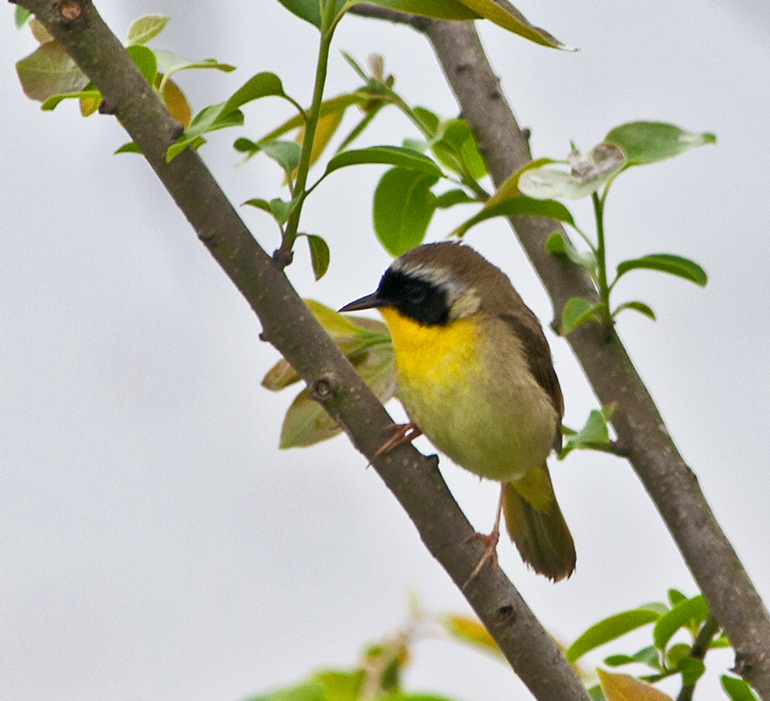
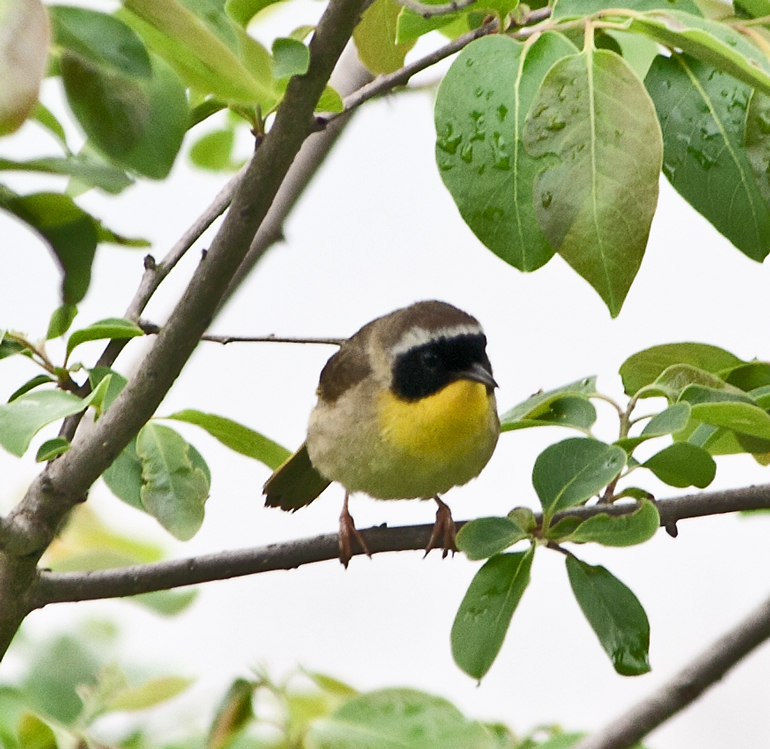
I have been hearing the calls of this little warbler for several weeks, but today was the first day that I got some clear shots of the male Common Yellowthroat (Geothlypis trichas).

I was fortunate that the foliage was not too dense when I initially spotted the bird and even when he moved to a second spot in the same tree, I had a relatively unobstructed view. Birders at my local marshland tell me that the male comes north before the female and that soon the females, which are not so brightly colored, will arrive.

warbler1_blog warbler2_blog

Michael Q. Powell. All rights reserved
Read Full Post »

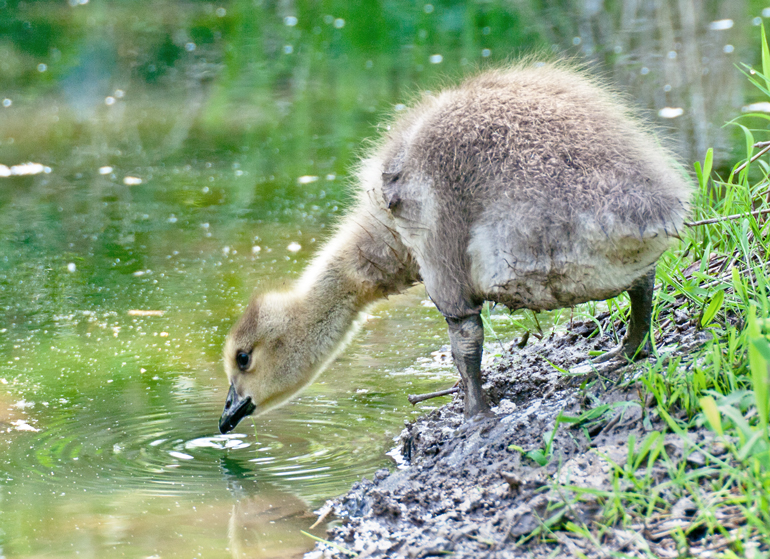
The last few weeks I have been following the adventures of a family of Canada Geese (Branta canadensis) at my local marshland and encountered them this morning as they were foraging in the muddy grass.

There are currently four goslings (there may have been six initially if this is the same family I saw previously) and it was fun to watch them as they would wander off a little from their parents and then scurry back quickly.

It was hard to get clear shots of the youngsters, but I did manage to get this shot that I like when one of the goslings walked to the water’s edge to get a drink.

gosling1_blog

Michael Q. Powell. All rights reserved
Read Full Post »

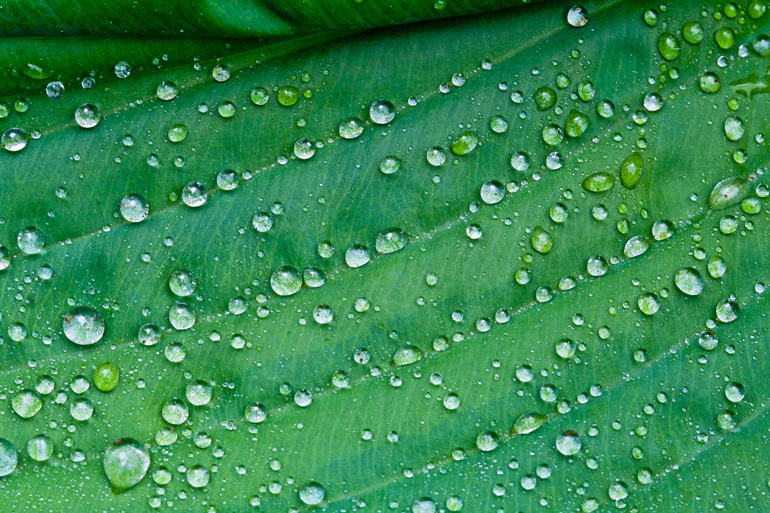
I love to photograph raindrops, normally focusing on a single drop, but I was really attracted this weekend to the rows of water drops on a single leaf of this Hosta plant. Many of them formed perfect little spheres of water, like tiny jewels or little water pearls.

Sometimes it’s easiest to find real beauty in simplicity, with no need for bright colors or ornate details.

drops1_blog

Michael Q. Powell. All rights reserved
Read Full Post »

One of my favorite spring flowers is the columbine (genus Aquilegia) and I especially like its distinctive shape. Yesterday I took this photo at Green Spring Gardens, a county-run historical garden, one of my favorite spots for photographing flowers.

The flower was growing at an unusual angle and I tried hard to capture the details of the flower, as well as the beautiful colors in the background. I’m pretty happy with the result.

pink_columbine_blog

Michael Q. Powell. All rights reserved
Read Full Post »

There is a spot in a back corner of my marshland park that I love to visit in the early morning, when the light produces beautiful reflections in the still waters of a small pond.

It’s accessible only by an informal muddy trail, so I don’t have to share the moments of tranquility with the baby strollers and power walkers that interrupt my conversations with nature when I am on the boardwalk. Sometimes I will see ducks and geese here and I have even spotted a bald eagle perching in a tall tree, but the main draw for me is not the wildlife—it’s the sense of peace that envelopes me when I am here.

Sometimes I like reflections in which you can easily identify the objects being reflected, like the two trees in the first image. Other times, I get lost in the reflections themselves, which can result in a Monet-like abstract image like the second image below.

All of us are looking for an inner peace—this is one place in which I am able to experience a few moments of that peace.

reflection1_blogreflection2_blog

Michael Q. Powell. All rights reserved

Read Full Post »

This portrait of a Tree Swallow (Tachycineta bicolor) looks almost like it was shot in a studio, but I am pretty sure that if it had been, I would have chosen a more attractive item on which to have her perch.

The green rusted metal post holds up a nesting box and this swallow may be building a nest in it or in one of the other nearby boxes, because she had a long piece of grass in her mouth when I started shooting. I think it might be a female, but it’s hard to tell, because males and females look a lot alike, though, according to my Peterson bird guide, the female is “slightly duller” than the male.

This was another shot that I took this past Monday, when the sky was heavily overcast. I made an effort to frame this shot with the swallow up against the sky and I think that I used my pop-up flash to add a little light. I probably will continue to experiment with the technique, especially when it’s really cloudy,  for I like the result that I got here. It does looks a little sterile and unnatural, but so often the background gets really cluttered and distracting.

treesparrow_post_blog

Michael Q. Powell. All rights reserved

Read Full Post »

The Great Blue Heron was too far away for me to capture many details, but the light early yesterday morning was especially beautiful, so I decided to pull back and try to capture the landscape, something that I don’t do very often.

I love the rich bands of color that I managed to capture in this shot and the gorgeous reflections in the water at my local marshland park. The red color, I believe, is from buds that were stripped from the trees by winds and rain this past week.

heron_blog

Michael Q. Powell. All rights reserved

Read Full Post »

It’s hard to imagine anything cuter than this tiny little Canada Goose that climbed into the water at my local marsh for a swim along with his siblings and his parents. They were close enough to me that I was able to frame the shot pretty much like you see it.

I really like the expression of the gosling as he seemed to turn his head to look at me and also like the contrast between the bright colors of the gosling and the more muted tones of the full-grown geese.

I just missed the drop of 15 Hooded Merganser ducklings from the nesting box this morning by about twenty minutes. Hopefully I will have the chance to celebrate more new lives like this little goose in the coming weeks.

gosling1_blog

Michael Q. Powell. All rights reserved

Read Full Post »

On my last full day in Vienna (at least for this trip), I decided to take some photos of the city as the sun started to set.

This is a shot of the Rathaus (Vienna City Hall), just after they turned on the lights to illuminate the building. I did not have a tripod with me, so I braced on or against various objects in an effort to steady myself. I may post a few more night shots of Vienna later (if I am not too sleepy or wake up really early), but thought I’d share this one right now.

My trip to Vienna was brief, but enjoyable. I got a lot accomplished work-wise, but had enough free time to really enjoy some amazing spring weather.

Rathaus1a

Michael Q. Powell. All rights reserved

Read Full Post »

When you travel to a well-known location, do you feel compelled to take some touristy photos of the famous landmarks? I confess that I almost always feel a need to take at least a few shots of the iconic sights.

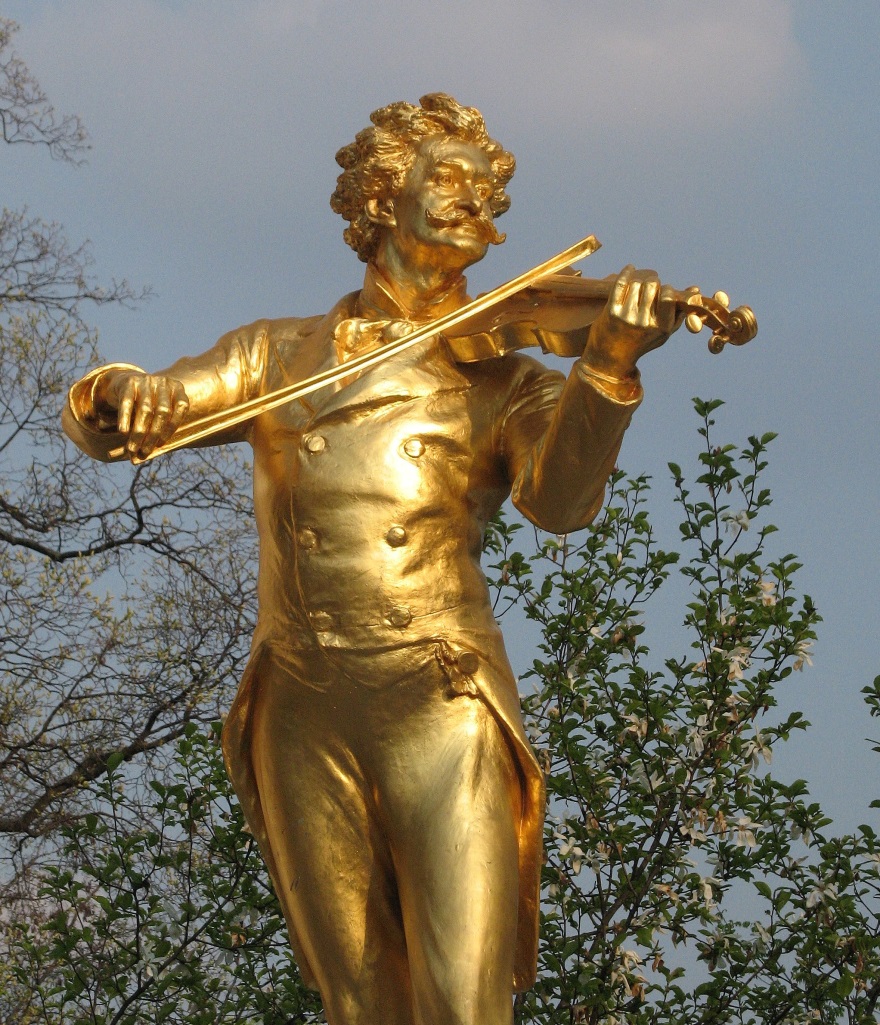
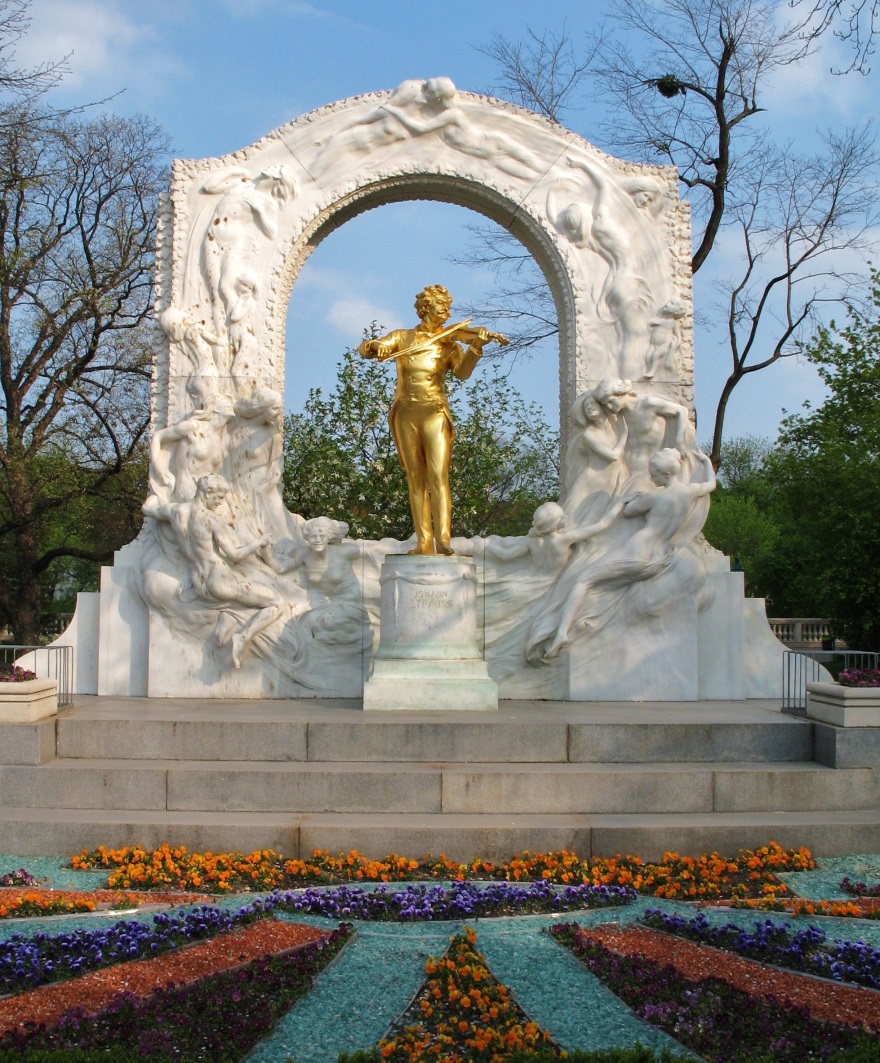
In Vienna, one of the most photographed monuments is the gold-plated bronze statue of Johann Strauss II in the City Park (Stadt Park). Strauss was an Austrian composer in the 19th century and is probably best known for popularizing waltzes. The statue itself was unveiled to the public in 1921 and was covered in gold in 1991, replacing the gold that had been removed in 1935.

One of the more interesting things about the statue is that people are permitted to climb right up next to the statue to have their picture taken. It was a lot of fun to watch the various poses that people would assume, including one lady who posed while trying to hold upright a large pitbull-type dog.

strauss1aStrauss2a

Michael Q. Powell. All rights reserved

Read Full Post »

It doesn’t get much simpler than this—light shining through this leaf from behind created a graphic image that stands out from its blurry background. The color palette is mostly just shades of green. The suggestions of lines in the background help to add some visual interest.

The image is both striking and soothing to me, an interesting combination of reactions.

leaf2_blog

Michael Q. Powell. All rights reserved

Read Full Post »

I have no idea what caused this abstract pattern to form in one of the watery areas of my local marsh, but it really caught my eye when I was looking down, searching for frogs. Maybe it was caused by mineral seepage or plants or some strange combination of the two. Who knows?

In any case, I really like the richness and variety of the colors in the curving patterns.

pattern_blog

Michael Q. Powell. All rights reserved
Read Full Post »

I’m finally finishing up with the shots from my trip last weekend to see the orchid exhibition and thought I’d post a couple of abstract images.

The first shot is a close-up of an elephant ear plant. I like the way its veins pop out, like a bodybuilder with a heavy weight. The image is somewhat symmetrical, but the two sides are not mirror images.

The second shot is a close-up of an orchid. Is it just me, or does it look like the flower contains a pink Darth Vader helmet?

ElephantEarCloseupDarthVadarPinkHelmet

© Michael Q. Powell. All rights reserved
Read Full Post »

I tend to look at cattails primarily as a place for interesting birds and insects to perch, but earlier this month I was really struck by the beauty, texture, colors, and lines of the cattails themselves.

How do you capture the uniqueness of the cattails? Here are the results of a couple of different approaches that I used to try to respond to that question.

cattail_blog

cattails2_blog

© Michael Q. Powell. All rights reserved

Read Full Post »

I love the way this Mourning Dove (Zenaida macroura) turned its head to look back at me yesterday and how the soft background complements and enhances its beauty.

dove1_blog

© Michael Q. Powell. All rights reserved

Read Full Post »

I love the dreamy look of the morning mist that provided such a beautiful backdrop for the flight of these two Canada Geese this past weekend.

geese_mist

© Michael Q. Powell. All rights reserved

Read Full Post »

My ears told me before my eyed did that some Red-winged Blackbirds (Agelaius phoeniceus) had returned to my local marshland park. I heard the very distinctive song of the blackbird last summer and fall often enough that it’s embedded in my brain. I am working on a couple of photos of blackbirds on cattails, but thought I’d share this image first.

It’s sort of a silhouette, but the red and yellow portion of the wing are very visible, so it’s probably not a true silhouette. There is something simple and graphic about the image that I like, even though normally important details like the eyes are not visible.

blackbird3_blog

© Michael Q. Powell. All rights reserved

Read Full Post »

What is this thing? If I squint my eyes a little, it looks like a weathered sandstone formation on the side of a steep mountain, with beautiful colors and textures.

When reality intervenes, I have to acknowledge that this is only a tree with some kind of growth on its side. I suspect that it’s a mushroom or some other kind of fungus, but I am not sure. Maybe it’s the tree version of a tumor.

Mostly, though, I don’t worry about answering my initial question—it’s not that important for me to identify what this is. I can enjoy its beauty in an abstract way by focusing on its shape and color and texture, by looking at the highlights and the shadows.

growth_blog

© Michael Q. Powell. All rights reserved

Read Full Post »

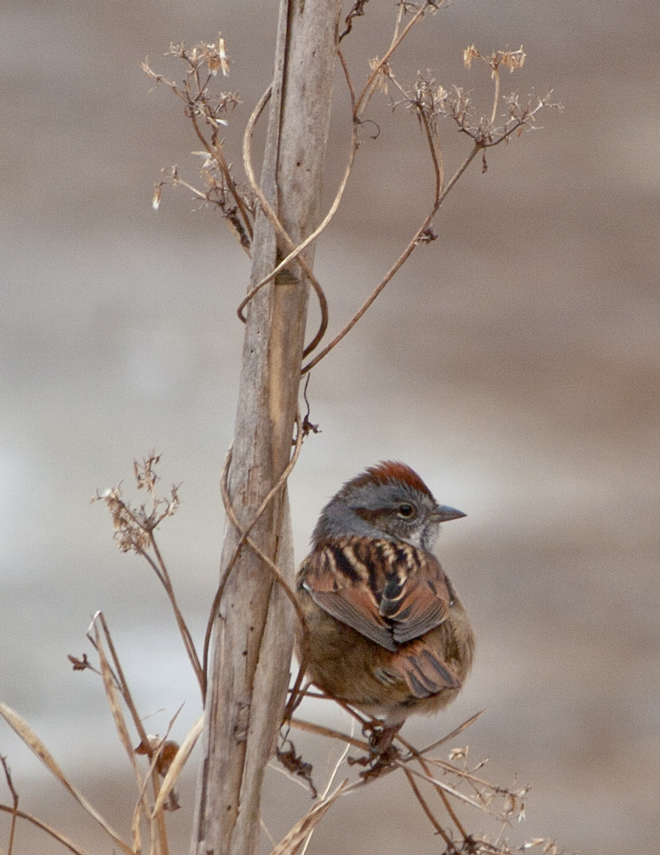
The crisscrossing pattern of the vine and the cooperative pose of the Song Sparrow combine to make this photo one of my recent favorites.

It is always exciting for me when the elements of an image work together in interesting and unexpected ways. I was attempting to photograph this Song Sparrow (Melospiza melodia) when he flew onto this stalk. He was facing away from me, but I kept shooting and them he turned his head. I am not sure that I could have intentionally come up with a more interesting pose—I love the way we are looking down his back and get to see his wings and also get a clear view of his face.

When I first looked at this photo, though, what caught my eyes the most were the crisscrossing vines, an unanticipated bonus. The X-shape of the vine is both linear and curved at the same time and I chose to crop the photo to highlight this feature.

One of the things that keeps me thrilled about photographing nature is the balance between preparation and spontaneity, between technical excellence and creativity. I try to put myself into situations outside in which I know there is a chance that I will see something interesting and then prepare myself (and my camera) to take advantage when something does happen (and it’s usually not what I anticipated).

sparrow_blog

© Michael Q. Powell. All rights reserved

Read Full Post »

The tall plants in the marsh have withered and faded, but they are still standing, defiantly displaying their interesting shapes and textures against a snow-covered backdrop. Two pods are standing together and one is apart, three others are bent over in the center. The bits of orange add a touch of color and the silken strands to the left add a different texture. In a few months, brighter colors will return, but for now this serves as a reminder that there is still life in the winter.

still_life_blog

Click on the photo to see more details.

© Michael Q. Powell. All rights reserved

Read Full Post »

Simple in composition and simple in color palette, I find something really appealing about this photo of a male Northern Cardinal (Cardinalis cardinalis).

The backdrop is made up of the gray composite elements of the boardwalk that wends its way through the marshland area of Huntley Meadows Park in Alexandria, VA. The gray “wood,” with its horizontal and diagonal lines helps to give a little structure to the image.

The cardinal cooperated by cocking his head in an interesting way and giving me a sidewards glance. I believe that the red berry-like fruits are rose hips. The cardinals seem to enjoy eating the inside part of the fruit, but seem to discard most of its flesh. Several areas of the board walk are littered with these red remains.

cardinal_blog

© Michael Q. Powell. All rights reserved

Read Full Post »

I came upon a rock last weekend and my eyes were drawn to its shape and texture and the way that it seemed to be floating in the sky. Normally I don’t shoot abstract shots, but I somehow felt compelled to take this photo. I like the way it turned out—it’s simple and graphic.

rock_blog

© Michael Q. Powell. All rights reserved

Read Full Post »

« Newer Posts - Older Posts »