Feeds:
Posts
Comments

Archive for the ‘animals’ Category

Whenever folks of my generation catch sight of a spotted fawn, we invariably think of the animated Disney movie Bambi, a movie that is an integral part of  our collective memory of childhood. Perhaps we remember the friendship of Bambi, Thumper,  and Flower or the love of Bambi and Faline  or the shocking death of Bambi’s mother. Our memories of the movie may vary, but I think we all feel a soft spot in our hearts if we are lucky enough to catch sight of a fawn.

I spotted this little deer on Tuesday at Prince William Forest Park in Triangle, Virginia. It was down in a small valley at the edge of some heavy vegetation. I watched from a distance from my higher vantage point as the fawn poked about in the vegetation. At some point, the fawn became aware of my presence and looked straight at me through its soft brown eyes. The deer held its gaze for what seemed like a long time and it faded into the underbrush and the spell was broken.

Thanks, Bambi, for sharing those magical moments with me.
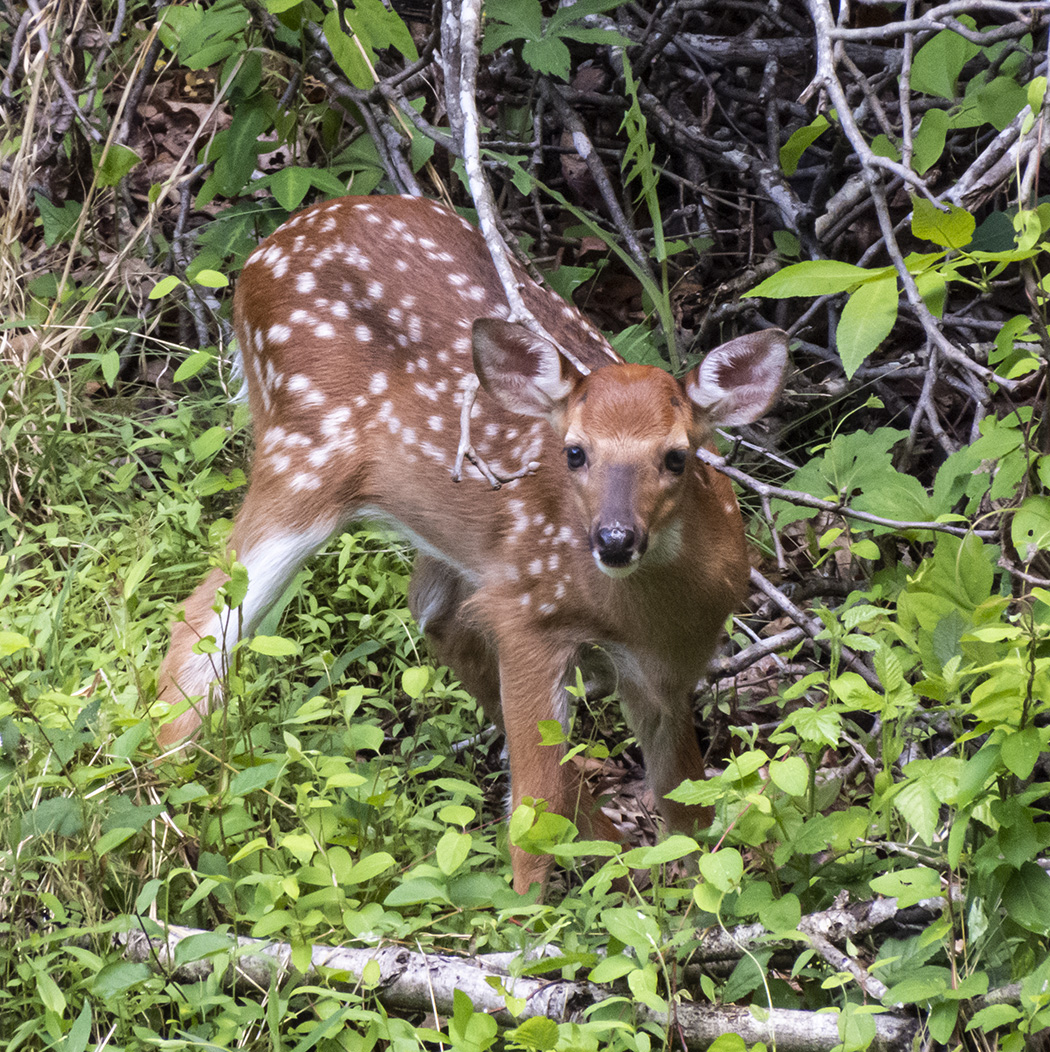
Bambi

© Michael Q. Powell. All rights reserved.

Read Full Post »

I hope that the title did not lead to an expectation that you would find photos of tiny deer in this posting. It may have been a stretch to use that title, but I wanted to give a hint of the fact that I captured all of these images with my macro lens. In fact, the first two images are uncropped, which gives you an idea of how close I was to the deer.

Yesterday I set off for Occoquan Regional Park to search primarily for dragonflies and butterflies. I put my Tamron 180 mm macro lens on my camera, a lens which is my go-to lens for much of the spring and summer. Now I must confess that the reach of this macro lens is a bit longer than the average macro lens, which generally has a focal length of 100 mm or so, but it certainly would not be my first choice for wildlife photography.

I was sitting on a log taking a break when I heard some nearby noise in the underbrush. I stood up, expecting to see a scurrying squirrel, and suddenly was face-to face with a White-tailed Deer (Odocoileus virginianus). For a considerable amount of time the deer eyed me with curiosity before slowly moving away. As I watched the deer depart, I noticed another deer, one with amazingly long ears. As I prepared to photograph the second deer, the first one photobombed us, resulting in the third image.

This situation reinforced to me the importance of shooting with whatever camera or lens that I happen to have at hand. It may not be the optimal option, but it can often yield surprisingly good results.

Whiite-tailed Deer

White-tailed Deer

White-tailed Deer

© Michael Q. Powell. All rights reserved.


Read Full Post »

As I was exploring Accotink Bay Wildlife Refuge earlier this week, I spotted an unusual shape in a small tree. I moved a little closer and zoomed in with my camera and discovered that it was a fairly large animal. It was bigger than a squirrel, so my initial thought was that it was a raccoon or an opossum, but as I studied my viewfinder, I quickly rejected those possibilities.

What was the animal? When I uploaded the images to my computer, the facial features reminded me of a beaver, but the visible portions of the animal’s tail look to be hairy, so I eliminated both the beaver and the muskrat. Grasping at straws, I started looking at photos of porcupines, but they didn’t match at all what I was seeing in the photo. Finally I came across some photos of a Groundhog (Marmota monax) and I realized that I had finally found a match.

I guess that the name “groundhog” threw me off, because I expected a groundhog to be on the “ground,” not in a tree and I can’t imagine a “hog” climbing a tree. According to Wikipedia, groundhogs, also known as woodchucks, “occasionally climb trees when escaping predators or when they want to survey their surroundings.”

groundhog

© Michael Q. Powell. All rights reserved.

Read Full Post »

During one of my recent early morning forays to Occoquan Bay National Wildlife Refuge, I was thrilled to spot several beavers. I had seen plenty of gnawed off trees in the area around this pond, so I knew that there had to be some beavers nearby. You generally have to be really lucky to see one, because they are mostly nocturnal creatures.

There were three beavers when I initially spotted them swimming towards me. Two of them seemed to sense my presence as they got a little closer and dove underwater. One kept approaching and I was able to capture the first image, a head shot  of a handsome North American Beaver (Castor canadensis). The second image shows the beaver as it was swimming and gives you a better sense of the environment in which it was found.

beaver

beaver

© Michael Q. Powell. All rights reserved.

Read Full Post »

Yesterday I was thrilled to observe a group of White-tailed Deer (Odocoileus virginianus) fording a stream at Occoquan Bay National Wildlife Refuge. The activity level of all kinds of creatures seems to be picking up as we move closer to or deeper into spring, depending on how you calculate the start of spring. The bottom of the body of water they were crossing seemed to be uneven and the deer had to move carefully. At one point it looked like they even had to swim a few steps, especially the smaller deer.

As I watched the deer, I was reminded of the lyrics of one of the songs from The Sound of Music that included the words “ford every stream.” Folks of my generation may well remember the inspirational message of the song “Climb Every Mountain,” which I have included below, as found at metrolyrics.com.

Here’s hoping that you will find your dreams, irrespective of whether or not it involves fording streams or climbing mountains.

“Climb every mountain,
Search high and low,
Follow every byway,
Every path you know.

Climb every mountain,
Ford every stream,
Follow every rainbow,
‘Till you find your dream.

A dream that will need
All the love you can give,
Every day of your life
For as long as you live.”

White-tailed Deer

White-tailed Deer


White-tailed Deer

© Michael Q. Powell. All rights reserved.

Read Full Post »

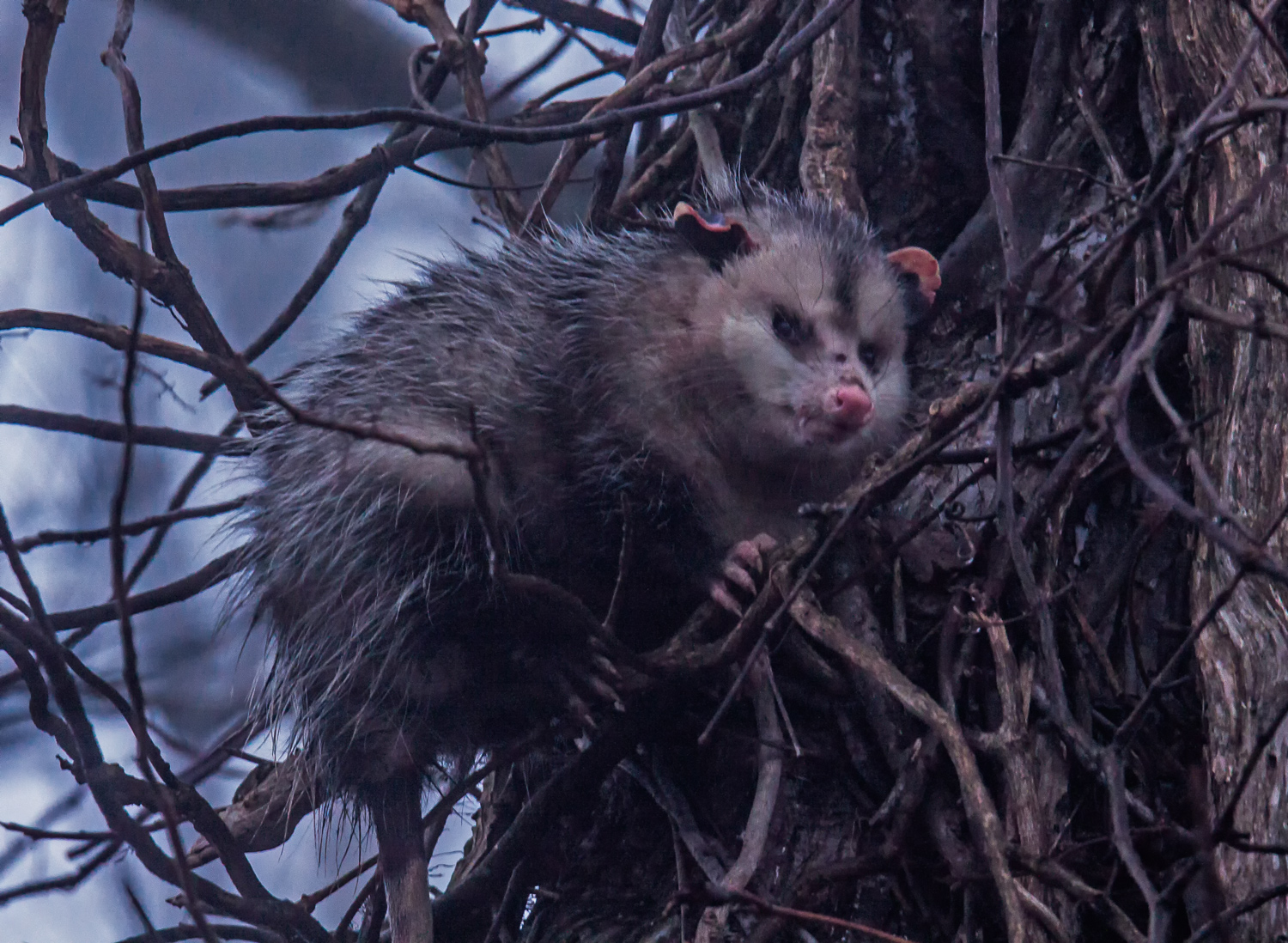
I have been to Occoquan Bay National Wildlife Refuge dozens and dozens of times, but had never seen an opossum there until yesterday. I am pretty sure that I would not have seen this one almost hidden in the trees if fellow photographer Ricky Kresslein had not pointed it out to me. Initially I was incredulous, suspecting that he had misidentified a raccoon, but as soon as I looked closely at the animal, I realized he was right.

The Virginia Opossum (Didelphis virginiana), the animal that I photographed, is the only marsupial found in North America north of Mexico. I had to double-check, but was able to confirm my remembrance that a marsupial is an animal with a pouch, like a kangaroo or a koala.

The connection to Australia and New Zealand is occasionally a source of some confusion, because the “possums” in those locations are entirely different species. Here in North American, “opossum” and “possum” are used interchangeably.

One of the most common references to this animal is the expression “playing possum.” In the literal sense, it refers to the Virginia Opossum’s reaction sometimes when threatened—it may roll over, become stiff, drool, breathe slowly and shallowly, and appear to be dead. In a more general sense, the expression has come to mean pretending to be dead or asleep to avoid having to deal with a problem.

Virginia Opossum

© Michael Q. Powell. All rights reserved.


Read Full Post »

Beavers are nocturnal creatures and consequently the best times to see them generally are at dawn and at dusk. Dragonflies, on the other hand, mostly like bright sunlight and they are often most visible during the hottest part of the day.

When I was walking around the small pond at Jackson Miles Abbott Wetland Refuge yesterday morning around 10:00, therefore, I was expecting to see dragonflies. Imagine my shock when some motion in the water caught my eye and I spotted a North American Beaver (Castor canadensis) lazily swimming by parallel to the shore on which I was standing.

The light on the water was amazing and gave it a golden glow, as you can see in the first image. The beaver made a gentle u-turn and I was able to capture the ripples and the wake it created in the second image. The beaver was then swimming  toward the light and that is why you can see some of the details of the eye in that second image.

I then decided to switch from my DSLR with my 180mm macro lens that I used for the first two shots to my Canon SX50 superzoom camera. The third image is framed just as it came out of the camera with no cropping and it lets you see some of the texture of the beaver’s fur and the little hairs that stick out of its face. I also love the way the patterns of the water look in this image.

This little incident was a reminder to be eternally vigilant. Wild creatures don’t always follow the rules and may turn up in unexpected places at unanticipated times.

beaver

beaver

beaver

© Michael Q. Powell. All rights reserved.

Read Full Post »

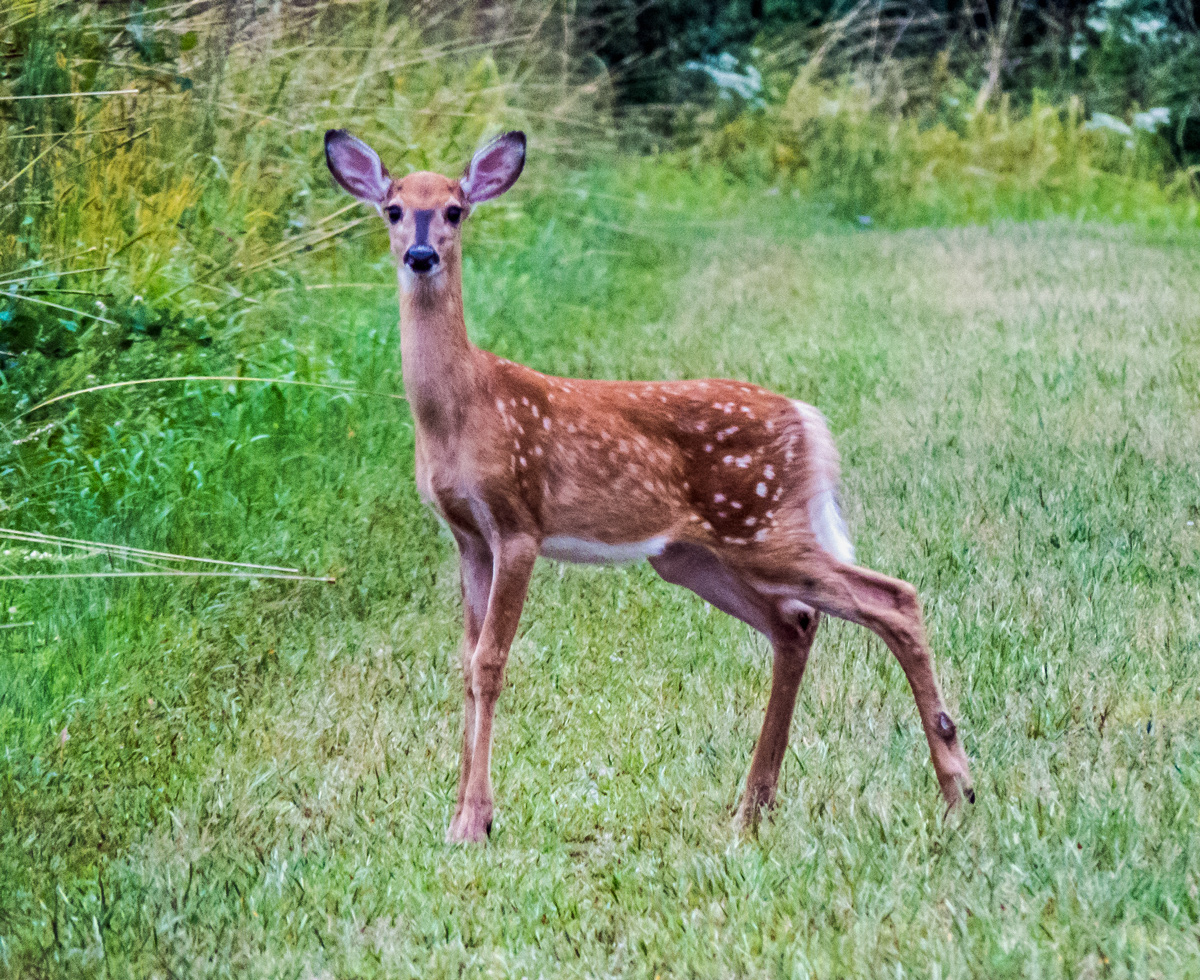
I spotted this curious little White-tailed Deer (Odocoileus virginianus) on Monday at Occoquan Bay National Wildlife Refuge.  The deer appears to have moved out of the cute little Bambi phase and seemed more like a gawky adolescent to me (though I confess I know very little about deer development).

I like the fact that you can still see some of its white spots, which look to be a little faded.

white-tailed deer

© Michael Q. Powell. All rights reserved

Read Full Post »

This little buck seemed more curious than fearful when he spotted me on Monday at Occoquan Bay National Wildlife Refuge. He continued to forage in a marshy area for a while before he finally disappeared from sight.

I know that we have a herd of White-tailed Deer (Odocoileus virginianus) on the wildlife refuge, though I see deer only on rare occasions. This little deer seemed to be alone and I was really struck by the shape of his antlers. It looks to me like they might be his first set of antlers, though I confess to knowing almost nothing about the stages of development of a deer.  The shape of the antlers reminds me of photos that I have seen of several species of antelope in Africa.

white-tailed deer

© Michael Q. Powell. All rights reserved

Read Full Post »

I tend to be more of a dog person than a cat person. Cats have always been somewhat mysterious creatures to me, a bit wild and uncontrollable. Nonetheless, I am usually the go-to person to watch her three cats when my neighbor and fellow photographer Cindy Dyer goes out of town.

This past weekend I watched and fed the three male cats and, as is usually the case, I attempted to take some photos of them. Cindy often manages to capture them in wonderful candid moments, but it was hard for me to get them to cooperate. I am not used to shooting indoors with limited light, so that was an additional challenge. I learned pretty quickly that the 180mm macro lens that I happened to have on my camera is not optimal for this task—it was tough to get far enough away to capture the cats’ major facial features.

Eventually I was able to capture a portrait of each of them. Queso, the orange cat who was rescued in the bushes outside of a Mexican restaurant, is the youngest one; Pixel is the one with the pixelated hair who loves to roll over to have his tummy scratched; and Lobo, the gray lone wolf of the pack, fixed me with a fierce stare when he finally let me take his picture.

I should be back to my more typical wildlife shots tomorrow in case any of you were concerned that I had abandoned my butterflies and dragonflies. I enjoy the challenge of a different set of subjects and I must admit that it was nice to shoot in the coolness of the air-conditioned indoors rather than in the hot, humid summer weather we have been experiencing.

.

Queso

Pixel

Lobo

© Michael Q. Powell. All rights reserved.

Read Full Post »

Six years ago today my photography mentor Cindy Dyer sat me down and told me that I was going to start a blog. She showed me the basics of WordPress editing and navigation and helped me set up my initial pages. I don’t think that either of us anticipated the degree to which I would grow to love the process of blogging, a process that has allowed me to express myself creatively in both words and images

WordPress data show that I have published 2768 posts and have had approximately 170800 views. Those posts have included 429649 words (about 155 words per posting) and well over 3000 photos.

The importance of my blog, though, cannot be expressed merely in numbers. More significantly the blog has helped me to develop relationships with a lot of different viewers, to share with you the different steps on my meandering journey into photography. Thanks to all of you for helping me along the way and sharing your comments, suggestions, and recommendations. I especially owe a debt of gratitude to Cindy Dyer for motivating me throughout this entire period, for pushing me at times when I was hesitant, and for serving as my museThanks, Cindy.

To celebrate this anniversary, I thought I would reprise a few of my favorite photos. These are not necessarily my most popular images or my “best” images, but they are ones that are particularly memorable to me. I am also including links to the original postings so you can read the accompanying text and additional commentary about the circumstances under which they were captured.

Links to original postings: Visible Song (8 March 2016); Fox on a frozen pond (31 January 2016); and Rescue of an injured Bald Eagle (4 November 2014).

Thanks again for all of your support and encouragement over these past six years. The journey continues onward.

Visible song

fox on frozen pond

eagle resuce

© Michael Q. Powell. All rights reserved.


Read Full Post »

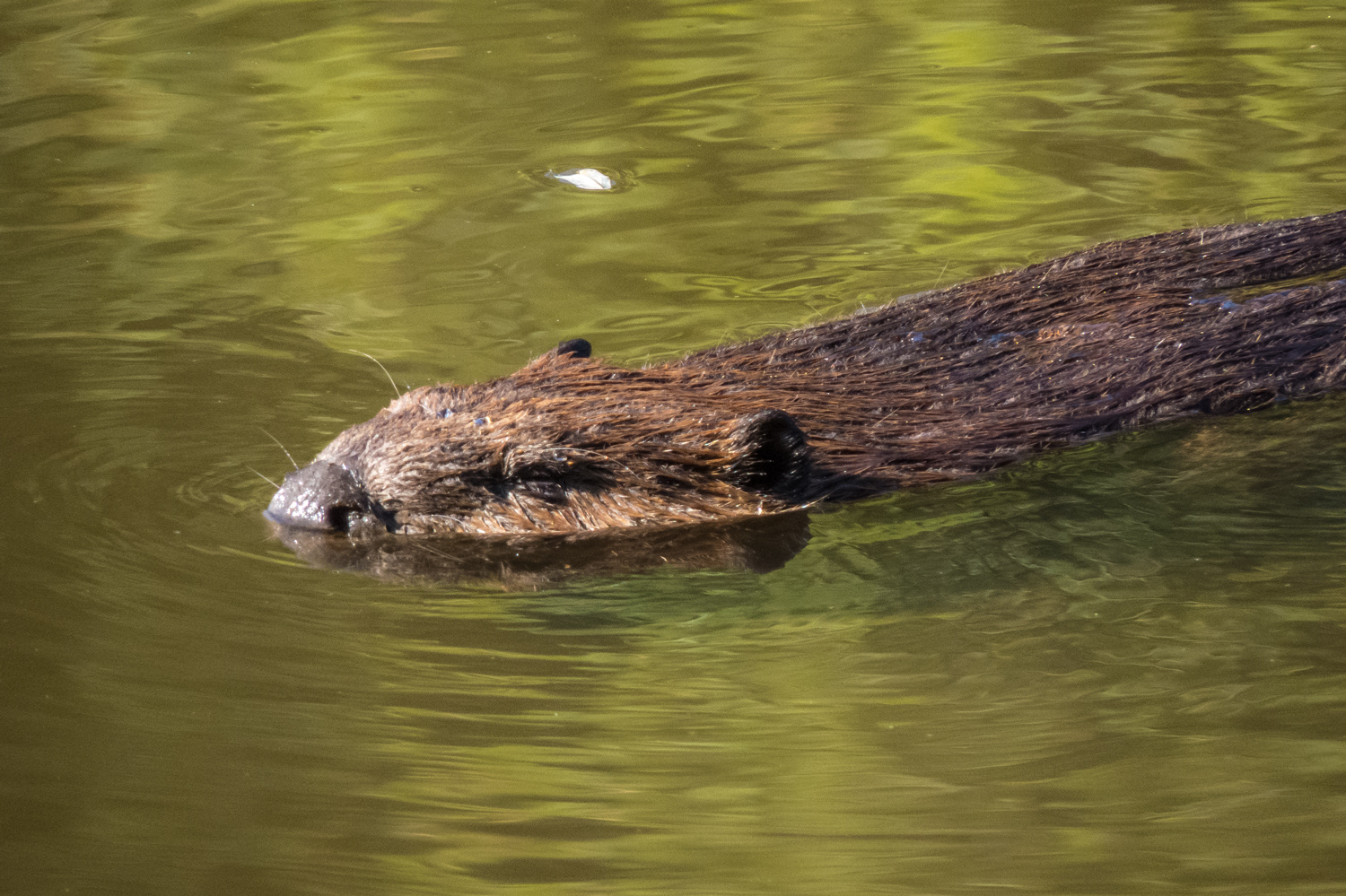
As I was looking over some images from about a month ago, I realized that I had not posted any views of this North American Beaver (Castor canadensis) that I spotted swimming off of Occoquan Bay National Wildlife Refuge one early morning. At that hour we both were moving pretty slowly—one of us on land and the other in the water.

As the beaver altered its course , the light falling on its face and body changed, occasionally catching a bit of sunlight from the just-risen sun. I love the way that the water was tinged with light blue and pink and how the mostly still water picked up the reflections of the swimming beaver.

North American Beaver

North American Beaver

North American Beaver

© Michael Q. Powell. All rights reserved.
Read Full Post »

I grew up in the suburbs, so even domesticated farmyard animals seem exotic to me, like this bantam rooster and Red Angus cow with her calf that I encountered last weekend in Montpelier, Virginia while I was out of town for a wedding.

I am also including an image of an American Robin (Turdus migratorius) that I also captured on the farm—I like the way that the color of the rusted barbs matches that of the robin’s breast and how their shape mirrors that of the robin’s clawed feet.

 bantam rooster
Red Angus cow
American Robin
© Michael Q. Powell. All rights reserved.

Read Full Post »

All wild creatures seem especially beautiful in the early morning light, like this cute little muskrat (Ondatra zibethicus) that I spotted last week in one of the small ponds at Occoquan Bay National Wildlife Refuge.

Muskrat

© Michael Q. Powell. All rights reserved

Read Full Post »

 When I spotted a dark shape in the distance yesterday morning at the edge of a trail alongside the water at Occoquan Bay National Wildlife Refuge, I had no idea what it was—then it started to move. These images suggest to me that it was a North American River Otter (Lontra canadensis), the first time I have seen one at this location and the first time that I have seen one in the wild on land rather than in the water.
North American River Otter
As my mind was busy processing what my eyes were seeing, the otter scurried into the brush and then into the water, where it was joined by a second otter. When I watched the otters swimming away, I was facing almost directly into the sun, so all I was able to capture was this “artsy” silhouette of one of them. I really like the way that the backlighting shows off the otter’s whiskers as it turned its head around and watched as the other otter caught up.
North American River Otter
© Michael Q. Powell. All rights reserved.

Read Full Post »

I know that rabbits don’t go south for the winter, but they seemed to disappear in late autumn and I did not see a single one during the winter months. Suddenly this past week, they started reappearing on the trails at Occoquan Bay National Wildlife Refuge.

Yesterday I spotted this cute little Eastern Cottontail (Sylvilagus floridanus) as it gathered up stalks of grass. Initially the rabbit grazed a bit before it started to accumulate a mouthful of the long, dry stalks of grass—perhaps there are little ones that need to be fed.

Eastern Cottontail

© Michael Q. Powell. All rights reserved.
Read Full Post »

I spotted this White-tailed Deer (Odocoileus virginianus) this past Friday at Occoquan Bay National Wildlife Refuge as it carefully made its way across one of the small streams that crisscross the refuge.

This deer was lagging behind a small group of four deer that I initially spotted. That group pretty quickly and I was not really ready for them, so my photos were not that good. I was quite happy when this final deer appeared and I was able to get some shots. I couldn’t tell for sure how stable the footing was where the deer was crossing, but the deer did appear to be very careful as it chose places to place its feet.

deer crossing

deer crossing

deer crossing

© Michael Q. Powell. All rights reserved.
Read Full Post »

What was the first thing that you saw when you opened your eyes on Christmas Day? For me, it was the beautiful brown eyes of Freckles, the little Cocker Spaniel that is staying with me over the Christmas weekend while her owners are visiting family. Freckles lived in my house for over a year in the past, so she is totally comfortable with me and with my rabbit.

Freckles is amazingly photogenic—here are some shots of her from the last few days that highlight her soulful eyes.

Freckles

Freckles

Freckles

© Michael Q. Powell. All rights reserved.


Read Full Post »

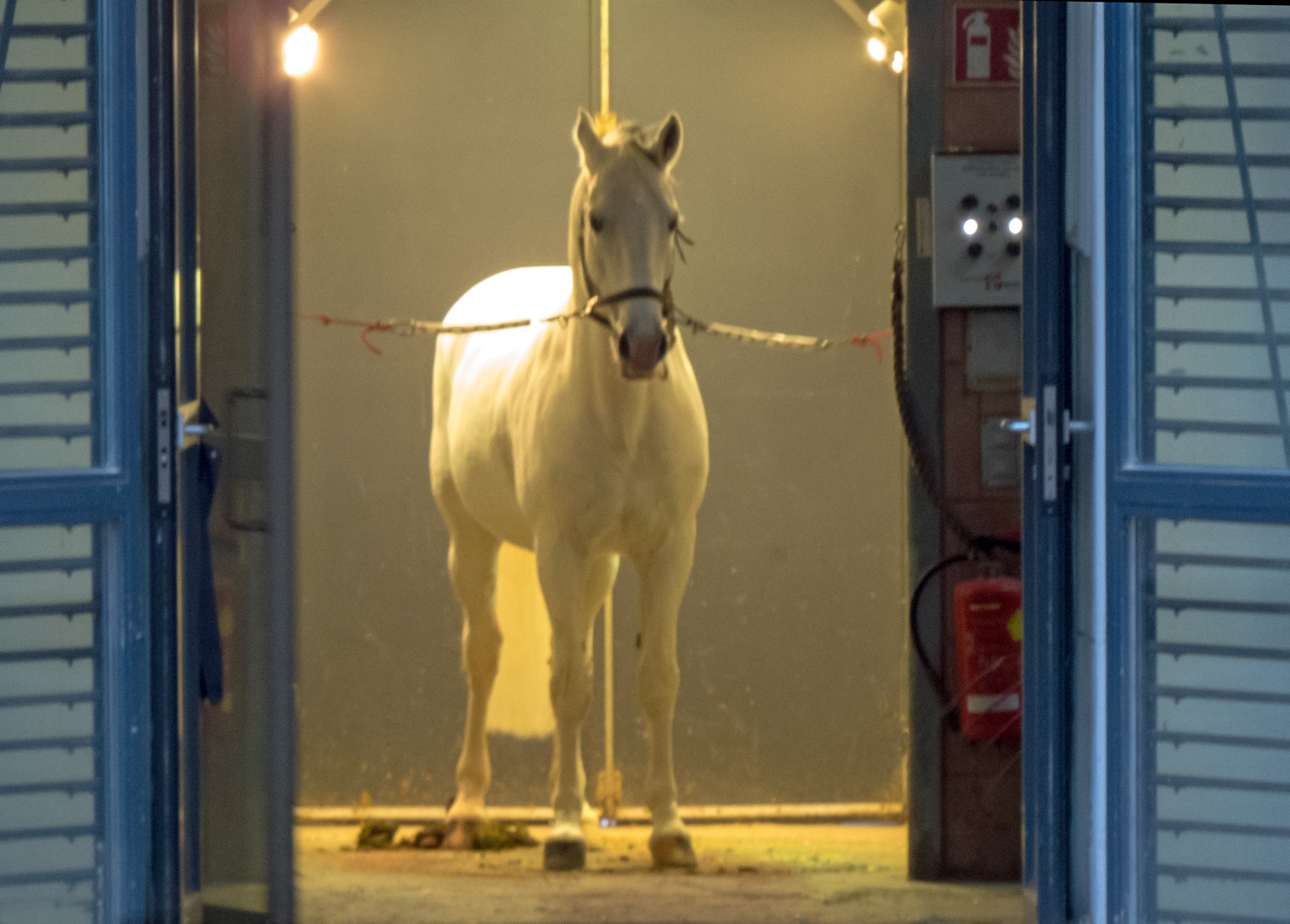
As I was walking to work through the streets of Vienna Friday morning, I passed by the Spanish Riding School in the Hofburg Palace and was thrilled to get a glimpse of some of the world-famous Lippizaner stallions. They were mostly hidden in their stalls, but occasionally one of these beautiful horse would pop its head out or a door would open briefly. I was also able to snap some quick photos as one of the horses was being prepared and was then walked across an open area.

Perhaps someday I will see a performance of the Lippizaners, but for now I am happy to have caught a glimpse of them on my last working day in Vienna for this trip.

Lippizaner

Lippizaner

Lippizaner

Lippizaner

© Michael Q. Powell. All rights reserved.

Read Full Post »

Liz from New Zealand loves to explore a lot more than just color in her blog Exploring Colour. She has a wonderful ongoing series on different aspects of beauty by guest writers and has started a new series on eyes. I am honored to be the first featured photographer and together we selected some of my photos that showed the eyes if such diverse subjects as a birds, a turtle, a fish, a dragonfly, and a fox. Be sure to check out her blog for beauty and inspiration in many forms and to see the five images of eyes (this turtle eye is a sneak preview).

Ms. Liz's avatarExploring Colour

Everywhere, eyes are watching! Wildlife and animal photography often provide a wonderful view into animals’ eyes and gives us a small insight into their world and their behaviour.

Eye detail, colour, shape and pattern are interesting in themselves. Focused eyes of predator, wary eyes of prey, even just a curious glance – all can make a strong impression.

Mike Powell (Virginia, USA) kindly assisted me in finding five photos from his collection that relate to ‘eyes’.

Let me know if you enjoy this post as I’m considering doing a ‘Five Eyes’ series, featuring a different photographer each time 🙂


Mike Powell blogs at:      Mike Powell  |  My journey through photography

As well as enjoying Mike’s photos, I enjoy the information and discussion that he writes for each post. Under each photo below is a link to his original post where you can read the story that goes…

View original post 126 more words

Read Full Post »

What was on your menu for Thanksgiving? No, I did not dine on muskrat for Thanksgiving dinner, but early in the morning yesterday this little muskrat (Ondatra zibethicus) at Huntley Meadows Park decided to celebrate the holiday with some fresh greens. That was almost certainly a healthier meal than most of us consumed later in the day.

muskrat

© Michael Q. Powell. All rights reserved.

Read Full Post »

Half-hidden by the vegetation, this shy little White-tailed deer (Odocoileus virginianus) gently gazed at me for several moments and then slowly turned and disappeared from sight last Friday at Occoquan Bay National Wildlife Refuge. Sometimes wildlife sightings set my heart racing in excitement, but this one left me feeling peaceful and mellow and a bit contemplative.

white-tailed deer

© Michael Q. Powell. All rights reserved.

Read Full Post »

As I scanned a field this morning at Occoquan Bay National Wildlife Refuge, I suddenly became aware of a pair of eyes staring back at me from the high vegetation. We shared a couple of moments of eye-to-eye contact before the handsome buck turned around and disappeared from sight.

There is an overabundance of White-tailed Deer (Odocoileus virginianus) in our area and as part of an effort to maintain the deer herd at a healthy level compatible with planned habitat goals and objectives, the wildlife refuge will be closed for several days in December for deer hunting. I know that topic of deer hunting is controversial to some, but the unfortunate alternative would be deer starving to death or being hit by cars as they seek to forage elsewhere. Still, it’s a little hard for me emotionally to look at this beautiful animal with the knowledge that someone else might soon be shooting at him with a gun rather than with a camera.

White-tailed Deer

© Michael Q. Powell. All rights reserved.

Read Full Post »

It looks like a massive amount of fluorescent Silly String has exploded onto parts of the marshland at Huntley Meadows Park, but I believe it is in reality a parasitic plant known as dodder. Early yesterday afternoon a White-tailed Deer (Odocoileus virginianus) found it to be so tasty that it was willing to ignore the people passing on the boardwalk less than ten feet away.

In taking this photo, I did something that I rarely do—I used the 150mm setting of my 150-600mm telephoto zoom lens. The deer was so close that I could capture only its head and shoulders, even with the lens at its widest setting.


deer and dodder

© Michael Q. Powell. All rights reserved

Read Full Post »

I don’t feature rabbits very often on this blog because I don’t see them very often. Actually that is not entirely accurate—I have a rabbit named Prime Rib who appears from time to time, but I don’t count him, because he does not live in wild and instead lives in a cage in my living room.

At Huntley Meadows Park,  where I do a lot of my wildlife photography, I rarely see rabbits. Perhaps the marshy and wooded habitat is less than ideal for the rabbits or perhaps the hawks are brutally efficient at keeping their numbers low. During some recent visits to Occoquan Bay National Wildlife Refuge, which has more open grassy areas, I’ve spotted numerous rabbits and decided to feature a couple of them today.

In a recent posting, I expressed my concern about possibly oversaturating my readers with dragonfly photos. In an exchange of comments, a faithful reader, Dan Antion, shared similar concerns about his photos of rabbits and squirrels and I warned him that I was going venture into his niche and post some rabbit photos. Dan is one of my favorite bloggers and I encourage everyone to check out his blog No Facilities for his humorous and insightful looks at the joys and frustrations of everyday life as well as some great photos, including images of the aforementioned squirrels and rabbits and his faithful dog Maddie.

This one is for you, Dan.

rabbit

rabbit

© Michael Q. Powell. All rights reserved

Read Full Post »

The White-tailed Deer (Odocoileus virginianus) seemed alert but unafraid when they first sensed my presence early one recent morning at Huntley Meadows Park. I watched them graze for a while before they silently faded back into the tree line.

white-tailed deer

© Michael Q. Powell. All rights reserved

Read Full Post »

In the early morning hours at Huntley Meadows Park this past weekend, a tiny muskrat (Ondatra zibethicus) silently swam to the shore and began to forage for food in the vegetation at the water’s edge. It was a peaceful moment, a perfect start to a beautiful day.

muskrat

© Michael Q. Powell. All rights reserved

Read Full Post »

As I was wandering about in the woods early yesterday morning at Huntley Meadows Park, I inadvertently spooked a raccoon (Procyon lotor) that was stretched out high above me on a tree limb. The raccoon quickly climbed inside the tree, but it seems like it was overcome by curiosity and poked its head out to get a better look at me.

A sharp-eyed viewer of my posting of this image in Facebook noted that the raccoon seems to have a problem with ticks, with several of them visible in one of its ears. I know that raccoons are notorious for carrying rabies, so I kept a close eye on the raccoon and was ready to move away if it had made a move to climb down from the tree.

raccoon

© Michael Q. Powell. All rights reserved.

Read Full Post »

Great Egrets (Ardea alba) always seem to me to be a little vain and self-centered—maybe if comes from being so beautiful and graceful. This one did not like being ignored, so it decided to photobomb my shot of a deer this past weekend at Huntley Meadows Park .
Great Egret

© Michael Q. Powell. All rights reserved

Read Full Post »

A White-tailed Deer (Odocoileus virginianus) seemed curious about the Great Blue Heron (Ardea herodias) perched on a log, but the heron remained impassive and did not react as the deer passed behind it early Saturday morning at Huntley Meadows Park.

Peaceful co-existence—we could all use some more of that in our daily lives.

peaceful co-existence

© Michael Q. Powell. All rights reserved

Read Full Post »

I am not completely certain what these two muskrats (Ondatra zibethicus) were doing on Monday at Huntley Meadows Park. It may have been only grooming, but to me it looks like muskrat love.

muskrat love

© Michael Q. Powell. All rights reserved

Read Full Post »

« Newer Posts - Older Posts »