Feeds:
Posts
Comments

Archive for the ‘Amphibians’ Category

The single American Toad (Anaxyrus americanus) inched closer and closer to the couple, looking like he wanted to cut in. Growing impatent, he decided that the only way to dislodge his rival was to take action.  With a big splash, he jumped right onto the other male’s back.

Was the maneuver successful? Well, I think he separated the couple, but I couldn’t tell which of the males ended up with the female.

American Toad

American Toad

© Michael Q. Powell. All rights reserved.


Read Full Post »

As I was preparing to leave work yesterday, one of my co-workers reminded me to wear something green today to celebrate St. Patrick’s Day. Some people go a little crazy on this day, drinking green beer and consuming food that has been dyed to an unnaturally bright shade of green.

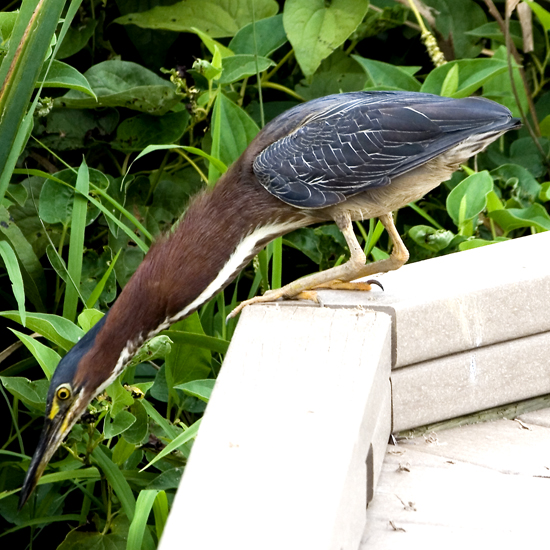
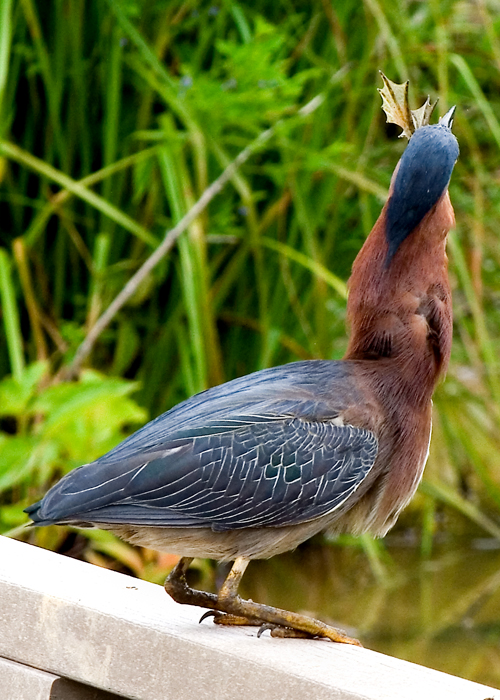
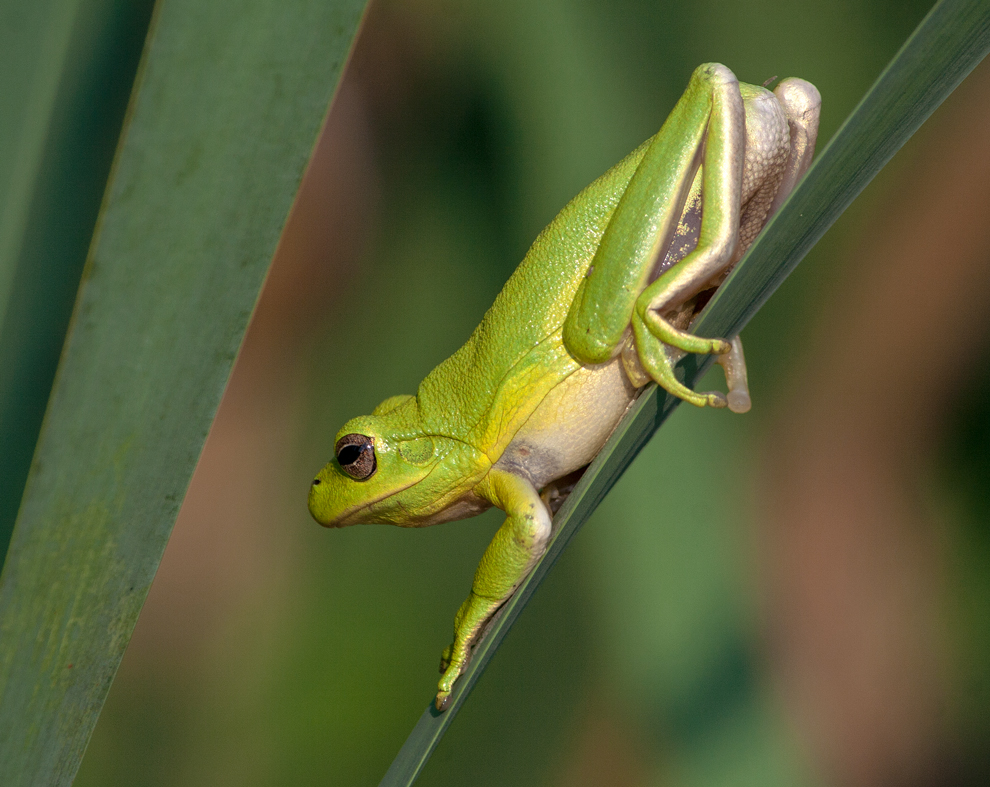
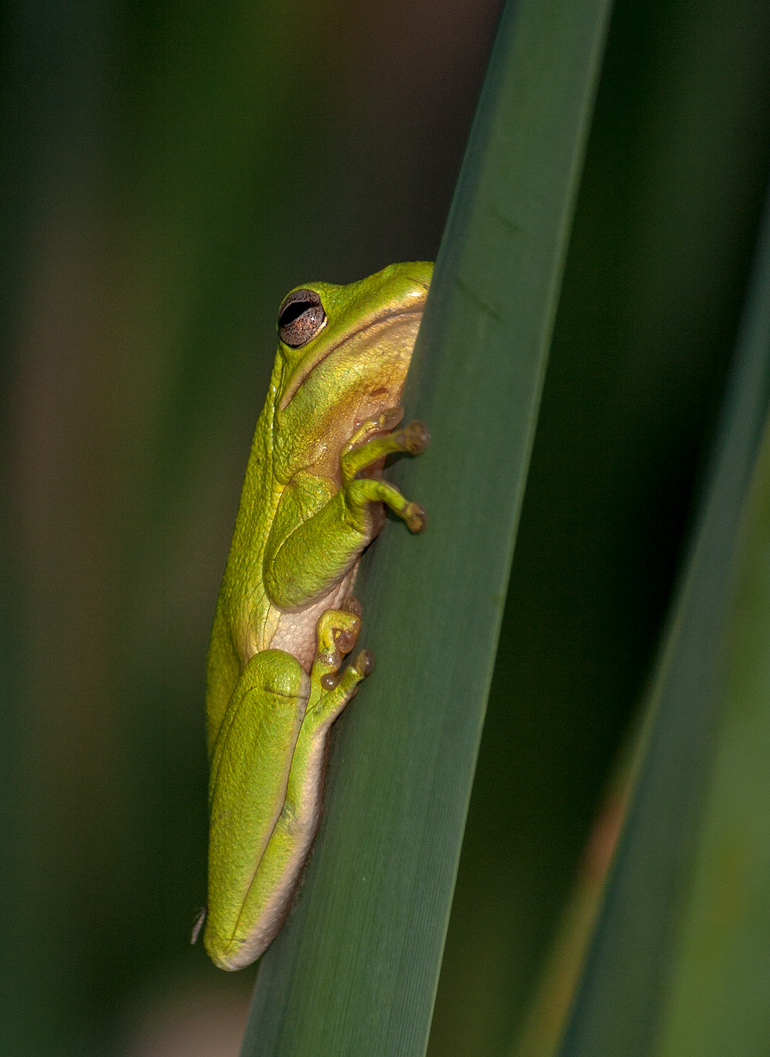
To celebrate the day, I thought I’d reprise a few photos of some of my favorite green creatures, including the Common Green Darner (Anax junius), the Green Heron (Butorides virescens), a green metallic bee, and little green frogs. If you are viewing the images in the blog itself (and not the Reader), click on any one of the photos to see a larger image in slide-show mode.

For those of you also celebrating St. Patrick’s Day, be safe and have fun.

© Michael Q. Powell. All rights reserved.

Read Full Post »

I usually think of seeing toads on dry land, but when it’s breeding time, they head to shallow pools of water. These Eastern American Toads (Anaxyrus americanus americanus) were swimming around this past Friday at Huntley Meadows Park in Northern Virginia.

Some of the toads were graceful swimmers, effortlessly skimming across the water. Others, however, seemed to have problems coordinating the actions of their limbs and floundered and splashed around a lot. The toads seemed to use a variety of strokes, though almost all of them used a variant of the frog kick with their rear legs.

How did the frogs get the naming rights for the kick? It could just as easily have been the “toad kick.” Perhaps marketing is a bit more difficult when you have as many warts as the average toad.

Eastern American Toad

Eastern American Toad

Eastern American Toad

Eastern American Toad

© Michael Q. Powell. All rights reserved.

Read Full Post »

The marsh at Huntley Meadows Park is alive with the sound of frogs and toads—it’s the start of the breeding season.

Yesterday, I captured this shot of an Eastern American Toad (Anaxyrus americanus americanus) as he was calling out to females. It’s amazing how long the toad is able to hold that long, high-pitched trill, as much as 20 to 30 seconds according to the Virginia Herpetological Society.

His expanded pouch (officially called a dewlap) reminds me of my childhood days, when I would attempt to blow large bubbles with the ever present bright pink bubble gum. One of my favorite gums was called Bazooka and the individually wrapped pieces of gum included a comic strip starring Bazooka Joe. (For more information about Bazooka, check out this Wikipedia article.)

I’ve decided I want to call this little guy Bazooka Joe and my unofficial name for the Eastern American Toad is the Bubble Gum Toad. As a side note, fellow photographer and blogger Walter Sanford has given nicknames to several of my lenses and he calls my Tamron 150-600mm lens Bazooka Joe. This, of course, is more a reference to the anti-tank rocket launcher than to the bubble gum—the size and length of the lens brings to mind a bazooka. (If you are not familiar with this weapon, check out this Wikipedia article.)

In case you are curious, I captured this image of Bazooka Joe with Bazooka Joe.

Eastern American Toad

© Michael Q. Powell. All rights reserved.

Read Full Post »

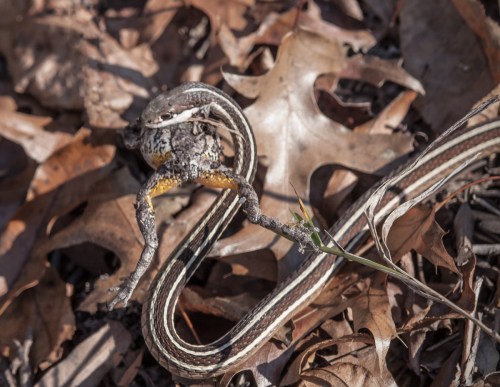
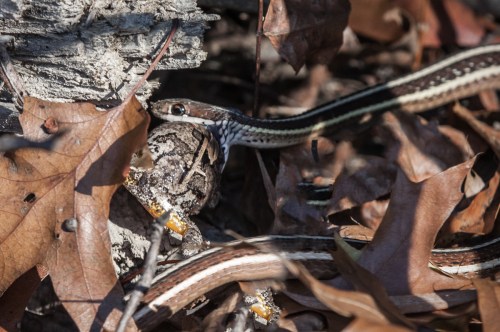
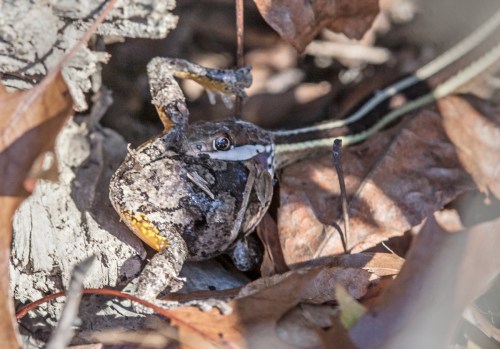
How is it possible to sneak up on a frog and grab it with such force that it is unable to escape as you slowly swallow it headfirst while it is still alive? With a mixture of horror and fascination, I witnessed part of the process yesterday when I spotted an Eastern Ribbon Snake (Thamnophis sauritus sauritus) that had captured a Gray Treefrog (Hyla versicolor).

I was walking through the vegetation at the edge of a field when I spotted a part of the body of the ribbon snake. I moved closer as my eyes traced the body of the snake as I searched for its head. When I spotted the head from a distance, I was confused—it was enlarged like that of a hooded cobra and it was swaying back and forth. What was going on?

I slowed down and gradually came to realize that the snake had a struggling frog in its mouth and was holding it in the air so that the flailing legs had nothing to grab onto for leverage. The frog seemed so much bigger than the snake’s head that it seemed almost impossible that the snake could swallow it.

The snake slithered a short distance away with its partially swallowed prey and continued the process. I managed to get a glimpse of the astonishing extent to which the snake can open its mouth before the disappeared disappeared under a pile of wood to enjoy its meal in peace.

Initially I couldn’t identify the frog, but my good friend Walter Sanford made an initial identification and pointed me to the website of the Virginia Herpetological Society. I carefully read the information there and have concluded that the frog is probably a Gray Treefrog (Hyla versicolor), although it is possible it could be a Cope’s Tree Frog (Hyla chrysoscelis). “Our two native gray treefrogs are identical in appearance. In the field the only two ways to distinguish H. chrysoscelis from H. versicolor is by their call and in some cases geographic location.”

I was particularly struck by the bright orange color on the hind legs of the frog. Wikepedia notes that both of the potential species have bright-yellow patches on their hind legs, which distinguishes them from other tree frogs and that “the bright patches are normally only visible while the frog is jumping.” Obviously the situation I witnessed is not “normal,” so I was able to see the colors, even though the frog was obviously not jumping.

I’ve included a small series of shots to give you a sense of the situation. They were all shot handheld with my Tamron 180mm macro lens.

Gray Treefrog

Gray Treefrog

Gray Treefrog

Gray Treefrog

Gray Treefrog

© Michael Q. Powell. All rights reserved.

Read Full Post »

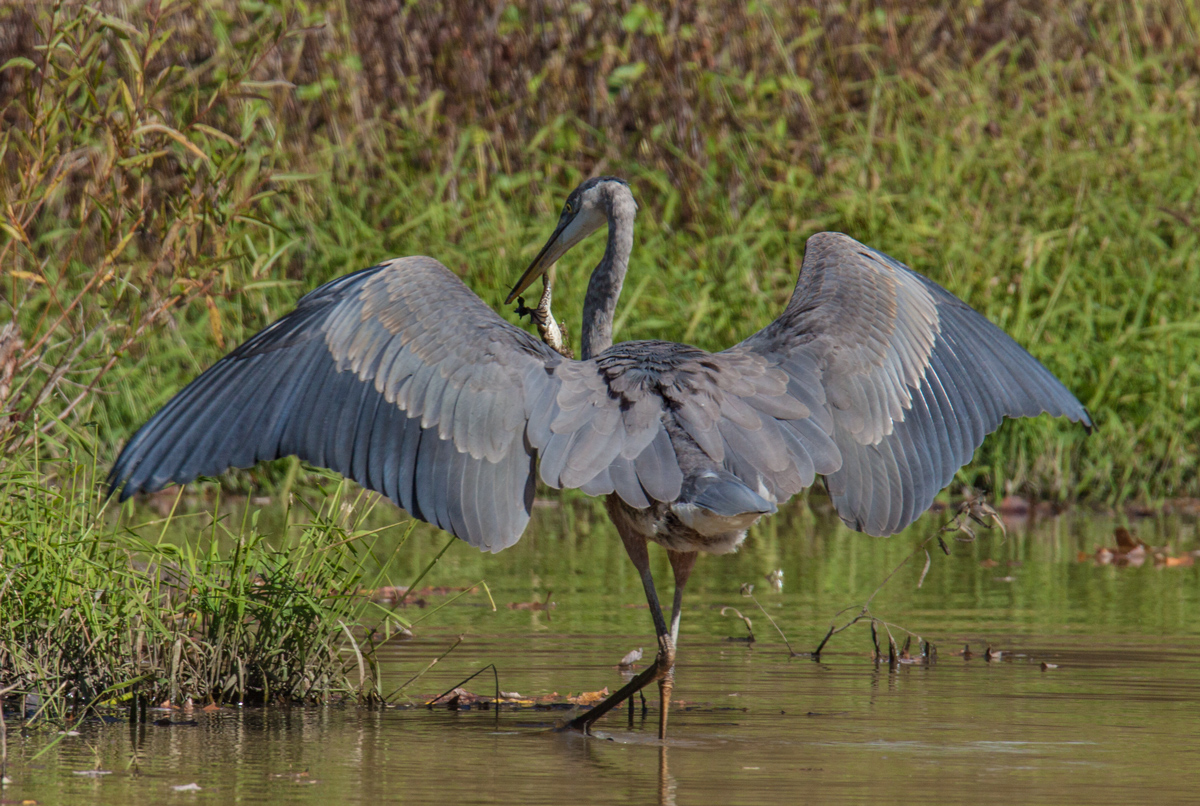
WARNING: This encounter did not turn out well for the frog. This past Saturday I spotted a Great Blue Heron (Ardea herodias) in the shallow water at the edge of a beaver pond at my favorite marshland. I watched and waited, knowing full well that a heron’s patience when fishing generally exceeds my own.

Suddenly the heron thrust its bill into the water with such force that it had to extend its wings for stability. Surely, I thought, the heron had just caught a massive fish.  When I caught a glimpse of the catch, however, I realized that it was not a fish—it was a frog. The heron’s grip on the frog looked to be a little problematic, for the heron had snagged the frog by its legs.

Now I realize that in some cultures, frog legs are considered to be a delicacy, but I was pretty confident that the heron was not going to settle for just the legs. The challenge for the heron was to reposition the frog without losing it. One added complication was that the frog appeared to be struggling, trying desperately to extricate itself from the heron’s tight grip.

Moving to the edge of the pond, the heron bent down and pinned the frog against the ground as it grasped the frog around its upper torso. Only then did the heron return to its original upright position, knowing that the frog’s fate was now sealed. With small movements of its head, the heron slowly repositioned the frog until it was in a heads-first position.

All of the sudden, the heron tilted its head back  and swallowed and the frog was gone so quickly that I was unable to capture its last moment.

Apparently the frog was just an appetizer, for I saw the heron catch a fish a short time later, but that may be the subject of a future post.

Great Blue Heron

The initial strike

Great Blue Heron

Hanging by the legs

Great Blue Heron

Grabbing the torso

Great Blue Heron

The beginning of the end

Great Blue Heron

Almost in position

Great Blue Heron

Ready for a big gulp

© Michael Q. Powell. All rights reserved.

Read Full Post »

Most of the frogs that I have seen in the last few months have been hopping away or diving into the water as I walked along small streams in search of dragonflies. Last weekend, though, I happened to notice a frog in the shallow water of a small pool in the woods of my favorite marshland park.

The light was nice and the frog was only partially submerged, so I moved closer to the frog to take some shots.  I could tell was a Southern Leopard frog (Lithobates sphenocephalus), a pretty common frog where I live. I really like the distinctive spots that are responsible for its name.

Standing relatively upright, I was able to get a good shot of the frog’s entire body. I was happy with the shot, but not fully satisfied, so I decided to try for a lower shot. Sometimes I will lie on my stomach with my elbows propped on the ground for this kind of shot, but the ground was wet and muddy, so I settled for a low crouch. I was hoping to get as close to eye level with the frog as I could.

When you look at the two photos, you can notice some interesting differences caused by the change of perspective. The frog appears much flatter in the second shot and some interesting reflections of the eyes have now appeared, which might have been caused more by a change in sunlight than by the change of position. Somehow I feel a little bit more immersed in the frog’s world in the second shot.

I’m not sure I’d be able to judge which of the two shots is better—I like aspects of each one. More importantly, I reminded myself of the important of varying my perspective, of changing angles and distances when working with a subject.

You can learn a lot by getting down with a frog.

Southern Leopard frog

Souothern Leopard frog

© Michael Q. Powell. All rights reserved.

Read Full Post »

When you are face-to-face with this toad, you might notice that he has a few skin issues, but when you see him from the side, you realize that he has a serious problem that anti-acne cream surely will not cure.

I don’t often see toads at my local marshland park, so I couldn’t help but move in for a closer look when I spotted this one last weekend. At the park, we have both Fowler’s toads (Anaxyrus fowleri) and Eastern American Toads (Anaxyrus americanus) and I have trouble telling them apart. To make matters worse, according to the Virginia Herpetological Society, these species hybridize, “making identification difficult.”

I was pretty amazed when I looked at my shots to see all of the different textures and patterns on the toad’s body body. There are warts and weaves and different kinds of stripes. I’m happy too that I was able to capture the toad’s toes, which most often are hidden.

toad

toad

© Michael Q. Powell. All rights reserved.


Read Full Post »

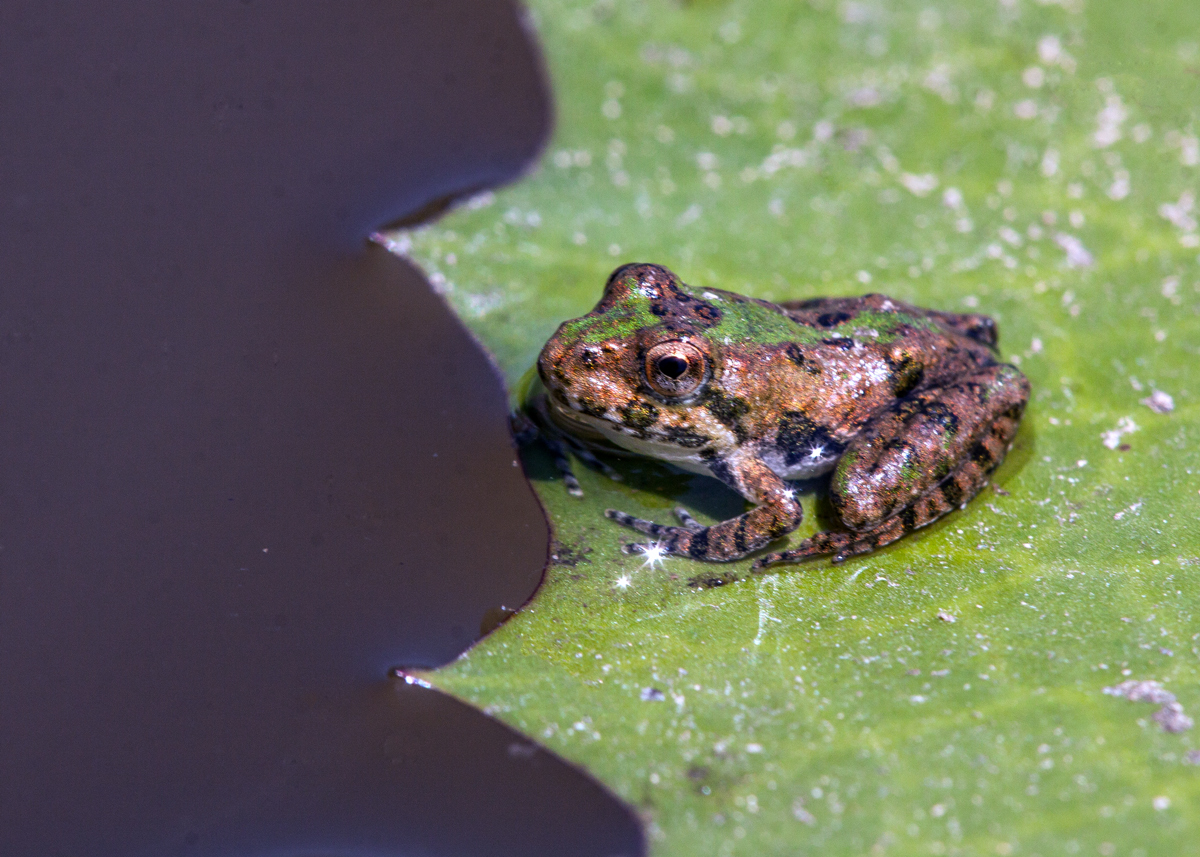
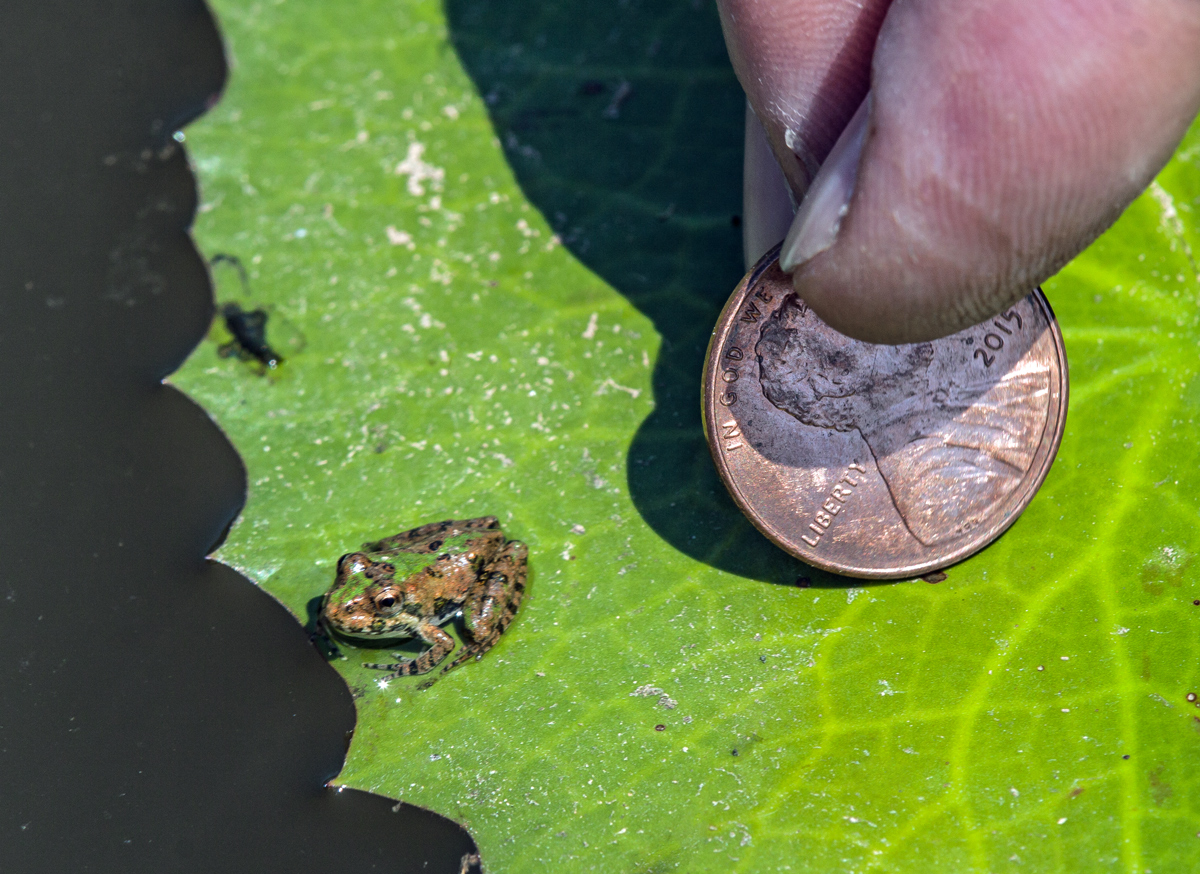
Perched at the edge of a lily pad, this frog at Lilypons Water Gardens was so small that I doubt I would have seen it by myself. However, one of my sharp-eyed fellow photographers spotted it and served as the hand model for the shot with the penny.

A helpful Facebook reader suggested that this is probably a Northern Cricket frog (Acris crepitans) and it certainly does look like the photos that I can find on the internet. Judging from the size of the penny, which is 3/4 of an inch in diameter (19 mm), I’d guess that the frog was less than 3/8 of an inch (9.5 mm) in size.

My fellow photographer tried to move the penny slowly into position, but, as I suspected would happen, the frog jumped away shortly after the second shot below. I would have liked to capture the frog in motion, but ended up instead with a shot of the vacant lily pad—the frog had jumped right out of the frame.

Northern Cricket frog

tiny2_frog_blog

© Michael Q. Powell. All rights reserved.


Read Full Post »

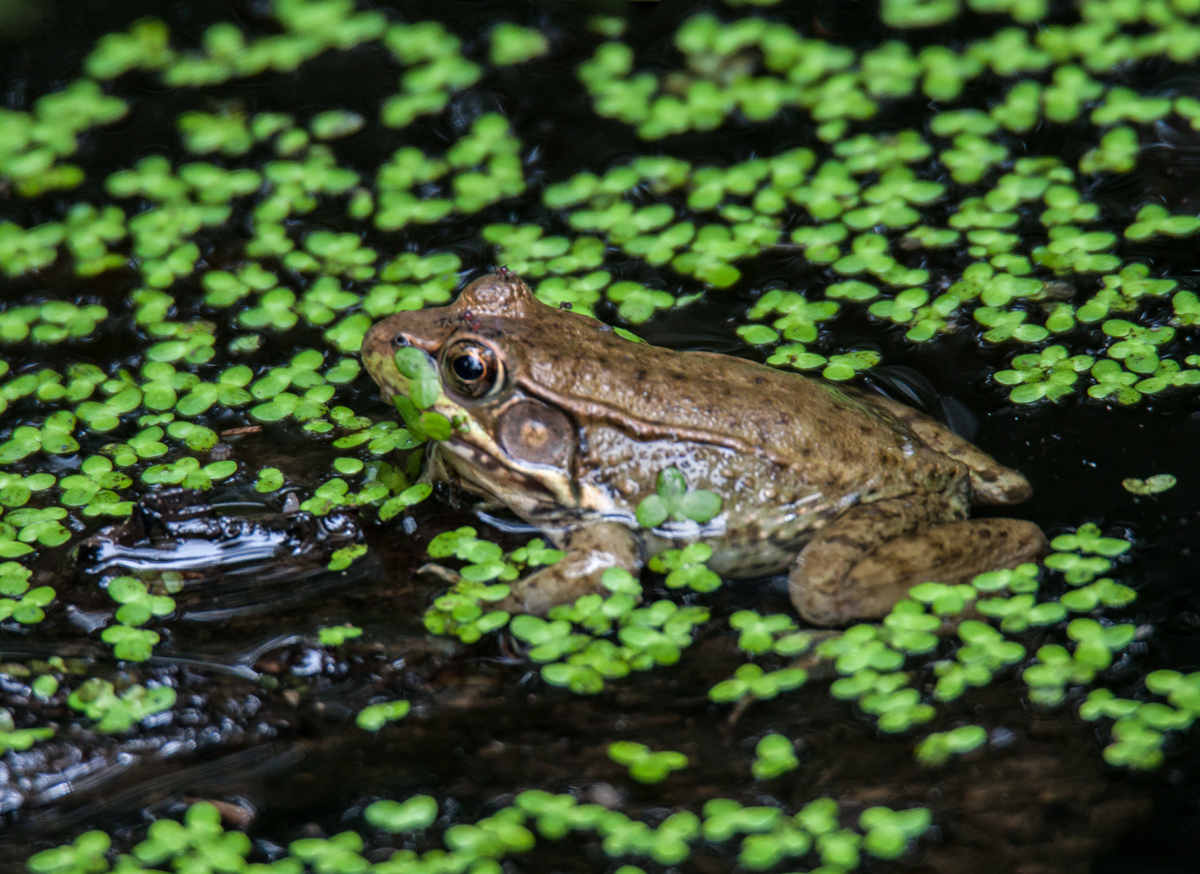
When a friend pointed toward a small pond and said he saw a bronze frog, I thought he was talking about a metal figurine. I had never even heard of bronze frogs and certainly had not seen one before.

Bronze Frogs (Rana clamitans clamitans) are a subspecies of the Green Frog (Rana clamitans) and I must confess that I really can’t tell them apart from the other subspecies, the Northern Green Frog (Rana clamitans melanota), because there is a significant amount of color variation.

Identification aside, I really like the way that this frog is surrounded by and partially covered with duckweed as he tries to stay cool on a hot day in July.

bronze frog

© Michael Q. Powell. All rights reserved

Read Full Post »

Safe inside the confines of an enormous lily pad, this little frog calmly watched the crowds of people last weekend in Washington D.C. at the Lotus and Water Lily Festival at Kenilworth Park and Aquatic Gardens.

frog on a lily pad

You can’t help but noticed that this is not your average lily pad. I believe that it is a tropical variety that comes from the Amazon River basin of the genus Victoria, possibly Amazonica victoria. According to Wikipedia, the leaves of this species can grow as large as 10 feet in diameter (3 meters), although this one was probably less than three feet (one meter) in size. Clearly it had no problem supporting the weight of the little frog.

Readers who follow my photography know that I love to try to get in close to my subjects, irrespective of whether I am shooting with a telephoto lens or a macro lens, and this was no exception. There was a waist-high wire fence around the cement pond in which the water lilies were growing, so I had some limitations in framing my shots, but did manage to get this shot of the frog looking over the edge of lily pad.

frog on a lily pad

© Michael Q. Powell. All rights reserved


Read Full Post »

I was thrilled to capture a shot of a frog on a lily pad, but in her newest posting, fellow blogger Ginny Alfano features a whole variety of frogs, including an amazing shot of five little frogs perched on a single lily pad. Check it out!

Ginny Alfano's avatarMaple Flats

Fourth of July came and went quite uneventfully which is how we like it.  As I was weeding my squash garden, I noticed some little tiny “frogs” that were the size of my pinky finger nail. I had seen them before, but wasn’t really sure what kind they were.  Upon further study on Sunday, I realized that they are not frogs at all, but baby American Toads!!  Just when I think I know so much about nature, I find that I don’t know anything at all.  It’s a continual learning process.  I think that’s why I love nature so much – it always keeps me thinking.  So, following are a small collection of the frogs and toad I have come across in my area.

PICKEREL FROG – THE MASTER OF DISGUISE!

HIDING FROM PREY & SECRETLY LOOKING FOR FOOD

SPRING PEEPER – THE HARBINGER OF SPRING

BABY AMERICAN TOAD

MINK…

View original post 10 more words

Read Full Post »

Yesterday the marsh was alive with the sound of music—frog music. As the temperatures soared to 65 degrees F (18 degrees C), the high-pitched sound of the frogs grew to almost deafening levels at some of the shallow vernal pools.

It was obvious that there were hundreds, if not thousands of frogs present in the area, but they seemed to be invisible. I managed to spot only a single one, this little Southern Leopard Frog that was partially submerged in the water at the edge of one of the pools.

In a few days the vernal equinox will arrive here in the Northern Hemisphere, marking the start of spring (according to the astrological calendar). The frogs obviously decided to get jump ahead a bit or are using the meteorological calendar, which calculates the start of spring as the beginning of the month of March.

Yesterday the frogs were loudly proclaiming that spring is here, and I am thrilled at the prospect of warmer weather and new life springing up everywhere.

Southern Leopard Frog

© Michael Q. Powell. All rights reserved.

Read Full Post »

It’s always great to spot a little Green Treefrog (Hyla cinera) in the reeds at my local marshland park, though they are often obscured by the vegetation and are tough to photograph.

I initially spotted this one on a large leaf, as shown in the second shot, shortly after I had mentioned to a fellow photographer how much I wanted to see one on one of these leaves. My wish came true.

As I was taking some shots, someone walked toward me on the boardwalk. I had to stop shooting, because of the vibrations of the approaching footsteps. As I anticipated, the passerby wanted to know what I was photographing and my efforts to point out the frog caused it to move.

Although I was initially a little irritated that the frog had jumped away, I quickly realized that it had not moved far and was in a more precarious and photogenic position. I had to work to shoot through the reeds, but ended up with a nice shot of this really cute frog.

Green Treefrog Green Treefrog

© Michael Q. Powell. All rights reserved.

Read Full Post »

Do your mix humor with your photography? I enjoy playing with words (and especially puns) and love looking for opportunities  to inject humor into my blog postings. One of my favorite bloggers, Lyle Krahn at Krahnpix, is a real master at mixing his incredible wildlife shots with a kindred kind of humor (or perhaps he might say “humour.)

This past Monday was my blog’s second anniversary and I am taking a brief pause from posting new photos to think about the blog and my photographic journey over the last two years. During this period I am re-posting some of my favorite postings.

The re-posting today of an encounter between a Green Heron (Butorides virescens) and a frog was one of my earliest attempts to add humor, from the title all the way down to the last line of the posting, and is one of my favorites over the past two years. Here’s a link to the original posting or you can read it in its entirety below.

Full text of blog posting on 24 July 2012 that I entitled “Not Seeing Eye to Eye”:

One can only imagine what is going through the frog’s mind as he looks into the crazed eyes of the green heron who has just speared him. Is he looking for mercy? Is he resigned to his fate?
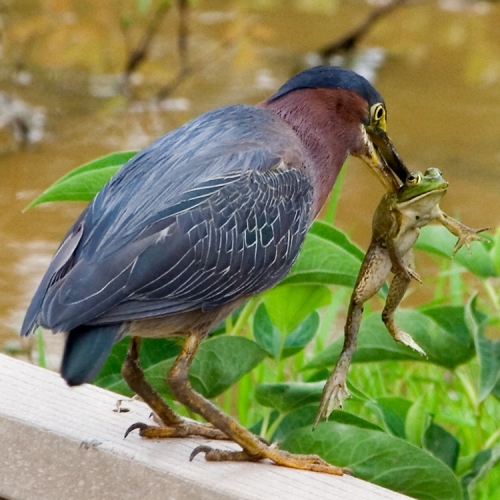
I watched the prelude to this moment unfold this afternoon at Huntley Meadows Park, a marshland park here in Virginia. The green heron was intently scanning the water from the edge of a boardwalk that runs through the march. Periodically he would extend his neck down toward the water.

Several times we heard an excited “eeep” sound followed by a splash, indicating another frog had escaped. After a few more minutes, however, the heron dived into the water and reappeared on the boardwalk with the speared frog you see in the first photo.

When you look at the comparative size of the heron’s mouth and the frog, it hardly seems possible that the green heron could swallow the entire frog. The heron took his time shifting the position of the frog and then all at once he turned his head, bent his neck back a little, and down went the frog. It happened so quickly that I was able to snap only a single photo that shows the frog’s webbed feet as the only remaining parts that have not yet been swallowed.

In this final photo the heron no longer has a slim neck. I have no idea how long it will take for the frog to reach the heron’s stomach but I am pretty sure he was not yet there when I took this photo.

And don’t try to talk with the heron during this period. Why not? Read the caption of the last photo!
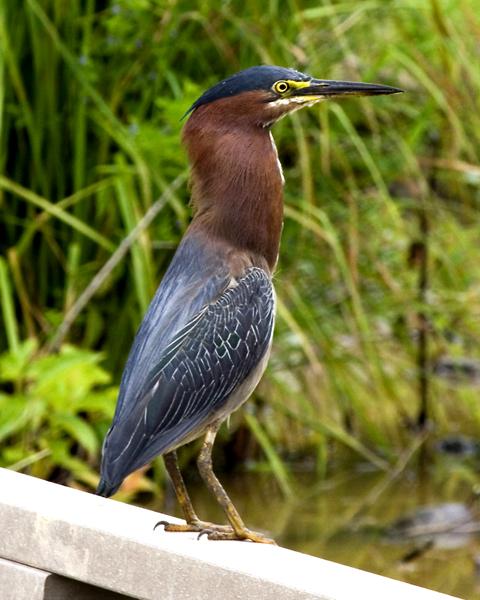
I can’t talk now. I have a frog in my throat.

© Michael Q. Powell. All rights reserved.


Read Full Post »

With the temperature in the 20’s (-5 C) the last few days, it’s hard to remember that we had record-breaking temperatures less than a week ago, when temperatures soared to 72 degrees (22 C).

During a trip to my marsh on one of the warm days last Saturday, I was a little shocked to see some frogs out of the water, which not long before had been covered with a thin sheet of ice. I thought they would be in a hibernation state by now. The frogs were in the reeds and the ones that I could see were Southern Leopard frogs (Lithobates sphenocephalus), like the one in this photo.

I figured that frogs buried themselves completely in the mud like turtles do, but was surprised to learn that is not the case. According to an article in Scientific American, aquatic frogs, like the leopard frog, do hibernate underwater, but they would suffocate if buried in the mud. Instead they remain on top of the mud or only partially buried.

In addition to the frogs, a lot of small turtles took advantage of the unseasonably warm weather and could be seen sunning themselves on logs in the marsh. Unfortunately, there were no cameo appearances by dragonflies—my fellow photographer and blogger Walter Sanford and I searched diligently for Autumn Meadowhawk dragonflies, which we had seen earlier in December, but we came up empty-handed.

frog2_dec_blog

© Michael Q. Powell. All rights reserved

Read Full Post »

As I walked along the boardwalk yesterday at Huntley Meadows Park, fellow photographer Christy Turner pointed out this Southern Leopard frog (Lithobates sphenocephalus) in the bushes and I managed to get a shot of the cool-looking frog.

These frogs are pretty common and I think I hear them often, but I hadn’t seen one in months. We have had a lot of rain this past week and this frog may have decided to chill out in the underbrush rather than remain in the now deep water in this part of the marsh. It was an interesting challenge to try to find an uncluttered visual pathway to get this shot—I crouched and leaned as I focused on the frog, conscious of the fact that I could end up in the bushes with the frog if I were not careful.

Things turned out pretty well, and I avoided falling in the water at that moment, though my feet got soaked later in the afternoon when I ventured too close to a flooded-out section of the boardwalk.

frog_leopard1_blog

© Michael Q. Powell. All rights reserved

Read Full Post »

Most of the tree frogs that I have seen until now have been lime green, but the one that I saw on Friday was a much darker shade of green. I am pretty sure, though, that he is a Green Treefrog (Hyla cinerea) and he was in a very familiar pose, comfortably napping during the heat of the day.

He was a pretty good distance away, perched on a small tree (or maybe a bush) in the partial shade, but luck was with me, because the sunlight was shining on him. I had a telephoto lens on my camera and managed to get a pretty good shot without scaring him away.

I left the frog thinking that he probably had the right approach—a nap sounded like a good idea.

dark_green_treefrog_blog

© Michael Q. Powell. All rights reserved

Read Full Post »

The pose of this bullfrog seemed almost Zen-like, as he contemplated the early morning sun in a calm, meditative state of mind and body.

zen_frog_blog

© Michael Q. Powell. All rights reserved

Read Full Post »

This large bullfrog was so content in the mud that he did not budge at all when I moved closer to take this shot. Compared to the tiny tree frogs that I have been photographing recently, this frog seemed enormous.

The mud may not be the best backdrop for a photo, but I like the way that the image has become a study in greens and browns, with a golden eye as a accent.

frog_mud_blog

© Michael Q. Powell. All rights reserved.

Read Full Post »

I can’t seem to get enough of these little green tree frogs and continue to try to get photos of them whenever I can.

In this shot, my eyes were drawn textures and colors—in particular, the bumpy texture of the frog’s skin and the contrast between the light olive green of the frog and the darker green of the leaf on which it is sitting.

frog_decay_blog

© Michael Q. Powell. All rights reserved.

Read Full Post »

As I was observing a tiny green tree frog in the cattails, a large fly suddenly buzzed into the frame and landed right next to the frog. Did the fly initially consider the frog to be a potential prey? Was the fly a daredevil who liked to flirt with danger? Was this an initiation test into a fly fraternity or perhaps the result of a bet between drunk buddies?

The unlikely juxtaposition of these two creatures makes me smile every time I look at it. As a child, I watched lots of cartoons in which frogs would flick out their very long tongues and snag unsuspecting flies from a great distance. I waited and watched, anticipating the moment when the frog would turn and strike. That moment never came—the fly eventually flew off to safety.

Real life doesn’t always live up to life in the cartoons.

frog_fly_blog

(Click on the photo to see a higher resolution view.)

© Michael Q. Powell. All rights reserved.

Read Full Post »

The lighting and the pose add some drama to this almost formal portrait of a Green Treefrog (Hyla cinerea) that I encountered at my local marsh.

Most of the tree frogs that I have seen have been snoozing in the cattails and it’s been tough to get a clear shot, but this one was conveniently perched on a horizontal leaf, giving me pretty good latitude to compose the shot that I wanted. Even the frog was cooperative and stayed put while I made adjustments to the camera in between shots.

I’m really happy with this image and think that the frog too would be content with this portrait.

frog_leaf_blog

© Michael Q. Powell. All rights reserved.

Read Full Post »

This little Green Treefrog (Hyla cinerea) was almost hidden in the cattails, comfortably napping at midday with its legs tucked under its body. It’s nice to know that I am not the only one who enjoys a little afternoon siesta.

sleeping_frog_blog

© Michael Q. Powell. All rights reserved

Read Full Post »

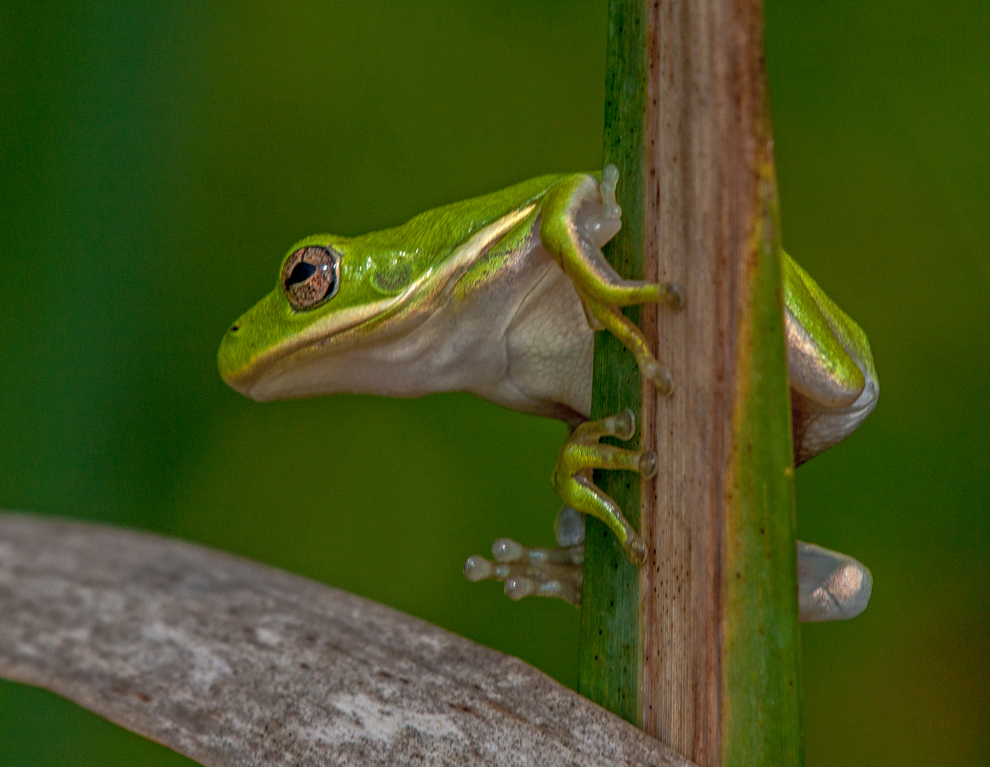
Unlike most of the tree frogs that I have encountered, this Green Treefrog (Hyla cinerea) was alert and moved about a bit when I tried to take its photo—the others were resting motionless on cattail plants and seemed half-asleep.

The frog initially hid behind the cattail leaf and then tentatively poked its head out, giving me the chance to get this shot. I really like the pose that I was able to capture and the really cool details that you can see of the pads on its toes, which help it to seemingly defy gravity. (Click on the image to see a higher resolution view.)

I too would love to be able to defy gravity.

hanging_on1_blog

© Michael Q. Powell. All rights reserved

Read Full Post »

This small Green Treefrog (Hyla cinerea) was swaying in the breeze, mostly obscured by the heavy growth in the marsh, when I first spotted it. I searched for an opening to get an unobstructed shot and finally found one, looking through a circularly bent dried leaf.

The different elements of the scene, however, were all in motion at different speeds.  I felt like I was playing a carnival game as I tried to aim and shoot at a target that would appear and disappear from view. Eventually I got a shot that was pretty close to the mental image that was my target and the frog was framed.

circle_frog_blog© Michael Q. Powell. All rights reserved

Read Full Post »

It had been years (and maybe even decades) since I had last seen a toad and somehow I had forgotten that they have lots of warts and bumps, unlike the smooth-skinned frogs that I am used to seeing.

I encountered this brown toad, which I think is an Eastern American Toad (Anaxyrus americanus americanus), at a garden in Maryland. According to Maryland’s Department of Natural Resources, there are only two types of true toads in the state, so my changes of being correct are pretty good. The other toad is a Fowler’s Toad.

Apparently, you can distinguish between the two types by the number of warts per dark spot on their backs. Maybe you can tell them apart—I wouldn’t even know where to start counting.

toad_blog

© Michael Q. Powell. All rights reserved

Read Full Post »

Usually it is hard for me to find frogs, because they blend in so well with their surroundings, but that certainly was not the case with this bright green frog. Doesn’t he realize how much he stands out in that environment? I was able to spot him from quite a distance away.

camouflage_blog

© Michael Q. Powell. All rights reserved

Read Full Post »

I spotted this little Green Treefrog (Hyla cinerea) in the cattails in the marsh at my local marshland park this past weekend and was pretty excited, because I had never before seen an adult tree frog up close.

I was amazed by its long toes with sticky pads, but it was the golden eyes that won my heart. I observed it for quite some time and managed to get some shots of it in different poses as it changed its position on the green leaves of the cattail.

Normally I think of tree frogs, I think of the ones with big red eyes that have been featured in National Geographic and other publications. It would be really cool some day to be able to photograph those tree frogs—for now I am content to explore the wildlife in my local area.

little_green_frog1_bloglittle_green_frog3_bloglittle_green_frog2_bloglittle_green_frog4_blog

© Michael Q. Powell. All rights reserved

Read Full Post »
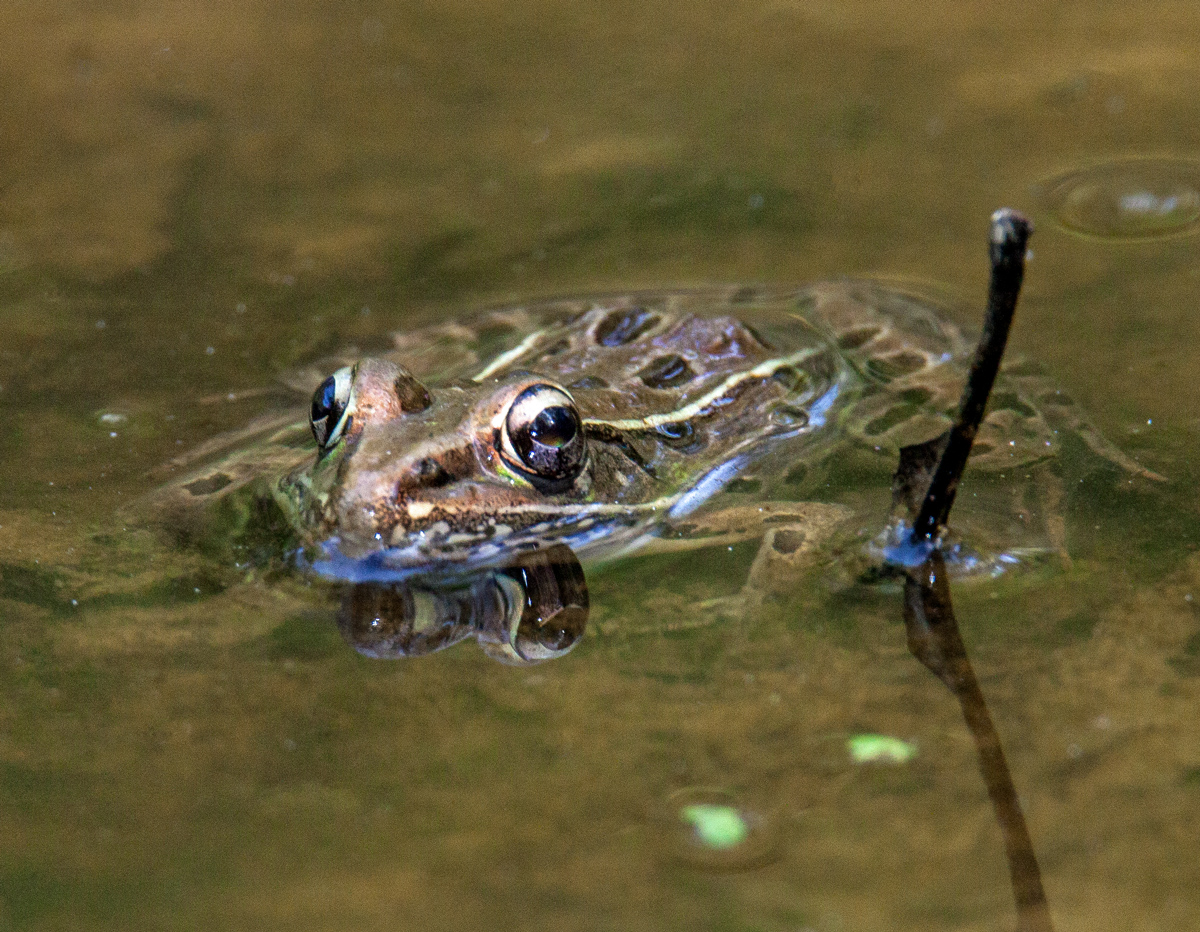
As I was searching for dragonflies and butterflies in the vegetation overlooking a small pond this past weekend, I spotted this little patch of yellow on the leaf of a small tree, which turned out to be a tiny tree frog.

The frog appears to still be in a developmental stage, with indistinct feature and a substantial amount of the tail that it had as a tadpole. The frog was yellowish in color and it is a little tough for me to figure out what kind of a frog it is.

I should note that this it the first tree frog that I have ever seen and I was amazed at how small it was. It is not much bigger than some of the insects that I have been photographing, but it is definitely a whole lot cuter.

little_frog1_bloglittle_frog2_blog

Michael Q. Powell. All rights reserved

Read Full Post »

Spotting the camera around my neck, an attractive young lady excitedly pointed out this frog to me, calling it a “Hollywood Frog,” because it reminded her of the ones in the movies.

I couldn’t resist asking her if she was going to kiss the frog to see if it would turn out to be a prince. She smiled a little, shook her head, and responded, “No, I’ve already kissed my fair share of frogs.”

greenfrog_blog

Michael Q. Powell. All rights reserved

Read Full Post »

« Newer Posts - Older Posts »