Feeds:
Posts
Comments

Archive for the ‘abstract’ Category

Many of us are old enough to remember when wall phones had long coiled cords that usually ended up stretched out and elongated. That’s exactly what I was thinking of when I spotted these coiled tendrils of some kind of flower yesterday when I was exploring Occoquan Bay National Wildlife Refuge.

I wasn’t sure how to capture them in an image and tried a couple of different approaches. The image below was my favorite. It is kind of a natural abstract image, but I included the flower in the corner of it to give the image a sense of context.

Those who read my postings regularly know that this is not the usual kind of photo that I post—sometimes it is fun to venture outside of my normal box.

coil

© Michael Q. Powell. All rights reserved.

Read Full Post »

I don’t often shoot landscape images, but I was so taken with the stark beauty of the ice-covered world that I encountered on New Year’s Day at Occoquan Bay National Wildlife Refuge that I decided that I should attempt to capture a sense of the moment. I used the wide-angle capabilities of my Canon SX50 superzoom camera in the first two images below and shot the third one with the Tamron 150-600mm lens, the lens that I use on my Canon 50D for a significant number of my the photos featured on this blog.

icescape

icescape

icescape

© Michael Q. Powell. All rights reserved.

Read Full Post »

It seems a little late in the season for Calico Pennant dragonflies (Celithemis elisa) to be mating, but I nevertheless spotted this couple in action this past Saturday at Occoquan Bay National Wildlife Refuge in Woodbridge, Virginia. In case you are curious, the male is the red one near the top of the image that is clasping the female by its head. I like the way that the soft background and simple composition draw our eyes to the shapes, colors, and patterns of the dragonflies, rendering the subject in a beautifully abstract way.

calico pennant dragonflies

© Michael Q. Powell. All rights reserved.

Read Full Post »

When it comes to dragonflies, what catches your eye? Is it their bright colors or their acrobatic flying skills? When it comes to male Twelve-spotted Skimmers (Libellula pulchella), it is definitely the bold brown-and-white pattern on their wings that irresistibly attracts me. I somehow feel compelled to chase after one whenever I spot it.

Yesterday I made a brief trip to Lilypons Water Gardens in Adamstown, Maryland. This sprawling facility has over 150 acres of amazing ponds and water gardens with fantastic displays of water lilies, which are for sale. (I’ll feature some of the different colored water lilies in an upcoming post.) Although I saw a lot of dragonflies there, I saw only a few Twelve-spotted Skimmers.

Most of them were remarkably elusive, but one finally perched on some vegetation overhanging the water. The bank was fairly steep, so there was no way that I could get a side shot or a head-on shot, which is one of my favorite shots of a dragonfly. What was I going to do?

Then it dawned on me that I had a perfect view of the magnificent wing patterns as I looked straight down the body of the dragonfly, facing in the same direction that he was facing. Boldly I decided to commit what is normally a cardinal sin for a photographer—I intentionally chose not to focus on the subject’s eyes. Lightning did not strike me as I pressed the shutter and I captured an almost abstract portrait of the dragonfly. For me, there is a real beauty in the simplicity and minimalism of this image.

In case you get confused about counting the twelve spots, you’re supposed to count only the brown spots. According to Wikipedia, though,some folks prefer to count the white spots and therefore call this dragonfly a “Ten-spot Skimmer.”

Twelve-spotted Skimmer

© Michael Q. Powell. All rights reserved


Read Full Post »

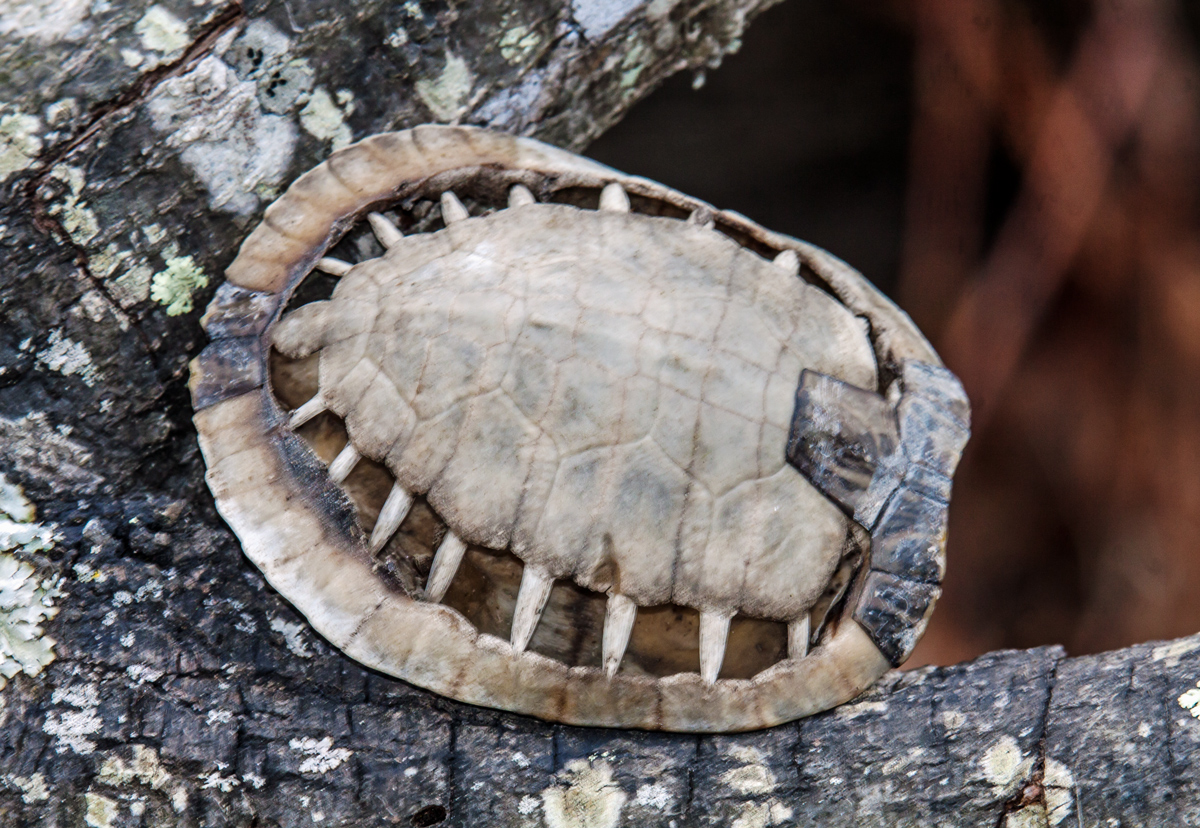
I never quite know what I will see when I wander about in the back areas of Huntley Meadows Park. This past Monday I came upon this partially deteriorated turtle shell. Initially it was in a muddy area adjacent to a beaver pond, but I moved it onto branches of a fallen tree to take the photos.

I just love the organic shapes and designs of the shell and the way that you can see some of its underlying structure.

turtle shell

turtle shell

© Michael Q. Powell. All rights reserved.

Read Full Post »

The skies over Huntley Meadows Park were amazing around 3:00 (15:00 hrs) yesterday afternoon when a cold front was blowing in. When certain clouds were illuminated by the sun they were transformed into pastel shades of the rainbow. At times there were varying shades of orange, green, aqua, and purple.

I suspected that moisture in the clouds was responsible for the colors, but I had never seen anything like it and did not know what it was called. After searching about on the internet, I learned that this diffraction phenomenon, known as cloud iridescence, is caused by small water droplets or ice crystals individually scattering light. According to Wikipedia, ” If parts of clouds have small droplets or crystals of similar size, their cumulative effect is seen as colors. The cloud must be optically thin, so that most rays encounter only a single droplet. Iridescence is therefore mostly seen at cloud edges or in semi-transparent clouds, and newly forming clouds produce the brightest and most colorful iridescence.”

cloud iridescence

cloud iridescence

© Michael Q. Powell. All rights reserved.

Read Full Post »

The leaves of the lotuses at Green Spring Gardens were well past their prime, but they turned out to be fascinating subjects for a series of abstract images.

lotus leaf

lotus leaf

lotus leaf

© Michael Q. Powell. All rights reserved.

Read Full Post »

« Newer Posts