Feeds:
Posts
Comments

Archive for November, 2025

Happy Thanksgiving to all those celebrating this American holiday. Whether we are soaring high or resting at water’s edge, like this Bald Eagle couple (Haliaeetus leucocephalus), we are all blessed.

The Scriptures tell us we should “Rejoice always, pray continually, give thanks in all circumstances.” A recent sermon reminded me that we are called to give thanks “in” all circumstances, even when it may not be possible to feel thankful “for” all of them. It’s a matter of having what some have called an “attitude of gratitude.”

© Michael Q. Powell. All rights reserved.


Read Full Post »

I haven’t yet checked this week, but these Autumn Meadowhawk dragonflies (Sympetrum vicinum) that I spotted on 17 November at Occoquan Bay National Wildlife Refuge are likely to be among the last dragonflies that I see this season.

Autumn Meadowhawks frequently perch flat on the ground or on dried leaves on the ground. I was delighted when a male Autumn Meadowhawk perched almost vertically on a colorful fallen leaf and I was able to capture the first image below. By contrast, the female in the second photo chose a less interesting drab leaf on which to perch.

I’ll try to go out later this week to see if I can find some late season survivors, but it is becoming clear to me that this year’s dragonfly season is nearly over.

Autumn Meadowhawk

Autumn Meadowhawk

© Michael Q. Powell. All rights reserved.

Read Full Post »

As I was walking along the trails at Occoquan Bay National Wildlife Refuge on Monday, I spotted a small flock of birds foraging high in the trees. When I zoomed in with my telephoto lens, I was delighted to see that they were Eastern Bluebirds (Sialia sialis). It may be a bit trite and a bit of a cliché, but I really do love bluebirds—they make me happy.

As you can see from the photos, Eastern Bluebirds have a substantial amount of orange plumage in addition to their blue feathers. Years ago, one of my youngest viewers, Benjamin, suggested that they should be known as Orange Bluebirds and I chuckle as I remember that comment every time that I spot a bluebird.

It was a bit of a challenge capturing shots of these hyperactive little birds as they moved about in the colorful foliage, but I managed to get a few relatively decent shots. Ideally I would have liked for the bluebirds to have been at eye level, but I try to do my best with the conditions that I am given. That is the typical fate of a wildlife photographer.

Eastern Bluebird

Eastern Bluebird

Eastern Bluebird

© Michael Q. Powell. All rights reserved.

Read Full Post »

As we approach winter, birds in the wild have to work hard to find food. Yesterday I photographed this tiny Carolina Chickadee (Poecile carolinensis) at Occoquan Bay National Wildlife Refuge, my local wildlife refuge as it worked to extract seeds from the spiky seed pods of a sweetgum tree.

Now that most of the insects are gone for the season, I have switched lenses on my camera. Although I usually have some additional lenses in my backpack when I am on my little photography expeditions, I generally tend to stick with the lens that is on my camera, During warmer months that tends to be a Tamron 18-400mm lens that has the flexibility to get wide angle shots in addition to close-up shots of insects, particularly dragonflies.

During the cold months, I use my Tamron 150-600mm lens, a longer telephoto zoom lens that gives me greater reach. This lens is quite heavy to hold for extended periods of time, so I normally use it with a monopod, as I was doing yesterday, to give me greater stability and hopefully sharper photos.

I am always amazed when I see chickadees hanging from these spiky seed balls. I realize that these birds don’t weigh much, but it’s hard to believe that they can hang from the same seed pod that they are working on.

I was thrilled to be able to capture this cool image of the chickadee in action, with the colorful foliage in the background giving it a real autumn vibe.

Carolina Chickadee

© Michael Q. Powell. All rights reserved.

Read Full Post »

I am still doing a lot of cross stitching and thought that I would mix things up a bit today by featuring two projects that I have recently completed that feature cardinals, one of my favorite birds. I have not figured out how/if I will frame the pieces, but figured it might be interesting to show you the variety of styles that attract me.

The first photo shows a piece called “Autumn Bird” that was designed by Jody Rice at Satsuma Street. Jody’s style is associated with modern cross stitching with its use of bold colors that are not necessarily related to the colors that you actually see in nature. You won’t, for example, see colorful autumn leaves that look like the ones that I stitched.

The second photo shows “Quirky Quaker Cardinal” by Darling and Whimsy Designs and is more reflective of traditional cross stitching, with its use of a limited palette of muted colors and traditional motifs. I love the simplicity of this approach and this project was a fun and easy stitch for me.

The world of counted cross stitch has changed a lot in recent decades, and many people now use digital patterns and software to display their patterns as they are stitching. I’m a bit of a traditionalist and like to use the paper patterns that I can purchase at my local cross stitch store. For the moment at least, these two approaches happily co-exist.

In many ways, the “modern vs. traditional” debate in cross stitch is similar to the range of approaches that exist for wildlife photography. I happily continue to use a digital single lens reflex camera with its mirror and optical viewfinder and am not quite ready to embrace the more modern mirrorless camera, with digital viewfinders and built-in image processors.

Autumn Bird

Quirky Quaker Cardinal


© Michael Q. Powell. All rights reserved.

Read Full Post »

As I was walking along one of the trails at Occoquan Bay National Wildlife Refuge this past Monday (10 November) I saw and heard a group of small birds moving about in the vegetation. Many of them flew away immediately, but a few of them remained in place a little while longer. I thought I recognized the prominent pattern as belonging to an American Goldfinch (Spinus tristis). I tracked one of the birds and captured the second shot, which confirmed my initial identification.

When I started to review my photos on my computer, I noticed that there was a second bird in the first photo below that I had not noticed when I took the photo. I naively assumed it must be another goldfinch. I posted the photo to a Facebook birding group and one of the more experienced birders there pointed out that the bill on the bird on the right was completely different. He identified the bird as an Orange-crowned Warbler (Leiothlypis celata), a species that he noted was “hard to find.” After reading that comment, I looked over my photos once again and decided to post the final photo of the warbler in a slightly different pose.

American Goldfinch Orange-crowned Warbler

American Goldfinch

Orange-crowned Warbler

© Michael Q. Powell. All rights reserved.


Read Full Post »
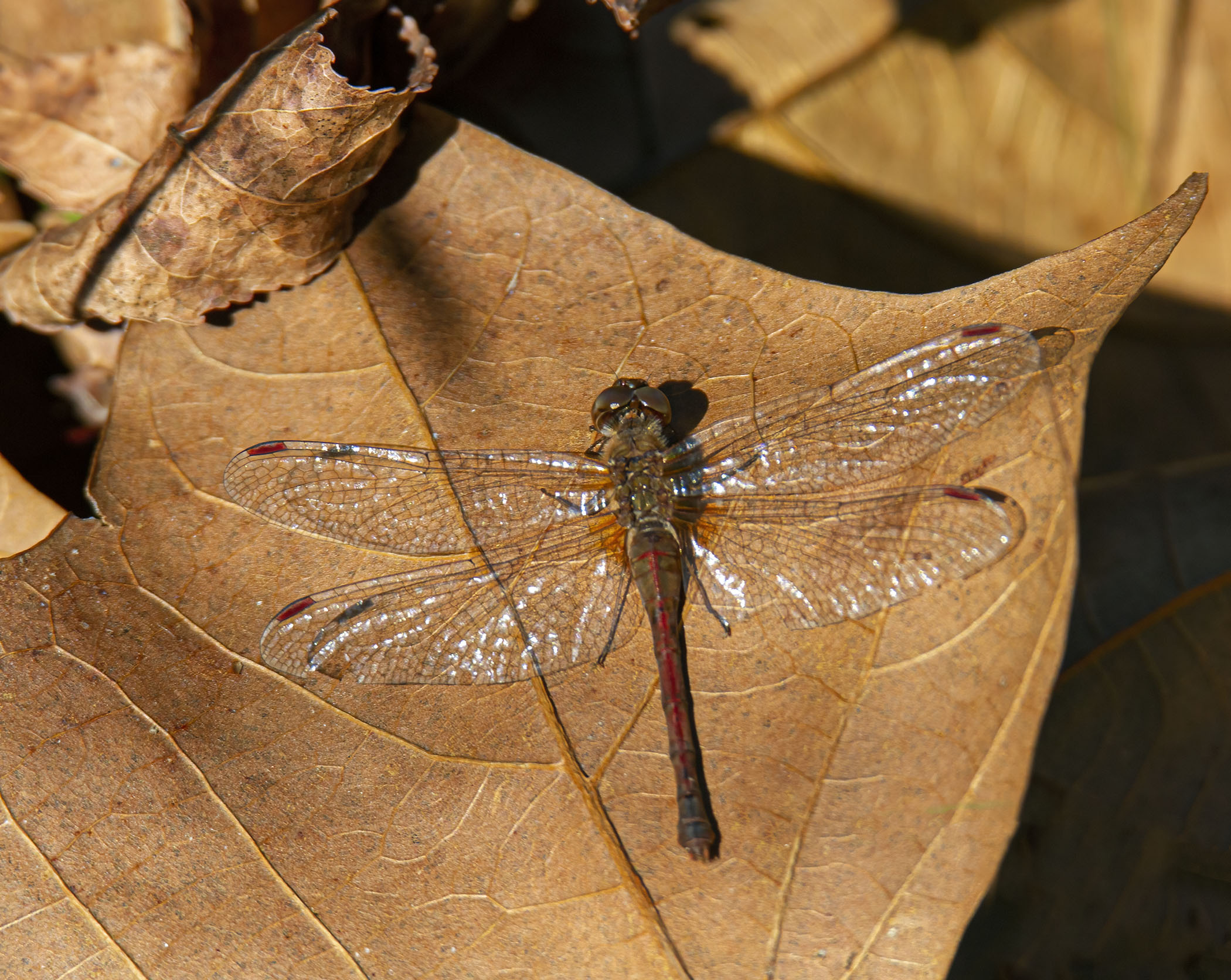
I think that we may well be down to our last surviving dragonfly species. On 10 November I ventured out to Occoquan Bay National Wildlife Refuge to look for any remaining dragonflies or butterflies. I did not find any butterflies, but was delighted to spot close to a dozen Autumn Meadowhawk dragonflies (Sympetrum vicinum).

Our temperatures this past week have dropped down close to the freezing level, which most dragonflies cannot tolerate. Autumn Meadowhawks, however,  are hardy enough to survive a few light frosts as long as daytime temperatures remain relatively warm and sunny. Once we start receiving a few heavy frosts the remaining population starts to die off.

I was happy to capture some photos of Autumn Meadowhawks as they perched on the colorful leaves that litter many of the trails at the wildlife refuge. The dragonflies appeared to be content to remain in place soaking up the warmth of the sun as I approached and some even posed for me.

Autumn Meadowhawk

Autumn Meadowhawk

Autumn Meadowhawk

© Michael Q. Powell. All rights reserved.


Read Full Post »

This past Monday (10 November) I was delighted to spot my first White-throated Sparrows (Zonotrichia albicollis) of the season. White-throated Sparrows overwinter in my area of Northern Virginia and seem to have arrived fairly recently.

I love the distinctive markings of these little birds, with their white “beards” that remind me of Santa Claus and their bright yellow lores, i.e. the region between the eye and the bill. They are the only species of sparrows that I can reliably identify—for other sparrows I have to look closely at guide books in order to guess their species.

White-throated Sparrow

© Michael Q. Powell. All rights reserved.

Read Full Post »

Sometimes it pays to be lucky (and persistent). Yesterday I visited Occoquan Bay National Wildlife Refuge for this first time in over a week. It was cool (about 45 degrees (7 degrees C) and breezy, so I knew that my focus would be primarily on birds rather than insects.

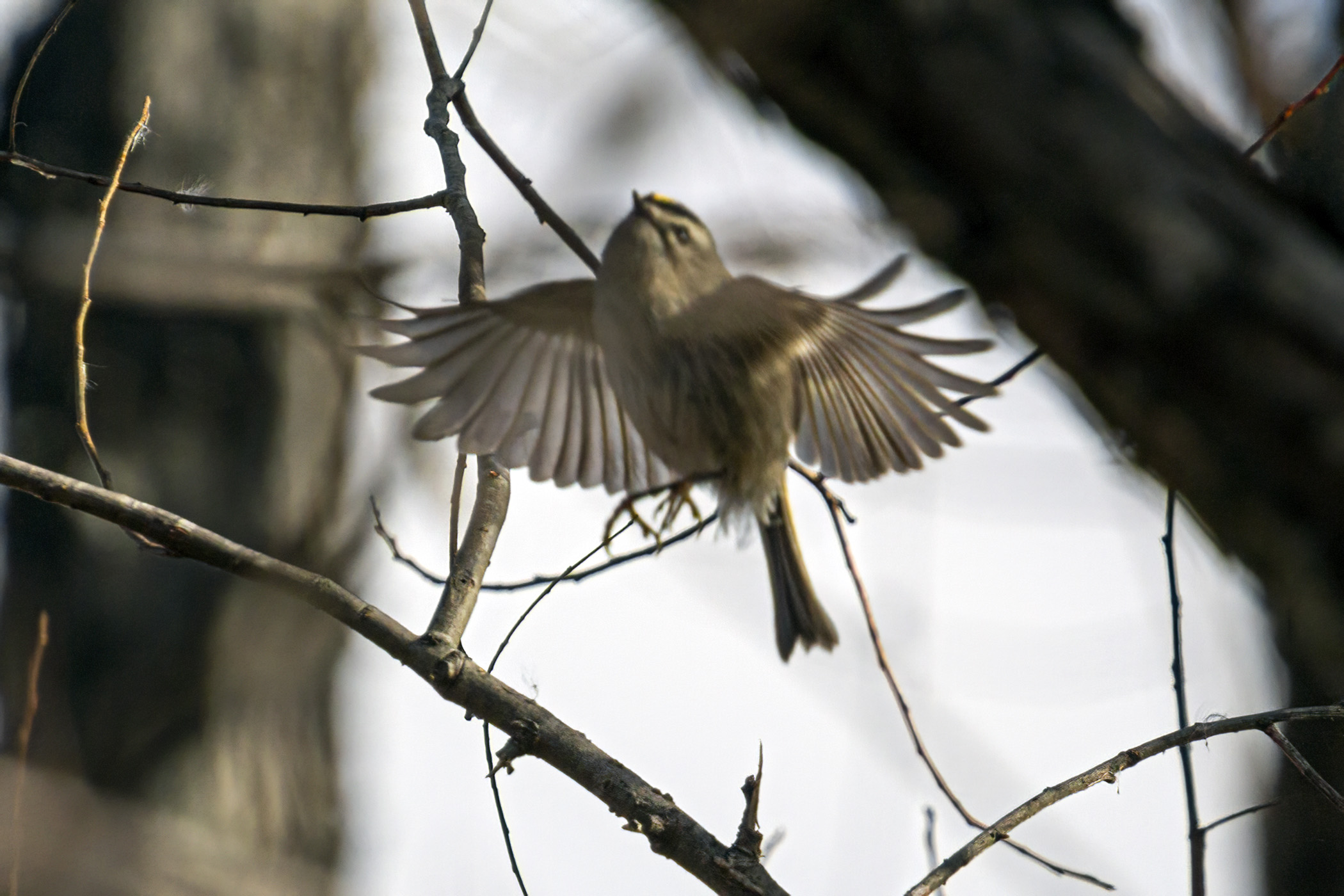
Midway through the morning, I spotted a bird moving about high in the trees and I tried to track it. Eventually I realized that it was a Golden-crowned Kinglet (Regulus satrapa), one of the smallest birds in our area at  only about 3-4 inches in length (8-11 cm). Golden-crowned Kinglets are skittish and do not stay still for very long, so I frantically tried to track this bird as it moved from branch to branch.

I took lots of photos, but in many of them the kinglet was partially hidden by the branches or was out of the frame. My favorite photo of the kinglet is the first one below. The kinglet paused for a moment and lifted it head, allowing me to get a little eye contact with the bird. As I was focusing in on the kinglet’s perch, the kinglet took off and I captured the second photo, a lucky midair shot. The final photo shows the kinglet in one of its many acrobatic poses that it used as it foraged for food.

In case some of you are curious, I did find a few dragonflies yesterday, but I’ll leave those photos for another blog post.

Golden-crowned Kinglet

Golden-crowned Kinglet

Golden-crowned Kinglet

© Michael Q. Powell. All rights reserved.

Read Full Post »

For a variety of reasons I did not manage to go out with my camera this past week, so I went through my photos from the previous week and was delighted to find this photo of a Blue-faced Meadowhawk dragonfly (Sympetrum vicinum). As I have noted in previous postings, Blue-faced Meadowhawks have such a wonderful combination of colors that make them one of my favorite dragonfly species.

I was quite fortunate that this particular individual landed on some leaves right next to one of my feet, so I was able to capture this cool image by shooting almost directly downwards. In fact, I had to digitally remove a bit of the boot I was wearing from the lower left edge of the photo to keep the viewer from getting distracted.

Several days ago we had some frost warnings, so I fear that more of the dragonflies will have disappeared for the season. Still, I hope to return to my local wildlife refuge in the next few days to see what I can find.

Blue-faced Meadowhawk

© Michael Q. Powell. All rights reserved.

Read Full Post »

It’s always fun to try to capture a shot of an Autumn Meadowhawk dragonfly (Sympetrum vicinum) with beautiful fall colors in the background, as I did last Friday (31 October) at Occoquan Bay National Wildlife Refuge. Autumn Meadowhawks are invariably the last surviving species of the dragonfly season. In past years I have spotted them as late as the middle of December, and fellow dragonfly enthusiasts have reportedly seen them in our area in early January.

Autumn Meadowhawk

© Michael Q. Powell. All rights reserved.

Read Full Post »

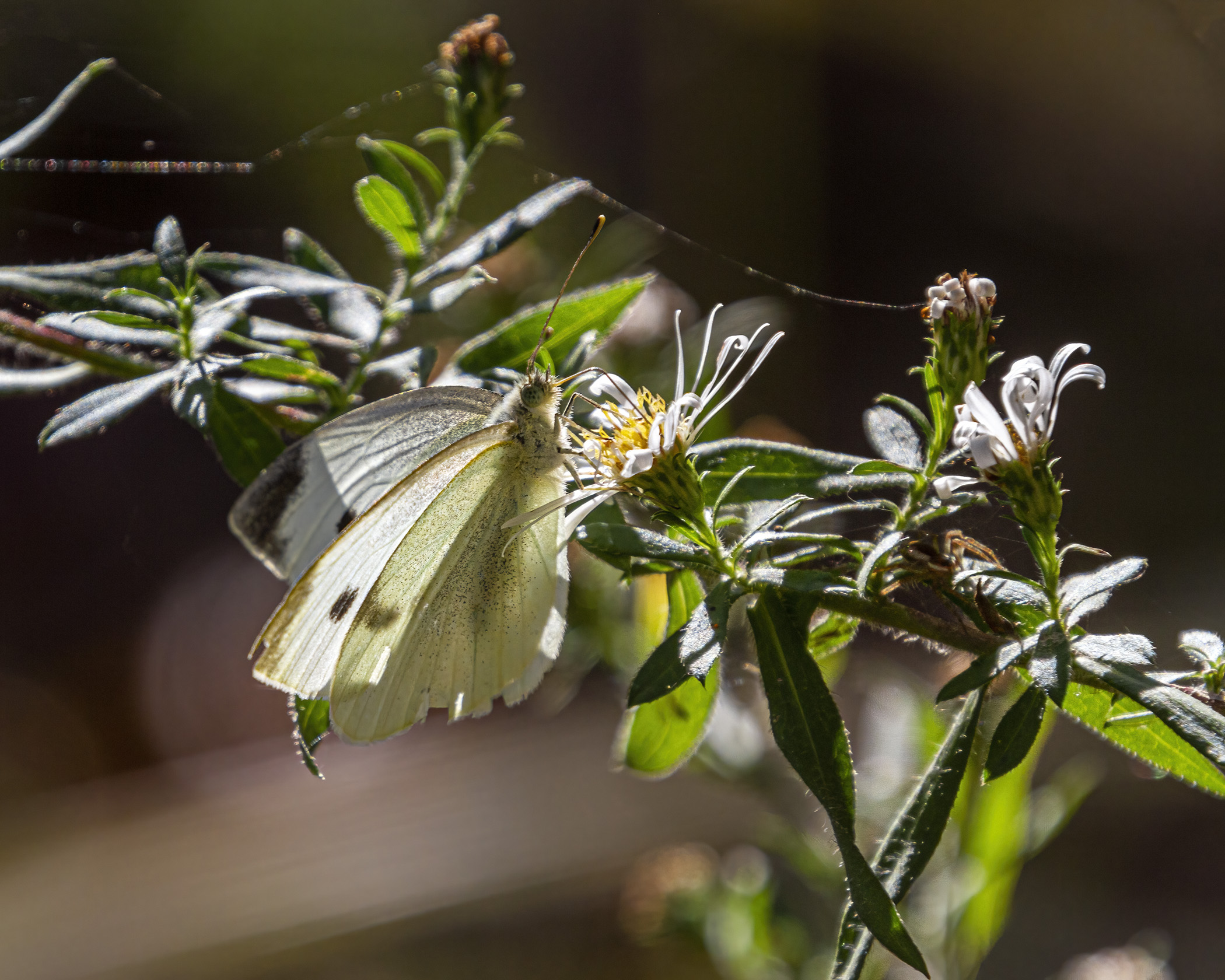
I spotted this pretty little Cabbage White butterfly (Pieris rapae) on 31 October at Occoquan Bay National Wildlife Refuge. This is a relatively common butterfly that has a natural range across Europe, Asia, and North Africa. According to Wikipedia, it was accidentally introduced to Quebec, Canada, around 1860 and spread rapidly throughout North America.

Most of the time Cabbage Whites flit about so much as they forage that it is hard to get a good photo of one. This Cabbage White, however, paused for a moment to feed on a flowering plant and I was able to capture an action shot. If you click on the image, you can get even see the extended proboscis that the tiny butterfly was using to suck nectar from the center of the flower.

Cabbage Whites are one of the earliest butterflies to appear in the spring and generally are still in flight in the fall until we have a hard freeze. The weather has cooled considerably, but so far the temperatures have not fallen below the freezing level.

Cabbage White

© Michael Q. Powell. All rights reserved.

Read Full Post »

I was delighted to spot this stunning Blue-faced Meadowhawk dragonfly (Sympetrum ambiguum) on Halloween Day at Occoquan Bay National Wildlife Refuge. We have had a series of cool, damp days recently, so when I saw the weather was forecast to be sunny, I went out to see if I could find any dragonflies. As I suspected, most of the dragonflies are now gone, but I was delighted to find a couple of Blue-faced Meadowhawks, one of my favorite species, and also a few Autumn Meadowhawks. The dragonfly season is not over yet.

I absolutely love the striking coloration of the male Blue-faced Meadowhawks, like the one in the photo below. Their turquoise faces, blue eyes, and bright red abdomens are incredibly beautiful. On a day when many children would be focusing on their “trick or treat” adventures, I felt like I received my “treat” a little early.

Blue-faced Meadowhawl

© Michael Q. Powell. All rights reserved.


Read Full Post »

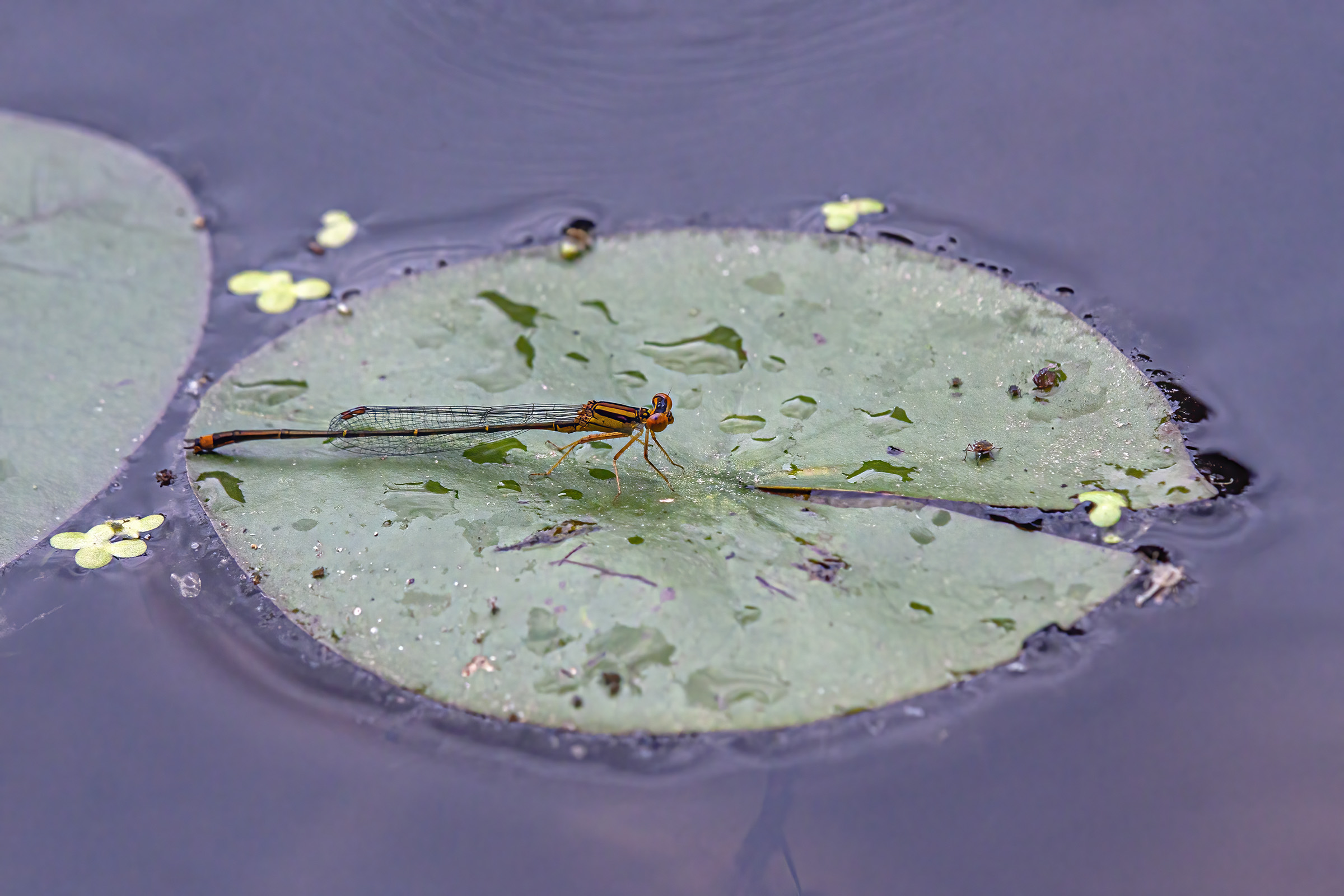
When I spotted this damselfly on 17 October at Occoquan Bay National Wildlife Refuge, I initially couldn’t figure out what species it was. I asked for help in a dragonfly/damselfly group in Facebook and was informed that it was an Orange Bluet damselfly (Enallagma signatum).

The name Orange Bluet seems to be an oxymoron. As the name “bluet” suggests, most of the 35 members of the genus American Bluet (Enallagma), the largest damselfly genus in North America, are blue. However, certain species come in other colors including red, orange, and green and the Rainbow Bluet combines red, yellow, and green.

I have actually photographed Orange Bluets before, but they have been a much brighter orange in color, as you can see in the second photo below from July 2022. The damselfly in the first photo was much duller in color, which may well be the reason for my uncertainty. However, it seems to be a perfect visual representation of the current autumn season.

Orange Bluet

orange bluet

© Michael Q. Powell. All rights reserved.


Read Full Post »