Feeds:
Posts
Comments

Archive for August, 2025

This insect looks a bit like a dragonfly at first glance, but if you look more closely you may notice that the wings and eyes are different from those of a dragonfly and this insect’s body is a lot hairier. This is a robber fly and I am pretty sure that it is a variety known as a Red-footed Cannibalfly (Promachus rufipes).

Red-footed Cannibalflies are among the coolest and creepiest insects that you may encounter in the wild. As their macabre moniker suggests, Red-footed cannibalflies usually feed on other insects, but they reportedly are capable of taking down a hummingbird.

Robber flies in general are predators that wait for their prey to fly by and then attack it. Wikipedia describes their attack in this way, “The fly attacks its prey by stabbing it with its short, strong proboscis  injecting the victim with saliva containing neurotoxic and proteolytic enzymes which very rapidly paralyze the victim and soon digest the insides; the fly then sucks the liquefied material through the proboscis.” Yikes!

I have a personal special attachment to Red-footed Cannibalflies. In 2013 I captured an image of one of these insects and for years it was my most popular photo on-line, with over 3700 views to date. Since then, a few other of my photos have jumped ahead of this cool-looking predator, which continues to get views a dozen years after it appeared in my blog.

I captured this image last Monday at Occoquan Bay National Wildlife Refuge. I spotted this cannibalfly perched on a branch that was partially in direct sunlight. To keep from blowing out the highlights on its body, I deliberately underexposed the shot, which meant that the background became really dark. Normally I don’t like that kind of starkness and prefer a more natural background, but in this case it seems to work well with my creepy subject, giving it a spooky, Halloween-style vibe.

Red-footed Cannibalfly

© Michael Q. Powell. All rights reserved.

Read Full Post »

A simple composition and an ordinary subject—sometimes that is all that it takes to capture a beautiful image. I spotted this little Common Buckeye butterfly (Junonia coenia) on Monday at Occoquan Bay National Wildlife Refuge. The Common Buckeye kept perching on the ground and would fly away a short distance every time that I approached it.

Eventually it perched in the vegetation at the edge of the trail and I was able to capture this image. Although the background is a bit cluttered, it was far enough away that it blurred into a series of shapes that do not distract from the central subject. Yes, the subject is mostly a dull brown in color that most viewers may not find to be very visually pleasing. However, the eyes are really drawn to the orange stripes on the butterfly’s body and then to the interesting shadow that the legs of the butterfly are casting.

For me, there is a real beauty in the simplicity of this photo and I like it a lot. Photography does not always have to be complicated to be effective.

Common Buckeye

© Michael Q. Powell. All rights reserved.


Read Full Post »

When I try to take photographs of a butterfly, I usually have multiple objectives. First, of course, I’d like to be able to capture some images that are more or less in focus. Ideally, I like to get an interesting wing position, which often means that I try to catch the butterfly with its wings open. Finally, I love to catch the butterfly in a visually attractive habitat or doing something interesting, though these variables are the ones over which I have the least amount of control.

On Monday I chased after this Eastern Tiger Swallowtail butterfly (Papilio glaucus) when I spotted it in flight and tracked it when it landed in some nearby vegetation. There did not seem to be any flowers there, so I was a little surprised that the butterfly had chosen to perch at that spot. I carefully chose my shooting angle and was pretty pleased that I was able to capture a lot of the habitat. Although there is still a lot of greenery, the dried-up leaves help to give the image an interesting autumn vibe.Eastern Tiger Swallowtail

© Michael Q. Powell. All rights reserved.


Read Full Post »

On Monday I managed to photograph this elusive Zebra Swallowtail butterfly (Eurytides marcellus) during a visit to Occoquan Bay National Wildlife Refuge. When the butterfly was in motion, I had no idea that it was damaged, but when it paused for a moment, it was immediately obvious that it was missing its tails.

Somehow the butterfly was able to compensate for their loss by adjusting its flight and its feeding behavior did not appear to be adversely affected. As we get older, we often worry about the things that we can no longer do as well as when we were younger, instead of adjusting our behavior to focus instead on all of the things that we are still possible.

Maybe we should take a cue from this damaged butterfly and live our lives positively, rather that wallow in our “what ifs…” or “if only…” mindsets.

Zebra Swallowtail

Zebra Swallowtail

© Michael Q. Powell. All rights reserved.

Read Full Post »

I was delighted to spot this Eastern Box Turtle (Terrapene carolina carolina) yesterday alongside one of the trails at Occoquan Bay National Wildlife Refuge. These beautiful land-dwelling turtles, also known as Woodland Box Turtles, are extremely long-lived and are capable of living over 100 years in captivity, though in the wild they often live much shorter lives due to disease and predation.

The brown eyes of this turtle suggest that that it is a female, though I have read that eye color is not always 100% accurate in determining the gender of a box turtle—males of this species often have red eyes. The shell pattern for each box turtle is supposed to be unique, like a fingerprint, which makes the wonderful patterns of this turtle’s shell especially intriguing.

Eastern Box Turtle

Eastern Box Turtle

© Michael Q. Powell. All rights reserved.


Read Full Post »

As we approach the end of August, some of the more common dragonfly species are becoming much less common. Some autumn species will soon take their places. At the moment the Common Whitetail dragonfly (Plathemis lydia) is the species that I see most often. During a recent visit to Huntley Meadows Park, I spotted this young male Common Whitetail perched vertically on some vegetation.

How do I know that it is a young male? Females of this species have a different pattern of dark patches on their wings, as you can see in the second image below from earlier in the season, and different terminal appendages. Males start out with a darker coloration like that of their female counterparts and as they age they develop a white powdery substance on their abdomens called pruinosity. The dragonfly in the first photo is currently a bluish white and some of the markings are still showing through—eventually he will turn a bright white in color.

Common Whitetail

Female Common Whitetail

© Michael Q. Powell. All rights reserved.

Read Full Post »

I was thrilled to spot this pristine Eastern Tiger Swallowtail butterfly (Papilio glaucus) last week at Occoquan Bay National Wildlife Refuge. Many of the butterflies that I see this late in the season are tattered and damaged, but this one appeared to be in a perfect condition as it hungrily fed on some blooming wildflowers.

Eastern Tiger Swallowtail

© Michael Q. Powell. All rights reserved.


Read Full Post »

As we near the end of August, I am seeing more and more reminders that Halloween is drawing near. Although we still have a couple of months before the 31st of October, store displays of candy and costumes and all other sorts of spooky merchandise have popped up everywhere.

Even when I was walking the trails of Occoquan Bay National Wildlife Refuge recently, I was reminded of the upcoming holiday when I spotted this Halloween Pennant dragonfly (Celithemis eponina) perched at the highest point of a patch of vegetation. Halloween Pennants have very distinctive markings on their wings that make then easy to identify. Unlike some other dragonfly species that perch on the ground and are therefore hard to spot amidst the fallen leaves, Halloween Pennants always seem to perch high above the ground and consequently are easy to spot. These perches often sway in the slightest of winds, causing the dragonflies to flutter in the wind, like pennants.

Halloween Pennant

© Michael Q. Powell. All rights reserved.

Read Full Post »

During a visit to Occoquan Bay National Wildlife Refuge, I was delighted to spot a clearwing moth flying about in the milkweed. I initially assumed that it was a Hummingbird Clearwing Moth (Hemaris thysbe), the most common clearwing moth in our area. When I looked more closely, however, I realized that it was a Snowberry Clearwing Moth (Hemaris diffinis).

Although these two species are similar in appearance, there are some noticeable differences. The first photo is one I took on Friday of a Snowberry Clearwing and the second photo from earlier in August is of a Hummingbird Clearwing. Snowberry Clearwing Moths have black legs, while those of a Hummingbird Clearwing Moth are paler in coloration. Snowberry Clearwings also have a black stripe on the thorax that runs up to the eye that is lacking on the Hummingbird Clearwings.

I suspect that there are some other differences too, but I am simply thrilled to know that we have both species present in our area. Most people seem to think that moths are dull and uninteresting, compared with butterflies, but these two species clearly show that moths have their own distinctive beauty and behavior, if you slow down enough to notice them.

Snowberry Clearwing Moth

Hummingbird Clearwing Moth

© Michael Q. Powell. All rights reserved.

Read Full Post »

While I was looking for dragonflies last Friday at a small pond at Occoquan Bay National Wildlife Refuge, I spotted this Solitary Sandpiper (Tringa solitaria) foraging in the shallow water. As its name suggests, the sandpiper was all by itself, with not another member of its species visible.

The bird was quite skittish, so I was not able to get close to it and observed it from a distance. The sandpiper was in almost constant motion as it waded through the water, periodically dipping its head down to hunt insects, crustaceans, mollusks, amphibians, and other prey. I think that the Solitary Sandpiper was having some success, though it was hard to tell for sure.

I was happy to be able to capture this shot of the bird as it plunged its opened bill into the water. The reflection of the sandpiper and the surrounding area in the water was a nice bonus.

Solitary Sandpiper

© Michael Q. Powell. All rights reserved.

Read Full Post »

I was absolutely thrilled to spot several Monarch butterflies (Danaus plexippus) yesterday during a visit to Occoquan Bay National Wildlife Refuge. Every year I worry that I will not see any Monarchs due to a reported decrease in suitable habitats, although I don’t think that Monarchs are officially on the endangered species list at the present time.

The Monarchs that I saw were very much focused on a particular patch of wildflowers, so I had a chance to move about a bit to frame my photos, as you can see below.

I have fond childhood memories of seeing photos of migration of Monarch butterflies in National Geographic magazine, and every time that I see them, it brings back those memories.

Monarch butterfly

Monarch butterfly

Monarch butterfly

© Michael Q. Powell. All rights reserved.

Read Full Post »

It is a bit early to be thinking of autumn, but early signs are beginning to appear. On Monday, classes begin for public school students in our county and traffic will be crazier than ever as commuters and school buses adjust to a changed dynamic.

Some species of summer dragonflies are beginning to disappear and I have begun to search for their autumn replacements. The trails at the wildlife refuges that I haunt are now littered with fallen leaves, making it hard to spot those species that perch on the ground.

This past Monday I captured this shot of a female Common Whitetail dragonfly (Plathemis lydia) at Huntley Meadows Park. This species is one of the most common in my area at this time of the year and I spotted a lot of them during my visit to the park. I particularly like the way that I was able to capture the texture and detail of the dried leaves on which the dragonfly was perched—I can almost hear the crunch of those leaves as I walked through them that day.

Truth be told, autumn is my favorite time of the year and I am patiently waiting for it to arrive. In the meantime, I am still enjoying the summer. “To everything there is a season, and a time to every purpose under heaven.”

Common Whitetail dragonfly

© Michael Q. Powell. All rights reserved.
Read Full Post »

On Monday I spotted this Great Blue Heron (Ardea herodias) on a stump in the middle of a pond at Huntley Meadows Park. The heron seemed to be fully attentive and somehow his pose struck me as regal, like that of a monarch surveying his kingdom. The wonderful reflections in the pond added additional visual interest to the image that I was able to capture.

Great Blue Heron

© Michael Q. Powell. All rights reserved.

Read Full Post »

It is tough to get a proper exposure during the harsh midday sunlight—all too often the image will be overexposed. I sometimes will deliberately compensate by underexposing the subject, which has the effect of significantly darkening the background of the image. This doesn’t always work, but I like the dramatic result that I got when I photographed this little skipper butterfly during a visit earlier this week to Huntley Meadows Park.

As I have noted in multiple post over the years, skipper butterflies are really tough to identify. I looked over lots of images on-line and have concluded that this might be a Zabulon Skipper butterfly (Poanes zabulon) or possibly a Peck’s Skipper butterfly (Polites peckius).

Why did I go with “Zabulon” in the title of this post rather than “Peck’s?” The answer is quite simple is not a scientific determination—I think the name “Zabulon” is a lot cooler than “Peck’s.”

Zabulon Skipper

© Michael Q. Powell. All rights reserved.

Read Full Post »

How do you handle the heat? For those of us who live in the Northern Hemisphere, the last few months have seen a series of unrelenting hot days. High temperatures have frequently been in the 90’s (33 degrees C) and have occasionally pushed past 100 degrees (38 degrees C).

Despite the heat, I ventured out yesterday with my camera during the middle of the day and visited Huntley Meadows Park, a local wetlands area. Wildlife activity seemed quite low—many of the creatures seemed to be sheltering out of sight in the shade. I did manage to spot this female Eastern Pondhawk dragonfly (Erythemis simplicicollis) that was perilously perched on a flimsy bit of vegetation. I don’t know for sure if she was taking a siesta or was simply chilling, but somehow her actions seemed make a bit more sense for dealing with the heat than those of this intrepid photographer.

Perhaps the old saying is true—”Mad dogs and Englishmen go out in the midday sun.” Technically I am not English, so what does that make me?

Eastern Pondhawk

© Michael Q. Powell. All rights reserved.

Read Full Post »

I was delighted to spot this Common Wood Nymph butterfly (Cercyonis pegala) during a recent visit to Occoquan Bay National Wildlife Refuge. I love the distinctive yellow patches on its wings that make it pretty easy to identify.

Common Wood Nymphs usually like to hang around near the edges of the woods rather than in the fields that many butterflies seem to prefer and consequently I do not see this cool-looking butterfly very often.

Common Wood Nymph

© Michael Q. Powell. All rights reserved.


Read Full Post »

On Monday I spotted this little Silver-spotted Skipper butterfly (Epargyreus clarus) feeding on a buttonbush (Cephalanthus occidentalis) at Jackson Miles Abbott Wetland Refuge. I love the distinctive spiky flower balls of this plant that have always reminded me of medieval maces.

A few years ago, however, I came to associate the shape of the balls with depictions of the COVID virus. Recently the number of COVID cases has reportedly been on the rise and I fear that they will increase even more when summer ends and people begin to spend more time indoors. Since I am over 65 years old and therefore considered to be “vulnerable,” I hope that I will be able to get an updated COVID shot (and a flu shot too) in the upcoming months. Neither offers 100% protection, but the shots will hopefully lessen the severity of symptoms if I do get sick.

Silver-spotted Skipper

Silver-spotted Skipper

© Michael Q. Powell. All rights reserved.


Read Full Post »

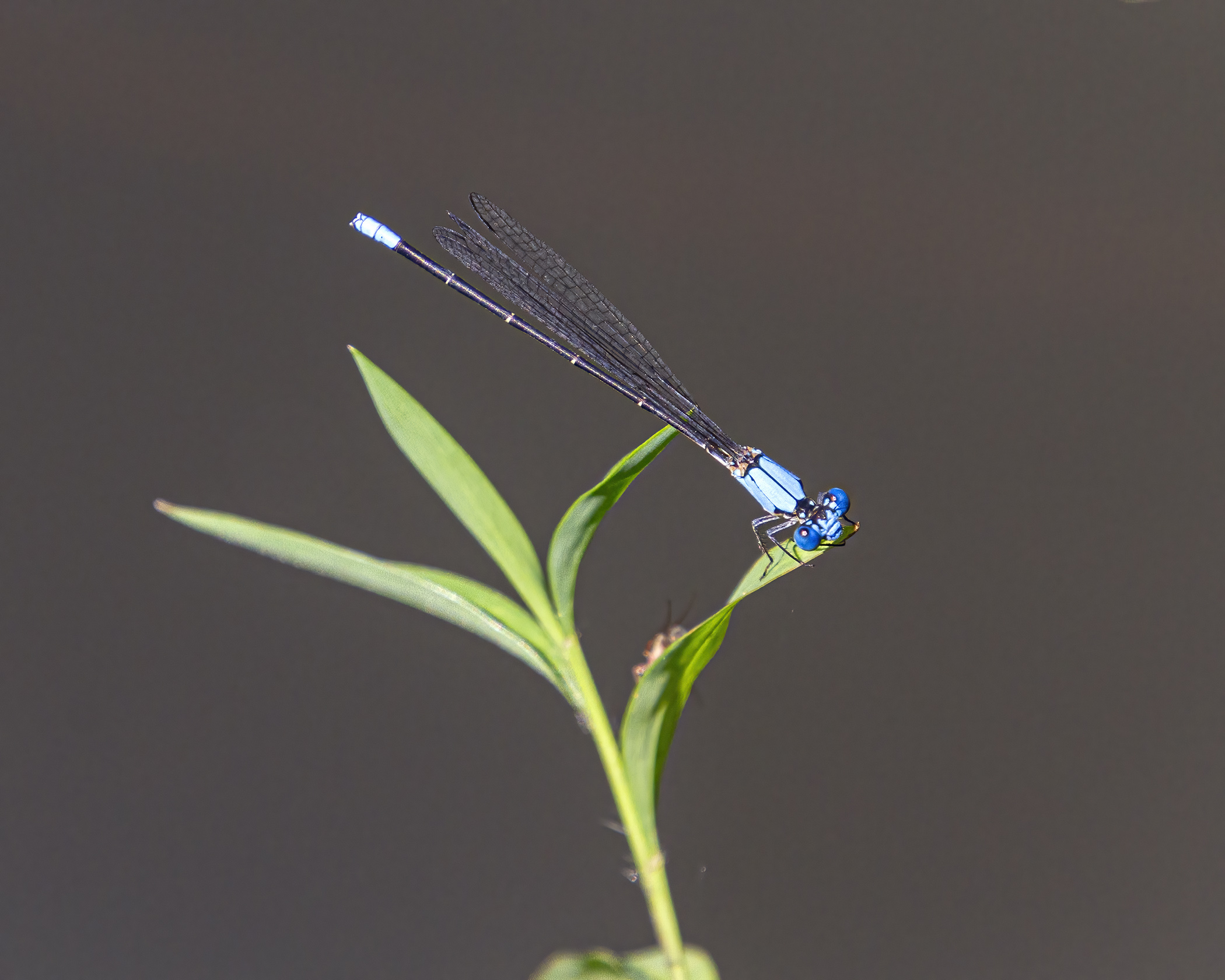
On Monday I spotted several Blue-fronted Dancer damselflies (Argia apicalis) during a visit to Jackson Miles Abbott Wetland Refuge. I don’t see this particular species of damselfly at most of my other favorite spots, so it was a nice treat to see them. According to my identification guide, Damselflies of the Northeast by Ed Lam, Blue-fronted Dancers can be found “on a wide variety of rivers and streams, occasionally lakes and ponds.”

In this case, I spotted the damselflies perched in the vegetation at the edge of a small pond (first photo) and perched on an exposed tree root a few feet from the pond (second photo). The males of this species are pretty easy to identify because their thoraxes (their “chest”) are almost completely blue, with only hairline black stripes.

Blue-fronted Dancer

Blue-fronted Dancer

© Michael Q. Powell. All rights reserved.


Read Full Post »

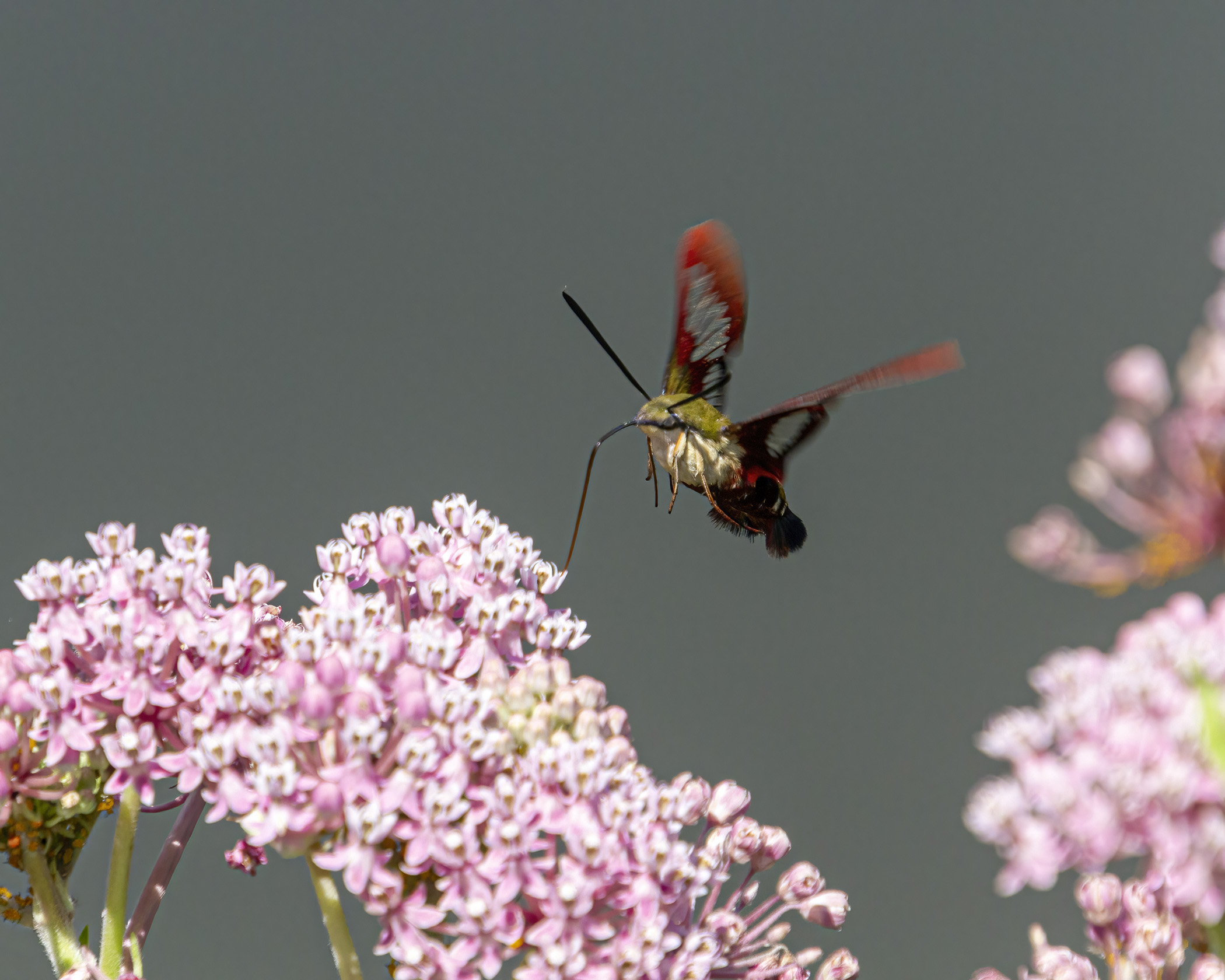
Yesterday I went out with my camera to Jackson Miles Abbott Wetland Refuge, a small nature pond that is overseen by the nearby Fort Belvoir military installation. I was looking for certain dragonfly species and mostly came up empty-handed. However, I was delighted to spot this spectacular Hummingbird Clearwing Moth (Hemaris thysbe) feeding in a patch of milkweed.

Like Hummingbirds, these moths hover in the air while extracting nectar from flower. Unlike hummingbirds that use long, slim beaks to get deep into the center of flowers, hummingbird moths use a long, hollow proboscis to suck out the nectar. The proboscis is normally coiled and is extended only when the moth is ready for action, as you can see in the photo below.

I used a relatively high shutter speed and managed to capture a pretty good view of the “clearwing” that is in the common name of this species. I did not have too much time to maneuver about, but crouched down a bit to isolate the clearwing moth against the backdrop of the pond, rather than risk having it be lost in the clutter of the vegetation.

UPDATE: I felt compelled to post the second photo below. I sort of missed it when I quickly sorted my photos, but the head-on shot really struck me as cool and unusual when I looked through the photos again. I particularly love the raised wing positions in the moment that I captured.

Hummingbird Clearwing Moth

Hummingbird Clearwing Moth

© Michael Q. Powell. All rights reserved.


Read Full Post »

Out of the more than 3500 species of skipper butterflies worldwide, there is only one that I can reliably identify, the Silver-spotted Skipper (Epargyreus clarus). I remember when I first started taking nature photos that I mistaken believed that all of the little, mostly brown butterflies were moths. Somehow I had done a kind of color sorting in my mind and had reserved the name “butterfly” exclusively for the large, colorful species.

As I look back, I realize that my initial oversimplified identification schema was a bit naive and incorrect. That does not necessarily mean that I am able to identify all of the skipper species now, but I can look at them more carefully and see the differences in their colors and patterns that will help me to find them in my identification guides.

I spotted this beautiful Silver-spotted Skipper during a recent visit to Occoquan Bay National Wildlife Refuge. The butterfly was skittish and elusive, but I eventually managed to capture this shot of it by peering through a “window” in the vegetation.

Silver-spotted Skipper

© Michael Q. Powell. All rights reserved.

Read Full Post »

I love dragonflies. There is something almost magical about these incredible aerial acrobats that never fails to fascinate and enchant me.

When I was attempting to compose a photo of this Great Blue Skimmer dragonfly (Libellula vibrans) last week at Occoquan Bay National Wildlife Refuge, I tried to use a leaf in the background to draw attention to my primary subject. It was only later, when I was review my images, that I realize that the leaf was heart-shaped, a perfect visual representation of my feelings towards dragonflies.

Great Blue Skimmer

© Michael Q. Powell. All rights reserved.


Read Full Post »