Feeds:
Posts
Comments

Archive for September, 2024

Last Wednesday I was thrilled to spot multiple Monarch butterflies (Danaus plexippus) during a visit to Occoquan Bay National Wildlife Refuge, the most Monarchs that I have seen at one time this entire season. I do not know if these are local Monarchs that are preparing to migrate southward or if they are migrating Monarchs that are stopping by to refuel their bodies as they continue on their journey.

In either case, the butterflies were really active, in almost constant motion as they moved about the the open thistle flowers. I was hoping to get multiple butterflies in a single shot, but was never able to capture more than two of them in any photo, as you can see in the first image below.

The final photo shows the kind of photo that I was trying to take, a sidewards view of the Monarch in action. If you look closely, you can even see the butterfly’s extended proboscis. I also love the wonderful contrast between the orange of the butterfly and the pink of the thistle flower.

Monarch butterfly

Monarch butterfly

© Michael Q. Powell. All rights reserved.

Read Full Post »

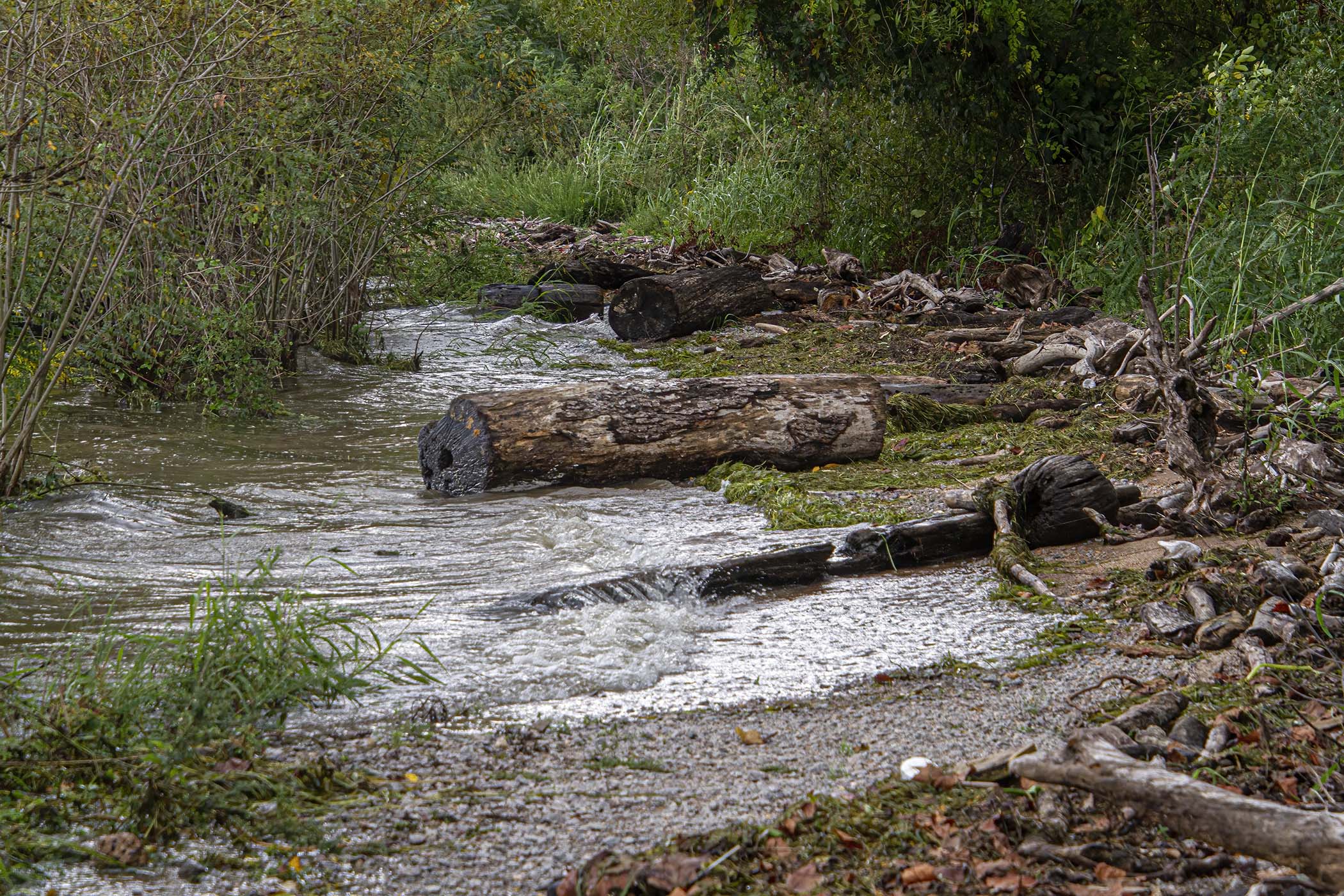
The Potomac River is affected by the tides and, as a result, the levels of water off of Occoquan Bay National Wildlife Refuge are also affected. Some of the trails at the refuge run parallel to the water and when tidal levels are unusually high, those trails are sometimes flooded.

This past Wednesday I visited the refuge. We had had some rainstorms recently, but I did not anticipated that I would encounter so much water on the trails. There were signs at several locations that warned of potential flooding, but they have been there before when there has been little, if any, flooding.

This time, however, there was a significant amount of flooding. In some cases, there was standing water on the trail, but in other cases, as you can see in the second photo below, the waves were washing onto the trail. There was a lot of debris on the trail as well, complicating my passage. I thought the water might be ankle-deep, but in a number of places, it reached my lower calf.

I was wearing boots that were somewhat waterproof, though they were inundated when the water levels were higher than the top of the boots. Fortunately, only about a third of the length of the trail was covered with water, so I was able to make my way down the trail without having to turn back. Needless to say, I did not see too many birds or dragonflies as I sloshed my way through the water, but strangely enough it was pleasant to experience to see these familiar trails in a different way.

We were mostly spared from the effects of Hurricane Helene, but I suspect that the water levels are still high in the Potomac River today. We had a fair amount of rain the last couple of day, but the sun appears to be shining right now, possibly encouraging me to go out with my camera today, though usually I avoid doing so on the weekends when the wildlife refuge is more likely to be crowded.

Occoquan Bay National Wildlife Refuge

Occoquan Bay National Wildlife Refuge

Occoquan Bay National Wildlife Refuge

© Michael Q. Powell. All rights reserved.
Read Full Post »

Several months ago, Great Blue Skimmer dragonflies (Libellula vibrans) were quite common at Occoquan Bay National Wildlife Refuge. As we approach the end of September, though, they have now become an uncommon sight and those that I do spot are often survivors that show signs of advanced age.

Last week I spotted this female Great Blue Skimmer. This species is quite easy to identify, because both males and females have white faces. Younger females are yellow and brown in color, but those colors gradually get duller and darker with age. Interestingly enough, their eyes also change colors—younger females have eyes that are reddish brown over a dull green and as they get older their eyes often become blue, like those of the dragonfly in the photo below.

I could not help but notice that this dragonfly has some damage to her wings, a frequent sight as the dragonflies get older. Still, she was getting along pretty well, a testament to the resilience and determination of these senior citizens of the dragonfly world.

Great Blue Skimmer

© Michael Q. Powell. All rights reserved.


Read Full Post »

Last week I spotted this female Big Bluet damselfly (Enallagma durum) at Occoquan Bay National Wildlife Refuge, one of the few damselflies still around this late in the season. Big Bluets are primarily a coastal species in our area, which helped me to narrow down the possibilities when trying to identify the damselfly species. Generally female damselflies are tougher to identify than males, but I pretty confident that this one is a Big Bluet.

UPDATE: A sharp-eyed viewer pointed out to me that this is probably an immature male Big Bluet, not a female, based on a number of specific physical features. I think he’s right! It is not the first time that I have misidentified a damselfly and it almost certainly will not be the last time.

I love the way that the light green in the background matches the color of the damselfly’s body and makes for a really pleasing image.

Big Bluet

© Michael Q. Powell. All rights reserved.


Read Full Post »

Last Thursday I captured my first shot of a Bald Eagle in a few months during a visit to Occoquan Bay National Wildlife Refuge. I have spotted Bald Eagles several times this summer, but I did not see them from a distance, because of the foliage on the trees, and my first indication of their presence was when they were flying away from me.

There are still quite a few leaves on the trees, so I was startled when I flushed an eagle last week. I was fortunate, though, the eagle flew across my field of view and I was able to snap off a couple of shots before it disappeared from sight. This is a crop of the image that came out of my camera and I am pretty happy with the results, especially considering the fact that I had no time to make any adjustments to my camera before taking the shot.

I am still trying to focus primarily on insects, but know that before long I will be switching my focus to birds. However, as this photo shows, I will rarely pass up an opportunity to get a shot of a Bald Eagle, irrespective of the season.

Bald Eagle

© Michael Q. Powell. All rights reserved.

Read Full Post »

It is getting to be that time of the year when certain dragonfly species, like the Common Green Darner (Anax junius), begin to migrate southward. Most people are aware of the migration of Monarch butterflies, but are surprised to learn that some dragonflies also migrate.

The Science News website described this amazing migration in an on-line article, “At least three generations make up the annual migration of Common Green Darner dragonflies. The first generation emerges in the southern United States, Mexico and the Caribbean starting around February and flies north. There, those insects lay eggs and die, giving rise to second generation that migrates south until late October. (Some in that second generation don’t fly south until the next year, after overwintering as nymphs.) A third generation, hatched in the south, overwinters there before laying eggs that will start the entire process over again.”

Last week I spotted a formation of helicopters flying in formation overhead as I was searching for dragonflies at Occoquan Bay National Wildlife Refuge. For a moment the helicopters, which look to be UH-60 Black Hawk helicopters, reminded me of migratory dragonflies. Before long their loud engines disturbed my reverie and I realized that they were probably flying to Fort Belvoir, a nearby military base.

The image I captured of the helicopters may look like it was turned into black-and-white after the fact, but that was actually the way that it came out of the camera. I really like the stark,  monochromatic feel of image that works well with the subject.

helicopters

© Michael Q. Powell. All rights reserved.

Read Full Post »

I have seen quite a few Viceroy butterflies this summer, but have had real difficulties finding Monarch butterflies (Danaus plexippus). I have repeatedly heard warnings about how their habitats are threatened and fears that they might soon become extinct.

I was therefore quite thrilled when I spotted this bright orange butterfly on Thursday at Occoquan Bay National Wildlife Refuge. It seemed to be a bit larger that the Viceroys that I am used to seeing, so I chased after it, full of hope that it might be a Monarch. It landed for only a moment and I was able to capture this shot of the beautiful creature—it was indeed a Monarch butterfly.

The Monarch took off a few seconds later and flew out of sight. I stayed in place a bit longer, still filled with awe and wonder at the brief encounter, before I too moved on. It is amazing how much moments like this one lift my spirits.

Monarch

© Michael Q. Powell. All rights reserved.

Read Full Post »

After searching diligently for the last few weeks, today yesterday I finally spotted a Fine-lined Emerald dragonfly (Somatochlora filosa) at Occoquan Bay National Wildlife Refuge. In the past this species has appeared on the scene in early September and is quite uncommon in my area.

As you can see from the photos, Fine-lined Emeralds like to hang vertically when they are perched, unlike many of the familiar dragonflies that I see throughout the summer that perch horizontally. When I spotted this dragonfly initially, it was flying back and forth at about knee-height and I immediately suspected that it was my target species. I have been watching dragonflies for a number of years and can identify some species (or at least make a good basis) on the basis of their flight profile.

I first spotted this species in 2017 at this refuge and have searched for them every year since then. The last few years it has grown increasingly hard to find Fine-lined Emeralds, so I was really happy yesterday to see this one.

This was actually my second encounter of the day with the species. A bit earlier, I observed one flying, but lost it in the vegetation while tracking it. This one might possibly be the same dragonfly, though it was far enough away that it could be a second one. Later in the day in another part of the refuge I caught a glimpse of another one as it zoomed by me. I chased after it, but came up empty-handed.

I will probably return to the wildlife refuge early next week to see if I can find another Fine-lined Emerald or perhaps I will find a Blue-faced Meadowhawk or an Autumn Meadowhawk, two other autumn dragonfly species.

Fine-lined Emerald

Fine-lined Emerald

© Michael Q. Powell. All rights reserved.

Read Full Post »

As I have mentioned previously, I have real difficulties in identifying many of the dark swallowtails that I encounter. However, sometimes I get a perfect view of one and the task is vastly simplified.

Last week at Occoquan Bay National Wildlife Refuge, for example, I spotted this Spicebush Swallowtail butterfly (Papilio troilus) feeding on a blooming thistle plant. I could tell it was a Spicebush Swallowtail because its row of inner orange spots was interrupted by a swoosh of blue that looks a bit like the tail of a comet. Additionally, the position of the butterfly made for a beautiful composition of the image that I was able to capture.

Spicebush Swallowtail

© Michael Q. Powell. All rights reserved.

Read Full Post »

I had not seen a Swift Setwing dragonfly (Dythemis velox) in several weeks at Jackson Miles Abbott Wetland Refuge and feared that they might be gone for the season. I was therefore thrilled when I spotted this one last Thursday. Most of the previous times when I have seen Swift Setwings, they have been perched with their wings pulled forward, but this one had its wings fully extended.
A bit later that same day, I spotted a Swift Setwing that appeared to be missing an entire wing, as you can see in the second photo below. I looked carefully at other shots of the same dragonfly and in a couple of them I can see at least a partial wing in that spot. It is interesting that I did not notice this problem with the wing while out in the field, and the dragonfly flew away without any issues whatsoever.

Swift Setwing

Swift Setwing

Swift Setwing

© Michael Q. Powell. All rights reserved.

Read Full Post »

Recently I have featured numerous large, beautiful butterflies feeding on blooming plants, especially thistles. Today, I decided to turn the spotlight to the smaller, more nondescript butterflies, commonly referred to as skippers, that have been equally active and visible in recent weeks.

According to Wikipedia, there are more than 3500 species of skipper butterflies in the world and many of the species are visually similar in appearance. For that reason, I am especially cautious in trying to identify one of these small butterflies. Sometimes I will request assistance in identifying specimens in one of many Facebook groups to which I belong. I have learned the “secret” to getting a response—if I make a misidentification, some experts who might not help me with an identification will feel compelled to correct me.

I spotted the little beauty in the photo below last week while I was exploring a patch of flowers at Jackson Miles Abbott Wetland Refuge. It might be a Peck’s Skipper (Polites peckius), but to me it looks a bit more like a Zabulon Skipper (Poanes zabulon). Whatever the case, I like the way that I was able to capture the butterfly in action, sipping nectar with its proboscis fully extended.

Peck's Skipper

© Michael Q. Powell. All rights reserved.

Read Full Post »

Some dragonflies will look me straight in the eye, but others, like this male Blue Dasher dragonfly (Pachydiplax longipennis), seem to prefer sidewards glances. I spotted this cute little dragonfly last Thursday at Jackson Miles Abbott Wetland Refuge. Blue Dasher dragonflies are among the first dragonflies to appear on the scene in the spring and among the last ones to disappear in the autumn.

The vegetation at this time of the year is always interesting, a combination of new growth and dried-out stems. I love both the colors and textures of the perch that this dragonfly had selected and the visible cobwebs add a nice touch of visual interest to the image.

Blue Dasher

© Michael Q. Powell. All rights reserved.

Read Full Post »

I spotted this spectacular Great Spangled Fritillary butterfly (Speyeria cybele) last week at Occoquan Bay National Wildlife Refuge. Although I usually have something to say about an image, in this case I will let it speak for itself. Suffice it to say that I love the wonderful combination of the pink of the flower and the orange of the butterfly. Wow!

Great Spangled Fritillary

© Michael Q. Powell. All rights reserved.

Read Full Post »

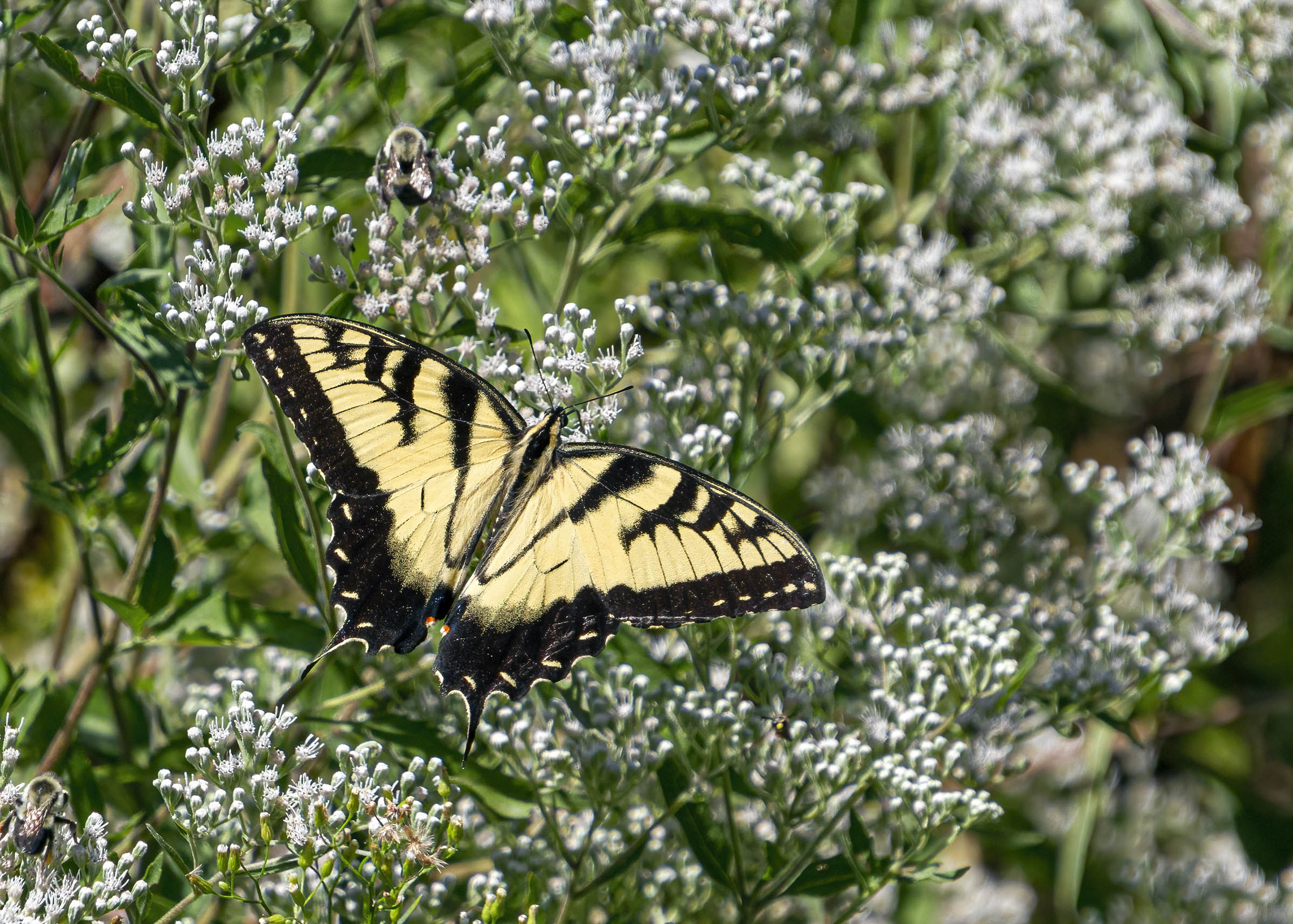
We are definitely in a period of time when butterflies are everywhere, especially in the patches of thistles that are blooming now. Earlier in the week I spotted this beautiful male Eastern Tiger Swallowtail (Papilio glaucus) at Occoquan Bay National Wildlife Refuge as he was feeding on a thistle. I was delighted to capture a shot when the butterfly had his wings fuly extended, showing off all the details of the wings.

In case you are curious, you can tell that the butterfly is a male because he lacks the band of blue spots along the hindwings that are found on the females of the species.

© Michael Q. Powell. All rights reserved.

Read Full Post »

On Monday I spotted these cool-looking black- and-red beetles at Occoquan Bay National Wildlife Refuge. I think that they are immature Florida Predatory Stink Bugs (Euthyrhynchus floridanus), a species considered to be beneficial, because its diet consists of many species of pest insects. The nymphs of this species go through five stages (instars) in their growth process and I believe these bugs are in one of the later stages of development.

Florida Predatory Stink Bugs

© Michael Q. Powell. All rights reserved.

Read Full Post »

The leaves are still on the trees, which makes it tough for me to spot perched birds, which is one the reasons why I focus on insects in the summer months. Nonetheless, I tend to scan the trees when I am out with my camera, hoping to spot a bird perched in the open.

On Monday at Occoquan Bay National Wildlife Refuge, I spotted an unfamiliar shape through the foliage as I was hiking along one of the trails. As I moved a bit to the side to get a better view, I realized that it was a Great Blue Heron (Ardea herodias). Now I know that herons will roost in the trees at night, but it is a little unusual for me to see on in a tree at midday. The bird appeared to be keeping an eye on something, almost like a sentinel, though I have no idea on what its attention was focused.

I moved slowly and stealthily to get a better shooting angle and eventually captured this image of the heron. As you can see in the photo, the heron was definitely alert and paying attention—it did not appear to be relaxing in the tree. Maybe the heron felt like the king of the world and was taking a moment to survey his realm.

Great Blue Heron

© Michael Q. Powell. All rights reserved.

Read Full Post »

There has been a relatively recent resurgence of butterflies in my area. In the past week or so I have seen more butterflies than at any other time this summer. Several of the dark swallowtail butterflies, though, are similar in appearance and are hard to tell apart, especially when wing damage hides some of the features that I rely on for identification.

Last week at Occoquan Bay National Wildlife Refuge, I spotted this beautiful dark swallowtail as it was feeding on a thistle plant. I can’t tell for sure, but I think that it may be a Spicebush Swallowtail butterfly (Papilio troilus). A chunk of the hind wing is missing, but otherwise the butterfly seems to be in good shape. It was moving around a lot on the thistle, but I was patient and eventually was able to capture a decent shot of this beautiful creature.

Pipevine Swallowtail

© Michael Q. Powell. All rights reserved.

Read Full Post »

How old does a dragonfly have to be to collect Social Security? OK, that’s a bit of a crazy question, but collecting Social Security is a sure sign that you are getting old. A couple of weeks ago, I received my first payment from the Social Security Administration, a sure sign that I am officially “old.” Last week I also stopped in a a Metro offices in Washington D.C. to sign up for a senior pass that allows me to ride Metro trains at a reduced rate—one of the few tangible benefits of becoming a senior.

Here in the United States, people are living longer than in the past and it is anticipated that the Social Security Administration will run out of money to pay full benefits in a decade or so of changes are not made. Politicians don’t want to deal with the issue and keep putting off coming up with a solution to the problem.

Comparatively speaking, dragonflies live uncomplicated lives. They hang on for as long as they can and then they die, hopefully after successfully procreating. Last week I spotted this elderly female Great Blue Skimmer dragonfly (Libellula vibrans) at Occoquan Bay National Wildlife Refuge. Her coloration was dark and faded and her wings were tattered, but she was still functioning. After spending a few quiet moments with her, I pushed onward, still lost in my thoughts about life and growing older.

Great Blue Skimmer

© Michael Q. Powell. All rights reserved.

Read Full Post »

I’ve noted several times recently the tattered butterflies that I tend to encounter at this time of the year. However, not all of the ones that I see have suffered wing damage. Some of them appear to have recently emerged and are in perfect condition, like these Eastern Tiger Swallowtail butterflies (Papilio glaucus) that I spotted during a recent visit to Occoquan Bay National Wildlife Refuge.

Eastern Tiger Swallowtail

Eastern Tiger Swallowtail

Eastern Tiger Swallowtail

© Michael Q. Powell. All rights reserved.

Read Full Post »

I love to see dragonflies with patterned wings and so I was delighted to spot this male Twelve-spotted Skimmer dragonfly (Libellula pulchella) on Tuesday at Occoquan Bay National Wildlife Refuge. The males of this species have a beautiful combination of brown and white patches on their wings.

I used to be confused about the name of the species, because there appear to be a total of twenty-two spots. To make things worse, this species is also known as the Ten-spot Skimmer. What? It apparently depends of how you count the spots. If you count only the brown spots that are present on both males and females, you get twelve spots, but if you count the white spots that are present on only the males, you get ten spots. Yikes! Who knew that math was so important in dragonfly identification. 🙂

Twelve-spotted Skimmer

© Michael Q. Powell. All rights reserved.


Read Full Post »

Earlier this summer Needham’s Skimmer dragonflies (Libellula needhami) were among the most common dragonflies that I would see at Occoquan Bay National Wildlife Refuge. The last month or so, however, their numbers have declined significantly and they are now quite hard to find. I was delighted, therefore, to photograph this slightly tattered female Needham’s Skimmer on Tuesday morning.

Our weather has cooled off this week, with early morning temperatures in the 50’s (10 degrees C) and daytime highs struggling to get to 80 degrees (27 degrees C). I looked at the 10-day weather forecast and see that temperatures are not predicted to hit the 90’s (33 degrees C). Now it would be premature to declare that summer is over and we may well have some hot days in store for us, but the seasons are definitely changing.

So I will continue to search for remaining dragonflies while again, hopeful that I will spot some of the autumn species, like the Autumn Meadowhawks and Blue-faced Meadowhawks that should be appearing soon. Personally, autumn is my favorite time of the year, with cool nights and warm, sunny days, but I am not yet ready to bid farewell to the summer.

Needham's Skimmer

© Michael Q. Powell. All rights reserved.

Read Full Post »

On Tuesday I spotted a really cool-looking butterfly at Occoquan Bay National Wildlife Refuge, a Red-banded Hairstreak (Calycopis cecrops). This species has distinctive reddish-orange markings across its hind and forewings. I don’t recall seeing this species very often, though I have included photographs of the butterflies in some blog postings in the past.

The Red-banded Hairstreak is quite small in size, with a wingspan of just over an inch (25 mm), so I had to focus very carefully on the butterfly to obtain a sharp image. I was pleasantly surprised by the results with my Tamron 18-400mm zoom lens that did a pretty good job in capturing a shot of such a small subject.

Red-banded Hairstreak

© Michael Q. Powell. All rights reserved.

Read Full Post »

The countdown begins. Now that we are into September, the number of dragonfly species is beginning to drop and many of the remaining ones are looking a little tattered. They seem to adapt and compensate for their disabilities while moving, perhaps, a bit more slowly.

Yesterday at Occoquan Bay National Wildlife I photographed a number of male Slaty Skimmer dragonflies (Libellula incesta). Their dark bodies and eyes make them pretty easy to identify. Some of them appeared to be in pretty good condition, like the one in the first photo, while others, like the one in the second photo, are showing the signs of a tough summer.

Aging in all species is inevitable. No matter how much we complain about it, we are fortunate if we are able to slow its effects—we cannot stop it. The 19th century French romantic poet Alphonse de Lamartine wrote about the passage of time in a famous poem called Le Lac (The Lake) that included these words:

“Just a few more moments, I ask — in vain, for time
Eludes me and takes flight.
I tell the night to pass more slowly, and dawn comes
To chase away the night.

“Then let us love! Then let us fill each fleeting hour
With joy and ecstasy!
Man does not have a port; time does not have a shore.
It passes, and so do we.”

Slaty Skimmer

Slaty Skimmer

© Michael Q. Powell. All rights reserved.
Read Full Post »

During a recent visit to Occoquan Bay National Wildlife Refuge I spotted quite a few Red Admiral butterflies (Vanessa atalanta), a fairly common species where I live. When I did a little research on-line, I learned that, according to Wikipedia, Red Admirals, also known as Red Admirables, are found in temperate regions of North Africa, North and Central America, Europe, Asia, and island regions of Hawaii, and the Caribbean. Wow!

I remember in the past that I sometimes referred to this species as a “patriotic” butterfly, because it had red, white, and blue areas in its coloration. I was happy to capture this shot of a Red Admiral with its wings partially open, because it gives you an idea of the interior colors as well as the exterior colors of the butterfly. As you can see, the inside of the wings feature wide reddish-orange stripes.

Red Admiral

© Michael Q. Powell. All rights reserved.

Read Full Post »

In those parts of the world that use a meteorological calendar, autumn arrived on the first day of September. The rest of us will have to wait until the 22nd of this month to mark the official changing of the season. As I have noted in some previous postings, I have already noted the decrease in several dragonfly species and the overall numbers of dragonflies will continue to drop during September.

It is also common for me to see butterflies with damaged wings at this time of the year. I marvel at the ability of butterflies to survive with a significant amount of damage to their wings. Last week I spotted this Common Buckeye butterfly (Junonia coenia) during a visit to Huntley Meadows Park. The butterfly was missing the lower portions of both of its wings, but somehow was still able to fly.

I recall reading somewhere that the purpose of the large eyespots on the wings of butterflies is to fool predators into attacking those portions of their bodies, thereby protecting their more vulnerable body parts. I don’t know it that was the case with this butterfly, but it may well be the cause of the damage that it has sustained.

Autumn often fills me with a vague sense of melancholy and I acutely feel the passage of time. Some aspects of life inexorably will come to a close or enter a state of dormancy.

I try desperately to hold on to the summer, but a part of me knows that change is inevitable. Enjoy the remaining portions of the season.

Common Buckeye

© Michael Q. Powell. All rights reserved.

Read Full Post »

I was delighted to spot this Great Spangled Fritillary butterfly (Speyeria cybele) feeding on a thistle flower during a recent visit to Huntley Meadows Park, a county-run wetland not far from where I live in Northern Virginia. I have not seen many of this species of butterfly this season, so I was happy to capture this artsy artsy shot of the Great Spangled Fritillary on the one open bloom of the thistle plant.

I love the way that they spiky unopened buds add visual interest to the image without drawing attention from the primary subject.

Great Spangled Fritillary

© Michael Q. Powell. All rights reserved.

Read Full Post »