Feeds:
Posts
Comments

Archive for August, 2024

Earlier this week I watched a distant Great Egret (Ardea alba) as he stared at the waters at Huntley Meadows Park. Initially he was standing tall, but slowly the egret bent over, carefully balancing himself on a floating tree trunk. We both watched and waited until the moment came when he plunged his head into the water. I fired off some shots, wondering if the egret had caught a fish.

I can’t say for certain that the egret was unsuccessful, but it sure looks to me like there was no fish in his bill as he withdrew his head from the water. It appeared to me like the egret was fishing for tiny fish, because he did not plunge his head very deep into the water. After this attempt, the egret stood upright and relaxed for a few moments, before eventually resuming his efforts.

I moved on, wishing him the best of luck in his pursuit of his next fish, as I continued to hunt for dragonflies.

Great Egret

© Michael Q. Powell. All rights reserved.


Read Full Post »

There must be something irresistible about thistle flowers, because on Tuesday I encountered multiple clusters of thistles with butterflies feeding on them during a short visit to Huntley Meadows Park. Sometimes the butterflies seemed to be socially distancing themselves, but at other times they were feeding side by side with other butterflies, including those of different species.

Of course, butterflies do not remain still while feeding—they move about constantly as they change their positions and flap their wings, complicating my efforts to capture images of them. The first photo below is one of my favorites. It shows a dark morph female Eastern Tiger Swallowtail (Papilio glaucus) sharing a thistle flower with two Great Spangled Fritillary butterflies (Speyeria cybele). I love the contrast between the colors of these two species that together provide a foretaste of the autumn season that is almost upon us.

The second photo provides a closer view of the dark morph Eastern Tiger Swallowtail. The final photo is a shot of what I believe is another female Eastern Tiger Swallowtail that has a yellow coloration similar to that of a male, but has an additional band of blue spots along the hindwings. I think it is really cool that there are two different color variants of females—in many insect and bird species, the males have more color and variation and the females are drab by comparison.

butterflies

Eastern Tiger Swallowtail

Eastern Tiger Swallowtail

© Michael Q. Powell. All rights reserved.
Read Full Post »

I love to search for Monarch butterflies, but this year I have spotted only a few of them. I am more likely to spot the similar looking Viceroy butterfly (Limenitis archippus), like this one that I photographed last week at Occoquan Bay National Wildlife Refuge. It paused for a moment as it perched high in the vegetation at the edge of the water of the bay and I captured the moment as the butterfly looked out on the watery expanse.

What was the butterfly thinking? I sometimes wonder what it would be like to be able to fly freely like a butterfly. Perhaps the butterfly was imaging what it would be like to swim like a fish.

We always are a little restless, wanting to be different from what we are. Maybe we should spend more time celebrating who we are in the present moment, a unique combination of strengths and weaknesses. As one of my brothers likes to say, “Be yourself—everyone else is already taken.”

Viceroy

© Michael Q. Powell. All rights reserved.

Read Full Post »

I chased this small orange butterfly around for quite a while before it finally landed. Only then was I able to determine that it was probably a Variegated Fritillary butterfly (Euptoieta claudia), a species that I do not see very often. I looked over my old blog postings and discovered that most of my sightings of this species have been late in the season—earlier in the season I tend to see the somewhat similar-looking Great Spangled Fritillary more often.

We have had a decent amount of rain recently, so there is still a lot of green in the vegetation that provides a nice contrast with the orange and brown tones of the butterfly. Those colors somehow remind me of the imminent arrival of the fall season. There is still a bit of the summer to enjoy, however, so I am not quite ready to jump ahead to the autumn—I prefer to live in the moment and celebrate what is in front of me in the present moments.

Variegated Fritillary

© Michael Q. Powell. All rights reserved.


Read Full Post »

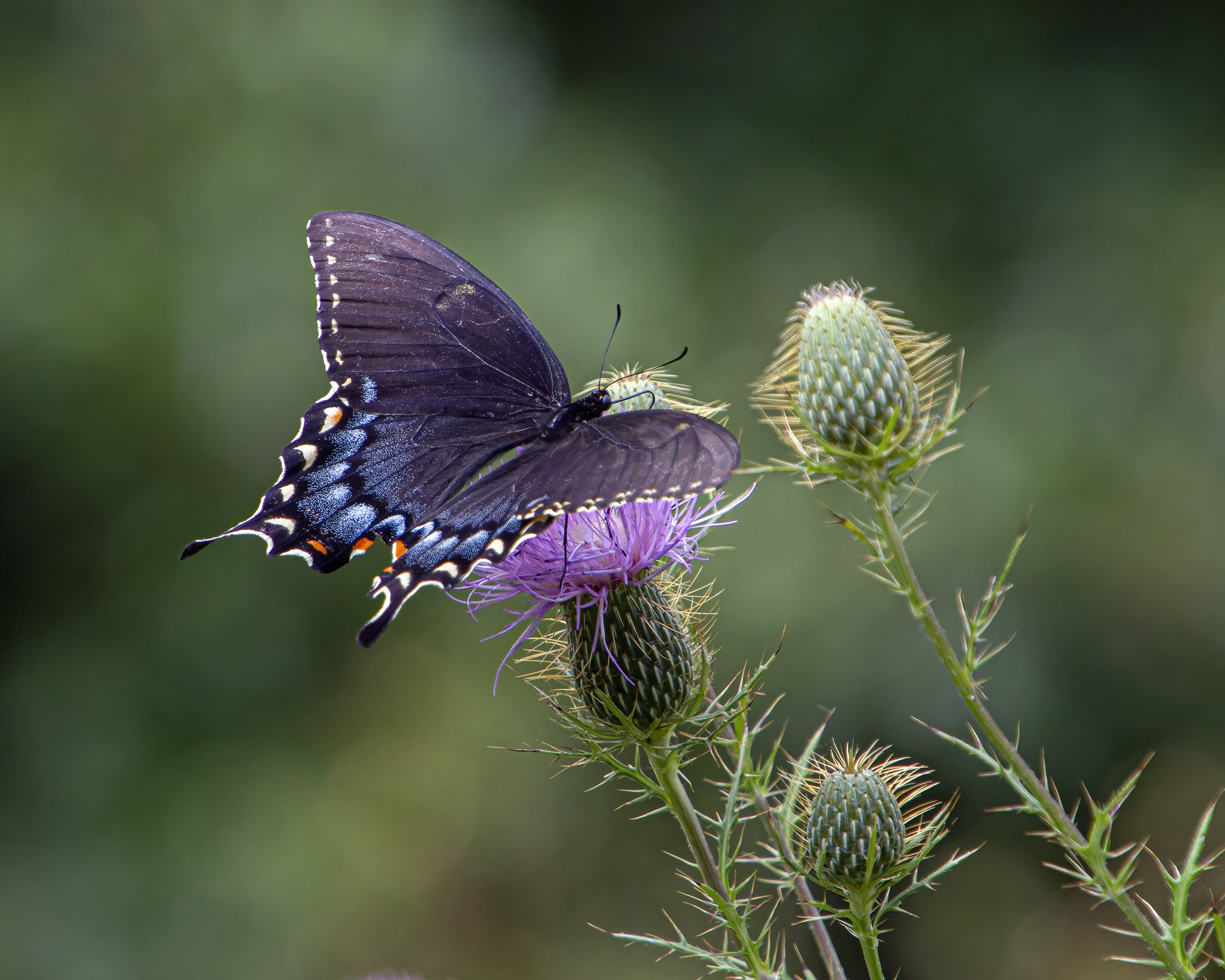
Last Friday I spotted this Black Swallowtail butterfly (Papilio polyxenes) as it was feeding on a thistle plant at Occoquan Bay National Wildlife Refuge. I love the shape, color, and texture of these thistle plants. I was a little shocked to see the excellent condition of the butterfly this late in the season.

When I returned home I did a little research and found out that this butterfly has at least two broods each year, with the second one flying at least until the end of August. Sometimes there is a partial third brood. Perhaps the butterfly in the photo recently emerged.

The later broods will lay eggs and winter is spent in a chrysalis stage. In the springtime, the adults will emerge and the cycle will continue. Nature is amazing!

Black Swallowtail

© Michael Q. Powell. All rights reserved.

Read Full Post »

I do not see deer very often at Occoquan Bay National Wildlife Refuge. A few times a year, the refuge is closed for for a few days for deer hunting, so I know that there must be plenty of deer, but they remain hidden most of the time.

On Friday I photographed a White-tailed Deer (Odocoileus virginianus) at the refuge. It was part of a group of at least four deer that I spotted as they grazed alongside the trail that I was following. Three of the deer moved into the brush on the side of the road as soon as they detected my presence, but one remained in place and stared at me with what appeared to be curiosity.

I had the impression that the deer was young, though I must confess that I have so little experience with deer that I have no idea how to tell their age. The deer appeared to be in good health. Some of my fellow photographers are virulently against hunting, but I recognize that deer overpopulation is a problem in our suburban area. Periodic hunting is a viable way of controlling the population size, though I personally am not a hunter and do not even own a gun.

My goal is to capture images with my camera of the wonders of the natural world and I felt blessed to be able to spend a few moments with this beautiful creature. After a few moments of staring at each other, the deer slowly made its way into the vegetation and disappeared from sight.

White-tailed Deer

© Michael Q. Powell. All rights reserved.


Read Full Post »

Early in the summer, Needham’s Skimmers (Libellula needhami) were among the most common dragonflies at Occoquan Bay National Wildlife Refuge. As the dragonfly season begins to wind down, their population size has been noticeably dwindling. I am still likely to see some of them, but I have to search a lot harder than I did a month or two ago.

Yesterday I captured this image of a female Needham’s Skimmer. She is in pretty good shape overall, with only a small portion of her wings looking a little tattered.

I like the way that this image shows the bright yellow veining near the leading edges of her wings, one of the distinctive identifying features of this dragonfly species. (The mature males are bright orange or red in coloration, making them even easier to identify.)

Needham's Skimmer

© Michael Q. Powell. All rights reserved.

Read Full Post »

I really like Blue Dasher dragonflies. They are quite common and visible throughout most of the summer. Unlike some other dragonfly species that require specific habitats, Blue Dashers (Pachydiplax longipennis) can be found almost anywhere.

I really like the description of the species on the Dragonflies of Northern Virginia website, one of my favorite resources for information about the dragonflies in my area:

“A very little guy in a big hungry world, Blue Dashers make up for their small size with plenty of moxie. Just about everything eats them…but it certainly hasn’t affected their numbers. The most abundant dragonfly in our area, they face their predator-filled worlds head on. Males aggressively defend their small, shore-line territories against larger skimmers, and spend a great deal of time with their black-tipped abdomens pointed high in the air – an aggressive threat display. It’s also a technique used to cool down by reducing surface area to the sun, called the obelisk position. However, Dashers use it more than other species, and half the time it appears to be done for the purpose of territorial display, rather than temperature control.”

I spotted this Blue Dasher on Monday at Jackson Miles Abbott Wetland Refuge. I couldn’t get really close to the dragonfly, but like the way that the abundant vegetation helped to frame the dragonfly.

Blue Dasher

© Michael Q. Powell. All rights reserved.
Read Full Post »

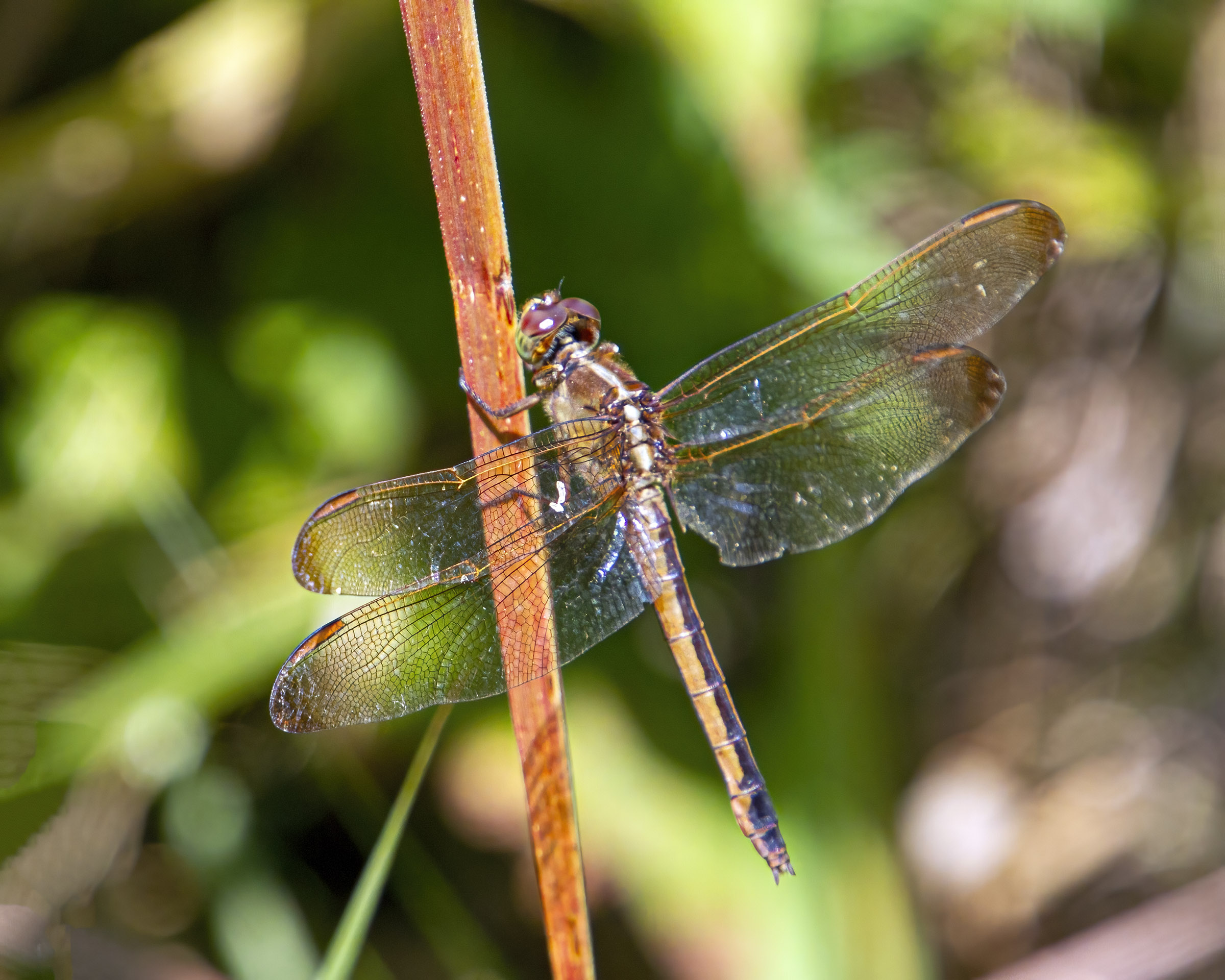
This female Slaty Skimmer (Libellula incesta) that I spotted on Monday at Jackson Miles Abbott Wetland Refuge has definitely seen better days. Its wings are growing tattered and its color has darkened with age. Nonetheless, the dragonfly is carrying on and compensating as it grows older. In fact, the dragonfly seemed to be feeding on some kind of insect when I photographed it.

A few weeks ago I turned 70 and I have become increasingly conscious of the passing of time. Tomorrow is not guaranteed, so I am trying to pay more attention to living my life in the moment, as perhaps this aging dragonfly is doing.

Slaty Skimmer

© Michael Q. Powell. All rights reserved


Read Full Post »

The countdown continues, but the dragonfly season is not over yet. I will undoubtedly continue to spot dragonflies for the next few months, but already their numbers seem to be diminishing as summer prepares to give way to autumn. We have had a series of cooler days this week, but I’m quite confident that summer is not quite ready to give up its hold and next week the high temperatures are forecast to return to the 90s.

I was happy on Monday to spot a Swift Setwing dragonfly (Dythemis velox) at Jackson Miles Abbott Wetland Refuge, the only one that I managed to photograph during my visit. I did have another sighting of a Swift Setwing that I was unable to photograph, but I am not sure if it was the same individual or a different one.

In the past, I have seen a Swift Setwing as late as September, but there are no guarantees that they will continue to be around that long this year. The population of Swift Setwing dragonflies is pretty well-established at this location, but it is quite small.

Each year I try to document my dragonfly sightings as we start to approach the end of the season, so I will probably return to this location again in the upcoming weeks. There are a few late-season species, like the Russet-tipped Clubtail, that will start to reappear, so I will keep my eyes open for them as well.

Swift Setwing

© Michael Q. Powell. All rights reserved


Read Full Post »

Eastern Amberwings (Perithemis tenera) are one of the smallest dragonfly species where I live—less than one inch (25 mm) in length. I often see the amber-colored males buzzing around at the ponds that I visit, but it is pretty rare for me to spot a female.

Yesterday I visited Jackson Miles Abbott Wetland Refuge and was a bit surprised to see a female Eastern Amberwing dragonfly in the vegetation near the edge of a small pond. Unlike the males, females of these species have patterned wings that are partially clear. I maneuvered around to composed a shot and managed to capture this image of the dragonfly.

According to the website Dragonflies of Northern Virginia, one of my favorite dragonfly websites, female Eastern Amberwing dragonflies are often found far from the water in meadows where they share perches with hornet and other wasps. When they are threatened, these dragonflies will rhythmically move their wings up and down while pulsing their abdomens in imitation of a wasp to scare off potential predators that believe they are about to be stung.

I don’t know if this female was checking out the males at the pond, searching for a suitable partner, or perhaps had just mated and was recovering from the experience. Whatever the case, I was delighted to spot this elusive little dragonfly.

Eastern Amberwing

© Michael Q. Powell. All rights reserved.


Read Full Post »

With most dragonfly species, the male is usually the one with the most distinctive coloration and females are often nondescript in appearance. That is definitely not the case with the Eastern Pondhawk dragonfly (Erythemis simplicicollis), where the female is bright green and has distinctive black bands on her abdomen. She also has a green face that makes it almost impossible to misidentify this species.

Immature males of this species have a similar coloration to that of the female, but they are gradually transformed into a duller shade of blue and finally a powdery bluish-gray. The terminal appendages of the male are different from those of the female and additionally the ovipositor of the female, the egg-laying organ, is frequently visible below the tip of her abdomen, as you can see in this photo that I took last week at Occoquan Bay National Wildlife Refuge.

Eastern Pondhawks are quite common in my area, though this year I have not seen as many as in previous years. Although other dragonflies are equally fierce predators as the Eastern Pondhawk, the majority of the times that I have seen a dragonfly with prey, particularly other dragonflies or damselflies, it has been an Eastern Pondhawk.

Eastern Pondhawk

© Michael Q. Powell. All rights reserved.

Read Full Post »

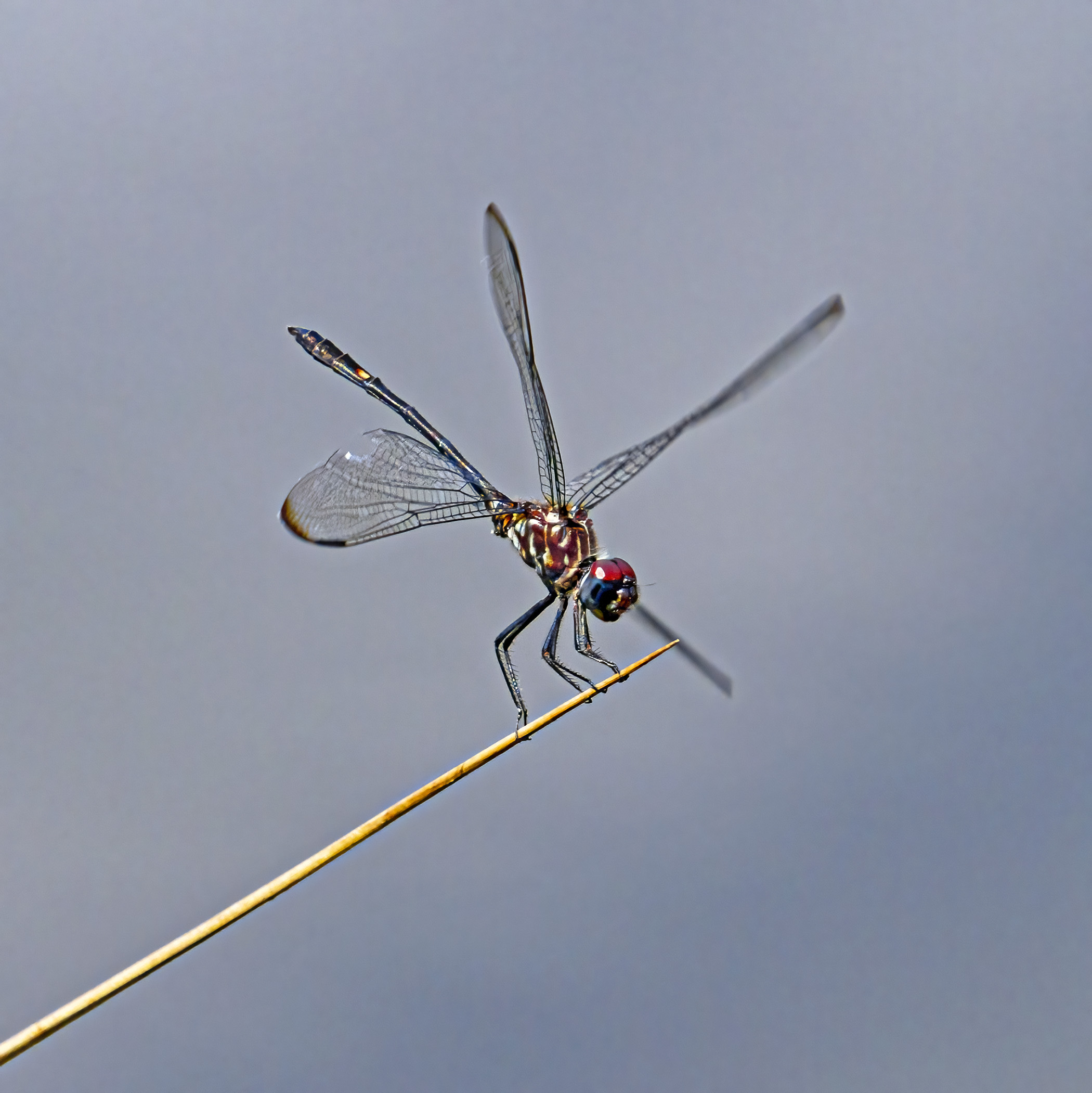
I thought that the Calico Pennant dragonflies (Celithemis elisa) might be gone for the season, so I was thrilled to spot this handsome male last Monday (12 August) at Occoquan Bay National Wildlife Refuge. Calico Pennants are among the most colorful dragonflies that I encounter, with beautiful patterned wings. Early in their development, male Calico Pennants have yellow bodies, like their female counterparts, but eventually they become a bright red in color.

When I captured this image of the Calico Pennant, he was perched at the very tip of the vegetation, a favorite perching spot for this species. Like other pennant species, Calico Pennants often occupy precarious perches that cause them to flap like a pennant when even the slightest breeze is blowing.

Calico Pennant

© Michael Q. Powell. All rights reserved.

Read Full Post »

If you want to photograph dragonflies for identification purposes, it is best to photograph them from the side. The side view gives you a good view of the head, thorax, and abdomen of the dragonfly, although the tips of the wings often are out of focus. If you are a scientist, the side view is probably the best one for you.

If you are are an artist, however, you are not so worried about having the entire dragonfly in focus. You focus on the beauty of the dragonfly and on different ways pf capturing that beauty. I personally really like head-on frontal shots of a dragonfly that provide an almost abstract view of the amazing creature.

This past Monday I encountered a Halloween Pennant dragonfly (Celithemis eponina) during a visit to Occoquan Bay National Wildlife Refuge. I carefully maneuvered around the dragonfly in order to get an almost head-on view of it.

Shooting at an upwards angle, I captured the image below. I really like the abstract feel of the shot—your mind has to do some quick processing to realize that the subject is a dragonfly. There is an abstract minimalism to the shot that I really like that was enhanced by the way that I had to shoot at an upward angle, which eliminated all of the clutter behind the dragonfly.

Halloween Pennant

© Michael Q. Powell. All rights reserved.

Read Full Post »

The end of the season is drawing near for many of the common dragonflies in my area. A month from now, some species will be gone entirely, with only a few hardy stragglers hanging on for a bit longer. Children return to school this coming week, which seems outrageously early to me—when I was growing up, school did not begin until after Labor Day.

I am starting to pay greater attention to the dragonflies that I encounter, never knowing for sure if I will see them again this season. Summer is not over yet, of course, but there are already signs that the seasons are changing.

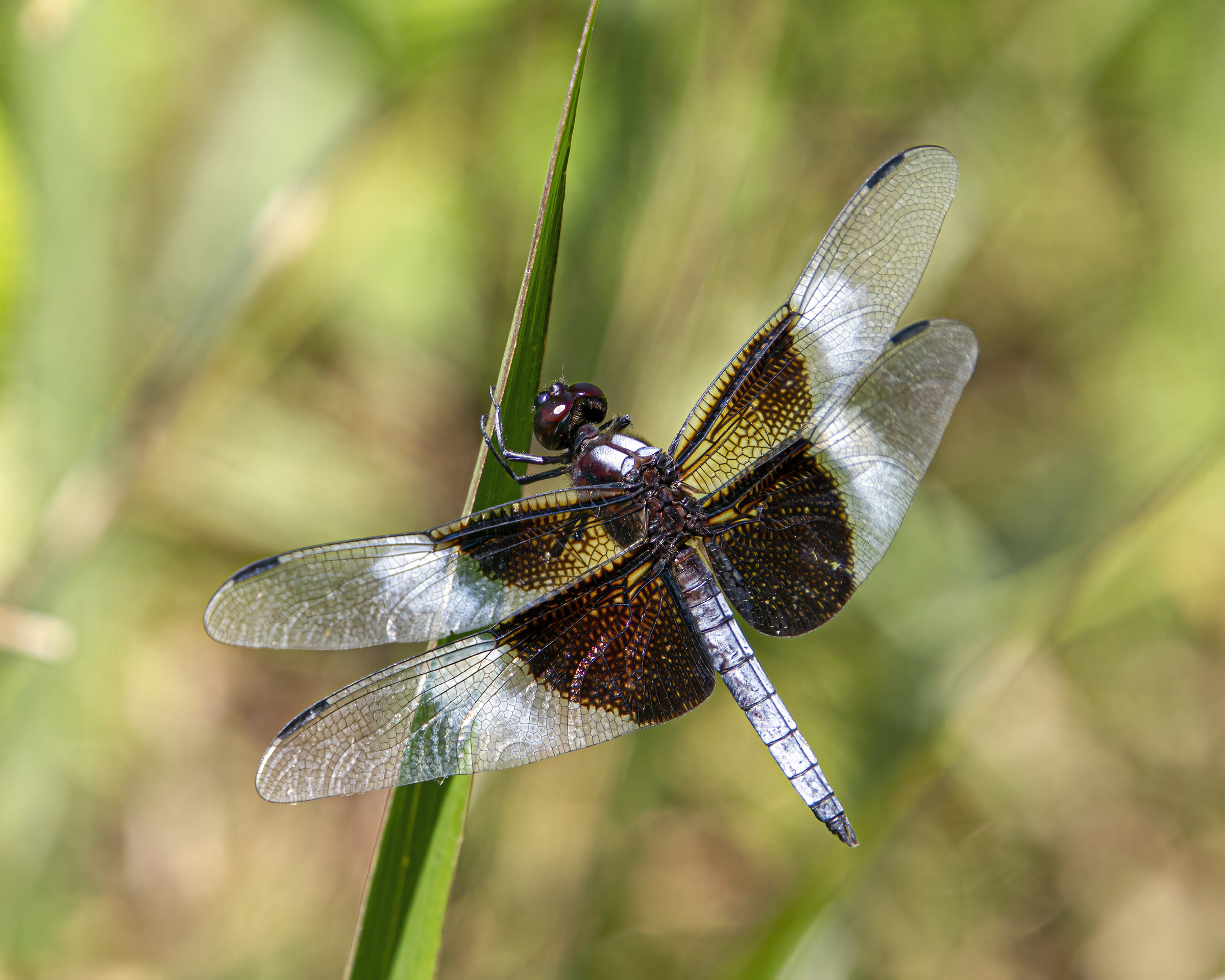
I spotted this male Widow Skimmer (Libellula luctuosa) on Monday at Occoquan Bay National Wildlife Refuge. Many of the dragonflies that I see are showing signs of wear, with tattered wings increasing common, but this individual was beautifully intact.

I suspect that dragonflies live in the moment, focused solely on the present for as long as they live. I recently read an article that noted how much of life many people miss, because they are focused too much on the future, which, of course, is never guaranteed. Yes, it is good to plan for the future, but be sure to enjoy your present life too.

Widow Skimmer

© Michael Q. Powell. All rights reserved.


Read Full Post »

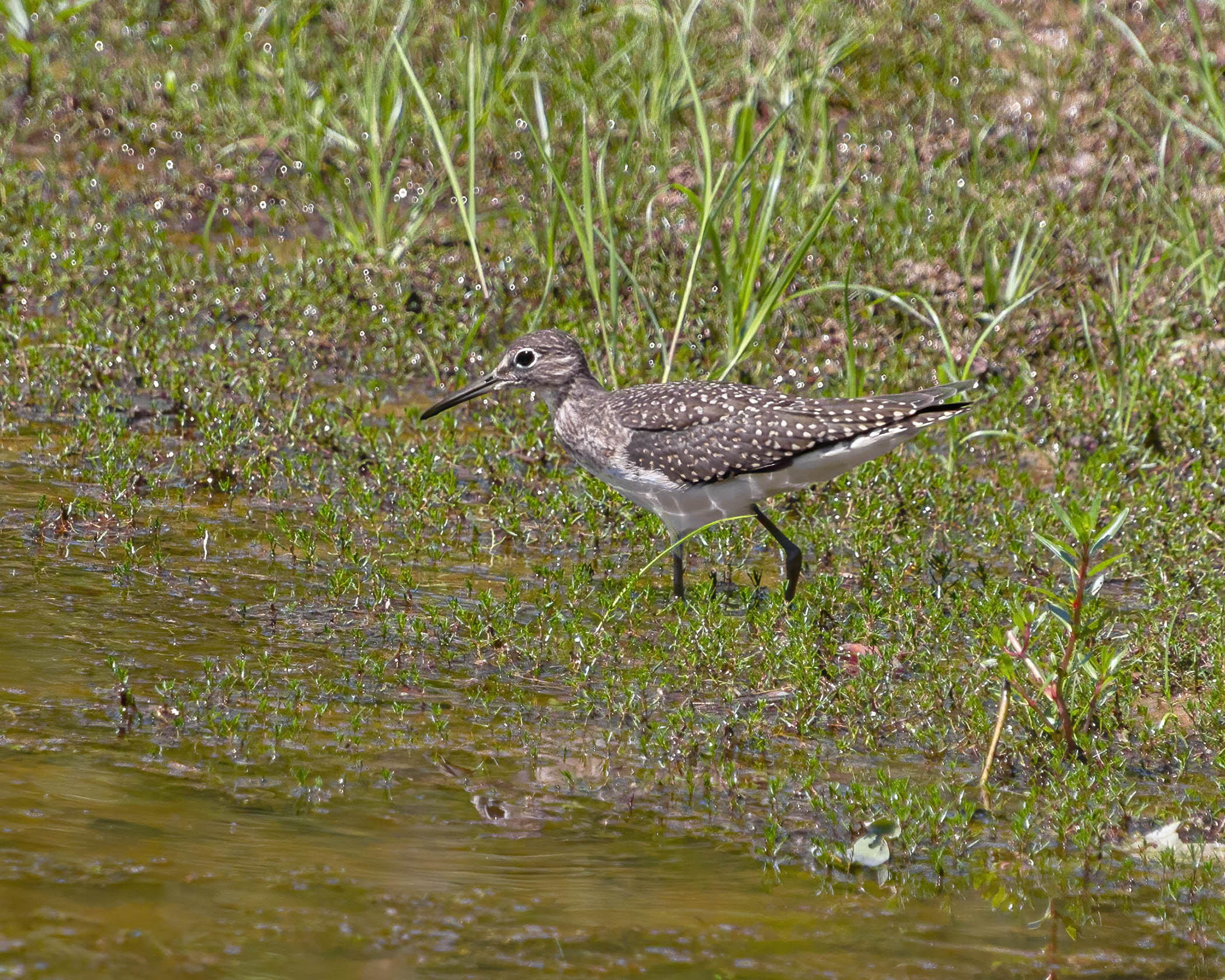
Shorebirds are always tough for me to identify—so many of them are similar in appearance. When I spotted this little bird on Monday at Occoquan Bay National Wildlife Refuge, I noticed that it was all alone. Half-jokingly, I thought to myself that maybe it is a Solitary Sandpiper (Tringa solitaria).

When I later checked my bird identification guide I was shocked to discover that it probably is a Solitary Sandpiper. As its name suggests, this bird was by itself, foraging for food in the shallow water at the edge of a pond. I watched it for a while, but when I moved closer to get a better shot, the bird flew away to a spot across the small pond.

Solitary Sandpiper

© Michael Q. Powell. All rights reserved.

Read Full Post »

With so many of the trees covered in leaves, it is a bit difficult for me to spot a perched bird. Sometimes, though, I get lucky and a bird will perch in the open on a dead tree and I will be able to get a clean shot of it. Otherwise, they can remain perched, hidden by the shadows of the trees.

We are in the doldrums of summer right now and many of the birds do not appear to be active during the warm, daylight hours. I was therefore delighted to spot this Osprey (Pandion haliaeteus) as it perched on the dead branches of a tree. This Osprey seemed to be relaxing and did not fly away immediately as I attempted to get a little closer. Occasionally it would turn its head from side to side, but otherwise remained in a relaxed position.

After I had taken a couple of shots, I continued on, leaving the Osprey at peace in the tree.

Osprey

Osprey

© Michael Q. Powell. All rights reserved.

Read Full Post »

During a recent visit to Jackson Miles Abbott Wetlands Refuge I spotted this Blue-tipped Dancer (Argia tibialis) damselfly. I was initially quite far from it when I first saw it and was not at all certain what it was. As I got closer to it, I could see that it was mostly black and only the very tip of its abdomen was blue in coloration. I did not immediately recognize it, but figured that I would be able to do so after the fact. In doing so, I was applying one of my primary rules of photography—shoot first and ask questions later.

When I got home and was processing the images, I decided that it was probably a Blue-tipped Dancer, a fairly common dark species that is reportedly found at a diverse number of locations. Upon discovering its name, I did a search of my past blog postings and discovered that I had seen one a few times before. I guess I would have remembered the name of the species if I saw it more often, but am happy that I was able to be able to retrieve it.

Yesterday we finally had a break from the extremely hot weather and I finally was able to get out with my camera. I am pretty sure that I captured some images that I will want to share with you all. Stay tuned for more.

Blue-tipped Dancer

© Michael Q. Powell. All rights reserved.


Read Full Post »

It was uncomfortably hot for me and I tried to stay in the shade as much as possible during a recent visit to Jackson Miles Abbott Wetland Refuge. A Painted Turtle (Chrysemys picta), however, had pulled itself almost completely out of the water to maximize its exposure to the direct sunlight. For the record, I am not the kind of guy who enjoys baking in the sun on a beach.

I really like the turtle’s pose and the way that it stands out amidst all of the water and the abundant vegetation. The beautiful reflection was a nice bonus, adding a bit of symmetry and additional visual interest to the image.

Painted Turtle

© Michael Q. Powell. All rights reserved.
 

Read Full Post »

Pearl Crescent butterflies (Phyciodes tharos) are quite common in my area, but they are small and skittish and often feed with their wings partially open, so it is hard to get a photo of one with its wings spread wide. Last week I spotted several Pearl Crescents in a large patch of Black-eyed Susans at Jackson Miles Abbott Wetland Refuge and I stalked them for quite some time. I was delighted when I finally managed to capture this image that shows wonderfully the beautiful details of this little butterfly.

Pearl Crescent

© Michael Q. Powell. All rights reserved.

Read Full Post »

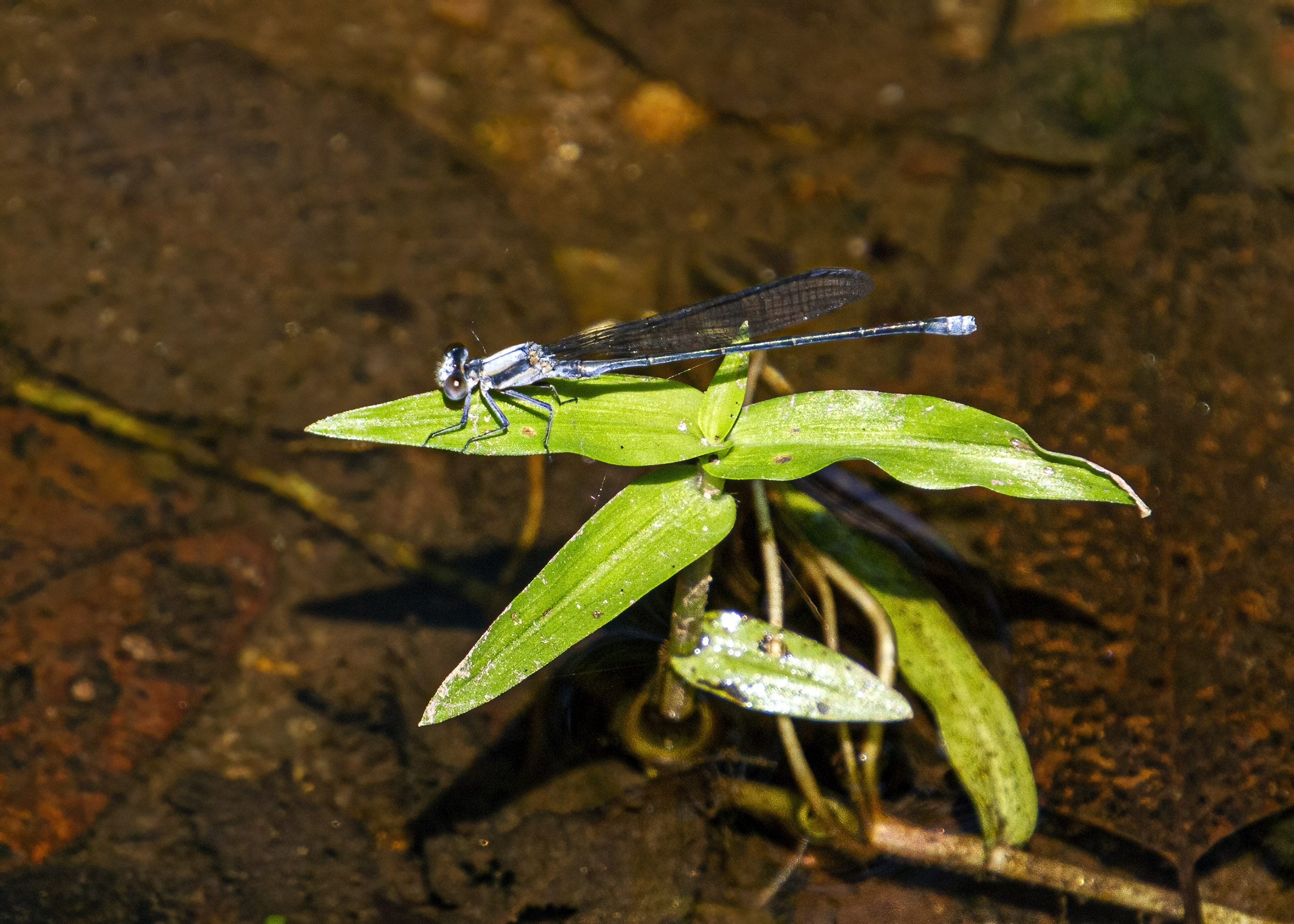
I was happy to spot these male Powdered Dancer damselflies (Argia moesta) on Monday at a creek in Prince William County, Virginia. Most of the damselflies that I see regularly are found at small ponds and marshy areas, but this species prefers rocky streams and rivers. Sometimes Powdered Dancers will perch in the streamside vegetation, but often they will perch flat on rocks in the water, as you can see in several of these shots.

The thoraxes of Male Powdered Dancers are mostly white due to pruinosity, i.e. they are covered by minute waxy dust particles that makes them look frosted or powdered. This phenomenon is present in some dragonflies too, most notably the male Common Whitetail dragonflies.

Powdered Dancer

Powdered Dancer

Powdered Dancer

© Michael Q. Powell. All rights reserved.


Read Full Post »

At first glance this insect looks a bit like a dragonfly, but if you look more closely you may notice that its wings and eyes are different from those of a dragonfly and its body is a lot hairier. I spotted this robber fly, a species commonly known as a Red-footed Cannibalfly (Promachus rufipes), on Monday while exploring a creek in Prince William County, Virginia. Red-footed Cannibalflies, as their name suggests, usually feed on other insects, but they reportedly are capable of taking down a hummingbird. Yikes!

A posting that I did in 2013 entitled “Red-footed Cannibalfly” amazingly has been among my most popular postings ever, with 3360 views to date. Apparently more people search for information about Red-footed Cannibalflies that I would have anticipated.

In case you are curious, my current most viewed blog posting is one from August 2013 entitled “Fuzzy White Caterpillar,” with over 6800 views, including 3219 views in 2024 alone. I do not consider that posting to be one of my best nor are the photos in it particularly good, but somehow the Google search algorithm likes it and I continue to get lots of views of that posting. In general, I do not put much stock in the number of views and/or likes of my posts and do not really give them much weight when considering the “success” of any of my posts.

Red-footed Cannibalfly

© Michael Q. Powell. All rights reserved.


Read Full Post »

During several recent visits to Jackson Miles Abbott Wetland Refuge, I did not see any Swift Setwing dragonflies (Dythemis velox), so I feared that they might be gone for the season. I was therefore delighted last Thursday to spot several of them at the small pond at this refuge.

Swift Setwings like to perch at the very tip of vegetation that hangs over the water, which makes getting a profile shot of one a challenge without getting wet. These little dragonflies often perch in a distinctive pose with their wings pulled forward, which reminded some scientist of the “ready-set-go” position of a sprinter and is reportedly the reason for the name of the species.

On this day, a breeze was blowing periodically and it seemed like the Swift Setwings had to repeatedly readjust their wing positions to maintain their balance, which you can see particularly well in the second photo below.

Swift Setwing

Swift Setwing

© Michael Q. Powell. All rights reserved.

Read Full Post »

As I watched television coverage of the Olympic Games in Paris, I could not help but notice the numerous handstands in almost all of the gymnastic events for the men. There were handstands on the floor, on the rings, on the parallel bars, the high bar, and even on the pommel horse.

When I spotted this male Blue Dasher dragonfly (Pachydiplax longipennis) doing a handstand last Thursday at Jackson Miles Abbott Wetland Refuge, I immediately thought of those Olympic gymnasts.

This position is sometimes referred to as the “obelisk” pose for dragonflies. Many scientists believe that it is used as a form of thermoregulation to keep the body cooler by reducing the amount of surface exposure to direct sunlight. Several other dragonfly species use this pose, but I observe it most often with the male Blue Dasher dragonflies.

Blue Dasher

© Michael Q. Powell. All rights reserved.

Read Full Post »

I was delighted to spot this handsome male Blue-fronted Dancer damselfly (Argia apicalis) on Thursday during a quick visit to Jackson Miles Abbott Wetland Refuge. This species is not rare, but I do not see it very often at my favorite locations for dragonflies and damselflies. It is pretty easy to identify a Blue-fronted Dancer because, as its name suggests, its thorax is almost completely blue, with only a few hairline shoulder stripes.

According to Wikipedia, the damselflies in the genus Argia, are commonly known as “dancers” because of the distinctive jerky form of flight they use, which contrasts with the straightforward direct flight of bluets, forktails, and other pond damselflies.

Blue-fronted Dancers are quite small, about 1.5 inches (38 mm) in length, so it was quite a challenge to get this one in focus as he perched on some vegetation close to the ground. I am pretty sure that I switched to manual focus for this shot, because the autofocus of my camera has trouble staying on such a narrow subject and kept trying to focus on the ground.

Blue-fronted Dancer

© Michael Q. Powell. All rights reserved.

Read Full Post »

Some dragonflies are openly curious and will look at me straight in the eye and even perch on me sometimes. Others will immediately fly away when they sense my presence.

This male Great Blue Skimmer dragonfly (Libellula vibrans) that I spotted during a recent visit to Occoquan Bay National Wildlife Refuge seemed to be a bit shy. He tolerated my presence well as I moved about to frame the shot, but gave me a sidewards glance instead of looking right at me. Was it shyness or maybe a little impatience that I was not taking the photo more quickly?

Whatever the case, I was happy to be able to capture his beautiful speckled blue eyes so well.

Great Blue Skimmer

© Michael Q. Powell. All rights reserved.
Read Full Post »

I am always looking for cool perches when I spot dragonflies. Sometimes I will try to communicate telepathically with the dragonflies to prompt them to move to photogenic perches, but, alas, I am rarely successful—I guess that my telepathic powers are weak.

I was delighted on Monday at Occoquan Regional Park when this dark male Slaty Skimmer (Libellula incesta) voluntarily perched on the flowering stalk of a beautiful dark red plant. I have no idea what kind of plant it is, but I really like the color combination of this dragonfly and the the vegetation. The twisting pattern of the flowers on the stalk were a nice bonus and add a bit of additional visual interest to the image.

Slaty Skimmer

© Michael Q. Powell. All rights reserved.

Read Full Post »