Feeds:
Posts
Comments

Archive for May, 2024

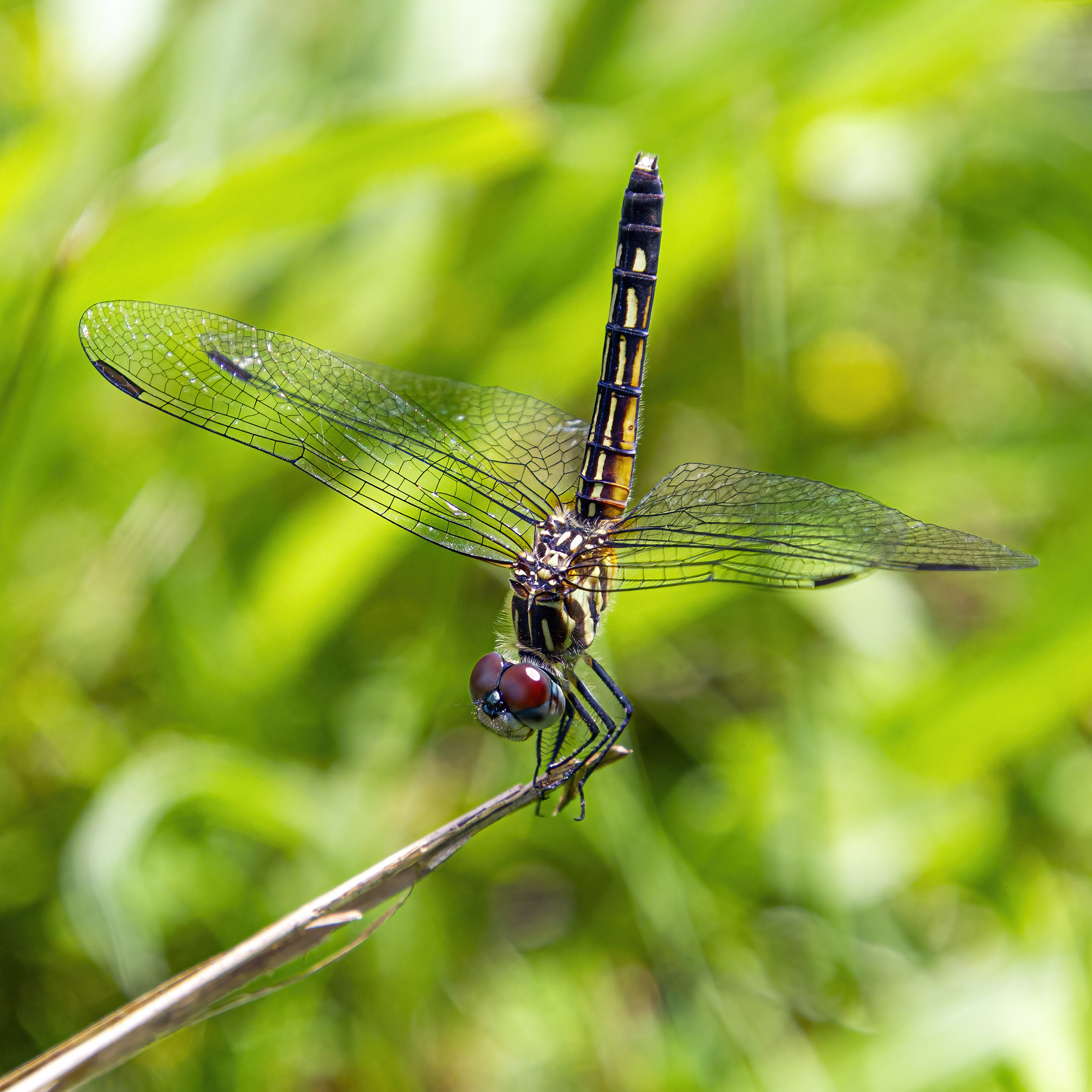
I know that summer is almost here when I start to see Blue Dasher dragonflies (Pachydiplax longipennis) at my local ponds and they will some become our the most abundant dragonfly species in our area. Mature Male Blue Dashers are blue, as their name suggests, but females have a black and yellow pattern on their abdomens, like the one pictured below that I photographed on Tuesday at Jackson Mile Abbott Wetland Refuge.

Quite often Blue Dashers perch on vegetation in the “obelisk” pose, with their abdomens raised up into an almost vertical position. It is thought that this pose is a type of thermoregulation, with the raised abdomen reducing the amount of exposure to the direct sunlight and thereby keeping the dragonfly’s body a bit cooler.

Blue Dashers are sentimentally special to me because my very first posting on this blog on July 7, 2012 featured a male Blue Dasher dragonfly in an obelisk pose. In case you are curious, here is a link to that posting that was simply entitled Blue Dasher dragonfly.

Blue Dasher

© Michael Q. Powell. All rights reserved.


Read Full Post »

Whenever I visit Jackson Miles Abbott Wetland Refuge, I never fail to check a spot near a fishing platform where there is a piece of twisted rebar sticking out of the water. In the past, I have seen dragonflies of various species perching on the rebar and it provides a wonderful photographic opportunity, assuming that the dragonfly does not immediately fly away. I generally prefer to photograph dragonflies on natural perches, not on manmade ones, but this is a case when I am more than happy to break that “rule.”

On Tuesday I was delighted to spot a male Eastern Amberwing dragonfly (Perithemis tenera) perched on the aforementioned piece of rebar. I love the contrast between the colors, patterns, and textures of the natural object, the dragonfly, and those of the man-made subject, the rebar. The floating debris on the surface of the pond helps to break up the mostly uniform background without being visually distracting.

I have taken similar shots to this one multiple times, but I don’t mind repeating myself. Each encounter is unique and subtly different. As the Greek philosopher Heraclitus of Ephesus is reported to have said, “No man ever steps in the same river twice, for it is not the same river and he is not the same man.”

Eastern Amberwing

© Michael Q. Powell. All rights reserved.

Read Full Post »

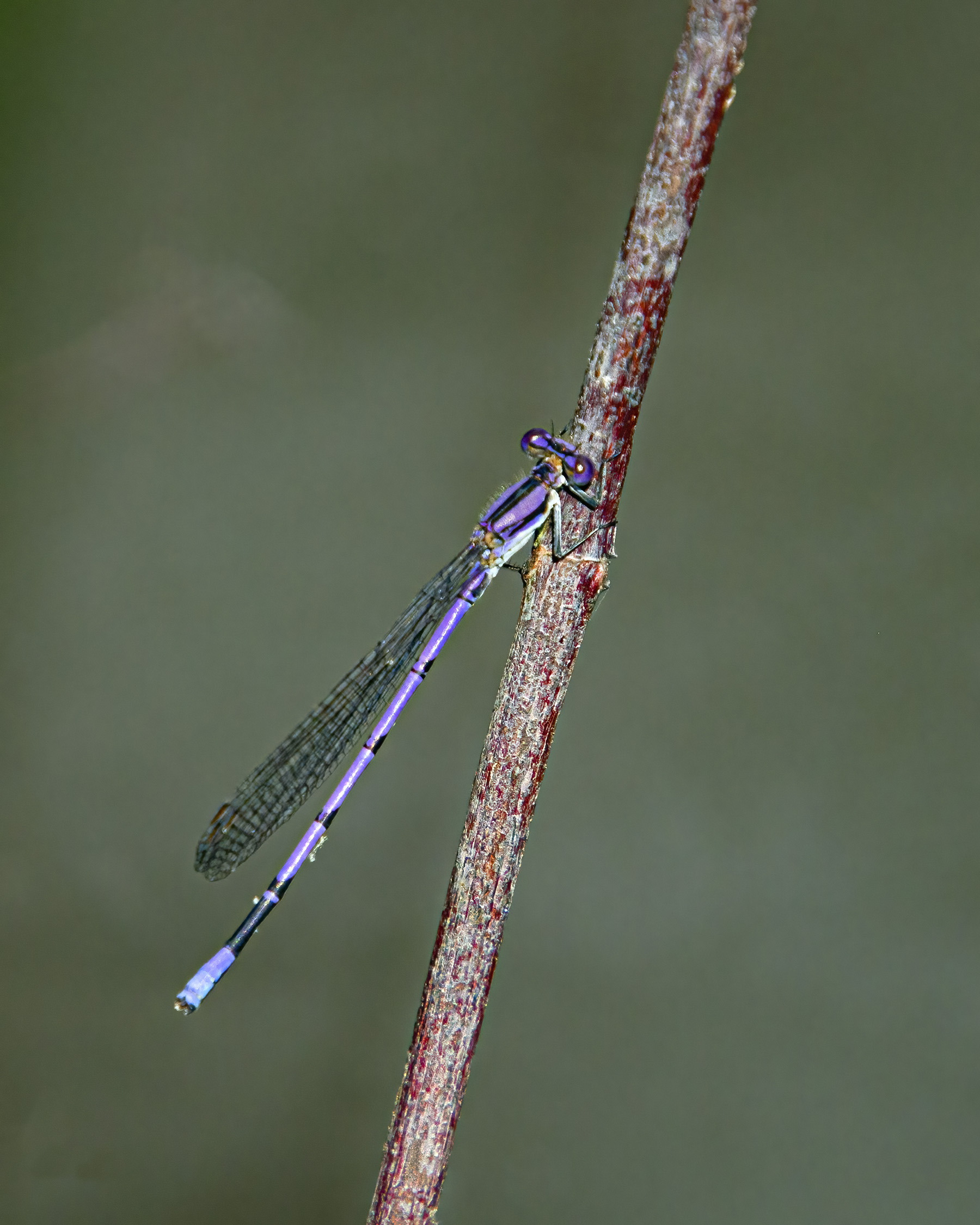
Yesterday at Jackson Miles Abbott Wetland Refuge I spotted some Variable Dancer damselflies (Argia fumipennis), one of my favorite damselfly species. I never fail to be shocked and delighted by the brilliant purple of eyes and body of the male of the subspecies known as the Violet Dancer (Argia fumipennis violacea). Some of you may have even noticed that I have used an image of a Violet Dancer as the banner image for the home page of my blog for a number of years.

Dancers are a genus of damselflies named for the distinctive jerky form of flight they use which contrasts with the straightforward direct flight of many other pond damselflies. I must confess that I don’t pay much attention to the way that particular damselflies fly, but instead rely primarily on their coloration to identify them,

Violet Dancer

© Michael Q. Powell. All rights reserved.

Read Full Post »

I love the light and delicate pose of this handsome male Calico Pennant dragonfly (Celithemis elisa) that I spotted during a recent visit to Occoquan Bay National Wildlife Refuge. Pennant dragonflies, like the Calico Pennant, usually perch on the very tips of vegetation where they sway in the slightest breeze—like a pennant.

The red of the dragonfly’s body and the green of the vegetation help the dragonfly to “pop,” because red and green are complementary colors, i.e. they are directly opposite each other on the traditional color wheel that artists use.

Callico Pennant

© Michael Q. Powell. All rights reserved.


Read Full Post »

Today in the United States we are commemorating Memorial Day, a day set aside to honor, mourn, and remember those who died while serving our country, especially in the armed forces. As some of you know, I spent 20 years in the U.S. Army and I personally feel a sense of  gratitude to those who gave what Lincoln so poignantly called “the last full measure of devotion” in his address at Gettysburg in 1863. He challenged his listeners and continues to challenge us with these words, “It is for us the living, rather, to be dedicated here to the unfinished work which they who fought here have thus far so nobly advanced.”

A little over a week ago I spent the weekend at a retreat at Shrine Mont in Orkney Springs, Virginia with a group from my church, St. Martin de Porres Episcopal Church. I was mostly unplugged all weekend in order to be more fully engaged with others and with the beautiful mountain setting. With my iPhone, though, I captured these images that give you a small sense of the beauty and serenity of Shrine Mont, including the outdoor cathedral that I visited each day in the early morning hours and at which we celebrated Pentecost Sunday with several other churches. Repeatedly throughout the weekend, I was captured by a sense of introspection and contemplation.

The third photo shows an extract from The Sermon to the Birds attributed to St. Francis of Assisi. Here is the full text, “My little sisters, the birds, much bounden are ye unto God, your creator, and always in every place ought ye to praise him, for that he hath given you liberty to fly about everywhere, and hath also given you double and triple raiment; moreover he preserved your seed in the ark of Noah, that your race might not perish out of the world; still more are ye beholden to him for the element of the air which he hath appointed for you; beyond all this, ye sow not, neither do you reap; and God feedeth you, and giveth you the streams and fountains for your drink; the mountains and valleys for your refuge and the high trees whereon to make your nests; and because ye know not how to spin or sow, God clotheth you, you and your children; wherefore your creator loveth you much, seeing that he hath bestowed on you so many benefits; and therefore, my little sisters, beware of the sin of ingratitude, and study always to give praises unto God.”

Today is a day set aside for us be thankful, an attitude which I believe we should cultivate every day and not just on special holidays. I can’t help but think of the Bible verses (Thessalonians 5:16-18) that say, “Rejoice always, pray continually, and give thanks in all circumstances.” Not long ago I heard a sermon that has prompted me to look at that verse in a new way—the pastor reminded us that the verse says to give thanks in all circumstances, not for all circumstances. We definitely cannot control our circumstances, no matter how hard we try, but we can control our response to those circumstances.

Shrine Mont

shrine mont

Shrine Mont

shrine mont

© Michael Q. Powell. All rights reserved.


Read Full Post »

I haven’t seen any Monarch butterflies yet this season, but I did spot this similar-looking Viceroy butterfly last week at Occoquan Bay National Wildlife Refuge. Viceroy butterflies are generally much smaller than Monarchs, so I can often tell them apart from a distance. When I get closer though, the most obvious distinguishing feature is that Viceroys nave a thin black line across their hind wings that Monarchs do not have.

Viceroy butterfly

© Michael Q. Powell. All rights reserved.


Read Full Post »

I was delighted to spot this cool-looking Brown Spiketail dragonfly (Cordulegaster bilineata) this past Wednesday at Occoquan Regional Park in Lorton, Virginia. I was hoping to get a closer shot, but the dragonfly did not hang around very long before flying away.

Fortunately I was shooting with a relatively long lens—I was at the long end of my Tamron 18-400mm zoom lens—and was able to capture a good deal of detail of the dragonfly, including its stunning two-toned compound eyes. The dragonfly appeared to be barely hanging on to the vegetation when I took this shot, which may partially account for its swift departure.

Brown Spiketail

© Michael Q. Powell. All rights reserved.

Read Full Post »

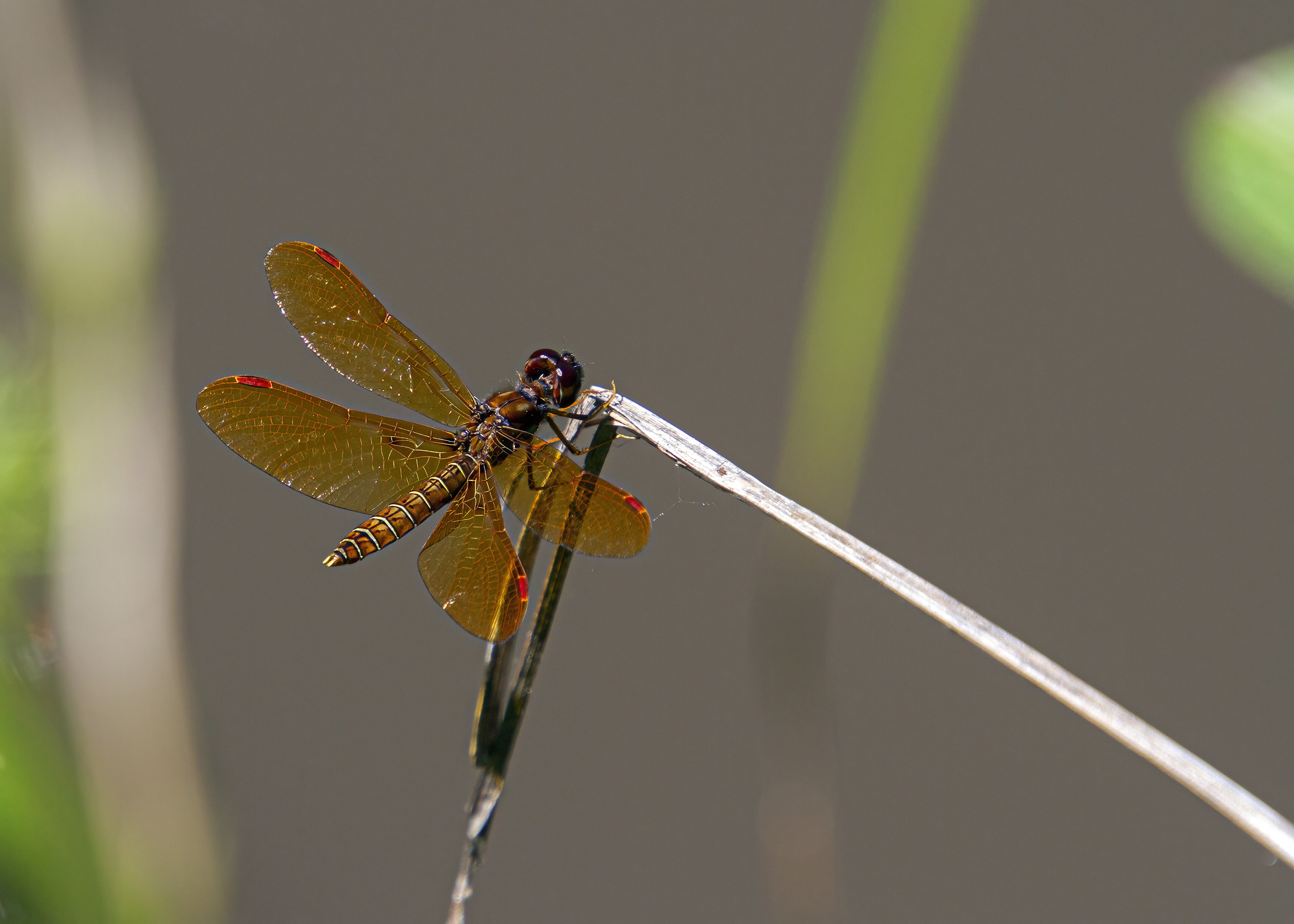
I know that summer is almost here when dragonflies like this male Eastern Amberwing (Perithemis tenera) begin to appear. I spotted this distinctive-looking dragonfly on Tuesday at a small pond at Jackson Miles Abbott Wetland Refuge.

Eastern Amberwings are really small at about one inch (25 mm) in length. According to the Dragonflies of Northern Virginia website, the Eastern Amberwing is “the smallest dragonfly in Northern Virginia, and second smallest in the U.S. (only Elfin Skimmers are smaller), Amberwings are fascinating little insects. No bigger than a horsefly or paperwasp, nature still found a way to pack a lot into this tiny package.”

These little dragonflies are considered to be wasp mimics, “Amberwings may be our only dragonfly that actively mimics a wasp. The markings and shape of their abdomens resemble a small wasp, but they take it several steps further. When threatened, they rhythmically move their wings up and down while pulsing their abdomens. All to imitate a wasp, we think, so as to scare off potential predators that believe they’re about to be stung.”

I love the stunning amber wings that are found on only the males of this species—the females have patterned wings that are mostly clear. As you can see in both photos, the male’s wings are quite transparent despite their darker color. I also really like the intricate patterns and markings on the abdomens of Eastern Amberwing dragonflies.

I look forward to seeing more and more Eastern Amberwings over the course of the next five months or so. Some summer dragonfly species have not yet appeared, but I am seeing more and more dragonflies as the temperatures rise and the hours of sunlight are extended.

Eastern Amberwing

Eastern Amberwing

© Michael Q. Powell. All rights reserved.

Read Full Post »

I spotted this beautiful Black Swallowtail butterfly (Papilio polyxenes) last week at Occoquan Bay National Wildlife Refuge. The orange circle with the black dot in between the wings helps to distinguish this species from several similar-looking dark butterflies in our area.

I chased this butterfly around for quite some time before it finally stopped for a moment on this vegetation—I often get a good workout when photographing butterflies. I am quite happy with the way that I was able to capture the varying shades of green surrounding the butterfly that add a lot of visual interest to this simple composition.

Black Swallowtail

© Michael Q. Powell. All rights reserved.


Read Full Post »

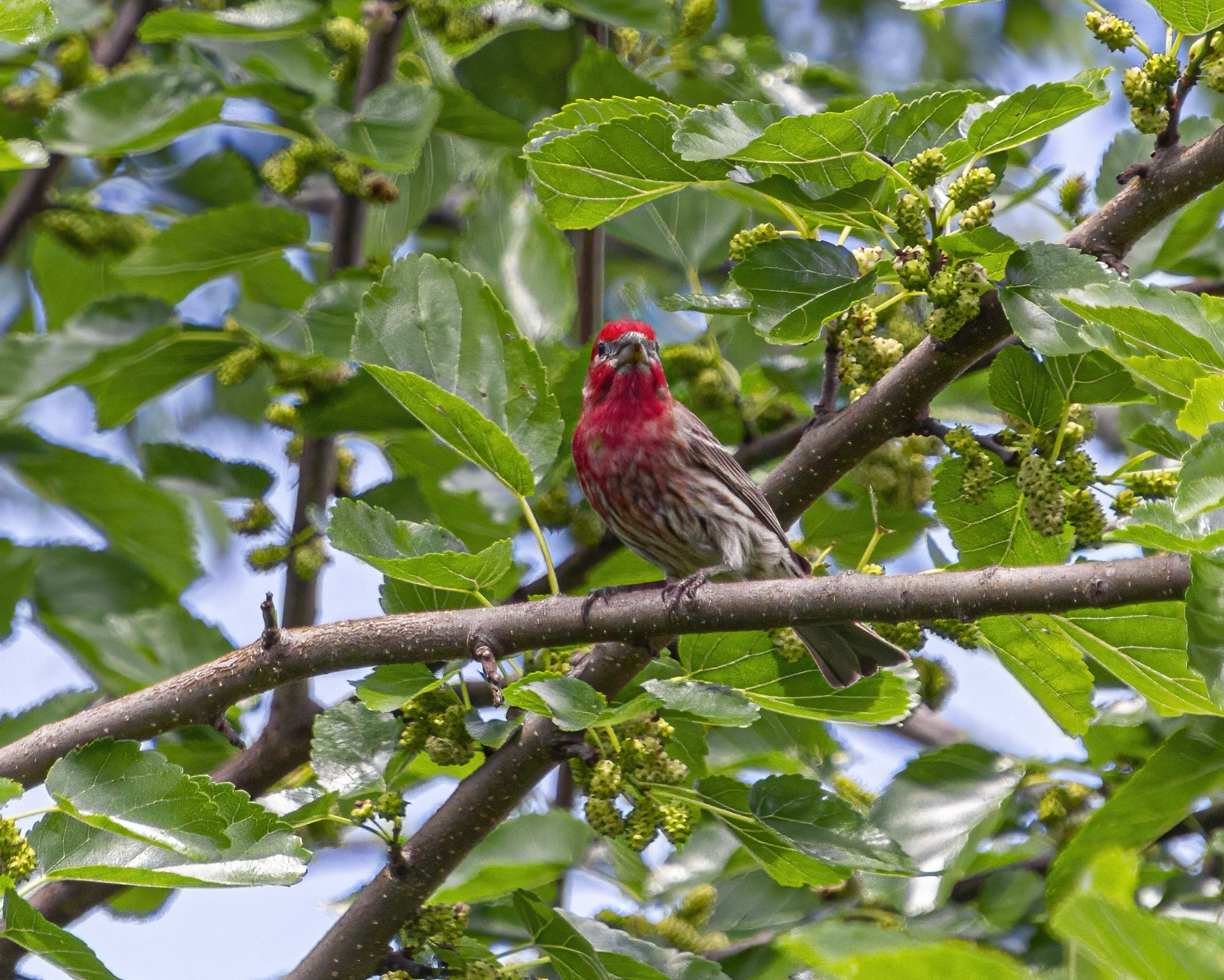
The bright red color of this male House Finch (Haemorhous mexicanus) really caught my eye last week at Occoquan Bay National Wildlife Refuge. For a split second I thought it was a cardinal until I looked more closely at the bird, it was clear that it was a different species.

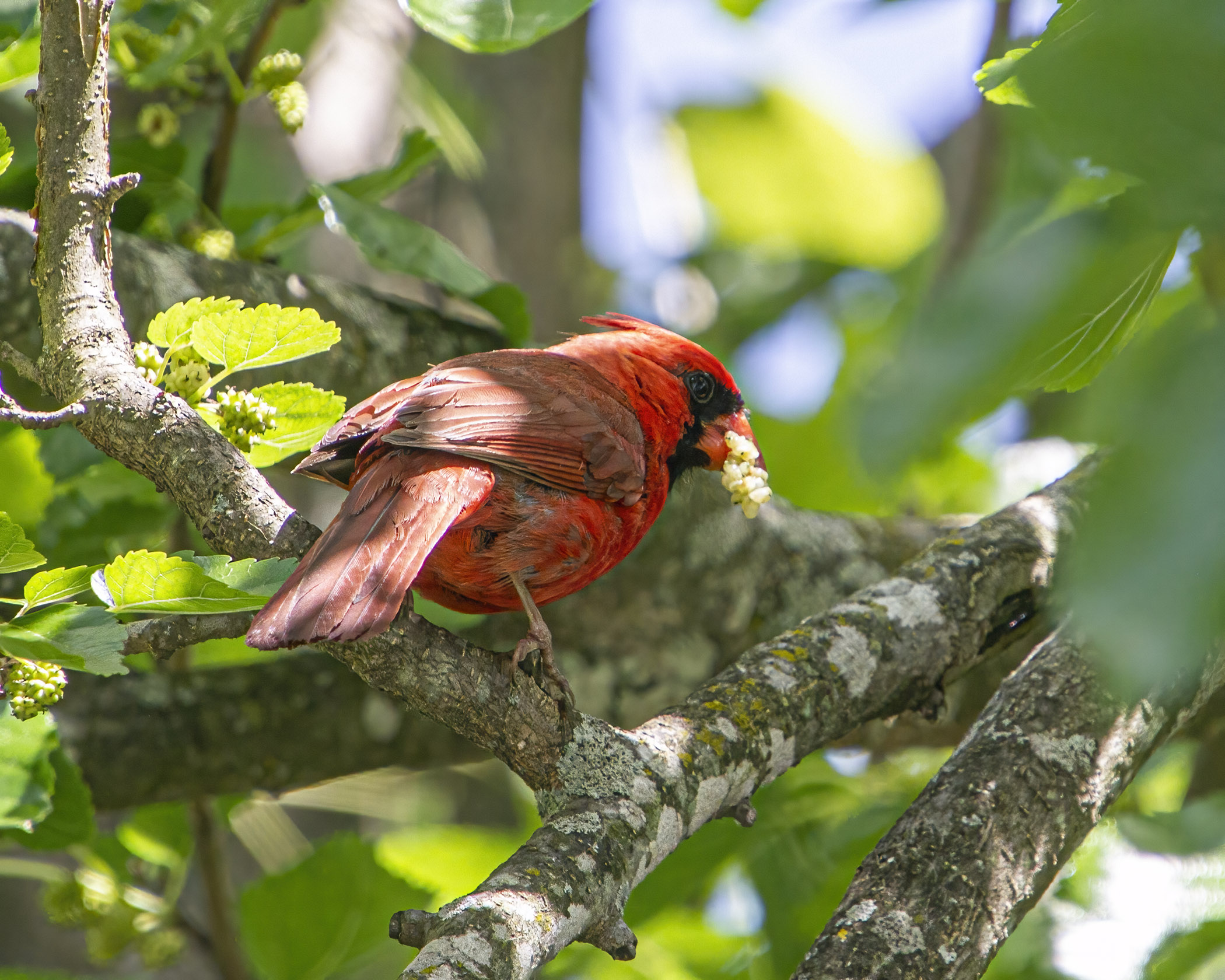
Later that same day I spotted an equally bright red male Northern Cardinal (Cardinalis cardinalis) that seemed quite pleased with whatever treat it had found. I think it may be plant material, but I can’t exclude the possibility that it is some kind of insect.

From a photography perspective, it is really helpful when a bird is this boldly colored and makes no effort to blend in with its surroundings, especially at this time of the year when there are so many leaves on the trees.

House Finch

Northern Cardinal

© Michael Q. Powell. All rights reserved.

Read Full Post »

I love the sweet little face on this Southeastern Mud Turtle (Kinosternon subrubrum subrubrum) that I spotted last Thursday at Occoquan Bay National Wildlife Refuge. Most of the turtles that I encounter are Red-eared Sliders or Painted Turtles and they generally are in the water or perched on logs floating in the water. Occasionally I will spot a box turtle or a snapping turtle. When it comes to mud turtles, however, I normally see only one or two a year.

According to the Virginia Herpetological Society, “Kinosternon subrubrum occupies a wide variety of aquatic habitats, including ponds, lakes, creeks, swamps, freshwater and brackish marshes, ditches, and boggy areas. They avoid large, deep bodies of water and fast-moving water. Preferred habitat is shallow, slow-moving water, with aquatic or emergent vegetation and a soft organic substrate. This turtle is often seen on land, especially after rainstorms. Mud Turtles may spend a considerable portion of the year on land and often overwinter in shallow burrows.”

mud turtle

© Michael Q. Powell. All rights reserved.


Read Full Post »

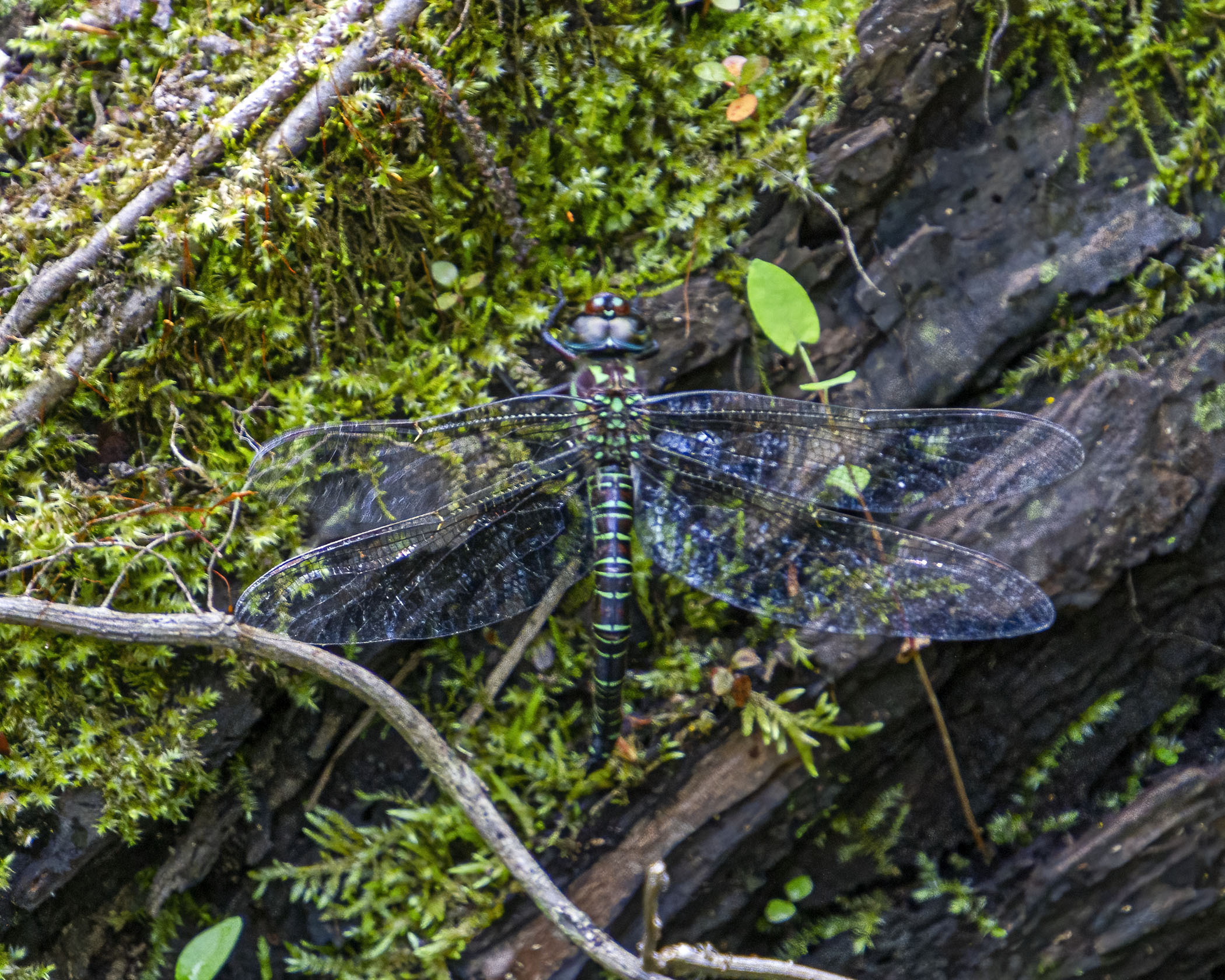
I photographed this stunning Lancet Clubtail dragonfly (Phanogomphus exilis) last Monday on a rotten log in the dappled sunlight as I was exploring an area near a creek in Prince William County, Virginia. Of course, I was excited to photograph this dragonfly, but it was actually the interesting lighting and the rough texture of the log that  mainly captured my attention.

Lancet Clubtail

© Michael Q. Powell. All rights reserved.

Read Full Post »

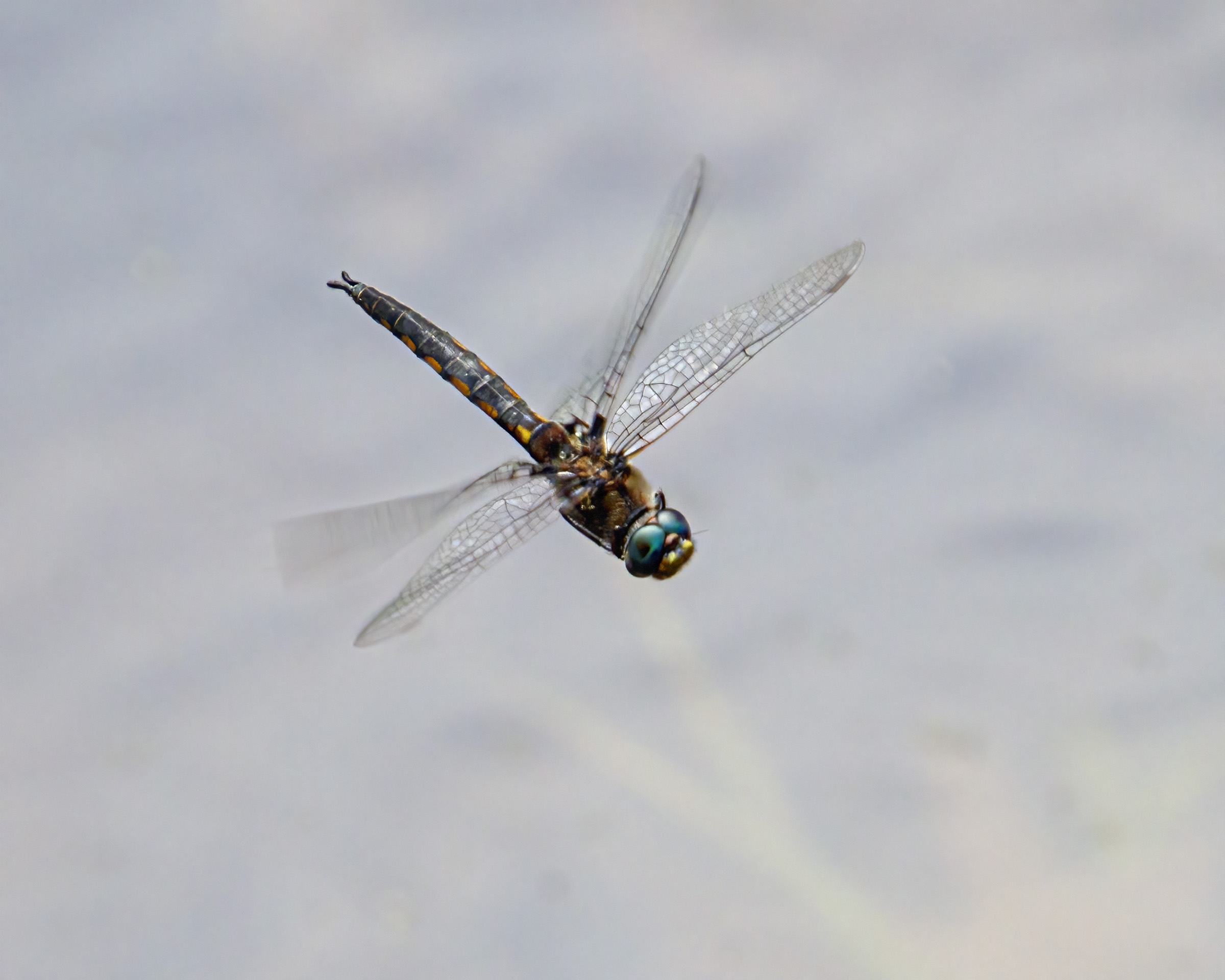
Some of the species of birds and dragonflies with the word “common” in their names are quite rare in my area. However, Common Baskettail dragonflies (Epitheca cynosura) have been quite common this month and I have seen them at a number of different locations, most notably at the small ponds that I like to visit. At these ponds, I usually spot the Common Baskettails as they conducted repeated low patrols over the surface of the water and I can never resist the chance to photograph them while they are in flight.

As I have noted in the past, it is very challenging to photograph a dragonfly while it is flight. Sometimes the dragonflies will hover a bit, giving me a better chance of getting them in focus, but often they whiz on by and I try to track them in my viewfinder. Occasionally I will manage to use auto-focus, but often I resort to manual focus, which, of course, is tough with a moving subject. I try to determine the flight track they are using and identify likely areas that they will pass through and then pre-focus on that area and wait for them to come by. Needless to say, you have to be very patient and persistent if you want to try this kind of photography.

I captured the first two shots at a small pond in Prince William County and was quite pleased with the images. The two shots were taken as part of a sequence and are quite similar with the exception of the position of the wings. Normally I am so thrilled to get a sharp shot that I am not concerned about the wing position, but in this case I had the luxury of having several variants of essentially the same shot.

The final two shots were taken at the pond at Jackson Miles Abbott Wetland Refuge. There was vegetation surrounding the water at the spot where I was standing and it sometimes would obstruct my view as I tried to track the dragonfly. In the third photo, I used one of the offending pieces of vegetation as a compositional element that makes it look like the dragonfly was approaching a finish line tape.

I included the final photo to give you a sense of the habitat. In several areas of the pond there were patches of lily pads and I tried to capture shots of the dragonfly flying over the lily pads. I was largely unsuccessful, but the photo gives you an idea of what I was trying to accomplish. (If this were a shot of a bird, it would definitely qualify as “butt shot,”but I am not sure that you can really say that a dragonfly has a “butt.”)

Common Baskettail

Common Baskettail

Common Baskettail

Common Baskettail

© Michael Q. Powell. All rights reserved.

Read Full Post »

On Monday I was happy to spot my first Stream Cruiser dragonfly (Didymops transversa) of 2024 in a field of ferns adjacent to a creek in Prince William County. Check out the length of those back legs. Wow!

I do not see Stream Cruisers at most of the usual locations where I search for dragonflies, because they can be found only in specific habitats. According to the Dragonflies of Northern Virginia website, “Stream Cruisers are habitat specialists. Look for them in stable, small to medium, forest streams, with good flow and rocks. The best place to find them is hunting in sunlit meadows near their wood-land waterways.”

Stream Cruiser

© Michael Q. Powell. All rights reserved.

Read Full Post »

On Monday I spotted this beautiful Red-spotted Purple butterfly (Limenitis arthemis astyanax) in a sea of ferns adjacent to a creek that I was exploring in Prince William County, Virgnia. I love the iridescent blue color on the wings and the little red spots that provide a nice accent color. Although I see a slight purplish tint to the wing on the right, I really don’t see very much purple on this butterfly’s body despite the fact that “purple” is a prominent part of the name of this species.

The color and texture of the ferns make for a beautiful backdrop for the butterfly and add a bit of visual interest without being distracting.

Red-spotted Purple

© Michael Q. Powell. All rights reserved.


Read Full Post »

Last week I photographed a female Swamp Darner dragonfly (Epiaeschna heros) depositing some eggs into a rotten log at the edge of a small pond at Occoquan Bay National Wildlife Refuge. Some dragonflies deposit a large number of eggs into the water or floating vegetation by tapping their abdomens rapidly and repeatedly at different locations, while others, like this Swamp Darner, deposit their larger eggs more slowly and deliberately by making a slit and inserting the eggs directly into wet wood and other debris with their blade-like ovipositors.

Swamp Darners are one of the largest dragonflies in our area, with a body length of about 3.4 inches (86 mm) in length. I love the description of this species on the Dragonflies of Northern Virginia website, “I often tell people on dragonfly walks that if they see a rhino with wings, it’s a swamp darner. Slight exaggeration, perhaps, but they are pretty impressive.” Some dragonflies are so nimble and acrobatic in their flight that they remind me of fighter aircraft, but the bulky size of the Swamp Darner makes me think more of bomber aircraft.

Swamp Darner

© Michael Q. Powell. All rights reserved.

Read Full Post »

Identification guides for birds, dragonflies, and damselflies often use illustrations rather than photos? Why? It is almost impossible for a photo to show all of the key identification features of a species.

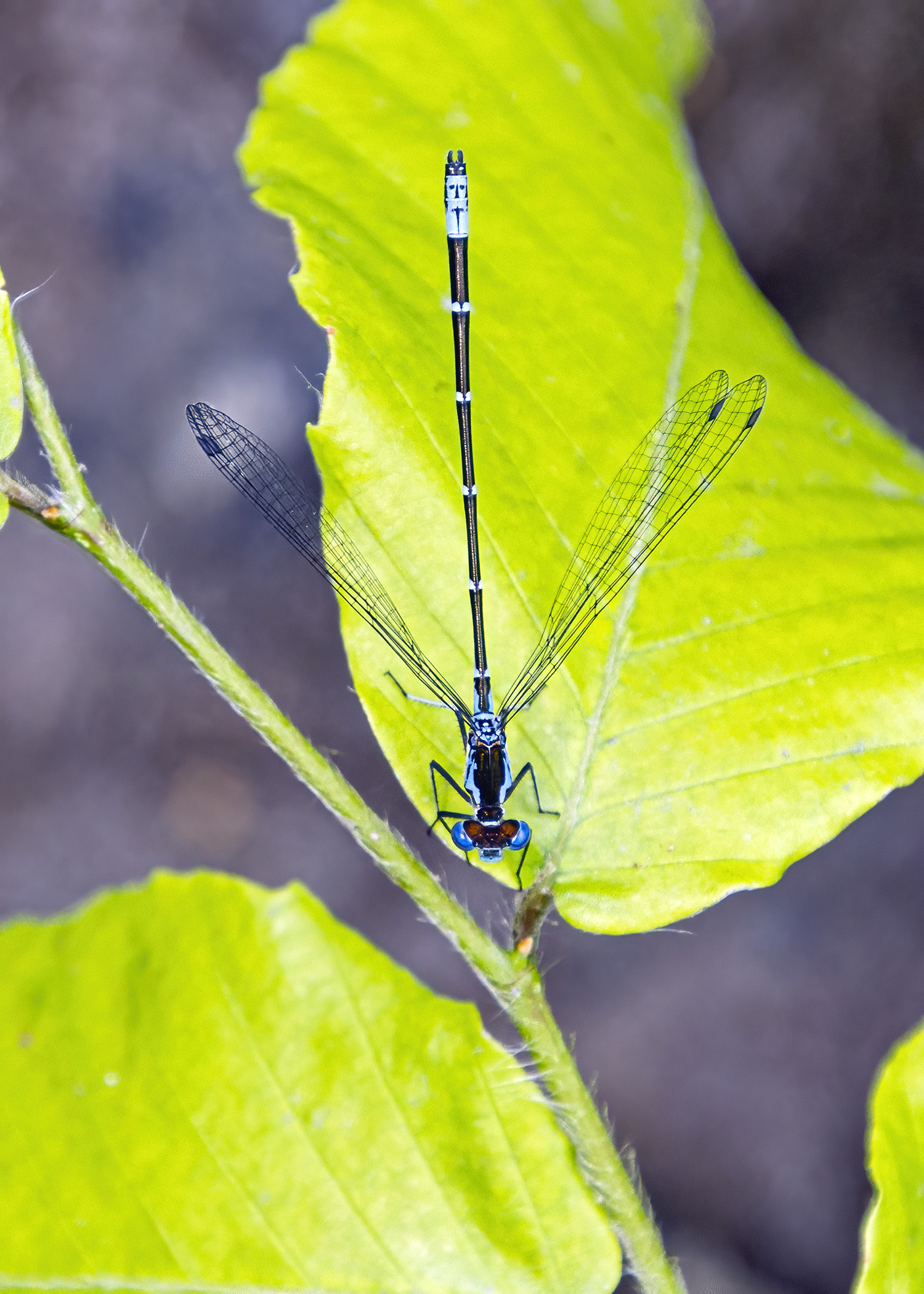
Last week, for example, I captured some wonderful photos of a male Aurora Damsel damselfly (Chromagrion conditum) at a small pond in Prince William County, Virginia. In the first photo below, I was able to capture an image from almost directly overhead that shows the markings on the tiny damselfly’s thorax and abdomen. The image also shows how this damselfly species perches with its wings partially spread, unlike most damselflies that perch with their wings closed above their bodies. The second shot shows many of the same features.

However, it is fairly uncommon to be able to capture views like those in the first two shots and they do not show what is often the key identification feature for this species. Both genders of Aurora Damsels have distinctive bright yellow patches on the sides of their thoraxes, as you can see in the third photo. You might notice that in this photo, the markings on the tip of the abdomen are much less clear than in the first two shots, but that’s not a problem, because that yellow patch immediately signals that it is an Aurora Damsel.

Whenever I can, I try to capture shots of my subjects from multiple angles. The different angles of view may help in identifying a species or may create a more aesthetically pleasing image. One of the coolest things about photography is the way in which it combines science and art—I can be as scientifically geeky or as artistically creative as I want to be.

Aurora Damsel

Chromagrion conditum

Aurora Damsel

© Michael Q. Powell. All rights reserved.


Read Full Post »

When it comes to camouflage, size does not always matter. Last Wednesday as I was exploring in Prince William County here in Virginia, both a large toad and a small frog were so well hidden that I did not see either of them until I almost literally stepped on them, which prompted them to move and reveal their presence.

I was really startled on Wednesday when a large toad suddenly leaped upwards right in front of me, exploding out of a covering of fallen leaves. I think that this is an Eastern American Toad (Anaxyrus americanus americanus), judging by its large size, but there is a chance that it is a Fowler’s Toad.

The tiny Eastern Cricket Frog (Acris crepitans) in the second photo blended in so well with the sandy edge of a stream that I initially did not see him until he moved a bit. The texture and color of his skin made him so hard to spot that when I focused on his eye in my camera’s viewfinder, I could not see the contours of the frog’s body.

toad

Cricket frog

© Michael Q. Powell. All rights reserved.

Read Full Post »

Over the past week I have spotted Woodland Box Turtles (Terrapene carolina carolina) at two different locations in my local area. The red eyes of both turtles suggest that that they are males, though I have read that eye color is not always 100% accurate in determining the gender of a box turtle. The shell pattern for each box turtle is supposed to be unique, like a fingerprint, and you can definitely see differences in the patterns on the shells of these two turtles.

It is always a treat to spot one of these box turtles, because they are so cool-looking. Unlike many turtles, the box turtle is primarily terrestrial rather than aquatic, and most of the times that I have encountered them, they have been out in the open. According to the Virginia Department of Wildlife Resources (DWR), “The box turtle has a low reproductive rate and is long lived. It requires 10-20 years to reach sexual maturity. Box turtles may sometimes live to over 100 years.”

Virginia has special protections for this species. According to the DWR,  “it is illegal to keep one in your home in Virginia due to the significant number of wild caught animals found in captivity. This species is primarily threatened due to the thousands that are caught for the pet trade from the wild each year; although habitat fragmentation and urbanization also account for a fraction of the population’s drop of 32% over the last 100 years.”

Woodland Box Turtles

Woodland Box Turtle

© Michael Q. Powell. All rights reserved.


Read Full Post »

On Monday I finally spotted some mature male Calico Pennant dragonflies (Celithemis elisa) with red markings at Occoquan Bay National Wildlife Refuge. Heretofore all of the males that I had seen this year were immature and had yellow markings, like those of their female counterparts.

The first two photos show male Calico Pennants. I love the way that the red marking on the abdomen look like a series of tiny hearts. The dragonfly in the third photo is an immature male—you can tell that it is a male by looking at the shape of the tip of the abdomen (the “tail”).

For the sake of comparison, I have added a final photo of a female Calico Pennant from a posting I did in May 2020. You can readily see that the dragonflies in the last two photos are similar in coloration, but you have to look a bit closer at them to see that the wing patterns are slightly different and the shapes of the terminal appendages are quite different.

Most of us tend to rely on colors for identifying species of birds and insects, but I have learned over time that color is often not a reliable identification feature, especially for immature subjects, when the males and females are often similar in color and the color differentiation becomes apparent only when they mature.

Calico Pennant

Calico Pennant

Calico Pennant

Calico Pennant

© Michael Q. Powell. All rights reserved.

Read Full Post »

I spotted this dragonfly during a recent visit to Occoquan Regional Park. I got a glimpse of the markings on its body as it zoomed past me, so I knew that it was a spiketail, but I was not sure about the species. I watched it patrol up and down a small stream and managed to finally get a shot of the dragonfly when it perched momentarily.

It turned out to be a Brown Spiketail (Cordulegaster bilineata), one of several spiketail species that I have seen in the past at this park. During most of my previous encounters with spiketails, they have been perching on vegetation in sunlit areas along a trail.

In this case, the area where the dragonfly was patrolling was mostly in the shade, so it was a real challenge to track and photograph the dragonfly. In case you are curious, I took the photo with my Canon 7D DSLR and my Tamron 18-400mm lens extended to 400mm with settings of ISO 800, F/8.0, and 1/320 sec. The settings were not optimal for getting a shot, but they worked well enough.

Brown Spiketail

© Michael Q. Powell. All rights reserved.

Read Full Post »

This dragonfly was perched on the ground on Monday at Occoquan Bay National Wildlife Refuge when I spotted it. I knew immediately that it was either a Lancet Clubtail (Phanogomphus exilis) or an Ashy Clubtail (Phanogomphus lividus), but these two species are so similar in appearance that it is tough for me to tell them apart.

I checked my identification guides and realized that I had to look at the dragonfly more closely and get a bit more geeky. The abdomen (the “tail”) of dragonflies  consists of ten segments traditionally numbered S1 through S10, starting from the point at which the thorax (the “chest”) meets the abdomen (S1) and going downward to the tip of the abdomen (S10).

The Dragonflies of Northern Virginia website notes that for Lancet Clubtails there is a “noticeable bright yellow flange on sides of S8 & S9 (male and female), while Ashy has almost no flange, and less bright yellow.” I knew about these differences, but couldn’t see them clearly enough when I was in the field.

The dragonfly was relatively cooperative and I was able to get a shot of it from almost directly overhead. The image is really cluttered, because of the vegetation, and  artistically is not a great photo, but it does provide the kind of details that are helpful for identification.

In the image I saw what appear to be yellow flanges on the sides of S8 and S9  and I could clearly see the appendages at the tip of the abdomen, which helps me identify the gender of the dragonfly. These elements suggested to me that it was a female Lancet Clubtail. I posted a photo in a Facebook group devoted to dragonflies and damselflies in Virginia and was delighted when one of the most experience members there agreed with my identification of this dragonfly.

I don’t expect most of my readers to delve this deeply into dragonfly anatomy, but I figured it might be interesting to learn about what some of the myriad considerations that swirl about in my mind as I seek to photograph and identify these beautiful little creatures. Sometimes I am successful in connecting the dots and coming to a conclusion, but at times the identities of my subjects remains a mystery.

Lancet Clubtail

© Michael Q. Powell. All rights reserved.


Read Full Post »

Most warblers nest either on the ground, in shrubs, or in trees, according to the Cornell Lab of Ornithology website, but the Prothonotary Warbler and the Lucy’s Warbler build their nests in holes in standing dead trees or may use nest boxes when available. On Monday I was delighted to spot a Prothonotary Warbler (Protonotaria citrea) at Occoquan Bay National Wildlife Refuge checking out a nest box from the outside and eventually from the inside too.

The nest box is old and may have a leaky roof, but the warbler seemed happy to have found it. The real estate market is tight in Northern Virginia right now and finding any place to live is difficult. After a short stay on the roof, the Prothonotary Warbler flew away and made an aerial approach from the front, perching at the entrance for a moment before entering the nest box.

I obviously could not see what was going on in the box, but periodically I could see flashes of yellow as the warbler moved about inside the box. Perhaps there are already eggs in the box. The warbler stayed inside the box for about five minutes before it poked its head out of the entrance and began to look around, as you can see in the final photo. I was hoping to capture a shot of the bird exiting the nest box, but it left more quickly and unexpectedly and I missed the shot.

I will be checking this spot out during my next visits to the wildlife refuge, hoping that I will be lucky enough to see some baby warblers.

Prothonotary Warbler

Prothonotary Warbler

Prothonotary Warbler

© Michael Q. Powell. All rights reserved.

Read Full Post »

This colorful bird was a long way away yesterday at Occoquan Bay National Wildlife Refuge and I assumed it was a Northern Cardinal, but I decided to photograph it anyways. When I was reviewing my photos, I was shocked to discover that it was an immature male Summer Tanager (Piranga rubra), a new species for me. Truth be told, I was not very certain what kind of bird it was, so I did some searching on-line and came up with the correct answer, as confirmed by some experts in a birding forum on Facebook.

I will take photos of anything that catches my eye, knowing that many of them will not be “keepers.” I will take photos of subjects that are really familiar and those that may be rare or unique. My general rule is to take a lot of photos, following what I call the Law of the Wild West, i.e. “Shoot first and ask questions later.”

Summer Tanager

© Michael Q. Powell. All rights reserved.

Read Full Post »

A month ago it was easy to spot the early-emerging insects, because very few of them were flying. Now, though, the air is so full of bees, flies, and other aerial creatures that it is a little harder to detect the dragonflies and damselflies that are my primary targets.

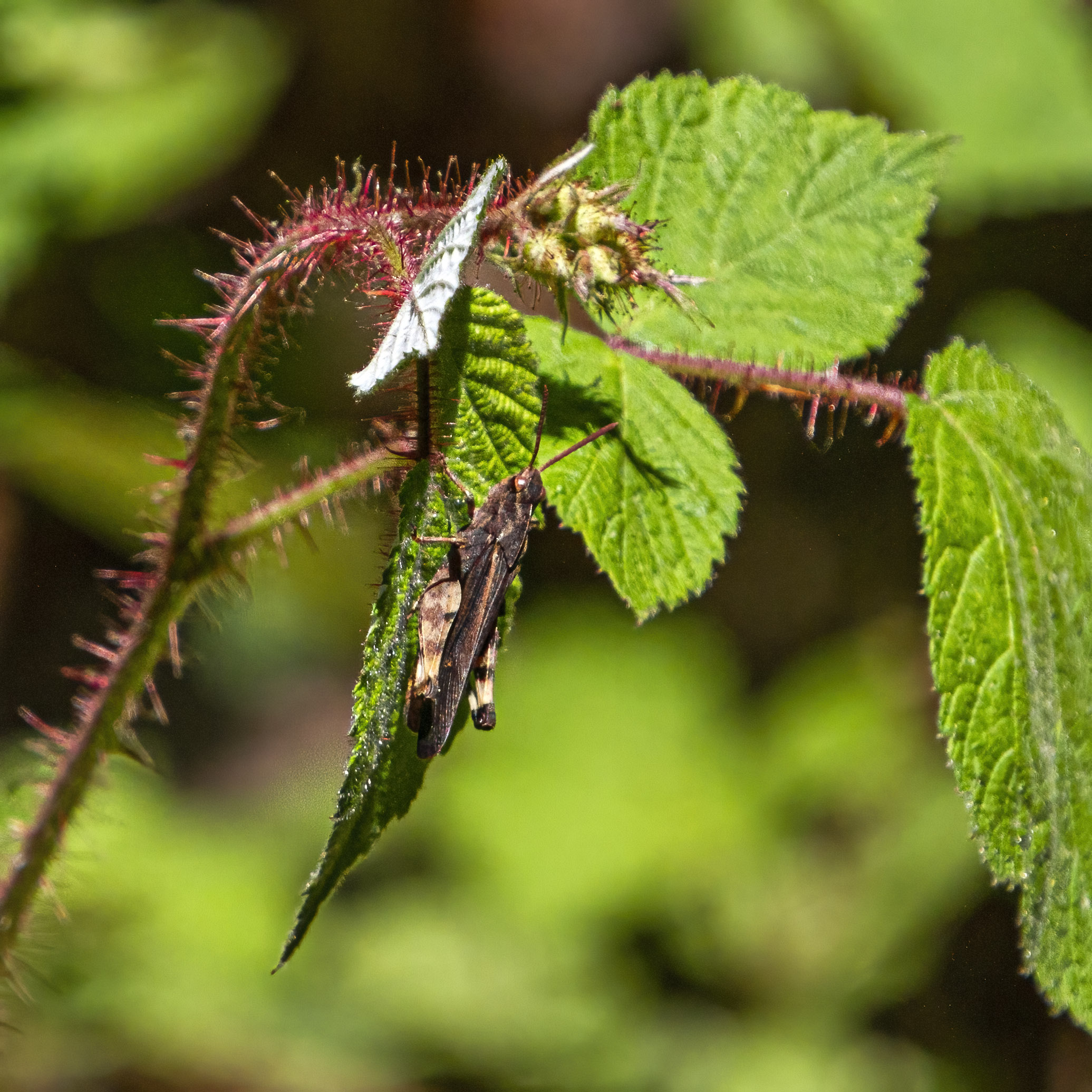
As I walk along grassy paths now, little clouds of grasshoppers burst into the air in front of me. Most of the grasshoppers jump out of sight, but occasionally one will perch on some nearby vegetation and remain immobile, hoping perhaps that I will not see him.  Last week at Occoquan Regional Park I captured a shot of one such grasshopper.

I am definitely not an expert on grasshoppers, so I had to pore over page after page of entries on the internet before I finally concluded that this might be a Green-striped Grasshopper (Chortophaga viridifasciata). Still unsure of the identification, I posted a request for help on the BugGuide website and an expert there confirmed my identification of this grasshopper.

From an aesthetic perspective, I loved the curve of the spiky stem of the plant and my initial instinct was to go for a looser crop of the image, as you can see below in the second photo. However, I realized that viewers could not see the details of the grasshopper, so I made the more zoomed-in version that you can see as the first photo below.

The two images, which are actually just different versions of the same shot, complement each other and serve different functions. The first one focuses more on the grasshopper as the primary subject, while the second one makes the environment a co-star. I like both versions.

Green-striped Grasshopper

Green-striped Grasshopper

© Michael Q. Powell. All rights reserved.

Read Full Post »

I spotted this beautiful female Red-winged Blackbird (Agelaius phoeniceus) poking about in the marshland vegetation last Thursday at Jackson Miles Abbott Wetland Refuge. As is the case with many birds, the name of the species matches the coloration and/or features of the male, but not those of the female, e.g. this Red-winged Blackbird is not black nor does it have red wings.

I had my first encounter with a female Red-winged Blackbird in June 2012, a few months before I started this blog. I remember well my initial difficulties in trying to identify the bird and my shock in learning that it was a blackbird—I assumed it was a sparrow of some sort. In September 2012, I posted some photos of that bird in a blog entry entitled “Intense bird.” I encourage you to click on that link and make your own judgment about the degree to which my photography “style” has remained consistent over the years.

In 2012 I was just starting to get serious about photography and my dear friend and photography mentor Cindy Dyer had lent me a Nikon D300 and a Tamron 180mm macro lens that day. I fell in love with that lens and quickly purchased one for my Canon, the brand that I mostly use. The Tamron 180mm macro lens remains one of my favorite lenses.

It was quite enjoyable to watch this blackbird last week exploring the vegetation protruding from the water. She would perch on some rather small stems, appearing to flare her tail to maintain her balance, as you can see in these photos, occasionally calling out to a male blackbird that I could hear, but did not see.

Red-winged Blackbird

Red-winged Blackbird

© Michael Q. Powell. All rights reserved.

Read Full Post »

Odonata is an order of flying insects that includes dragonflies and damselflies. During the warmer months of the year I spend a lot of time hunting for dragonflies, the larger members of this group of magical creatures, but I also enjoy searching for damselflies, their smaller and more fragile “cousins.”

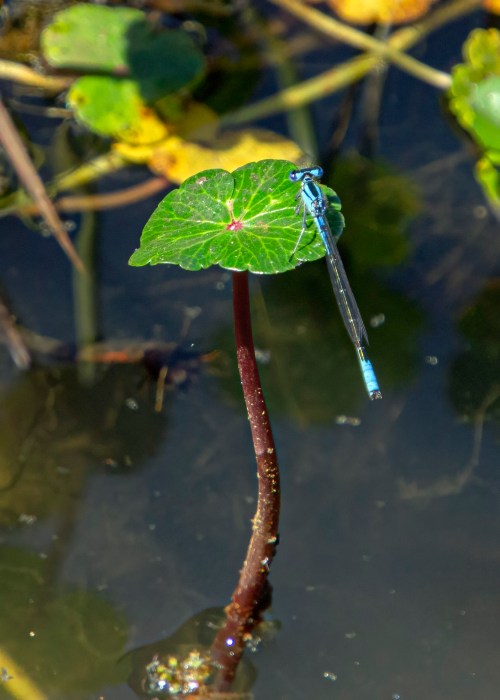
Damselflies, like dragonflies, come in a variety of colors and shapes. Here is a sampling of images of damselflies that I captured this past Thursday during visits to Jackson Miles Abbott Wetland Refuge and Occoquan Regional Park, both of which are located within 15 miles (24 km) of my house.

The first photo shows a Orange Bluet (Enallagma signatum). I am always amused by the name of this species, because it seems incongruous to have an orange-colored member of a genus called American Bluets. Most male bluets are, in fact, blue, but others are orange, scarlet, and burgundy and there is even a “Rainbow Bluet.”

The second image shows a male Azure Bluet (Enallagma aspersum), whose colors are closer to my mental image of a bluet. Most bluets are some combination of blue and black and it can be tricky trying to determine specific species by examining the color patterns on the body and in the eyes.

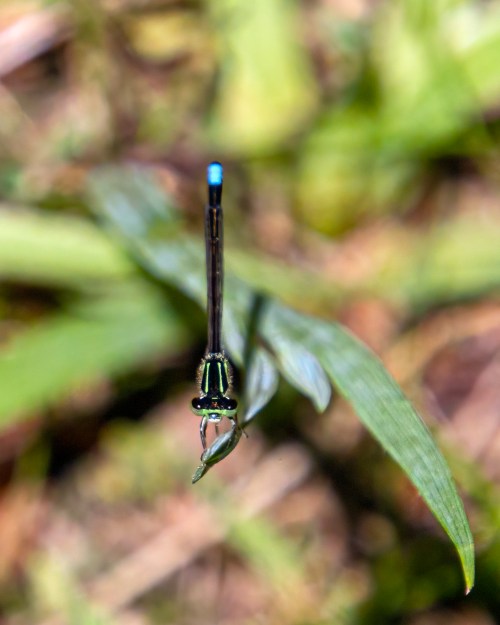
The third shot is of a male Fragile Forktail (Ischnura posita), one of the first damselflies to emerge each spring. Fragile Forktails are really tiny (about an inch (25 mm) in length, but are relatively easy to identify by their broken shoulder stripe that looks like an exclamation point.

In the final photo I was eye-to-eye with the damselfly so his abdomen is almost completely out of focus. Nonetheless enough details are visible for me to say this is almost certainly a male Eastern Forktail damselfly (Ischnura verticalis).

I like to try to vary my approach to capturing images of most subjects, including damselflies, as you can see in this little collection of photos. Sometimes, as in the first shot, I will try to isolate the subject from its background in order to focus the viewer’s complete attention on the subject. Recently, though, I have developed a preference for including more of the habitat in my shots, as in the second image, in order to give the viewer a sense of the environment in which I took the shot. When possible, I like to attempt to capture some “artsy” shots, like the final image, by using selective focus and choosing carefully my angle of view.

No matter what approach I choose with damselflies, I have to be careful not to fall into the water, where most of these dragonflies were perching. I am not always successful in keeping my feet dry.

Orange Bluet

Azure Bluet

Fragile Forktail

Eastern Forktail

© Michael Q. Powell. All rights reserved.

Read Full Post »
I don’t know how much longer the migrating warblers will be in my area, but this past few weeks I have been trying to get outside with my camera as often as I can, hoping to be able to photograph these colorful little birds.  On Tuesday I spotted a Prairie Warbler (Setophaga discolor) in the patient and patiently tracked it as it moved about.

The first photo was a bit of an anomaly, because the warbler momentarily gave me an unobstructed view when it jumped to a high branch. The second photo gives you a much better idea of the typical challenge I face, with the warbler barely showing itself from behind the wall of foliage. Fortunately, I reacted quick and got a shot that is one of my favorites of this warbler season, which has been my most successful one to date.

Prairie Warbler

Prairie Warbler

© Michael Q. Powell. All rights reserved.

Read Full Post »

On Wednesday I spotted a skink with a shockingly orange head while I was exploring Occoquan Bay National Wildlife Refuge. Why was the skink’s head so orange? During mating season, adult male skinks get swollen heads that turn bright orange-red in color. I am not sure what biological purpose the color change serves, but it sure is impressive.

I think that this is probably a Common Five-lined Skink (Plestiodon fasciatus), the most common skink species in my area. However, the Broad-headed Skink (Plestiodon laticeps) is similar in appearance and I am not very good at telling them apart. Whatever the case, the males in both species have orange heads during mating season.

Five-lined Skink

© Michael Q. Powell. All rights reserved.

Read Full Post »
This female Eastern Pondhawk dragonfly (Erythemis simplicicollis) blended in so well with the vegetation that I almost missed seeing her yesterday at Occoquan Bay National Wildlife Refuge. Eastern Pondhawks are one of the most commonly seen dragonflies in my area during the summer, but this is the first one that I have seen so far this year.

I love the beautiful emerald color of female Eastern Pondhawks (as well as immature males of the species). They are not particularly large as dragonflies go, but they are very fierce predators. Several times each season I stumble upon Eastern Pondhawks gnawing on damselflies or other dragonflies that they have caught. Yikes!

Eastern Pondhawk

© Michael Q. Powell. All rights reserved.


Read Full Post »

Prothonotary Warblers (Protonotaria citrea) are probably my favorite warblers. I just love their brilliant yellow plumage that seems to glow. Many warblers have touches of bright yellow, especially during the spring breeding season, but the Prothonotary Warbler outdoes them all and is almost completely covered in yellow.

I spotted this little beauty yesterday (1 May) at Occoquan Bay National Wildlife Refuge. I initially caught sight of the warbler as it was flitting about in the foliage. I would see flashes of yellow as it foraged, but could not get a clear look at it. All of the sudden the warbler flew across the trail and landed in a bush, momentarily give me a clear shot.

Quite often I strain my neck when trying to photograph warblers, a phenomenon that is colloquially called “warbler neck.” It is so common that the Audubon website has an article entitled, “A Birder’s Workout Guide for Preventing Warbler Neck.” I was very fortunate in this case, though, that the bird was perched below eye level, so I was able to capture a lot of detail without harming my neck, detail that is often hidden when I am shooting upwards at a sharp angle.

Prothonotary Warbler

© Michael Q. Powell. All rights reserved.

Read Full Post »

Older Posts »