Feeds:
Posts
Comments

Archive for July, 2021

On July 7, 2012 my photography mentor Cindy Dyer told me that I needed to start a blog. She had been blogging for several years already and was familiar with WordPress. She helped me choose a theme, craft an “About Me” page, and prepare my first posting. That posting was entitled Blue Dasher dragonfly, featured a single photo, and had a short text that simply stated, “I photographed this Blue Dasher dragonfly (Pachydiplax longipennis) at Kenilworth Aquatic Gardens this morning.”

I remember feeling a mixture of excitement and fear when I pressed the “Publish” button for the first time. Inside I had all kinds of concerns about my inadequacies as a photographer and about not being ready to share my images with a broad audience. Was I ready? Perhaps I was not, but having been pushed into the deep end of the pool, I quickly learned to swim.

From the very beginning, I found myself surrounded by a community of people who have been overwhelmingly supportive of my efforts and that has pushed me to to improve my skills and to find my “voice.” I started this blog at a time in my life when I had decided to stop working full-time—for the first seven years I worked three days a week and now I am fully retired. This blog and my photography have helped me to forge an identity separate from my job, to reignite a curiosity about the natural world, and to unlock a creative side of me that had long been dormant. My blog has become an integral part of my daily life, though I no longer freak out if life circumstances cause me to miss an occasional day.

According to WordPress, over the lifespan of my blog I have published 4068 postings (a few of which have been re-blogs of postings by others) that have had a total of 306,436 views. Is that a lot? Like most things in life, it depends on what you use as a measuring stick.

I do not write my blog to make money or to grow a large audience or following. My goals are much more modest—my blog is a tool to express myself as authentically as possible by sharing my thoughts and photos and connecting with others. I appreciate all of the support, feedback, and encouragement that so many of you have provided to me throughout this lengthy journey. Thanks. It is overwhelming to think about the diversity of the group of people who read my posts, people from all walks of life scattered throughout the world. Wow.

Today I am featuring a photo of a Gray Petaltail dragonfly (Tachopteryx thoreyi) that I encountered yesterday in a seepy area in Fairfax County, my home county in Virginia. This species of dragonfly originates in this kind of perpetually wet habitat, where skunk cabbage is likely to be growing. I like to visit seeps with the hope that someday I will come across a Gray Petaltail as it is emerging.

As you can see from the photo, the coloration of the Gray Petaltail allows it to almost disappear in this kind of habitat. I spotted this perched dragonfly because I know that many dragonflies are drawn to sunny spots, so whenever I am in the forest or other dark locations, I will look for sunlit patches to explore.

So, I am now starting my tenth year. I suppose that I should update the WordPress theme of the blog, which I have not changed since I chose it nine years ago, and my “About me” page, which also has not been touched in a really long time. Beyond those possible cosmetic changes, I expect to continue on in my journey into photography, wandering about and sharing my experiences with all of you. Thanks again for sharing in this experience with me.

Gray Petaltail

© Michael Q. Powell. All rights reserved.

Read Full Post »

When Americans hear the word “spangled,” they are likely to think of our flag and our national anthem, especially this past weekend as we celebrated Independence Day. I think too of Spangled Skimmer dragonflies (Libellula cyanea), like this handsome male that I photographed this past Saturday in Fairfax County, Virginia. While the “spangles” in the Star-Spangled Banner refer to the stars on the flag, the “spangles” of this species refer to the little white patches, known as stigmas, on their wings.

Spangled Skimmer

© Michael Q. Powell. All rights reserved.

Read Full Post »

The ponds and marshes are alive with the sight of flying dragonflies. As the summer weather has grown increasingly hot and humid, the number of dragonflies has increased —we are probably nearing the peak of dragonfly activity.

One of the species that I encounter most frequently is the Eastern Pondhawk (Erythemis simplicicollis). When male Eastern Pondhawks are immature, they sport the emerald  coloration and striped abdomens of their female siblings, but as they get older they turn into a beautiful shade of blue that is a perfect complement to their bright green faces and bluish-green eyes.

I spotted these two adult male Eastern Pondhawks last Saturday during a visit to Occoquan Regional Park. Unlike some species that always perch in the same way, Eastern Pondhawks will perch in a variety of different ways almost anywhere. I selected these two photos today because I like the way that they show off the coloration of these handsome dragonflies.

Eastern Pondhawk


Eastern Pondhawk

© Michael Q. Powell. All rights reserved.


Read Full Post »

I was feeling a little “artsy” on Saturday morning when I composed this close-up image of one of day lilies now growing in the garden of my dear friend and neighbor Cindy Dyer. Over the last nine years of so Cindy has served as my photographic mentor and muse.  I remember how liberated I felt when she first told me it was ok to photograph parts of a flower and not just the whole thing—it opened my eyes to all kinds of new creative possibilities that went way beyond merely documenting “reality.”

Beauty is everywhere!

day lily

© Michael Q. Powell. All rights reserved.

Read Full Post »

Some of you may remember my excitement from my blog posting a week ago when I photographed an Eastern Least Clubtail dragonfly (Stylogomphus albistylus) for the first time in my life. Yesterday I returned to the same location in Fairfax County and explored several branches of the stream in which I had previously seen the Eastern Clubtail perched on a rock.

I mostly paid attention to the sunny spots in the stream and to the stones in the middle of them, which they are supposed to prefer, but came up empty-handed. Eastern Least Clubtails are only 1.2 to 1.4 inches (31-36 mm) in length, so it was a bit like looking for a needle in a haystack. I returned several times to the exact location where I previously photographed the dragonfly—I can actually identify the precise rock on which he perched—and on one of those occasions I visually tracked a dragonfly as it landed in some nearby vegetation.

Imagine my shock when I realized that the dragonfly perched only a few feet away was a male Eastern Least Clubtail—the shapes and brightness of the appendages at the tip of the abdomen (the “tail”) are unmistakeable. I captured a few images before the dragonfly flew off again and I was able to resume my breathing. I am not sure what kind of vegetation this is, but it made for a cool-looking landing pad for this handsome dragonfly.

According to the Dragonflies of Northern Virginia website, this species should be around until almost the end of July, so I will probably return a few more time to this spot to see if I can spot this tiny dragonfly again and, with some luck, will manage to spot a female—both of the Eastern Least Clubtails that I have photographed have been males.

Eastern Least Clubtail

© Michael Q. Powell. All rights reserved.


Read Full Post »

It was pretty early this morning when I walked over to the garden of my dear friend and neighbor Cindy Dyer, but a bee was already busy on one of her lavender plants. A shot like this is easy to get with my 180mm macro lens, which lets me stand back farther from my subject. However, I happened to have a much shorter 60mm macro lens on my camera, which meant that I had to be almost on top of the bee. The bee was focused on the flower and did not seem to be bothered by my presence.

bee

© Michael Q. Powell. All rights reserved.

Read Full Post »

Sometimes the shadows are at least as interesting as the subject in my wildlife photos, as was the case with this Ebony Jewelwing damselfly (Calopteryx maculata) that I spotted last week while exploring a stream in Fairfax County. Initially the dragonfly was perched on the rock with its wings closed and I merely observed it. As soon as it flared its wings, though, I knew I had to take a shot and am pretty happy at the way that it turned out.

Ebony Jewelwing

© Michael Q. Powell. All rights reserved.


Read Full Post »

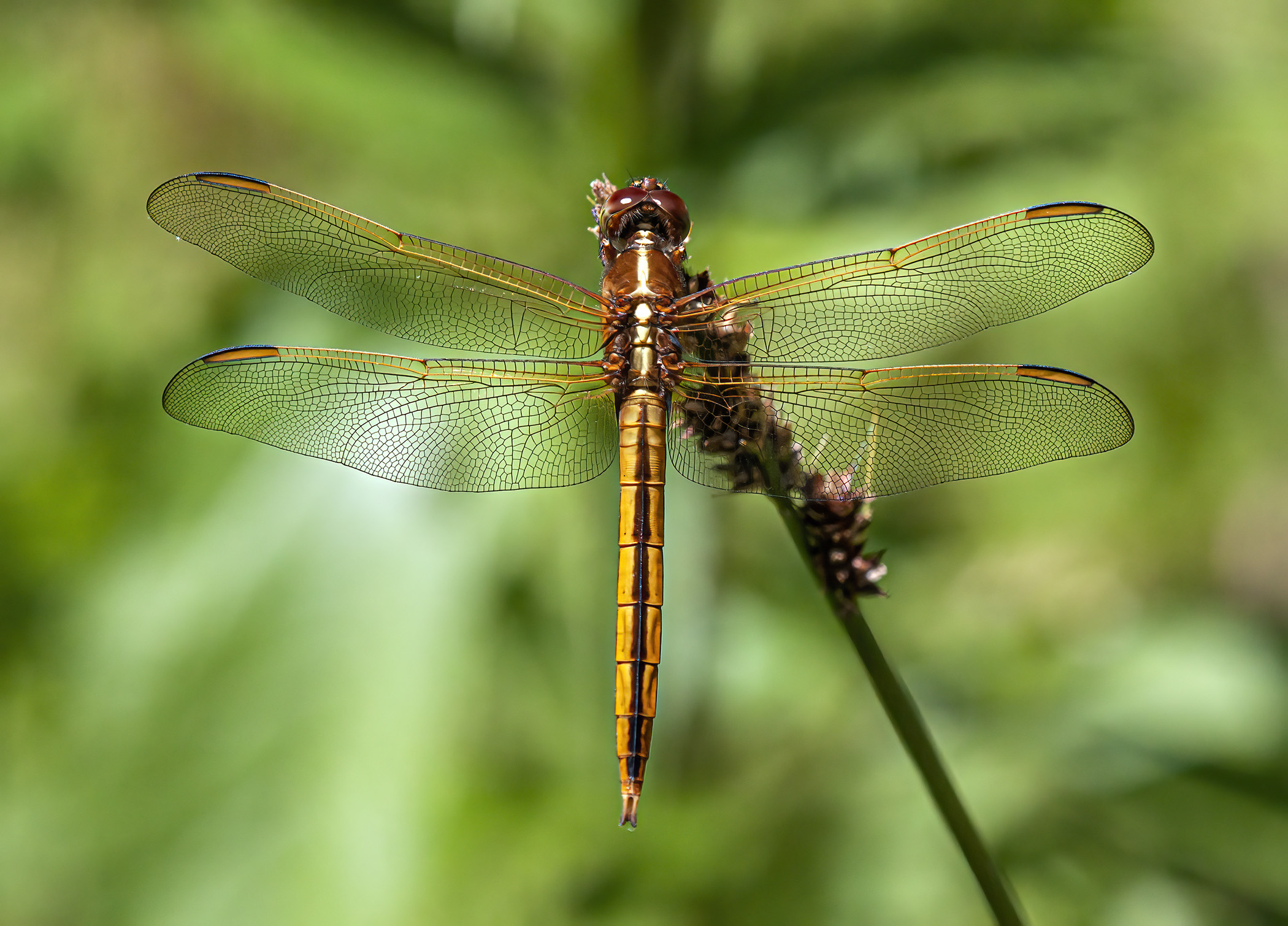
Have you even examined dragonfly wings really closely? I tend to think of dragonfly wings as being made up lots of individual “cells” that are uniform in size and shape, like the squares on piece of graph paper. The reality, however, is that the wings are incredibly complex and are full of intricate designs and shapes that presumably help the dragonfly to maneuver its way so masterfully through the air.

Last week I captured this image of an immature male Needham’s Skimmer (Libellula needhami) while I was exploring in Occoquan Regional Park. I managed to position my camera so that I was almost perfectly parallel to the plane of the wings that are consequently in sharp focus. I highly encourage you to click on the image to see the breathtaking wing details that form such complex mosaic-like patterns. Wow!

It is no wonder that it is so hard for me to draw or paint dragonfly wings that look realistic.

Needham's Skimmer

© Michael Q. Powell. All rights reserved.
Read Full Post »

I was happy to spot these handsome Powdered Dancer damselflies (Argia moesta) in mid-June as I was exploring a rocky stream in Prince William County. Most of time when I see a damselfly it is at a pond or marshy area, but this large, distinctive damselfly seems to prefer rivers and streams. Although I occasionally spot them perched in vegetation, as in the second photo, Powdered Dancers quite often perch on bare ground or on flat stones.


Powdered Dancer

Powdered Dancer

© Michael Q. Powell. All rights reserved.


Read Full Post »

« Newer Posts