No matter what else happened yesterday, I knew it was already an amazing day when I captured this shot of a Bald Eagle (Haliaeetus leucocephalus) early in the morning at Huntley Meadows Park.

© Michael Q. Powell. All rights reserved.
Posted in Birds, Nature, Photography, spring, wildlife, tagged Alexandria VA, Bald Eagle, Canon 50D, Haliaeetus leucocephalus, Huntley Meadows Park, Tamron 150-600mm telephoto on May 5, 2015| 10 Comments »
No matter what else happened yesterday, I knew it was already an amazing day when I captured this shot of a Bald Eagle (Haliaeetus leucocephalus) early in the morning at Huntley Meadows Park.
© Michael Q. Powell. All rights reserved.
Posted in Butterflies, Insects, Macro Photography, Nature, Photography, spring, wildlife, tagged Canon 50D, Danaus plexippus, Lewis Ginter Botanical Garden, Monarch, monarch butterfly, Richmond VA, Tamron 180mm macro lens on May 4, 2015| 4 Comments »
I don’t know if this Monarch butterfly (Danaus plexippus) migrated from the south or was a refugee from the indoor butterfly garden, but I was sure happy to see it this past Saturday at Lewis Ginter Botanical Garden outside of Richmond, Virginia. Monarch butterflies have been pretty scarce in this area the last couple of years.

© Michael Q. Powell. All rights reserved.
Posted in Art, Flowers, Gardening, Insects, Macro Photography, Photography, spring, tagged Alexandria VA, ant, Canon 50D, columbine, green spring gardens, Tamron 180mm macro lens on May 4, 2015| 11 Comments »
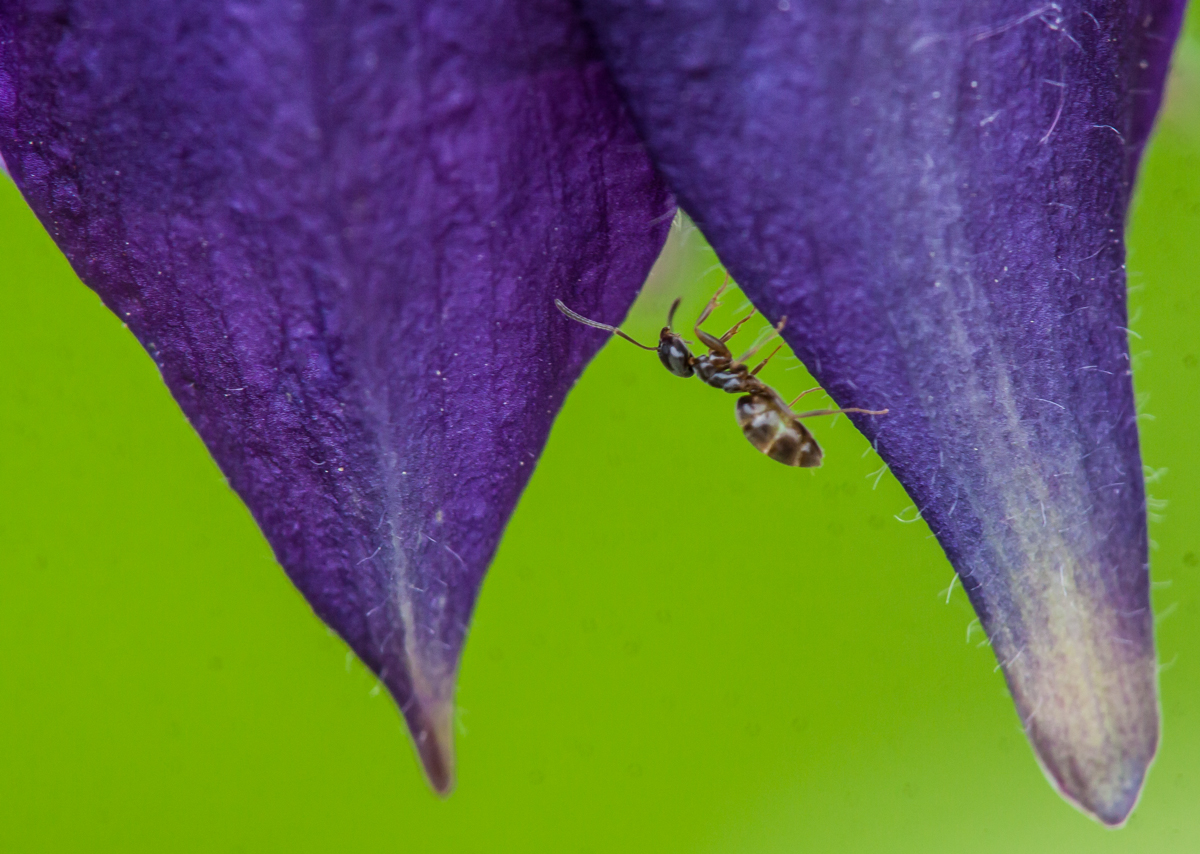
There were lots of flowers in bloom during a trip this past Friday to Green Spring Gardens, but not many insects. However, I did manage to find this intrepid ant testing his mountaineering skills as he climbed up and down the edges of a purple Columbine flower.
© Michael Q. Powell. All rights reserved.
Posted in Dragonflies, Insects, Macro Photography, Nature, Photography, spring, wildlife, tagged Canon 50D, Canon 70-300mm telephoto zoom lens, Common Baskettail, Common Baskettail dragonfly, dragonfly in flight, Epitheca cynosura, Lewis Ginter Botanical Garden, Richmond VA on May 3, 2015| 18 Comments »
What is the most difficult subject that you attempt to capture with your camera? Is it a certain moment when the lighting is perfect or perhaps an elusive, exotic creature in a distant location?
For me, the unicorns that I chase come in the form of dragonflies. I have an irrepressible desire to try to take photos of dragonflies while they are in mid-air. Sometimes the dragonflies will cooperate a bit and hover briefly over the water, but much of the time they are in constant motion as they zig and zag over the water in an often unpredictable pattern.
Yesterday I traveled with some fellow photographers to Lewis Ginter Botanical Gardens in Richmond, Virginia, primarily to photograph flowers. Not surprisingly for those who know me, I got distracted and focused much of my attention on searching for insects.
Toward the end of a gorgeous spring day, I finally spotted a dragonfly patrolling over a section of a small pond. I moved closer and tried to track it in my camera’s viewfinder. Over the winter, I’ve practiced tracking birds in flight and can usually keep them in the viewfinder—the challenge is to keep them in focus. With dragonflies, however, it’s a challenge to even keep them in the viewfinder and auto focus is a virtual impossibility.
Has anyone ever challenged you to pat your head and rub your stomach at the same time? That’s how I feel as I try to track a moving dragonfly and focus manually at the same time. I ended up with some out-of-focus ghostly images of the dragonfly or empty frames with a view of the water.
I managed to capture a single image that I really liked of what appears to be a Common Baskettail dragonfly (Epitheca cynosaura). There is some motion blur, but you can see some of the beautiful details and colors of the dragonfly. (Check out a recent posting that I did to see an image of a perching Common Baskettail dragonfly at my local marshland park in late April.)
I don’t always check the EXIF data for my images, but I was curious to see what the settings were that produced this image. I was shocked to see the information, because I realized that I had neglected to change the settings of my camera when I moved from shooting a stationary subject in the sun to chasing a moving subject that was flying in and out of the shadows over the water.
The camera was set to ISO 100, f/11, 275mm (on a 70-300mm zoom lens) and 1/40 sec. Needless to say, that is not the shutter speed that I would have used if I had been paying more attention, but somehow it worked out ok. I was shooting in aperture-priority mode, as I do most of the time, and I probably should have been shooting at ISO 800, which would have given me a faster shutter speed. The bonus, though, of the low ISO was that I got a cleaner image that I could adjust more aggressively.
As we move into summer, I’ll continue my quest to capture other dragonflies in flight. For the moment, I am content with yesterday’s image, but fully recognize that a huge amount of luck was involved in capturing it.

© Michael Q. Powell. All rights reserved.
Posted in Art, Flowers, Gardening, Macro Photography, Nature, Photography, spring, tagged Alexandria VA, Canon 50D, columbine, genus Aquilegia, green spring gardens, Tamron 180mm macro lens on May 2, 2015| 4 Comments »
One of my favorite spring flowers is the Columbine (genus Aquilegia), whose name comes from the Latin for “dove,” because the inverted flower is said to resemble five doves clustered together. Columbines come in many colors and color combinations and I am always fascinated by the shapes and colors of this unusual-looking flower.
I photographed this beautiful little Columbine on the first day of May at Green Spring Gardens in Alexandria, Virginia, a county-run historical garden that is one of my favorite places for photographing flowers.

© Michael Q. Powell. All rights reserved.
Posted in Birds, Nature, Photography, spring, wildlife, tagged Alexandria VA, Ardea herodias, Canon 50D, Great Blue Heron, heron, Huntley Meadows Park, Tamron 150-600mm telephoto on May 1, 2015| 13 Comments »
I love the morning light as it gradually illuminates different parts of the natural world. This Great Blue Heron (Ardea herodias) had turned its head toward the rising sun and the light was shining on its white face while other parts of its body were still hidden in the shadows.
In the limited light, I used a pretty slow shutter speed (1/80 sec) to keep from having to raise my ISO too high and I was able to get reasonably sharp shots when the heron was stationary. However, when the heron took off, I had a substantial amount of motion blur, as you can see in the final two shots.
I usually lead my postings with my favorite shot, but I had real trouble with this posting trying to decided which one to use. Should I choose one of the sharpest shots or should I go with one of the “artsy” blurred ones? I like different aspects of all four of these images and vacillated for quite some time before deciding to lead with the shot of the heron with his head tilted at an interesting angle.
Did I make a good choice?


© Michael Q. Powell. All rights reserved.
 Mike Powell