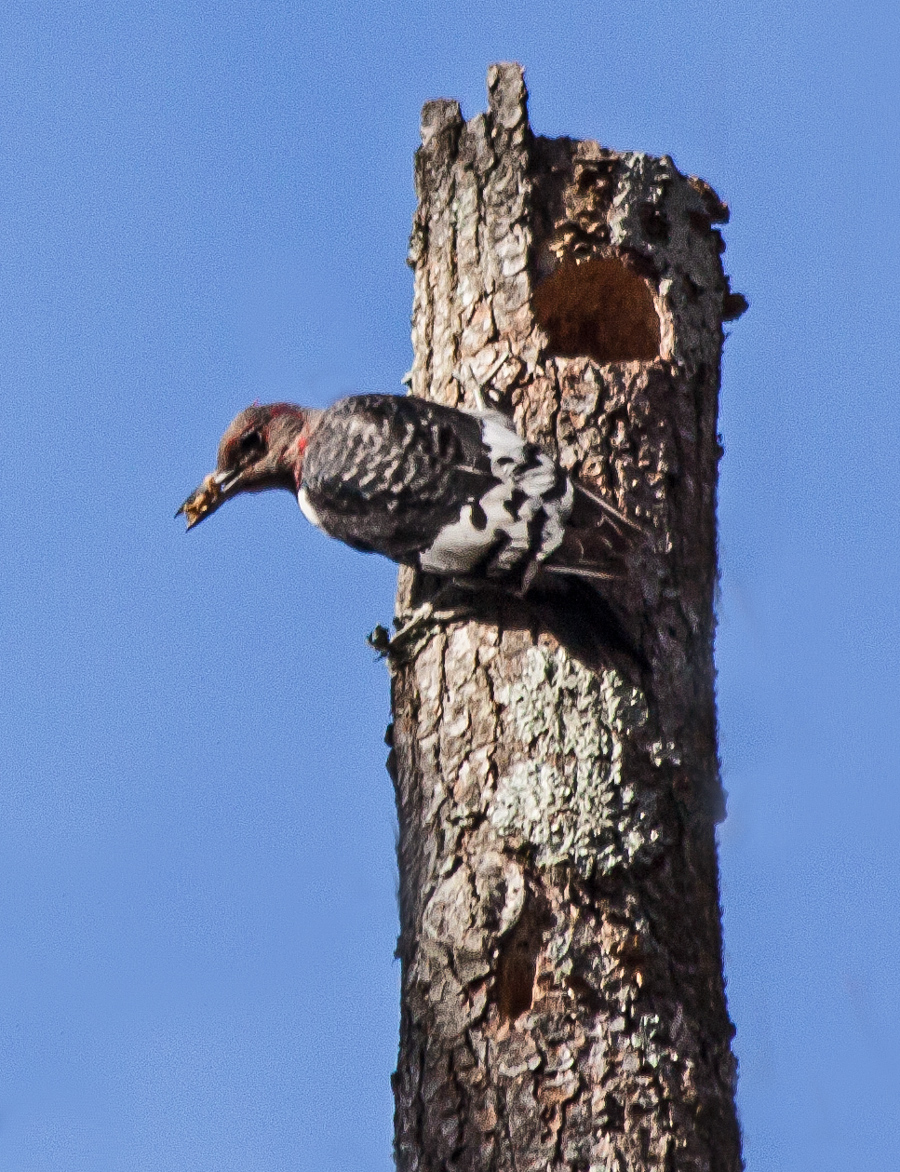
Wouldn’t you know it, I finally see a Red-headed Woodpecker (Melanerpes erythrocephalus) and its head is not red. It’s a juvenile one and if you look closely you can see a few traces of the spectacular red that it will eventually sport on its entire head.
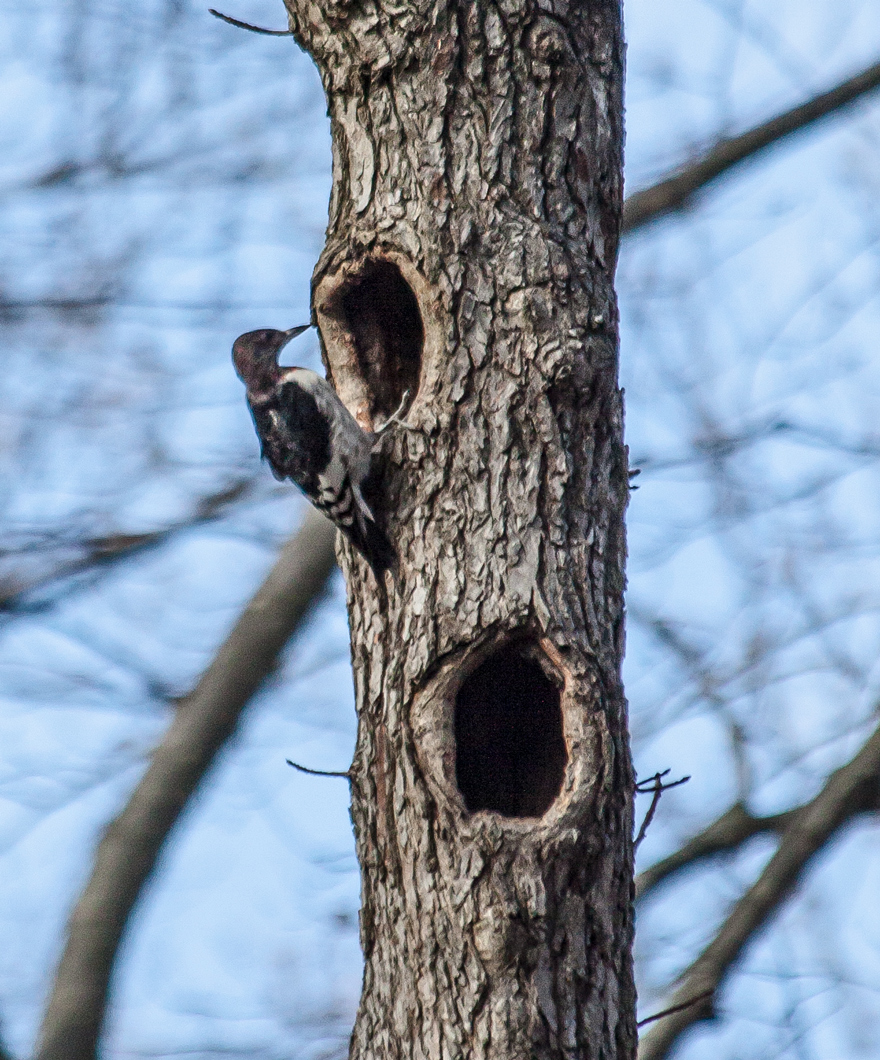
One of the serious birders at my local marshland park identified the area in which two juvenile Red-headed Woodpeckers had been seen regularly and I was fortunate to spot one of them this past Monday. The woodpecker seemed to be carving out a cavity in the tree and actually climbed into the hole as it chiseled away the bits of wood. Earlier, I saw one of them in the distance at a nearby tree with two large cavities (see the third photo). The bird stuck its head inside one of the cavities and I couldn’t tell if it was checking out the hole or was storing food there.
The Cornell Lab of Ornithology notes that the Red-headed Woodpecker is one of only four North American woodpeckers known to store food, and it is the only one known to cover the stored food with wood or bark. These woodpeckers have a varied diet and will eat both insects, which they sometimes catch in the air, and a a number of plant materials, especially acorns.
I don’t know how long it will take for this bird’s head to turn red, but I will certainly be keeping an eye out for it, now that I have an approximate idea of its territory.

© Michael Q. Powell. All rights reserved.
 Mike Powell
What an excellent photography – where is your local marshland?
It’s a place called Huntley Meadows Park, a kind of oasis in suburban Northern Virginia. If you want to learn more about it, check out this link http://www.fairfaxcounty.gov/parks/huntley-meadows-park/ .
What a great opening line to start a post! Nice find anyway.
I might just be heading over to your favorite marshland! I’ve been wanting to add a Red-Head to my life list!!
Come on down. There seem to be a couple of juveniles and there might be an adult or two as well, though I have never seen them. I am hoping they will be here all winter–I saw them again today, though I didn’t get very good photos.
I looked it up on ebird, and it seems Redheaded Woodpeckers are seen pretty regularly in your favorite marsh. I will definitely be over, hopefully before Christmas, to see that marsh!!
Learned a lot about the redheaded woodpecker. I’ve had little experience with them.
From what I read, their numbers are decreasing as their habitat area shrinks.
Looks kind of scruffy to me…. I’m impressed that you could make this identification. I am hopeless with juveniles. Don’t even try.
I had a really experienced birder point it out to me the first time and I have learned to recognize its call. I would have had troubles identifying it on my own.
I see the adults fairly often but finding a juvenile is a rare treat.
I’m still looking to see my first adult–but it’s definitely a treat for me to see any Red-headed Woodpeckers (mostly all I see are Downy and Red-bellied Woodpeckers).