Feeds:
Posts
Comments

Archive for May, 2013

Although it is usually best not to take head-on shots of birds, I can’t help but post this image of a Barn Swallow (Hirundo rustica) looking at me with angry eyes. I don’t know if the swallow qualifies as an Angry Bird, but there is no denying the intensity of the stare.

I grew up with the music of Loggins and Messina and one of their popular songs entitled “Angry Eyes”  opens with these words:

Time, time and again
I see you staring down at me
Now, then and again
I wonder what it is that you see

With those angry eyes
Well, I bet you wish you could cut me down
With those angry eyes

(Lyrics from www.elyrics.net)

What does go on in the minds of barn swallows when they encounter us?

eyes_blog

Michael Q. Powell. All rights reserved

Read Full Post »

Swans have Swan Lake, so why shouldn’t shorebirds have Shorebird Ballet?

It looked like these Lesser Yellowlegs (Tringa flavipes) were practicing their dance moves in the water one day recently. As you can see, it requires great balance and, as the second photo shows, attention to the foot position—you have to keep the toes pointed. (One or more of these might be Greater Yellowlegs (Tringa melanoleuca), but my identification skills are not honed enough to be able to distinguish between the two with any great certainty.)

You can’t turn on the television these days without seeing commercials for dance competition programs like Dancing With the Stars or So You Think You Can Dance.  These birds could be at the leading edge of a new dance craze, Dancing With the Birds.

They already have a leg up on their competition.

ballet2_blogballet1_blog

Michael Q. Powell. All rights reserved

Read Full Post »

All alone, this Hooded Merganser duckling sought refuge on a floating log, separated from his family. I don’t know for sure what happened to the rest of the ducklings and the mother, but I had heard some reports of dwindling numbers of ducklings.

The duckling seemed to feel safe on the log and appeared to relax a little, but kept looking forlornly out into the distance. Eventually he was joined by a turtle on the log. For a brief moment, perhaps, he felt a little less alone. Deep inside, though, he felt a desire to grow stronger, so he stretched out his wings, fervently believing that someday he would be able to fly.

Alone_blog

Where are the others?

alone2_blog

Feeling a little more comfortable

alone3_blog

Someday I’ll be able to fly

Michael Q. Powell. All rights reserved

Read Full Post »

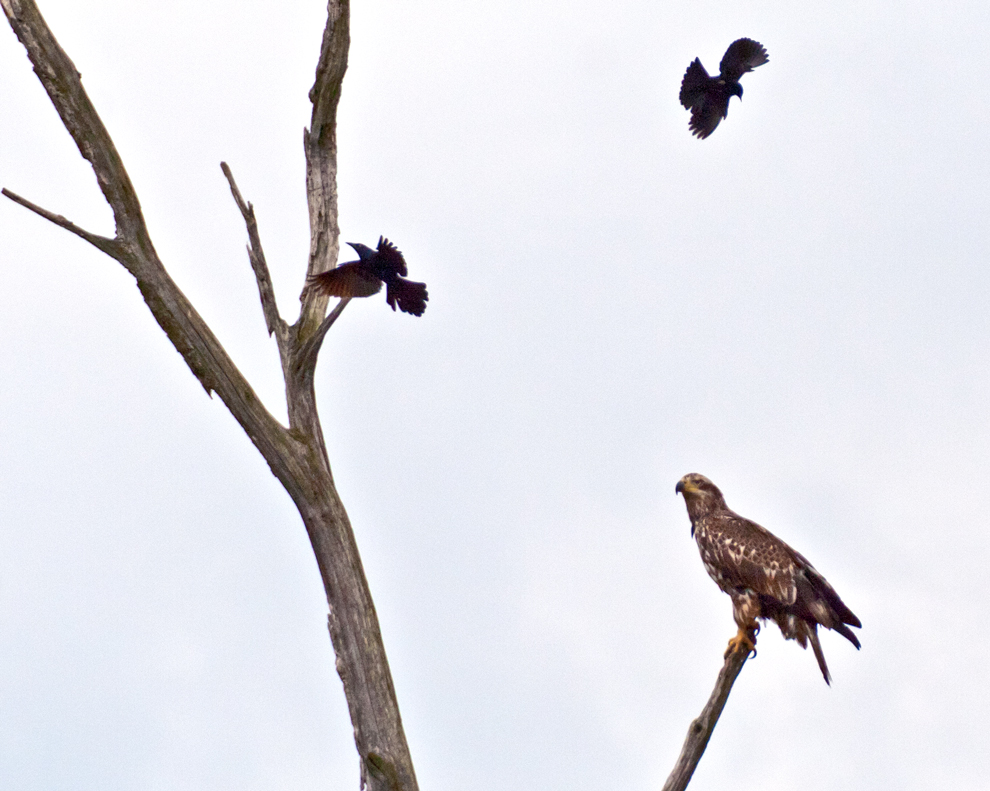
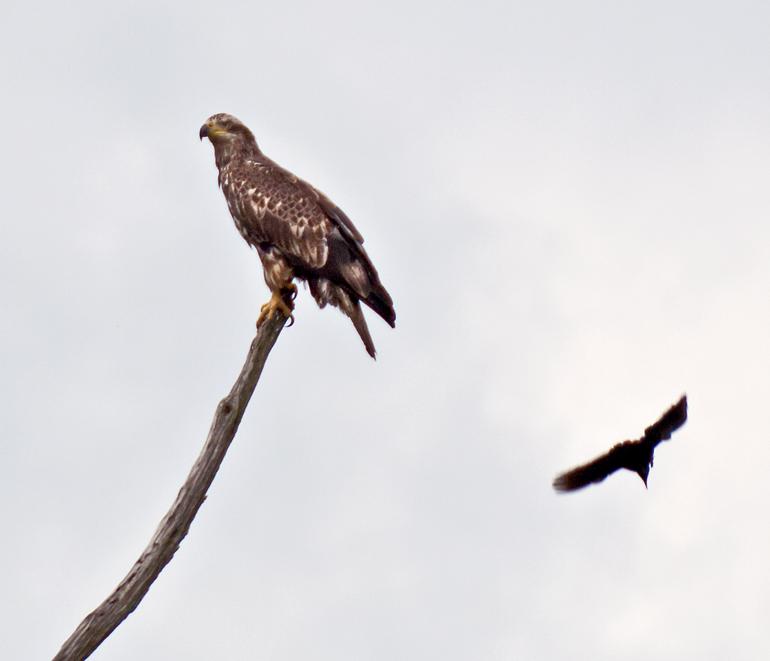
After doing an initial posting earlier this week on an encounter between a young Bald Eagle (Haliaeetus leucocephalus) and group of Red-winged Blackbirds (Agelaius phoeniceus), I reviewed my photos and came up with a few more to share.

These shots show various moments in the assault of the blackbirds, which seemed determined to harass the much larger eagle. I naturally paid the most attention to the juvenile eagle and tried to capture his attitude of alertness and wariness. After a few minutes of the off-an-on attacks, the eagle finally took off, seemingly in pursuit of the blackbirds.

It was amazing to watch this action and I am glad I managed to get some photos to document the encounter.

eagle3_blog

Buzzing the eagle (click on photo for higher resolution view)

eagle7_blog

Circling around for the next attack

eagle6_blog

Ever vigilant

eagle5_blog

Alert for the next attack

eagle4_blog

Relaxed but wary

Michael Q. Powell. All rights reserved

Read Full Post »

I hadn’t intended to do a head-and-shoulders portrait of this Barn Swallow (Hirundo rustica), but my telephoto zoom was near the far end when I carefully placed my tripod on the boardwalk and focused on the swallow.

Sensing that the bird was not going to remain perched for very long, I quickly snapped off a few exposures. My left hand was adjusting the ballhead of my tripod and my right hand was pressing the shutter, so zooming out was not really an option at that moment. The image that you see is as much of the bird as I was able to capture.

I did manage to get some good detail in the eye (and I recommend clicking on the photo for a higher resolution view) and I am happy with the background, which once again looks like a studio setting—it may not be very exciting, but it sure is uncluttered.

I suppose that the lesson for me is to have my camera fully adjusted as I am sneaking up on birds, but sometimes “mistakes” turn out pretty well too.

headandshoulders_blog

Michael Q. Powell. All rights reserved

Read Full Post »

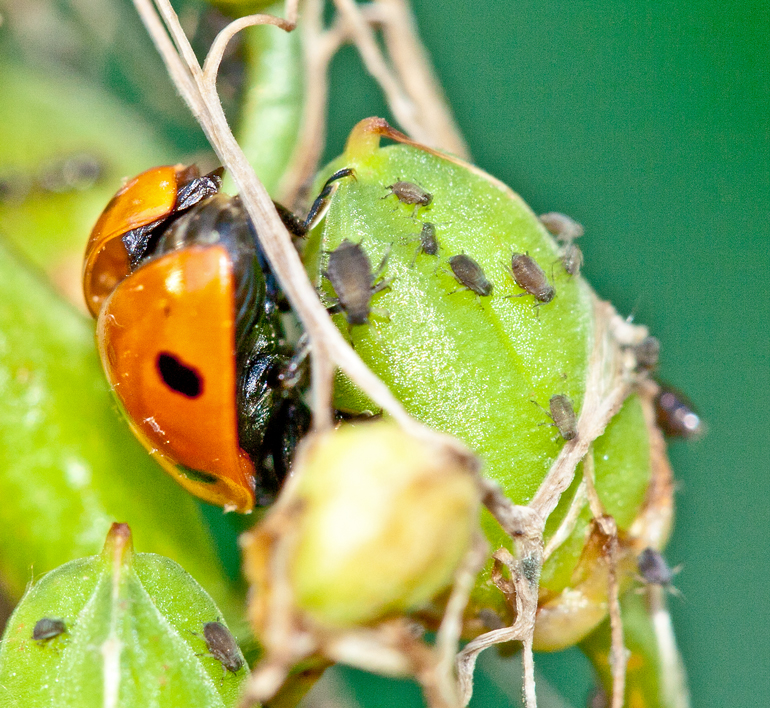
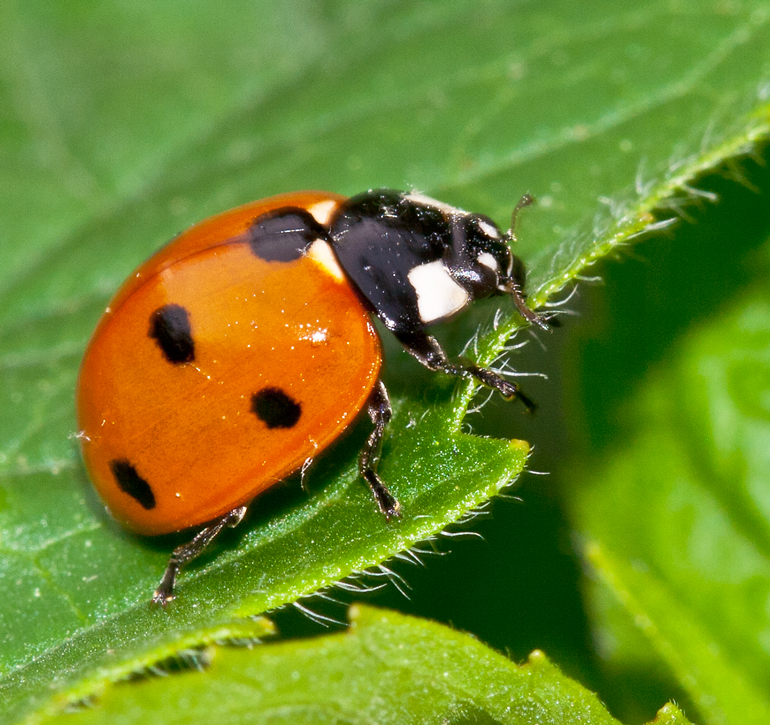
This ladybug was not in a very good position for me to get a shot, but I usually try to photograph every ladybug that I see, so I took the shot, totally oblivious to the fact that she was not the only bug in the frame.

Occasionally, when I am photographing a flower or an insect, there is an additional insect in the photo that I notice only when reviewing the  images, what my friend Cindy Dyer calls a “bonus bug.” How did I miss almost a dozen bugs in my viewfinder?

Can anyone identify the little bugs?

bugs_blog

Michael Q. Powell. All rights reserved

Read Full Post »

Looking at this plant from the side, all you notice are the tall, straw-like spikes that radiate from the center, but from above, it’s like looking into a kaleidoscope. I love the repetition of the colors and patterns in a wide circle around the center blossom.

I don’t have any idea what kind of flower this is, so I’ll make up my own name for it and call it the Kaleidoscope flower.

circle_blog

Michael Q. Powell. All rights reserved

Read Full Post »

I was checking out a location this morning where I had previously seen an eagle, when suddenly a juvenile Bald Eagle (Haliaeetus leucocephalus) landed on the tree at which I was staring. He seemed a little flustered and I soon found out why—he was being harassed by a group of Red-winged Blackbirds (Agelaius phoeniceus). They may have been crows, but one of my shots seems to show a flash of red on one of the black birds.

I have a few more shots that I am working on, but thought I’d give you an idea of the scene that I witnessed. I am pretty sure that this is a juvenile Bald Eagle, but would welcome a correction if I am wrong. In any case, it was pretty exciting for me.

eagle1_blogeagle2_blog

Michael Q. Powell. All rights reserved

Read Full Post »

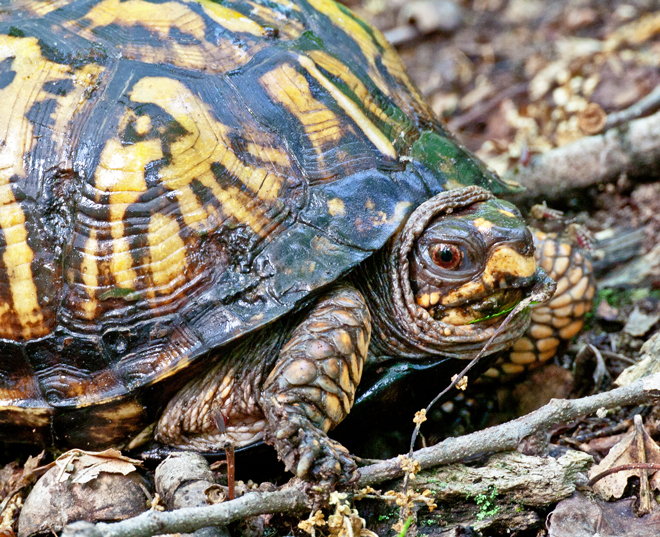
Previously I have seen turtles only in the water or sunning themselves on logs, but this weekend I encountered this cool-looking turtle, which I have identified as an Eastern Box Turtle (Terrapene carolina carolina), while I was walking through the woods.

As I was searching to identify the turtle, I came across all kind of interesting factoids, like the box turtle’s ability to close itself up entirely in its shell and its normal lifespan of 25-30 years. The Eastern Box Turtle is so popular that, according to Wikipedia, it is is the official state reptile of North Carolina and Tennessee.

As for me, I am particularly attracted to its eyes, which somehow remind me of those of Yoda, the Star Wars character.

turtle2_blogturtle1_blog

Michael Q. Powell. All rights reserved

Read Full Post »

I really enjoy the challenge of trying to photograph insects and this ladybug was a relatively cooperative subject. She sat still for quite a while, which allowed me to experiment a little with techniques. The first show was taken after she started to move a little.

The light was fading a little, so I decided to see what would happen if I used my pop-up flash. It’s obvious to me that I risk having a hot spot, which is most visible in the second shot, but it seems that the additional light helped to bring out some additional details. I have seen the fancy setups advertised that use dual external flashes, but don’t think that I am ready to make that kind of financial commitment. Perhaps I will experiment with a cheaper, LED light or possibly a ring light and see how well they work.

ladybug2_blogladybug1_blog

Michael Q. Powell. All rights reserved

Read Full Post »

I was pleasantly surprised to come across a group of irises in one of the marshy areas of Huntley Meadows Park, the nature center where I do a lot of my shooting.

It probably reveals my ignorance about flowers, but I had no idea that irises could grow in such moist conditions. Although the irises were smaller and less showy than many of the cultivated ones that I see, they were no less beautiful.

It had been raining intermittently the morning that I took this photo and you can see drops of water on some of the petals. I tried very carefully to frame this image and am pretty happy with the way that it turned out, with the blurry image of a second iris in the background repeating the shape and color of the iris in the foreground.

swamp_iris_blog

Michael Q. Powell. All rights reserved

Read Full Post »

Do you prefer to take photos alone or with others?

Normally I prefer to shoot alone, to move at my own pace and shoot whatever catches my eye at a given moment. However, there are advantages to working side-by-side with another photographer. The other person can serve as a spotter and point out opportunities and subject that you might have otherwise missed. It’s also interesting and instructive after a shoot is done to compare images and see the same scene through another set of eyes.

Friday late in the afternoon, I noticed that my neighbor, friend, and photography mentor, Cindy Dyer, was out in her garden taking photos of her beautiful flowers. Cindy, a noted photographer, has been a constant influence on my photography this past year, encouraging me and inspiring me. She loves this time of the year, when nature explodes with color, and her blog is full of beautiful images of flowers of all varieties (and lots of other cool photos too).

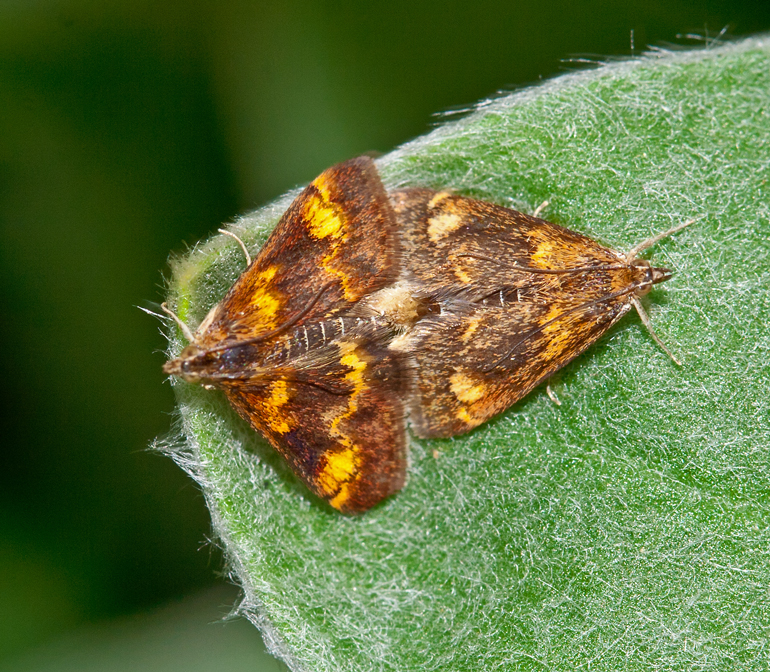
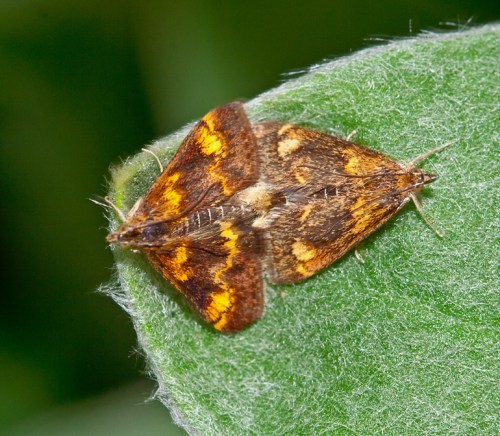
When I started shooting with Cindy, I was shooting a lot of flowers and a few insects, but gradually moved to shooting more insects than flowers. Somehow my eyes are attracted to insects. Shortly after joining Cindy in her garden with my camera and tripod, I spotted what I thought was an interesting looking insect. Upon closer examination, it turned out to be a pair of mating moths, that together were about one inch long (2.5 centimeters). They were positioned in such a way that the only way to capture them was to shoot from directly overhead. I had real problems with depth of field as I got my macro lens as close as it would let me get.

I challenged Cindy (in a friendly way) to photograph this couple and she took up the challenge and posted an image in her blog. It was an interesting challenge pitting Nikon against Canon and teacher against student as we explored the limits of our macro lenses and photography skills.

This little incident helped to remind me of the benefits of shooting with someone else, especially someone who gently pushes me forward. It usually works best for me when we travel somewhere and shoot side-by-side part of the time and wander on our own the rest of the time—the best of both worlds.
moths_mating_blog

Michael Q. Powell. All rights reserved

Read Full Post »

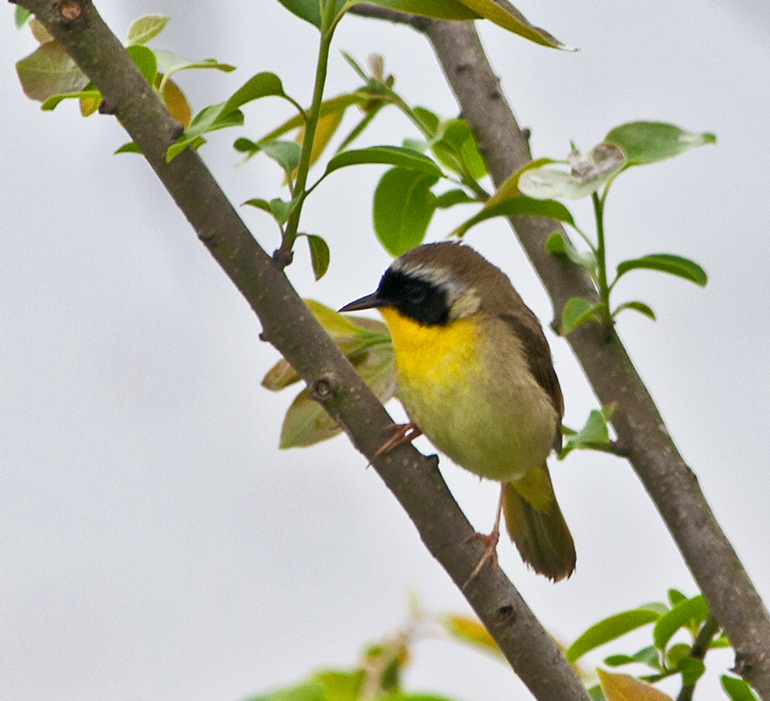
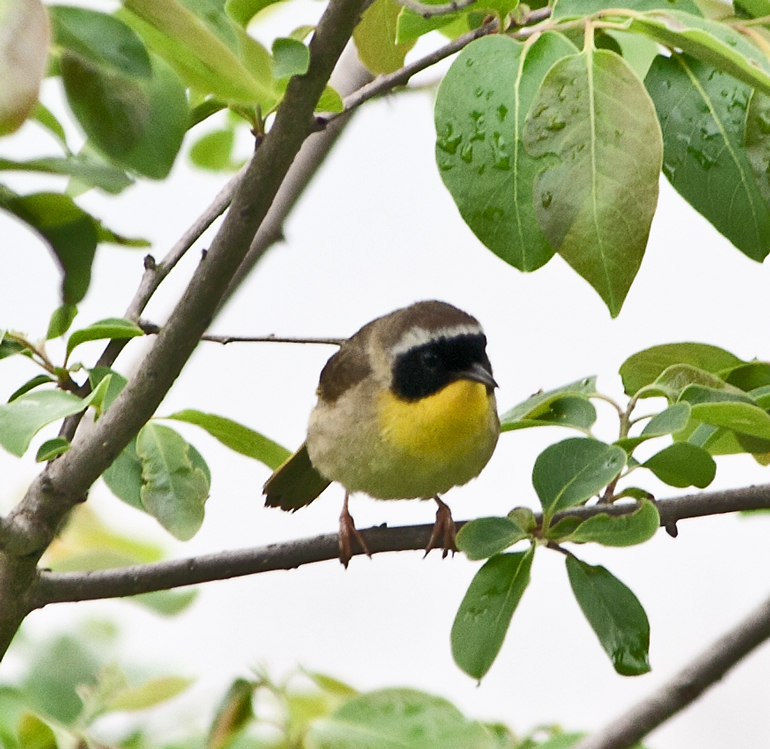
I have been hearing the calls of this little warbler for several weeks, but today was the first day that I got some clear shots of the male Common Yellowthroat (Geothlypis trichas).

I was fortunate that the foliage was not too dense when I initially spotted the bird and even when he moved to a second spot in the same tree, I had a relatively unobstructed view. Birders at my local marshland tell me that the male comes north before the female and that soon the females, which are not so brightly colored, will arrive.

warbler1_blog warbler2_blog

Michael Q. Powell. All rights reserved

Read Full Post »

Yesterday was warm and humid, which felt almost like summer here and brought out more dragonflies.

The sun was a little harsh just before noon, but I couldn’t help chasing after the dragonflies and got this shot of a male Common Whitetail dragonfly (Plathemis lydia).

head-on_blog

Michael Q. Powell. All rights reserved

Read Full Post »

I have been taking photos of a lot of flowers in a lot of different places and thought I would post a few of my favorites.

The first one is of a plant called Lily of the Valley that was growing in the back yard of one of my neighbors. It was pretty small and close to the ground, so I have to create a makeshift bean bag to support my camera, using cushions for lawn furniture

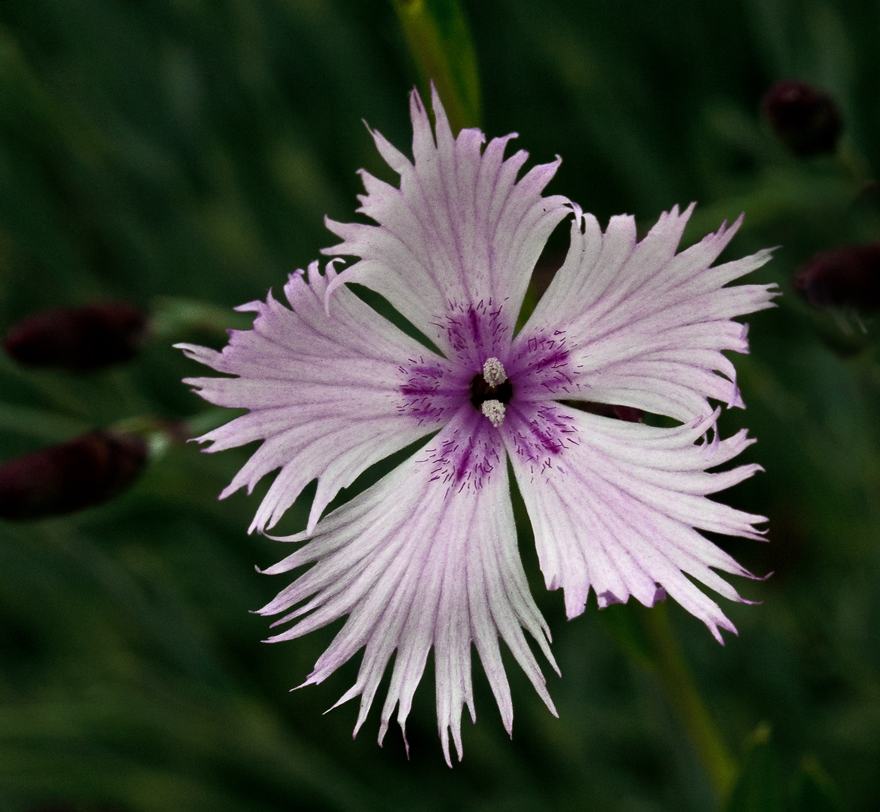
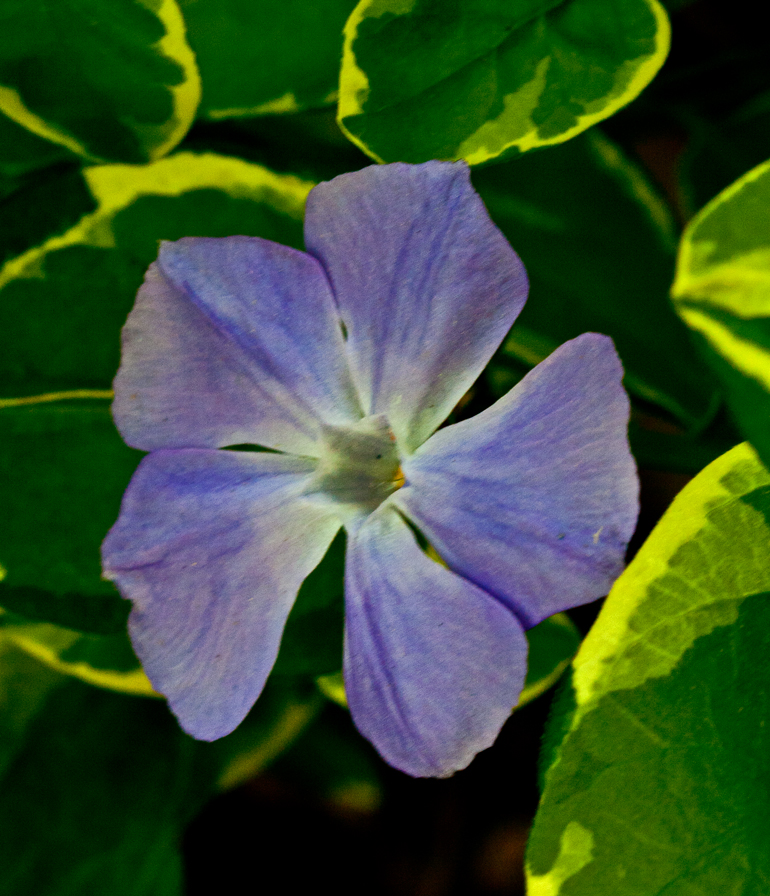
I really don’t know what the second flower is called, but I really liked the shape of its petals and the slight pinkish-purple tinge of color .

The final shot is a small plant that was growing in the rock garden of a county-run historical garden that I love to visit. From a distance, the flower looked like it was in the shape of a cube.

lily_blogflake_blogsquare_blog

Michael Q. Powell. All rights reserved

Read Full Post »

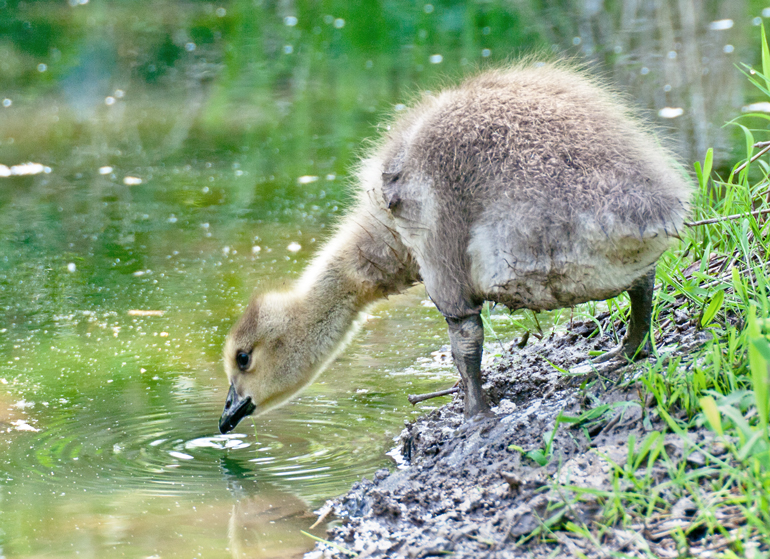
The last few weeks I have been following the adventures of a family of Canada Geese (Branta canadensis) at my local marshland and encountered them this morning as they were foraging in the muddy grass.

There are currently four goslings (there may have been six initially if this is the same family I saw previously) and it was fun to watch them as they would wander off a little from their parents and then scurry back quickly.

It was hard to get clear shots of the youngsters, but I did manage to get this shot that I like when one of the goslings walked to the water’s edge to get a drink.

gosling1_blog

Michael Q. Powell. All rights reserved

Read Full Post »

On a heavily overcast day with intermittent rain, most birds seemed to be in hiding, but this male Red-winged Blackbird (Agelaius phoeniceus) took the opposite approach by flying to the highest tree and loudly announcing his presence to the world with his distinctive call.

I like the way that the limited lighting caused this profile shot to turn into almost a silhouette, but somehow the colorful shoulder markings managed to show through.

blackbird_whitesky_blog

Michael Q. Powell. All rights reserved

Read Full Post »

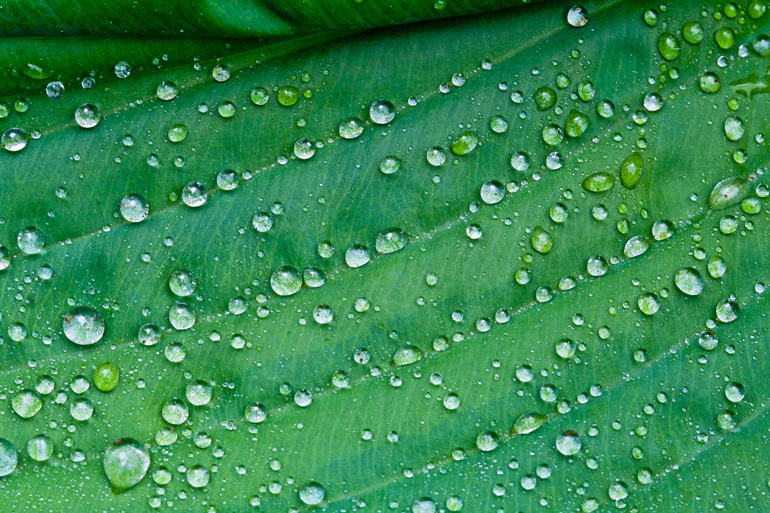
I love to photograph raindrops, normally focusing on a single drop, but I was really attracted this weekend to the rows of water drops on a single leaf of this Hosta plant. Many of them formed perfect little spheres of water, like tiny jewels or little water pearls.

Sometimes it’s easiest to find real beauty in simplicity, with no need for bright colors or ornate details.

drops1_blog

Michael Q. Powell. All rights reserved

Read Full Post »
Love-in-a-mist (Nigella damascena) is a flower that looks like it came from outer space, with wild tendrils shooting out of its middle and green spikes surrounding it.

I was surprised this past weekend to see some of the plants putting out blossoms this early at a local garden that I like to visit. I had never seen Love-in-a-mist (I love saying the flower’s name) in its early stage of growth and really like the look of the bud in the last photo, surrounded by the soft green spikes, as the flower is at all stages of growth.

Before long, entire patches of this garden will be covered with this remarkable flower—we can always use more Love, whether it is in a mist or not.

love1a_bloglove3_bloglove2_blog

Michael Q. Powell. All rights reserved

Read Full Post »

Columbines come in a variety of colors and they have sharp angles as well as soft curves—these are a few of the reasons that columbines are among my favorite spring flowers.

purple_columbine_blogdown_blog

Michael Q. Powell. All rights reserved

Read Full Post »

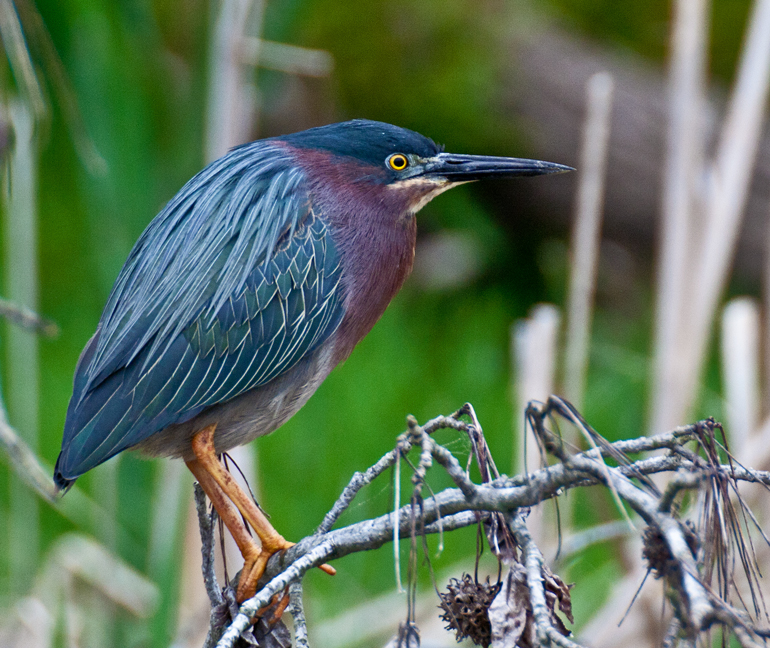
I stopped dead in my tracks on Monday when I spotted this Green Heron (Butorides virescens) as I was walking along the boardwalk at my local marshland park.

Only rarely have I had such an unobstructed view of this beautiful bird. My camera was already affixed to my tripod and I slowly opened its legs and set it down, all the while keeping my eyes on the Green Heron. I didn’t dare to make any sudden movements and felt like I was moving in slow motion as I inched my way forward to the edge of the boardwalk.

I don’t know if the heron was actively hunting for prey, but he seemed really focused and unaware of my presence (or was willing to ignore me). Initially upright, the heron gradually leaned more and more forward and appeared to be focusing even more intently.

My breathing seemed loud in my ears and my shutter sounded like a machine gun to me, but the heron hung around long enough for me to get some pretty good photos. Eventually, though, he got spooked and flew away, but I think I have an idea of the general area in which he hangs out, so I hope to encounter him again.

greenheron1_bloggreenheron2_bloggreenheron3_blog

Michael Q. Powell. All rights reserved

Read Full Post »
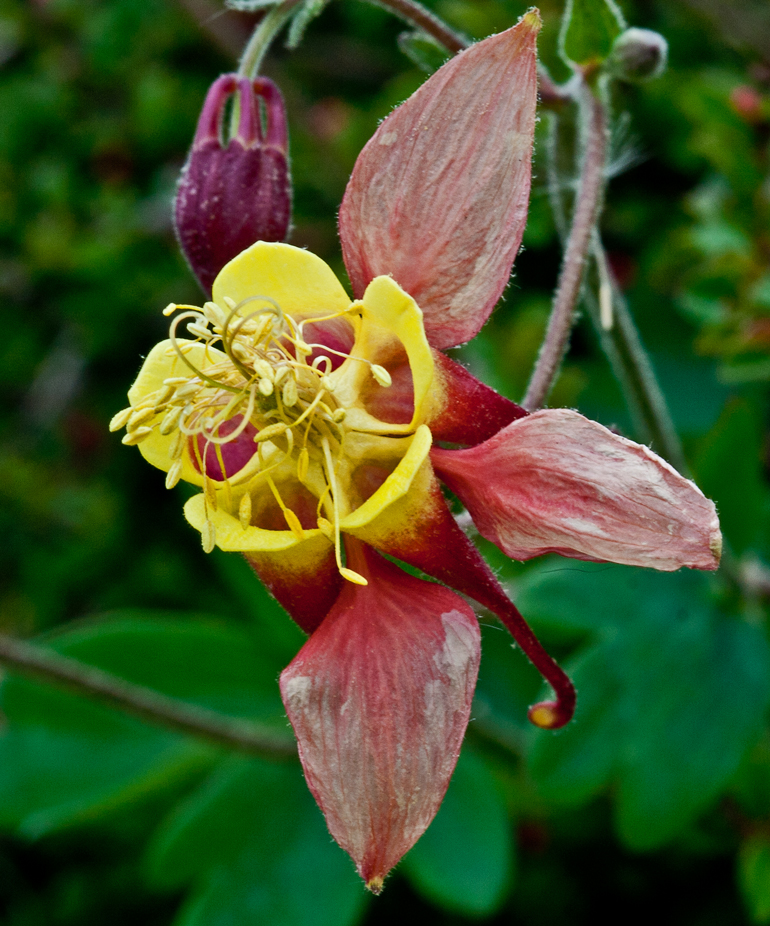
One of my favorite spring flowers is the columbine (genus Aquilegia) and I especially like its distinctive shape. Yesterday I took this photo at Green Spring Gardens, a county-run historical garden, one of my favorite spots for photographing flowers.

The flower was growing at an unusual angle and I tried hard to capture the details of the flower, as well as the beautiful colors in the background. I’m pretty happy with the result.

pink_columbine_blog

Michael Q. Powell. All rights reserved

Read Full Post »

In my neighbors’ garden facing the street, a beautiful purple bearded iris has a position of prominence, but unseen by most, a more modest, but equally beautiful purple flower grows amidst the vines in a corner of the back yard.

This iris is a showy flower, with deep, rich colors, frilly petals, and the colorful accent of the beard. How can you not like such a flower? It is the first iris to bloom and doesn’t have to share its glory.

Yet I am just as attracted to the geometric simplicity of the little purple flower in the back yard. The owner, Cindy Dyer, who posts amazing flower photos on her blog, told me the name of the flower (or perhaps it is considered a weed), but it didn’t stick in my memory.

Spring offers such a bounty of flowers, that there are bound to be some that appeal to your tastes and moods and sensitivities—it is definitely worth slowing down to smell the roses (and taking in the beauty of the other flowers too).

Iris_blogpurple_blog

Michael Q. Powell. All rights reserved

Read Full Post »

Ladybugs are often considered symbols of good luck and many people look at them as cute. Consequently, you have probably never considered them as menacing (assuming that you are not an aphid), but that is the descriptor that came to mind when I first looked at this head-on image of a ladybug that I photographed yesterday.

Perhaps I am just not used to looking eye to eye with a ladybug, but this one seems to have a deadly serious look on its face, like it was not happy that I was disturbing it.

I took the shot in my neighbor’s garden, using a macro lens and a hand-held diffuser to cut down on the intensity of the sunlight. Although I stopped down the lens to get some additional depth of field, the back portion of the ladybug, including its rear legs, are out of focus, which helps to draw attention to the face.

The change in seasons means that I will probably be featuring fewer birds in my blog than during the winter, and a whole lot more insects and flowers.

ladybug1a_blog

Michael Q. Powell. All rights reserved

Read Full Post »
There is a spot in a back corner of my marshland park that I love to visit in the early morning, when the light produces beautiful reflections in the still waters of a small pond.

It’s accessible only by an informal muddy trail, so I don’t have to share the moments of tranquility with the baby strollers and power walkers that interrupt my conversations with nature when I am on the boardwalk. Sometimes I will see ducks and geese here and I have even spotted a bald eagle perching in a tall tree, but the main draw for me is not the wildlife—it’s the sense of peace that envelopes me when I am here.

Sometimes I like reflections in which you can easily identify the objects being reflected, like the two trees in the first image. Other times, I get lost in the reflections themselves, which can result in a Monet-like abstract image like the second image below.

All of us are looking for an inner peace—this is one place in which I am able to experience a few moments of that peace.

reflection1_blogreflection2_blog

Michael Q. Powell. All rights reserved

Read Full Post »

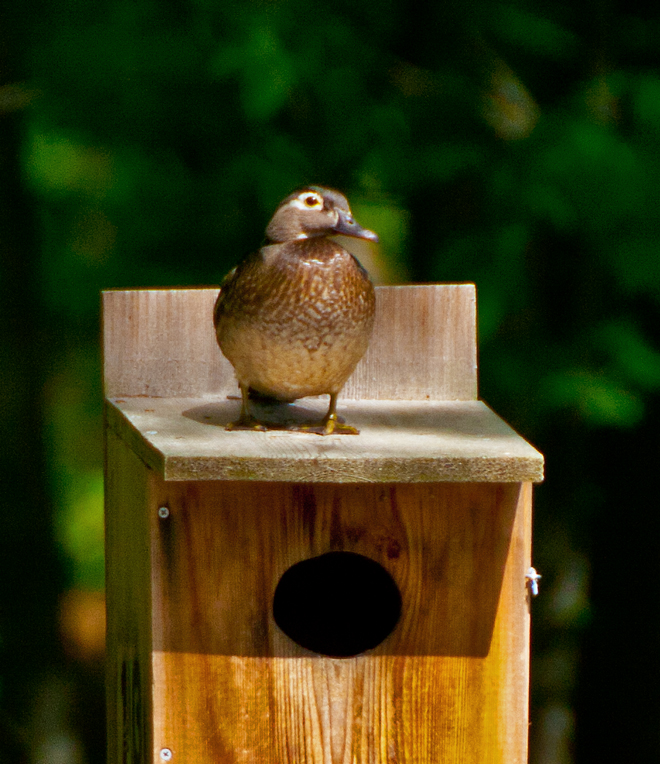
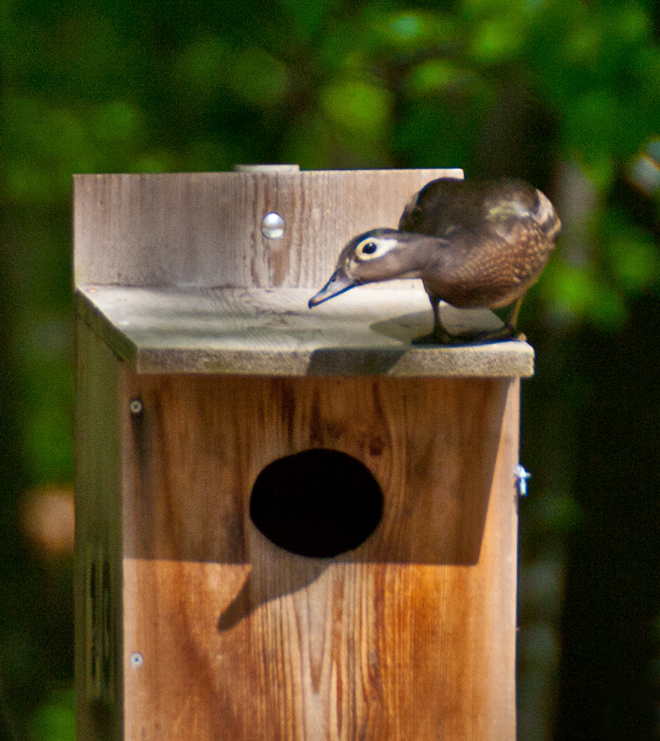
Yesterday I watched and waited as a female Wood Duck (Aix sponsa), perched on top of a nesting box at my local marsh park, decided when it was the right moment to enter into the box and work on her nest.

Initially I was surprised when I spotted the duck atop this particular nesting box, because Hooded Merganser babies had exited from the box only a week earlier. The female moved around a bit on top of the box, looking in both directions (second photo). Eventually she bent her head lower and lower, as if checking to see that the entrance to the box was clear (third and fourth photos.

When she finally did take off, she flew a little to one side (fifth photo) and made a tight little circle in the air. In the final shot, you can see the female duck with her eyes on the target, approaching it from just below the level of the bottom of the nesting box.

I led with the shot that I like the most. I am amazed that the duck can synchronize her movements so well and arrest her forward momentum to keep from banging into the back of the box (and to keep her wings from getting stuck).  The lighting kept changing as waited for the action to develop, to the point that I moved into manual mode, something that I only rarely do. I am happy that the sun was shining at the moment when she entered the box, because I think the shadow adds to the interest of the photo.

I missed seeing the Hooded Merganser duckings leaving the box—maybe I will be luckier with these Wood Ducks.

woody5_blogwoody1_blogwoody2_blogwoody2a_blogwoody3_blogwoody4_blog

Michael Q. Powell. All rights reserved

Read Full Post »

With the arrival of blue skies, I was finally able to a close-up shot of a Barn Swallow (Hirundo rustica) with a natural backdrop (vice the white background of the overcast days).

The lighting was beautiful and the swallow cooperated by turning its head slightly, enabling me to capture the catch light in its eye. The shadows are pretty minimal, but help to keep the image from being too flat.

I even like the serious expression on the swallow’s face, as though he had decided that this was a formal portrait.

barn_sky_blog

Michael Q. Powell. All rights reserved

Read Full Post »

Wood Ducks (Aix sponsa), especially the males, are probably the coolest-looking ducks, but in the past few months the only ones that I have seen have been flying away from me, generally from branches on which they were perched.

I was not really expecting that I would see any Wood Ducks on the ground when I approached a tiny pond earlier this week. However, I did notice a little movement at the water’s edge and had just focused on that area, when suddenly a pair of wood ducks took off. I snapped off a few shots, not really expecting that they would be in focus and was pleasantly surprised at the result

The ducks in this image ended up pretty much in focus, especially the male’s head, his most prominent and colorful feature. The wings have some motion blur, but it’s not too distracting.

I’d like to say that my focusing skills are getting better, but I know that this shot was primarily the result of luck. It doesn’t really matter that much how I got the shot—what matters more to me is that I like the result.

woodduck_flying_blog

Michael Q. Powell. All rights reserved

Read Full Post »
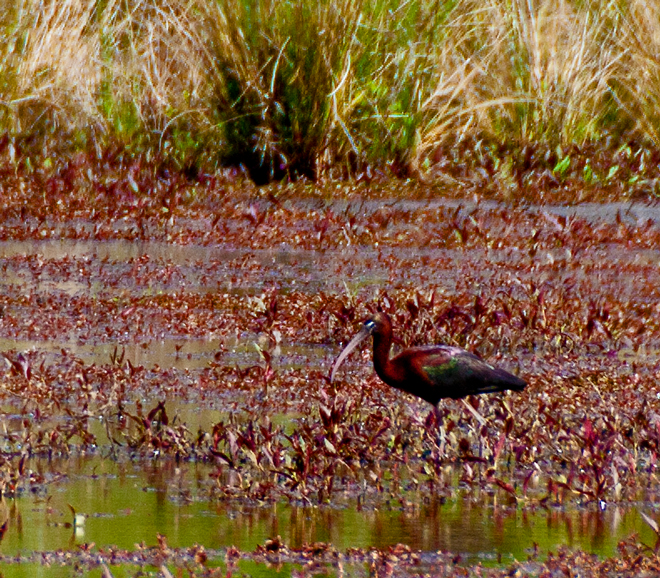
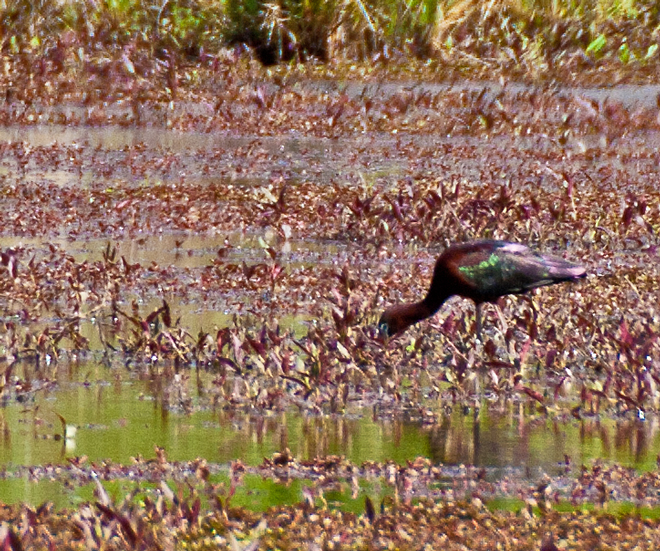
Yesterday at my local marsh, several birders were really excited about the unexpected presence of a pair of Glossy Ibises (Plegadis falcinellus). I missed seeing them fly in, but spent almost an hour watching them forage in the distance, listening to the debate among the birders about whether these were Glossy Ibises or White-faced Ibises—they concluded the birds were Glossy Ibises.

I think that these strange-looking wading birds tend to be found nearer the coast and it is relatively rare, though not unprecedented, to have them at our marsh. I was not able to get any close-up shots, but I did manage to take some photos that show their downward-curved bills and colorful breeding plumage. The last shot really gives you a sense of the color—one of the ibises opened its wings to hop over a little patch of water.

ibis3_blogibis2_blogibis1_blogibus4_blog

Michael Q. Powell. All rights reserved

Read Full Post »

Today I got this shot of a Tree Swallow (Tachycineta bicolor) gathering materials for a nest. I suspect that the swallow is using the nest that is attached to the metal pole on which it is perched, although I never actually saw the swallow enter the box.

nesting1_blognesting2_blog

Michael Q. Powell. All rights reserved

Read Full Post »
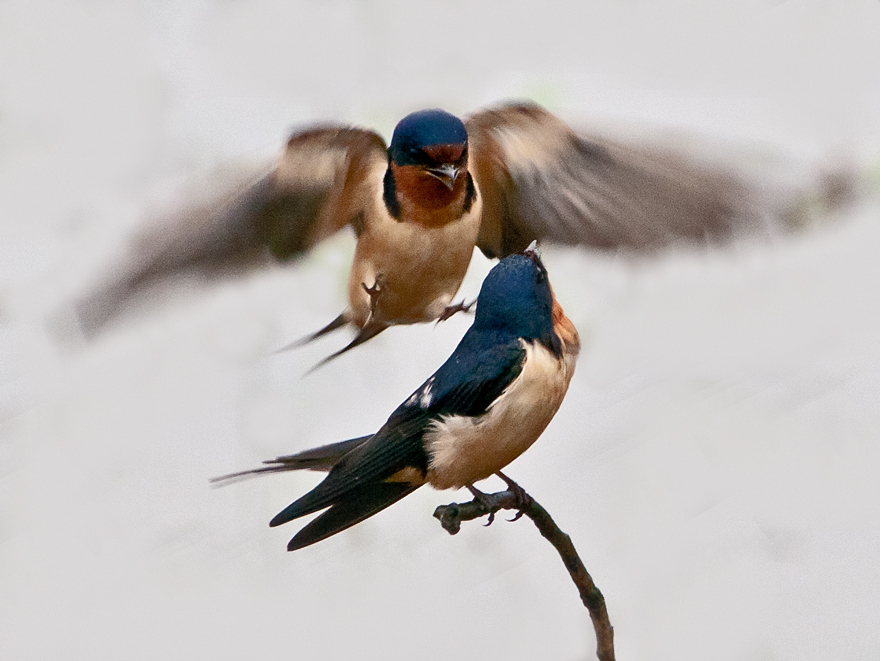
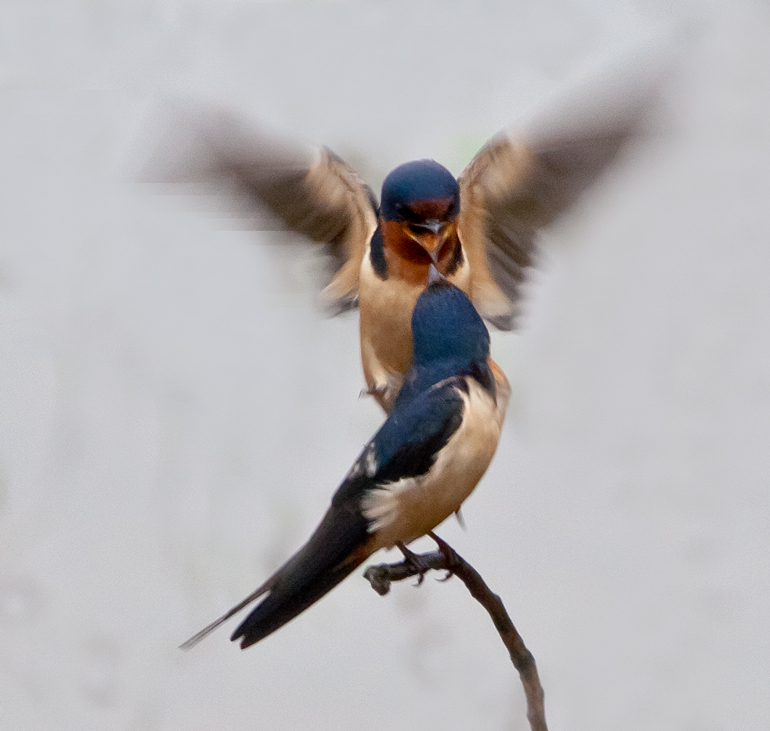
Are Barn  Swallows normally hostile toward each other?

As I was looking over once more the shots that I took on Monday, I came across this little series of images of two Barn Swallows (Hirundo rustica) interacting. I had passed over these photos when I did my first sorting, because they were seriously underexposed. Unlike the photo that I posted earlier this week of a confrontation between two swallows, I was not using a flash for these photos, which meant, however,  that I was able to take a burst of photos. (When I used my pop-up flash, I had to wait for the flash to re-cycle in order to shoot again.)

I tweaked these photos in Photoshop Elements (and cleaned up the background a little) and was amazed to discover that this confrontation seems to have escalated a bit beyond the previous one. The flying swallow seems much more aggressive and threatening, going beyond the squawking I had seen before, and looking more like he was ready to attack the sitting swallow, who seems to be paying attention to the incoming bird.

These photos would have been better with a higher shutter speed and better light, but I am amazed that I was able to capture this moment. I love interactions between members of the same species (and between different species) and I enjoy trying to catch those moments.

scream2c_blogScream2a_blogscream2b_blog

Michael Q. Powell. All rights reserved

Read Full Post »

« Newer Posts - Older Posts »