Feeds:
Posts
Comments

Archive for April, 2013

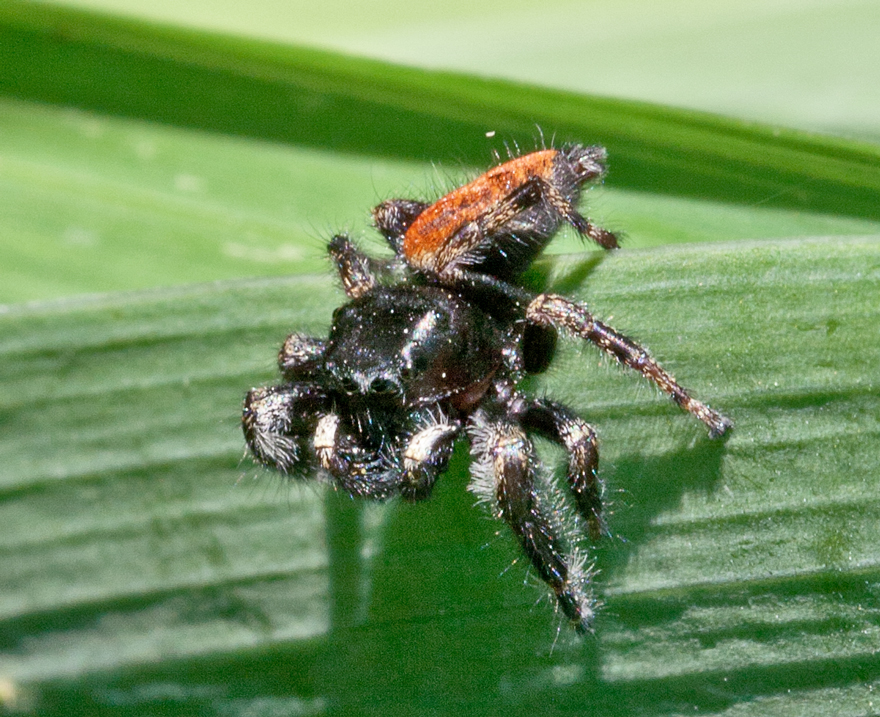
I was checking out the plants yesterday in my neighbor’s garden when I came upon this cool-looking spider, a type that I had never before encountered. From an initial check on-line, it looks like this might be a kind of jumping spider, though I really am out on a limb with the guess. In any case, I really like the combination of red and black on his body and the multiple eyes that are just visible.

With the arrival of spring, I am starting to see some familiar insects from last year and some new “friends.” It’s an exciting time for me.

spider_blog

Michael Q. Powell. All rights reserved

Read Full Post »

A blog about a frog on a log in a bog—is this how Doctor Seuss got started?

The subject is ordinary and the composition is simple, but I really like the result. The frog seems to be lost in a moment of contemplation as he stares out across the pond and I made sure not to wake him from his reverie as I quietly snapped his photo and moved on.

frog1_blog

Michael Q. Powell. All rights reserved

Read Full Post »

When I came across this fairly large snake, which I think is a Northern Black Racer snake (Coluber constrictor constrictor), I was happy that I had a fairly long telephoto lens.

He looked to be about 48 inches long (1.2 meters) and was partially coiled on top of a bush at the edge of the beaver pond at my local marsh. Although he was basking in the sun, he was definitely alert, which was one of the reasons why I was very cautious. The photo provides a close-up view of his head, but it was shot with my zoom lens at about 340mm, so I was not close and personal with him.

Wikipedia notes that this snake usually swallows its prey alive, despite the “constrictor” in its Latin name. Although these snakes will try to avoid predators, “once cornered they put up a vigorous fight, biting hard and often.” I’ll definitely keep that in mind.

One other interesting bit of trivia that I discovered about the Northern Black Racer snake (and I recognize that I could be wrong in my identification) is that the snake was designated as the official state reptile of Ohio in 1995.

snake_blog

Michael Q. Powell. All rights reserved

Read Full Post »

I am going to have to brush up on my insect identification skills, but I think that this cool-looking insect is a larval form of a ladybug.

I don’t have a garden of my own, but one of my neighbors, fellow blogger and photographer Cindy Dyer, has a wonderful garden that is always full of colorful flowers and insects. I photographed this insect in her garden this afternoon.

The sunlight was a little too direct and the shadows are too harsh. I am happy, though, that I was able to pick up many of the insect’s details with my macro lens. In case you are curious, the bright red in the background is a group of tulips that are in full bloom.

As always, I welcome corrections or clarifications about my identification of my subject—there are lots of folks on-line with greater knowledge and experience in all of the subject areas in which I shoot.

insect_blog

Michael Q. Powell. All rights reserved

Read Full Post »

Standing at an apparent crossroad, I was struggling to decide if I should continue to focus my attention on birds, as I did much of the winter, or switch back to the insects that populated so many of my photographs last summer.

This photo of a Red-winged Blackbird (Agelaius phoeniceus) from yesterday suggests that maybe I don’t necessarily have to choose one or the other, that maybe I can live in both worlds at least some of the time.

I wonder how often in my life I set up these kind of false choices, when I would be better served by thinking more expansively and creatively.

blackbird_bug_blog

Michael Q. Powell. All rights reserved

Read Full Post »

Today I saw my first dragonflies of the spring, which I am pretty sure were Common Green Darners (Anax junius). They buzzed by me several times, but never stopped to perch.

I had reconciled myself to the likelihood that I would not get a single shot.  Suddenly a dragonfly that I was chasing stopped and hovered over the water. I have never had any success before in capturing an in-flight image of a dragonfly, but somehow I was able to grab focus and got several pretty good shots. The beautiful, two-toned colors of this dragonfly are amazing.

I look forward to a new season of chasing dragonflies, but suspect that I will have to work hard to top this first dragonfly of the spring.

dragonfly_blog

Michael Q. Powell. All rights reserved

Read Full Post »

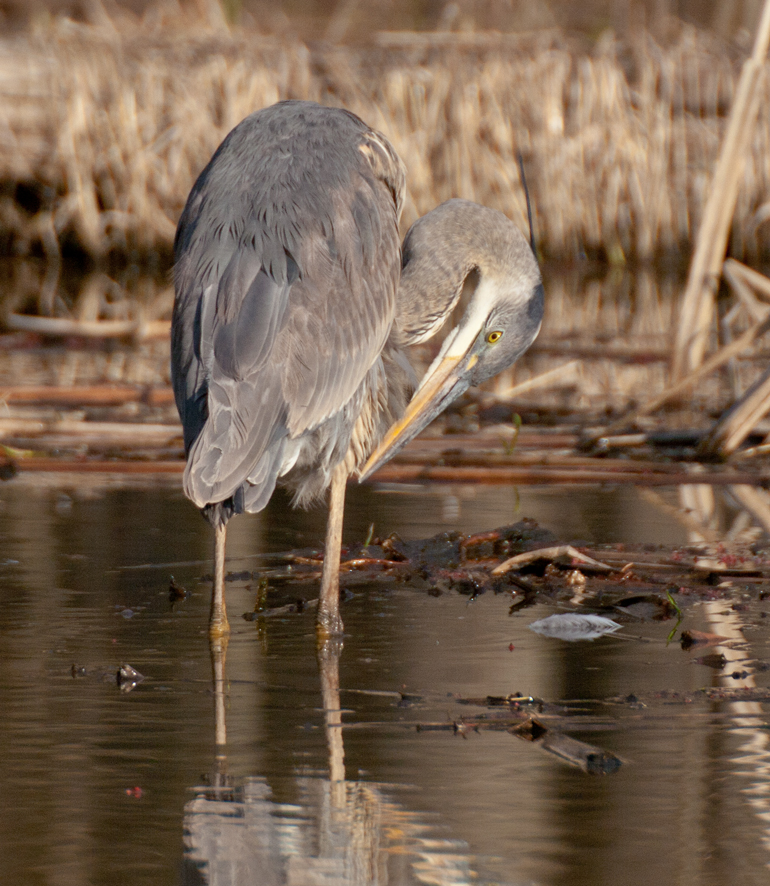
I arrived at the marsh early in the morning, just as this Great Blue Heron (Ardea herodias) was getting up. He seemed to be going through his pre-breakfast routine, grooming and preening and getting ready for the day ahead. It was fascinating to watch him contort his long neck as he sought to arrange his feathers just so. The water was calm enough that he could have used it as a mirror, if he had wanted to do so.

I am not sure if he was trying to make himself look bigger and fluffier, was airing himself out,  or just wanted some additional air for insulation, but at one point he shook himself vigorously. I was fortunate enough to get the first photo as he was in the process of ruffling the feathers.

Eventually, my feathered friend decided that he was presentable and stood motionless, as though posing for me. I’ll post some of those images later.

standing_heron3_blog

standing_heron2_blog

Michael Q. Powell. All rights reserved

Read Full Post »

This is another close-up, pseudo-macro image that I shot with my telephoto zoom lens and I really like the way that the yellow in the center of the white flower seems to glow. Controlling depth of field was especially challenging when shooting something like this with my lens set a little over 300mm. I wanted the background to be as green as I could get it, which is tough at this time of year, so I had to bend low to get this angle. I achieved that goal partially,  though I was not able to blur out the background very well.

I guess it’s finally time to pull out the macro lens.

glow_blog

Michael Q. Powell. All rights reserved

Read Full Post »

Most often I see small woodpeckers high up in the trees, pecking at the smaller branches there, but this male Red-bellied Woodpecker (Melanerpes carolinus) seemed determined to take on the challenge of the trunk of this substantial-sized tree. I really like his pose, as he appears to be contemplating how best to tackle this problem.

Does he dream of great things, like excavating holes in trees like those in the second and third photos? Maybe he was an orphan and was raised by a family of Pileated Woodpeckers and doesn’t recognize any limitations in his size.

I am still trying to get photos of the larger woodpeckers that made the impressive series of holes. I hear a jackhammer-like sound when they are working, but they manage to elude me each time.

For now, I am content with my photo of the smaller woodpecker, attempting to punch above his weight class.

woodpecker1_blogtree1_blogtree2_blog

Michael Q. Powell. All rights reserved

Read Full Post »

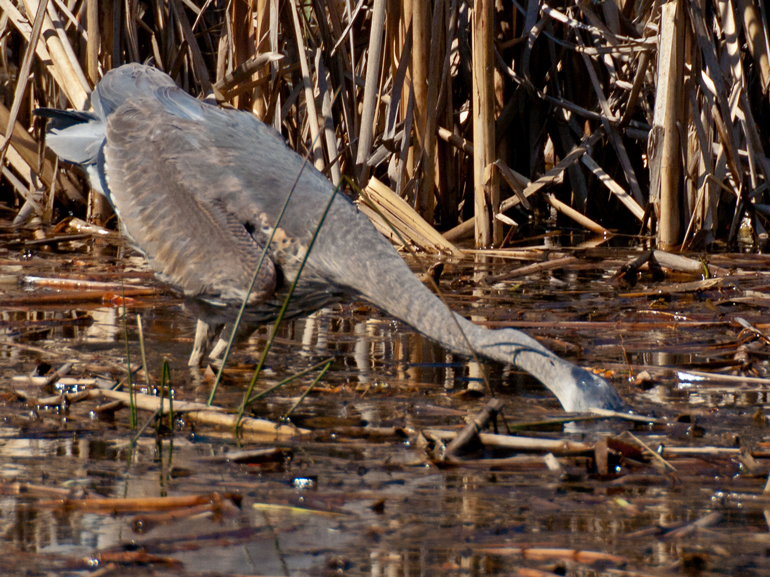
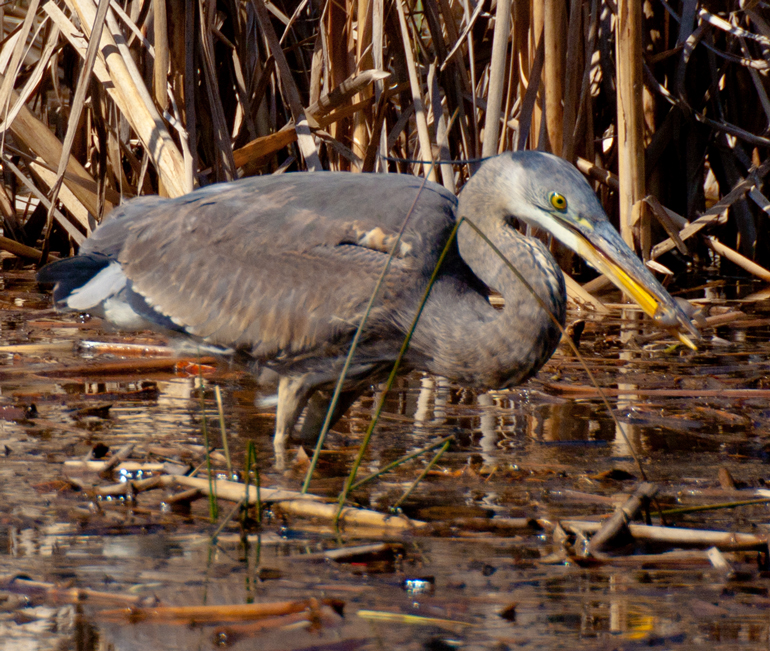
A Great Blue Heron this weekend was poised, waiting to strike, and I waited with my camera and my tripod, hoping to capture the moment of triumphal success.

I had visions of the heron pulling some big fish out of the water, like I see in Phil Lanoue‘s incredible photos, and watching as he struggled to swallow it whole.

The reality, as you can see, was much more modest. After all, the Great Blue Heron (Ardea herodias) was fishing in the beaver pond at my local marsh and the pickings were pretty slim. Initially, I though he had caught a frog, but the photo suggests it was a small fish, though it is hard to tell for sure because of the catch’s small size.

The second photo shows his pre-strike position. The heron stood motionless in this position for what seemed like an eternity. I am amazed that he could see anything in the shallow, reed-covered water.

When he struck, he didn’t even have to put his head very deeply into the water or use a lot of force to catch the fish. The final shot shows the heron swallowing his catch. It did not take any special maneuvering to get the little fish down his throat.

I saw a heron hanging around the same beaver pond the following day. I hope he is not spending all of his time in this one location or I may end up photographing a really skinny heron in the future.

heron1_blogheron2_blogheron3_blogheron4_blog

Michael Q. Powell. All rights reserved

Read Full Post »

Although I really like the pose of this male Northern Cardinal (Cardinal cardinalis) as he prepares to smash a single rose hip against the boardwalk, I love the geometric shapes in the photo just as much.

There is a neat symmetry in the lighter-colored triangle at the top and the dark one in the bottom and they are nicely separated by a series of medium-toned parallelograms. All of the geometric shapes are subdued in color, which helps to provide a nice backdrop for the brightly-colored cardinal and the equally bright rose hip.

Lots of colorful birds are starting to show up now, but I feel special about the cardinals—they were with me throughout the winter, brightening up many a grey winter day.

cardinal_blog

Michael Q. Powell. All rights reserved

Read Full Post »

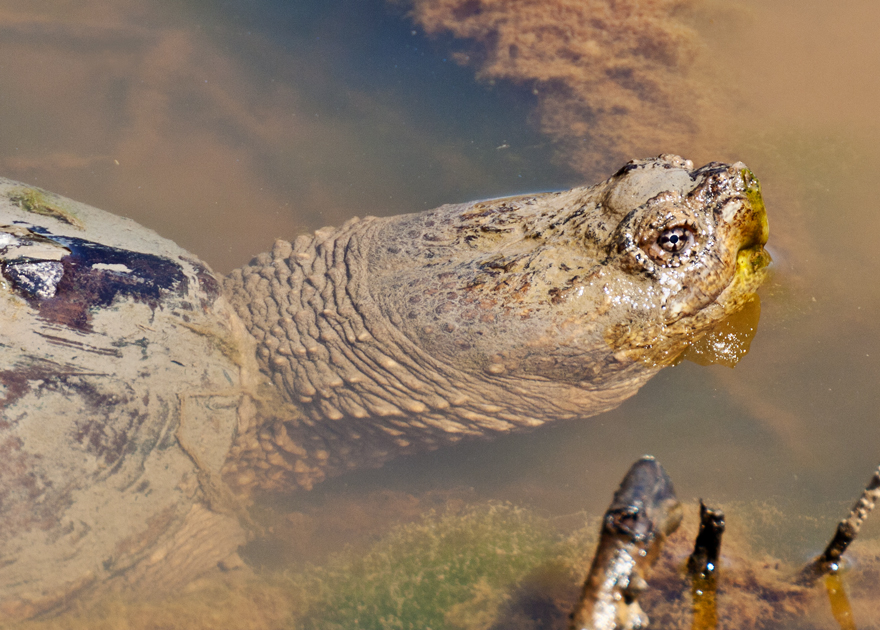
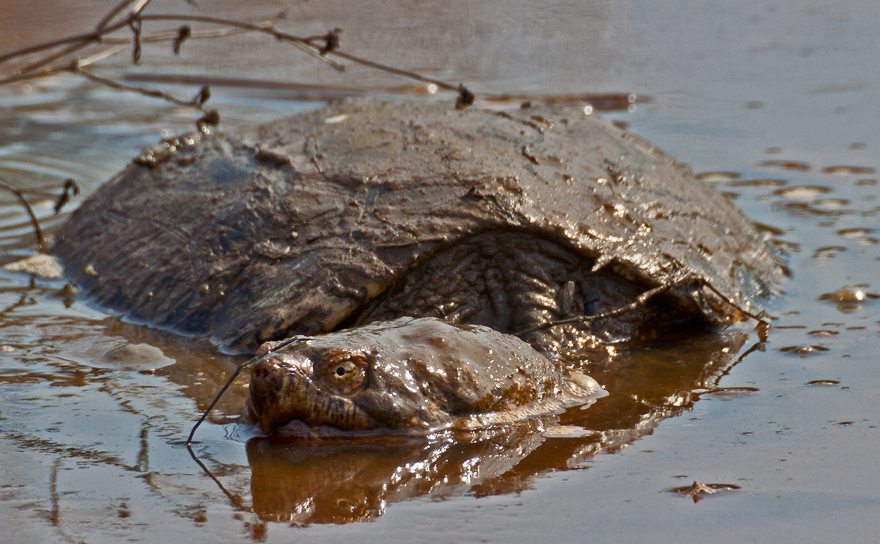
Like prehistoric beasts from another era, the snapping turtles have finally emerged from the mud and the slime of my local marsh.

Painted turtles and Red-eared Sliders have been basking in the sun for weeks now, but it seems like the Eastern Snapping Turtles (Chelydra serpentina serpentina) like for it to be a bit warmer before they start moving. This past weekend I saw quite a few snapping turtles in the marsh, most of them with a lot of mud still piled on the top of their shells, including some pretty big ones. Some of them were floating on the surface of the water, but they don’t appear to bask on land like their smaller counterparts.

I would hesitate to call any of them beautiful or even ruggedly handsome—scarey seems a more appropriate adjective. After reading that snapping turtles are omnivores, I have reconfirmed my desire to keep my distance from these creatures. Thankfully, I have a long telephoto lens.

snapping_blogsnapping2_blog

Michael Q. Powell. All rights reserved

Read Full Post »

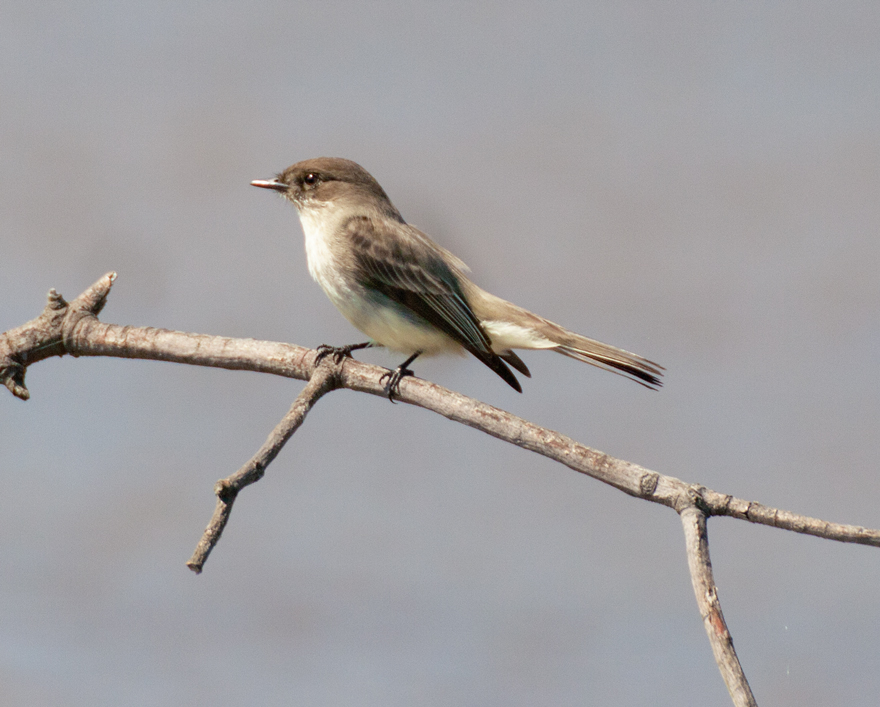
Spring has complicated my life when it comes to bird identification. I started photographing (and trying to identify) birds last fall, when many of the birds had already left the area. Over the winter, there was a limited set of birds that I gradually became accustomed to seeing and I learned to identify them. Even when we had lots of different kinds of ducks, I could look in the section of my identification guide and figure out what they were.

Spring has brought all kinds of new species that have left me baffled and confused. Some of the birders are all excited by the return of warblers, including the Yellow-rumped Warbler. I can’t even see the birds when they point them out to me, much less figure out what color the color of the bird’s rump.

Here’s a recent photo I took of a pretty little bird that I have not yet been able to identify. I’d welcome any hints about what kind of a bird it is.

little_bird_blog

To add insult to injury, leaves are starting to appear on the trees, which will future challenge my ability to identify birds. I may have to go back to photographing insects.

Michael Q. Powell. All rights reserved

Read Full Post »

I am not sure if she was searching for food or was gathering nesting materials, but this female Red-winged Blackbird (Agelaius phoeniceus) was relentlessly attacking a cattail stalk. She paused for a minute and looked up, providing me with this photo op.

I like the way that her bill and her feet are covered with the cottony inner fibers of the cattail. The shadowy image of the male Red-winged Blackbird, with his distinctive shoulder patches, adds a interesting element to the background.

blackbirds_blog

Michael Q. Powell. All rights reserved

Read Full Post »

The sun was almost directly in front of me, a situation that is usually not optimal for photographs, but I really liked the interplay of the light and the shadows on this white and yellow daffodil.

It’s definitely a side of the daffodil that is not featured very often, but it is a lesson for me of the value of looking for new perspectives. I like image that I managed to get by looking at the flower from the other side.

daffodil1_blog

Michael Q. Powell. All rights reserved

Read Full Post »

It may sound like an oxymoron, but I think that this pretty little flower really is called a Summer Snowflake (Leucojum aestivum).

Yesterday was a beautiful, sunny day and I took the opportunity to visit Green Spring Gardens, a local county-run local historical and horticultural center. It is still a little early in the season for most of the showy blossoms, but I came across several patches of the snowflake flower. Apparently there are two varieties of snowflakes—spring and summer—and, strange as it sounds, these are blooming so late that they are probably Summer Snowflakes.

My mind is still geared on photographing birds, so I was carrying around my camera with the 135-400mm telephoto lens. I had my macro lens in the bag I was carrying and probably should have changed lenses when I took some shots of this flower, but I guess the warmth of the sun made me feel a little lazy.

I took this shot at 400mm, which is equivalent to a 640mm on a 35mm camera, because of my crop-sensor camera. The shot is a little soft, but it is clear enough to show that I may have captured an additional subject. If you look closely at the top of the green stem, you will see what I think is a tiny spider. My fellow blogger and photography mentor, Cindy Dyer, likes to call these “bonus bugs.” You shoot check out her blog for some great shots of snowflake flowers and lots of other flowers too.

As insects and flowers return, I will have to retrain my eyes to focus on close-in details, rather than looking out into the distance, as I have during much of the winter when I was photographing a lot of birds. I look forward to the challenge.

snowflake1_blog

Michael Q. Powell. All rights reserved

Read Full Post »
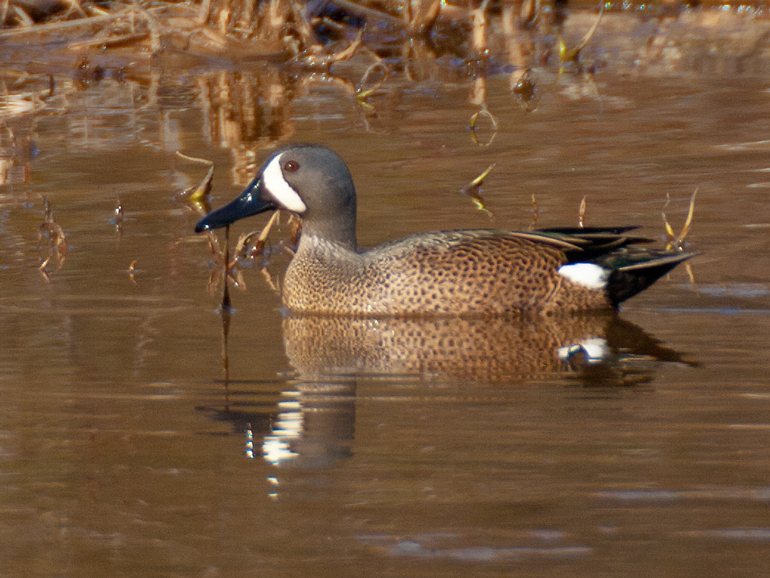
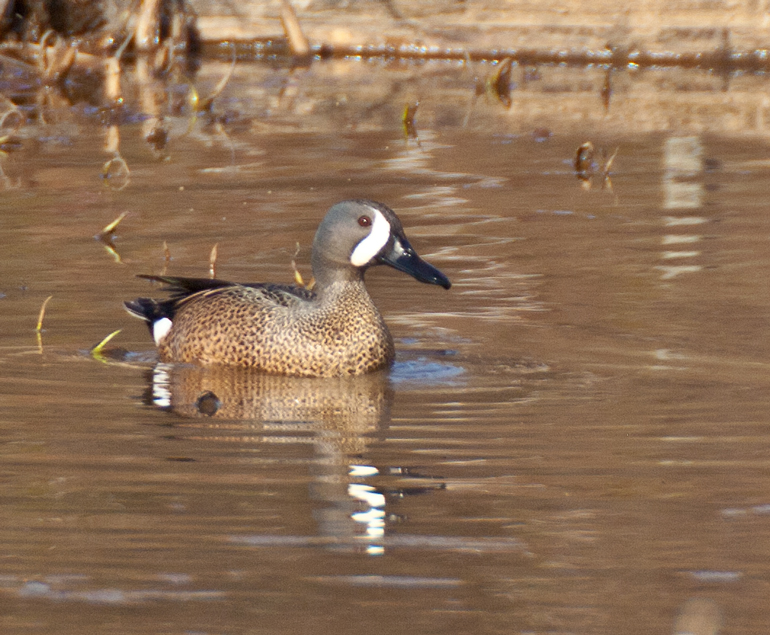
Yesterday was the first time that I managed to get a photograph of a male Blue-winged Teal (Anas discors), a small, very striking dabbling duck. I was quite fortunate that the lighting and location was quite favorable, since these small ducks usually hang out at the far reached of the pond.

Although the Cornell Lab of Ornithology states that the Blue-winged Teal is the second most abundant duck in North America, after the Mallard, I am not sure that I have seen one before, and certainly not closely enough to photograph one. The range maps suggest that I am in the migration region for these birds, so I doubt that these birds will hang around for too long.

I really like the look of the speckled body, blue bill, and bold white stripe across the face of this Blue-winged Teal. He was traveling with a small group of Blue-winged Teals and they were even more beautiful when they took to the air and displayed a beautiful patch of blue on their wings.

blue-winged_blogblue-winged2_blog

Michael Q. Powell. All rights reserved

Read Full Post »

Early yesterday morning when I arrived at my local marsh, two Great Egrets (Ardea alba), were already up and trying to find some breakfast. At this time of year, I suspect that they may be eating a lot of frogs at this location, though I didn’t actually see them catch anything. Eventually they wandered into the reeds and cattails, so I gradually lost sight of them.

In the past, I had a lot of trouble taking photos of these beautiful white birds and usually I ended up blowing out the highlights. Two things seemed to have helped me deal with these issues. I am paying a lot more attention to exposure compensation and I am underexposing by as much as two f-stops. Additionally, I am using a longer telephoto lens and filling more of the frame with the subject somehow helps me to get a better exposure.

egret1_blogegret2_blog

Michael Q. Powell. All rights reserved

Read Full Post »

I have no idea what caused this abstract pattern to form in one of the watery areas of my local marsh, but it really caught my eye when I was looking down, searching for frogs. Maybe it was caused by mineral seepage or plants or some strange combination of the two. Who knows?

In any case, I really like the richness and variety of the colors in the curving patterns.

pattern_blog

Michael Q. Powell. All rights reserved

Read Full Post »

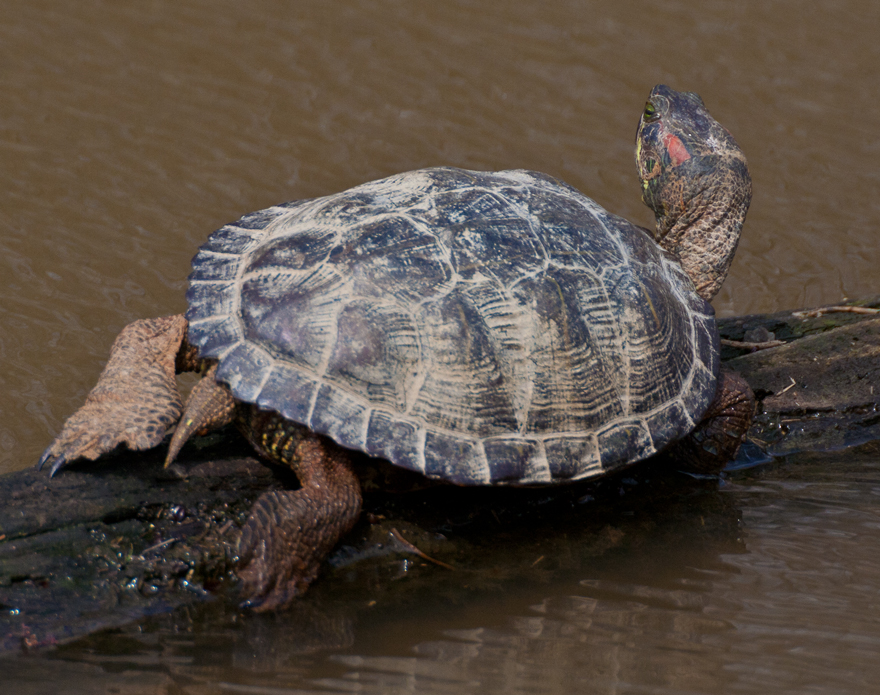
A warm day this past weekend brought out the turtles in my local marsh, who lined up on logs to bask in the sun. On some logs as many as a dozen turtles of all sizes were crowded together, but somehow this big Red-eared Slider turtle (Trachemys scripta elegans) managed to get a log all to himself.

In the first photo, he seemed a little annoyed when the sun disappeared behind the clouds, but he quickly resumed his zen-like pose in the second shot, when the sun reappeared.

turtle2_blogturtle1_blog

Michael Q. Powell. All rights reserved

Read Full Post »

This past weekend I went back to locations where I have seen Belted Kingfishers (Megaceryle alcyon) in the past and encountered this male kingfisher (you may recall that the female has a chestnut stripe on her chest).

Initially he was on a wire above the stream, as shown in the second photo, but eventually he moved to a tree, where his pose looks more natural. He was pretty high in the tree and seemed to be surveying the entire area.

This was the first time that I was able to photograph the kingfisher with a longer lens and I had hoped to get some close-up shots. However, the kingfisher was not very cooperative this time and stayed close to the limit of the range of the lens. I was able to get pretty good detail in the first photo, however, despite a large amount of cropping, probably because I shot from a tripod.

As I said in a previous post, I enjoy stalking kingfishers—there is something about their look that I really like. I will continue to chase after them in search of better shots and hope they cooperate by staying in their current locations.

kingfisher1_blogkingfisher2_blog

Michael Q. Powell. All rights reserved

Read Full Post »

We had a foggy start to one of the weekend mornings and I traveled to my local marshland park with the hope (but no real expectation) of seeing some spider webs. When I arrived at the park, the ground was covered in places with funnel webs, but that was not really what I was looking for.

As I walked along, I suddenly came upon this modestly-sized web. It is not really ornate and is broken in places, but I was thrilled to find it nonetheless. I did not see any spiders, but the web is clear evidence that they are around.

It’s only a matter of time now before I post a shot of a spider!

web2_blog

Michael Q. Powell. All rights reserved

Read Full Post »
I have been hearing the sound of frogs for weeks, but I rarely catch a glimpse of one and was happy to spot this Southern Leopard frog (Lithobates sphenocephalus) on Monday.

I really like the view from the front, with the frog surrounded by little bubbles, his eyes reflecting in the water. The second view, however, lets you see better the positioning of his legs.

The frogs are active now and I even saw a pair of intertwined snakes. Spring is here in full force in Northern Viriginia.

Frog1_blogfrog2_blog

Michael Q. Powell. All rights reserved

Read Full Post »

I am not sure what the other Canada Goose said or did, but this goose was clearly an angry bird yesterday. He seemed to put his whole body into the expression of his strong feelings, from the tip of this tongue to the tip of his tail.

Do they have a goose in the game Angry Birds?  If not, perhaps they should.

goose_tongue_blog

Michael Q. Powell. All rights reserved

Read Full Post »

One of my fellow photographers identified some newly arrived birds as Tree Swallows (Tachycineta bicolor) and yesterday I spotted them checking out the nesting boxes at my local marsh. I felt like they could have used a real estate agent to point out the advantages of the different styles of houses available. The first one has the charm of a log cabin and the second one has enhanced security features to discourage intruders. I don’t think that the swallows have made their decision yet—for now they seemed to be checking out the neighborhood.

swallow1_blogswallow2_blogswallow3_blogMichael Q. Powell. All rights reserved

Read Full Post »

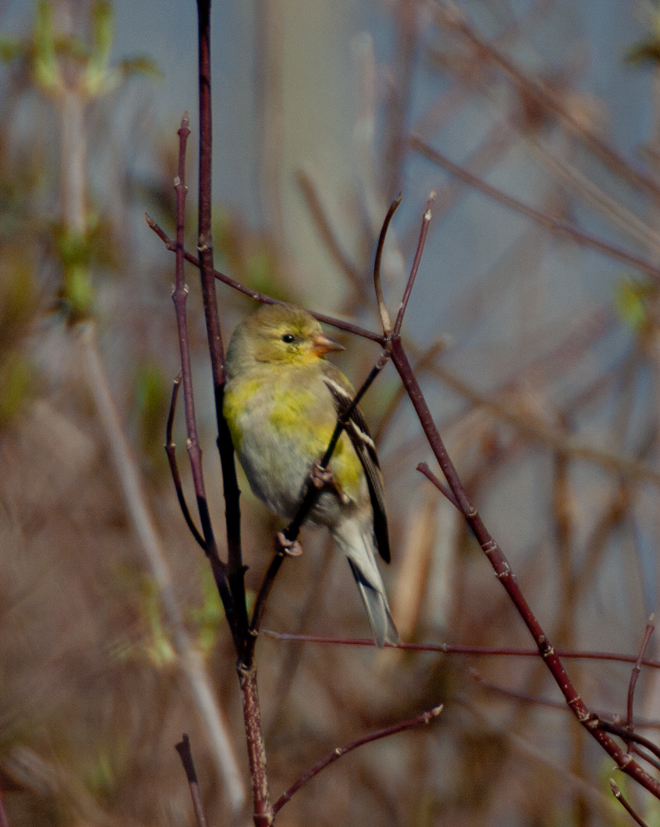
I was thrilled today to see the brilliant yellow color of the American Goldfinch (Spinus tristis)—it almost looked like they had gotten dressed-up for Easter yesterday.

Although range maps indicate that American Goldfinches are in our area year-round, I haven’t seen one in a really long time. There is still not much vegetation on the trees and bushes, so the bright color of the goldfinches stood out. However, the goldfinches spent almost all of their time in the center of bushes and it was hard to get an unobstructed shot.

I am looking forward to more and more bright colors as we move deeper into spring. (I probably should mention that I drive an orange-colored car, which may say something about my attitude toward bright colors.)

goldfinch2_bloggoldfinch1_blog

Michael Q. Powell. All rights reserved

Read Full Post »

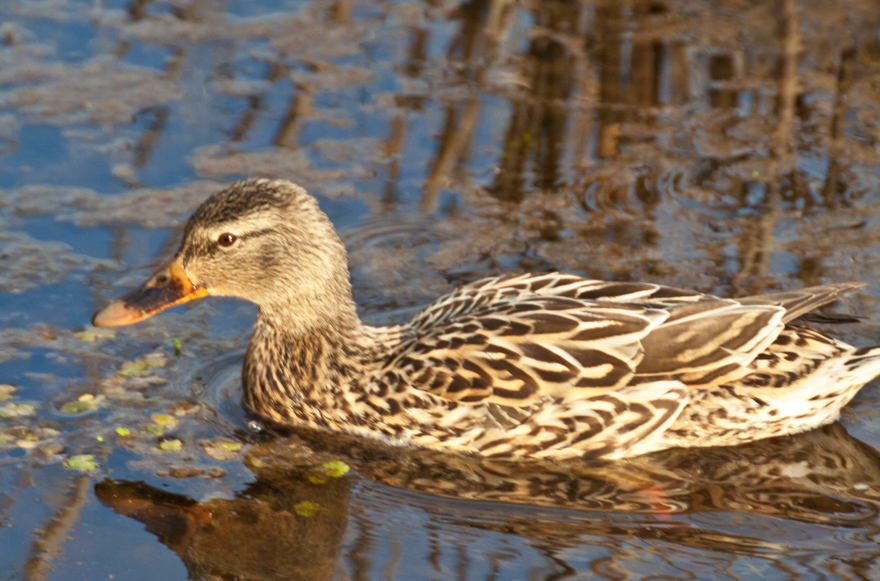
Do you ever find yourself in such beautiful light that you are almost desperate to find a suitable subject? Saturday morning, for a brief period, the rays of the sun were producing wonderful light and incredible reflections in the water of my local marsh, reminding me of some of my favorite Monet paintings.

I looked all around and finally spied this male mallard duck and his mate and they became my models. They didn’t take instructions very well and wouldn’t stay still in one place for very long, but I was able to get some shots that I like.

mallard1_blogmallard2_blog

Michael Q. Powell. All rights reserved

Read Full Post »
« Newer Posts