Feeds:
Posts
Comments

Posts Tagged ‘Woodbridge VA’

Do you have a favorite insect? This is such a strange question that most folks would not have an immediate answer and would have to stop and think a bit before responding. The quickest responses would undoubtedly come from those who simply do not like insects at all. The most common positive answer, I suspect, might well be a Monarch Butterfly.

Many readers know that I see lots of beautiful dragonflies and butterflies, but my favorite insect is almost certainly the Handsome Meadow Katydid (Orchelimum pulchellum), like this one that I photographed on Monday at Occoquan Bay National Wildlife Refuge. I remember my sense of awe and amazement the first time that I spotted one—I couldn’t believe my own eyes, because the combination of colors seemed so bright and almost unreal. When I initially posted a photo of the Handsome Meadow Katydid, one of my friends thought that I had added the colors in Photoshop.

To this day, I never fail to marvel at a Handsome Meadow Katydid’s spectacular rainbow colors and incredible blue eyes and am always thrilled to discover again their amazing beauty when I am fortunate enough to find one.

Handsome Meadow Katydid

© Michael Q. Powell. All rights reserved

Read Full Post »

Whenever I see bees buzzing around flowers, I keep an eye out for hummingbird moths. For some unknown reason, I have seen more of these colorful moths this summer than in past years.

Although you could argue about whether or not thistles are flowers, my vigilance was rewarded when I spotted this beautiful Hummingbird Clearwing Moth (Hemaris thysbe) feeding on this thistle bloom on Monday at Occoquan Bay National Wildlife Refuge.

Hummingbird Clearwing Moth

Hummingbird Clearwing Moth

© Michael Q. Powell. All rights reserved

Read Full Post »

As summer begins to wind down for those of us in the Northern Hemisphere, some of the dragonfly species in our area are starting to disappear. Fortunately, though, some new species appear late in the season to take their places, like this Russet-tipped Clubtail dragonfly (Stylurus plagiatus) that I spotted yesterday at Occoquan Bay National Wildlife Refuge in Woodbridge, Virginia.

Unlike many of the dragonflies that I see regularly that seem to prefer pole-like perches or perch flat on the ground, Russet-tipped Clubtails like to hang from the leaves of vegetation either at an angle, as this one is doing, or vertically. I was pretty excited to find this dragonfly, because I have seen a member of this species only once before, last year at a different location, Jackson Miles Abbott Wetland Refuge.

Russet-tipped Clubtail

© Michael Q. Powell. All rights reserved

Read Full Post »

“Beautiful Spider”—I know that some people would consider that an oxymoron, a contradiction in terms. I, however, am fascinated with spiders and photographed this Black and Yellow Garden Spider (Argiope aurantia) at Jackson Miles Abbott Wetland Refuge as carefully as if I were doing a beauty shot in a photo studio. The spider had constructed her web on some vegetation overhanging a small pond, which is why  I was able to get such an uncluttered gray background.

Argiope aurantia

Earlier this month I captured an image of a spider of the same species while exploring Occoquan Bay National Wildlife Refuge—this seems to be the prime season for these spiders, which I have seen at multiple locations. This image shows well the amazing reach of the spider’s amazingly long legs and, as was the case in the first image, shows the ziz-zag portion of the web that is associated with this species.

Argiope aurantia

© Michael Q. Powell. All rights reserved

Read Full Post »

Different species of dragonflies fly in different ways. Some soar high in the air and some cruise just above the surface of the water. A dragonfly’s wings allow it to perform all kinds of aerial acrobatics that are entrancing to observe. Given their size and speed, it’s a significant challenge to try to capture them in flight, though frequent readers of this blog know that I will sometimes spend extended periods of time trying to meet that challenge.

During a recent trip to Occoquan Bay National Wildlife Refuge, I noticed a dragonfly flying above my head. Its flight reminded me of eagles and hawks that I have seen gliding effortlessly on thermal updrafts. I couldn’t make out the flight pattern that it was following, but it repeatedly flew over me. Each time that it returned, I would point my camera almost straight up and eventually I was able to capture this shot of an easy-to-identify Black Saddlebags dragonfly (Tramea lacerata)—the pattern of black blotches on the wings are very distinctive.

Black Saddlebags

Later that same day I spotted a dragonfly making repeated patrols above the water. The dragonfly never seemed to rest or to perch, so I tried and tried to capture some shots of it as it zoomed on by me. Most of my shots were out of focus, but I like the one below. The choppy water in the background reminds me of the clouds that I will sometimes see when I look out of the window of an aircraft that has reached its cruising altitude. In my mind’s eye, I can imagine this dragonfly flying high in the sky, peacefully soaring above the clouds and the turbulence below it.

Prince Baskettail

© Michael Q. Powell. All rights reserved


Read Full Post »

The beautiful Monarch Butterfly (Danaus plexippus) is often featured in conservation efforts that focus on its dwindling numbers and shrinking habitat. It was therefore a little disconcerting to stumble upon a Monarch that had been ensnared in the web of a Black and Yellow Garden Spider (Argiope aurantia) during a visit this past weekend to Occoquan Bay National Wildlife Refuge.

I have no idea how long the butterfly had been in the web, but it appeared to be totally immobilized. Spiders like this one, known also as Yellow Garden Spiders or Writing Spiders, kill their prey by injecting venom and often wrap them up in web material for later consumption.

I considered cropping this image to focus more attention on the spider and the butterfly, but ultimately decided that I liked the context provided by the elements of the spider’s web and the murky, out-of-focus background.


spider and Monarch

© Michael Q. Powell. All rights reserved


Read Full Post »

One of the coolest looking butterflies in our area is the Zebra Swallowtail butterfly (Eurytides marcellus). In addition to having beautiful coloration, it has amazingly long “tails” that flutter when it is in flight. It is not a species that I see very often, so I will spend a lot of time chasing after one when I spot it, hoping, often in vain, that it will perch long enough for me to get a shot.

This Zebra Swallowtail, which I chased this past Friday at Occoquan Bay National Wildlife Refuge, was reasonably cooperative, though it refused to open its wings to give me a view of its entire wingspan.

Zebra Swallowtail

© Michael Q. Powell. All rights reserved

Read Full Post »

Predator or prey? Dragonflies are fearsome predators, but they can also become prey—it’s the whole circle of life cycle in the natural world.

This past Friday as I was walking around Occoquan Bay National Wildlife Refuge, I spotted the twisted body of a dragonfly suspended in the air against a backdrop of the sky. Instinctively I knew that there must be a spider web there, although it was not initially visible. The wing pattern of the dragonfly made it easy to identify as a Common Whitetail (Plathemis lydia).

As I got closer, I realized that a large spider was holding onto the body of the dragonfly. I am not totally certain of the spider identification, but it looks to me like it is a Spotted Orbweaver (Neoscona crucifera). Often when I approach a spider, it will scurry to the edge of its web, but this spider defiantly stayed in place—it looked like it was determined not to give up its prey.

As many readers know, I really like dragonflies, but spiders have to eat too. Undoubtedly this scenario plays out multiple times each day, but it is still a little unsettling to see it face-to-face.

spider and dragonfly

© Michael Q. Powell. All rights reserved


Read Full Post »

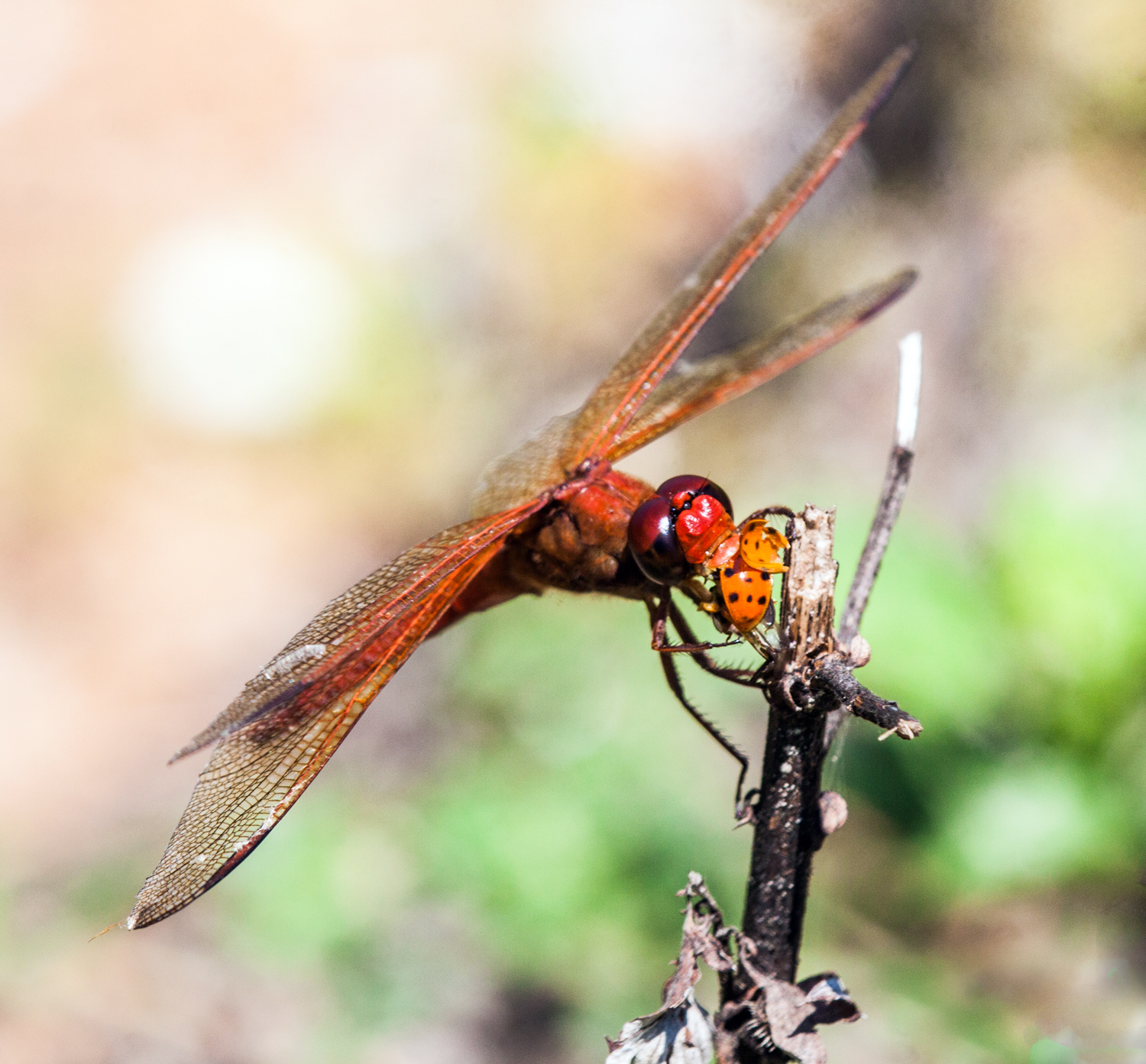
Dragonflies have to eat too, but I was a little shocked when I stumbled upon this Needham’s Skimmer dragonfly (Libellula needhami) munching on a ladybug or two yesterday at Occoquan Bay National Wildlife Refuge in Woodbridge, Virginia. Although I know that dragonflies are fearsome predators, I guess that I am not used to thinking of ladybugs as prey—they are usually depicted as cute, which is why they are seen so often on children’s clothing and furnishings.

dragonfly and ladybug

© Michael Q. Powell. All rights reserved

Read Full Post »

I don’t feature rabbits very often on this blog because I don’t see them very often. Actually that is not entirely accurate—I have a rabbit named Prime Rib who appears from time to time, but I don’t count him, because he does not live in wild and instead lives in a cage in my living room.

At Huntley Meadows Park,  where I do a lot of my wildlife photography, I rarely see rabbits. Perhaps the marshy and wooded habitat is less than ideal for the rabbits or perhaps the hawks are brutally efficient at keeping their numbers low. During some recent visits to Occoquan Bay National Wildlife Refuge, which has more open grassy areas, I’ve spotted numerous rabbits and decided to feature a couple of them today.

In a recent posting, I expressed my concern about possibly oversaturating my readers with dragonfly photos. In an exchange of comments, a faithful reader, Dan Antion, shared similar concerns about his photos of rabbits and squirrels and I warned him that I was going venture into his niche and post some rabbit photos. Dan is one of my favorite bloggers and I encourage everyone to check out his blog No Facilities for his humorous and insightful looks at the joys and frustrations of everyday life as well as some great photos, including images of the aforementioned squirrels and rabbits and his faithful dog Maddie.

This one is for you, Dan.

rabbit

rabbit

© Michael Q. Powell. All rights reserved

Read Full Post »

For wildlife photographers, I would argue, a successful image is most often the result of some combination of luck, skill, and equipment. We inhabit a world of tremendous uncertainty and have to be hypervigilant, never knowing when “the moment” will arrive when we will be forced to make a series of split-second decisions.

One of those moments arrived for me yesterday as I was exploring Occoquan Bay National Wildlife Refuge in Woodbridge, Virginia. Although I was quite aware that there were bald eagles in the area, because some of the trails in the refuge near eagle nesting sites were closed, I was primarily chasing dragonflies and butterflies, so I had my 180mm macro lens mounted on my camera. I knew that I would be doing a lot of walking, so in order to minimize weight, I was not carrying my trusty (and heavy) 150-600mm zoom lens.

I was following a trail that ran parallel to the waters of Occoquan Bay and was a little frustrated that the view was frequently obstructed by heavy vegetation. When I reached an opening in the vegetation I looked out at the water and suddenly a Bald Eagle (Haliaeetus leucocephalus) burst into view out of nowhere. The eagle was almost at eye level and seemed to be struggling a little to gain altitude. As I later was able to ascertain, it had just caught a fish.

The logical part of my brain might have told me that a 180mm lens is not long enough to capture an image of an eagle in flight, but think I was acting on an instinctive level at that moment and I was able to snap off some shots before the eagle disappeared out of sight. It took a while for the adrenaline to wear off and I didn’t know for sure if I had been able to capture the moment. It was only when I reviewed the images on my computer that I realized that I had gotten my best eagle shots ever.

As is the case with most of my bird images, I cropped the first image to bring the subject in a bit closer. However, I am also including an uncropped version of the same image. It boggles my mind to think that I filled up that much of the frame with an eagle in flight with a 180mm lens.

Luck was hugely important; skill played a role, though it was my quick reaction time that was critical; and equipment turned out to be less important that I would have anticipated.

Bald Eagle

Bald Eagle

© Michael Q. Powell. All rights reserved
 

Read Full Post »

Yesterday at Occoquan Bay National Wildlife Refuge in Woodbridge, Virginia,  I was able to photograph a new dragonfly species for me, the beautiful Calico Pennant (Celithemis elisa). Fellow photographer and dragonfly enthusiast Walter Sanford had alerted me to the presence of these dragonflies at this location and had given me a general idea of where I might find them.

When I arrived at the wildlife refuge, which I had never visited before, I was a bit disoriented at first, but eventually found the pond that was my target location. The challenge, though, was to find the diminutive dragonflies. I walked about for quite some time before I finally spotted one perched on the very top of some vegetation in a field adjacent to the pond. Like other pennant dragonflies, Calico Pennants usually hang on to the most fragile, flimsy branches of plants and are often flapping in the breeze like a pennant.

Here are a couple of shots of Calico Pennant dragonflies that I observed. The one with the yellow abdomen is a female and the male has the red abdomen. As is the case with many species, immature males have the same coloration as the females, so it usually pays to look at the terminal appendages to determine the gender.

female Calico Pennant

male Calico Pennant

© Michael Q. Powell. All rights reserved.

Read Full Post »

« Newer Posts