Feeds:
Posts
Comments

Posts Tagged ‘Woodbridge VA’

When they keep their wings closed, some butterflies match their surroundings so well that they are almost invisible. Question Mark butterflies (Polygonia interrogationis) look like dead leaves and at this time of the year there are plenty of fallen leaves littering the landscape.

It was impossible for me to me the distinctive autumn colors of this Question Mark when I spotted it earlier this month at Occoquan Bay National Wildlife Refuge.  I had to back up a bit in order to focus on the butterfly with my telephoto zoom lens and I actually had trouble seeing it when it decided to close its wings. Fortunately it spread its wings a little bit and I was able to capture the second image below.

A month or so ago it seemed like there were more dragonflies than butterflies, but now the ratio seems to have shifted. Butterflies, especially Common Buckeyes, are still flying in good numbers, while the quantity of dragonflies continues to drop.
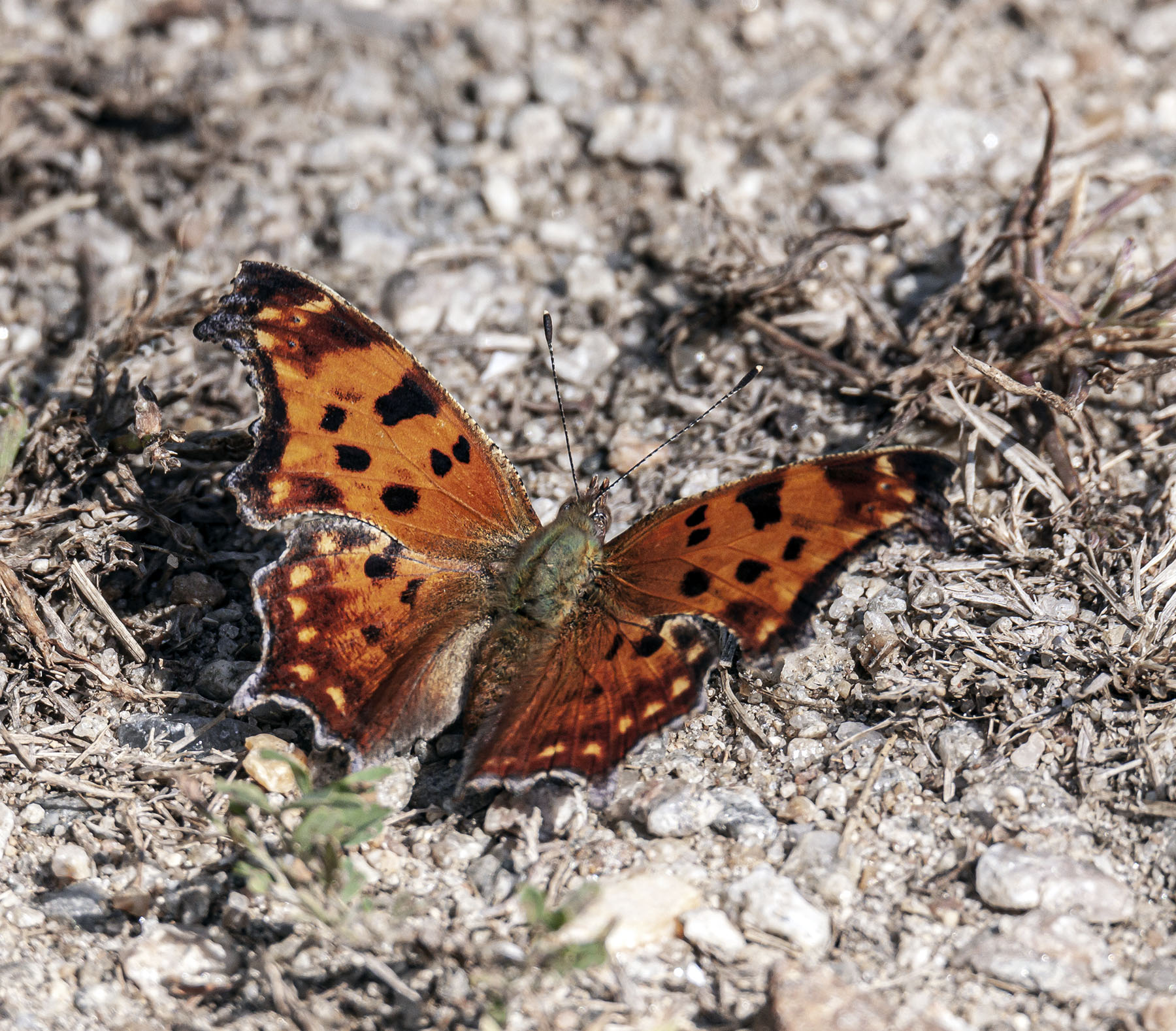
Question Mark

Question Mark

© Michael Q. Powell. All rights reserved.


Read Full Post »

It’s always fun to encounter cute little rabbits like this one that I spotted recently as I was walking along one of the trails at Occoquan Bay National Wildlife Refuge.

I do not see a lot of mammals during my walks, with the notable exception of squirrels, so I am always happy to see a rabbit or a deer or a beaver. As most of you know, I tend to see a lot more insects and birds and that is one of the reasons why they appear so often in my postings.

On the sides of some of the trails at the refuge there are heavy thickets and my observations suggest that they are the preferred habitat for the rabbits, which are almost certainly Eastern Cottontail rabbits (Sylvilagus floridanus).  The rabbits at the wildlife refuge generally seem to be very cautious, which is probably a good survival tactic, considering the number of hawks and eagles in the area.

This particular rabbit froze in place for a moment when it first detected me, allowing me to get this shot. After a brief pause, it scampered away into the safety of the heavy vegetation.

rabbit

© Michael Q. Powell. All rights reserved.


Read Full Post »

I love the effects of the light in this image of a Great Egret (Ardea alba) that I captured on Tuesday at Occoquan Bay National Wildlife Refuge. (For the sake of clarity, I should note that I captured the image and not the egret.) When I first spotted the egret, its wings were down and it was more or less just a silhouette. As I was focusing on it, though, the egret hopped into the air and flapped its wings and I snapped the shot. I was looking almost directly into the sun and I was fascinated by the way the light illuminated the outstretched wings and was happy that I was able to capture, at least in part, that effect.

Great Egret

© Michael Q. Powell. All rights reserved.


Read Full Post »

Wandering Gliders (Pantala flavescens) are the most widespread dragonfly species in the world and are found on all continents except Antarctica. I was thrilled on Tuesday when one stopped wandering for a moment at Occoquan Bay National Wildlife Refuge and I was able to capture this image. According to Wikipedia, individual Wandering Gliders can fly more than 3730 miles (6000 km)—one of the farthest known migrations of all insect species.

Wandering Glider

© Michael Q. Powell. All rights reserved.
Read Full Post »

Most of my dragonflies have disappeared for the season. I will still occasionally spot a few survivors of the summer species, but their numbers are dwindling in the cooler autumn weather. One notable exception is the aptly named Autumn Meadowhawk dragonfly (Sympetrum vicinum). On Tuesday I spotted a good number of Autumn Meadowhawks while exploring Occoquan Bay National Wildlife Refuge and captured these images with my long telephoto zoom lens—it is a bit of a challenge to focus on such a small subject with a lens zoomed out to 600mm.

In the area in which I live, Autumn Meadowhawks remain with us throughout October and November. I have personally spotted some in December and have heard of other sightings in early January.

Autumn Meadowhawk

Autumn Meadowhawk

Autumn Meadowhawk

© Michael Q. Powell. All rights reserved.

Read Full Post »

Two Black Vultures (Coragyps atratus) appeared to be intently staring at me as I drew closer to them on Tuesday at Occoquan Bay National Wildlife Refuge. Were they sizing me up, hoping I might drop dead on the spot? As Halloween approaches, it is easy to feel a little creeped out in situations like this. Although I believe that they were simply curious about my presence, I did make sure that I moved around enough to ensure that the vultures knew that I was still alive.

Black Vulture

Black Vulture

© Michael Q. Powell. All rights reserved.


Read Full Post »

Any day that I spot a Bald Eagle (Haliaeetus leucocephalus) is a good day. Yesterday qualified as a great day when I was able to capture an image of a Bald Eagle taking off from the slender branches of a tree at Occoquan Bay National Wildlife Refuge.

I was a bit shocked when I initially spotted the eagle perched in a cluster of leaves overhanging one of the trails at the wildlife refuge—presumably there was a branch in there somewhere, but it did not seem substantial enough to hold the weight of an eagle.

I zoomed in all the way with my 150-600mm lens and was able to get a pretty detailed shot of the eagle, as you can see in the final shot. The eagle turned its head in various directions and I knew that I did not have much time before it decided to take off. When the eagle turned its body toward the water and began to crouch, I tried to ready myself and anticipate the direction of its initial movement. In most of the shots in the burst that I took, the eagle’s wings blocked its face or extended well beyond the edges of the frame, but I was pretty happy with the one that I posted as the initial photo in this posting.

Why did the eagle choose such a precarious perch? I have no idea why, but I am happy that it gave me the chance to get these shots.

Bald Eagle

Bald Eagle

Bald Eagle

© Michael Q. Powell. All rights reserved.

Read Full Post »

We are in a period of transition. All around I see the signs of autumn, but summer has not completely loosed its grasp. Last week I spotted this female Eastern Pondhawk dragonfly (Erythemis simplicicollis) at Occoquan Bay National Wildlife Refuge. Eastern Pondhawks are among our most common dragonflies—they are still with us, but their numbers are clearly dwindling.

In this image I really like the juxtaposition of the dragonfly’s bright summer coloration with the more muted autumn colors of the fallen leaves, a visual representation of this time of transition.

Eastern Pondhawk

© Michael Q. Powell. All rights reserved.

Read Full Post »

I spotted a Great Blue Heron (Ardea herodias) perched in a tree last Friday at Occoquan Bay National Wildlife Refuge, calmly surveying the area, as shown in the second shot. As I drew closer, I could sense the heron beginning to gather itself.  I managed to capture the first image as the Great Blue Heron leaped into the air, preparing to take flight.

Great Blue Heron

Great Blue Heron

© Michael Q. Powell. All rights reserved.

Read Full Post »

This Bald Eagle (Haliaeetus leucocephalus) was so well hidden in a tree on Friday at Occoquan Bay National Wildlife Refuge that I almost missed it. Fortunately I caught a glimpse of the sun reflecting off of its bright white head and was able to move close enough to capture this image.

As you may have noticed in recent postings, I have marked the changing of the seasons by changing my “walk around” lens from a Tamron 180mm macro lens to a Tamron 150-600mm telephoto zoom lens. This means that it is easier for me to get photos of birds like this eagle, but tougher, though not impossible, to capture images of the remaining butterflies and dragonflies.

Bald Eagle

© Michael Q. Powell. All rights reserved.

Read Full Post »

It won’t be long until all of the Great Egrets (Ardea alba) leave my area and head for warmer locations. That makes each encounter now with a Great Egret even more special. Yesterday while I was exploring Occoquan Bay National Wildlife Refuge, I spotted this egret perched high in a tree. Initially my view was blocked by a lot of branches, but eventually I was able to maneuver into a position from which I could get an unobstructed shot.

I really like the way that the branches act as a natural frame for the egret. Additionally I like the whimsical element of the feather sticking up on the bird’s head—it reminds me of the cowlick that I had as a young boy, back when I had hair. Sometimes my Mom would lick her fingers and unsuccessfully attempt get my hair under control.

Great Egret

© Michael Q. Powell. All rights reserved.

Read Full Post »

When I spotted this raptor flying over a distant field earlier this week at Occoquan Bay Wildlife Refuge, I suspected that it was a Northern Harrier (Circus hudsonius). Although I do not see this species very often, Northern Harriers fly in a very distinctive way—they glide low over grasslands and marshlands, in part because they rely on their sense of hearing  when hunting.

I was a little disappointed that this harrier, which several folks in a Facebook birding group identified as a female, made only a single pass over the field and never flew very close. However, I am pretty happy that I was able to capture this image that gives you a good sense of the flight profile of the harrier and the environment in which she was flying.

Northern Harrier

© Michael Q. Powell. All rights reserved.

Read Full Post »

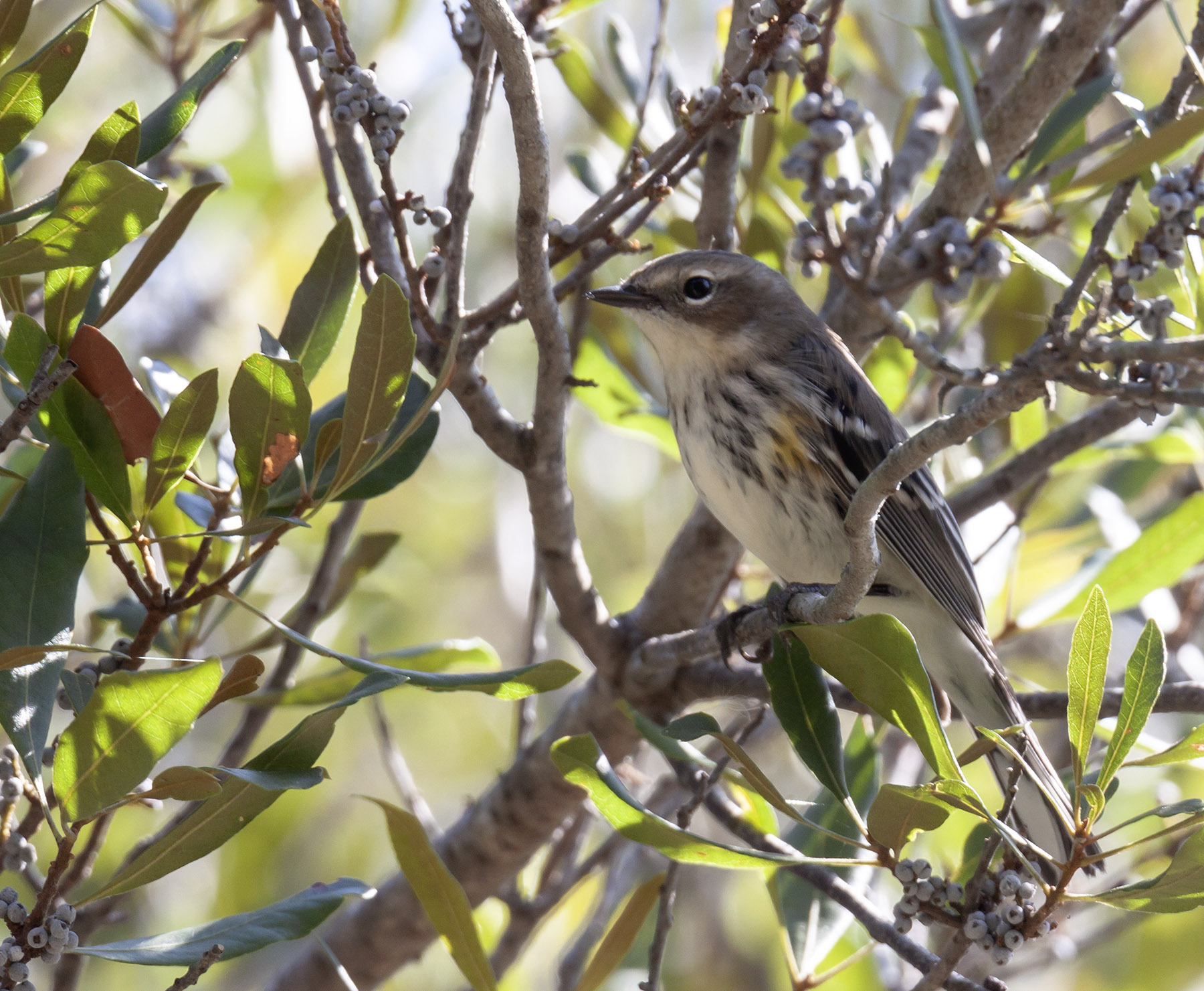
Yellow-rumped Warblers (Setophaga coronata) have returned in force to Occoquan Bay National Wildlife Refuge. There are still lots of leaves on the trees, though, so it is a real challenge to get unobstructed shots of them. I catch sight of them moving in and out of the foliage, but only rarely do they pop out into the open. So I patiently watch and wait.

Here are pretty clear views of Yellow-rumped Warblers that I eventually managed to capture on Wednesday. Most warblers are in our area only briefly as they make their way north in the spring and south in the autumn. Yellow-rumped Warblers, however, remain with us for much of the winter, so I may have more chances to see them better as the trees gradually give up their leaves.

Yellow-rumped Warbler

Yellow-rumped Warbler

Yellow-rumped Warbler

© Michael Q. Powell. All rights reserved.

Read Full Post »

Female Blue-faced Meadowhawk dragonflies (Sympetrum ambiguum) come in several different color variations. Some, like the one in the first image below have a reddish colored body, like the male of the species—they are known as andromorphs. Others are brownish in color, like the one in the second image below, and are know as heteromorphs. Irrespective of the body color, though, all of the females have striking blue eyes.

Usually it is harder to spot females than the more brightly colored males, but for some reason, these two females were the only Blue-faced Meadowhawks that I saw as I was exploring Occoquan Bay National Wildlife Refuge one day last week.

Where were all the males? Maybe they were watching a sporting event or were congregating at a local bar (or both).  🙂

Blue-faced Meadowhawk

Blue-faced Meadowhawk

© Michael Q. Powell. All rights reserved.


Read Full Post »

What is the fastest animal on earth? My mind immediately thinks of the cheetah, which can run in short bursts at speeds up to 75 miles per hour (121 km/h). Indeed the cheetah is the fastest land animal. However, the Peregrine Falcon (Falco peregrinus), the fastest member of the animal kingdom, can reach speeds up to 242 miles per hour (389 km/h) when in a dive.

I was thrilled last week to spot this Peregrine Falcon perched at the top of a distant tree while exploring Occoquan Bay National Wildlife Refuge. The bird was hard to see on an overcast day, but the muscular way that it was perched caused me to conclude that it was a bird of prey. I took this shot with my macro lens in order to document my sighting. As I was pulling out my camera with a longer zoom lens, the falcon flew off into the air. It flew away too fast for me to get a shot

When I read about the top speed of the Peregrine Falcon, I wondered how in the world that speed was determined. I came across this fascinating National Geographic film clip that documents one effort to measure the speed of a Peregrine Falcon. It is a short video that is well worth watching and includes a trained falcon and sky-diving scientists.

I love watching birds of all shapes and sizes, but there is something really special about seeing a powerful raptor like this Peregrine Falcon.


Peregrine Falcon

© Michael Q. Powell. All rights reserved.

Read Full Post »

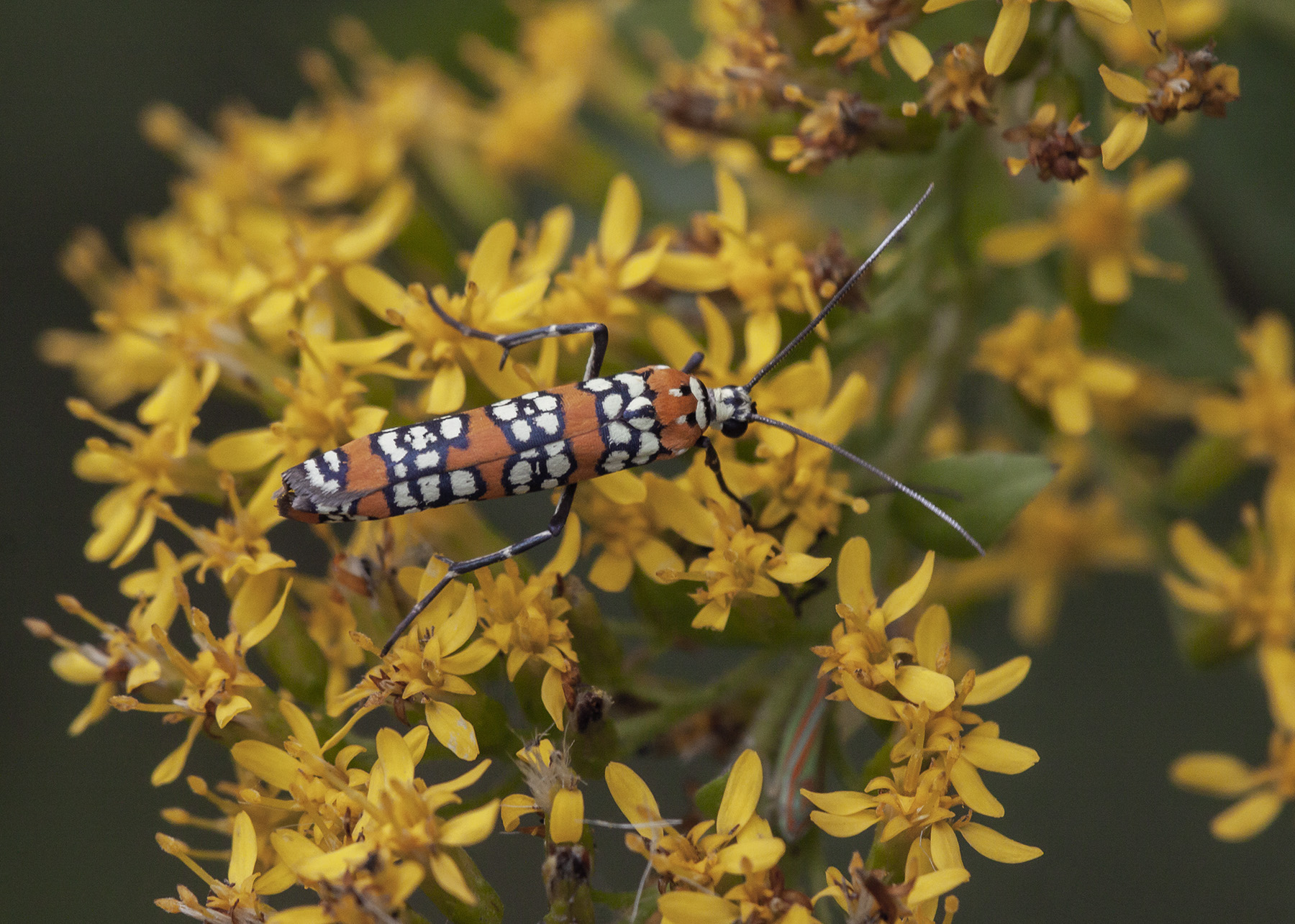
Whenever I see an Ailanthus Webworm moth (Atteva aurea), I assume that it is some kind of beetle. It is hard to believe that the colorful patterns are actually part of the wings and not a hard exterior shell. I spotted this beautiful little moth on some goldenrod last week while exploring Occoquan Bay National Wildlife Refuge.

The pattern on this insect’s body reminds me of an animal print. Wouldn’t it be cool to have fabric printed with this bold pattern? I can imagine throw pillows and even fashion accessories. From a marketing perspective, though, I think we would have to come up with a new name for the insect—a name like “webworm” probably would not attract many customers.

Ailanthus Webworm moth

© Michael Q. Powell. All rights reserved.


Read Full Post »

Do you ever stop to look at grasshoppers? A lot of them are really cool, like this giant one that I spotted on Thursday at Occoquan Bay National Wildlife Refuge. I love how it looks like the grasshopper is wearing a helmet on its head and a suit of armor on its torso.

I am not very good in identifying grasshopper species, but after looking through various internet sites, I wonder if this might be an Eastern Lubber grasshopper (Romalea guttata). This species is found only in the southeastern part of the United States. Virginia, where I live, is not within its listed range, so it is possible that this is a related species. Whatever the case, I definitely love the bold coloration of this giant grasshopper.

yellow grasshopper

© Michael Q. Powell. All rights reserved.


Read Full Post »

As many of you know, I love to photograph dragonflies and will often try to get close-up shots of them. Initially I captured a head-on shot of a female Blue-faced Meadowhawk dragonfly (Sympetrum ambiguum) that I spotted on Thursday at Occoquan Bay National Wildlife Refuge.

As I was observing this dragonfly at close range, she began to groom herself. I am not sure if she was cleaning her eyes or merely scratching an itch, but it was a bit eerie when she rotated her head more than 90 degrees to do so, as you can see in the second image. It brought back memories from my youth of Linda Blair’s spinning head in the original version of The Exorcist, though fortunately the dragonfly’s head did not rotate 360 degrees.

Blue-faced Meadowhawk

Blue-faced Meadowhawk

© Michael Q. Powell. All rights reserved.
Read Full Post »

Most woodpeckers have simple patterns of red, black, and white feathers and it is sometimes difficult to tell them apart. The Northern Flicker (Colaptes auratus) outdoes them all with a dazzling combination of colors and patterns—they are pretty easy to identify.

The sky was overcast yesterday morning when I went exploring at Occoquan Bay National Wildlife Refuge. I had to play around with my camera exposures and as a result the background turned almost pure white when I photographed this male Northern Flicker that had light coming from behind him. I like the effect in this case because it helps viewers to focus on the details of the beautiful bird, including the wonderful yellow feathers that you can see in the final photo. In case you are curious, I can tell that the flicker is a male because of the black “mustache” that females do not have.

There are two distinct subspecies of flickers. The ones that we have in the North and East have a little red crescent on the back of its neck, yellow underwings, and, in the case of males, a black mustache. The western flickers have no red crescent, have red underwings, and, in the case of males, a red mustache.

Northern Flicker

Northern Flicker

Northern Flicker

© Michael Q. Powell. All rights reserved.

Read Full Post »

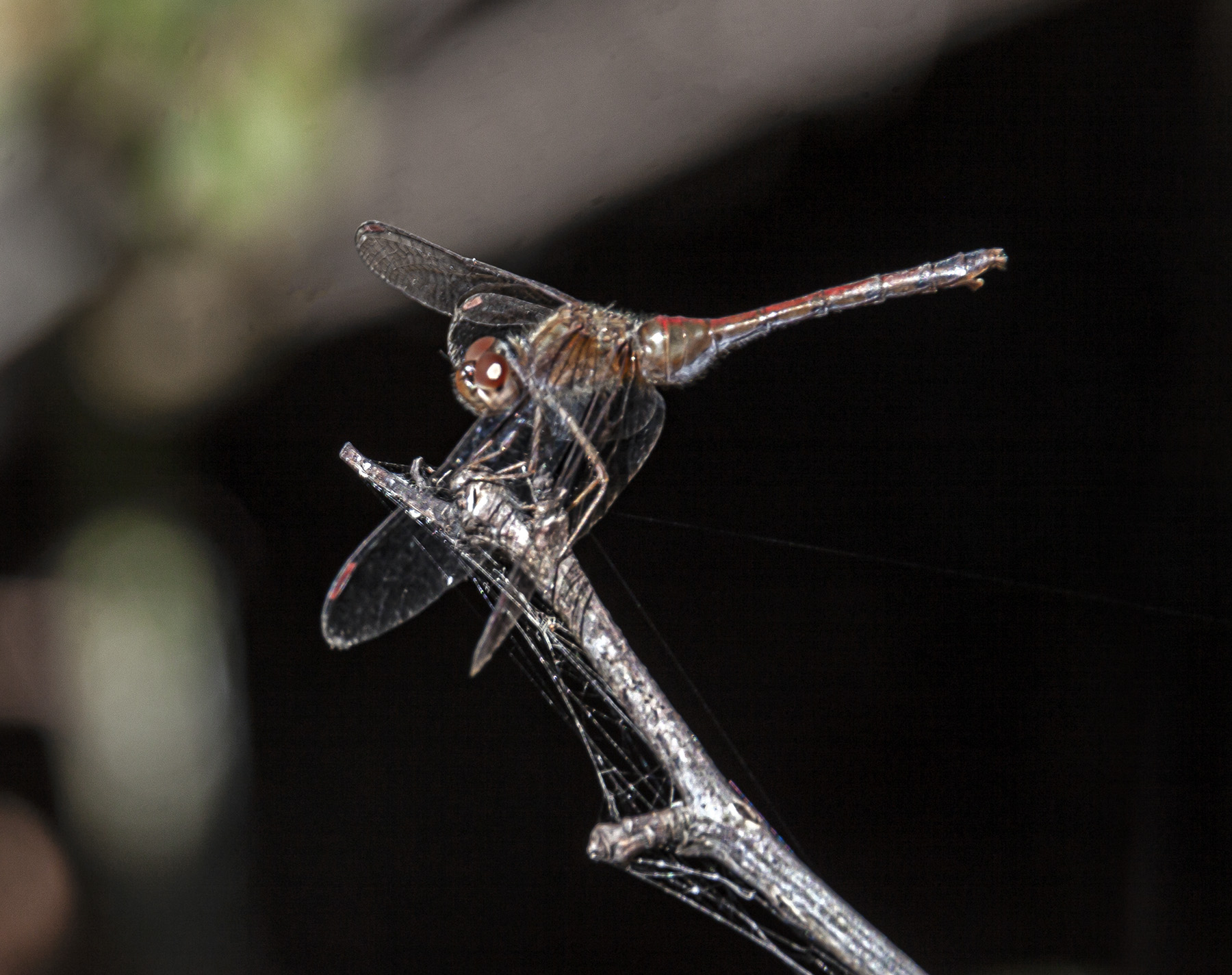
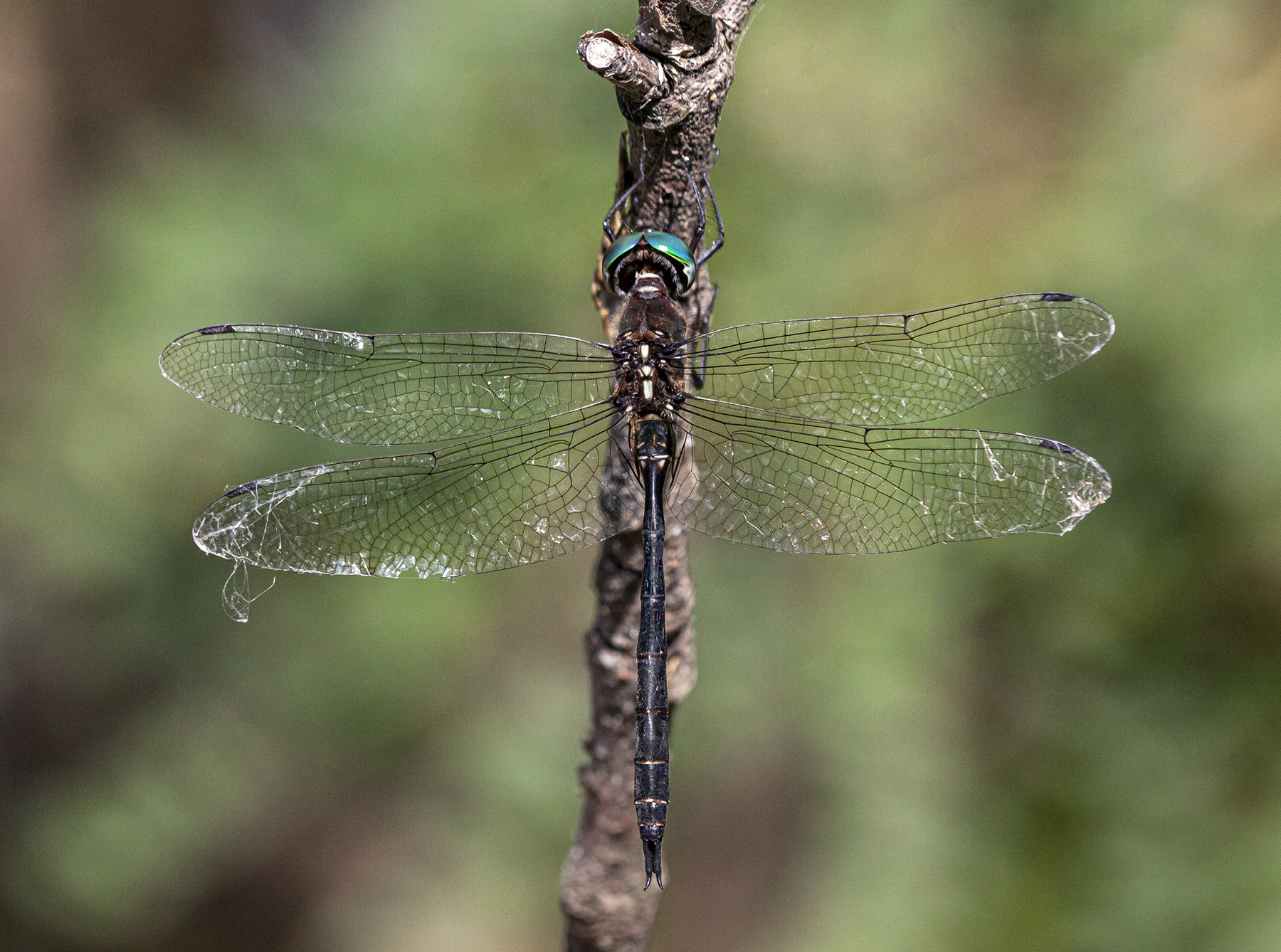
If you were a dragonfly, one of the constant hazards that you would face would be the ubiquitous spider webs that threaten to entangle you. At this time of the year those same webs annoy me as well—there is just something “icky” about an unexpected facial encounter with spider silk.

Last week I captured some more images of Fine-lined Emerald dragonflies (Somatochlora filosa) at Occoquan Bay National Wildlife Refuge. These rare and exotic dragonflies are always one of the highlights of my early autumn days.

In both images below there seems to be evidence of a spider’s work. What appears to be spider silk is hanging from the dragonfly’s wings in several place in the first image. In the second image there are remnants of a spider web on the branch from which the dragonfly was hanging.

I know that spiders have to eat too, but I must confess that I am rooting for the dragonflies when it comes to struggles between spiders and dragonflies.

Fine-lined Emerald

Fine-lined Emerald

© Michael Q. Powell. All rights reserved.

Read Full Post »

Warblers are migrating southward through my area at this time of the year. Although I can sometimes hear them, most often they stay hidden behind the foliage. I was happy therefore when I caught site of this Palm Warbler (Setophaga palmarum), one of our most common warblers, this past week at Occoquan Bay National Wildlife Refuge.

When I initially spotted this little bird, it was feeding in the grass, as shown in the second image. The warbler was part of a small group and all of them appeared to be really skittish and took to the air when I was still a long way off. Fortunately one of them flew into a tree and paused momentarily, allowing me to get a mostly unobstructed shot of it.

Most of the warblers remain in our area for a short period of time, so I am never confident when or if I will see any of them. I guess that the best way to increase my odds is to spend more time outside with my camera at the ready.

Palm Warbler

Palm Warbler

© Michael Q. Powell. All rights reserved.

Read Full Post »

This female Great Blue Skimmer dragonfly (Libellula vibrans) seemed to be grinning at me one morning this past week at Occoquan Bay National Wildlife Refuge. Smiling is contagious, I have found.

I hope that your Sunday brings an equivalent smile to your face.

Great Blue Skimmer

© Michael Q. Powell. All rights reserved.


Read Full Post »

I do not know where the Wild Turkeys (Meleagris gallopavo) were hiding, but I don’t think that I spotted a single one all summer. All of the sudden they seem to be back and I have seen them repeatedly during my most recent visits to Occoquan Bay National Wildlife Refuge.

During most of my encounters, I have spotted them in the distance, pecking away at the side of the trail. Before I can get within camera range, they usually sense my presence and waddle into the undergrowth. I was fortunate, however, to capture a shot of this one turkey who had lingered in the open a bit longer than his compatriots.

Wild Turkey

© Michael Q. Powell. All rights reserved.

Read Full Post »

I am blessed to live in an area in which Bald Eagles (Haliaeetus leucocephalus) are present throughout most of the year. During the summer, however, my encounters have been pretty infrequent, so I was excited to spot this one on Monday while visiting Occoquan Bay National Wildlife Refuge. I was looking for dragonflies that day and had a macro lens on my DSLR camera and I realized the eagle was too far away for me to capture a decent image.

It was precisely for situations like this that I also carry my Canon SX50 super-zoom camera. The resolution of this camera is not as good as that of my “big” camera, but it gives me a lot of reach. After I had zoomed in to take the first shot, I zoomed out and realized that there was a second bald eagle perched above the one I had just photographed. The second shot shows the relative positions of the two eagles.

I was hoping for better head positions for the two eagles, but they flew away shortly after I took the second shot. I have discovered that it is usually best to get a shot as early as possible in such encounters and then work to get a better shot. If I had waited for the “perfect” moment, I almost certainly would have come up empty-handed.

Bald Eagle

Bald Eagles

© Michael Q. Powell. All rights reserved.
Read Full Post »

On Monday I was really happy to spot this male Twelve-spotted Skimmer dragonfly (Libellula pulchella) at Occoquan Bay National Wildlife Refuge. Most dragonflies have clear wings and it is always special to see one with boldly patterned wings, like the Twelve-spotted Skimmer. This species is not particularly rare, but this is the first one that I have photographed this season.

Those of you who are mathematically inclined may wonder why this species is called “twelve-spotted” when there are clearly more than twelve spots. For the purposes of counting, however, only the dark spots matter and there are three on each wing. The female of the species also has twelve spots, but lacks the distinctive white spots of the male.


Twelve-spotted Skimmer

© Michael Q. Powell. All rights reserved.

Read Full Post »

Although the astronomical calendar indicates that it is now autumn, the summer season continues for many dragonflies. Many of them are showing a lot of wear and tear, like this female Great Blue Skimmer (Libellula vibrans) with tattered wings that I spotted last week at Occoquan Bay National Wildlife Refuge.

At this time of the year it is not uncommon to see dragonflies and butterflies with damaged wings, but this is one of the most extreme cases that I have ever witnessed. Amazingly, she was still able to fly.

Great Blue Skimmer

© Michael Q. Powell. All rights reserved.

Read Full Post »

For those of us in the Northern Hemisphere, today is the first day of autumn. In my area, today’s high temperature is forecast to reach 90 degrees (32 degrees C), so it does not really feel like autumn yet. However, it is beginning to look like autumn, with browns and orange tones starting to appear in the landscape.

Fortunately there are still lots of butterflies around, like this Viceroy Butterfly (Limenitis archippus) that I spotted last Wednesday at Occoquan Bay National Wildlife Refuge. The color palette of this shot really speaks to me of this new season.

Given that seasons are determined differently in different places by using meteorological or astrological calendars, I probably should try to be scrupulously inclusive and wish everyone a Happy September Equinox Day rather than Happy Autumn.

UPDATE: I took this shot while photowalking with fellow photographer and blogger, Walter Sanford. We did not talk about when we/if we might post an image of this butterfly, but it turns out he also posted one today. Checking out his posting if you like to read another take on our adventure and see a slightly different approach to photographing this butterfly. Walter and I have different backgrounds that affect the way we express ourselves in our words and in our images. Our complementary posts help to remind me that “reality” is as much subjective as it is objective.

Viceroy

© Michael Q. Powell. All rights reserved.

Read Full Post »

I spotted this large Snapping Turtle (Chelydra serpentina) in the grassy vegetation at the edge of one of the trails at Occoquan Bay National Wildlife Refuge on Monday. The turtle seemed to notice me as I bent down to take the shot, but made no attempt to move away (or to snap at me). Still. I decided to play it safe, kept a healthy distance from the turtle, and departed from the turtle without disturbing it from its comfortable resting spot.

In the past I have seen snapping turtles out of the water only in the spring, when they emerge from the muddy pond bottoms where they spend their winters, and when they are laying their eggs. I am not at all sure why this one decided to spend some time on dry land.

snapping turtle

© Michael Q. Powell. All rights reserved.

Read Full Post »

I will often shoot the same subjects over and over again. Each photo opportunity offers the possibility of a difference setting, a different pose, and different lighting conditions. I guess that is why I like the excitement and unpredictability of nature photography versus the more controlled environment of studio photography.

Last week I captured this image of a female Big Bluet damselfly (Enallagma durum) at Occoquan Bay National Wildlife Refuge. The single leaf on which the damselfly is perched makes for a simple composition that helps the subject to stand out, which is really important when the subject is so small. The sunlight helped to create a cool elongated shadow on the leaf that add additional visual interest to the shot. The minimal color palette works well too, I think.

Sometimes it is nice to have a little extra drama in our lives, even if it is only a dramatic damselfly.


Big Bluet

© Michael Q. Powell. All rights reserved.

Read Full Post »

On Monday I spotted this freshly emerged female Common Green Darner dragonfly (Anax junius) at Occoquan Bay National Wildlife Refuge.  It won’t be long before it will be time for her to migrate southward. Yes, some dragonflies actually migrate.

When I first started getting into dragonflies, it never struck me that dragonflies could travel long distances. I figured that they lived and died in a relatively confined geographic area. Although that may be true for some dragonfly species, that is not the case for the Common Green Darner. One of my favorite websites, Dragonflies of Northern Virginia, describes the amazing saga of this species in these words:

“They emerge in the Southeast and fly north, arriving here late March thru May. After their long flight, they mate, lay eggs and die. Their young emerge in July and August. Congregating in large swarms, this 2nd generation begins flying south in September. They lay eggs that fall, after arriving in their southern destinations, and die. When their young hatch in March, they fly back to Northern Virginia and it starts again – a two generation migration.”

Many of us have gotten used to using Global Positioning System (GPS) devices to help us navigate or use Google Maps. How do these dragonflies know where to go? How do they find a destination that they have never visited before? It boggles my mind and fills me with awe and wonder when I contemplate questions like these.

Common Green Darner

Common Green Darner

© Michael Q. Powell. All rights reserved.


Read Full Post »

When I first spotted two small dark shapes in the the waters of Occoquan Bay, I wasn’t sure what I was seeing. As I zoomed in and saw that it was two birds, I assumed that they were cormorants or some similar bird. When the birds changed position and the sun reflected off their white heads, I was shocked to realize that it was two adult Bald Eagles (Haliaeetus leucocephalus) perched on a floating log.

The photo is a little deceptive because it makes it look like the foreground is a beach. The tide was fairly low when I took this shot and the shallower water was covered with some kind of floating debris—it was definitely not solid ground.

Why were the eagles on the log? I thought that maybe they were feeding, but when I scanned the log, I could not see any evidence of a fish. It looks to me like this is a couple, with the larger female on the left, that is involved in some kind of marital dispute. She seems to be telling her mate something and he seems to be a bit cowed and defensive.

What do you the conversation is about between these two eagles?

bald eagles

© Michael Q. Powell. All rights reserved.
Read Full Post »

« Newer Posts - Older Posts »