Feeds:
Posts
Comments

Posts Tagged ‘Woodbridge VA’

Throughout the summer I have did not spot very many butterflies—maybe they were as uncomfortable in the midday heat and humidity as I was. Now that we are in September I seem to see them all of the time. One of my favorites that I managed to photograph on Monday at Occoquan Bay National Wildlife Refuge was this beautiful Eastern Comma butterfly (Polygonia comma).

As many of you know, the Eastern Comma is one of the two “punctuation” butterflies in my area—the other is the Question Mark butterfly (Polygonia interrogationis). The two species are quite similar in appearance, with the arrangement of spots on the wings being the chief means of distinguishing between them.

I love the beautiful orange color of this butterfly, a color that seems to be a perfect match for the autumn season that is either imminent or already upon us, depending on whether you use the astrological calendar or the meteorological calendar. Meteorological autumn begins on September 1 and ends on November 30, providing a consistent three month period for data analysis. Astrologically the autumn season begins at the Autumn Equinox (in the Northern Hemisphere) that is between September 21 and September 24—in 2025 it falls on September 22.

Eastern Comma

© Michael Q. Powell. All rights reserved.
Read Full Post »

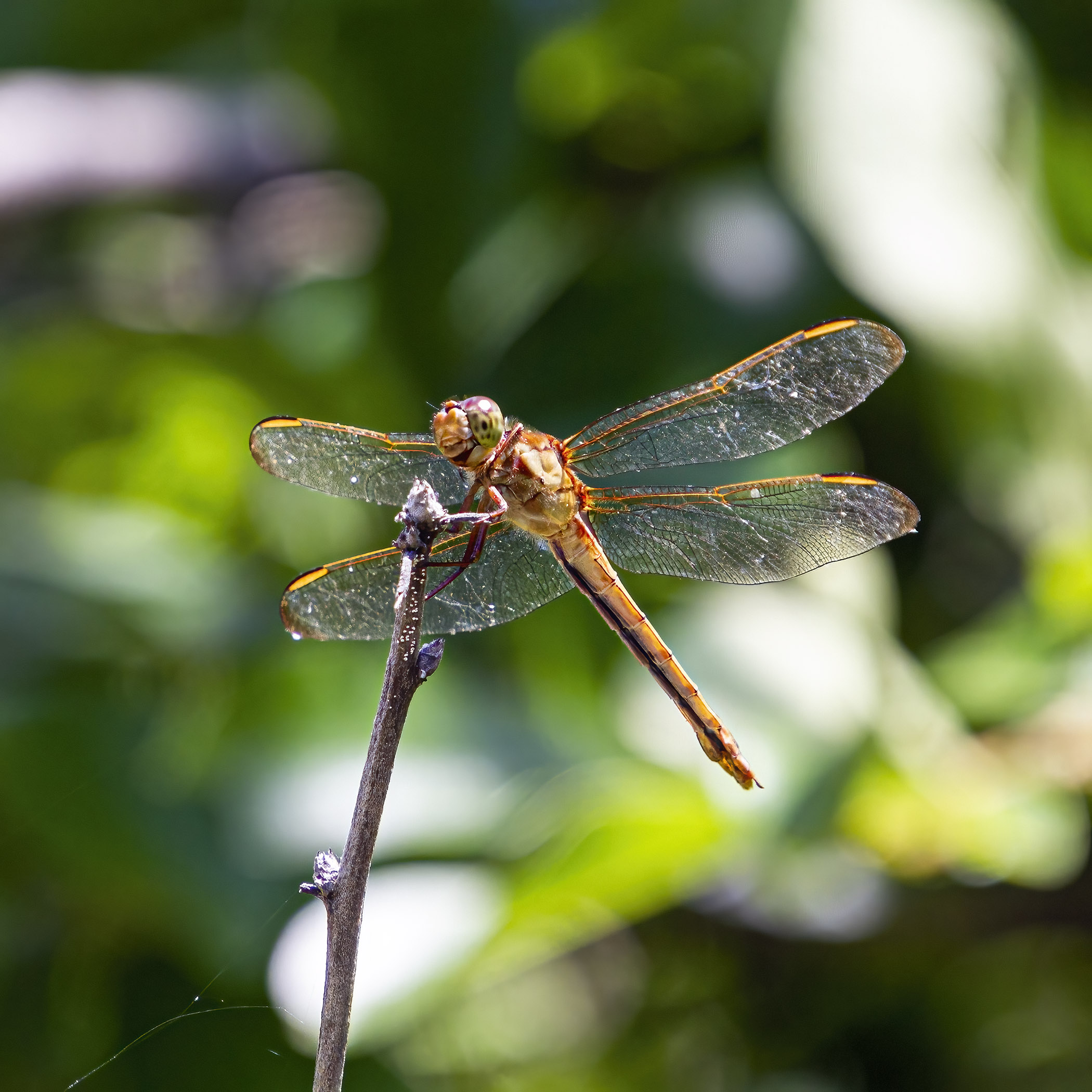
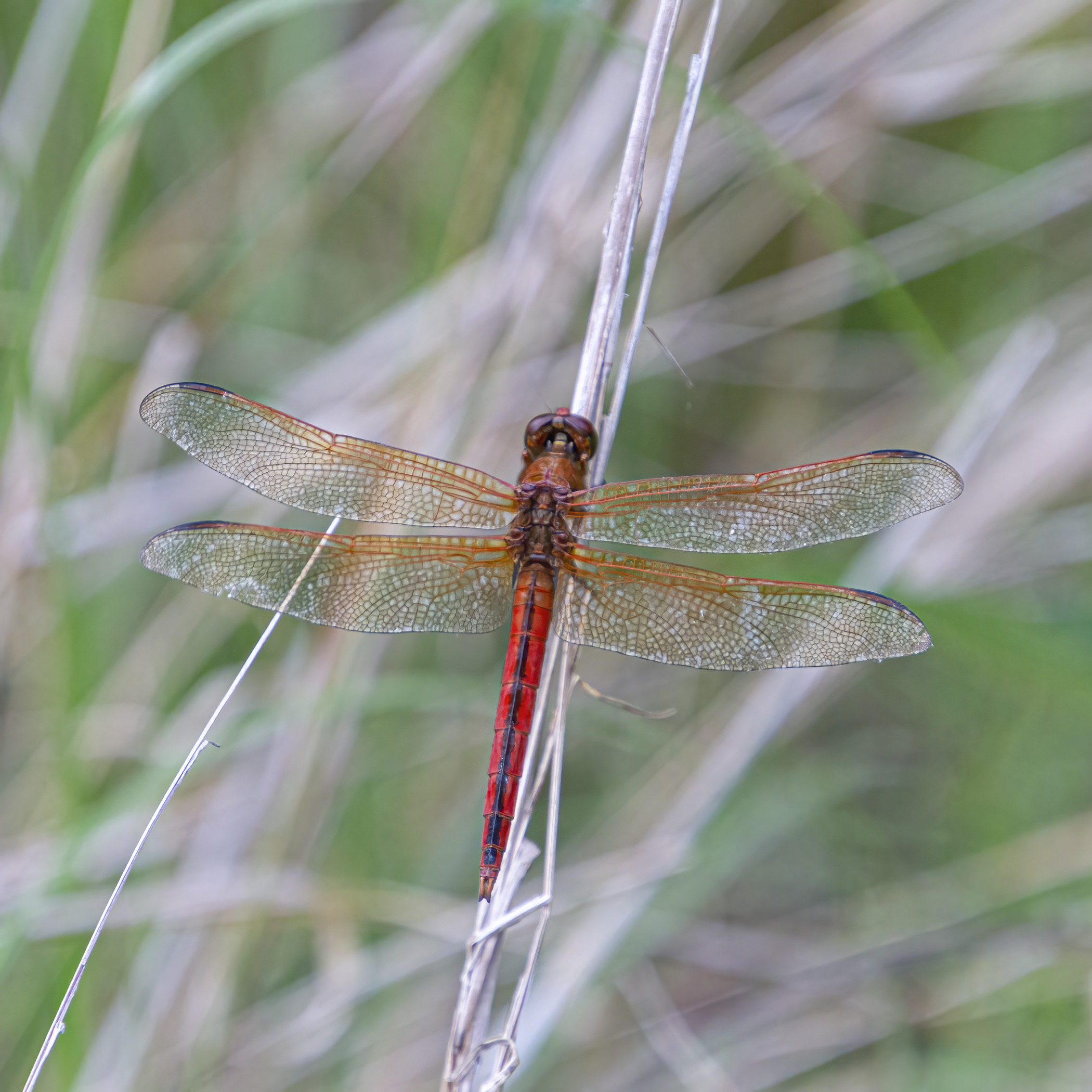
Earlier in the summer Needham’s Skimmers (Libellula needhami) were one of the most common dragonflies that I would encounter at Occoquan Bay National Wildlife Refuge, but over the past month their numbers have dropped significantly as their flight season draws to a close. I was therefore quite pleased to spot this mature female Needham’s Skimmer on Monday at the wildlife refuge.

The dragonfly’s colors seemed a bit faded, but otherwise she appeared to be in good shape. I am not sure if the stalk of vegetation on which she was perching was comfortable, but it helped me to isolate her from the background and its pointy protrusions add visual interest to the image.

Needham's Skimmer

© Michael Q. Powell. All rights reserved.

Read Full Post »

Surprisingly I have seen more Monarch butterflies this year than Viceroy Butterflies (Limenitis archippus), so I was delighted last week to spot this Viceroy last week at Occoquan Bay National Wildlife Refuge when it spread its wings. When an orange blur first moves across my sight line, I can’t tell the species apart. However, when the butterfly lands and I am able to look closely at the wing patterns, I can usually see the thin black stripe across the hindwings of Viceroys that is absent in Monarchs.

Viceroy butterfly

© Michael Q. Powell. All rights reserved.

Read Full Post »

This insect looks a bit like a dragonfly at first glance, but if you look more closely you may notice that the wings and eyes are different from those of a dragonfly and this insect’s body is a lot hairier. This is a robber fly and I am pretty sure that it is a variety known as a Red-footed Cannibalfly (Promachus rufipes).

Red-footed Cannibalflies are among the coolest and creepiest insects that you may encounter in the wild. As their macabre moniker suggests, Red-footed cannibalflies usually feed on other insects, but they reportedly are capable of taking down a hummingbird.

Robber flies in general are predators that wait for their prey to fly by and then attack it. Wikipedia describes their attack in this way, “The fly attacks its prey by stabbing it with its short, strong proboscis  injecting the victim with saliva containing neurotoxic and proteolytic enzymes which very rapidly paralyze the victim and soon digest the insides; the fly then sucks the liquefied material through the proboscis.” Yikes!

I have a personal special attachment to Red-footed Cannibalflies. In 2013 I captured an image of one of these insects and for years it was my most popular photo on-line, with over 3700 views to date. Since then, a few other of my photos have jumped ahead of this cool-looking predator, which continues to get views a dozen years after it appeared in my blog.

I captured this image last Monday at Occoquan Bay National Wildlife Refuge. I spotted this cannibalfly perched on a branch that was partially in direct sunlight. To keep from blowing out the highlights on its body, I deliberately underexposed the shot, which meant that the background became really dark. Normally I don’t like that kind of starkness and prefer a more natural background, but in this case it seems to work well with my creepy subject, giving it a spooky, Halloween-style vibe.

Red-footed Cannibalfly

© Michael Q. Powell. All rights reserved.

Read Full Post »

A simple composition and an ordinary subject—sometimes that is all that it takes to capture a beautiful image. I spotted this little Common Buckeye butterfly (Junonia coenia) on Monday at Occoquan Bay National Wildlife Refuge. The Common Buckeye kept perching on the ground and would fly away a short distance every time that I approached it.

Eventually it perched in the vegetation at the edge of the trail and I was able to capture this image. Although the background is a bit cluttered, it was far enough away that it blurred into a series of shapes that do not distract from the central subject. Yes, the subject is mostly a dull brown in color that most viewers may not find to be very visually pleasing. However, the eyes are really drawn to the orange stripes on the butterfly’s body and then to the interesting shadow that the legs of the butterfly are casting.

For me, there is a real beauty in the simplicity of this photo and I like it a lot. Photography does not always have to be complicated to be effective.

Common Buckeye

© Michael Q. Powell. All rights reserved.


Read Full Post »

When I try to take photographs of a butterfly, I usually have multiple objectives. First, of course, I’d like to be able to capture some images that are more or less in focus. Ideally, I like to get an interesting wing position, which often means that I try to catch the butterfly with its wings open. Finally, I love to catch the butterfly in a visually attractive habitat or doing something interesting, though these variables are the ones over which I have the least amount of control.

On Monday I chased after this Eastern Tiger Swallowtail butterfly (Papilio glaucus) when I spotted it in flight and tracked it when it landed in some nearby vegetation. There did not seem to be any flowers there, so I was a little surprised that the butterfly had chosen to perch at that spot. I carefully chose my shooting angle and was pretty pleased that I was able to capture a lot of the habitat. Although there is still a lot of greenery, the dried-up leaves help to give the image an interesting autumn vibe.Eastern Tiger Swallowtail

© Michael Q. Powell. All rights reserved.


Read Full Post »

On Monday I managed to photograph this elusive Zebra Swallowtail butterfly (Eurytides marcellus) during a visit to Occoquan Bay National Wildlife Refuge. When the butterfly was in motion, I had no idea that it was damaged, but when it paused for a moment, it was immediately obvious that it was missing its tails.

Somehow the butterfly was able to compensate for their loss by adjusting its flight and its feeding behavior did not appear to be adversely affected. As we get older, we often worry about the things that we can no longer do as well as when we were younger, instead of adjusting our behavior to focus instead on all of the things that we are still possible.

Maybe we should take a cue from this damaged butterfly and live our lives positively, rather that wallow in our “what ifs…” or “if only…” mindsets.

Zebra Swallowtail

Zebra Swallowtail

© Michael Q. Powell. All rights reserved.

Read Full Post »

I was delighted to spot this Eastern Box Turtle (Terrapene carolina carolina) yesterday alongside one of the trails at Occoquan Bay National Wildlife Refuge. These beautiful land-dwelling turtles, also known as Woodland Box Turtles, are extremely long-lived and are capable of living over 100 years in captivity, though in the wild they often live much shorter lives due to disease and predation.

The brown eyes of this turtle suggest that that it is a female, though I have read that eye color is not always 100% accurate in determining the gender of a box turtle—males of this species often have red eyes. The shell pattern for each box turtle is supposed to be unique, like a fingerprint, which makes the wonderful patterns of this turtle’s shell especially intriguing.

Eastern Box Turtle

Eastern Box Turtle

© Michael Q. Powell. All rights reserved.


Read Full Post »

I was thrilled to spot this pristine Eastern Tiger Swallowtail butterfly (Papilio glaucus) last week at Occoquan Bay National Wildlife Refuge. Many of the butterflies that I see this late in the season are tattered and damaged, but this one appeared to be in a perfect condition as it hungrily fed on some blooming wildflowers.

Eastern Tiger Swallowtail

© Michael Q. Powell. All rights reserved.


Read Full Post »

As we near the end of August, I am seeing more and more reminders that Halloween is drawing near. Although we still have a couple of months before the 31st of October, store displays of candy and costumes and all other sorts of spooky merchandise have popped up everywhere.

Even when I was walking the trails of Occoquan Bay National Wildlife Refuge recently, I was reminded of the upcoming holiday when I spotted this Halloween Pennant dragonfly (Celithemis eponina) perched at the highest point of a patch of vegetation. Halloween Pennants have very distinctive markings on their wings that make then easy to identify. Unlike some other dragonfly species that perch on the ground and are therefore hard to spot amidst the fallen leaves, Halloween Pennants always seem to perch high above the ground and consequently are easy to spot. These perches often sway in the slightest of winds, causing the dragonflies to flutter in the wind, like pennants.

Halloween Pennant

© Michael Q. Powell. All rights reserved.

Read Full Post »

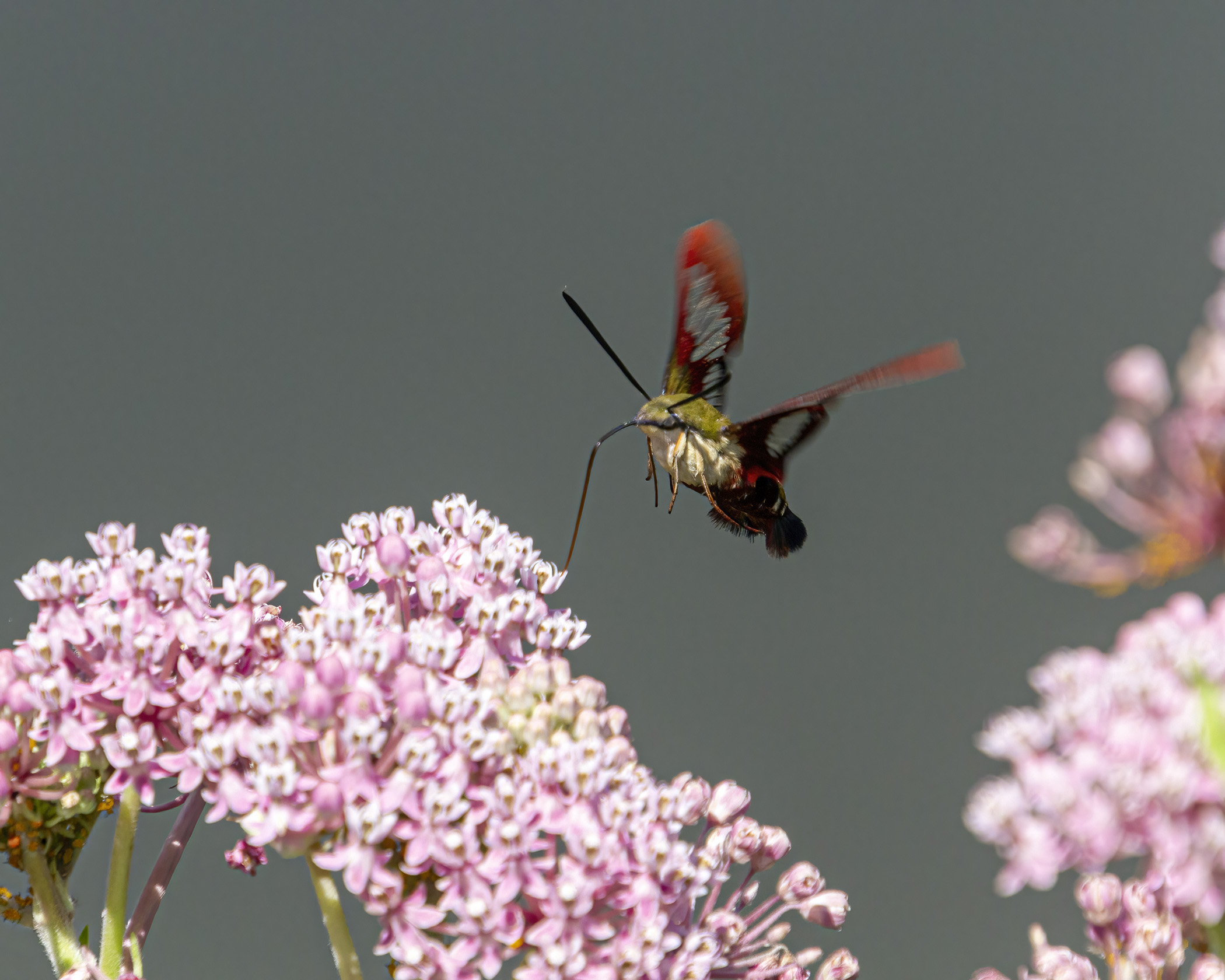
During a visit to Occoquan Bay National Wildlife Refuge, I was delighted to spot a clearwing moth flying about in the milkweed. I initially assumed that it was a Hummingbird Clearwing Moth (Hemaris thysbe), the most common clearwing moth in our area. When I looked more closely, however, I realized that it was a Snowberry Clearwing Moth (Hemaris diffinis).

Although these two species are similar in appearance, there are some noticeable differences. The first photo is one I took on Friday of a Snowberry Clearwing and the second photo from earlier in August is of a Hummingbird Clearwing. Snowberry Clearwing Moths have black legs, while those of a Hummingbird Clearwing Moth are paler in coloration. Snowberry Clearwings also have a black stripe on the thorax that runs up to the eye that is lacking on the Hummingbird Clearwings.

I suspect that there are some other differences too, but I am simply thrilled to know that we have both species present in our area. Most people seem to think that moths are dull and uninteresting, compared with butterflies, but these two species clearly show that moths have their own distinctive beauty and behavior, if you slow down enough to notice them.

Snowberry Clearwing Moth

Hummingbird Clearwing Moth

© Michael Q. Powell. All rights reserved.

Read Full Post »

While I was looking for dragonflies last Friday at a small pond at Occoquan Bay National Wildlife Refuge, I spotted this Solitary Sandpiper (Tringa solitaria) foraging in the shallow water. As its name suggests, the sandpiper was all by itself, with not another member of its species visible.

The bird was quite skittish, so I was not able to get close to it and observed it from a distance. The sandpiper was in almost constant motion as it waded through the water, periodically dipping its head down to hunt insects, crustaceans, mollusks, amphibians, and other prey. I think that the Solitary Sandpiper was having some success, though it was hard to tell for sure.

I was happy to be able to capture this shot of the bird as it plunged its opened bill into the water. The reflection of the sandpiper and the surrounding area in the water was a nice bonus.

Solitary Sandpiper

© Michael Q. Powell. All rights reserved.

Read Full Post »

I was absolutely thrilled to spot several Monarch butterflies (Danaus plexippus) yesterday during a visit to Occoquan Bay National Wildlife Refuge. Every year I worry that I will not see any Monarchs due to a reported decrease in suitable habitats, although I don’t think that Monarchs are officially on the endangered species list at the present time.

The Monarchs that I saw were very much focused on a particular patch of wildflowers, so I had a chance to move about a bit to frame my photos, as you can see below.

I have fond childhood memories of seeing photos of migration of Monarch butterflies in National Geographic magazine, and every time that I see them, it brings back those memories.

Monarch butterfly

Monarch butterfly

Monarch butterfly

© Michael Q. Powell. All rights reserved.
Read Full Post »

I was delighted to spot this Common Wood Nymph butterfly (Cercyonis pegala) during a recent visit to Occoquan Bay National Wildlife Refuge. I love the distinctive yellow patches on its wings that make it pretty easy to identify.

Common Wood Nymphs usually like to hang around near the edges of the woods rather than in the fields that many butterflies seem to prefer and consequently I do not see this cool-looking butterfly very often.

Common Wood Nymph

© Michael Q. Powell. All rights reserved.


Read Full Post »

Out of the more than 3500 species of skipper butterflies worldwide, there is only one that I can reliably identify, the Silver-spotted Skipper (Epargyreus clarus). I remember when I first started taking nature photos that I mistaken believed that all of the little, mostly brown butterflies were moths. Somehow I had done a kind of color sorting in my mind and had reserved the name “butterfly” exclusively for the large, colorful species.

As I look back, I realize that my initial oversimplified identification schema was a bit naive and incorrect. That does not necessarily mean that I am able to identify all of the skipper species now, but I can look at them more carefully and see the differences in their colors and patterns that will help me to find them in my identification guides.

I spotted this beautiful Silver-spotted Skipper during a recent visit to Occoquan Bay National Wildlife Refuge. The butterfly was skittish and elusive, but I eventually managed to capture this shot of it by peering through a “window” in the vegetation.

Silver-spotted Skipper

© Michael Q. Powell. All rights reserved.

Read Full Post »

I love dragonflies. There is something almost magical about these incredible aerial acrobats that never fails to fascinate and enchant me.

When I was attempting to compose a photo of this Great Blue Skimmer dragonfly (Libellula vibrans) last week at Occoquan Bay National Wildlife Refuge, I tried to use a leaf in the background to draw attention to my primary subject. It was only later, when I was review my images, that I realize that the leaf was heart-shaped, a perfect visual representation of my feelings towards dragonflies.

Great Blue Skimmer

© Michael Q. Powell. All rights reserved.


Read Full Post »

My mind sometimes works in mysterious ways. Often when I see a bright green female Eastern Pondhawk dragonfly (Erythemis simplicicollis), like the one in this image that I captured during a visit to Occoquan Bay National Wildlife Refuge, I can’t help but think of Kermit the Frog. Why?

Kermit the Frog has always been my favorite Muppets character. I have distinct memories of Kermit singing one of his signature songs, “It’s not easy being green” in which he laments his green coloration, expressing his concern that green “blends in with so many ordinary things” and wishing to be some other color.

“It’s not that easy being green;
Having to spend each day the color of the leaves.
When I think it could be nicer being red, or yellow or gold-
or something much more colorful like that.

It’s not easy being green.
It seems you blend in with so many other ordinary things.
And people tend to pass you over ’cause you’re not standing out like flashy sparkles in the water-
or stars in the sky.”

Have you ever felt that way, wishing you could stand out more from the crowd, uncomfortable in your own skin? I know that I have sometimes felt that way.

In the end, though, Kermit recalls positive associations with the color green, and concludes by accepting and embracing his color.

“But green’s the color of Spring.
And green can be cool and friendly-like.
And green can be big like an ocean, or important like a mountain, or tall like a tree.

When green is all there is to be
It could make you wonder why

But, why wonder? Why wonder?
I’m green and it’ll do fine
It’s beautiful, and I think it’s what I want to be.”

Life’s too short to worry and complain about all the things that we are not, to constantly compare ourselves with others, to become green with envy. It is so much more rewarding when you can boldly embrace who you are and ignore the views of the naysayers on the sidelines.

Eastern Pondhawk

© Michael Q. Powell. All rights reserved.

Read Full Post »

When it is really hot outside, birds try to avoid direct sunlight, like this Great Blue Heron (Ardea herodias) that I spotted last week during a visit to Occoquan Bay National Wildlife Refuge. The heron was relaxing in the vegetation at the edge of a small pond and appearing to be standing on a single leg, with the other leg probably tucked under.

In the winter months, I often see herons using this position as a way of conserving body heat, which obviously was not needed on this hot, humid day, so I am wondering if the “missing” leg was simply hidden by the vegetation.

Great Blue Heron

© Michael Q. Powell. All rights reserved.

Read Full Post »

It’s always fun to see how different certain butterflies look with their wings open vice closed, like this pretty little Pearl Crescent butterfly (Phyciodes tharos) that I photographed last week at Occoquan Bay National Wildlife Refuge. Most of the time when I see Pearl Crescents, their wings are mostly or fully open, so it was really nice to see one with its wings closed long enough for me to get a shot of it.

Pearl Crescent

Pearl Crescent

© Michael Q. Powell. All rights reserved.

Read Full Post »

I was thrilled to see this beautiful Zebra Swallowtail butterfly (Eurytides marcellus) last week at Occoquan Bay National Wildlife Refuge as it was feeding on some small wildflowers. Although it was missing the tip of one of its wings and one of its long “tails,” it seemed to be functioning perfectly well.

From a photography perspective I was really happy with the way that I was able to compose this image, with flowers in both the foreground and the background and the subject in pretty sharp focus.

Zebra Swallowtail

© Michael Q. Powell. All rights reserved.

Read Full Post »

During a recent visit to Occoquan Bay National Wildlife Refuge I was delighted to spot some bright red male Needham’s Skimmer dragonflies (Libellula needhami). The combination of the golden accents on the edges of their wings with that reddish-orange coloration makes these dragonflies visually stunning. The Needham’s Skimmers often were skittish, flying away as I approached, I managed to capture a few shots of them when they perched momentarily within range of my telephoto lens.

At this moment, Needham’s Skimmers are one of the most common dragonfly species that I encounter at this wildlife refuge, along with Common Whitetails. Some of the species that were present in the spring have disappeared and the autumn species have not yet taken their place. In that sense, we are in the midst of the summer doldrums, when the air is heavy with heat and humidity and new activity has slowed down to a snail’s pace.

Needham's Skimmer

Needham's Skimmer

© Michael Q. Powell. All rights reserved.


Read Full Post »

There were lots of dragonflies, mostly Common Whitetails and Needham’s Skimmers, flying about on Monday when I visited Occoquan Bay National Wildlife Refuge along with an abundance of pesky flies and mosquitoes. The temperatures were marginally cooler than in recent days, but the high humidity made it feel like I was slicing my way through the water-laden air.

I was delighted to spot this male Widow Skimmer dragonfly (Libellula luctuosa), a species that I do not often at this location, perched in the vegetation adjacent to a small pond. Like female Widow Skimmers, male have dark patches on their wings, but they also have a white patch on each wing, which makes them easy to identify. These patches are visible when male Widow Skimmers are flying, causing them to look a bit like fluttering butterflies.

When I was processing this image, I was surprised to see what appears to be an ant attached to the tip of one of the back legs of this dragonfly—you may need to click on the image to see this detail. I am not sure if the ant had hitched a ride on the dragonfly from its previous perch or, more likely, was merely exploring this unexpected intruder that had landed on this stalk of vegetation.

Widow Skimmer

© Michael Q. Powell. All rights reserved.


Read Full Post »

The weather in my area this month has been mostly miserable. It has been hot and humid and we have had almost daily thunderstorms, resulting in a significant amount of localized flooding.

Some of the dragonflies in our are are also showing signs of the stresses of summer, like this male Calico Pennant dragonfly (Celithemis elisa) that I spotted during a recent visit to Occoquan Bay National Wildlife Refuge. The photo below shows a substantial amount of damage to the wings of this dragonfly. I can’t tell if the damage was caused by a predator or if it is part of the normal wear-and-tear associated with life as a dragonfly.

I hope to get out a bit more often with my camera during the second half of July, perhaps starting out a bit earlier in the morning before things heat up to miserable levels.

Calico Pennant dragonfly

© Michael Q. Powell. All rights reserved.

Read Full Post »

Last Saturday I inadvertently spooked this Great Blue Skimmer dragonfly (Libellula vibrans) while exploring Occoquan Bay National Wildlife Refuge and it flew up into some high vegetation. I was not hopeful that I would be able to get a shot of it, but I decided to try to do so anyways. I’m quite pleased with the result.

I really like the way that the light was shining through the dragonfly’s slightly shredded wings and the shape and structure of the branch draw in a viewer’s eyes too. Overall it’s a fun “artsy” photo that makes me smile.

Great Blue Skimmer

© Michael Q. Powell. All rights reserved.


Read Full Post »

When I first spotted this Black Swallowtail butterfly (Papilio polyxenes) last Saturday at Occoquan Bay National Wildlife Refuge, I thought that it was a fresh, newly-emerged specimen. It was only when the butterfly opened its wings fully that I realized that it was missing the lower portion of one of its wings. Although the butterfly seemed to fly quite normally, the significant damage to its wing was visually noticeable.

This encounter caused me to recall a conversation that I had with a fellow wildlife/nature photographer many years ago. This photographer told me that he only photographs “perfect” subject, i.e. those without damage or blemishes. I was a bit stunned at that approach, to be honest. Most aspects of our lives imperfect in one way or another, after all we are humans.

Is beauty to be found only in perfection? I don’t think so, and my general approach to photography (and to life) is to look for the beauty all around me, a beauty that can be found literally everywhere. So I endeavored to highlight the beauty of the damaged butterfly, a beauty that transcends its physical appearance.

Is your idea of beauty based on external, physical characteristics or does it include other aspects as well? Is beauty universal or is it individual and personal? I sometimes ponder and reflect on these kinds of “big” questions, not really seeking for definitive answers to them, but instead forcing myself to explore the limits of my understanding and consciousness and perhaps even expand those limits in the process.

Black Swallowtail

© Michael Q. Powell. All rights reserved.

Read Full Post »

Last Saturday I spotted this stunning female Eastern Pondhawk dragonfly (Erythemis simplicicollis) during a visit to Occoquan Bay National Wildlife Refuge. The thorn-like projection near the tip of the abdomen that helps her to lay eggs made it immediately obvious that this was a female. The bright green coloration, distinctive black bands on her abdomen, and her green face make it almost impossible to misidentify this species.

As I was checking my blog yesterday, I came across a notice from WordPress informing me that I had started my blog 13 years ago. Wow! It’s hard to believe that I have kept this blog going for that long. According to the statistics from WordPress I have had 524,468 views of 5,417 posts since I began posting.

It is a bit of a cliché but it is absolutely true that I could not have done this without all of the support, suggestions, and encouragement. Thank you to all of you. I remember my modest expectations when I started the blog, looking simply for a place to post my wildlife and nature photographs. Over time this blog has become a kind of diary in which I have been able to express a lot of what I think and feel as I experience the beauty of the natural world. I have come to enjoy expressing myself as much in my written words as I have in my photos, reflecting on many different aspects of my life, including religion, poetry, and various artistic pursuits.

I remember deciding on the subheading for the blog some 13 years ago, calling it “My journey through photography.” Though the path has often been meandering and full of detours and distractions, that journey still continues. Once again, I thank all of you who have chosen to walk alongside me and to experience the world in part as I see it.

Female Eastern Pondhawk

© Michael Q. Powell. All rights reserved.
Read Full Post »

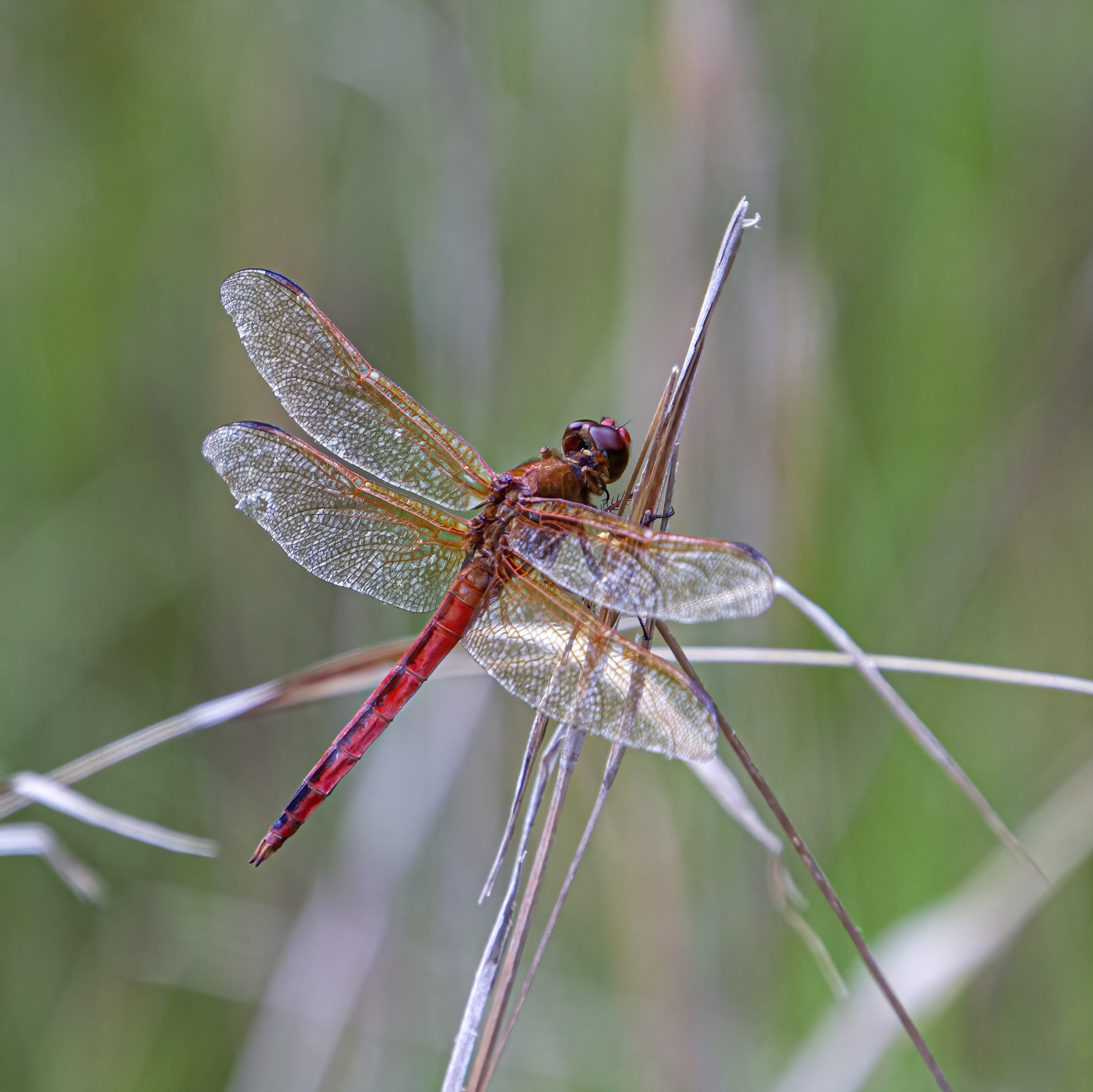
I have spent a lot more time indoors this past month than I normally, as a result of our unusually warm and stormy weather. On Saturday I finally made it out to Occoquan Bay National Wildlife Refuge, my favorite place to explore with my camera, and was greeted by an abundance of dragonflies.

Many of the dragonflies I encountered were Needham’s Skimmers that were often perched at the tops of vegetation that seems to have grown a lot recently. A lot of other flies were common too and they pestered me incessantly by buzzing around my ears, but fortunately they did not appear to be interested in biting me.

I was delighted that many dragonflies seemed be smiling at me, like this cool-looking Needhams’s Skimmer (Libellula needhami). I also really like that I able to capture the beauty of the beautiful two-toned, speckled eyes.

Needham's Skimmer

© Michael Q. Powell. All rights reserved.
Read Full Post »

Mourning Cloak butterflies (Nymphalis antiopa) are often one of the first butterflies that I see in early spring, because they overwinter with us as adults in a kind of hibernation. According to Wikipedia, Mourning Cloaks, known in Britain as the Camberwell Beauty, have a lifespan of 11 to 12 months, one of the longest lifespans for any butterfly.

In the springtime, these butterflies mate and I suspect that the butterfly in the photo below that I spotted in early June at Occoquan Bay National Wildlife Refuge is part of the “new generation.” I don’t know a whole lot about the entire life cycle of the Mourning Cloak, but from what I have read, their lives include periods of activity followed by long periods of inactivity. During the summer, for example, they enter into a “dormant” stage, known as aestivation that is somewhat similar to hibernation, and then become active again in the autumn.

I love the markings of this beautiful butterfly and was thrilled when it held its wings open for a few seconds and let me see the stunning blue markings on its inner wings that stand out among the mostly subdued colors on its body.

Mourning Cloak butterfly

© Michael Q. Powell. All rights reserved.

Read Full Post »

Earlier in June I spotted this cool-looking bird at Occoquan Bay National Wildlife Refuge. I am not really sure what species it is, but I think it might be a Great Crested Flycatcher (Myiarchus crinitus). The bird was mostly hidden in the foliage, but I managed to get a couple of reasonably clear shots of it.

I love the wash of yellow on its belly that gradually fades into the gray of its throat. There are a few other birds in the flycatcher family that are somewhat similar in appearance, so I could be off in my identification, but this is the one that most closely matches the descriptions and images in my identification guides.

Great Crested Flycatcher

Great Crested Flycatcher

© Michael Q. Powell. All rights reserved.

Read Full Post »

A dragonfly couple in wheel formation flew by me during a recent visit Occoquan Bay National Wildlife Refuge and landed on some nearby vegetation. This acrobatic position is the one used by most dragonflies for mating—sometimes they will mate while in the air and other times they will “do the deed” while perched.

I am not totally certain but I believe that these dragonflies are Unicorn Clubtails (Arigomphus villosipes), a species that I see from time to time in my area.

Happy Friday the 13th!

Unicorn Clubtail

© Michael Q. Powell. All rights reserved.


Read Full Post »

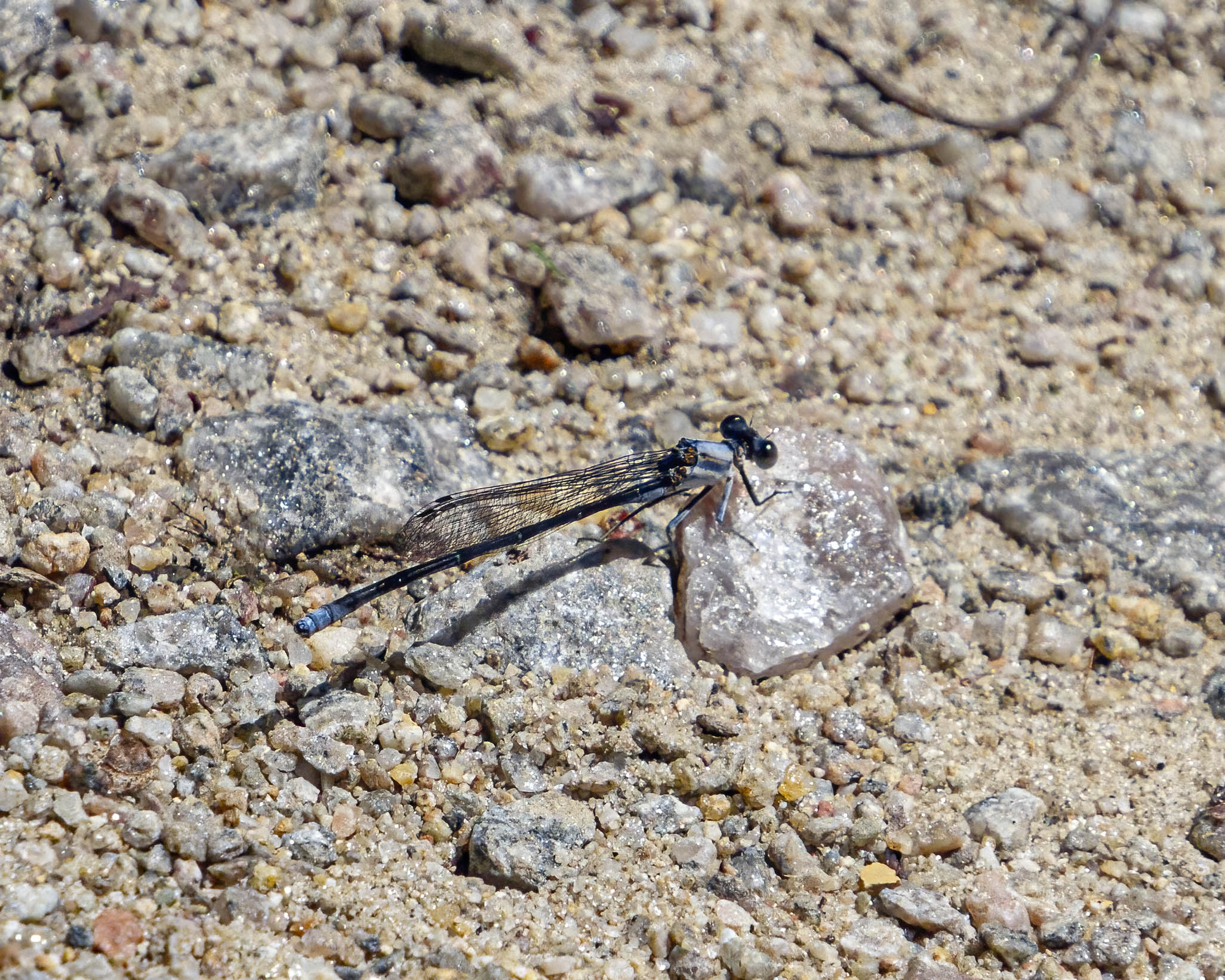
Most of the time that I see damselflies, they are perched in the vegetation. Powdered Dancer damselflies (Argia moesta), like this one that I spotted last week at Occoquan Bay National Wildlife Refuge, however, like to perch on bare ground, emergent stones, and along trails. Immature male Powdered Dancers are tan to dark brown, turn darker with age, and becoming almost completely whitish at maturity.

The “powdered” color of this damselfly helped in to blend in almost perfectly with the sand and gravel on this trail at the wildlife refuge. If I had not seen it land, I suspect that I would have had real trouble spotting this Powdered Dancer damselfly.

Powdered Dancer

© Michael Q. Powell. All rights reserved.

Read Full Post »

« Newer Posts - Older Posts »