Feeds:
Posts
Comments

Posts Tagged ‘Troglodytes hiemalis’

Throughout this winter, I have been trying to capture an image of Winter Wren (Troglodytes hiemalis), a tiny bird that spends the cold season in my area. As described by the Cornell Lab of Ornithology, “Winter Wrens hop and scamper through the understory moving more like a mouse than a bird as they investigate upturned roots and decaying logs for food. These energetic birds often bob their entire bodies as if doing squats while they nervously look around in the forest understory.”

I have occasionally caught glimpses of Winter Wrens, but they have invariably moved away before I could get a shot. These wrens are really elusive as they scurry about among the tangled branches and leaves and my camera has struggled to focus on them, choosing instead to focus on the surrounding vegetation.

On Monday, I finally managed to get a shot of a Winter Wren, after tracking it through the brush for almost 15 minutes. It is definitely not a prize-winner, but I am pretty confident that I achieved my goal. Parts of the bird are hidden by branches, but I think helps viewers to better understand the environment in which this little birds are found.

Now I have a new challenge—to get a better shot of a Winter Wren. That’s part of the cycle of being a wildlife photographer, celebrating small achievements, but always believing that I can do better. That’s why I return again and again to the same places, always watching, always waiting, wildly optimistic that new opportunities will present themselves.

Winter Wren

© Michael Q. Powell. All rights reserved.


Read Full Post »

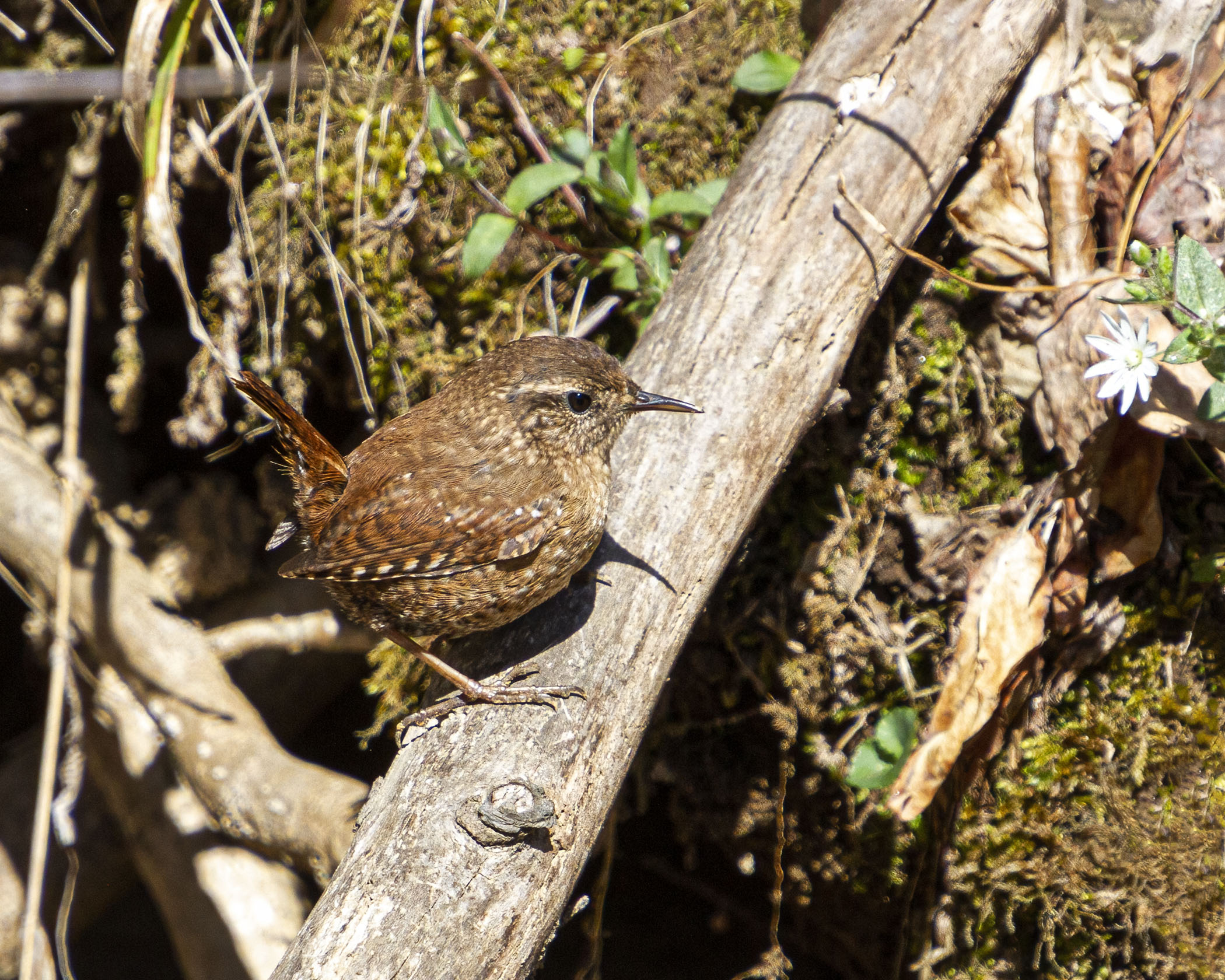
Throughout the winter I searched in vain for a Winter Wren (Troglodytes hiemalis), but finally managed to spot one last Thursday as I was exploring a stream in Prince William County, Virginia on a sunny spring day. According to the Audubon Field Guide, the Winter Wren is “A secretive little bird of dense woods. It often creeps about among fallen logs and dense tangles, behaving more like a mouse than a bird, remaining out of sight but giving an occasional kimp-kimp callnote.”

When I took these photos, I was standing in a dried-up stream bed, so I was almost at eye-level with this tiny bird. This angle of view allowed me to get much better shots that I would have gotten if I had been shooting downwards at the subject. I recommend that you click on the images to get a closer look at the beautiful details on this wren, including its speckled feathers, upturned tail, large feet, and sharp bill.

Winter Wren

Winter Wren

© Michael Q. Powell. All rights reserved.

Read Full Post »

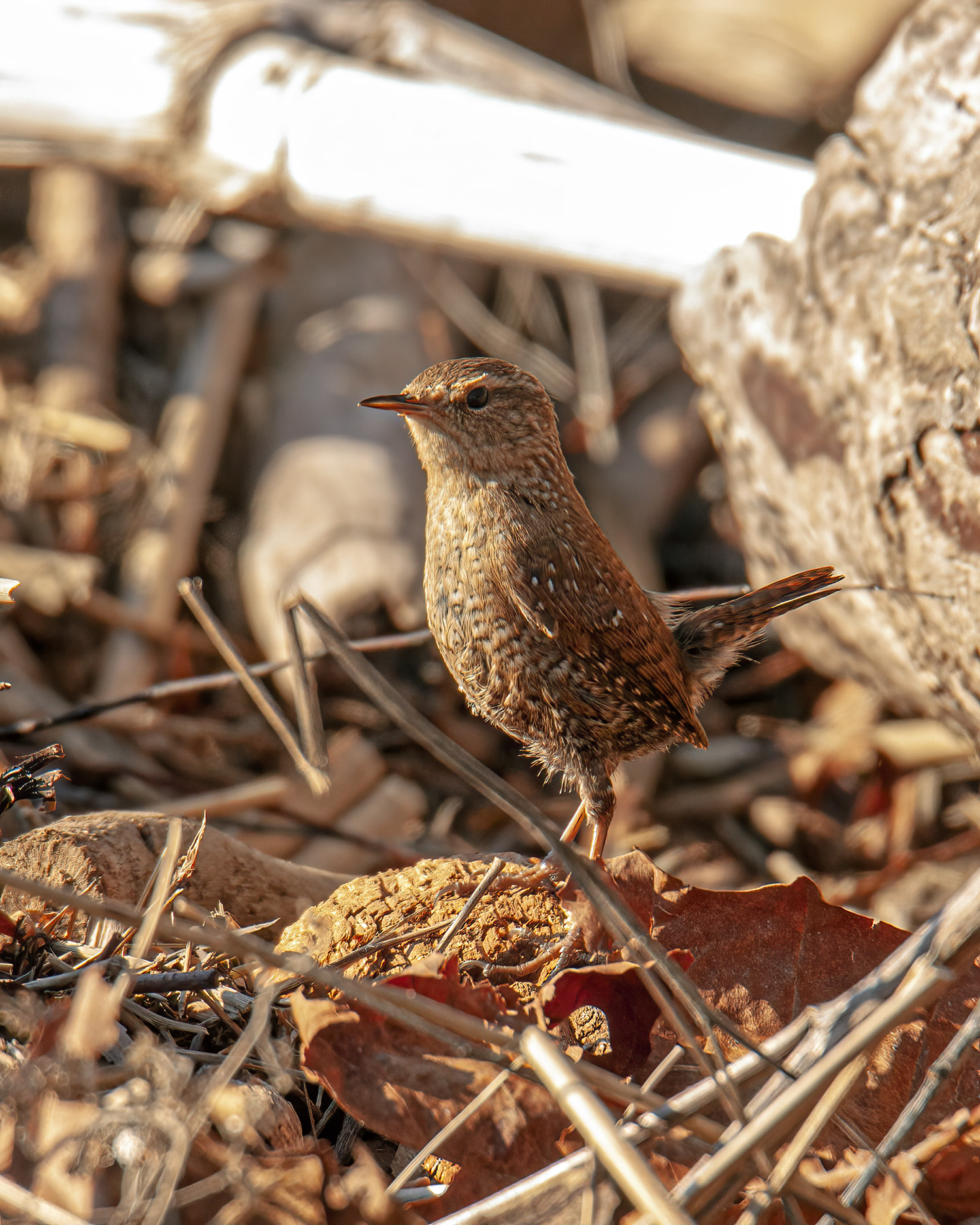
Throughout most of the year, if I am fortunate enough to spot a wren, it is likely to be a Carolina Wren. During the cold months, though, there is a chance that I may find a Winter Wren (Troglodytes hiemalis), a species that overwinters in my area. I have been trying to photograph one all winter and finally on Tuesday I managed to get a couple of shots of one during a visit to Occoquan Bay National Wildlife Refuge.

I really like the way the Audubon Guide to North American Birds describes the Winter Wren, “A secretive little bird of dense woods. It often creeps about among fallen logs and dense tangles, behaving more like a mouse than a bird, remaining out of sight but giving an occasional kimp-kimp callnote.” It is quite amazing to watch this energetic little bird as is crawls in and out of the undergrowth, rarely popping into view.

Normally Winter Wrens appear to be rather plump and round, as you can see in the second image. Something attracted the wren’s attention when I was taking the first shot that caused it to stretch out a bit, giving the bird a longer, more lanky look. The first shot also gives you a pretty good look at the varied patterns in the plumage of a Winter Wren—when the wren is in the shadows it looks to be a solid brown color, but there are actually a lot of speckles and stripes.

Winter Wren

Winter Wren

© Michael Q. Powell. All rights reserved.
Read Full Post »

I could hear rustling in the fallen leaves along one of the trails yesterday at Occoquan Bay National Wildlife Refuge, but had trouble determining what was making the noise. Most of the time, sparrows fly away in similar situations, but this little creature seemed to be crawling about, moving in one direction undeterred by my presence. When I finally got a partial glimpse of it, I realized that it was a Winter Wren (Troglodytes hiemalis).

The Cornell Lab of Ornithology describes the appearance and behavior of the Winter Wren in these words, “It sports a palette of browns with dark barring on the wings, tail, and belly. It habitually holds its tiny tail straight up and bounces up and down. This rather weak flier hops and scampers among fallen logs mouselike, inspecting upturned roots and vegetation for insects.” Wow. I don’t recall any other instance of the term “mouselike” being used to describe a bird, but it fits pretty well.

The little Winter Wren was a ball of energy, moving all the time in and out of the vegetation, making it hard to track and even harder to photograph. Eventually it hopped up onto a perch for a few seconds and I was able to capture the first two images. Most of the time, though, it was hidden in the undergrowth, even when it was mostly exposed as in the final image, which gives you a good idea of its habitat.

I really encourage you to click on the images to get a closer view of the different shades of brown and detailed patterns on this beautiful little Winter Wren.


Winter Wren

Winter Wren

Winter Wren

© Michael Q. Powell. All rights reserved.

Read Full Post »

This bird was tiny and elusive, but I finally managed to get a shot of what I confirmed is a Winter Wren (Troglodytes hiemalis) today at Huntley Meadows Park. The Winter Wren is smaller—about 3-4 inches (8-11 mm) in length—and has darker markings on its belly than the Carolina Wrens that I am more accustomed to seeing.

The description of this bird found on the website of the Cornell Lab of Ornithology matches perfectly the behavior I observed today. “It habitually holds its tiny tail straight up and bounces up and down. This rather weak flier hops and scampers among fallen logs mouselike, inspecting upturned roots and vegetation for insects.”

Winter Wren

© Michael Q. Powell. All rights reserved.


Read Full Post »

Peering through my telephoto lens at this tiny bird, I couldn’t help but smile—its energetic personality, round body, and tiny wings and tail were cartoon-like.  It looked like a wren, but it certainly didn’t resemble the Carolina Wrens that I am used to seeing.

I did a little research and have concluded that this is probably a Winter Wren (Troglodytes hiemalis). According to the Cornell Lab of Ornithology, these little birds are “incomparably energetic in voice” and per unit weight deliver their songs with ten times more power than a crowing rooster. I can only imagine groups of scientists with tiny scales and microphones conducting the research to back up that statement.

I noted on the statistics page of my blog that this will be posting number 1,000. I never imagined how much I would come to enjoy the process of blogging when I started this blog on July 7, 2012 with a photo of a Blue Dasher dragonfly. The support and encouragement from innumerable readers has helped to sustain me on my journey into photography. Thanks to all of you.

The journey continues.

winter_wren2_blogwinter_wren1_blog

© Michael Q. Powell. All rights reserved.

Read Full Post »