Feeds:
Posts
Comments

Posts Tagged ‘Tamron 180mm’

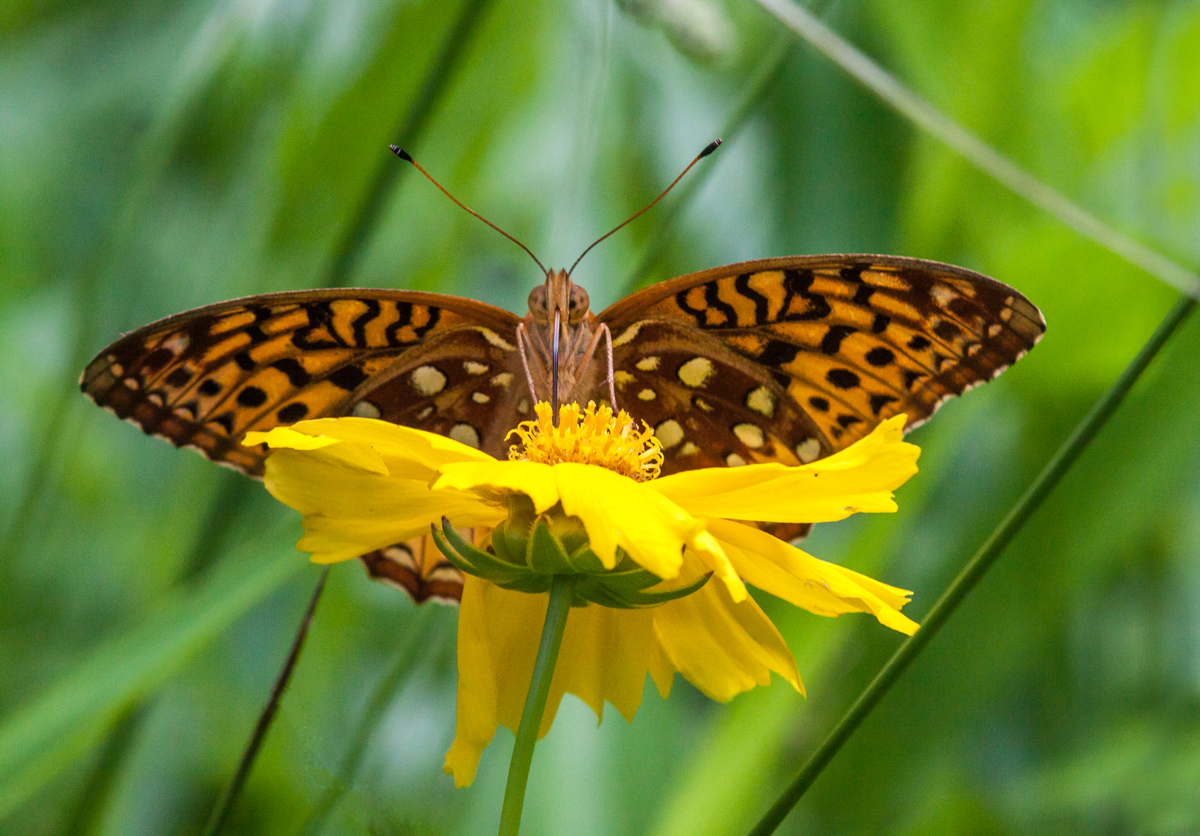
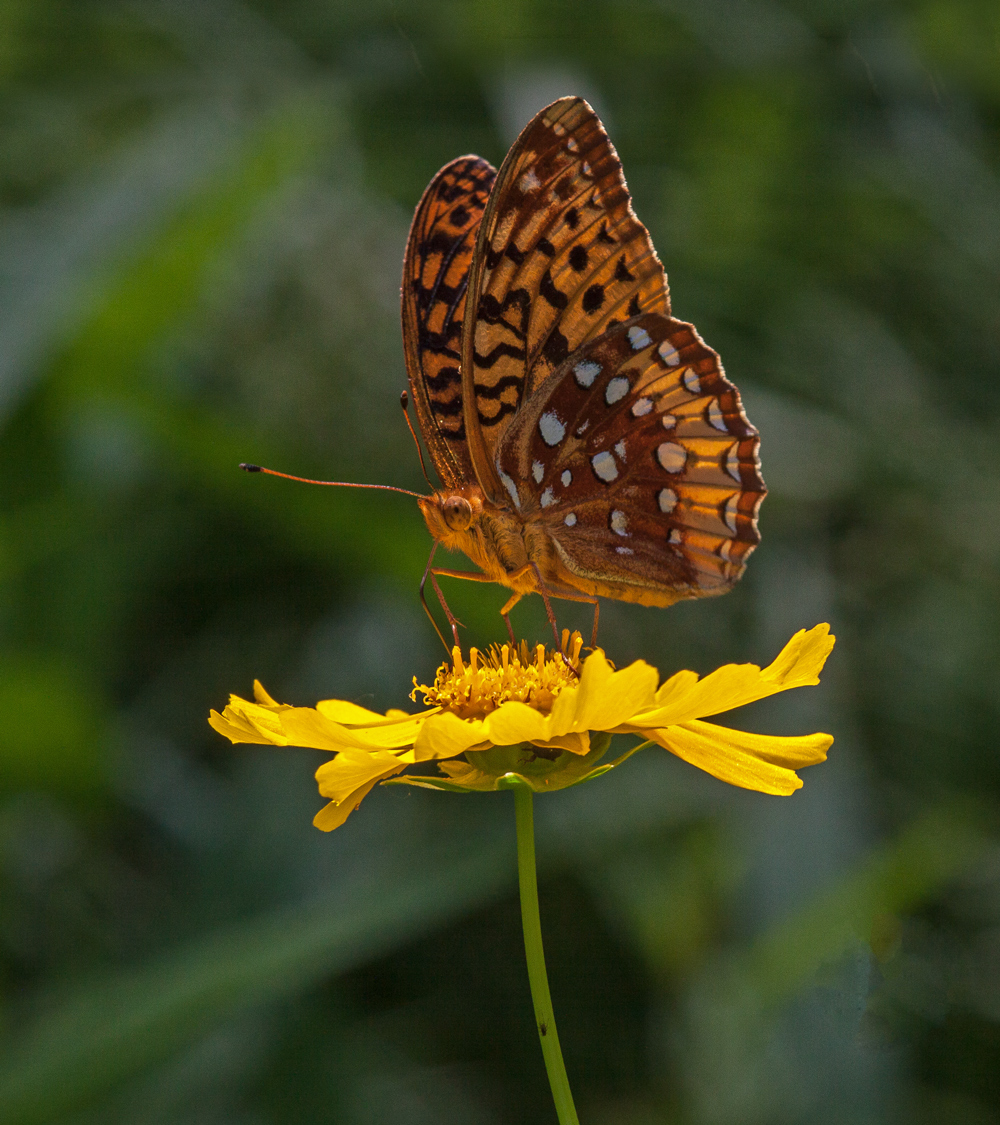
Spring is a time for chasing butterflies. This past week there seems to have been an explosion of Great Spangled Fritillary (Speyeria cybele) butterflies and I saw them at multiple locations yesterday as I trekked about in Huntley Meadows Park. The butterflies were very active, stopping for only short periods of time at flowers before moving on to the next one. My chasing behavior was impeded somewhat by the tall vegetation that has grown up in the fields, thanks to the large amount of rain that we had in May.

One of my favorite approaches with butterflies is to try to get at eye level with then and a few times yesterday I was able to get the kind of shot that I really like.

Great Spangled Fritillary

Great Spangled Fritillary

© Michael Q. Powell. All rights reserved.

Read Full Post »

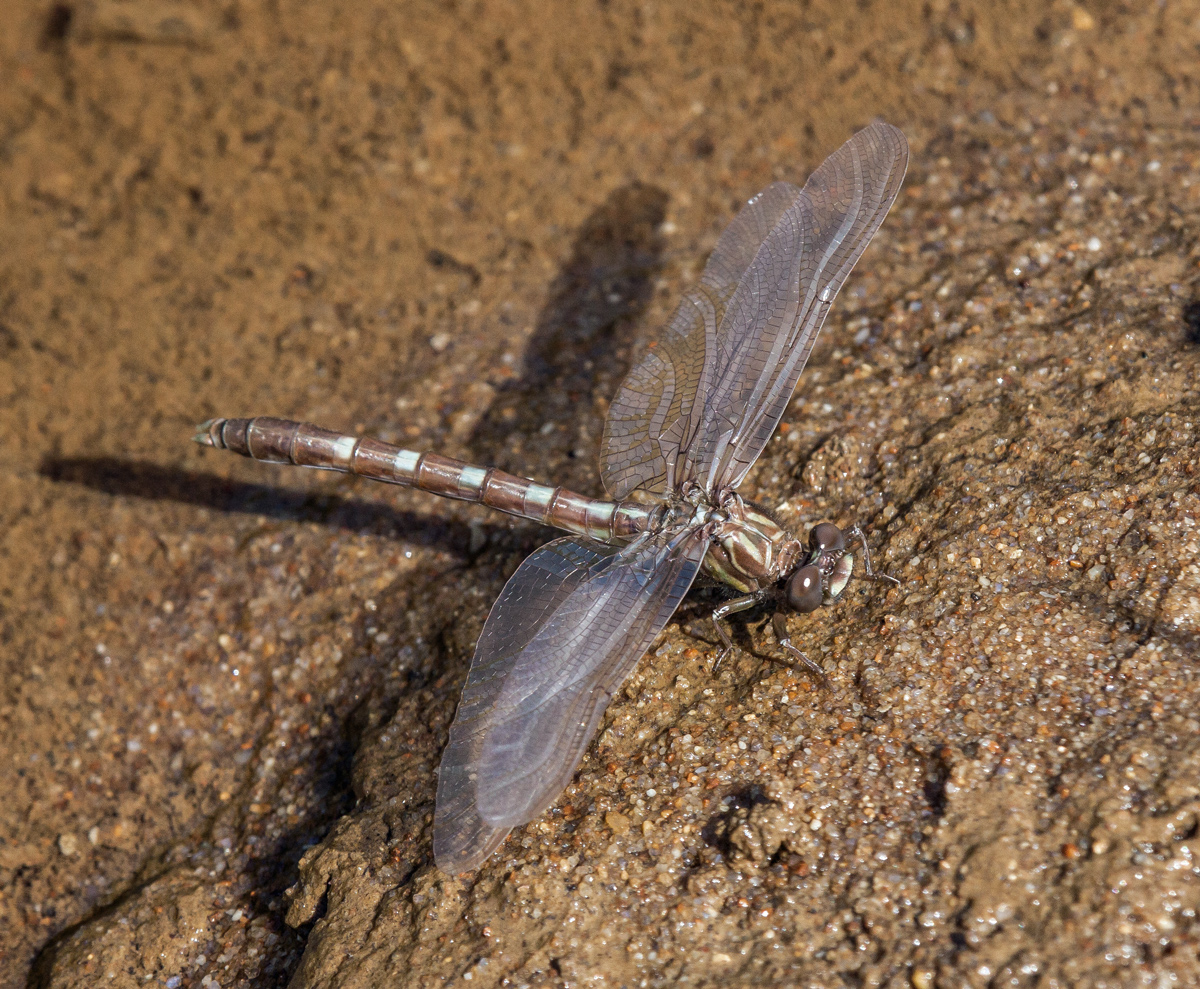
Where do you go to find sanddragons? Although it sounds like a trick question, the correct response is the obvious one—you generally find Common Sanddragon dragonflies (Progomphus obscurus) perched on the sandy bank of a stream. Sometimes Common Sanddragons will perch almost flat on the sand, but often they will raise their abdomens up, sometimes assuming the obelisk position, in which the tip of the abdomen is pointing almost straight up. Why do they do this? The most frequent explanation for this behavior that I have seen is that it is a method of thermoregulation. The dragonfly keeps from overheating by reducing the amount of its body that is directly exposed to the sun.

Common Sanddragon

Common Sanddragon

© Michael Q. Powell. All rights reserved.

Read Full Post »

While exploring Meadowood Recreation Area in Lorton, VA last month with fellow photographer Walter Sanford, I observed this Giant Water Bug (Lethocerus americanus) perched in the vegetation at the edge of a small pond. The bug’s size and its pose remind me of a tree frog—it’s over 2 inches (5 cm) long.
I have since learned that these bugs are nicknamed “toe-biters” and am happy that I didn’t get too close to it.
Giant Water Bug
© Michael Q. Powell. All rights reserved.

Read Full Post »

Dragonflies spend most of their lives as nymphs in the water.  When the time is right, they crawl out of the water, break out of their exoskeletons, and turn into the colorful aerial acrobats that I love to watch and to photograph.

Although I have seen photos and videos of this amazing transformation, I have not yet witnessed the entire process in person. However, this past weekend I did spot some newly emerged Common Sanddragon dragonflies (Progomphus obscurus) at Huntley Meadows Park. Nymphs of many dragonfly species attach themselves to vegetation as they undergo their metamorphosis, but Common Sanddragon nymphs merely crawl out of the water onto a sandy area at the edge of a stream.

After I had spotted the dragonflies, I scoured the sandy stream bank and managed to find some cast-off skins (exuviae). Looking at the exuvia in the photo, you can see how the nymph has broken through the shell just behind the eyes and crawled out. The stringy white things on the top of the exuvia are breathing tubes used by the nymphs.

My last image is a visual reminder of how complicated and delicate this transformation can be be. The dragonfly obviously had some kind of a problem in expanding its wings and it is doubtful that it was able to survive for very long.

Common Sanddragon

Common Sanddragon

Common Sanddragon

Common Sanddragon exuvia

Common Sanddragon

© Michael Q. Powell. All rights reserved.


Read Full Post »

I don’t see deer very often at my local marshland park. When I do, it is generally only a flash of their white tails as they bound out of sight. On Friday, however, I spotted a young White-tailed Deer (Odocoileus virginianus) foraging in the forest at Huntley Meadows Park on the other side of a small stream from where I was located.

I stopped and crouched and the deer slowly moved closer and closer to me. I think that the deer was aware of my presence, but did not seem to view me as a threat. I did not want to move around too much for fear of spooking the deer, so I used the lens that was on my camera at that moment and stayed in place. A 180mm macro lens would not have been my first choice for photographing a deer, but it worked out surprisingly well.

As the deer moved forward, I thought it might try to hop over the stream right where I was at, but eventually the deer moved upstream a bit and made its way to the side of the stream on which I was standing. It lingered for a while in a field before it finally disappeared from sight.

Here are a few shots from my encounter with the young deer. My favorite one might be the first one—I had no idea that deer were so flexible. The third image, which I only cropped a little gives you an idea of how close the deer was to me.

White-tailed Deer

White-tailed Deer

White-tailed Deer

White-tailed Deer

© Michael Q. Powell. All rights reserved.

Read Full Post »

The coloration of this female Eastern Pondhawk dragonfly (Erythemis simplicicollis) helped it to blend in almost perfectly with the lush green vegetation this past Friday at Huntley Meadows Park. This species of dragonfly is not only beautiful, but it is also deadly. I was reminded of this latter fact when I realized why the dragonfly had stopped and perched—it was consuming a small moth that it had just caught.

Eastern Pondhawk

© Michael Q. Powell. All rights reserved.

Read Full Post »

Necrophila americana—what a creepy Latin name for this beetle, known in English as the American Carrion Beetle, that feeds on dead and decaying flesh. Fortunately the backdrop was more pleasant for this specimen that I spotted on Monday in one of the fields at Huntley Meadows Park.

American Carrion Beetle

© Michael Q. Powell. All rights reserved.

Read Full Post »

It’s dragonfly season and this past Friday fellow dragonfly enthusiast and photographer Walter Sanford guided me to a new spot to search for the elusive beauties. Accotink Bay Wildlife Refuge is a nature preserve located on Fort Belvoir, a nearby military base in Fairfax County, Virginia.

We are in a lull period of sorts for dragonflies—some of the early dragonflies are gone and others have not yet appeared. As we were making one final swing through likely locations, having come up almost empty-handed in our search, Walter spotted a dragonfly. The wings were so clear and shiny that it was obviously a teneral dragonfly, one that had only recently emerged.

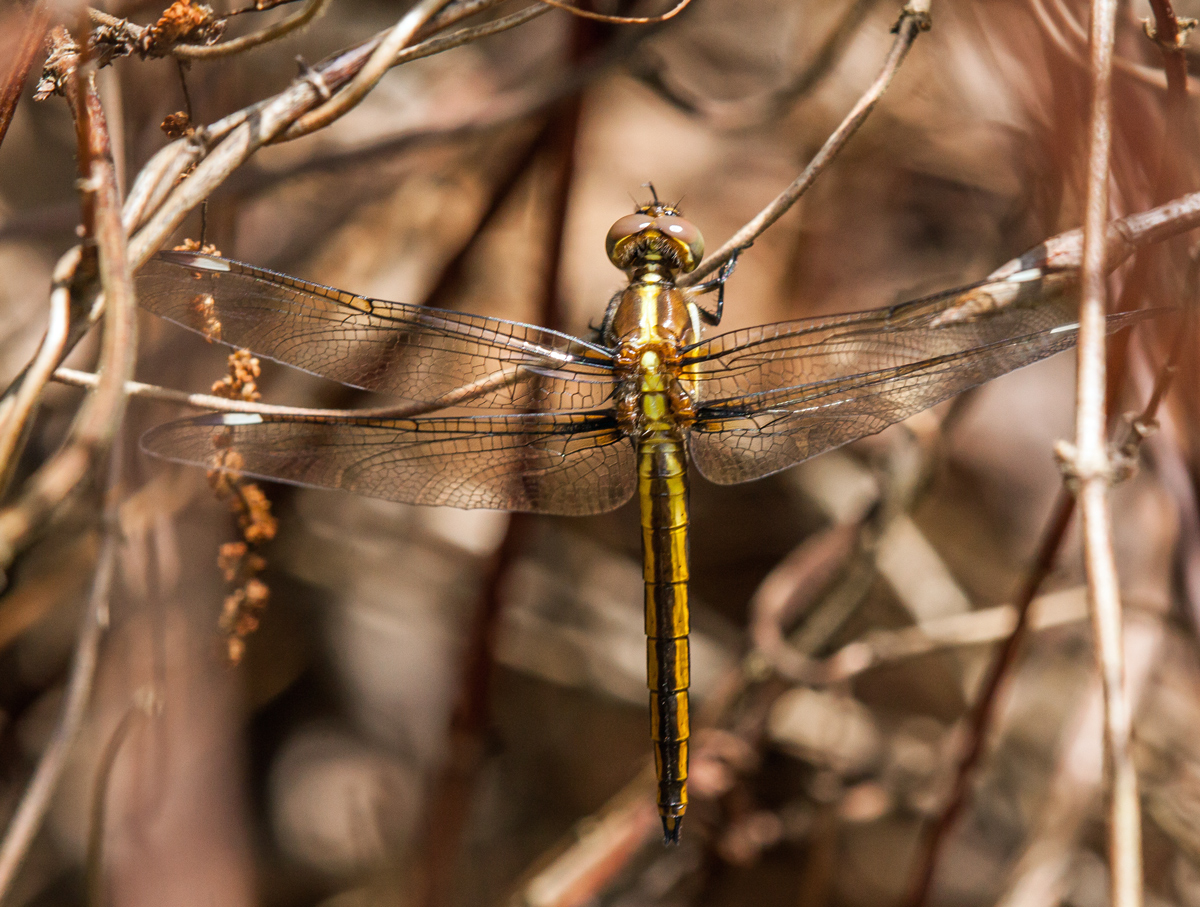
Identification (and photography) was a bit of a challenge, because the young dragonfly was perched inside of a tangled mass of vegetation, making it almost impossible to get an unobstructed view. Eventually we were able to find a visual tunnel and I was able to get the first shot below. It gives a pretty good view of the dragonfly, which after the fact I could clearly see is a Spangled Skimmer (Libellula cyanea), but I really wasn’t satisfied with it.

Eventually I managed to get a second shot. It doesn’t show the dragonfly’s entire body and many element are out of focus, but it has an artistic sense that I find really appealing. I’m not sure if it’s because of the more vibrant colors or the unusual angle—I just know I like that image a whole lot more than the first one.

Spangled Skimmer

Spangled Skimmer

© Michael Q. Powell. All rights reserved.


Read Full Post »

As I turned to photograph a tiny damselfly perched on an overhanging branch, it flew down to the water. Initially I was disappointed, but then I looked more closely through my camera’s viewfinder. The male Fragile Forktail (Ischnura posita) had landed on a floating leaf and had assumed a pose that made it look like he was riding a surfboard. As a bonus, I was able to capture a fascinating area of bubbles in the algae in the foreground of the image.

Fragile Forktail

© Michael Q. Powell. All rights reserved.

Read Full Post »

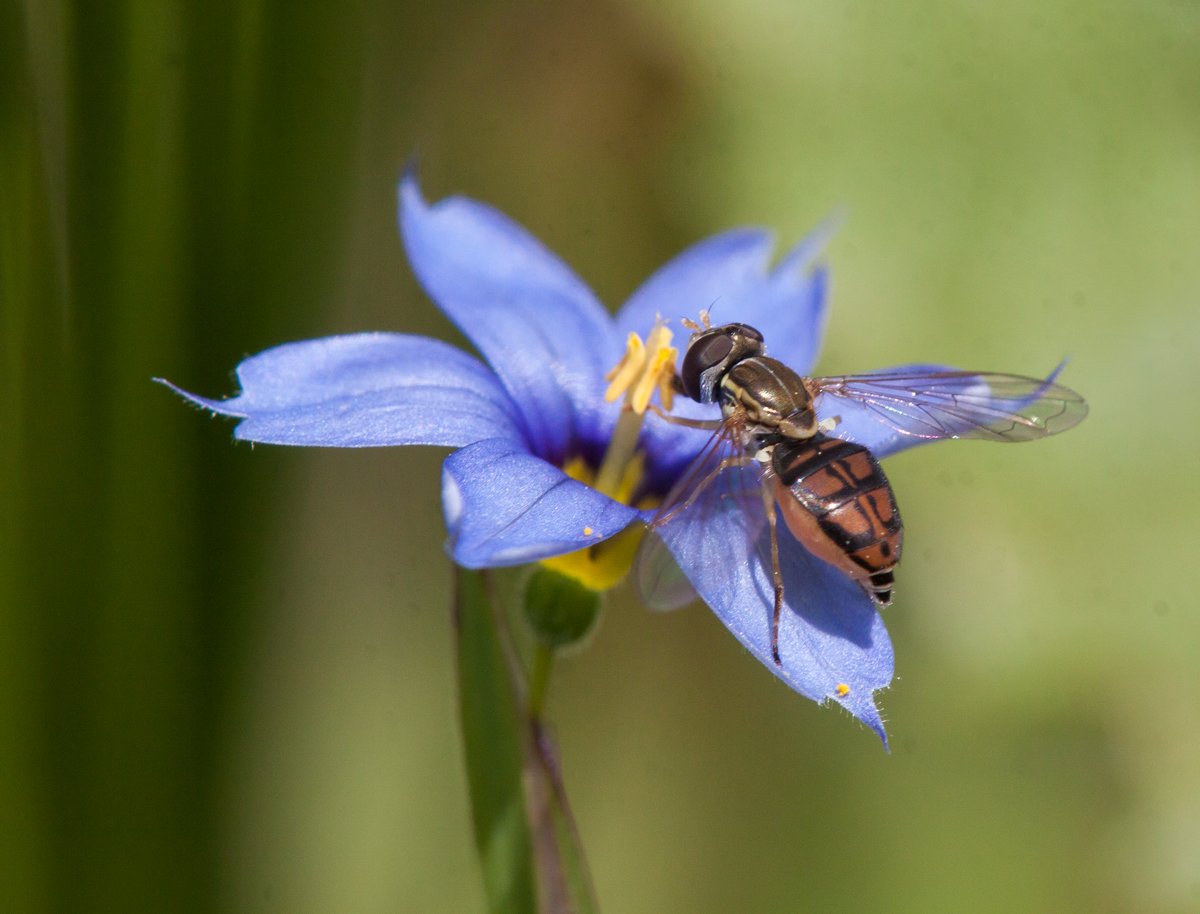
While I was hunting for dragonflies the past Friday at Meadowood Recreation Area in Lorton, Virginia, I managed to get this shot of a hoverfly (family Syrphidae) on what I was told was blue-eyed grass (Sisyrinchium) by some folks conducting a wildlife survey.

I had no idea what blue-eyed grass was, so I turned to the internet when I got home. It turns out that blue-eyed grass is not actually a grass, but a perennial plant of the iris family, and sometimes it is not blue. According to Wikipedia, the genus of blue-eyed grasses includes up to 200 species that may have blue, white, yellow, or purple petals.

hoverfly

© Michael Q. Powell. All rights reserved.

Read Full Post »

Most dragonflies like sunshine, so it’s been tough this month to find very many of them, given the almost constant cloud cover and frequent rain showers. Here are a few shots nevertheless of female Common Whitetail dragonflies (Plathemis lydia) from earlier in May. All of them appear to be young ones, in particular the one in the final shot, whose wings have not yet acquired their final coloration, indicating that it has only recently emerged.

Common Whitetail

Common Whitetail

Common Whitetail

© Michael Q. Powell. All rights reserved.

Read Full Post »

At this time of the year I love seeing irises growing in the wild at Huntley Meadows Park. I think these all are Blue Flag Irises (Iris versicolor), though I am not absolutely certain of this identification. These irises are not as big and showy as the ones growing in my neighbors’ gardens, but I find them to be equally beautiful.

Blue Flag Iris

Blue FLag Iris

Blue FLag Iris

© Michael Q. Powell. All rights reserved.

Read Full Post »

As I was wandering through the woods of Huntley Meadows Park last Friday, I came upon a giant Luna Moth (Actias luna) that seemed to be almost as big as my hand. I was trying to get a close-up of its really cool antennae when an ant crawled onto one of the moth’s legs. I thought the ant might become lunch until I learned that Luna Moths don’t eat—they have no mouths and they only live for about a week as adults, with a sole purpose of mating, according to a Fairfax County Public Schools webpage.

Luna Moth

Luna Moth

Luna Moth

© Michael Q. Powell. All rights reserved.

Read Full Post »

I was a bit surprised recently to spot an Eastern Garter Snake (Thamnophis sirtalis) with blue eyes at Huntley Meadows Park. Normally, a garter snake’s eyes are clear and bright and if I can get close enough, I can sometimes see my own reflection.

As I moved closer, I could see that the bluish covering over the eyes was somewhere between translucent and opaque, looking a little like cataracts. The snake was aware of my presence and flicked its tongue when I got too close, but did not try to slither away. A search on the internet revealed that the eyes turn this blue color when the snake is getting ready to shed its skin, a process that generally takes about a week.

When my macro lens is on my camera I feel drawn to move closer and closer to my subject, as you can see in the first image. This shot gives a good view of the blue eye, but doesn’t give you much a sense of the snake’s environment. When I pulled back to include the snake’s entire body, you get a look at the sinuous curves of the body, but the eye is almost lost. The final image here was a mid-range shot that was a kind of compromise—some of the body shows, but the eye has greater prominence than in the second image.

Which image do I like the most? It’s hard for me to decide, but I think it was a good idea to photograph the snake at different distances to give myself some options. I’m going to have to try that approach more often.

garter snake

garter snake

garter snake

© Michael Q. Powell. All rights reserved.

Read Full Post »

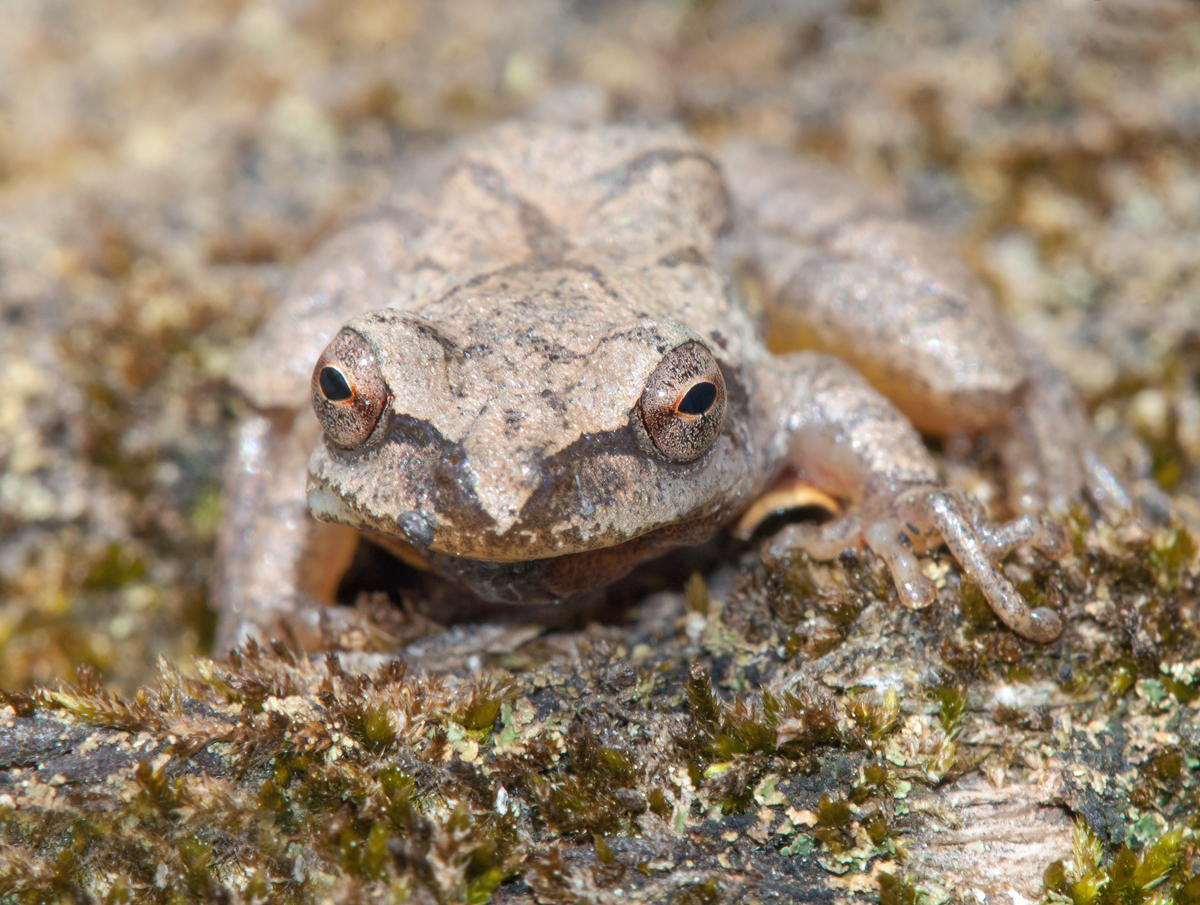
The high-pitched calls of the Spring Peeper frog (Pseudacris crucifer) are one of the harbingers of spring for many of us, but have you ever actually seen one of these diminutive songsters? Even when there was a loud chorus of Spring Peepers, these tiny frogs seemed to be invisible.

Last Friday, while hunting for dragonflies at Huntley Meadows Park with my friend and fellow photographer Walter Sanford, we almost literally stumbled upon a Spring Peeper near the edge of the water. As we were photographing one peeper, another jumped into view. The thing that struck me most about the spring peepers was how small they are, a bit over one inch and certainly less than two inches in length (about 3-5 cm). The other thing that I noticed was how low they were to the ground—it was tough getting a good viewing angle even when my elbows and knees were submerged in the marshy soil.

Here are three of my favorite shots of the Spring Peepers in a couple of different settings. You can’t help but notice how well the frog blends in with its surroundings, which helps explain why I had never been able to spot one previously. My one regret is that we never heard a peep from the frogs. Perhaps next time I will be able to get a shot of a Spring Peeper with its vocal sac inflated.

Spring Peeper

Spring Peeper

Spring Peeper

© Michael Q. Powell. All rights reserved.


Read Full Post »

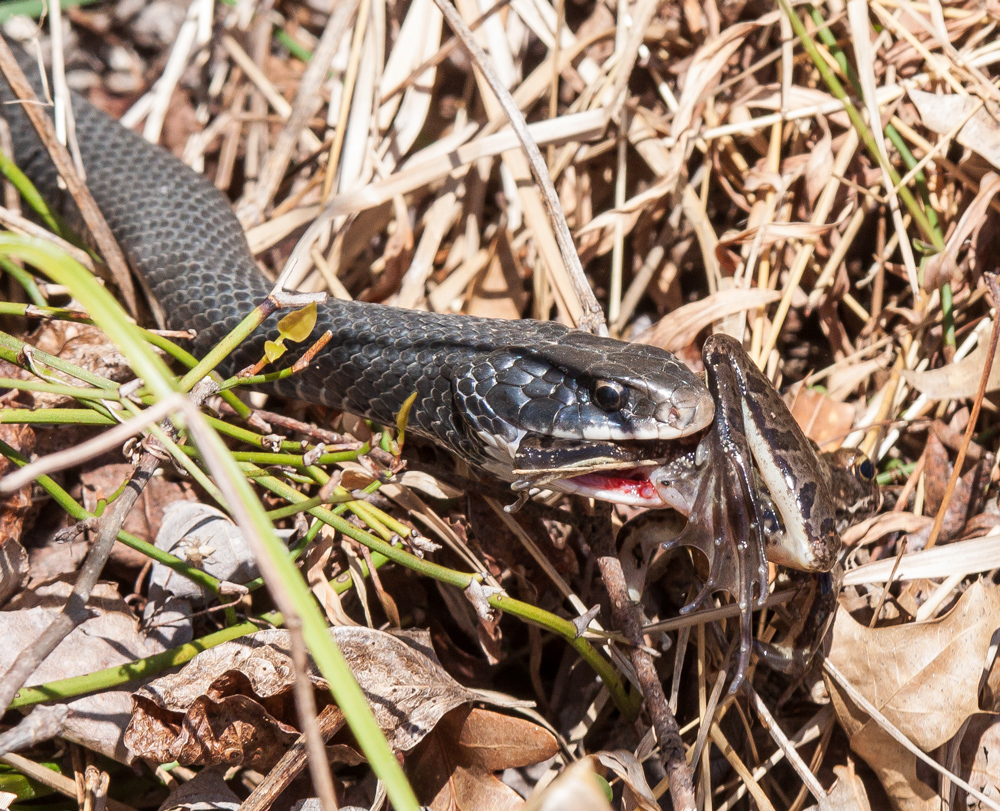
With a mixture of horror and fascination, I watched as a large black snake slowly ingested a Southern Leopard Frog (Lithobates sphenocephalus) that it had caught on Friday at Huntley Meadows Park. The frog was struggling and crying out loudly and then suddenly it was free. The lucky frog hopped away and the snake could only tell its friends about the one that got away.

When I first spotted the snake, it was holding the frog in the air. It appeared to have grabbed the frog by one of its back legs and was trying to adjust the frog so that it could swallow it. Unlike a Great Blue Heron that swallows its prey in a single gulp, the snake has to pull its prey in slowly. Little by little the snake seemed to get more of the frog’s leg in its mouth.

The frog continued to struggle, seeking to get some leverage so that it could pull its way out of the snake’s death grip. I didn’t see exactly how it happened, but all of the sudden the frog was free. It almost looked like that snake had released the frog, though that just seems so unlikely to have happened. Whatever the case, the frog was extremely fortunate—all of the previous encounters that I have observed between snakes and frogs have ended with the frog inside of the snake.

I was shooting with my macro lens, so I couldn’t zoom in closer, but I did manage to capture a sequence of shots that show some of the action.

release2_15Apr_blog

release3_15Apr_blog

release1_15Apr_blog

release5_blog_blog

© Michael Q. Powell. All rights reserved.

Read Full Post »

Do you find yourself shooting the same subjects with the same lens all of the time? Sometimes it’s fun to try to try to photograph a subject with the “wrong” lens.

Conventional wisdom tells me to use a telephoto lens to photo birds, a macro lens to photograph insects, and a wide-angle lens to photograph landscapes. Following that wisdom, I had my macro lens on my camera this past weekend when I traveled with some friends to Meadowlark Botanical Gardens in Vienna, Virginia, where I anticipated that I would be shooting flowers and insects.

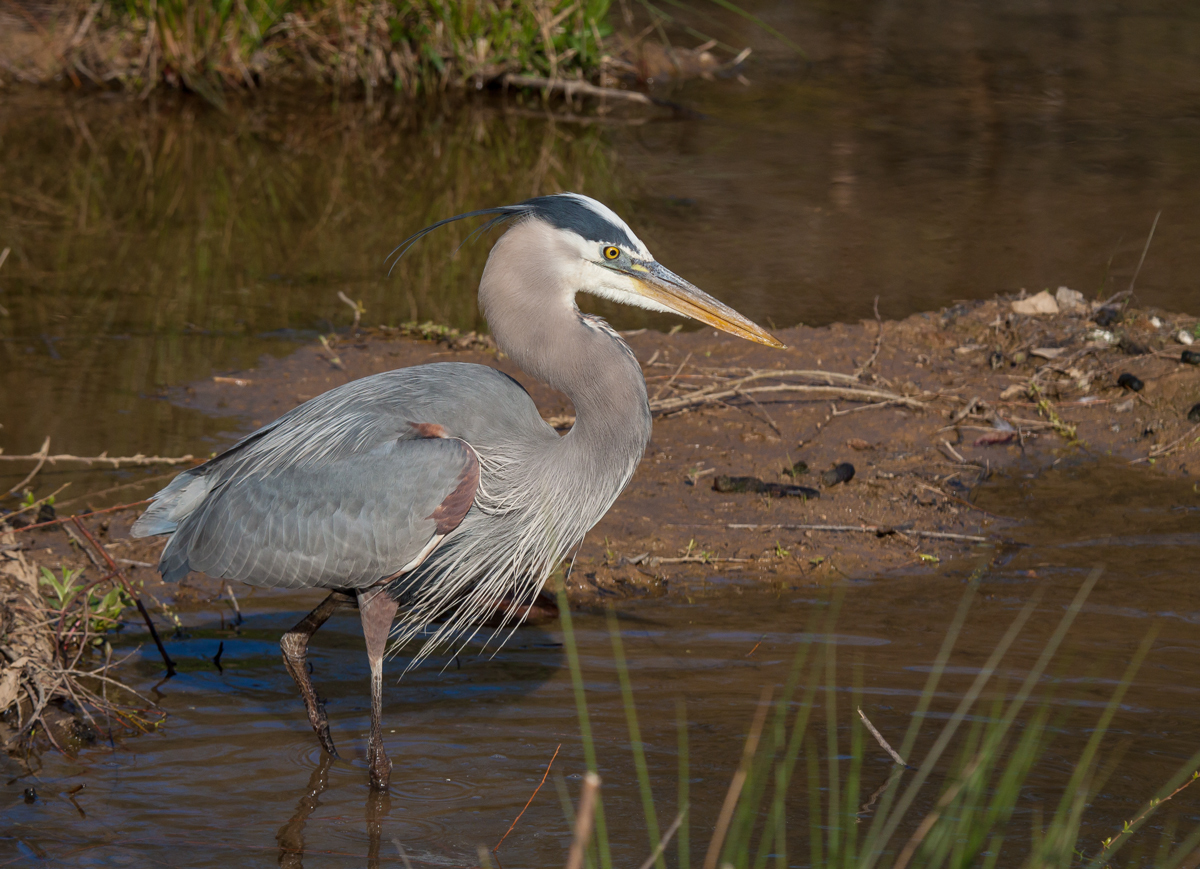
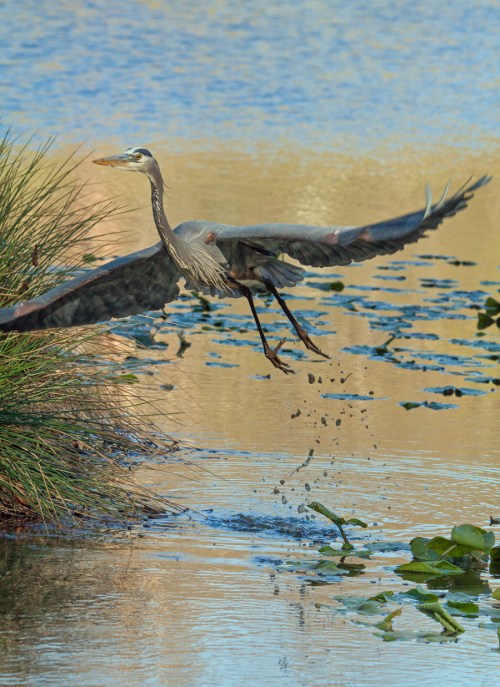
As I was walking around a small pond, hoping in vain to spot some dragonflies, I suddenly came upon a Great Blue Heron (Ardea herodias). From a distance, vegetation at the water’s edge had blocked the heron from view. With the heron right in front of me, I had two choices—I could try to change to the 70-300mm lens that I had in my camera bag to gain some additional reach or I could make do with my macro lens. I chose the latter option.

My macro lens is a 180mm Tamron lens. It is slow and noisy when focusing at close distances, but when I pay attention to my technique, I have taken some pretty good macro shots with it. How would it do with a bird? I have gotten used to photographing birds with a 150-600mm Tamron lens that has a built-in image stabilization system and, obviously, lets me zoom in and out. My macro lens lacks both of these capabilities, so I really did not know how well it would fare, particularly when I tried to capture some in-flight shots of the heron—I was pretty sure the heron would be spooked by my presence and I proved to be right.

Well, I ended up following the heron around for quite a while and captured images of it at several locations, including in the air. It worked out remarkably well. In some ways, it was even more enjoyable shooting with a prime lens than with a zoom lens, because I could concentrate better on tracking and framing the subject—my decision process was simplified when I had to zoom with my feet.

I particularly like the first photo below. The lighting at that moment was very unusual and the colors are so vivid that a friend asked me if I had used some kind of art filter. With the exception of a few minor tweaks in post-processing, however, the image looks like it did when I first looked at it on the back of my camera.

So what did I learn? I have a greater appreciation of the capabilities of my macro lens and realize that I can use it for more than just macro shots. I think that I also appreciate better the experience of shooting with a prime lens—I think my zoom lenses sometimes make me a bit lazy and sloppy.

I look forward to trying to shoot some more little experiments like this of thinking outside of the box and shooting more subjects with the “wrong” lens.
Great Blue Heron

Great Blue Heron

Great Blue Heron

Great Blue Heron

© Michael Q. Powell. All rights reserved.

Read Full Post »
Yesterday when a Great Blue Heron at Meadowlark Botanical Gardens in Vienna, Virginia turned and intently stared at me, its look conveyed a definite sense of stern disapproval.
I went to the gardens with some friends with the intent of photographing flowers, but my attention was hijacked by this very photogenic Great Blue Heron (Ardea herodias). Despite the fact that I was shooting with my macro lens, I managed to get some wonderful shots of the heron, including some in-flight shots, that I will post later. I loved the look in the heron’s eyes and its pose so much that I decided to post this image immediately.
Great Blue Heron

© Michael Q. Powell. All rights reserved.


Read Full Post »
This past Monday as I was exploring Huntley Meadows Park with fellow photographer Walter Sanford, he spotted an Eastern Garter Snake (Thamnophis sirtalis sirtalis). We both like to photograph snakes, so we sprung into action. Following my normal instincts, I moved in close to the snake. How close did I get? At a certain point in time I actually had to back up a little to make sure I included the snake’s entire head in the image.

Some readers of this blog may recall that Walter and I use different camera systems and approach our shots in different ways, partly because he is using a zoom lens and I am often using a macro lens with a fixed focal length. If you shoot side by side with another photographer, you’ll often get the same shots, but that’s usually not the case for Walter and me. We normally choose different angles of view and frame our shots differently—I am usually the one sprawled on the ground.

Walter and I have shot together often enough that he knows the “tricks” that I employ when shooting. From my earliest days, my photography mentor Cindy Dyer emphasized to me the importance of using a tripod. Frequently I carry a tripod with me, but for low-angle shots, I prefer to use my camera bag as a kind of improvised tripod to help steady my camera. In the past month I have used this techniques with varying subjects including a jumping spider and a beaver. Special thanks to Walter for allowing me to use one of the photos he shot of me in action with my improvised tripod.

The snake was amazingly tolerant of our presence. Unbelievably it stayed in place when I moved a stalk of grass next to its head that was getting in the way of a clear shot. The first shot below was shot with my improvised tripod and was not cropped at all. The other two shots, I believe, were handheld and cropped slightly, because the snake had changed positions and I did not have the luxury of stabilizing my camera. In all cases I tried to focus on the snake’s eye and I really like the way that I managed to capture a reflection in the eye.

Walter will soon be posting a companion post that I will reblog, so that you can contrast the images that we captured when shooting the same subject together.

Eastern Garter Snake

alternative tripod

Using my camera bag as an improvised tripod (Photo by Walter Sanford)


Eastern Garter Snake

He’s got lips like Jagger

Eastern Garter Snake

Environmental portrait of a garter snake

© Michael Q. Powell. All rights reserved.


Read Full Post »

I know that spring has truly arrived when I start to walk around with a macro lens on my camera. I captured this shot of a Bold Jumping Spider (Phidippus audax) on the boardwalk yesterday at Huntley Meadows Park.

As I was walking into the park, a departing fellow photographer alerted me to the presence of the spiders, so I changed lenses in the hope that I would see one. Most of the winter months I have been using my Tamron 150-600mm lens to shoot birds and other wildlife, but I had my Tamron 180mm macro lens with me. It’s amazing how my field of vision changes with the shift in lenses. With the long lens, I am used to looking up and out, in part because it has a minimum focus distance of 8.9 feet (1.7 meters). With the macro lens, I am am scanning a much smaller area, primarily near my feet and just beyond.

Eventually I located a jumping spider. It seemed to be spending most of its time in the cracks between the synthetic boards of the boardwalk, but occasionally would venture out. Despite its name, the Bold Jumping Spider seemed to be pretty timid. In fact, I never did see it jump—it seemed content to crawl slowly.

The coolest thing about jumping spiders, of course, is their eyes. I am absolutely mesmerized by their multiple eyes and I was really happy that I was able to capture some reflections in the eyes. The reflections are most noticeable in the head-on shot, but they are also visible in the action shot. It’s a fun challenge to try to capture action when this close to a subject, but somehow I managed, though the higher shutter speed needed when shooting handheld meant that that my depth of field was pretty limited.

Bold Jumping Spider

Bold Jumping Spider

© Michael Q. Powell. All rights reserved.

Read Full Post »

What lenses do you generally carry with you when you go out to shoot wildlife? This past year I have kept my Tamron 150-600mm lens on my camera the majority of the time and sometimes switch to my Tamron 180mm macro lens. The third lens that I have with me generally is a Canon 50mm lens that I use only occasionally.

While I was going to be away in Vienna, I decided to lend my long lens to a friend. We got into a conversation about the lens when I delivered it to him and I noted that one of th disadvantages of the Tamron zoom was that it is slow, with a maximum aperture of f/6.3 when extended to 600mm.

I contrasted the speed of the long lens with that of my “nifty fifty” that has a maximum aperture of f/1.8. In order to demonstrate how much more light I could get at f/1.8, I had him hold a couple of his guinea pigs and I took some portrait shots handheld in the limited available indoor light with the lens wide open. With a human subject, I would probably have been uncomfortably close, but the guinea pigs didn’t seem to mind.

Finally I took a few shots using the 180mm wide open at f/3.5. It was quite a bit harder to frame the squirming guinea pig at the greater distance, but I got a few shots that look almost like I used studio lighting.

I think my friend learned a bit more about the lenses (and I ended up lending him the 50mm lens too) and I rediscovered the joy of switching lenses and zooming with my feet.

gp1_web

gp6_blog

gp2_web

gp4_web

gp8_blog

© Michael Q. Powell. All rights reserved.


Read Full Post »

« Newer Posts