Feeds:
Posts
Comments

Posts Tagged ‘Six-spotted Tiger Beetle’

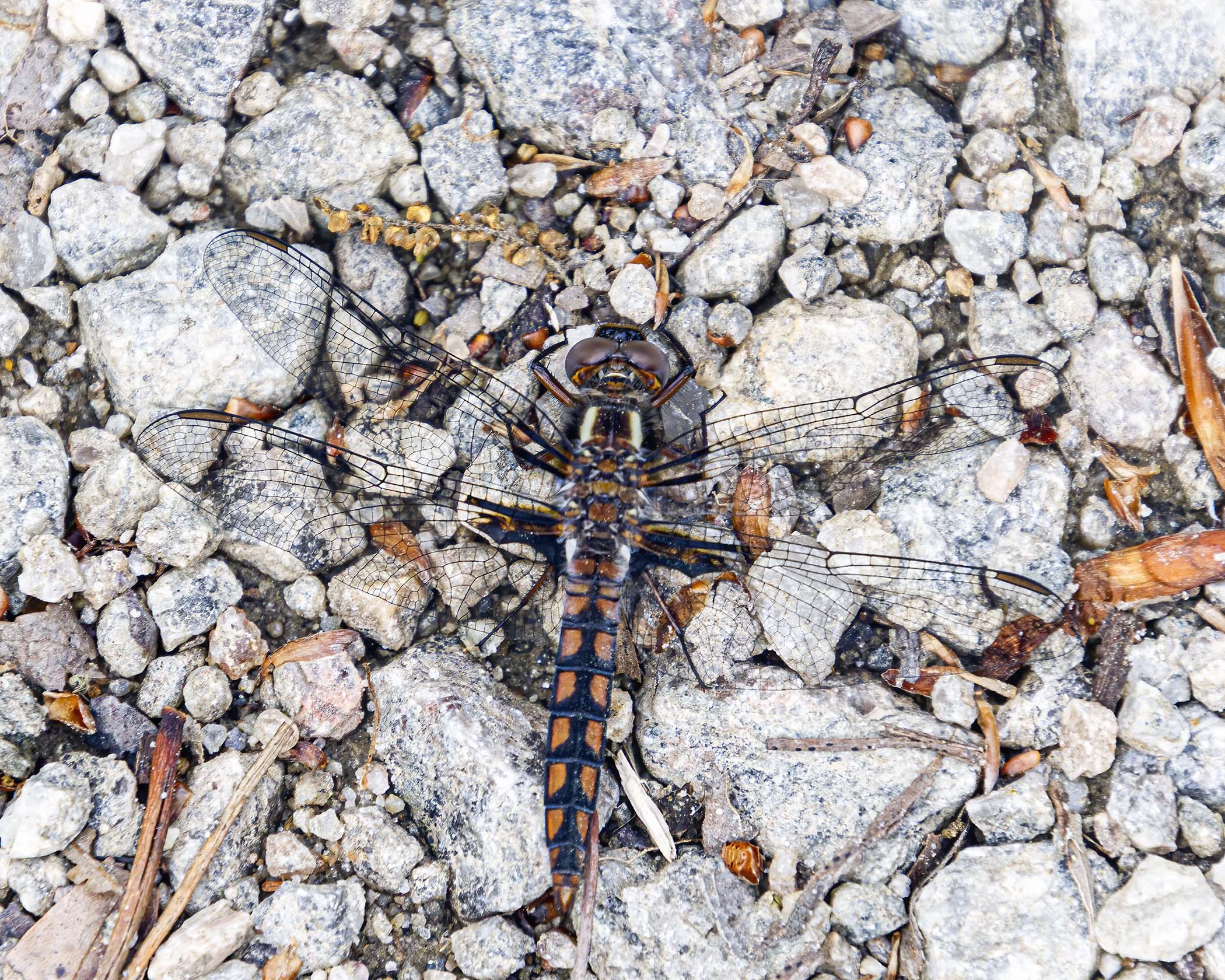
I am a little late in finding my first dragonflies of 2025, but on Wednesday (15 April) I finally spotted some Blue Corporals (Ladona deplanata) at Occoquan Bay National Wildlife Refuge. As an added bonus, the first image also shows a metallic-green Six-spotted Tiger Beetle (Cicindela sexguttata) that was crawling past the dragonfly.

Blue Corporals, one of the first dragonflies to emerge in the spring, are relatively easy to identify because they have two stripes of their shoulders—two stripes is the traditional marking for the rank of corporal in the armed forces. When they first emerge, males and females have similar colorations, but the males turn blue as they mature. Judging from the shape of their terminal appendages, I believe that the dragonflies in the first two images are females and the one in the final photo is an immature male.

Blue Corporal

Blue Corporal

Blue Corporal

© Michael Q. Powell. All rights reserved.
Read Full Post »

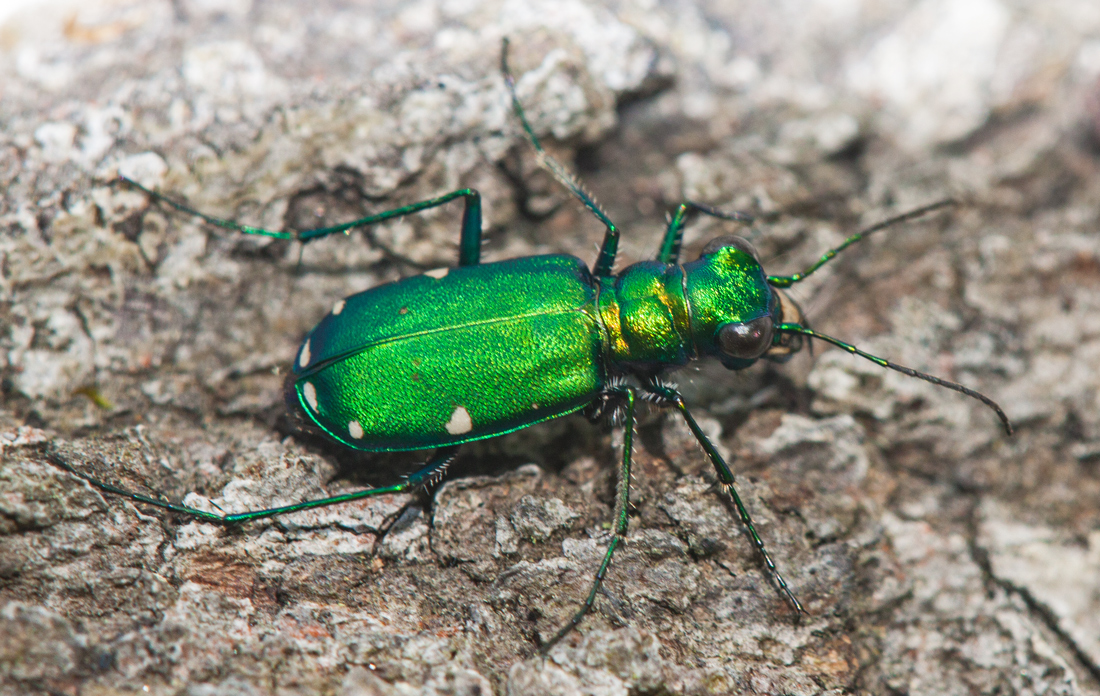
Many beetles are dark-colored and go about their business in the underbrush, unseen by human eyes. Six-spotted Tiger Beetles (Cicindela sexguttata), on the other hand, are hard to miss—their metallic-green bodies sparkle as they perch in the open, like this one that I spotted on Monday in the middle of a sun-lit forest trail in Prince William Forest Park.

The beetle’s common name refers to the six small white spots on the beetle’s metallic-green elytra (the beetle’s hardened wing cases), although the number of spots is somewhat variable. I think that I can see six spots on this beetle, but have sometimes seen as many as eight spots in the past.

As I was doing a bit of research a few years ago, I recall stumbling upon the fact that elytra is the plural form of elytron, following the the same pattern as “criterion” and its plural form “criteria.” For what it is worth, spell-check highlights elytron as an unknown word. English is a strange language.

Yesterday I came across this fun fact about tiger beetles at the University of Minnesota Department of Entomology website. “Tiger beetles’ long legs allow them to dart across the ground at high speeds. In fact, they can run so fast that their eyes can’t keep up, rendering them momentarily blind. This is why they only run short distances at a time.” Wow!

Six-spotted Tiger Beetle

© Michael Q. Powell. All rights reserved.

Read Full Post »

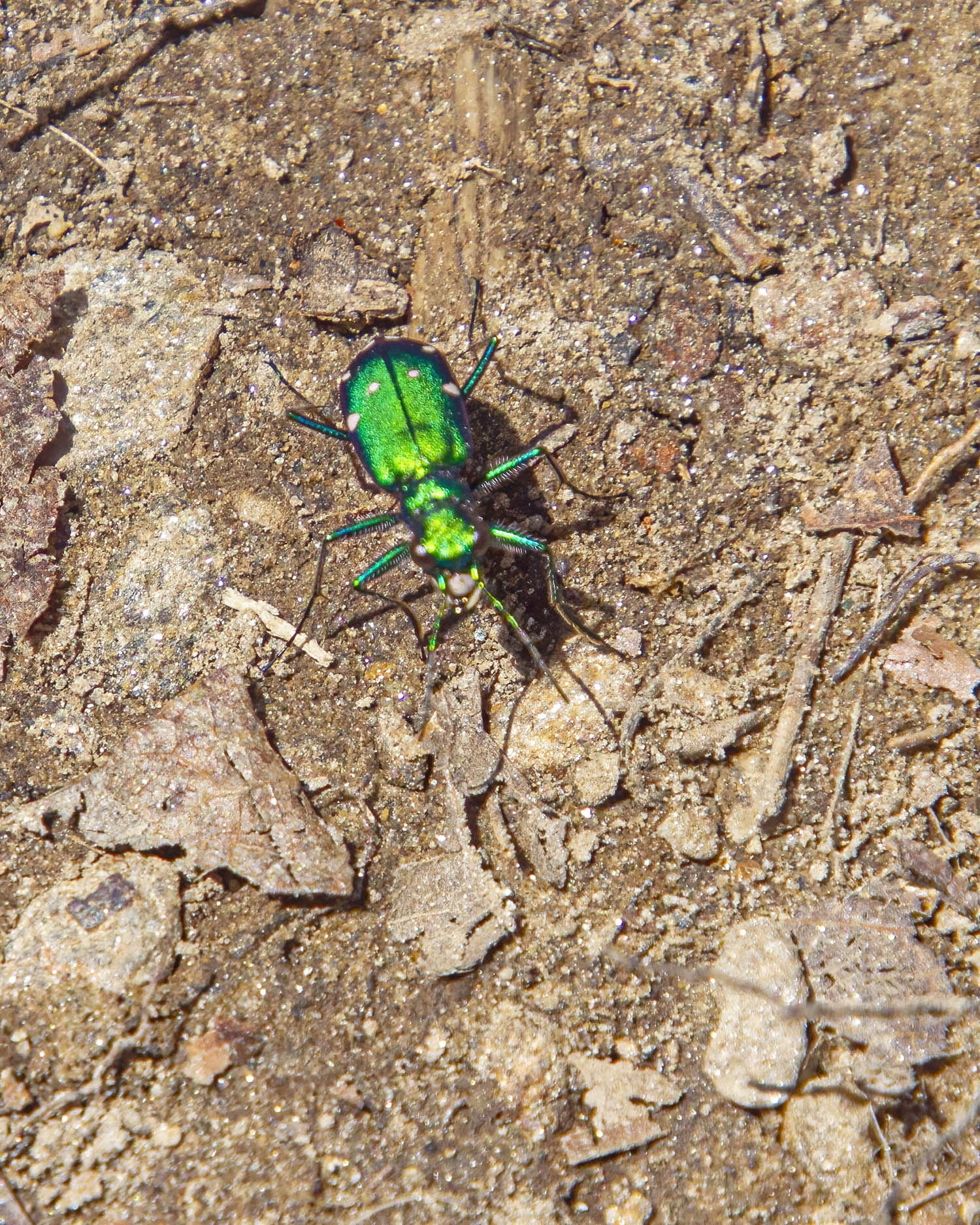
The ground in the forest is covered with fallen leaves at this time of the year, making it really easy to spot a Six-spotted Tiger Beetle (Cicindela sexguttata). The metallic green of their bodies shines so brightly that it is almost impossible to miss them as they scurry in and out of the underbrush.

I spotted this little beauty on Monday as I searched for dragonflies in Prince William County, Virginia. After months of photographing birds, often at a great distance, my eyes are gradually readjusting to searching for small subjects at close range. In the springtime I switch to using a macro lens most of the time rather than the long telephoto zoom lens that has been my constant companion throughout the cold, dark days of winter.

I also tend to slow down my pace as I search for tiny insects, scanning for changes in colors and patterns and, most importantly, for movement. In this style of photography, I cannot afford to be in a hurry and often my patience are persistence are rewarded.

Six-spotted Tiger Beetle


Six-spotted Tiger Beetle

© Michael Q. Powell. All rights reserved.

Read Full Post »

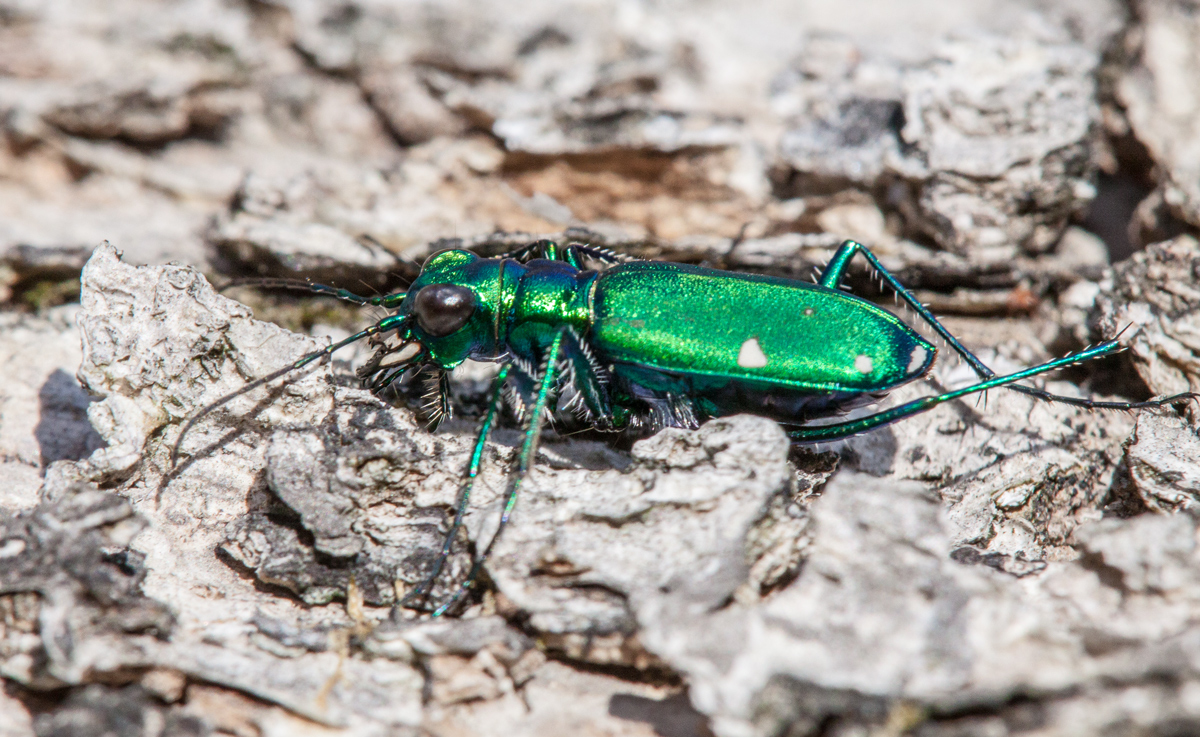
Many beetles are dark-colored and go about their business in the underbrush, unseen by human eyes. Six-spotted Tiger Beetles (Cicindela sexguttata), on the other hand, are hard to miss—their metallic-green bodies sparkle as they perch in the middle of the sun-lit forest trails on which I have been hiking in recent weeks.

The beetle’s common name refer to the six small white spots on the beetle’s metallic-green elytra (the beetle’s hardened wing cases), although the number of spots is somewhat variable—I think I count eight spots on this individual. As I was doing a bit of research, I stumbled upon the fact that elytra is the plural form of elytron—I think that I have almost always seen the word used in the plural form and the spell-check highlights elytron as an unknown word.

It is often hard to get a shot of one of these beetles, because they are skittish and often fly away as I bend down to photograph them. For this photo, I was fortunate that the beetle chose to perch on a trunk of a tree at eye-level and no contortions were therefore required on my part.

Six-spotted Tiger Beetle

© Michael Q. Powell. All rights reserved.

Read Full Post »

I’m happy to see that some insects are still with us despite the cooling autumn weather. On Friday, I spotted this gorgeous metallic green Six-spotted Tiger Beetle (Cicindela sexguttata) on a fallen log at Huntley Meadows Park in Alexandria, Virginia.

Six-spotted Tiger Beetle

© Michael Q. Powell. All rights reserved.
Read Full Post »

Some insects blend in so perfectly with their environments that they are difficult to spot. That is clearly not the case with this Six-spotted Tiger Beetle (Cicindela sexguttata) that I spotted yesterday at my local marsh.

The beetle’s metallic green body glistened in the sun and made it stand out against the bark of the fallen tree on which it was perched. It flew away several times when I got close to it, but kept returning, eventually remaining in place long enough for me to get this shot. Click on the image to get a higher resolution view of the beetle, including its textured body and multi-segment antennae.

emerald1_blog

© Michael Q. Powell. All rights reserved

Read Full Post »