Feeds:
Posts
Comments

Posts Tagged ‘robber fly’

This insect looks a bit like a dragonfly at first glance, but if you look more closely you may notice that the wings and eyes are different from those of a dragonfly and this insect’s body is a lot hairier. This is a robber fly and I am pretty sure that it is a variety known as a Red-footed Cannibalfly (Promachus rufipes).

Red-footed Cannibalflies are among the coolest and creepiest insects that you may encounter in the wild. As their macabre moniker suggests, Red-footed cannibalflies usually feed on other insects, but they reportedly are capable of taking down a hummingbird.

Robber flies in general are predators that wait for their prey to fly by and then attack it. Wikipedia describes their attack in this way, “The fly attacks its prey by stabbing it with its short, strong proboscis  injecting the victim with saliva containing neurotoxic and proteolytic enzymes which very rapidly paralyze the victim and soon digest the insides; the fly then sucks the liquefied material through the proboscis.” Yikes!

I have a personal special attachment to Red-footed Cannibalflies. In 2013 I captured an image of one of these insects and for years it was my most popular photo on-line, with over 3700 views to date. Since then, a few other of my photos have jumped ahead of this cool-looking predator, which continues to get views a dozen years after it appeared in my blog.

I captured this image last Monday at Occoquan Bay National Wildlife Refuge. I spotted this cannibalfly perched on a branch that was partially in direct sunlight. To keep from blowing out the highlights on its body, I deliberately underexposed the shot, which meant that the background became really dark. Normally I don’t like that kind of starkness and prefer a more natural background, but in this case it seems to work well with my creepy subject, giving it a spooky, Halloween-style vibe.

Red-footed Cannibalfly

© Michael Q. Powell. All rights reserved.

Read Full Post »

At first glance this insect looks a bit like a dragonfly, but if you look more closely you may notice that its wings and eyes are different from those of a dragonfly and its body is a lot hairier. I spotted this robber fly, a species commonly known as a Red-footed Cannibalfly (Promachus rufipes), on Monday while exploring a creek in Prince William County, Virginia. Red-footed Cannibalflies, as their name suggests, usually feed on other insects, but they reportedly are capable of taking down a hummingbird. Yikes!

A posting that I did in 2013 entitled “Red-footed Cannibalfly” amazingly has been among my most popular postings ever, with 3360 views to date. Apparently more people search for information about Red-footed Cannibalflies that I would have anticipated.

In case you are curious, my current most viewed blog posting is one from August 2013 entitled “Fuzzy White Caterpillar,” with over 6800 views, including 3219 views in 2024 alone. I do not consider that posting to be one of my best nor are the photos in it particularly good, but somehow the Google search algorithm likes it and I continue to get lots of views of that posting. In general, I do not put much stock in the number of views and/or likes of my posts and do not really give them much weight when considering the “success” of any of my posts.

Red-footed Cannibalfly

© Michael Q. Powell. All rights reserved.


Read Full Post »

At first glance you might think that the insect in this photo is a dragonfly, especially if you know how much I like dragonflies. If you look a little more closely, you will see that the wings are completely different from those of a dragonfly. This is actually a Red-footed Cannibalfly (Promachus rufipes), one of the coolest and creepiest insects that you can encounter in the wild.

Red-footed Cannibalflies, a type of robber fly, usually feed on other insects, but they reportedly are capable of taking down a hummingbird. Thankfully I have never seen that happen, since I really like hummingbirds, but several years ago I did photograph a Red-footed Cannibalfly with a large Hummingbird Moth that it had captured (see my 2017 posting Demise of a hummingbird moth).

I have a special relationship with this insect with the macabre moniker. In August 2013 I did a posting with the fairly basic title of Red-footed Cannibalfly. The posting was a modest success and had 61 views in 2013. Since that time, though, the posting has generated a lot of interest, primarily as a result of internet searches,  and the total number of views has risen to 2,842, which makes it the second most viewed posting of my more than four thousand postings to date. Yikes!

I spotted this Red-footed Cannibalfly last Thursday as I was exploring a small pond in Prince William County, Virginia. I am always amazed at the relative bulkiness of this insect compared to the average dragonfly and thought that it might have captured a prey. A closer examination of the Red-footed Cannibalfly showed that it was empty-handed or maybe I should more properly say empty-footed.

In the back of my mind I hear the words of the Wikipedia description of a robber fly attack that I included in the 2013 posting, “The fly attacks its prey by stabbing it with its short, strong proboscis  injecting the victim with saliva containing neurotoxic and proteolytic enzymes which very rapidly paralyze the victim and soon digest the insides; the fly then sucks the liquefied material through the proboscis.” It is enough to give a person nightmares.

Red-footed Cannibalfly

© Michael Q. Powell. All rights reserved.

Read Full Post »

When I first encountered two insects this past weekend at Huntley Meadows Park, I thought they were mating. Looking a little closer, I realized it was a robber fly and its prey, which, after some research, I conclude is probably a Striped Horse Fly (Tabanus lineola). In addition to its unusual eyes, check out the sharp mouth parts of the horse fly that are used, I believe, for biting. Ouch!

There is a whole family of robber flies, known as Asilidae, of varying sizes and shapes, including the Red-footed Cannibalfly that I have featured several times recently. This robber fly was considerably smaller than a Red-footed Cannibalfly, but has many of the same general characteristics. They both grasp their prey with their long legs and inject it with saliva that paralyzes the victim. The saliva eventually liquifies the insides of the prey and the robber fly sucks out the liquified material through its proboscis. I think that the robber fly in the photo was in the middle of that process when I spotted it.

Robber Fly

© Michael Q. Powell. All rights reserved


Read Full Post »

As I was walking through my local marsh yesterday, I caught sight of a giant flying insect. Upon closer examination, it proved to be a pair of mating Red-footed Cannibalflies  (Promachus rufipes).

They eventually settled on a leaf, just above eye level. It was a heavily vegetated area and it was tough getting a clear line of sight and a good angle of view (and standing on my tiptoes probably is not an optimal shooting position). This first shot was the only one I got where both of these giant insects were in focus.

At a certain point of time, one of them, which I suspect was the female, tried to escape and I got the second shot, capturing an unusual moment in time. In the original version, the background was mostly light colored, but there were some ugly smudges of greenish gray.  I tried to remove them hastily in post processing to highlight better the subjects, but I noted that I didn’t do a very good job when, after the fact, I looked at the posting on a computer screen, vice my laptop, on which it was composed..

The second shot seems to be begging for a clever caption. Does anyone have a suggestion?


Mating Red-footed Cannibalflies

Matting Red-footed Cannibalflies

© Michael Q. Powell. All rights reserved.


Read Full Post »

There is something both creepy and compelling about the fearsomely-named Red-footed Cannibalfly (Promachus rufipes). I first spotted one last summer and noted in a posting that these insects, sometimes referred to as Bee Panthers, are reported to be capable of taking down a hummingbird.

I caught sight of this specimen earlier this week as I was making my way along a creek in the back area of my local marsh, searching for the equally fierce Dragonhunter dragonfly (Hagenius brevistylus). The Dragonhunter is a very large dragonfly that, as its name suggests, specializes in hunting other dragonflies (along with bees, wasps, and butterflies).

The Red-footed Cannibalfly is part of a larger group of giant robber flies of the genus Promachus, a name that in Greek means “who leads in battle,” according to Wikipedia. I am fairly confident of my identification, but would welcome any corrections from more experienced insect hunters.

Be sure to look carefully at the claws on the front legs in the image. I am sure that it’s almost impossible to escape when this predator sinks those claws into you and injects you with a toxin that paralyzes you and liquifies your insides.

As one blogger so eloquently put it, “Be thankful these insects aren’t the size of Sandhill Cranes.”

Red-footed Cannibalfly

© Michael Q. Powell. All rights reserved.

Read Full Post »

As I was getting ready to leave my local marshland park on Friday, I spotted what I thought was a small dragonfly. Upon closer examination, it turned out to be a robber fly, subduing a captured prey.

There are a lot of varieties of robber flies in the Asilidae family and I am not sure which kind this is, but robber flies have a reputation for being really vicious predators.

Wikipedia describes their hunting method in these words, “The fly attacks its prey by stabbing it with its short, strong proboscis injecting the victim with saliva containing neurotoxic and proteolytic enzymes which very rapidly paralyze the victim and soon digest the insides; the fly then sucks the liquefied material through the proboscis.”

I guess we can all be thankful that robber flies are not big enough to hunt humans—except perhaps in science fiction movies.

robber1_june_blog

© Michael Q. Powell. All rights reserved.

Read Full Post »

Most of us have heard that female praying mantises eat their mates after mating, so what happens when a pair of cannibal flies mate?

I was quite a distance away when I spotted this pair of insects, but I immediately recognized them as  Red-footed Cannibalflies (Promachus rufipes), a species of giant robber flies. These flies are really big and have a very distinctively shaped body (and I had done some research on them for a previous posting). Cannibalflies are fierce predators and are reportedly very aggressive. Would the male survive the mating process?

I observed the pair for quite a while and concluded that the “cannibal” in this insect’s name refers to its behavior toward other insects. The male cannibal fly flew away unscathed.

robber_mating_blog

© Michael Q. Powell. All rights reserved.

Read Full Post »

If you were an insect or even a hummingbird, you would definitely not want to encounter this large insect with the macabre moniker of Red-footed Cannibalfly (Promachus rufipes), also known as the Bee Panther.

This insect is considered to be a giant robber fly. Robber flies in general are predators that wait for their prey to fly by and then attack it. Wikipedia describes the attack in this way, “The fly attacks its prey by stabbing it with its short, strong proboscis  injecting the victim with saliva containing neurotoxic and proteolytic enzymes which very rapidly paralyze the victim and soon digest the insides; the fly then sucks the liquefied material through the proboscis.”

It’s hard to believe that a fly could actually take down a hummingbird, but bugguide, which I have found to be a good reference for insects, notes that there have been reports of a Red-footed Cannibalfly attacking a Ruby-throated Hummingbird.

When I first saw this insect fly by, I thought it was some strange kind of hairy dragonfly, but the more that I looked at it, the more I realized that it was not a dragonfly—the eyes and wings were all wrong. I have spotted several of these flies already, but so far have not seen any with captured prey.

I came across a wonderful commentary on these insects in a blog called Ohio Birds and Biodiversity that sums up my feelings about them—”Be thankful these insects aren’t the size of Sandhill Cranes.”

big_insect_blogcannibal_blog

© Michael Q. Powell. All rights reserved

Read Full Post »

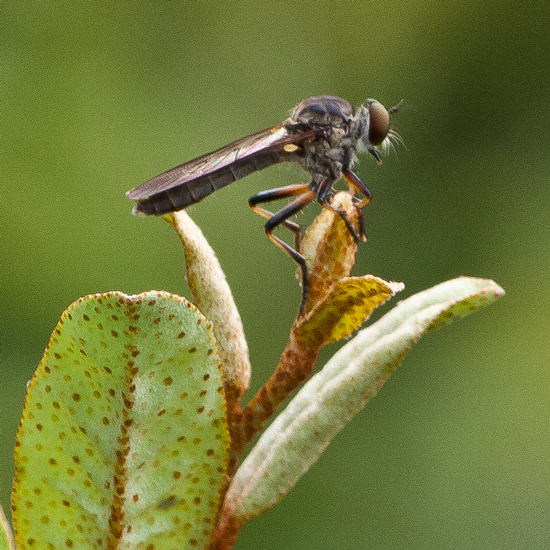
My eyes were so attuned to dragonflies yesterday that my first thought when I stumbled upon this insect perched at the top of a plant was that it was a tiny dragonfly. The pose especially looked familiar.

The more I looked at it, however, the more I realized that the legs and winds were all wrong and the head, which in this profile shot looks a bit like a dragonfly’s, was really different. From another angle it sort of looked like a fly, but not any fly that I had ever seen. What is it?

I think that what I have here is a robber fly (from the insect family Asilidae). So far I have not been able to get any more precise in identifying this guy’s species. The description of robber flies in Wikipedia, however, is pretty. scarey.

“The short, strong proboscis is used to stab and inject victims with saliva containing neurotoxic and proteolytic enzymes which paralyze and digest the insides; the fly then sucks the liquefied meal through the proboscis.”

Yikes! That description alone is enough to bring back flashbacks of alien movies and zombie thrillers.

I may not sleep well tonight.

© Michael Q. Powell. All rights reserved.

Read Full Post »