Feeds:
Posts
Comments

Posts Tagged ‘Prince William County VA’

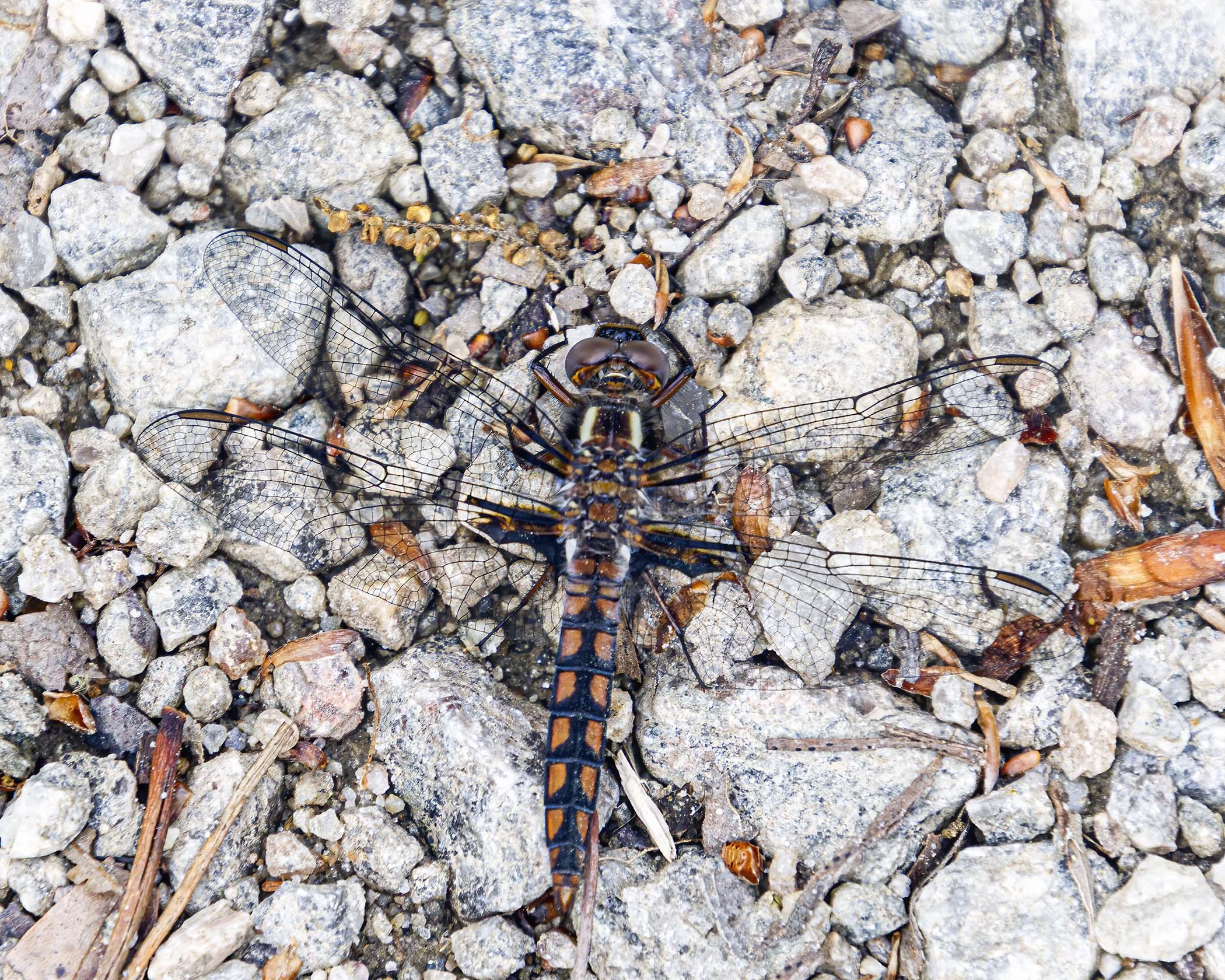
I am finally starting to see some male Blue Corporal dragonflies (Ladona deplanata) that are blue in color. In mid-April I started seeing Blue Corporals, but the males that I spotted at that time were all immature, like the one in the second photo below, and shared the coloration of females of the species.

The dragonfly in the first photo is a mature male. I spotted it during a recent hike along a creek in Prince William County. When you compare its feature to those of the immature male, you can see that the adult coloration is definitely bluer and the “shoulder” stripes on its thorax are a bit faded.

I really like the head-on angle that I used to photograph the Blue Corporal in the first photo. Technically only a small portion of the dragonfly is in sharp focus when you shoot from this angle, the eye-to-eye direct contact works well and draws in the viewer. As you can probably tell, I took this from a low angle, which helped to draw attention to the dragonfly’s interesting pose and to separate the subject from the somewhat cluttered background.

Blue Corporal

Blue Corporal

© Michael Q. Powell. All rights reserved.


Read Full Post »

I am not sure that I can say that dragonfly activity is at a peak yet, but I did see a whole lot more dragonflies this past Wednesday in Prince William County than in previous trips there earlier in April.  I was particularly delighted to spot some Common Baskettail dragonflies (Epitheca cynosura) that were perched—quite often I have seen them in the past only when they were flying.

The Common Baskettail in the first photo seems to be a mature male. I love the way that I was able to capture an image that shows the way that it hangs when perching and the distinctive terminal appendages that always remind me of the handles of some pliers that are wrapped in plastic.

The dragonfly in the second photo looks to be a recently emerged Common Baskettail. Its eyes are still pale and its wings are very clear and are probably not fully hardened yet.

I got a late start this year in finding spring dragonflies, but feel that I have more or less caught up as we near the end of April, though there are still some spring species that I have not yet seen.

Common Baskettail

Common Baskettail

© Michael Q. Powell. All rights reserved.

Read Full Post »

Dragonfly season has definitely begun. I spotted several Stream Cruiser dragonflies (Didymops transversa) on Wednesday this week while I was exploring several creeks in Prince William Park here in Virginia. Stream Cruisers are pretty easy to identify, with a single stripe on their thoraxes, pale-colored tips of their abdomens, and long, thin legs. They tend to perch at an angle or to hang vertically.

Stream Cruisers are one of the earliest dragonfly species to appear each spring and it was exciting to spot them. They tend to be habitat specialists and are generally found near forest streams with good flow and rocks.

Stream Cruiser

Stream Cruiser

Stream Cruiser

© Michael Q. Powell. All rights reserved.


Read Full Post »

The weather has warmed up considerably and I have started to see many of the spring dragonflies and even some of those that will remain with us through the summer. Last Friday I spotted numerous Ashy Clubtail dragonflies (Phanogomphus lividus), many of which appeared to have emerged recently, judging from their very shiny wings and pale coloration, as you can see in the first photo. Getting shots of them was tough, because they perch on the ground in the vegetation, are only about 2 inches in length (50 mm), and are often very skittish.

Kevin Munroe described well the challenges of finding early spring dragonflies in his wonderful Dragonflies of Northern Virginia website, “Searching for dragonflies in spring is a wholly different endeavor than finding them in July and August. Most summer dragonflies spend their time at sunny ponds or open fields, and engage in showy displays and aerial battles – they are, in a word, visible. The majority belong to the showy and successful skimmer family, along with a few darners and emeralds. The spring dragonfly community is more diverse, and has a very different M.O. They are for the most part, habitat specialists, with low population numbers, secretive habits, and denizens of woodland streams, not sunny ponds. Spiketails, Petaltails, Clubtails, Darners and Emeralds are all out and about in spring. To find these species in April and May, one must spend many hours searching forest edges, woodland clearings, and the banks of springs, streams and creeks.”

In fact, I photographed these Ashy Clubtails in the vegetation near a creek in Prince William County and I can testify to the fact that I walked about for hours searching for them. I am pretty happy with the photos that I was able to take. I especially like the second photo that has some really cool shadows that seem to magnify the number of legs and wings of the dragonfly.

The final two photos were taken only a few seconds apart and show the wings in very different positions. The penultimate photo shows the wings in a typical outstretched pose, while the final photo shows the wings clasped together over the dragonfly’s body, similar to the way that damselflies hold their wings when perched. In my experience recently emerged dragonflies sometimes flex their wings this way as fluid is pumped into the wings and the wings are hardening.

Ashy Clubtail

Ashy Clubtail

Ashy Clubtail

Ashy Clubtail

© Michael Q. Powell. All rights reserved.


Read Full Post »

I was delighted to finally spot my first Uhler’s Sundragon (Helocordulia uhleri) of the year on 18 April near a small pond in Prince William County, Virginia. I went searching for these dragonflies, which are usually the first ones I see in the spring, on several occasions in late March and early April, but came up empty-handed. Uhler’s Sundragons are usually around for only about a month, soI was fearful that I might miss them this season.

I have a pretty good idea of the type of habitat that this early season dragonfly prefers and tend to begin my searches by returning to spots where I have photographed them in the past and then begin to widen my search. Quite often this means that I spend a lot of time walking and watching, trying to remain alert to any movement in the air or on the ground.

As you can see in the first photo, Uhler’s Sundragons often hang from a perch, rather than perch horizontally, which makes it a little easier to get a detailed shot. When the dragonfly perches low to the ground, as in the second photo when it hung from the stem of a fallen leaf, I end up doing some improvised acrobatics to capture an image.

Uhler's Sundragon

Uhler's Sundragon

© Michael Q. Powell. All rights reserved.

Read Full Post »
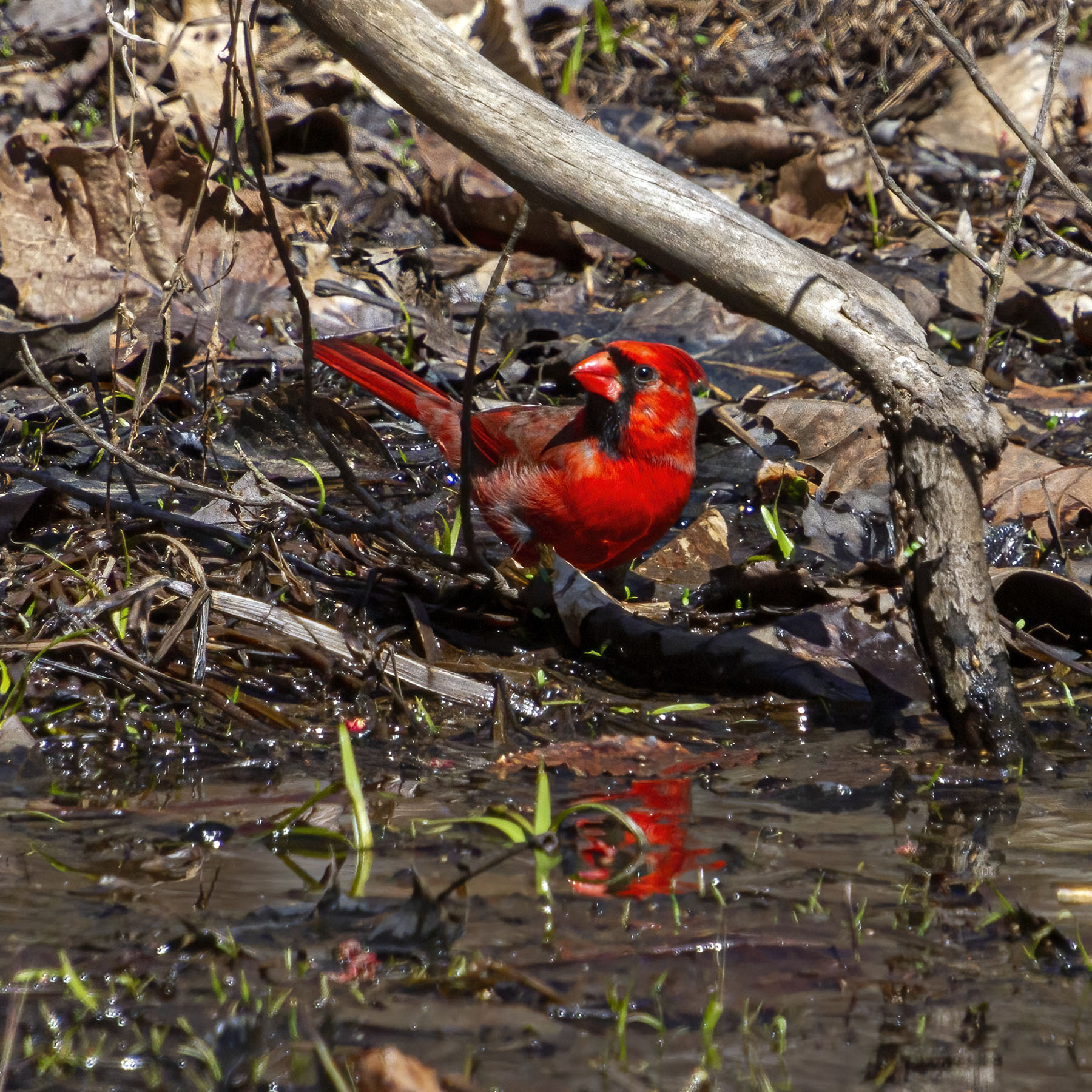
I spotted this male Northern Cardinal (Cardinalis cardinalis) as he was hopping around on the ground near a stream last week in Prince William County, Virginia. I was delighted when the cardinal bent over and drank briefly from the shallow water. In the first photo, I captured the moment when the cardinal lifted his head and dribbled a few drops of water from his mouth.

It seemed like the cardinal suddenly became aware of my presence and realized that my previous photo might not have been very flattering, which is usually the case when you snap a shot of someone eating or drinking. He then struck a profile pose for me to show his better side. Note the slight tilt of the head that helps to present a slimmer neck—clearly this cardinal had some previous experience as a model.

Northern Cardinal

Northern Cardinal

© Michael Q. Powell. All rights reserved.

Read Full Post »

Springtime has definitely arrived in Northern Virginia. All kinds of trees are starting to put out buds and leaves and Washington D.C.’s famous cherry trees are now in full bloom.

On Wednesday I explored a creek in Prince William County, hoping to find some early dragonflies. I was not successful in my quest, but I was quite happy to capture this image of a female Northern Cardinal (Cardinalis cardinalis) with some of the bright spring colors that have recently emerged. The subdued coloration of the female Cardinal does not stand out quite as much as that of her male counterpart, but I find it her more refined colors to be even more beautiful than those of the male.

Northern Cardinal

© Michael Q. Powell. All rights reserved.

Read Full Post »

At first glance this insect looks a bit like a dragonfly, but if you look more closely you may notice that its wings and eyes are different from those of a dragonfly and its body is a lot hairier. I spotted this robber fly, a species commonly known as a Red-footed Cannibalfly (Promachus rufipes), on Monday while exploring a creek in Prince William County, Virginia. Red-footed Cannibalflies, as their name suggests, usually feed on other insects, but they reportedly are capable of taking down a hummingbird. Yikes!

A posting that I did in 2013 entitled “Red-footed Cannibalfly” amazingly has been among my most popular postings ever, with 3360 views to date. Apparently more people search for information about Red-footed Cannibalflies that I would have anticipated.

In case you are curious, my current most viewed blog posting is one from August 2013 entitled “Fuzzy White Caterpillar,” with over 6800 views, including 3219 views in 2024 alone. I do not consider that posting to be one of my best nor are the photos in it particularly good, but somehow the Google search algorithm likes it and I continue to get lots of views of that posting. In general, I do not put much stock in the number of views and/or likes of my posts and do not really give them much weight when considering the “success” of any of my posts.

Red-footed Cannibalfly

© Michael Q. Powell. All rights reserved.


Read Full Post »

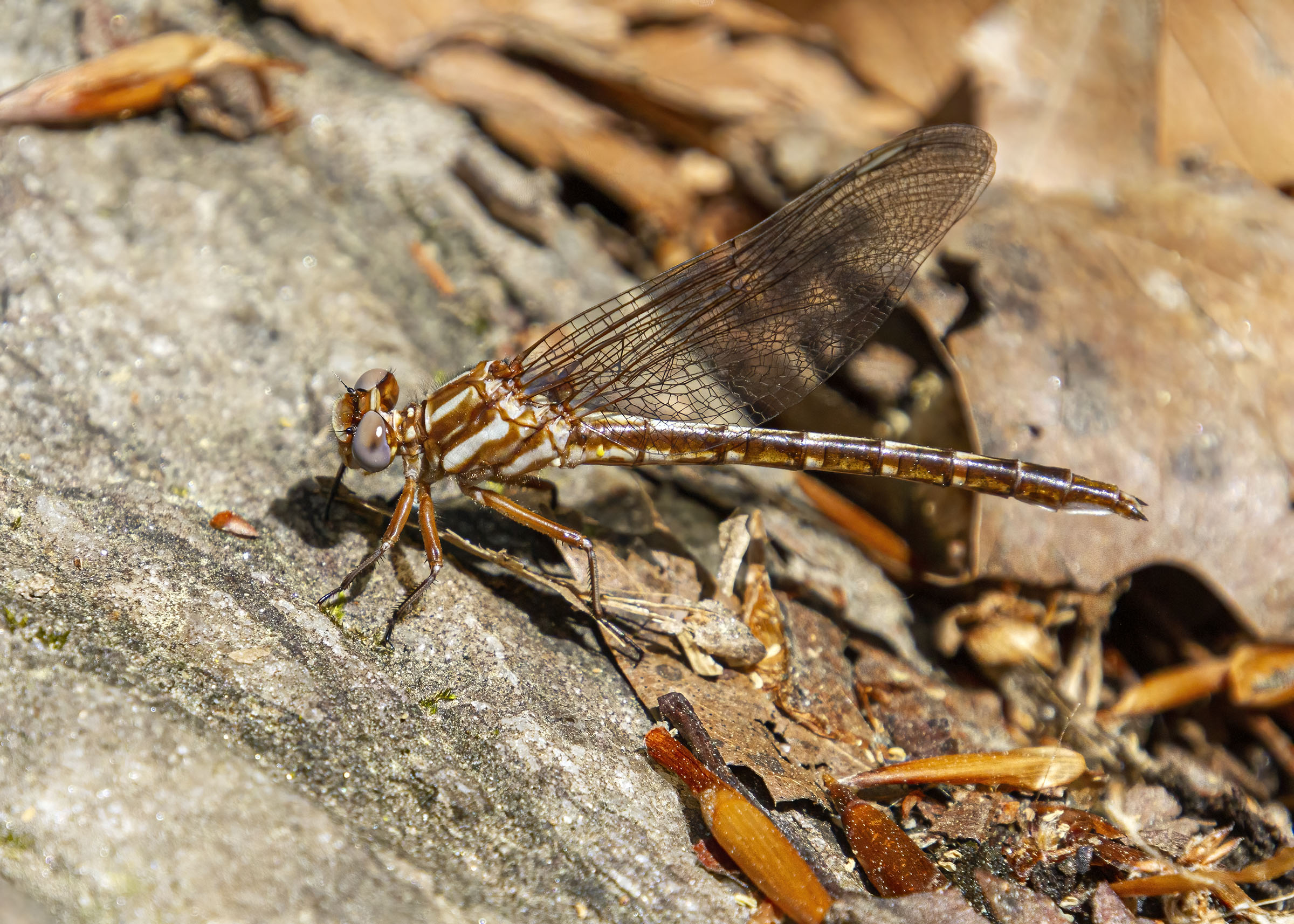
I photographed this stunning Lancet Clubtail dragonfly (Phanogomphus exilis) last Monday on a rotten log in the dappled sunlight as I was exploring an area near a creek in Prince William County, Virginia. Of course, I was excited to photograph this dragonfly, but it was actually the interesting lighting and the rough texture of the log that  mainly captured my attention.

Lancet Clubtail

© Michael Q. Powell. All rights reserved.

Read Full Post »

On Monday I was happy to spot my first Stream Cruiser dragonfly (Didymops transversa) of 2024 in a field of ferns adjacent to a creek in Prince William County. Check out the length of those back legs. Wow!

I do not see Stream Cruisers at most of the usual locations where I search for dragonflies, because they can be found only in specific habitats. According to the Dragonflies of Northern Virginia website, “Stream Cruisers are habitat specialists. Look for them in stable, small to medium, forest streams, with good flow and rocks. The best place to find them is hunting in sunlit meadows near their wood-land waterways.”

Stream Cruiser

© Michael Q. Powell. All rights reserved.

Read Full Post »

On Monday I spotted this beautiful Red-spotted Purple butterfly (Limenitis arthemis astyanax) in a sea of ferns adjacent to a creek that I was exploring in Prince William County, Virgnia. I love the iridescent blue color on the wings and the little red spots that provide a nice accent color. Although I see a slight purplish tint to the wing on the right, I really don’t see very much purple on this butterfly’s body despite the fact that “purple” is a prominent part of the name of this species.

The color and texture of the ferns make for a beautiful backdrop for the butterfly and add a bit of visual interest without being distracting.

Red-spotted Purple

© Michael Q. Powell. All rights reserved.


Read Full Post »

Identification guides for birds, dragonflies, and damselflies often use illustrations rather than photos? Why? It is almost impossible for a photo to show all of the key identification features of a species.

Last week, for example, I captured some wonderful photos of a male Aurora Damsel damselfly (Chromagrion conditum) at a small pond in Prince William County, Virginia. In the first photo below, I was able to capture an image from almost directly overhead that shows the markings on the tiny damselfly’s thorax and abdomen. The image also shows how this damselfly species perches with its wings partially spread, unlike most damselflies that perch with their wings closed above their bodies. The second shot shows many of the same features.

However, it is fairly uncommon to be able to capture views like those in the first two shots and they do not show what is often the key identification feature for this species. Both genders of Aurora Damsels have distinctive bright yellow patches on the sides of their thoraxes, as you can see in the third photo. You might notice that in this photo, the markings on the tip of the abdomen are much less clear than in the first two shots, but that’s not a problem, because that yellow patch immediately signals that it is an Aurora Damsel.

Whenever I can, I try to capture shots of my subjects from multiple angles. The different angles of view may help in identifying a species or may create a more aesthetically pleasing image. One of the coolest things about photography is the way in which it combines science and art—I can be as scientifically geeky or as artistically creative as I want to be.

Aurora Damsel

Chromagrion conditum

Aurora Damsel

© Michael Q. Powell. All rights reserved.


Read Full Post »

When it comes to camouflage, size does not always matter. Last Wednesday as I was exploring in Prince William County here in Virginia, both a large toad and a small frog were so well hidden that I did not see either of them until I almost literally stepped on them, which prompted them to move and reveal their presence.

I was really startled on Wednesday when a large toad suddenly leaped upwards right in front of me, exploding out of a covering of fallen leaves. I think that this is an Eastern American Toad (Anaxyrus americanus americanus), judging by its large size, but there is a chance that it is a Fowler’s Toad.

The tiny Eastern Cricket Frog (Acris crepitans) in the second photo blended in so well with the sandy edge of a stream that I initially did not see him until he moved a bit. The texture and color of his skin made him so hard to spot that when I focused on his eye in my camera’s viewfinder, I could not see the contours of the frog’s body.

toad

Cricket frog

© Michael Q. Powell. All rights reserved.

Read Full Post »

During the summer it seems like dragonflies are everywhere, perching prominently in plain sight in all kinds of environments, but this early in the season there are a whole lot fewer of them and the ones that are around are relatively hard to find. Last week, though, I was blessed to encounter quite a few Ashy Clubtail dragonflies (Phanogomphus lividus) while I was exploring a creek in Prince William County, Virginia.

The Dragonflies of Northern Virginia website, one of my favorite on-line dragonfly resources, described well the environment in which to find this species. “To find Ashies, look for clean, stable, rocky forest streams and then search out the closest sunny clearing, stream-side meadow or sunlit path. Like Common Whitetails and Blue Corporals, Ashy Clubtails prefer to perch flat on bare-soil, fallen logs, rocks or leaf litter.”

Most of the Ashy Clubtails that I spotted were in fact perched in the middle of the trails that I was following, like the one in the final photo. Although the dragonflies are sometimes skittish, it is relatively easy to get a photo of one, albeit with a fairly uninteresting background. The Ashy Clubtail in the first photo has a somewhat more interesting pose, with a nice shadow to add some visual interest.

My favorite photo of this little group, however, has to be the middle one. I really like the confrontational pose of the female Ashy Clubtail as she perched on a leaf and looked right at me. In case you are curious, the dragonflies in the first and second photos are females and the one in the final photo is the male. If you look carefully at the tips of their abdomens (their “tails”), you can see that only the males have terminal appendages that look like a sidewards-facing parenthesis and are quite distinctive.

Ashy Clubtail

Ashy Clubtail

Ashy Clubtail

© Michael Q. Powell. All rights reserved.


Read Full Post »
Many people in the United States were excited to view yesterday’s solar eclipse. I too paused for a few moments in the afternoon to view the eclipse through solar glasses that I had obtained last week during a visit to the Air and Space Museum in the Washington D.C. area.

However, I must confess that I was more excited earlier in the day when I had multiple encounters with Uhler’s Sundragons (Helocordulia uhleri), the first dragonflies that I have been able to photograph in 2024. (Some of you may recall that I searched for dragonflies last week and think that I saw one flying over a stream. However, I did not get a photo of the dragonfly, so for me that first sighting does not really “count.)

I spent several hours yesterday looking carefully at the vegetation along a creek in Prince William County, Virginia where I had spotted Uhler’s Sundragons in previous years. This species appears in limited locations in the early spring and is usually gone by early May. Unlike many of the dragonflies that I will see during the summer that are habitat generalists, Uhler’s Sundragons require a specific kind of habitat, usually a mountain stream. According to the Dragonflies of Northern Virginia website, “Uhler’s need clean, small to medium, rocky forest streams with gravelly and/or sandy substrate, and a decent flow.”

I was fortunate to be able to photograph both female and male Uhler’s Sundragons. I have alternated genders in the photos below, with the females in the odd-numbered images and the males in the even ones. One of the ways to tell the genders apart is to look at the tips of the abdomens (the “tails”) and you can see that the terminal appendages are different. The lower portion of the abdomens of the males is also somewhat enlarged, as you can see in some of the photos.

Dragonflies perch in many different ways. Some species perch horizontally and some hang vertically. Uhler’s Sundragons most often perch at an angle, as shown in the first and last photos, though sometimes they may hang vertically from the vegetation.

The dragonfly season has now opened and I look forward to many more encounters with these amazingly beautiful aerial acrobatic insects that have a magical appeal for me.

Uhler's Sundragon

Uhler's Sundragon


Uhler's Sundragon

Uhler's Sundragon

Uhler's Sundragon

Uhler's Sundragon

© Michael Q. Powell. All rights reserved.

Read Full Post »

Now that we have moved into April, I have begun to really search for dragonflies. On Thursday, I explored a creek in Prince William County, Virginia where I have found early-season dragonflies in past years, but, alas, I was not able to photograph any. However, I am pretty sure that I spotted a dragonfly flying low over the waters of the creek, so I am somewhat optimistic that the dragonfly season for me will soon start. The lighting was not good and the dragonfly was pretty far away, so I am not sure what kind it was, but there are so few insects flying this early in the year that the few that are in the air readily catch my eye.

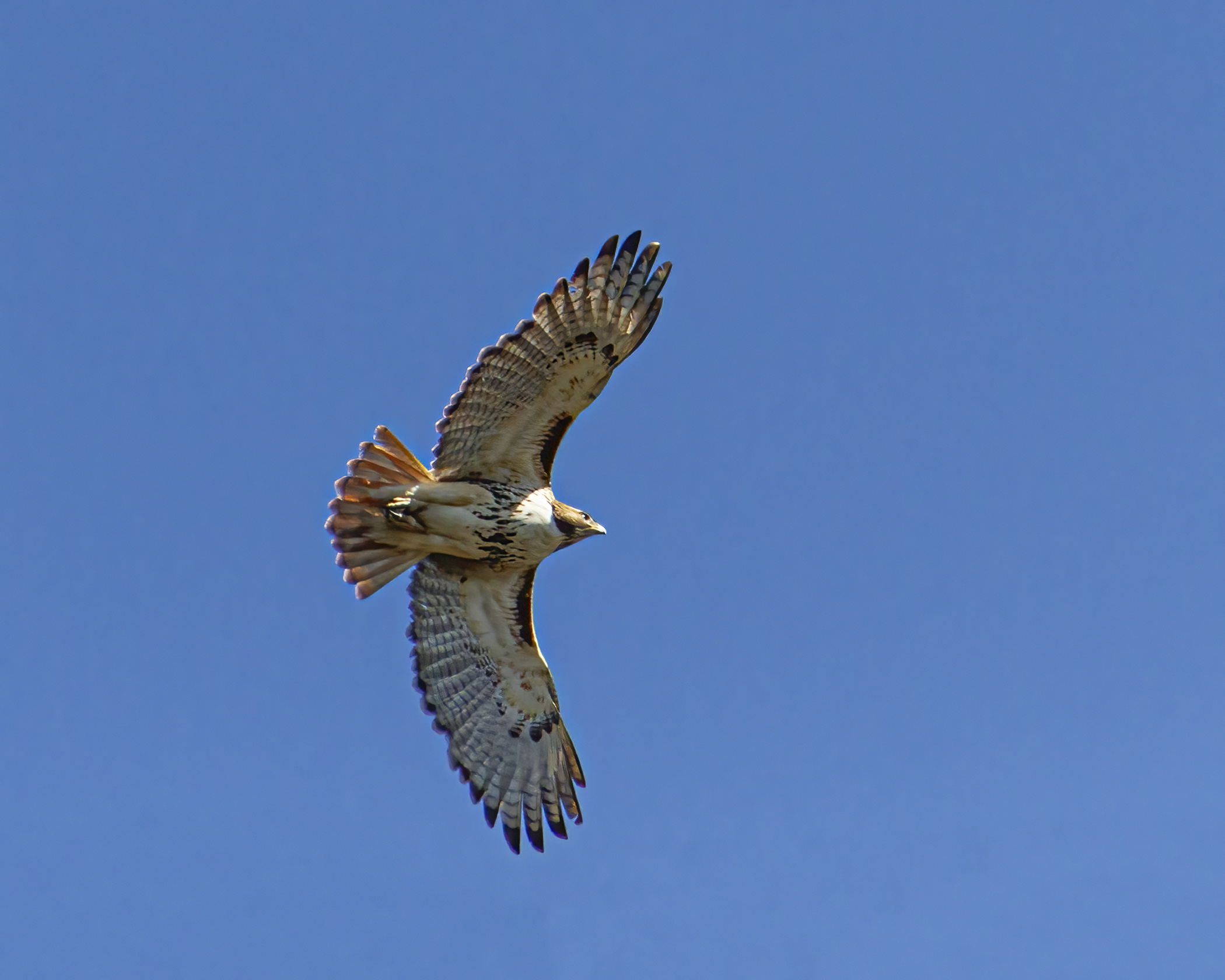
While I was searching along the edges of the creek, I spotted a hawk soaring overhead and was able to get a few shots of it. I am pretty confident that this is a Red-tailed Hawk (Buteo jamaicensis), judging from the coloration of the tail and the prominent “belly band” of darker feathers.

I was using my versatile Tamron 18-400mm lens, so I did not have the reach of the “normal” lens that I use for birds, i.e. the Tamron 150-600mm telephoto zoom lens. I have to say, though, that I am quite happy with the images that I was able to capture of this beautiful soaring hawk.

Red-tailed Hawk

Red-tailed Hawk

© Michael Q. Powell. All rights reserved.

Read Full Post »

Each time I venture out into the forested trails of Prince William Forest Park at this time of the year I encounter different wildflowers, most of which are present for only a short period of time. This past Monday, for example, I spotted some Bloodroot plants (Sanguinaria canadensis) in bloom, my first of the season. These white flowers are a bit bigger than many of the other wildflowers that I see.

According to the Missouri Botanical Garden website, “Each [bloodroot] flower stalk produces a solitary, 2″ (50 mm) wide, 8-10 petaled, 1.5″ (38 mm) diameter, white flower with numerous yellow center stamens. Flowers open up in sun but close at night, and are very short-lived (1-2 days). Leaves continue to grow in size after bloom (sometimes to as much as 9″ (228 mm) across) and remain attractive until mid to late summer when the plant goes dormant.”

The forest floor was quite cluttered, so I decided to take this photo from directly above the bloodroot flower. I like the way that the shot emphasizes the geometric shape of the petals in an almost abstract way.

bloodroot

© Michael Q. Powell. All rights reserved.

Read Full Post »

One of the most common dragonflies that I see at this time of the year is the Slaty Skimmer (Libellula incesta). Male Slaty Skimmers have dark bodies and dark eyes and are pretty easy to identify. Slaty Skimmers tend to perch on bare stalks and one of my challenges in photographing them is to try to frame my shots so that the background is interesting.

Here are three images in which I tried to use a bit of my creativity in the way that I composed the shots by including some of the vegetation, as in the first and second shots, or by focusing on lines and angles, as in the final photo.

I am making another trip this week to Massachusetts and Maine to deal with some family issues, so this may be my last blog post of the week. I am planning to return on Saturday, so perhaps there will be a new posting on Sunday morning.

Slaty Skimmer

Slaty Skimmer

Slaty Skimmer

© Michael Q. Powell. All rights reserved.


Read Full Post »

Most of the damselflies that I photograph are found at ponds. However, there are other damselflies that are found primarily at streams and creeks. I spotted two such species this past Tuesday when I was exploring a creek in Prince William County, Virginia.

The damselfly in the first photo is a Powdered Dancer (Argia moesta) that I spotted on a rocky ledge of the creek. Male Powdered Dancers are the only mostly white damselflies that I have seen and they get increasingly white as they mature. I love the way the angle of the shot makes it look like the damselfly was perched on the side of a massive mountain that it was attempting to climb.

The damselfly in the second photo is a Dusky Dancer (Argia translata). This damselfly may have the most intense blue eyes that I have ever seen on an insect. It was perched on a rocky ledge at the edge of a creek. I would have liked to get a closer shot, but the bank of the creek was high and steep and the ledge was inaccessible to me (unless I was willing to get really wet, which I did not want to do).

According to Wikipedia, the damselflies in the genus Argia, are commonly known as “dancers” because of the distinctive jerky form of flight they use which contrasts with the straightforward direct flight of bluets, forktails, and other pond damselflies.

Powdered Dancer

Dusky Dancer

© Michael Q. Powell. All rights reserved.

Read Full Post »

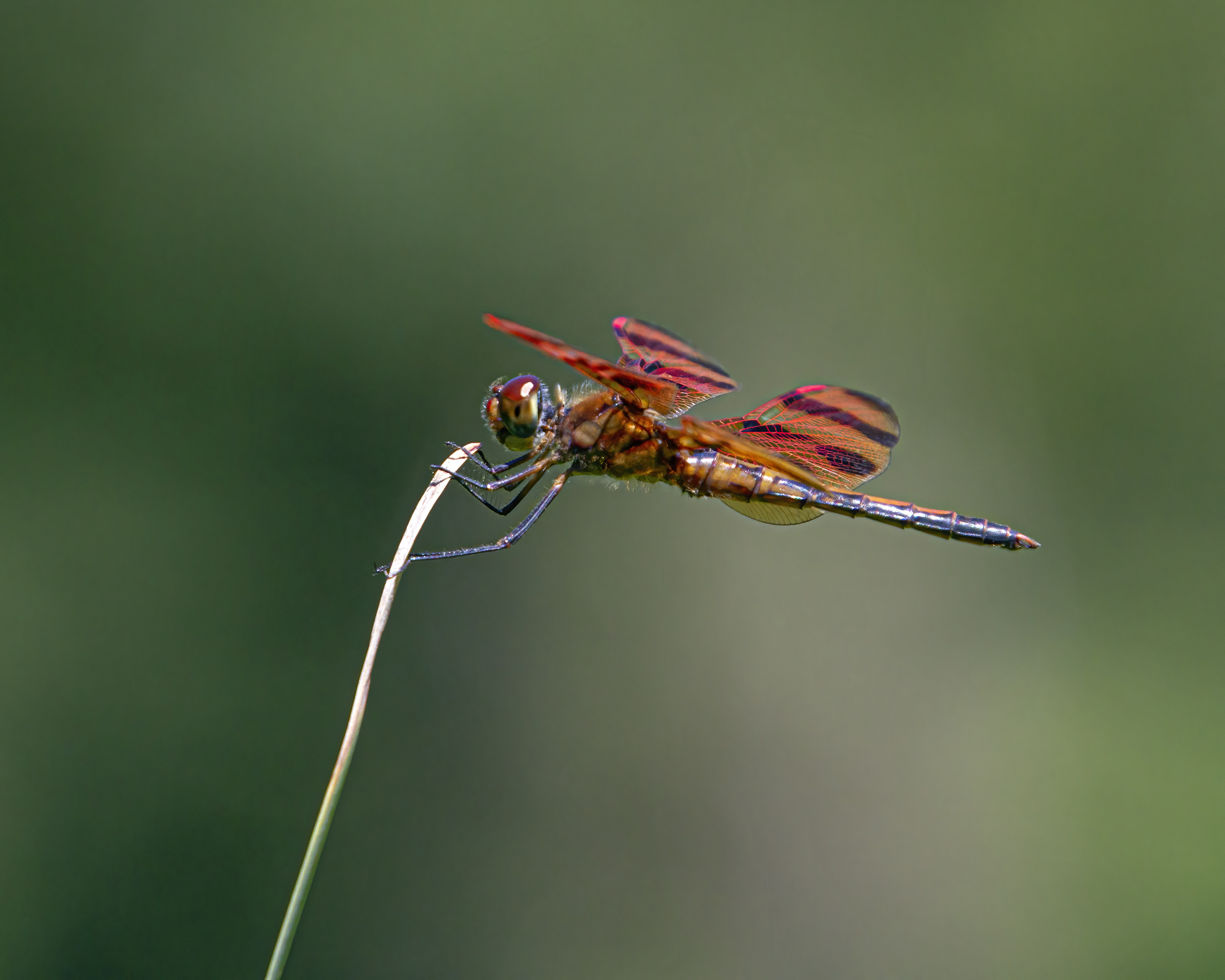
On Tuesday I was thrilled to spot the distinctive color and patterns of a Halloween Pennant (Celithemis eponina) dragonfly as I was exploring a field adjacent to a creek in Prince William County, Virginia. The Halloween Pennant’s wings are orange in color with dark brown bands, the Halloween inspiration for its common name.

Like other “pennant” dragonflies, Halloween Pennants like to perch at the tips of plants, as you can see in these images, which causes them to wave like pennants in even the slightest breezes. I love the way the photos how the dragonfly uses its three sets of legs to grasp the vegetation, ensuring that it can hold on even when the wind is blowing hard.

Halloween Pennant

Halloween Pennant

Halloween Pennant

© Michael Q. Powell. All rights reserved.

Read Full Post »
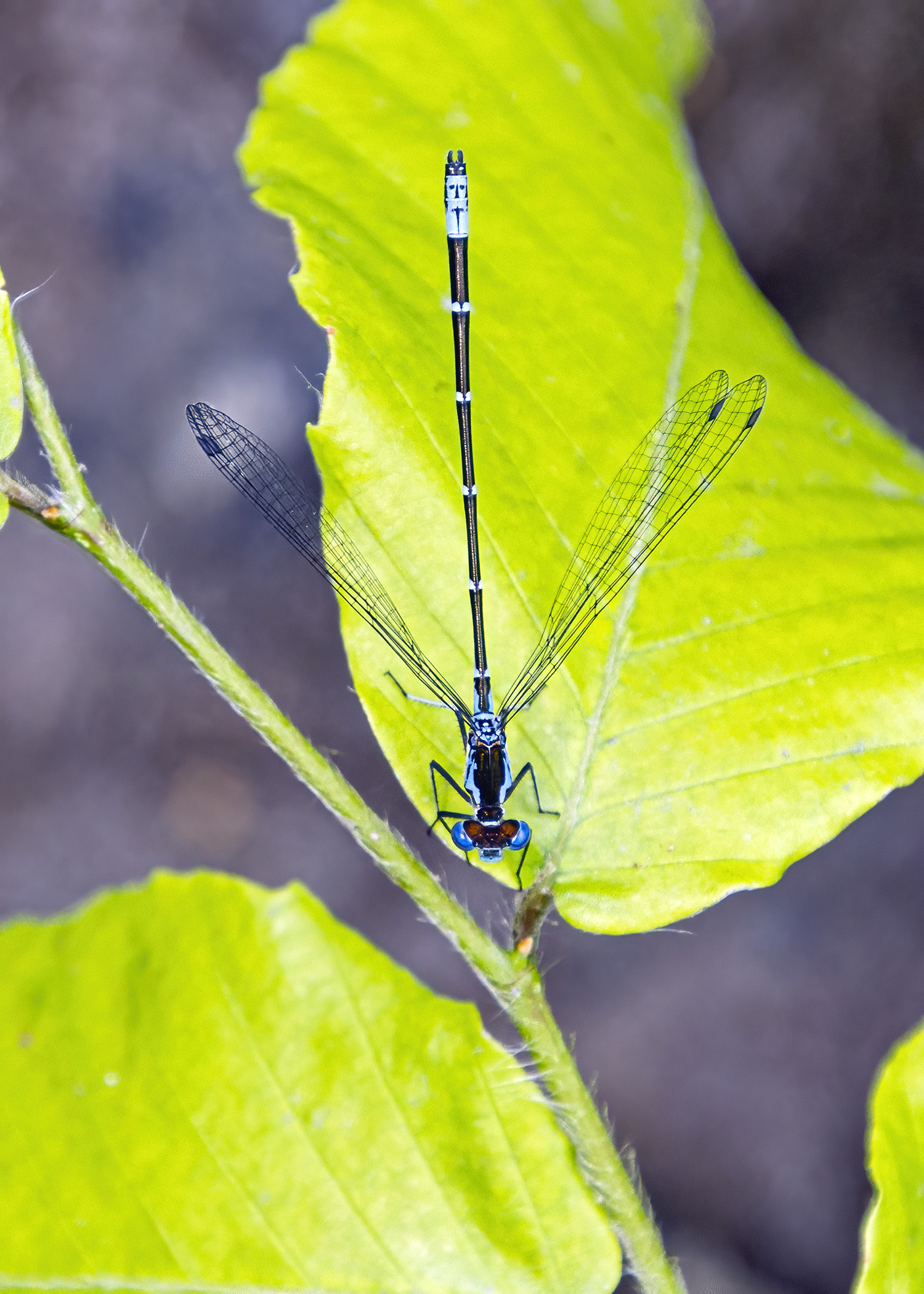
I spotted this cool-looking dragonfly yesterday when it flew to a hanging perch in some shaded vegetation along a creek in Prince William County. I was walking along a trail parallel to the creek and was primarily looking towards the water. Out of the corner of my eye, I detected some movement and spotted where the dragonfly had landed.

A couple of things immediately stood out to me. The dragonfly was hanging vertically, which meant that it was probably not one of the more common skimmers that I am used to seeing at this time of the year. I noted too that the dragonfly was long and skinny and, realizing that my camera was going to have trouble focusing on the dragonfly, I switched to manual focusing. I was able to snap off only a couple of shots before the dragonfly flew away and despite my efforts to relocate it, I was not able to find the dragonfly again.

When I looked on the back of my camera at the images that I had captured, I was not able to identify the dragonfly. When I returned home, I looked through my dragonfly guides and determined that it was a Fawn Darner dragonfly (Boyeria vinosa), a new species for me. Some experts in a Facebook dragonfly group confirmed my identification.

According to the Dragonflies of Northern Virginia website, “Unlike most other darners, and in fact most dragonflies, Fawns shun open, sunny areas. They spend the day hiding in dense, shady underbrush, hanging from the branches of shrubs and young trees. Around 4PM they start venturing out to patrol their shady, forest streams, peaking from about 6PM-8PM.” I encountered the Fawn Darner around midday, so I may have been disturbing its resting period.

Wildlife and nature photographers use many different approaches. Some of them go out to researched locations with a goal of seeing specific species—they are very targeted in their tactics. Others, like me, are opportunistic photographers who wander about, ready to react to whatever they encounter. Although I do love to spot species that are new to me, as was the case with this Fawn Darner, such encounters tend to be almost serendipitous—I tend to stumble upon new species.

Fawn Darner

© Michael Q. Powell. All rights reserved.

Read Full Post »

Last week I was delighted to spot several Aurora Damsel (Chromagrion conditum) damselflies as I was exploring a pond in Prince William County. I had seem some Aurora Damsels earlier in the spring, when they were newly emerged, but had not yet seen any mature adults.

According to the damselfly guide that I use for reference, Damselflies of the Northeast by Ed Lam, the genus Chromagrion “consists of a single species, the Aurora Damsel, a blue and black damselfly with bright yellow on the side of the thorax. It lacks eyespots and shoulder stripes and often perches with its wings slightly spread, unlike most members of its family” of Pond Damsels (Coenagrionidae).

As I have learned from photographing insects and birds, I rarely can capture all of the distinguishing features of a species in a single photograph. In the first photo, you can see the slightly-spread wings, the distinctive markings on the abdomen and thorax, and the lack of eye spots.  You cannot, however, see the bright yellow markings on the thorax. I like to think of these kinds of shots as “scientific,” because the entire body of the damselfly is in almost perfect focus.

I personally tend to be a little more fond of shots like the second image. The damselfly seems to be posing for me with its head slightly cocked and the background and the perch are creative parts of the image. The eyes of the damselfly are in focus, but most of the rest of its body is at least a little blurry. I like to think of this type of shots as “artistic.”

Most of my photography is a mixture of  the “scientific” and the “artistic” approaches. Sometimes the approach is dictated by the circumstance, e.g. when I have to react instantaneously, and sometimes the approach is a consequence of the creative choices that I have made in my camera settings or in composition or angle of view. The cool thing about photography is that it easily accommodates a wide range of approaches and I can be as geeky or artsy as I want to be at ay given moment.

Aurora damsel

Aurora Damsel

© Michael Q. Powell. All rights reserved.

Read Full Post »

Can you spot the dragonfly in the first photo? Let me give you a clue—the large dragonfly is in the center of the image. Can you see it now?

Some dragonflies are easy to see, because of their bright colors or the way that they perch in the open on prominent stalks of vegetation. Others are a bit harder to see, because they perch on the ground or in dense vegetation (or they fly continuously and rarely seem to land).

The Gray Petaltail dragonfly (Tachopteryx thoreyi) is a bit of an anomaly—it perches in the open, but is still very hard to spot. Why? Its gray and black coloration is an almost perfect match for the rough bark of the trees on which it usually perches vertically. In the past I have watched a Gray Petaltail fly to a tree and perch and had trouble seeing it, even though I knew exactly where it was.

Last Wednesday I spotted my first Gray Petaltail of the season as I was exploring a small pond in Prince William County, Virginia. I had seen this dragonfly species at this location several times to the past, so I was carefully scanning the trunks of trees on which they sunlight was shining directly—Gray Petaltails seem to prefer direct sunlight, especially earlier in the day.

I often have to rely on movement to see dragonflies that are so well camouflage, but amazingly I spotted the dragonfly in the first photo while it was still perched. I cropped the image and made a few tweaks to make it a little more visible for you, but it was so tough to spot that I had to creep closer and look from a different angle to make sure that my eyes were not playing tricks on me.

For the second and third shots, I moved around the tree in an effort to better isolate the dragonfly from the tree. I think that approach worked especially well in the final photo in which the dragonfly had raised its wings a bit. Suddenly the Gray Petaltail was much more visible. I chose my angle carefully to try to get a bit of the sky in the photo—I was shooting at an upward angle—and I really like the way that the background came out in the final image.

Gray Petaltail

Gray Petaltail

Gray Petaltail

© Michael Q. Powell. All rights reserved.

Read Full Post »

Some people get creeped out by spiders, but many of them are quite beautiful, like this tiny Orchard Orbweaver spider (Leucauge venusta) that I spotted on Wednesday in Prince William County. The sun was shining brightly on the shiny body of the spider, so I underexposed the image intentionally, which is why it looks so dark in the photo—the background was green in real life. I was also leaning my lens against a branch for stability, since even the slightest movement at such close range can blur an image.

Orchard Orbweavers are really common where I live, but I suspect that most people do not look closely enough at them to see their beautiful colors. According to the LSU AgCenter, “Orchard spiders are .13 to .3 inches (3.5 to 7.5 mm) in length, with females typically larger than males.” I believe that the aforementioned measurements are for the body alone and do not include the legs.

In addition to capturing some of the beautiful colors of the Orchard Orbweaver, I was thrilled to capture a look at the web of the spider. These webs are much smaller and compact than the webs of some of the larger orbweaver spiders in our area, which is a good thing, because many of these webs seem to be built across paths and I often run into them face-first.

Orchard Orbweaver

© Michael Q. Powell. All rights reserved.


Read Full Post »

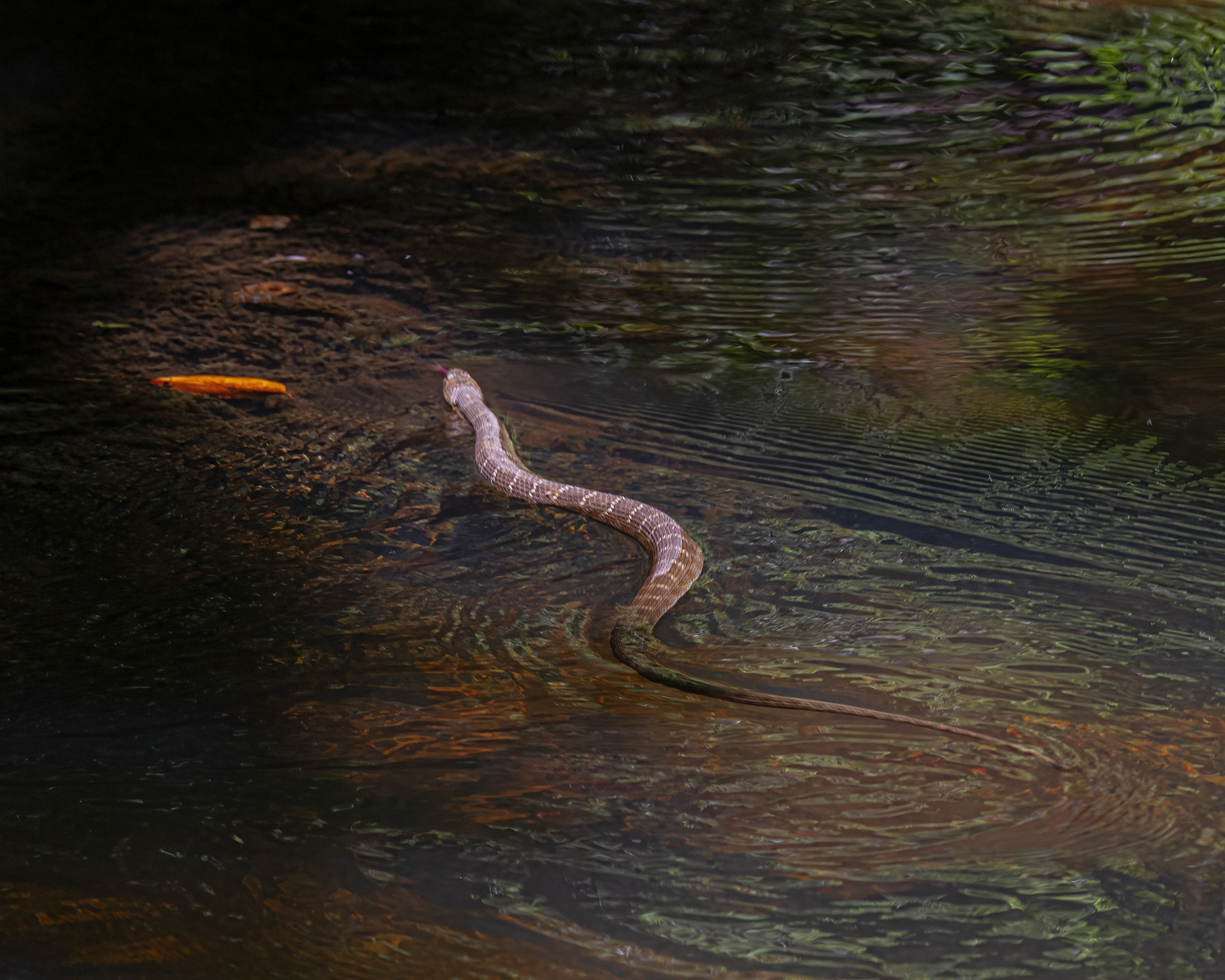
Our recent warm weather has brought out all kinds of creatures, including Northern Water Snakes (Nerodia sipedon). On Wednesday I spotted my first Northern Water Snake of the day as I was sitting on a rock, taking a break alongside a stream. When I spotted it, the snake was swimming vigorously downstream and the first photo captured some of the sinuous movement of the snake’s body. I lost sight of the snake as it approached a series of cascades and was not able to see how the snake handled them

Later that same day I spotted another snake at a small pond. This Northern Water Snake had hidden its body in the debris at the edge of the pond, with just its head visible above the water. This snake was alert and seemed to be in a hunting mode, so I kept my distance and watched the snake carefully as I took the second shot below. Although I know that Northern Water Snakes are not venomous, I remember reading that their bites are painful and that their saliva contains an anticoagulant that causes bites to bleed profusely.

Northern Water Snake

Northern Water Snake

© Michael Q. Powell. All rights reserved.

Read Full Post »

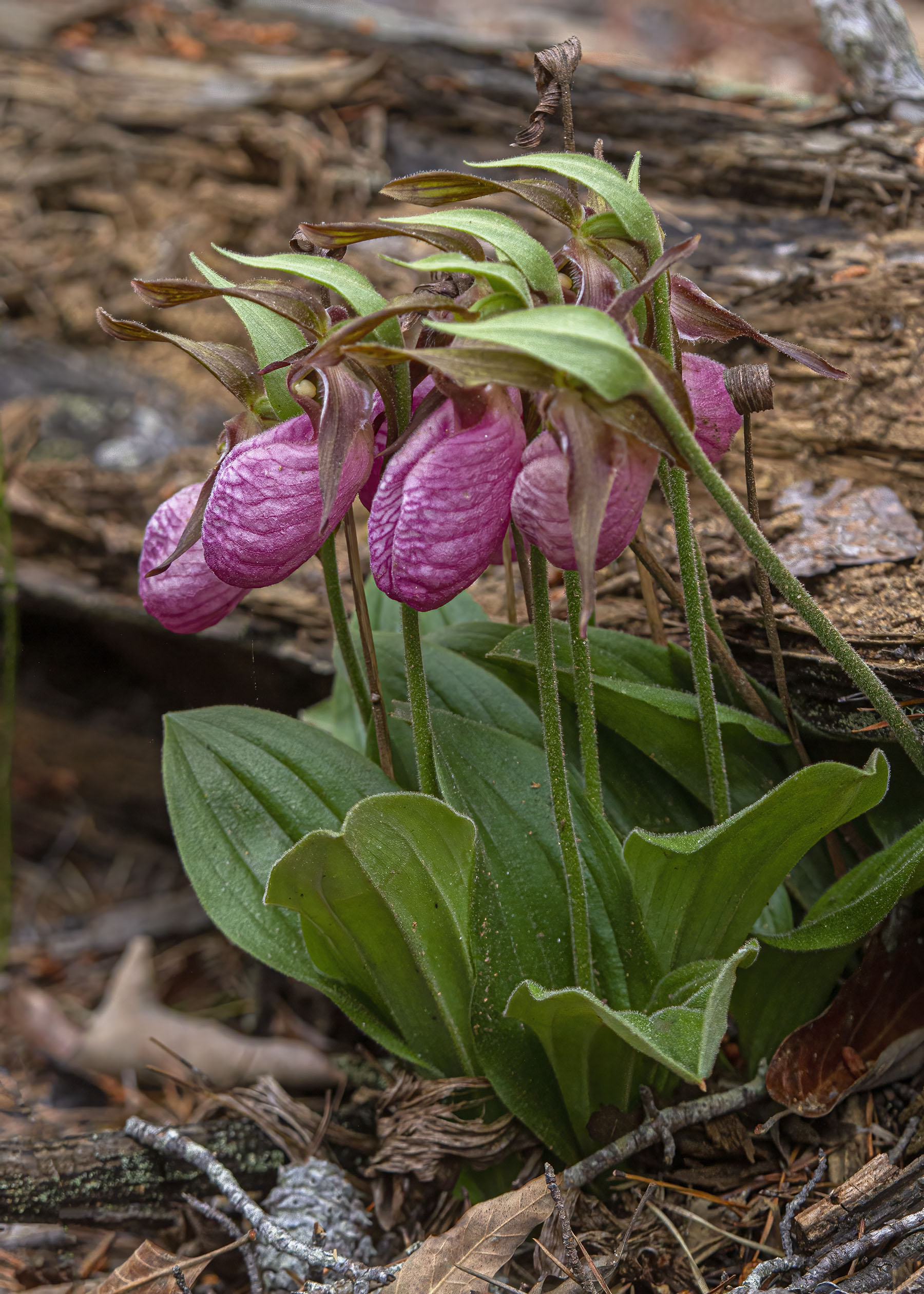
I was thrilled earlier this month to spot a dozen or so Pink Lady’s Slippers (Cypripedium acaule) as I exploring a creek in Prince William County, Virginia. Most of them were growing individually, but there were a few small clusters of these beautiful native orchids.

I have seen these flowers several times in previous years, so I had a general idea of where to look for them, but when I set out on the hike to search for them, I was not certain that my timing was right—it was a bit earlier than I had seen them in past years. I had to walk for several miles to get to this location and initially I could not find any lady’s slippers. Eventually I spotted a single one and was really happy. All of the sudden I started seeing them in multiple spots and was able to capture a variety of images.

I am fascinated by the shape of these flowers and my first instinct was to move in close and capture macro shots to highlight the details of the flower by isolating it from the background, as you can see in the first three images. When it came to groupings of flowers, though, the background could not be eliminated. That turned out to be a blessing in disguise, because I was “forced” to show the environment in which I found the flowers—I have a tendency to forget to take these kinds of shots in my zeal to zoom in. As it turns out, the last image is one of my favorites, though I must admit that the first image in my absolute favorite of these photos.

Pink Lady's Slipper

Pink Lady's Slipper

Pink Lady's Slipper

Pink Lady's Slipper

Pink Lady's Slipper

© Michael Q. Powell. All rights reserved.

Read Full Post »

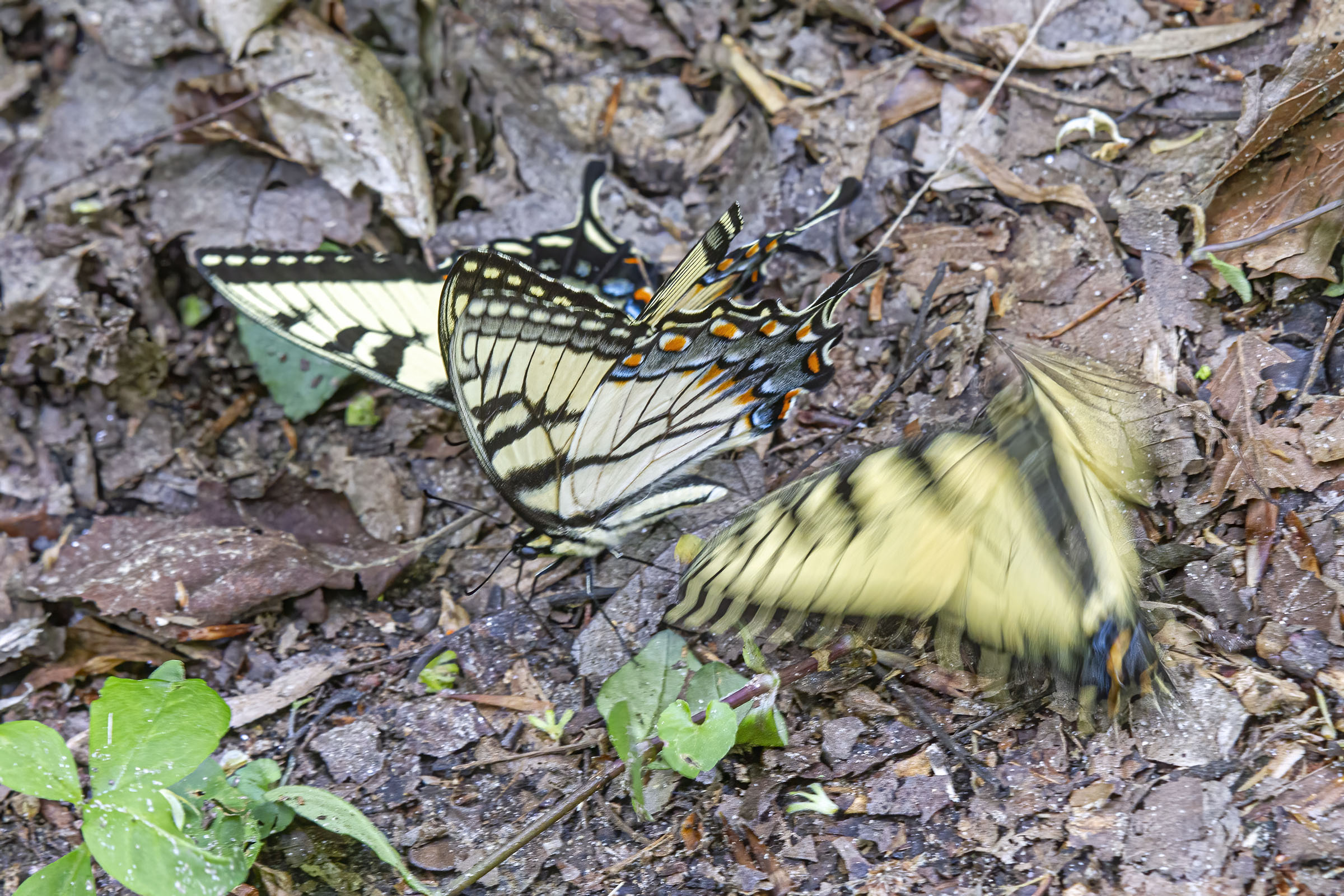
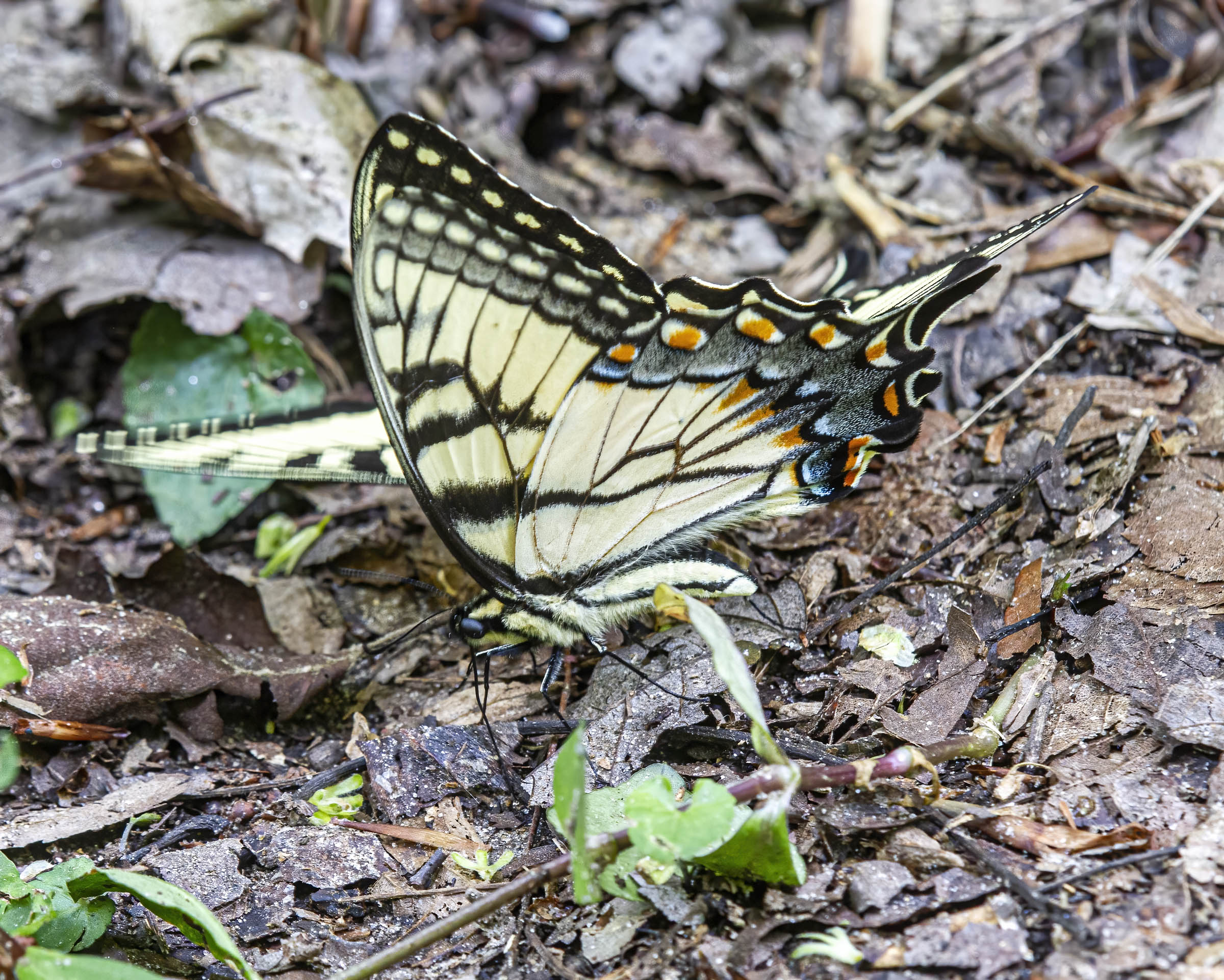
I usually think of butterflies drinking nectar from colorful flowers. Sometimes, though, newly emerged Eastern Tiger Swallowtails (Papilio polyxenes) will gather around  mud puddles or other damp spots—a behavior often referred to as “puddling”—to suck minerals and other substances out of the damp ground, like these butterflies that I spotted in early May alongside a creek in Prince William County, Virginia.

Butterflies were constantly moving in and out of a small group that seemed to be concentrated at one particular spot. As I was taking this shot, a new arrival “photobombed” me. I really like the motion blur of the arriving butterfly, which gives the image a dynamic feel and also a bit of whimsy. The second shot is a close-up view of one of the butterflies as it extracted nutrients from the moist area.

“Puddling” behavior is mostly associated with male butterflies.  According to an article at the Thoughtco website, “Nectar lacks some important nutrients the butterflies need for reproduction. For those, butterflies visit puddles. By sipping moisture from mud puddles, butterflies take in salts and minerals from the soil. This behavior is called puddling, and is mostly seen in male butterflies. That’s because males incorporate those extra salts and minerals into their sperm.”

Eastern Tiger Swallowtail

Eastern Tiger Swallowtail

© Michael Q. Powell. All rights reserved.

Read Full Post »

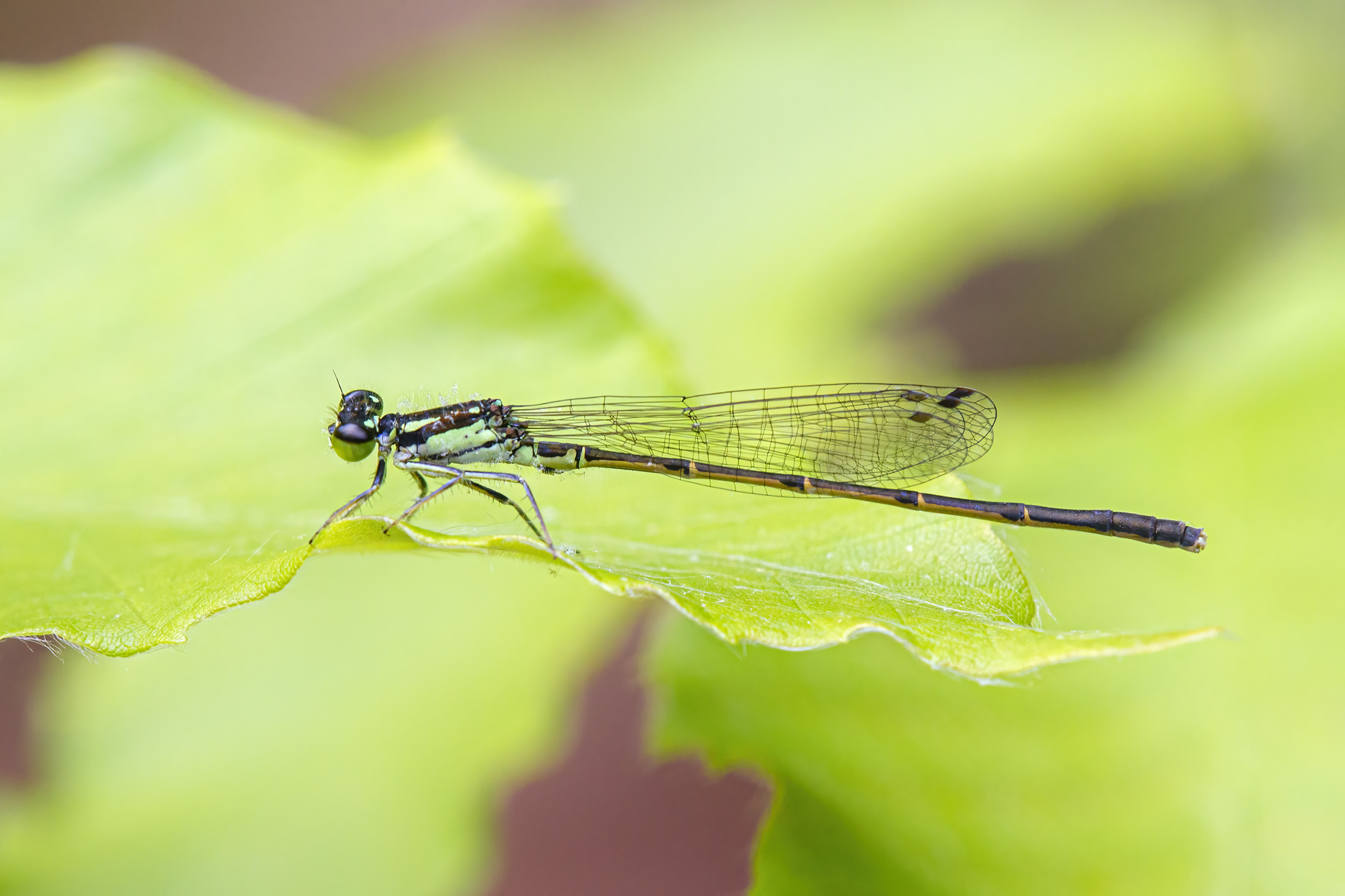
I love to use my macro lenses. There is something almost magical about capturing details on tiny subjects, like this Fragile Forktail damselfly (Ischnura posita) that I spotted this past Monday alongside a pond in Prince William County, Virginia. Fragile Forktails are only about an inch (25 mm) in length, so I had to get pretty close to my subject to “fill the frame,” even with my 180mm macro lens.

One of the biggest challenges when I get this close to a subject is that my depth of field is really shallow, so I risk having a lot of my subject out of focus. In fact, in the majority of my photos of this damselfly, either the eyes or the tip of the abdomen is in focus, but not both. In this kind of situation, the “trick” to having the entire subject in focus is to position myself so that the sensor of my camera is parallel with the plane of the subject.

In this image, you can see that about the only things in focus are the damselfly and the edge of the leaf on which it was perched—the rest of the image is pleasingly blurred. This approach works pretty well with damselflies, which hold their wings above their bodies when perched, but does not work as well with dragonflies, which perch with outstretched wings. As a result, portions of the dragonflies in most of my photos are blurred, though I usually give top priority to keeping their eyes in focus.

Fragile Forktail

© Michael Q. Powell. All rights reserved.

Read Full Post »

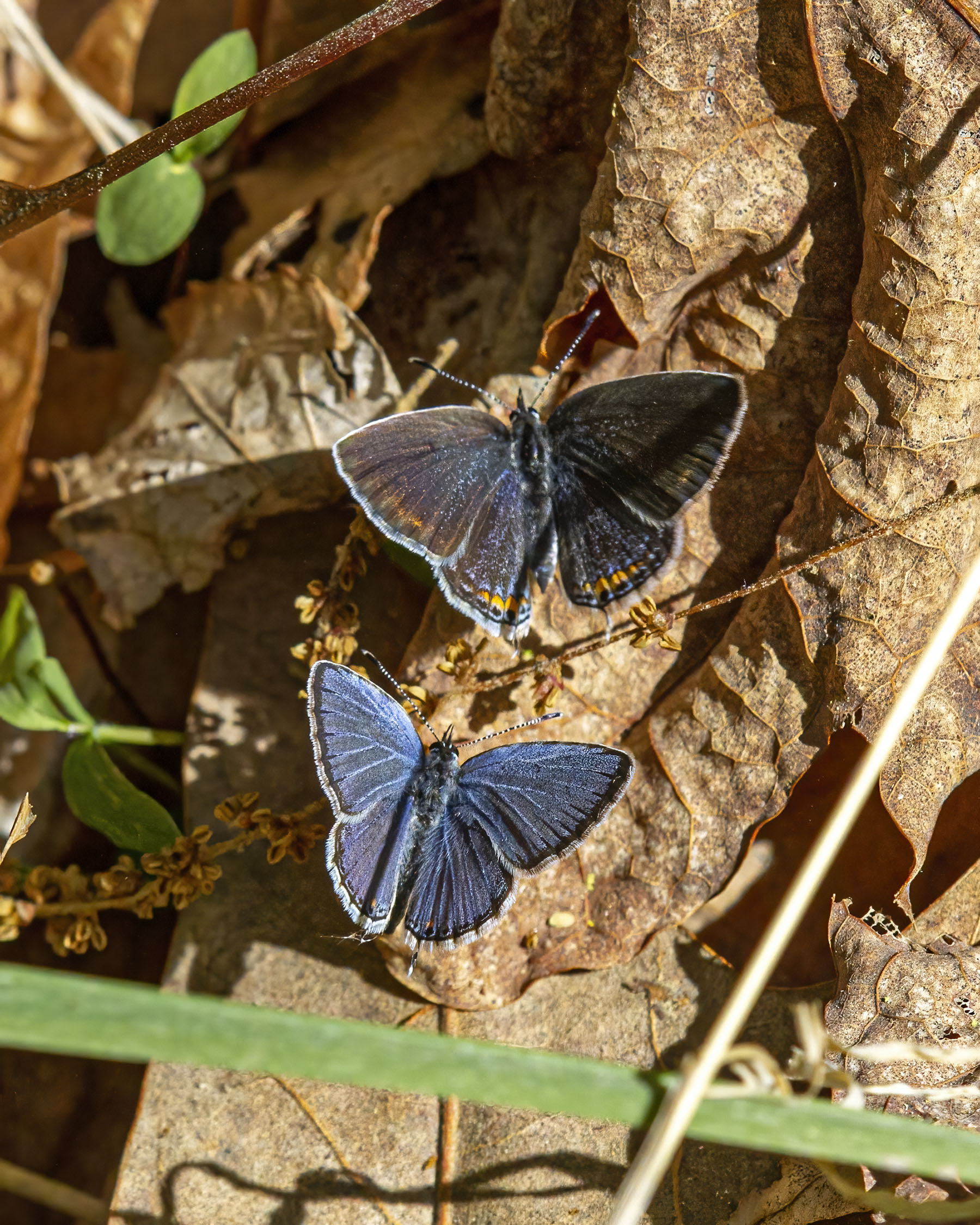
I don’t know much about the courting behavior of Eastern Tailed-blue butterflies (Cupido comyntas), but the male at the bottom of the photo was actively pursuing a female when I photographed them on Wednesday in Prince William County. Eastern Tailed-blues are tiny butterflies, with a wingspan of about an inch (25 mm), so you have to look really closely to see the single narrow tail on each hind wing. When their wings are closed, Eastern Tailed-blues are mostly grayish0-white in color, so it was a real visual treat to be able to capture them with their wings open.

Eastern Tailed-blue

© Michael Q. Powell. All rights reserved.

Read Full Post »

Most of the time fishing spiders have some of their legs in the water to sense the vibrations of potential prey, but the large Six-spotted Fishing Spider (Dolomedes triton) that I spotted last Friday in Prince William County was perched on a log at the edge of a small creek. When I posted the photo on Facebook, one of my friends noted that he often finds fishing spiders far from the water, including in his wood pile.

I do not know how large this spider was, but it looked huge to me. Perhaps that is because the spider had all of its legs fully extended, unlike some spiders whose legs are partially bent when they are in a web.

Six-spotted Fishing Spider

© Michael Q. Powell. All rights reserved.


Read Full Post »

Different dragonfly species perch in different ways. Some perch high and some perch low; some perch horizontally, others perch at an angle, and others hang vertically.  I am always intrigued to look at the way a dragonfly is perched and, in particular, to see how the dragonfly is using its legs.

Last week I was delighted to spot a male Stream Cruiser (Didymops transversa) while I was exploring the edge of a creek in Prince William County, Virginia. The Steam Cruiser was perched low in the vegetation at an angle. Stream Cruisers have such long legs that they look somewhat uncomfortable when they are perching.

If you click on the image below, you can get a closer look at the dragonfly’s legs. The dragonfly does not seem to be using its front legs at all to perch and appears to be relying almost exclusively on its middle set of legs. The back set of legs look to be amazing long and are probably more useful for capturing prey than for perching.

Stream Cruiser

© Michael Q. Powell. All rights reserved.

Read Full Post »

Older Posts »