Feeds:
Posts
Comments

Posts Tagged ‘Prince Baskettail’

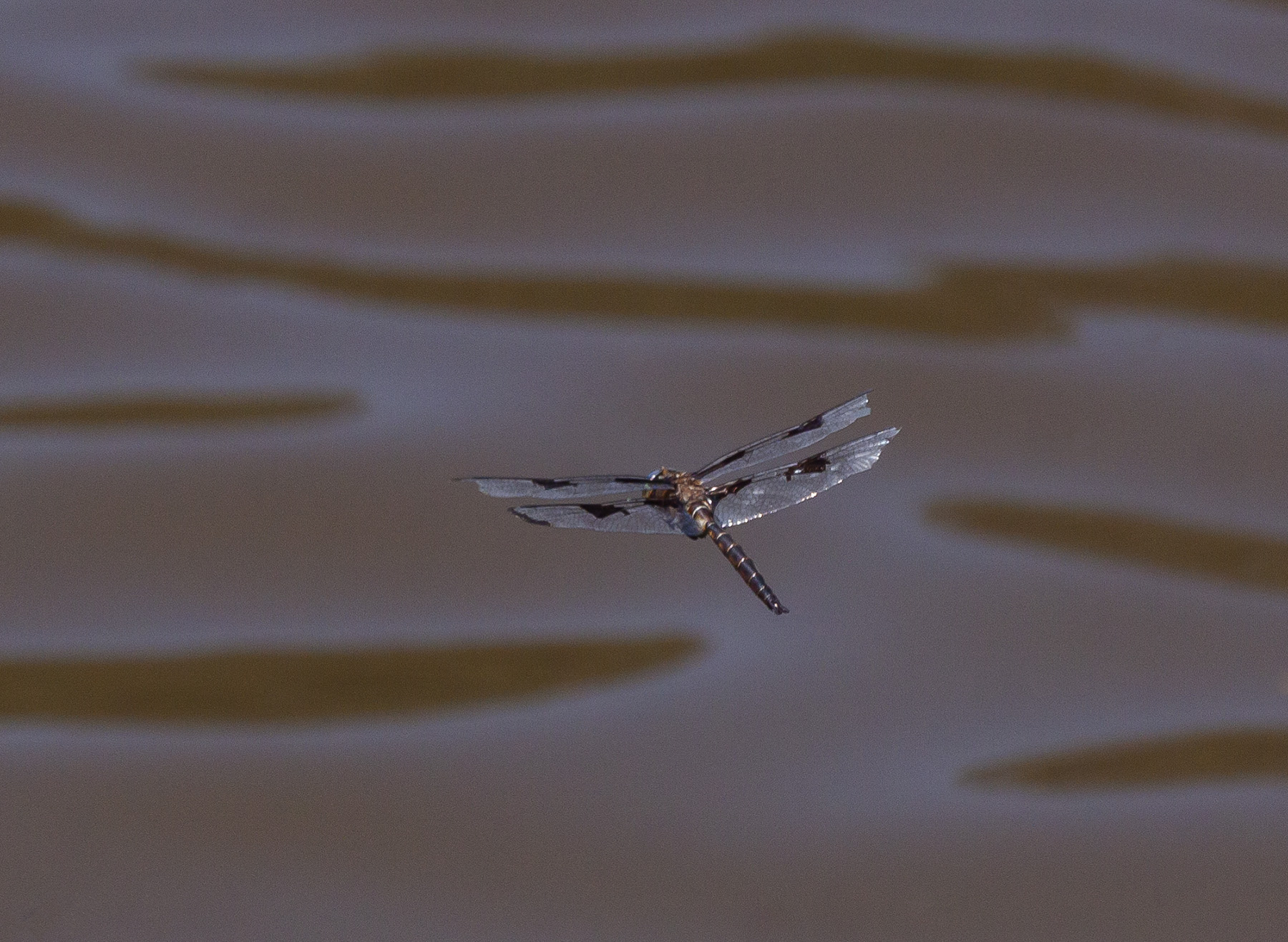
When I spotted a dragonfly patrolling over the water of a small pond yesterday at Jackson Miles Abbott Wetland Refuge, I knew almost immediately that it was a Prince Baskettail dragonfly (Epitheca princeps). How could I tell? As it flew by, I could catch glimpses of the dark patches on its wings and the Prince Baskettail is the only large dragonfly with patterned wings in our area. (Prince Baskettails are almost three inches (76 mm) in length).

Seeing the dragonfly in flight was easy, but getting a clear shot of it was a considerable challenge. I watched the dragonfly and was able to determine its approximate patrol area. When it flew into that area, I attempted to track it, sometimes using my camera’s autofocus and sometimes focusing manually. Most of my shots were out of focus or did not include the dragonfly in the frame, but I managed to get a few decent shots, with the image below being the best of the lot.

Some of my fellow wildlife photographers marvel at images like this and think that high end gear or special techniques are necessary. The reality, though, is that I use relatively modest equipment and the “secret” to my success quite often is a combination of patience, practice, and persistence.

Prince Baskettail

© Michael Q. Powell. All rights reserved.

Read Full Post »

Yesterday I had the chance to test my skill and my patience as I tried to capture images of dragonflies in flight at Jackson Miles Abbott Wetland Refuge. I believe they are a Royal River Cruiser (Macromia taeniolata), a Prince Baskettail (Epitheca cynosura), and a Russet-tipped Clubtail (Stylurus plagiatus), members of three different families of dragonflies.

The Royal River Cruiser is the most uncommon of these three species—I have only seen one a few times and this is the first time that I have gotten a decent shot of one. Cruisers are large dragonflies with large eyes and long legs that generally fly up and down streams or rivers or along lake shores. I did not expect to see one at the small pond at this refuge, but there is an adjacent wetland and a small stream, so maybe the dragonfly made a detour in its patrol over those areas. This dragonfly followed the shore of the pond and flew fast in a single direction.

The Prince Baskettail is the most common of the three dragonflies and I have featured in-flight shots of this species multiple times. The Prince Baskettail appears to have a portion of the shoreline as its territory and it flies back and forth, giving me multiple opportunities to get a shot. This dragonfly has amazing stamina and rarely seems to rest—in ten years of observing dragonflies, I have seen a perched Prince Baskettail only a couple of times.

The Russet-tipped Clubtail is a dragonfly that appears in the late summer and I usually spot one when it is hanging from the vegetation. This one was the first sighting for me of the species this season. Although the dragonfly never came close to the shore, the distinctive color of its “tail” made it easy for me to identify it, even when it was flying.

In case any of you are curious, I captured all of these images with my Canon 7D DSLR and my Tamron 18-400mm zoom lens. Sometimes I focus manually when trying to photographing dragonflies in flight, but I believe I used my camera’s autofocus for these shots with a group of nine focus points in the center selected.

Royal River Cruiser

Prince Baskettail

Russet-tipped Clubtail

© Michael Q. Powell. All rights reserved.
 

Read Full Post »

On Monday I spent several hours at Jackson Miles Abbott Wetland Refuge, focusing my attention primarily on trying to capture shots of Prince Baskettail dragonflies (Epitheca cynosura) in flight. There appeared to be several of them patrolling over the waters of the small pond and I managed to find some good vantage points that gave me unobstructed views of them as they passed by.

One of the locations where I spotted a Prince Baskettail included some lily pads and I decided to try to include them in the shots to give a sense of the environment. The downside of this approach, though, was that it made it even harder to keep my camera’s focus on the dragonfly—the camera kept trying to focus on the background. I was persistent, however, and managed to get a few good shots, as you can see in the first three images below.

I took the final image at a different spot where there were no lily pads. This shot is undoubtedly the sharpest one of today’s photos. Although you can’t see much of the environment in the image, the ripples in the water do add some visual interest.

I couldn’t help but notice that the dragonfly in the final photo had its legs in a lower position than normally—generally a Prince Baskettail flies with its legs held tightly against its thorax to present the most aerodynamic profile. I know that some dragonfly species catch prey on the fly with their legs extended like a basket and wonder if that was what this dragonfly was attempting to do.

Prince Baskettail

Prince Baskettail

Prince Baskettail

Prince Baskettail

© Michael Q. Powell. All rights reserved.


Read Full Post »

Yesterday I visited Jackson Miles Abbott Wetland Refuge and spent a lot of my time there trying to get shots of dragonflies in flight. The dragonflies were not very cooperative and kept their distance most of the time, but eventually I managed to get a few decent shots. What was especially cool was that I captured images of dragonflies from three different families—Skimmer, Darner, and Emerald.

The first photo shows a Banded Pennant (Celithemis fasciata), a Skimmer, as he was flying toward me. Banded Pennants are pretty small at about 1.3 inches (33 mm) in length, so I was pretty thrilled to capture this shot as he was flying toward me. This was actually the first time that I had seen a Banded Skimmer this season.

The second photo shows a Cyrano Darner (Nasiaeschna pentacantha). Despite the fact that I took the shot from a long distance away, you can still see the prominent “nose” that is supposedly reminiscent of the long nose of literary character Cyrano de Bergerac.

The last two photos show Prince Baskettails (Epitheca cynosura) that are members of the Emerald family. Prince Baskettails, which are about 2.9 inches (74 mm) are quite easy to identify, because they are the only large dragonfly in our area with patterned wings. I had more opportunities with this species that with the others, because several Prince Baskettails were flying repetitive patrols only various parts of the pond and passed by me multiple times. Although it is a little easier to focus on a dragonfly in flight when the background is clear, I think it is even cooler when I manage to include reflections in the water in a photo, as was the case with the reflections of the branches in the final photo.

Banded Pennant

Cyrano Darner

Prince Baskettail

Prince Baskettail

© Michael Q. Powell. All rights reserved.


Read Full Post »

On Monday I was thrilled to spot this Prince Baskettail dragonfly (Epitheca cynosura) flying patrols over the small pond at Jackson Miles Abbott Wetland Refuge. Previously I had spotted Common Baskettails doing the same thing at this location—see my recent posting Common Baskettails in flight—but they seem to have been supplanted by the Prince Baskettails. How do you tell them apart? Although they are both part of the Emerald family, only Prince Baskettails have patterned wings, as you can see in these photos.

I really like the description of this species on the Dragonflies of Northern Virginia website:

“This sleek, elegant dragonfly could in fact be called King Baskettail, as it is the largest member of the Emerald family. There are seven families of dragonflies in the US–Emeralds are known for their glowing green eyes (hence the family name), and their endless, acrobatic flight. Like other members of this family, Prince Baskettails rarely land and can spend many hours in ceaseless flight. Look for this powerful flier making long, repeated, low patrols over open water habitats such as lakes, ponds, canals, and sluggish river sections.”

As a result of the repeated patrols, I was able to track the dragonfly as it flew by me and capture these images. The dragonfly did not get really close to the bank on which I was standing, so my autofocus would not detect my subject and I had to resort to focusing manually. I am pretty happy with the results and I encourage you to click on the images to see the beautiful markings on the body of this Prince Baskettail dragonfly.

Prince Baskettail

Prince Baskettail

Prince Baskettail

© Michael Q. Powell. All rights reserved.

Read Full Post »

I was a little surprised on Wednesday to see a Prince Baskettail dragonfly (Epitheca princeps) flying over the pond at Jackson Miles Abbott Wetland Refuge—I thought they were all gone by now. There were not too many other dragonflies around, so I concentrated on trying to capture in-flight shots of this elusive dragonfly that I never saw perch.

Photographing dragonflies while they are flying is a huge challenge for both my skill and my patience. I had a general idea of the area in which this dragonfly was flying as he flew repeatedly over a patch of lily pads. However, his specific flight path varied a lot and he often changed directions without warning.

Most of my photos were blurry or did not contain my subject, but I eventually managed to get a few decent shots of the Prince Baskettail. The first one is the sharpest, but it does not give you much of a sense of the environment in which the dragonfly was flying. The second shot has a bit of blur, but I really like the background pattern of the water of the pond. The dragonfly was flying away from me when I took the final photo, but I like the way that the image shows the pond vegetation and the tiny perched Eastern Amberwing dragonfly in the foreground was a nice bonus.

Prince Baskettail

Prince Baskettail

Prince Baskettail

© Michael Q. Powell. All rights reserved.


Read Full Post »

It is a fun challenge to try to photograph dragonflies in flight—I will usually try to meet this challenge at least a few times each dragonfly season. It requires a lot of patience and persistence, as you can probably imagine, and results are certainly not guaranteed.

I captured these shots of Prince Baskettail dragonflies (Epitheca cynosura) as they was flew more or less toward me on Tuesday at Jackson Miles Abbott Wetland Refuge. Normally I use manual focus for these kinds of shots when I am shooting with my Tamron 180mm macro lens because it is really slow in acquiring focus.

For these shots, though, I used my Tamron 18-400mm lens and the longer reach let me acquire and track my subjects when they were farther away. Amazingly I was able to use auto focus. The first two shots were taken with the zoom lens fully extended to 400mm and the lens was at 265mm for the final photo.

None of these photos will win any prizes, but they are kind of fun. As one of my friends commented in Facebook, the view is “kind of like being a tail gunner in a B17 over France during WWII.” More importantly for me, though, these shots provide an indication that I am not giving up too many capabilities if I choose to walk around with this lens alone. It will never fully replace my macro lens or my longer telephoto zoom lens, but the Tamron 18-400mm lens is continuing to impress me with its versatility.

Prince Baskettail

Prince Baskettail


Prince Baskettail

© Michael Q. Powell. All rights reserved.


Read Full Post »

I was shocked and thrilled to spot a Prince Baskettail dragonfly (Epitheca princeps) perched in a tree on Monday at Occoquan Bay National Wildlife Refuge. This was only the second time that I have seen one that was not flying—they never seem to take a break. As the Dragonflies of Northern Virginia website succinctly states, “Flies almost constantly, rarely perches.”

Earlier in the day I had seen Prince Baskettails several times, flying overhead as I walked along a trail parallel to the waters of Occoquan Bay. Those of you who have followed my blog for a while know that I can never resist the chance to attempt to capture a shot of a dragonfly in flight. This time was a bit different, though, because I was using my long telephoto zoom lens and the dragonfly was not flying over the water, but was high in the air. The second image was one of my more successful attempts.

Normally the only place where I see Prince Baskettails at this time of the year is at a small pond at Jackson Miles Abbott Wetland Refuge, where the Prince Baskettails fly repeated patrols low over the water. I have had some success in capturing shots of them in flight, like the final photo that I took last Thursday as a Prince Baskettail was flying by parallel to my position on the shore.

Prince Baskettail

Prince Baskettail

Prince Baskettail

© Michael Q. Powell. All rights reserved.

Read Full Post »

I stopped by Jackson Miles Abbott Wetland Refuge yesterday and noticed that a changing of the guards has taken place. The last time I was there, Common Baskettail dragonflies (Epitheca cynosura) were patrolling the pond, but it looks like they have now been replaced by Prince Baskettail dragonflies (Epitheca princeps). The species are relatively easy to tell apart, because the Prince Baskettails have dark patterns on their wings, a feature that is visible even when they are flying.

In both cases, these are dragonflies that fly endlessly, moving back and forth in low patrols near the edges of the pond, never seeming to perch. The only way to capture an image of one is to photograph it in flight. If you watch one for long enough, though, you can start to detect patterns in the way that it flies. Each Prince Baskettail seems to have its own area of responsibility and often will turn around when it reaches its outermost boundaries.

So there is some predictability in the flight path of the dragonfly, but the dragonfly will instantaneously alter its path when it needs to chase off intruders or when the wind changes or for other reasons that I cannot understand or anticipate.

Here are a few of my more successful shots from yesterday—I had lots and lots of shots in which the dragonfly was out of focus or entirely missing from the frame. In some cases, a Prince Baskettail would fly relatively close to the shore and I was able to point my camera down at it, as in the first photo. Most of the time, though, I had to try to focus on the dragonfly at a greater distance and my camera was more level, as you can see in the second image and to a certain extent in the final photo.

I am often content to photograph dragonflies when they are perched, but from time to time it is good to push my skills and my patience by attempting shots like these. I remember my sense of amazement the first time I saw photos of dragonflies in flight and never imagined that I would eventually be able to capture similar images.


Prince Baskettail

Prince Baskettail

Prince Baskettail

© Michael Q. Powell. All rights reserved.


Read Full Post »

If you are lucky and persistent, it is not hard to photograph a perched dragonfly. Some of them are amazingly tolerant of the presence of a human and will let you get really close to them. Even when they do fly away, many of them will return to the very same perch.

If you want to really challenge your skills as a photographer and perhaps even your sanity, you attempt to photograph members of dragonfly species that fly almost constantly and rarely perch, like this male Prince Baskettail dragonfly (Epitheca princeps) that I spotted late in June at Jackson Miles Abbott Wetland Refuge. This dragonfly was flying irregular patrols low over the waters of a small pond at the refuge—sometimes he would fly relatively close to the shore, but often his flight path was unpredictable.

So how do I do it? I generally use the same 180mm macro lens that I use for close-up shots of dragonflies. However, I know that the lens tends to focus slowly and autofocus simply can’t acquire the subject, because it fills such a small part of the frame, so I switch to manual focus. I pre-focus on a general area and then as I track the dragonfly, I adjust the focus on the fly as he zooms by and fire away in burst mode. As dragonflies go, a Prince Baskettail is relatively large, almost 3 inches in length (75 mm), but it is really tough to get an in focus shot of one while he is flying.

On a second occasion when I was visiting the same refuge, I got a chance to try a variation of the technique. The dragonflies were patrolling  high overhead as I stood in a grassy area at one end of the pond. The second shot was the best that I could manage—the wing pattern suggests that it is also a Prince Baskettail, but the eye coloration and the terminal appendages at the tip of the abdomen make me wonder if this one is a female. What I discovered is that it is actually a lot harder to focus on a dragonfly when I am looking straight up than when looking down at the water and my arms get tired a lot quicker when holding my camera up hight for an extended period of time.

Prince Baskettail

Prince Baskettail

© Michael Q. Powell. All rights reserved.


Read Full Post »

Life can be tough and can wear you down if you are a prince, at least if you are a Prince Baskettail dragonfly (Epitheca princeps). Last Saturday I spent a pretty good amount of time observing Prince Baskettails patrolling a pond at Jackson Miles Abbott Wetland Refuge.

As I am wont to do, I tried to photograph them in flight and managed to get a few shots in focus. As I reviewed the images, I couldn’t help but notice that the wings of all of the dragonflies were worn down and/or damaged. I am used to seeing such damage with dragonflies that fly through thickets and heavy vegetation, but I was a little surprised to see it with dragonflies that seem to spend most of the time flying over open water.

As we move deeper into summer, I am certain to encounter more and more dragonflies with damaged wings. I am always amazed to see that such dragonflies are still capable of amazing aerial acrobatics despite their physical limitations—somehow they manage.

Prince Baskettail

Prince Baskettail

Prince Baskettail

© Michael Q. Powell. All rights reserved.

Read Full Post »

Do dragonflies have noses? That sounds like a crazy question, but it is the first one that came to mind when I looked at the image that I had captured of a dragonfly in flight this past week at Jackson Miles Abbott Wetland Refuge. I could not immediately identify it, so I consulted with experts in a Facebook group and learned that it is a Cyrano Darner (Nasiaeschna pentacantha). This species has a protruding forehead—it’s not a nose— that is reminiscent of the long nose of literary character Cyrano de Bergerac.

The species in the second shot is a Prince Baskettail (Epitheca cynosura), a species that I have featured multiple times in this blog. During much of the summer, I can usually spot one or two Prince Baskettail dragonflies patrolling over the pond at the same wetland refuge and I love trying to capture shots of them in flight. What makes this image distinctive, though, is not so much the dragonfly, but the background. There were ripples in the pond and the way that I shot and processed the image turned them into a wonderfully abstract background.

When I post photos like these, I often get questions about how I am able to capture images of flying dragonflies. Luck and persistence are the keys to getting shots like these. I use my 180mm macro lens and focus manually as the dragonflies zoom by, because the dragonflies don’t fill enough of the frame for my auto-focus to engage quickly and accurately. I have found that is almost impossible for me to use a zoom lens in this task—I get overwhelmed when I try to zoom, track, and focus simultaneously.

Cyrano Darner

Prince Baskettail

© Michael Q. Powell. All rights reserved.


Read Full Post »

This Prince Baskettail dragonfly (Epitheca princeps) almost looks like it was flying at an airplane’s cruising altitude and was looking down at a landscape with rivers, mountains, and lakes. I spotted this dragonfly last weekend at Occoquan Bay National Wildlife Refuge and spent quite a while trying to get a shot of it in flight.

The dragonfly, however, never ventured close enough to shore for me to get a detailed shot of it. I was a little disappointed until I opened up the image on my computer and discovered that I had managed to capture a wonderful, fanciful background. Sometimes I try to document the reality that I see and other times it seems like it is just my imagination running away with me.

Prince Baskettail

© Michael Q. Powell. All rights reserved.

Read Full Post »

Different species of dragonflies fly in different ways. Some soar high in the air and some cruise just above the surface of the water. A dragonfly’s wings allow it to perform all kinds of aerial acrobatics that are entrancing to observe. Given their size and speed, it’s a significant challenge to try to capture them in flight, though frequent readers of this blog know that I will sometimes spend extended periods of time trying to meet that challenge.

During a recent trip to Occoquan Bay National Wildlife Refuge, I noticed a dragonfly flying above my head. Its flight reminded me of eagles and hawks that I have seen gliding effortlessly on thermal updrafts. I couldn’t make out the flight pattern that it was following, but it repeatedly flew over me. Each time that it returned, I would point my camera almost straight up and eventually I was able to capture this shot of an easy-to-identify Black Saddlebags dragonfly (Tramea lacerata)—the pattern of black blotches on the wings are very distinctive.

Black Saddlebags

Later that same day I spotted a dragonfly making repeated patrols above the water. The dragonfly never seemed to rest or to perch, so I tried and tried to capture some shots of it as it zoomed on by me. Most of my shots were out of focus, but I like the one below. The choppy water in the background reminds me of the clouds that I will sometimes see when I look out of the window of an aircraft that has reached its cruising altitude. In my mind’s eye, I can imagine this dragonfly flying high in the sky, peacefully soaring above the clouds and the turbulence below it.

Prince Baskettail

© Michael Q. Powell. All rights reserved


Read Full Post »

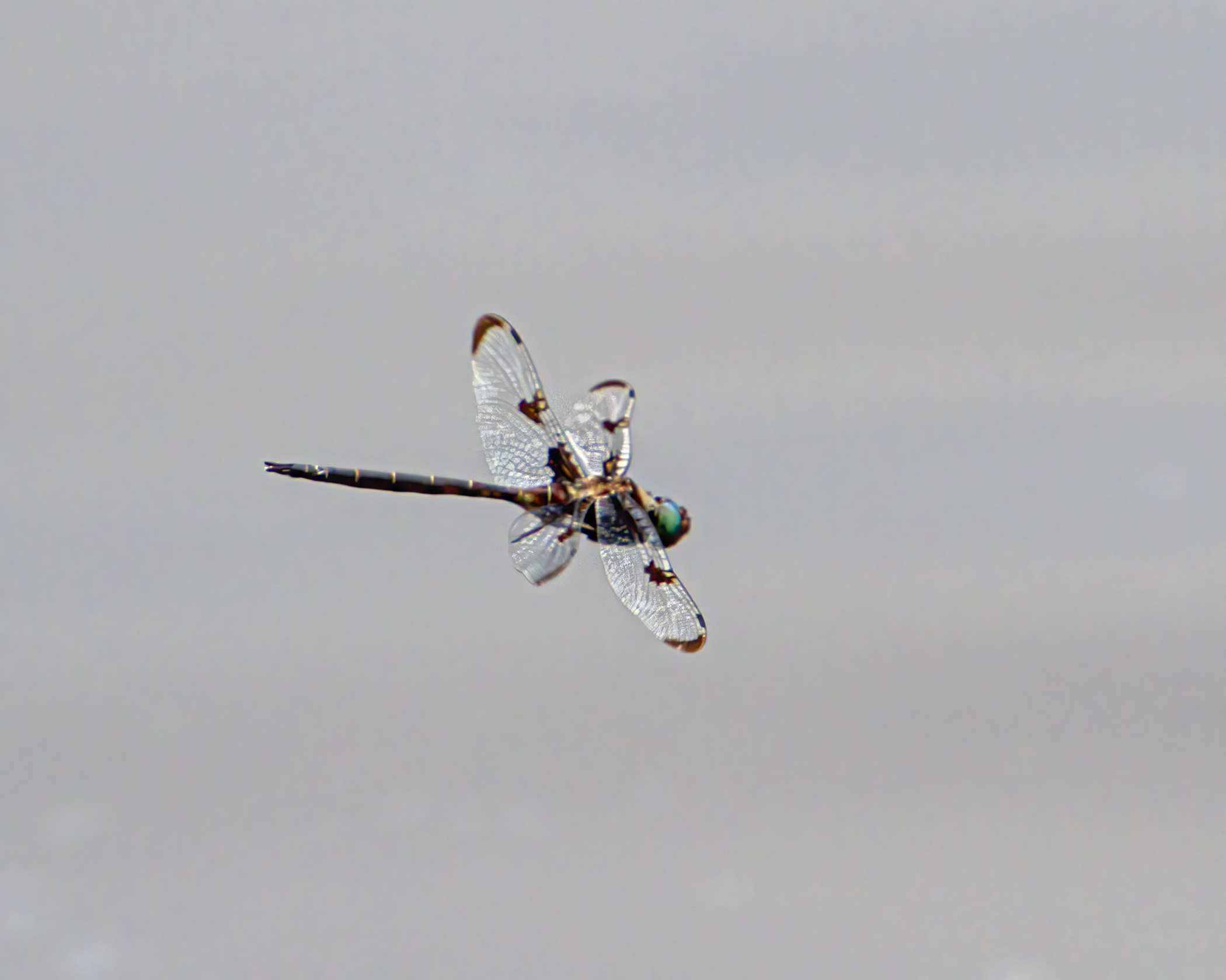
It’s a fun challenge to try to capture an image of a dragonfly in flight and I spent a lot of quality time this morning with a Prince Baskettail (Epitheca princeps) at Jackson Miles Abbott Wetland Refuge. Generally he flew patrols in the center of the pond, out of range of my lens (a 180mm macro), but occasionally he would fly tantalizingly close and give me a split second to react.

Most of the time I was unable to track him and focus quickly enough, but eventually I did manage get a few relatively sharp photos. This one is my favorite.

Prince Baskettail

© Michael Q. Powell. All rights reserved.
Read Full Post »

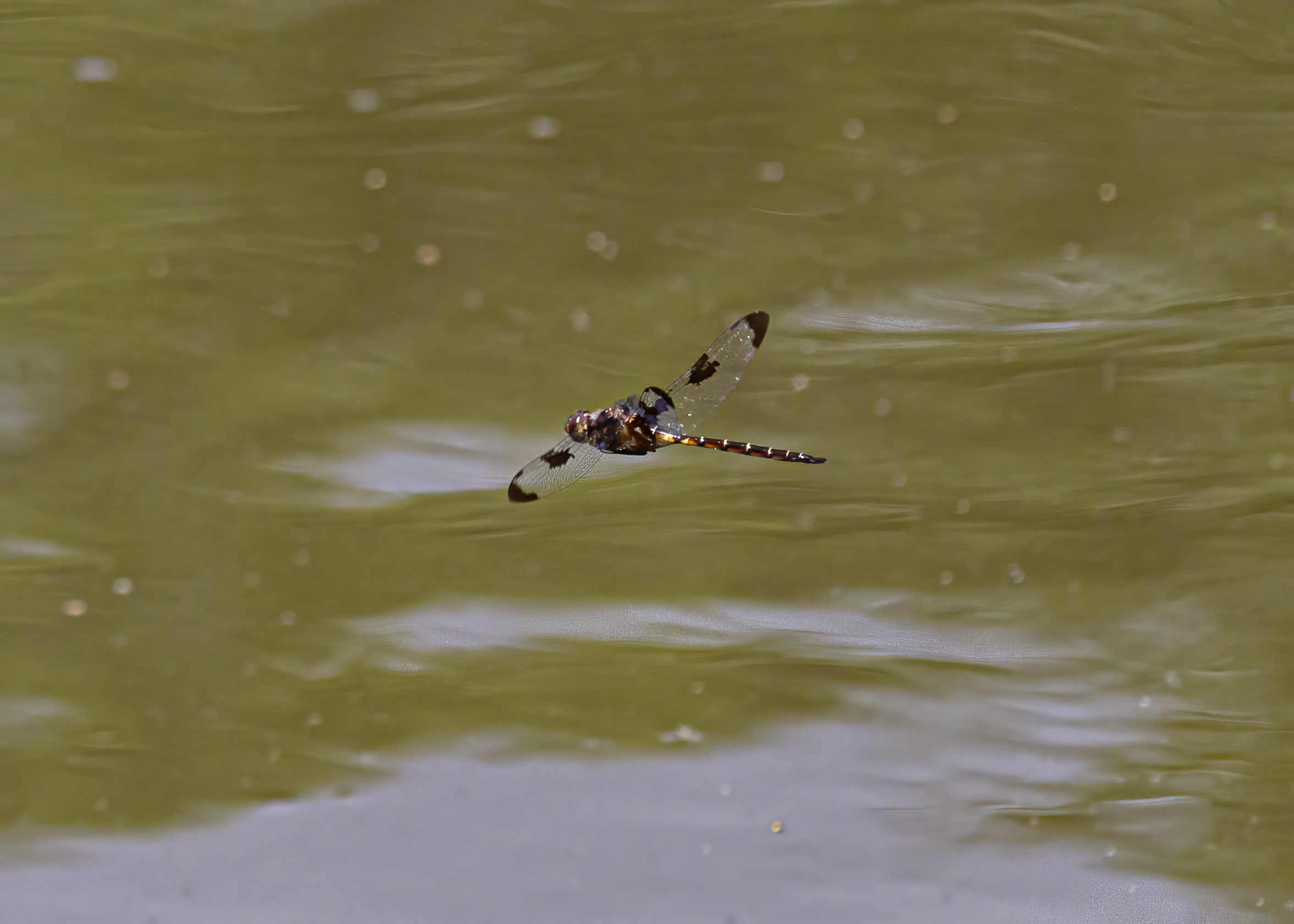
If you want a really lesson in patience, trying photographing dragonflies in flight. Yesterday I spent several hours trying to capture images of Prince Baskettail dragonflies (Epitheca princeps) as they conducted long, low patrols over a small pond at Jackson Miles Abbott Wetlands Refuge in Fort Belvoir, Virginia.

The Prince Baskettails didn’t always follow the same flight paths and their changes in flight direction often were unpredictable, but they kept coming back, giving me lots of chances to attempt to get shots. With some species you can wait for the flying dragonflies to take a break and perch for a moment or two, but Prince Baskettails have amazing stamina—I have never seen one stationary.

There are a number of different approaches to capturing in-flight images. Some folks like to pre-focus on a zone and wait until the dragonfly comes into that area. I like to acquire my target with my naked eye as it approaches and then track it through the camera’s viewfinder for as long as I can. The biggest problem is acquiring focus.  My preferred lens for shooting dragonflies is my trusty Tamron 180mm macro lens. Its focal length lets me use it as both a telephoto and a macro lens, but it is somewhat slow in focusing, so I ended up with lots of blurry shots.

However, I was able to capture some shots that were in focus, including this image that shows the amazing eyes and beautiful markings of this spectacular dragonfly. It’s probably my imagination, but the dragonfly in the photo almost seemed to be glancing in my direction as it flew by and giving me a little smile.

Prince Baskettail

© Michael Q. Powell. All rights reserved.


Read Full Post »