Feeds:
Posts
Comments

Posts Tagged ‘Picoides pubescens’

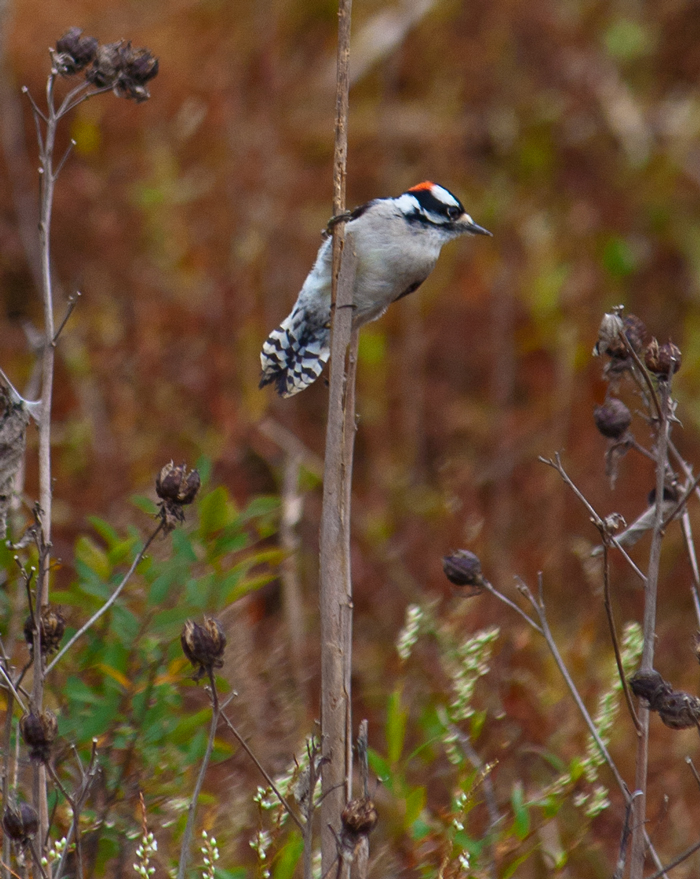
At the edge of a cattail patch, this male Downy Woodpecker (Picoides pubescens) was pecking away at the branches of a small tree, moving upward until he had reached the tip of the branch. For a short moment, he took a break from his work and turned his head to the side, which let me take a nice profile shot.

Perhaps he was searching for the next plant to peck, maybe the cattail in the distance.

downy1_blog

© Michael Q. Powell. All rights reserved

Read Full Post »

Borrowing a longer telephoto lens earlier this week,  I was able to get some shots of the tiny birds that I often see, but rarely am able to photograph.

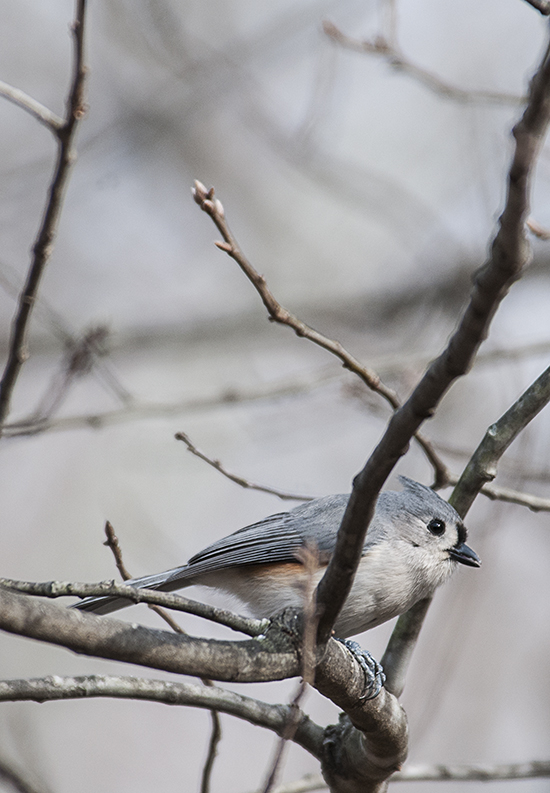
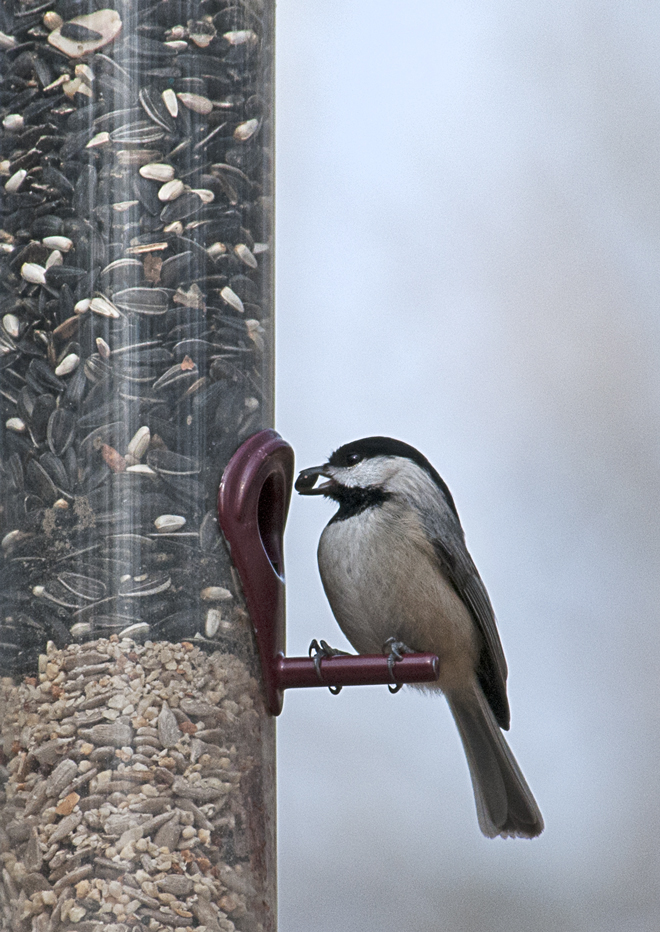
On Monday, my photography mentor, Cindy Dyer, lent me a Nikon D300 with a Nikon 80-400mm lens. It was a lot of fun to experiment with a much longer telephoto than I am accustomed to using. We spent only a limited time at a local nature center, so I did not have a chance to photograph anything too exotic, but I did get some shots of a Downy Woodpecker (Picoides pubescens), a Black-capped Chickadee (Poecile atricapillus),  and a Tufted Titmouse (Baeolophus bicolor).

The background in the first image really grabbed my attention when I pulled up the image on the computer—the tree branches look an awful lot like a suspension bridge.

I included the blurry final image of the chickadee flying away just for fun. I get this kind of image on a regular basis, although usually the bird is out of the frame. The Nikon I was using has a much higher frame rate (up to 7 images a second) than my Canon (a more modest three frames a second), so the chickadee is still in the frame.

I am pretty sure that I will stick with Canon and not switch to Nikon, but, as fellow blogger Lyle Krahn predicted, I am starting to hear the siren call of a longer lens.

Downy Woodpecker lorez

Chickadee 2 lorezTuftedTitmouse lorez

feeder_blogBlurryBird lorez

© Michael Q. Powell. All rights reserved

Read Full Post »

Do your find yourself shooting the same subjects over and over, hoping that you will find the perfect combination of lighting, pose, and background? That is certainly the case for me when it comes to photographing birds. It is both frustrating and challenging to realize that the only variables over which I have any control are me and my trusty camera. I can try to creep closer to birds or adjust the exposure and composition, but luck and perseverance are the overwhelmingly dominant factors in achieving success, however you choose to definite it.

Walking along a path at my local marshland park this past Friday, I heard the now-familiar tap-tap of a woodpecker. I looked up and saw a male Downy Woodpecker (Picoides pubescens) at work in the upper branches of a tree. Instantly I knew I had a chance for a pretty good shot, because the lighting was good, the view was uncluttered,  and the sky was blue in the background. The woodpecker was persistent as he moved along the branch and so was I, snapping away with my head bent back at an uncomfortable angle.

Downy Woodpecker portrait

How did I do? Well, you can judge for yourself, but I think that this is about as close to perfection as I can achieve with my current skills and equipment. The elements fell into place and I managed to take an image with which I am pretty happy, a nice portrait of a Downy Woodpecker.

© Michael Q. Powell. All rights reserved

Read Full Post »

Downy Woodpeckers (Picoides pubescens) are so small and light that they can perch almost anywhere. I was little surprised, however, when I looked down into the water of the marsh and saw a Downy Woodpecker on a very small piece of wood that was jutting out just a little above the surface of the water. I had never before seen a woodpecker that close to water level.

Downy Woodpecker just above the marsh water

The branch was small, just big enough for him to relax, but the woodpecker was not there to rest—he was there to work. There doesn’t seem like there is much room for him to maneuver, but somehow he got into position and was soon hammering away at that little piece of wood. I was concerned that the vibration might loosen the branch and cause him to tumble into the water, but that didn’t happen.

No piece of wood is too small

I guess that if you are a small woodpecker, almost any piece of wood is fair game—size does not matter.

© Michael Q. Powell. All rights reserved.

Read Full Post »

Some birds seem to enjoy relaxing and posing and showing off their beauty, embodying a carefree approach to life. Woodpeckers, on the other hand, seem to be serious and focused, with a look of sheer determination in their eyes. It’s the same look that I see in so many of the people here in the Washington D.C. area, so driven in their professional lives that they are in danger of losing their identities apart from work.

Today, I photographed this Downy Woodpecker (Picoides pubescens) as he was preparing himself for work. Look deeply into his eye and what to you see? (Click on the photo to see more details.) The dead tree seems huge in comparison to this tiny bird. Yet he seems determined, determined to beat his head repeatedly against that wood, determined to find the food that he hopes and believes may be hidden inside.

Determined Downy Woodpecker


Do you ever feel like this woodpecker?

© Michael Q. Powell. All rights reserved.

Read Full Post »

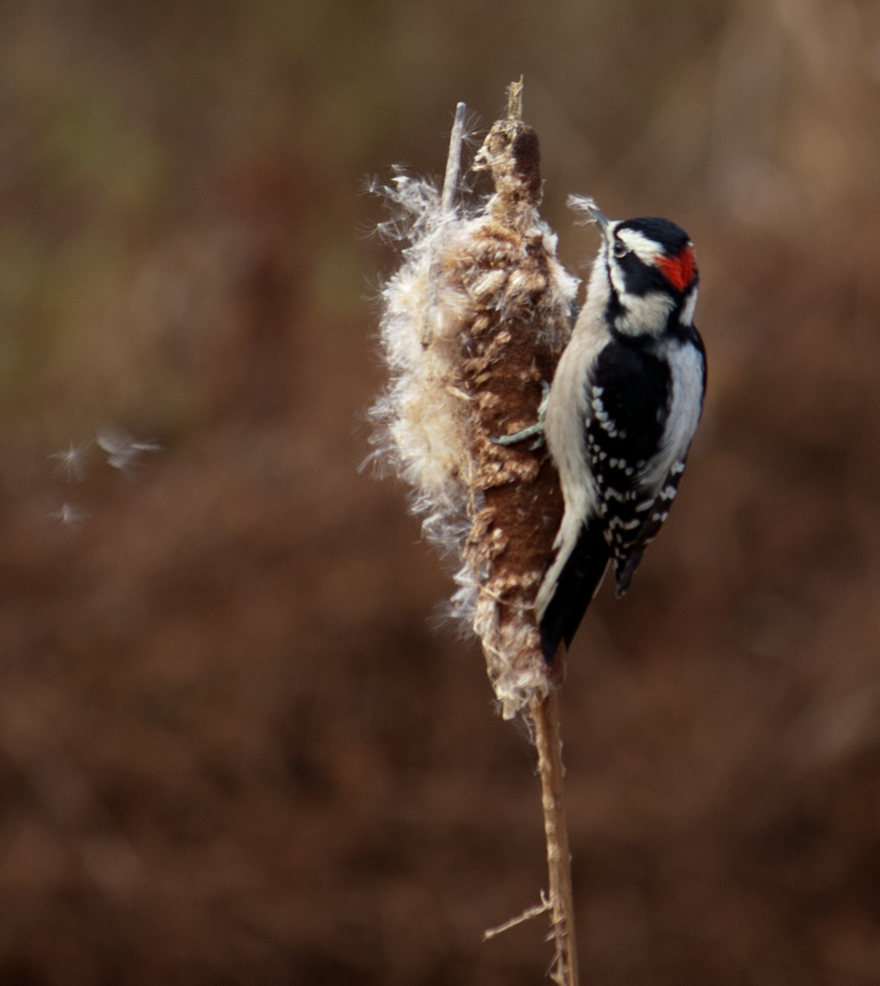
If I were a woodpecker, I would want to be a male Downy woodpecker (Picoides pubescens) and slam my head into something soft as a pillow—like this cattail—and not always into solid wood. Of course, you can end up with a mouthful of cattail fibers, and not just a tasty bug.

Downy woodpecker with mouthful of cattail

Downy woodpecker on cattail

More seriously, scientists are doing research to figure out why woodpeckers don’t end up with concussions, given that they can slam their heads into wood with the force of 1,000 times that of gravity, according to an article on livescience.com. By comparison, humans can survive a force of up to G’s, according to Air Force research, though there are reports of race car drivers surviving a force of over 100 G’s. According to the article, Chinese researchers are studying the microscopic structure of the bones surrounding the brain and also the beak to try to understand how the woodpecker’s brain is protected. If you are interested in the research, an article on a website called Inkfish explains in layman’s terms the research methodology and some of the preliminary conclusions.

© Michael Q. Powell. All rights reserved.

Read Full Post »

This weekend I learned some new things about woodpeckers. I always thought that woodpeckers were found exclusively in the trees. Isn’t it logical that woodpeckers need wood to peck? (It reminds me of the response attributed to Willie Sutton on why he robbed banks—”Because that’s where the money is.”) Well, I saw a woodpecker pecking at the stalks of cattails and other similar vegetation that clearly were not made of solid wood.

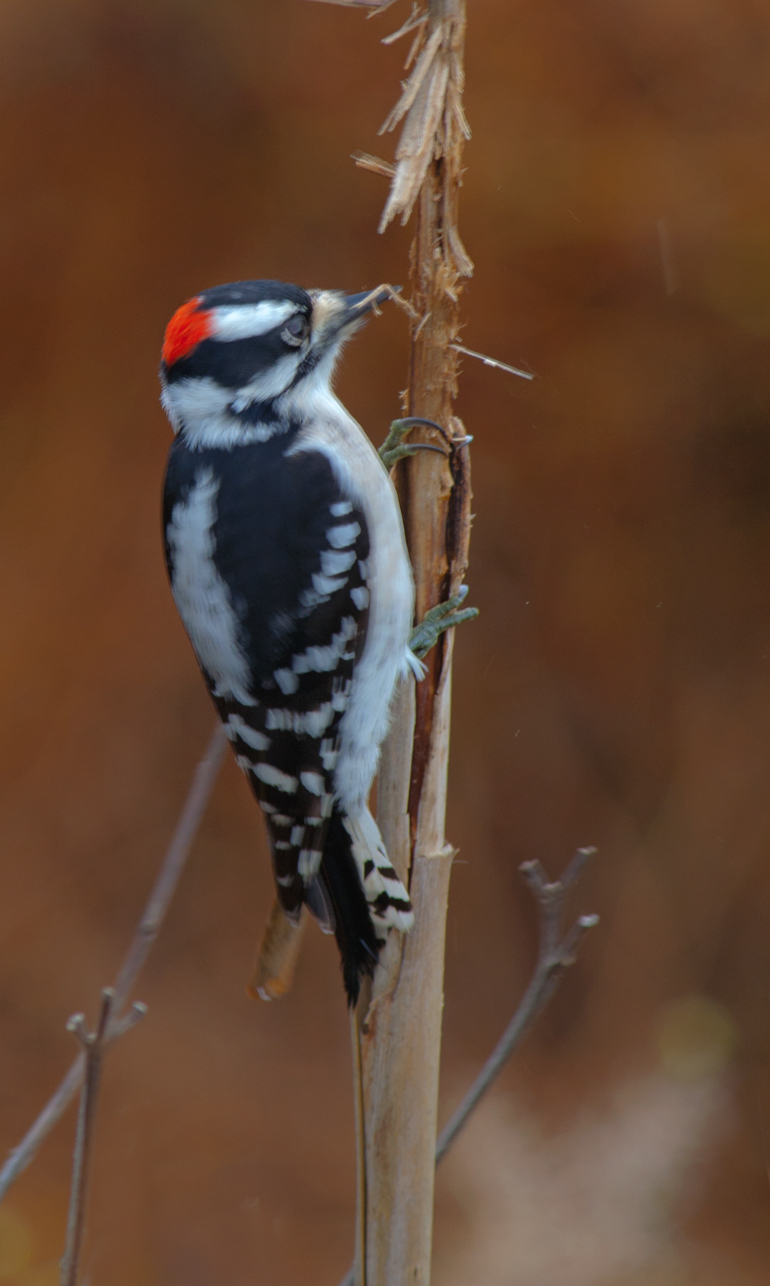
Secondly I learned that the woodpecker that had a big red spot on the back of his head was not a Red-Headed Woodpecker. Fortunately, it was not too hard to determine that the little woodpecker that I saw and photographed was a male Downy Woodpecker (Picoides pubescens). He was very active climbing up and down the stalks of a whole series of plants in the middle of a marsh and was a lot of fun to watch.

Here are a couple of photos of that beautiful bird. I am not sure that I did full justice to the blazing red color on his head that initially attracted my attention or to the wonderful black and white pattern of his feathers. I hope that I have another chance soon to see more woodpeckers and learn even more new things about them.

Male Downy Woodpecker in the field

Downy Woodpecker looks to the side

© Michael Q. Powell. All rights reserved.

Read Full Post »

« Newer Posts