Feeds:
Posts
Comments

Posts Tagged ‘Phyciodes tharos’

It’s always fun to see how different certain butterflies look with their wings open vice closed, like this pretty little Pearl Crescent butterfly (Phyciodes tharos) that I photographed last week at Occoquan Bay National Wildlife Refuge. Most of the time when I see Pearl Crescents, their wings are mostly or fully open, so it was really nice to see one with its wings closed long enough for me to get a shot of it.

Pearl Crescent

Pearl Crescent

© Michael Q. Powell. All rights reserved.

Read Full Post »

Happy Easter to friends and family who are celebrating today. This past week has been a whirlwind of activity and services for me at my church as we have commemorated Christ’s last days, beginning with his entry into Jerusalem on Palm Sunday, through his last supper, and finally his crucifixion and burial. Today we celebrate Jesus’s triumph over death with a joyous Easter service.

I photographed this beautiful little Pearl Crescent butterfly (Phyciodes tharos) during a recent visit to Occoquan Bay National Wildlife Refuge. Butterflies have always been special for me as symbols of the amazing transformations that can take place in this world, even when the situation seems hopeless and sad.

I offer my prayers for all of you, believers and non-believers alike, that your lives will be full of joy, hope, and peace.

Christ is risen!

Pearl Crescent

© Michael Q. Powell. All rights reserved.

Read Full Post »

Pearl Crescent butterflies (Phyciodes tharos) are quite common in my area, but they are small and skittish and often feed with their wings partially open, so it is hard to get a photo of one with its wings spread wide. Last week I spotted several Pearl Crescents in a large patch of Black-eyed Susans at Jackson Miles Abbott Wetland Refuge and I stalked them for quite some time. I was delighted when I finally managed to capture this image that shows wonderfully the beautiful details of this little butterfly.

Pearl Crescent

© Michael Q. Powell. All rights reserved.

Read Full Post »

July is finally coming to an end, a month of endless hot, hazy, and humid days. It has been tough to get myself motivated to go out with my camera and I have been forced to keep my outings relatively short. Weather-wise autumn is my favorite time of the year, but we have a lot more summer weather to endure before the cooling temperatures of autumn arrive.

During a recent visit to Jackson Miles Abbott Wetland Refuge I was delighted to spot this Pearl Crescent butterfly (Phyciodes tharos). It was feeding in a patch of what looked to be Black-eyed Susan flowers (Rudbeckia hirta), although I must confess that I am not very good at identifying flowers, so my identification may not be accurate.

Initially the little butterfly perched with its wings only partially open, but I waited patiently and eventually it fully extended its wings and I was able to capture this image. It is a relatively simple composition, but I really like the way that it gives you a sense of the environment while also showing you the beautiful markings of the Pearl Crescent butterfly.

pearl crescent

© Michael Q. Powell. All rights reserved.


Read Full Post »

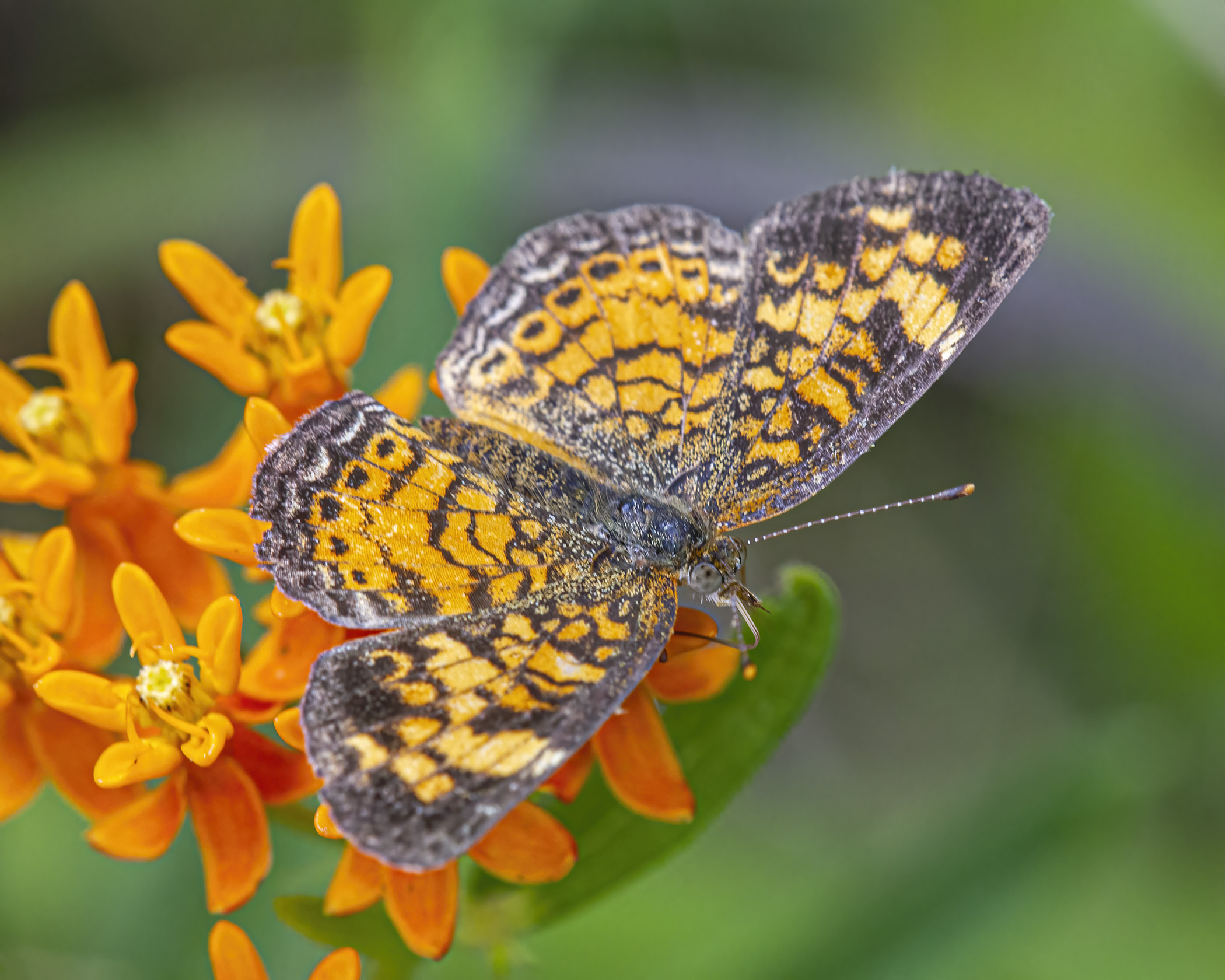
It is always a joy to see butterfly weed (Asclepias tuberosa), a bright orange species of milkweed that is full of nectar and attracts lots of butterflies. On Monday I spotted what I believe is a Pearl Crescent butterfly (Phyciodes tharos) feeding on some butterfly weed at Huntley Meadows Park in Alexandria, Virginia. I spotted some regular milkweed earlier in the day and was hoping to see my first Monarch butterfly of the season, but, alas, I came up empty-handed this time.

I love bright colors and some of you may recall that I drive an Ignition Orange KIA Soul. I was delighted to be able to capture some of the beautiful details and color of the butterfly weed and also some details of the butterfly, including its striking eyes and extended proboscis.

Pearl Crescent

© Michael Q. Powell. All rights reserved.

Read Full Post »

Tuesday was a wonderful day for butterflies at Occoquan Bay National Wildlife Refuge and I was delighted to see lots of them, including the three orange varieties that I am featuring today. First up is a pretty Monarch butterfly (Danaus plexippus). Although its wings show some damage, it was happily feeding on some milkweed. Recent reports have shown that Monarchs are endangered, so it is always exciting to spot one.

The next photo shows a Viceroy butterfly (Limenitis archippus), which is visually quite similar to the Monarch. As I have noted before, the biggest distinguishing feature to tell the two species apart is the line on the hind wing of the Viceroys that Monarchs do not have.

The final orange butterfly is the much smaller Pearl Crescent butterfly (Phyciodes tharos). I see Pearl Crescent butterflies much more often than its larger counterparts, but they are usually quite skittish and perch so close to the ground that it is a challenge to photograph them.

Many of you know that I really like the color orange. I frequently wear a pair of orange Converse All-star sneakers and drive the orange KIA Soul that made a guest appearance in a recent blog post. For me, the color is warm and comfortable. Although it is often associated with the autumn, orange is very much a summer color too, as you can easily see in these butterfly photos.

Monarch

Viceroy

Pearl Crescent

© Michael Q. Powell. All rights reserved.


Read Full Post »

Normally I try to do a posting to my blog every day, but for the next three weeks my posting schedule will be much more erratic. I am in the final stages of packing my car for a trip to visit my son and his family outside of Seattle, Washington. There are multiple decision points along the way and I have not yet decided on my final route, but no matter how I go, it is likely to be about 3,000 miles (4828 km) each way.

I have some camping gear with me, including a water jug that holds six gallon (23 liter), so I may well be spending some time disconnected from the virtual world. I’ll try to take some photos along the way and will share them when I am able.

I am leaving you with a shot of a pretty little butterfly, which I think is a Pearl Crescent (Phyciodes tharos) perched on some Butterfly Weed (Asclepias tuberosa). I love the different shades of orange in the image.

In case some of you do not know it, my KIA Soul, in which I am driving out West, is orange in color. It is a coppery orange and not a pumpkin orange and it definitely stands out in a parking lot. My license plate holder has SOUL on it and my license plate itself is “BLESS MY.”

I am attaching a couple of photos of my car from January 2016, after a big snow storm. So many of us throughout the Northern Hemisphere are suffering from oppressive heat and I thought that the sight of snow might cool us off a little. I’ll close with a joke that I say on-line today that is a perfect fit for my quirky sense of humor—”Just be thankful that it is not snowing. Imagine shoveling snow in this heat!”

KIA Soul

KIA Soul

© Michael Q. Powell. All rights reserved.


Read Full Post »

Beauty can often be found in small things in ordinary situations. On Thursday I captured this image of a beautiful Pearl Crescent butterfly (Phyciodes tharos) feeding on a dandelion while I was exploring in Prince William County with fellow dragonfly enthusiast Walter Sanford. Although we were focused on searching for dragonflies, most of you know that I am an opportunistic photographer and will take a photo of almost anything that catches my eye.

I am not completely certain about the identification of this butterfly—I have trouble distinguishing between a Silvery Checkerspot butterfly (Chlosyne nycteis) and a Pearl Crescent butterfly. In fact, I am not really sure if this is a dandelion or one of a number of small flowers that are similar in appearance.

The funny thing is, though, that I am totally unconcerned about the accuracy of my identification in this case. This image is more about art than it is about science. It is about light and color and patterns and details. I encourage you to click on the image and immerse yourself in the enlarged image. You will be amazed to see the speckles in the butterfly’s eyes and the flecks of pollen on its extended proboscis.

Beauty can often be found in small things in ordinary situations.

Pearl Crescent

© Michael Q. Powell. All rights reserved.

Read Full Post »

It is now rare for me to spot an insect when I am walking about in nature with my camera. There is still a chance that I might spot a dragonfly—a few Autumn Meadowhawks are normally around in late November—or maybe a butterfly. I held off posting this image of a butterfly that I spotted a couple of weeks ago at Occoquan Bay National Wildlife Refuge in the hope that I would continue to see more.

Now I accept the distinct possibility that this beautiful little Pearl Crescent butterfly (Phyciodes tharos) may be the last butterfly of the season for me. Fortunately there will be new photographic opportunities for me in the coming months as I turn my attention and my long telephoto zoom lens almost exclusively to birds.

Pearl Crescent butterfly

© Michael Q. Powell. All rights reserved.

Read Full Post »

There were so many butterflies concentrated in a small patch of swamp milkweed (Asclepias incarnata) that they looked like a bouquet of orange flowers when I first spotted them on Tuesday at Jackson Miles Abbott Wetland Refuge. I believe that they are all Pearl Crescent butterflies (Phyciodes tharos), though there is also a chance that they might be the similar-looking Silvery Checkerspot butterfly (Chlosyne nycteis).

pearl crescent

© Michael Q. Powell. All rights reserved.

Read Full Post »

Last Saturday I spotted this Pearl Crescent butterfly (Phyciodes tharos) on what looks to be a Black-eyed Susan flower (Rudbeckia hirta) at Jackson Miles Abbott Wetland Refuge. Initially the butterfly’s wings were open, which made for an ok shot. When the butterfly partially closed its wings, however, the light coming from the back helped to illuminate one wing like a stained glass window.

It is amazing how a slight change in the position of a subject can radically change the feel of an image—that is one of the reason why I like to shoot in short bursts, hoping to capture a variety of poses in a short period of time.

Pearl Crescent

© Michael Q. Powell. All rights reserved.


Read Full Post »

On Monday I spotted this small patch of Butterfly Weed (Asclepias tuberosa) at Jackson Miles Abbott Wetland Refuge. True to its name, the Butterfly Weed had attracted several butterflies, which I think are Pearl Crescent butterflies (Phyciodes tharos), as well as several metallic green sweat bees (genus Agapostemon). The insects seemed to love the plant’s nectar and the scene provided a visual feast for viewers like me.

butterfly weed

© Michael Q. Powell. All rights reserved.


Read Full Post »
It’s springtime and love is in the air. So many creatures seem to be searching for mates and some of them have obviously found one, like this pair of Pearl Crescent butterflies (Phyciodes tharos) that I spotted in flagrante delicto at Jackson Miles Abbott Wetland Refuge in Northern Virginia this past Friday.

I am no expert in butterfly anatomy and have no idea how this works, but there is a real beauty in the position, which appropriately looks  to me like a double heart. What can I say, I am a romantic at heart.

Pearl Crescent

© Michael Q. Powell. All rights reserved

Read Full Post »

I chased this little orange butterfly through the woods for quite some time this past weekend in an effort to get my first butterfly image of the season, a Pearl Crescent butterfly (Phyciodes tharos). It may not be as big and brightly colored as some of the butterflies that I may encounter later in the season, but I find a real beauty in its minimal color palette and intricate design.

butterfly_may_blog

© Michael Q. Powell. All rights reserved.

Read Full Post »

With thousands of gorgeous flowers blooming at Brookside Gardens in Wheaton, Maryland today, this beautiful butterfly, which I think is a Variegated Fritillary (Euptoieta claudia), chose to land on a lowly dandelion growing at the edge of a walkway. Why did it make that choice?

I had been chasing this butterfly around though several sections of the garden, hoping desperately that it would land somewhere within range of my 100mm macro lens. When it did finally land, I approached it cautiously and got a few shots handheld that came out pretty well. I am also including a shot that gives you an idea of the setting—there was a landscape timber to the left and a series of stone tiles that made up the walkway, and the dandelion was growing low to the ground at the edge of the walkway. The lighting was less than optimal, but sometimes you have to work with what you have, especially when the subject is likely to fly away at any moment.

I deliberated for quite some time over the identification of the butterfly. At first, I was sure that it was a Pearl Crescent (Phyciodes tharos), which is orange and has brown spots. As I looked at more photos, though, I changed my mind and now think that it may be a Variegated Fritillary.

As always, I welcome assistance on the identification of my subjects.

pearl2_blogpearl1_blogpearl3_blogMichael Q. Powell. All rights reserved

Read Full Post »
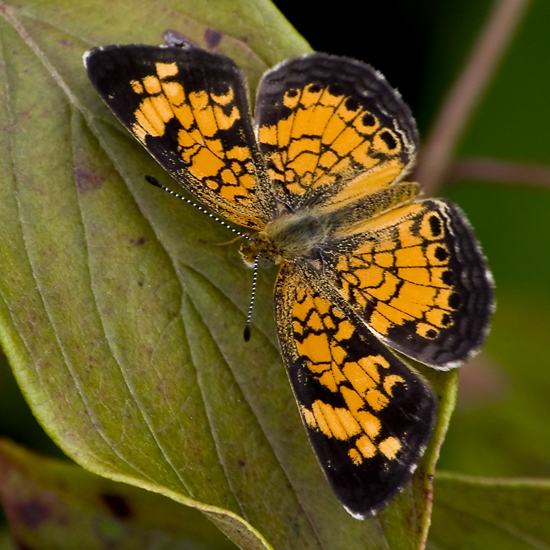
Here are a couple of shots of a Pearl Crescent butterfly (Phyciodes tharos) that I took yesterday at Huntley Meadows Park in Alexandria, Virginia. The Gardens With Wings website cautions that the Pearl Crescent resembles several other butterflies and the patterns of Pearl Crescent butterflies are variable, according to Wikipedia. I apologize in advance, therefore, if I have misidentified this butterfly, but I think we can all agree that he is amazingly beautiful.

© Michael Q. Powell. All rights reserved.

Read Full Post »