Feeds:
Posts
Comments

Posts Tagged ‘Phanogomphus exilis’

I photographed this stunning Lancet Clubtail dragonfly (Phanogomphus exilis) last Monday on a rotten log in the dappled sunlight as I was exploring an area near a creek in Prince William County, Virginia. Of course, I was excited to photograph this dragonfly, but it was actually the interesting lighting and the rough texture of the log that  mainly captured my attention.

Lancet Clubtail

© Michael Q. Powell. All rights reserved.

Read Full Post »

This dragonfly was perched on the ground on Monday at Occoquan Bay National Wildlife Refuge when I spotted it. I knew immediately that it was either a Lancet Clubtail (Phanogomphus exilis) or an Ashy Clubtail (Phanogomphus lividus), but these two species are so similar in appearance that it is tough for me to tell them apart.

I checked my identification guides and realized that I had to look at the dragonfly more closely and get a bit more geeky. The abdomen (the “tail”) of dragonflies  consists of ten segments traditionally numbered S1 through S10, starting from the point at which the thorax (the “chest”) meets the abdomen (S1) and going downward to the tip of the abdomen (S10).

The Dragonflies of Northern Virginia website notes that for Lancet Clubtails there is a “noticeable bright yellow flange on sides of S8 & S9 (male and female), while Ashy has almost no flange, and less bright yellow.” I knew about these differences, but couldn’t see them clearly enough when I was in the field.

The dragonfly was relatively cooperative and I was able to get a shot of it from almost directly overhead. The image is really cluttered, because of the vegetation, and  artistically is not a great photo, but it does provide the kind of details that are helpful for identification.

In the image I saw what appear to be yellow flanges on the sides of S8 and S9  and I could clearly see the appendages at the tip of the abdomen, which helps me identify the gender of the dragonfly. These elements suggested to me that it was a female Lancet Clubtail. I posted a photo in a Facebook group devoted to dragonflies and damselflies in Virginia and was delighted when one of the most experience members there agreed with my identification of this dragonfly.

I don’t expect most of my readers to delve this deeply into dragonfly anatomy, but I figured it might be interesting to learn about what some of the myriad considerations that swirl about in my mind as I seek to photograph and identify these beautiful little creatures. Sometimes I am successful in connecting the dots and coming to a conclusion, but at times the identities of my subjects remains a mystery.

Lancet Clubtail

© Michael Q. Powell. All rights reserved.


Read Full Post »

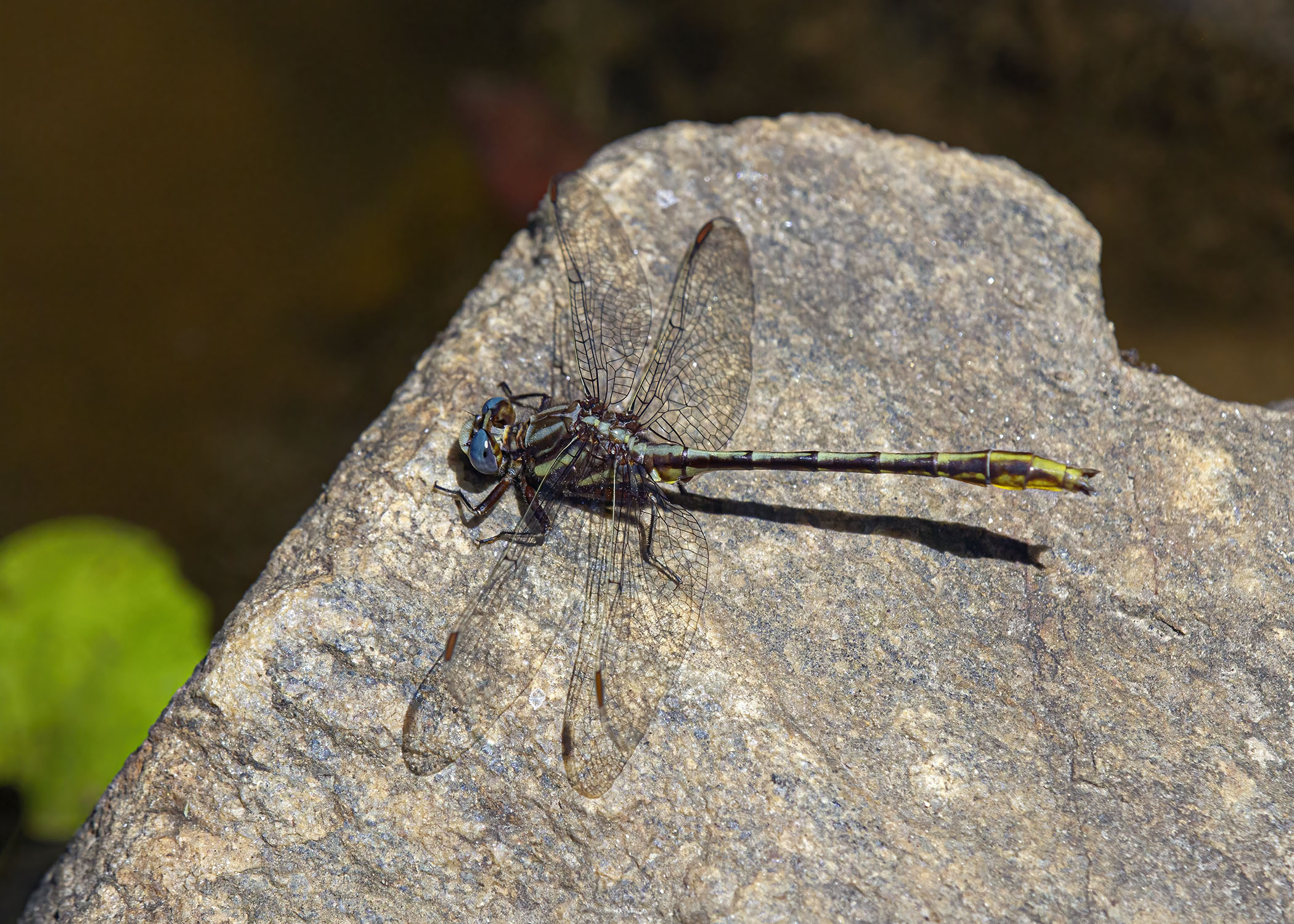
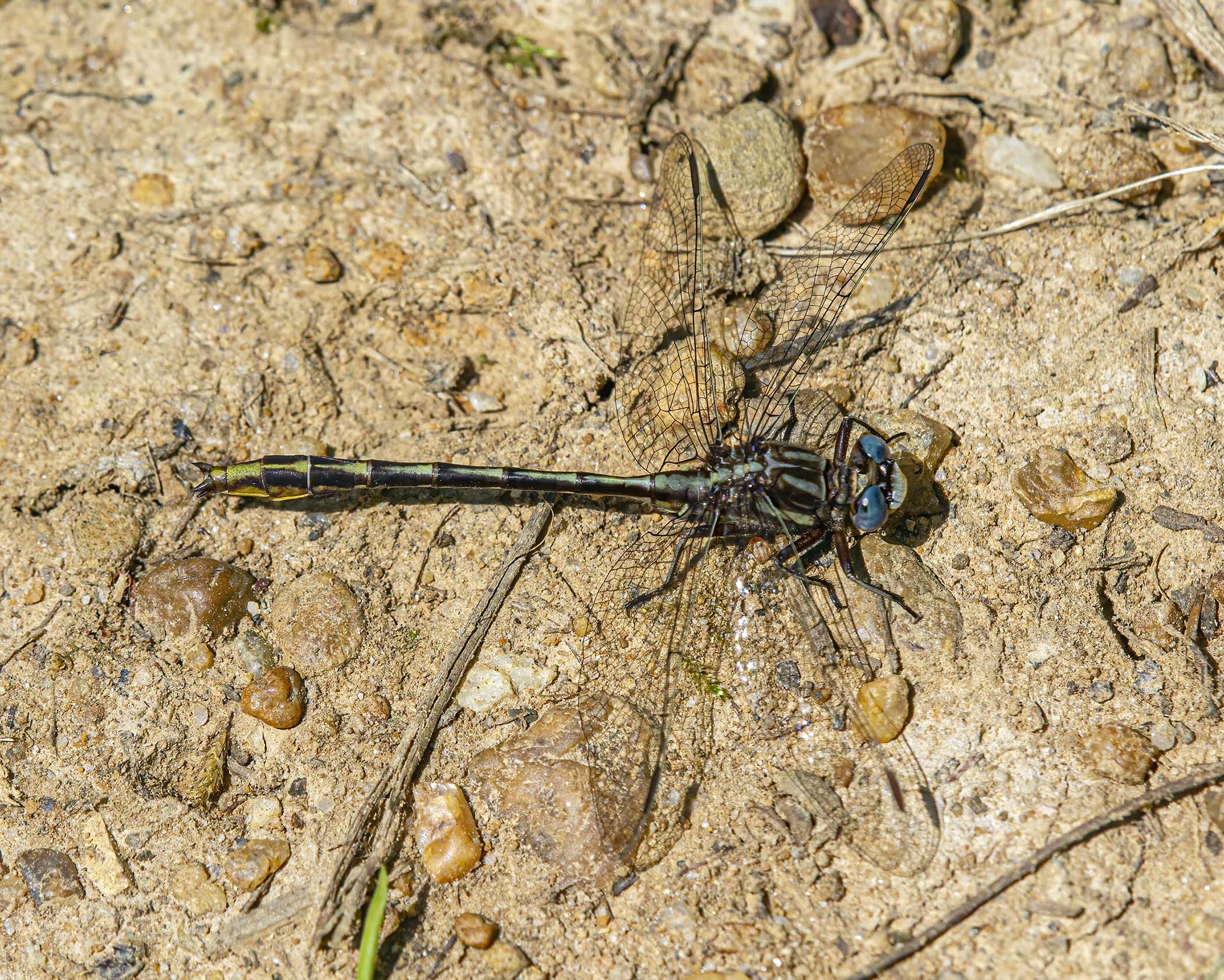
I was delighted to spot several handsome Lancet Clubtail dragonflies (Phanogomphus exilis) during a recent visit to Jackson Miles Abbott Wetland Refuge, my first sightings of this species this season. As you can see from these two photos, Lancet Clubtails like to perch flat on the ground and I spotted both of these near the edge of the pond.

I love the bright blue eyes of Lancet Clubtails and the yellow flange near the tip of the abdomen, a feature that helps to distinguish Lancet Clubtails from the visually-similar Ashy Clubtails. Some members of the Clubtail family have large and obvious “clubtails,” but the one on the male Lancet Clubtails is relatively small—you have to look at the proper angle to see it well. I like the way that the shadow in the first photo makes it easy to see the enlarged area near the end of abdomen that constitutes the “clubtail.”

Lancet Clubtail

Lancet Clubtail

© Michael Q. Powell. All rights reserved.

Read Full Post »

I was delighted to spot this female Lancet Clubtail dragonfly (Phanogomphus exilis) on Thursday in Prince William County, the first member of this species that I have seen this season. She seemed to be glancing upwards at me as she smiled and posed for me.

When I was doing some research on this species, I got a little confused, because sometimes the Latin name for the species was given as Phanogomphus exilis and sometimes as Gomphus exilis. As far as I can understand it, the Lancet Clubtail used to be included in Gomphus genus. However, according to Wikipedia, “As a result of phylogenetic studies, Gomphus subgenera Gomphurus, Hylogomphus, Phanogomphus, and Stenogomphus were elevated in rank to genus in 2017. With the removal of their member species, Gomphus ended up with 11 of its previous 54 species, none of which are found in the Western Hemisphere.” Yikes!

Lancet Clubtail

Lancet Clubtail

© Michael Q. Powell. All rights reserved.

Read Full Post »

Eye contact and posture are often key factors when trying to assess the attitude of another person we encounter. Is the same true for dragonflies? I am certainly guilty of anthropomorphism when I attribute human emotions and other traits to my little flying friends, but I often cannot help but do so—it is fun to let my imagination run free.

I grew up watching cowboy movies and one of the traditions of these movies was a showdown, often at high noon, at which two gunfighters face off for a climactic formal duel. I spotted the first male Lancet Clubtail dragonfly (Phanogomphus exilis) on Tuesday in the rocks on the banks of a stream in Prince William County. The small dragonfly did not seem to be afraid of me at all and in fact his whole attitude and direct stare seemed almost confrontational, like he was challenging me to a gunfight.

The male Lancet Clubtail in the nearby vegetation, by contrast, seemed shy and demure, glancing at me only out of the corner of his eyes. Perhaps he was hoping that I would simply go away, but he did not want to push the issue and definitely seemed to be avoiding a direct confrontation.

Who knows what goes on in the minds of dragonflies and other wild creatures? Whenever I look at the massive compound eyes of a dragonfly, I am acutely aware that they perceive the world in a way that is radically different from the way that I do. My mind threatens to explode when I try to imagine what it would be like have that kind of sensory input. Sometimes I try to interpret their behavior in human terms, but most often I simply gaze at them with awe and wonder, marveling at their beauty and extraordinary capabilities.

Lancet Clubtail

Lancet Clubtail

© Michael Q. Powell. All rights reserved.


Read Full Post »

I was happy on Tuesday to spot this male Lancet Clubtail dragonfly (Phanogomphus exilis) perched in the vegetation overhanging the small pond at Jackson Miles Abbott Wetland Refuge. I would like to have gotten a closer shot, but the bank was steep and the water in the pond appears to be deep at that spot. Staying dry, I was content to capture this environmental portrait of the handsome little dragonfly with such striking blue eyes.

lancet clubtail

© Michael Q. Powell. All rights reserved.

Read Full Post »

What’s your strategy for beating the heat? One of the favorite approaches here in the Washington D.C. area is to stay indoors with the air conditioning cranked up. For a wildlife photographer, though, that is not really an option. My subjects manage to survive in the heat of the day and I need to be other there if I want to photograph them.

Birds seem to be most active early in the day and late in the day, when temperatures are usually coolest, but many dragonflies seem to thrive in bright, direct sunlight. How do they do it? How do they regulate their body temperatures?

If you have ever observed dragonflies on a hot summer day, you may have seen some of them perching in a hand-stand like position, like an Olympic gymnast. This is often referred to as the obelisk posture. The abdomen is raised to minimize the surface area exposed to the sun and when the sun is close to directly overhead, the vertical alignment of the dragonfly’s body suggests an obelisk, like the Washington Monument that I see every time that I venture into the city.

Here are a couple of shots of a Lancet Clubtail dragonfly (Gomphus exilis) that I spotted this past Monday at Jackson Miles Wetland Refuge, only a few miles from where I live. Unlike some clubtail dragonflies, like the Dragonhunter that I featured recently, the Lancet Clubtail is pretty small, about 1.7 inches (43 mm) in length. What I find to be particularly stunning about this dragonfly are its deep blue eyes, which seemed to draw me in.

Initially the dragonfly had its abdomen at an angle, but gradually it kept raising it higher until it ended up in an almost perfect obelisk pose. If I were a judge at the Olympics, I would give this dragonfly a perfect score of 10.

Lancet Clubtail

Lancet Clubtail

© Michael Q. Powell. All rights reserved.

Read Full Post »