Feeds:
Posts
Comments

Posts Tagged ‘Pachydiplax longipennis’

How can you photographing a dragonfly while it is flying? As we have moved into dragonfly season, I have been thinking a lot about that question and earlier this week, I had some success in getting images of a female Blue Dasher dragonfly that I believe was ovipositing.
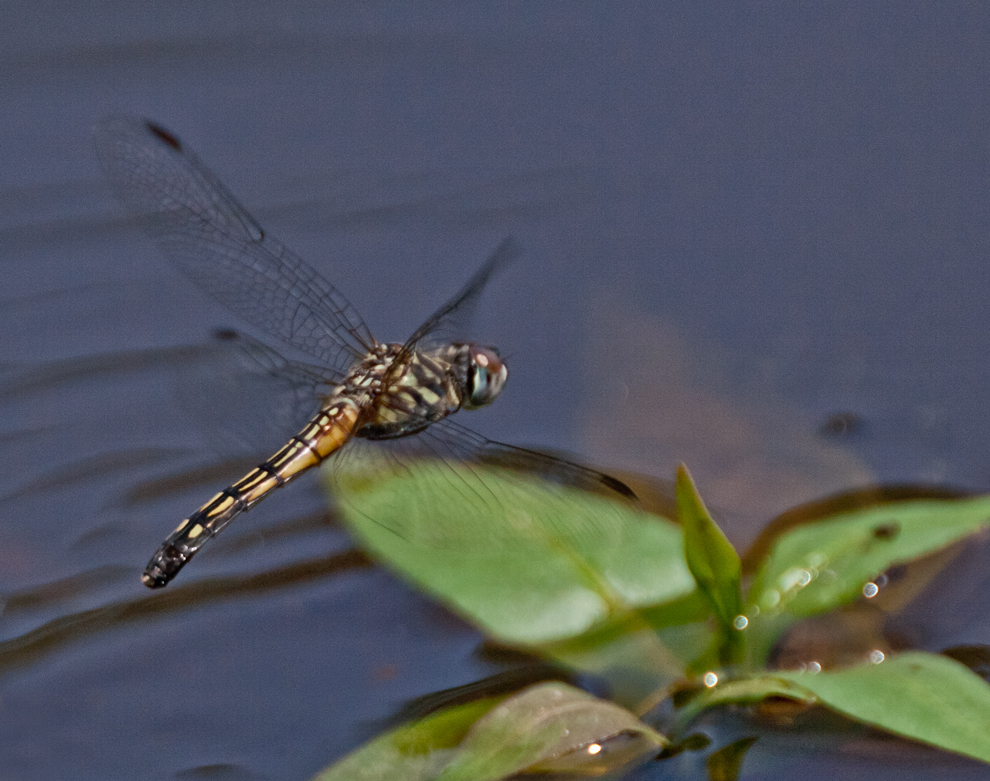
female_dasher2_blog

Last year, I was content to photograph perched dragonflies (and still love to do so) and occasionally would capture one as it was leaving a perch. This year I am challenging myself and am actively seeking out opportunities to follow dragonflies with my lens and, if possible, to catch them in motion. They are so agile in flight, that the challenge is somewhat daunting. I have experimented with auto focusing and manual focusing. I have tried pre-focusing on an area and waiting and hoping a dragonfly would fly into it. I have had my best luck so far when I can catch the dragonfly as it is hovering.

This female Blue Dasher dragonfly (Pachydiplax longipennis) approached this little clump of vegetation several times and would begin to hover. Then she would bend her tail forward and move it rapidly back-and-forth for a few seconds, which I think meant that she was laying eggs.
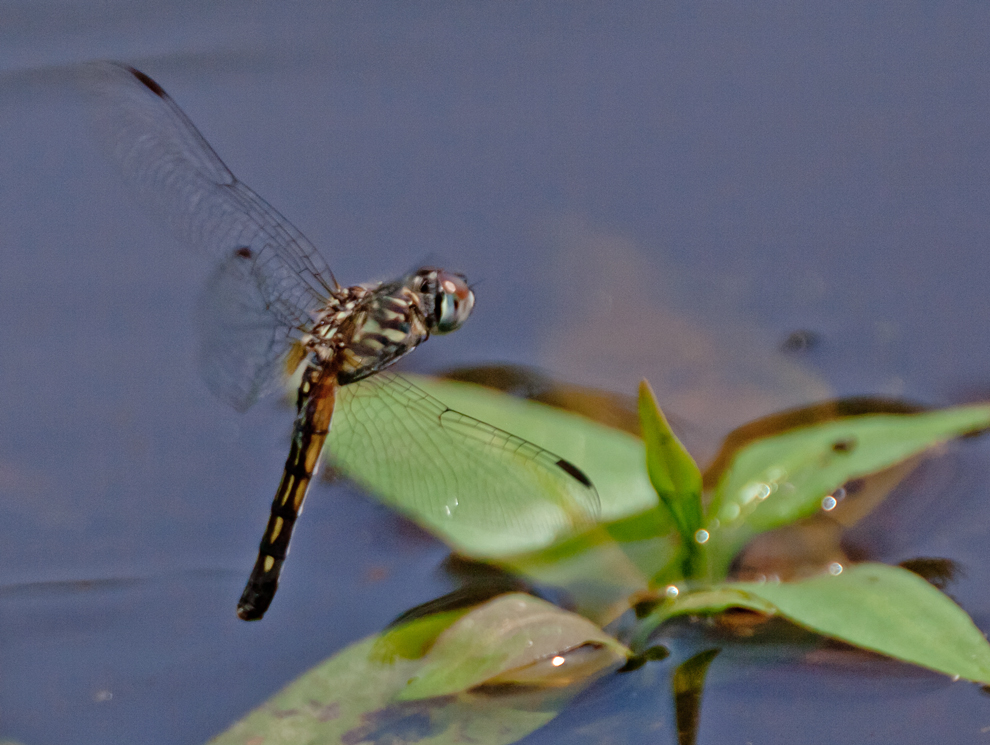
female_dasher1_blog

I am definitely not an expert on dragonfly behavior and may be totally wrong about what she was doing. However, from a purely photographic point of view, this offered my best chance of getting some shots of this dragonfly in flight. As I recall, I got my best shots when focusing manually and snapping as many shots as I could when it looked like things were coming into focus.

female_dasher3_blog

The Blue Dasher female (and you’ve probably noticed that the females of this species are not blue, despite their name) flew away and returned several times, but eventually was done with her business. I am continuing to observe the different species of dragonflies and hope to identify the types of behavior they exhibit that will maximize the chance of me getting some more shots like these ones.

Michael Q. Powell. All rights reserved
Read Full Post »

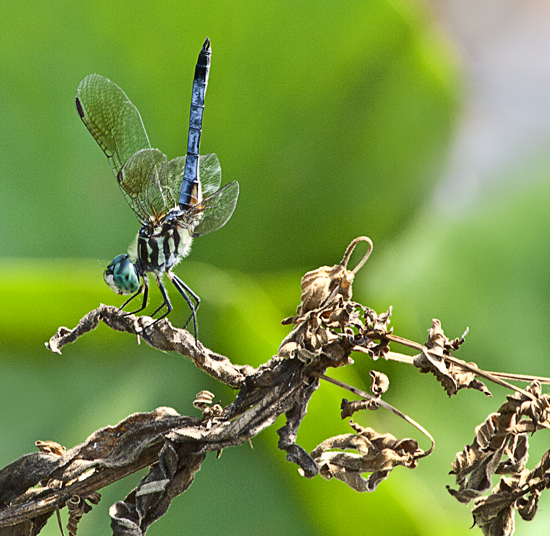
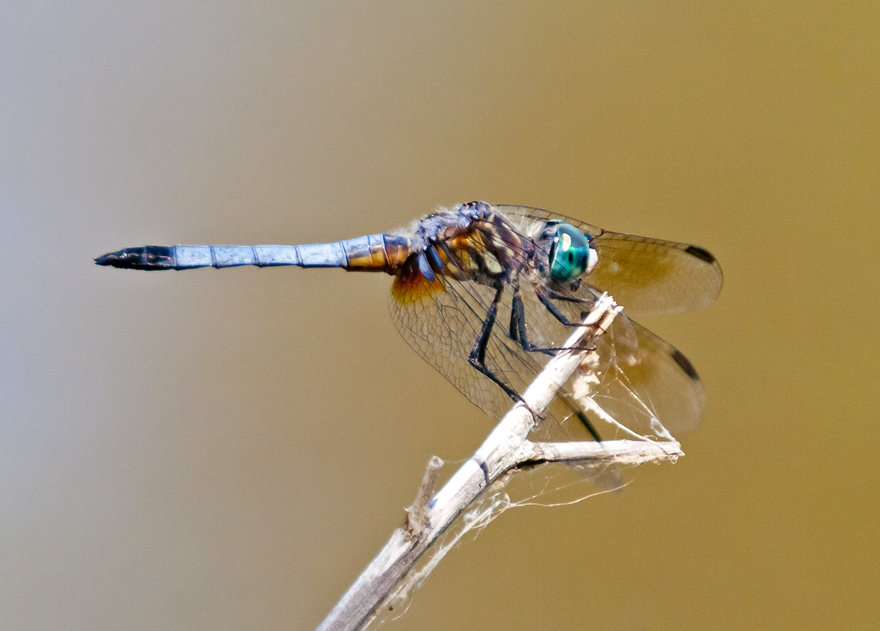
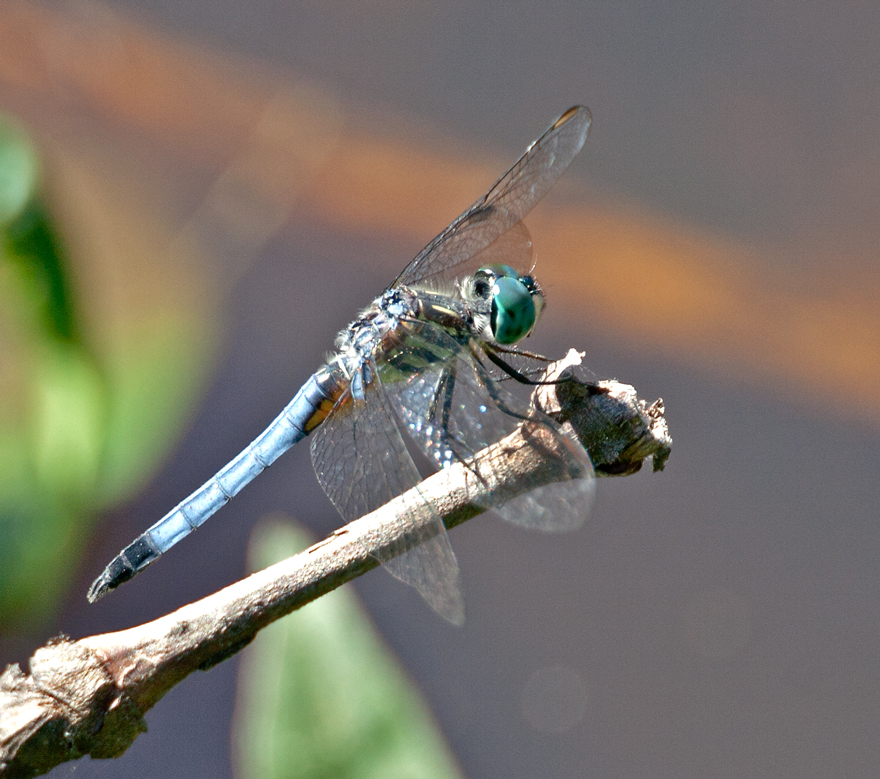
Last summer, my favorite photographic subject was the Blue Dasher dragonfly (Pachydiplax longipennis) and I was really excited on Friday to see that they are once again present at my local marshland park.

It continues to be a challenge to get close enough to capture the wonderful details of the dragonfly and to manage the background so that it is not too cluttered. I am happy to have gotten a few good images of male Blue Dashers to start the season, with the promise of more shots to come.

dasher1_blogdasher2_blog

Michael Q. Powell. All rights reserved
Read Full Post »

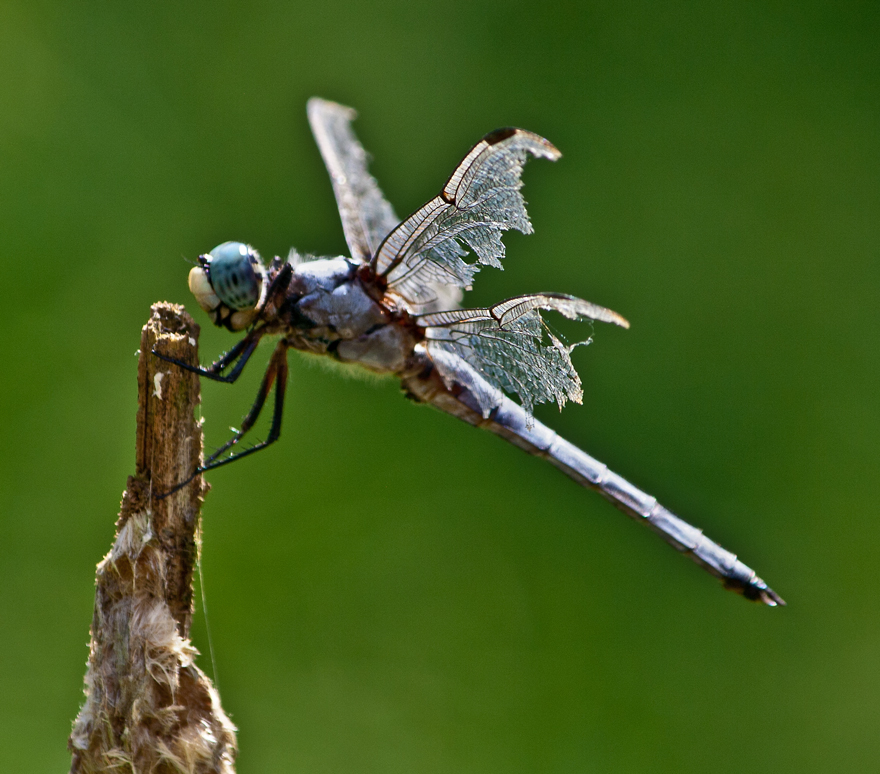
I don’t know if this Blue Dasher dragonfly is long in the tooth (do dragonflies have teeth?) or has simply had a tough life. How do you tell the age of a dragonfly? In any case, his wings are tattered and torn to such a degree that it is surprising that he can still fly. Yet I seem to detect a smile on his face, a reflection of contentment. (Yes, I know, I am guilty of anthropomorphism.)

Tattered wings,but still able to fly

I have been thinking about aging ever since Sunday when I read a wonderful column in the Washington Post by John Kelly entitled “You can learn a lot about growing old from a dog.” Kelly describes how the accelerated aging process of his dog has made him more conscious of the fact that he too is growing old. I recommend the article to all, but want to highlight the final paragraph of the column. Kelly concludes:

“Aging is unknown territory for each of us, despite the fact that humans have been doing it forever. I think there are worse ways to spend your final years than napping next to someone you love, dreaming of what was and what still might be.”

I doubt that this dragonfly will end his final days in peace and contentment like Kelly’s dog, but it is my fervent hope that we can accept the infirmities of growing old with grace and patience, and can focus—as this dragonfly appears to be doing—on the things that we are still able to do, on contributions that can make this world a better place.

© Michael Q. Powell. All rights reserved.

Read Full Post »

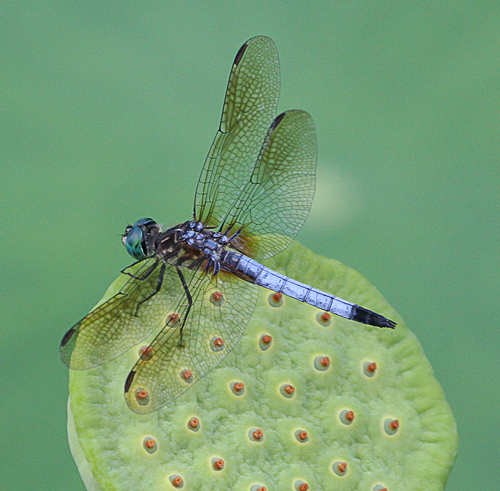
I finally managed to get a shot of a Blue Dasher dragonfly (Pachydiplax longipennis) on a lotus flower bud this past weekend. Previously I had photographed Blue Dashers on various plants and stalks and other things, but I have always thought that it would be especially cool to get on perched on the tip of a lotus bud.

It’s nice sometimes to have your wishes fulfilled and, yes, I think the photo met my expectations.

Blue Dasher dragonfly on lotus bud

© Michael Q. Powell. All rights reserved.

Read Full Post »

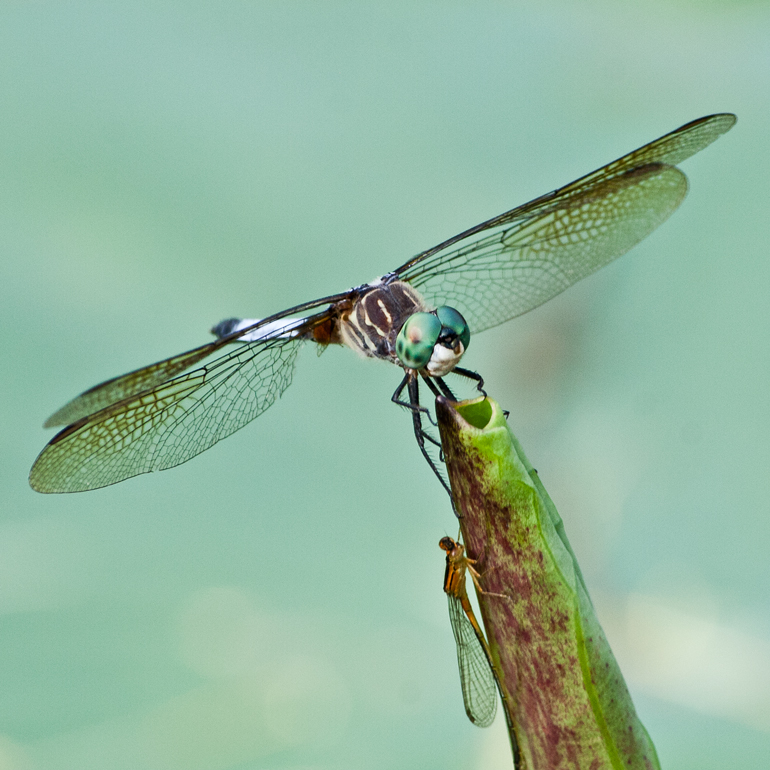
Sometimes when I open my images on my computer I am pleasantly surprised. I was going through my images from yesterday afternoon and came upon this one.

Click on the image for greater resolution and details

I had been focusing on shooting dragonflies that had stopped to pose on various objects. In this case I am certain that I was looking at the Blue Dasher dragonfly (Pachydiplax longipennis) perched on the rolled-up leaf of a lotus plant and never noticed the damselfly in the photo. The damselfly appears to be scaling the leaf, ready to do battle with the dragonfly. The dragonfly seems to be looking down with a little concern, wondering who is trying to challenge his position. When I compare the relative sizes of the two insects, I can’t help but think of the Biblical story of the boy David taking on the giant Goliath. In this case it would essentially be a family feud, since both dragonflies and damselflies are part of the Odonata family.

It’s a lesson to me to check my images carefully when I process them—there may be all kinds of hidden treasures waiting to be discovered.

© Michael Q. Powell. All rights reserved.

Read Full Post »

My friend and photography mentor Cindy Dyer and I went out yesterday to photograph dragonflies at Green Spring Gardens in Alexandria, VA, a local garden that is my favorite place to go when the urge to shoot some photos overwhelms me. We were often taking photos side by side. I was really beneficial for me to watch how Cindy, an experienced professional, approached the  photographic task, what things drew her attention, and the way in which she composed her shots. At one point I even got to put my memory card into her camera, a Nikon D300 with a Tamron 180mm macro lens, and shoot for a while. It was definitely a big change from my Canon Rebel XT with a 55-250mm telephoto with which I was shooting at the time. Her set-up was a lot heavier but had a much brighter, bigger viewfinder, and faster focusing.

We were both excited when one Blue Dasher dragonfly (Pachydiplax longipennis), the most common dragonfly that we saw all day, decided to use a lotus seed pod as his home base. He would periodically fly away, but always seemed to come back to the seed pod. She and I were both able to get shots of this dragonfly against the backdrop of a lotus leaf. The light colored circular object you can see is the center of that leaf. I love the crimped edges of this particular pod—it reminds me of a home-made pie crust.

This photo came out so good that I though it probably had been shot with her camera. However, when I checked out the RAW file information I realized it was from my camera. For those who might wonder about the exposure, it was shot at f11, 1/125 sec, ISO 800, at 163mm of the 55-250mm zoom lens. If you are interested in checking out Cindy’s comparable shot (her’s is even sharper) as well as some other wonderful shots she’s taken of dragonflies the last couple of days, check out her blog postings.

Blue Dasher dragonfly on a lotus seed pod

© Michael Q. Powell. All rights reserved.

Read Full Post »

Four weeks ago today my friend and mentor Cindy Dyer helped me to start this blog. She has been teaching me and encouraging me as I seek to express myself through my photography. I owe her my thanks.

Over the past month I’ve tried a lot of different things: short posts and long ones; serious posts and funny ones; scientific posts and artistic ones; and scarey posts and beautiful ones. Some have been successful and others less so. The best thing about this blog, however, is that I have encountered a wide array of fellow bloggers. You have taught me so much and supported me with words of encouragement and inspiration. Thanks to all of you.

My first blog posting featured a Blue Dasher dragonfly, one of my favorite subjects. It somehow seems appropriate to feature another one as I celebrate my four-week anniversary. I photographed this Blue Dasher dragonfly (Pachydiplax longipennis) in late June at Green Spring Garden, a county-run facility that has a pond as well as a garden. It is only a few miles from my house and has been a kind of laboratory for me as I have worked on my photography.

Today is a hot, humid day here in the Washington DC area and I have stayed indoors poring over some of my images from the past month or so. I came across this one and after I adjusted the exposure a bit I realized that it was a pretty good shot. The lighting and background help to make it stand out from some of my other dragonfly photos (and I have lots). I uploaded a higher resolution image to allow viewers to see some more of the details, including the “eyelashes” of the dragonfly. Be sure to click on the image.

Click on the photo for a more detailed view of the dragonfly

© Michael Q. Powell. All rights reserved.

Read Full Post »

I know that this sounds like a trick question but I asked myself this very question when I encountered the dragonfly pictured below this afternoon.  I have had lots of practice observing and photographing Blue Dasher dragonflies (Pachydiplax longipennis) and they have always been blue.

From the “waist” up this looks like a typical Blue Dasher with the distinctive chest markings. (I realize that I am not using the anatomically correct language so I apologize if anyone is offended by my ignorance.) The tail, though, is completely different in color—it is not blue.

A little research on the internet reveals that the female Blue Dasher, as shown above, is not blue. She (and juvenile males) have the yellow stripes on the tail as shown.

I am still left wondering, though, about the male-female ratio for Blue Dashers and have no explanation why until now I have seen only males.

I will leave you to ponder that mystery as you look at one of my favorite photo from yesterday of a male Blue Dasher.

© Michael Q. Powell. All rights reserved.

Read Full Post »

I photographed this Blue Dasher dragonfly (Pachydiplax longipennis) at Kenilworth Aquatic Gardens this morning.

© Michael Q. Powell. All rights reserved.

Blue Dasher

Read Full Post »

« Newer Posts