Feeds:
Posts
Comments

Posts Tagged ‘Orange Bluet damselfly’

When I spotted this damselfly on 17 October at Occoquan Bay National Wildlife Refuge, I initially couldn’t figure out what species it was. I asked for help in a dragonfly/damselfly group in Facebook and was informed that it was an Orange Bluet damselfly (Enallagma signatum).

The name Orange Bluet seems to be an oxymoron. As the name “bluet” suggests, most of the 35 members of the genus American Bluet (Enallagma), the largest damselfly genus in North America, are blue. However, certain species come in other colors including red, orange, and green and the Rainbow Bluet combines red, yellow, and green.

I have actually photographed Orange Bluets before, but they have been a much brighter orange in color, as you can see in the second photo below from July 2022. The damselfly in the first photo was much duller in color, which may well be the reason for my uncertainty. However, it seems to be a perfect visual representation of the current autumn season.

Orange Bluet

orange bluet

© Michael Q. Powell. All rights reserved.


Read Full Post »

Odonata is an order of flying insects that includes dragonflies and damselflies. During the warmer months of the year I spend a lot of time hunting for dragonflies, the larger members of this group of magical creatures, but I also enjoy searching for damselflies, their smaller and more fragile “cousins.”

Damselflies, like dragonflies, come in a variety of colors and shapes. Here is a sampling of images of damselflies that I captured this past Thursday during visits to Jackson Miles Abbott Wetland Refuge and Occoquan Regional Park, both of which are located within 15 miles (24 km) of my house.

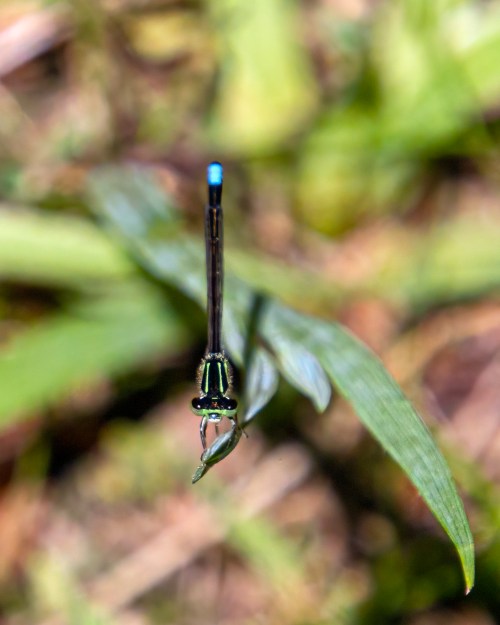
The first photo shows a Orange Bluet (Enallagma signatum). I am always amused by the name of this species, because it seems incongruous to have an orange-colored member of a genus called American Bluets. Most male bluets are, in fact, blue, but others are orange, scarlet, and burgundy and there is even a “Rainbow Bluet.”

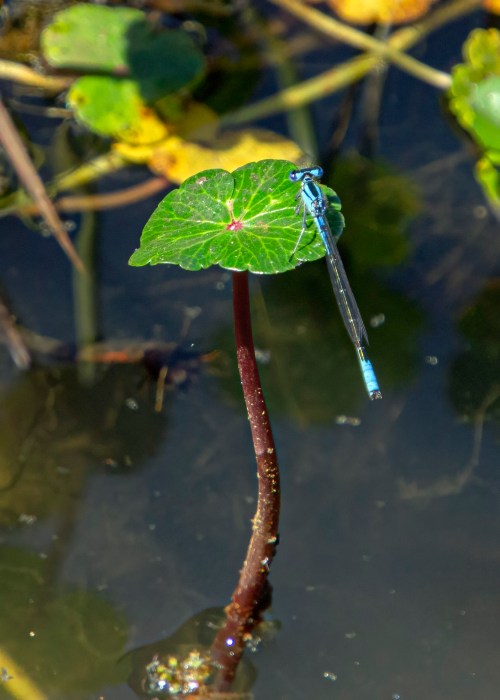
The second image shows a male Azure Bluet (Enallagma aspersum), whose colors are closer to my mental image of a bluet. Most bluets are some combination of blue and black and it can be tricky trying to determine specific species by examining the color patterns on the body and in the eyes.

The third shot is of a male Fragile Forktail (Ischnura posita), one of the first damselflies to emerge each spring. Fragile Forktails are really tiny (about an inch (25 mm) in length, but are relatively easy to identify by their broken shoulder stripe that looks like an exclamation point.

In the final photo I was eye-to-eye with the damselfly so his abdomen is almost completely out of focus. Nonetheless enough details are visible for me to say this is almost certainly a male Eastern Forktail damselfly (Ischnura verticalis).

I like to try to vary my approach to capturing images of most subjects, including damselflies, as you can see in this little collection of photos. Sometimes, as in the first shot, I will try to isolate the subject from its background in order to focus the viewer’s complete attention on the subject. Recently, though, I have developed a preference for including more of the habitat in my shots, as in the second image, in order to give the viewer a sense of the environment in which I took the shot. When possible, I like to attempt to capture some “artsy” shots, like the final image, by using selective focus and choosing carefully my angle of view.

No matter what approach I choose with damselflies, I have to be careful not to fall into the water, where most of these dragonflies were perching. I am not always successful in keeping my feet dry.

Orange Bluet

Azure Bluet

Fragile Forktail

Eastern Forktail

© Michael Q. Powell. All rights reserved.

Read Full Post »

Although the name of this Orange Bluet damselfly (Enallagma signatum) sounds like an oxymoron, its colors are a perfect match for this autumn season. As the name suggest, most damselflies in the bluet family are blue, but they do come in other colors.

I photographed this handsome male Orange Bluet on 10 October at Occoquan Bay National Wildlife Refuge and was thrilled to be able to capture a little autumn color in the background of the image.

Orange Bluet

© Michael Q. Powell. All rights reserved.

Read Full Post »
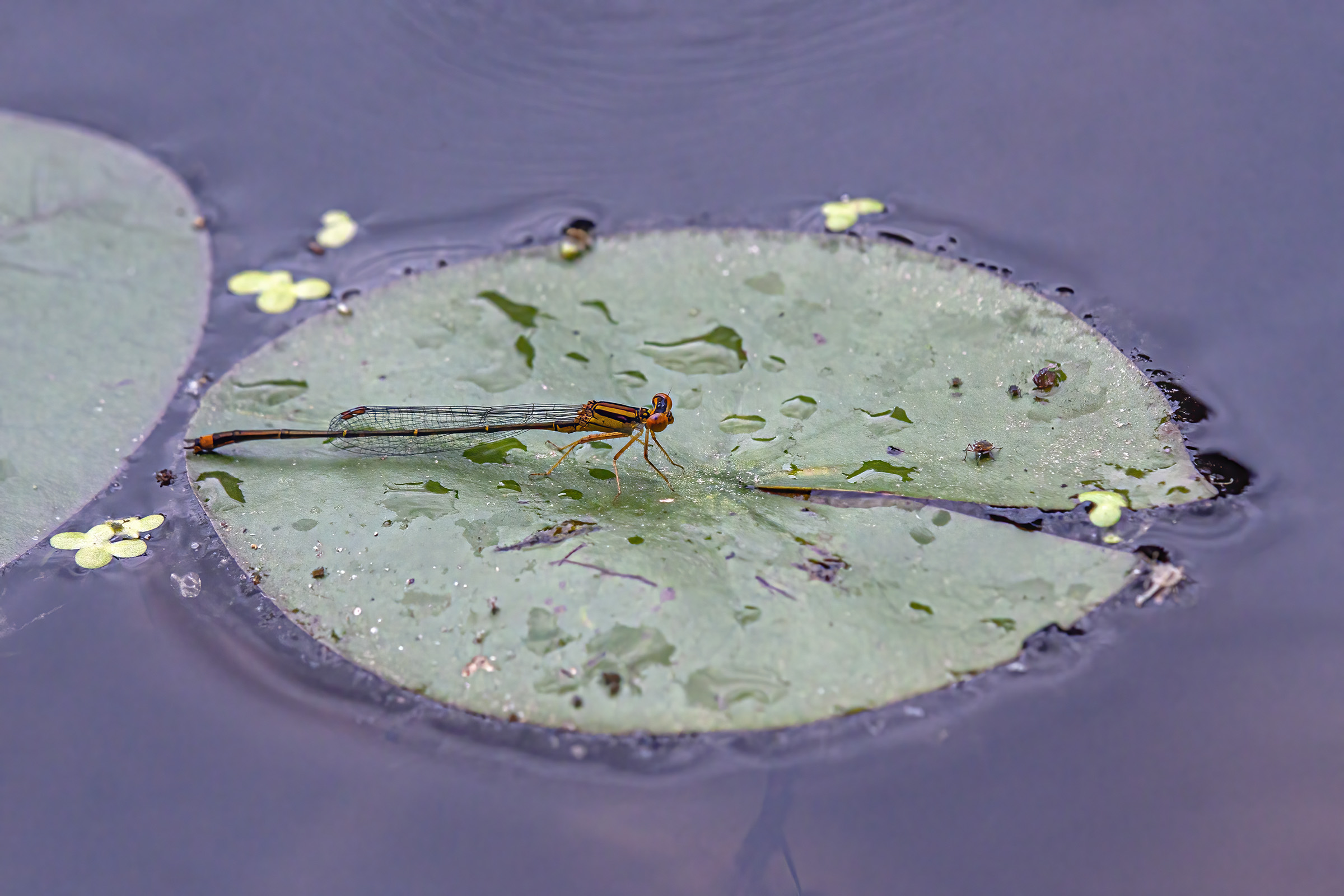
This little damselfly is called an Orange Bluet (Enallagma signatum). Yes, the name is confusing and seems to be a bit of an oxymoron. Most bluets have various patterns of blue and black on their bodies, but surprisingly there are also bluets that are patterned predominantly in red, orange, yellow, green or black. The male Orange Bluet adopted a seemingly confrontational pose and stared right at me as I prepared to photograph him last Thursday at Jackson Miles Abbott Wetland Refuge—maybe he felt the need to defend his territory.

I would have liked to have captured an eye-to-eye shot, but was afraid of scaring away the damselfly if I bent down closer to it, so took the shot from a downward angle. Although a substantial part of the Orange Bluet’s body is out of focus in this image, I think the shot worked out ok, owing largely to the fact that the damselfly’s eyes were in focus. The curve of the stalk on which it was perched was a nice bonus and added some visual interest to the shot.

Orange Bluet

© Michael Q. Powell. All rights reserved.

Read Full Post »

I love the distinctive coloration of Orange Bluet damselflies (Enallagma signatum), whose name always causes me to smile at the apparent oxymoron. How can a bluet be orange? As the name “bluet” suggests, most of the 35 members of the genus American Bluet (Enallagma), the largest damselfly genus in North America, are blue. However, certain species come in other colors including red, orange, and green and the Rainbow Bluet combines red, yellow, and green.

I spotted this handsome male Orange Bluet last Wednesday as he was perching on a lily pad in a small pond at Green Spring Gardens. He posed beautifully for me and I was able to capture quite a few details of this little damselfly. I recommend that you click on the image to get a closer look at this Orange Blue, including his wonderful orange markings.

Orange Bluet

© Michael Q. Powell. All rights reserved.

Read Full Post »

As I glanced down at the dark waters of the pond last Thursday at Huntley Meadows Park, a damselfly couple (Orange Bluets (Enallagma signatum), I think) flew by in tandem and I snapped this shot. I love how it looks like we are peering into a night sky, watching the damselflies fly past the celestial bodies of the Milky Way.

I couldn’t help but think about the opening title sequence from the Star Wars movies that begins with the words, “A long time ago in a galaxy far, far away….”

Orange Bluet

© Michael Q. Powell. All rights reserved.

Read Full Post »

Roses are red and bluets are blue, except when the bluets are damselflies, when they might be a different color. Last week while photowalking at Occoquan Bay National Wildlife Refuge, fellow dragonfly enthusiast Walter Sanford pointed out this Orange Bluet damselfly (Enallagma signatum) that was perched in a tree just above eye level. As he pulled back a branch that was blocking my view, I was able to get this unobstructed shot of the beautiful little damselfly.

You might think that the bright coloration of this damselfly would make it easy to spot, but Orange Bluers are small, less than an inch and a half (38 mm) in length, and elusive. I am lucky if I manage to spot a couple of them during an entire season, so I was thankful for Walter’s sharp eyes.

This Orange Bluet, I think, would make a good mascot for the autumn season, when oranges and browns begin to dominate the natural and manmade landscape and the stores are filled with decorations for Halloween and Thanksgiving. I suspect that some stores are already starting to decorate for Christmas, but I am not ready to give up on the waning moments of summer—for some of us, tomorrow is the autumnal equinox, the first day of fall.

Orange Bluet

© Michael Q. Powell. All rights reserved.


Read Full Post »

I love the distinctive coloration of Orange Bluet damselflies (Enallagma signatum), whose name always causes me to smile at the apparent oxymoron. I spotted this couple in tandem earlier in August at Jackson Miles Abbott Wetland Refuge. Many damselflies remain in this position after they have completed mating, with the male at the top attached to the female as she deposits her eggs.

As the name “bluet” suggests, most of the 35 members of the genus American Bluet (Enallagma), the largest damselfly genus in North America, are blue. However, certain species come in other colors including red, orange, and green and the Rainbow Bluet combines red, yellow, and green.


Orange Bluet

© Michael Q. Powell. All rights reserved.

Read Full Post »
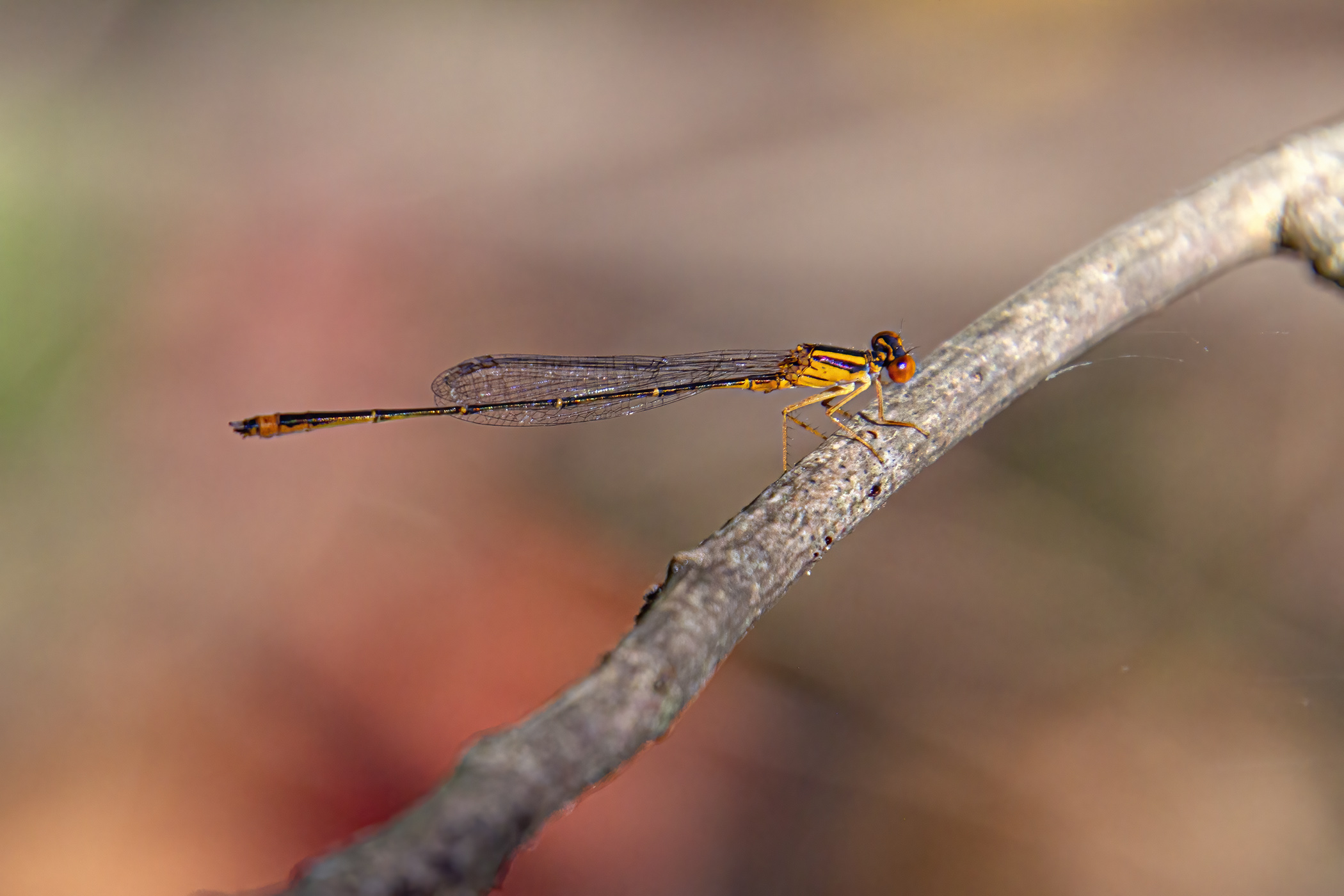
Names can sometimes be misleading. There is a genus of damselflies, consisting of 35 species, called American bluets. As the common name “bluet” suggests, most members of the genus are primarily blue in color. One notable exception is the adult male Orange Bluet (Enallagma signatum) that often does not appear to have even a speck of blue on its body.

I spotted this little guy last Friday at Jackson Miles Abbott Wetland Refuge and was a bit shocked by his bright red eyes when I looked through the viewfinder of the camera. The male Orange Bluet was perched at the extreme end of some vegetation overhanging a pond.

I would have liked to have gotten a shot in which more of its body was in focus, but I did not want to risk falling in the water, which looked to be pretty deep at that spot. As I look at the photo now, I realize that the soft focus of the body may actually be a good thing, because it draws a viewer’s attention even more to the eyes of the handsome little damselfly.

orange bluet

© Michael Q. Powell. All rights reserved.

Read Full Post »

I know that damselflies come in many colors, but my brain wanted to cramp up when I was told that this stunning orange damselfly was a bluet. An orange bluet? Aren’t bluets blue?

Apparently that is not always the case, and this little beauty is in fact a male Orange Bluet damselfly (Enallagma signatum). This shot looks like it was done with flash, but I double checked the EXIF data and confirmed that it was simply an effect caused simply by using exposure compensation and metering carefully on the subject. Normally, I am not a big fan of a black background, which can be caused when the light from the flash overpowers the ambient light, but I think that it works well in this shot, which looks almost like it was shot in a studio.

In the second shot, the brown color of the muddy water shows through in a way that is a little more natural. I took this shot when the damselfly was farther away than in the first shot and I like the way that it shows a bit more of the environment than in the first image.

One of the advantages of shooting in bright light and on a tripod was that I was able to shoot at ISO 100 and at f/11, which gave me images that were a lot cleaner than I often get.

orange1_blogorange2_blog

© Michael Q. Powell. All rights reserved.


Read Full Post »