Feeds:
Posts
Comments

Posts Tagged ‘Occoquan Regional Park’

Survival in the wild is challenging even when you are able-bodied. The difficulties are multiplied when you have a major deformity, like this Gray Petaltail dragonfly (Tachopteryx thoreyi) that I spotted on Friday at Occoquan Regional Park.

I not sure what caused the sharp bend in the abdominal region of this dragonfly, but I observed that it was able to fly and to perch. Perhaps it is able to capture prey, but mating seems out of the question. I admire that the fact that it appears to be fighting for its survival.

For the sake of contrast, I am including a photo of another Gray Petaltail dragonfly that I observed the same day at the park.

Gray Petaltail

Gray Petaltail

© Michael Q. Powell. All rights reserved.

Read Full Post »

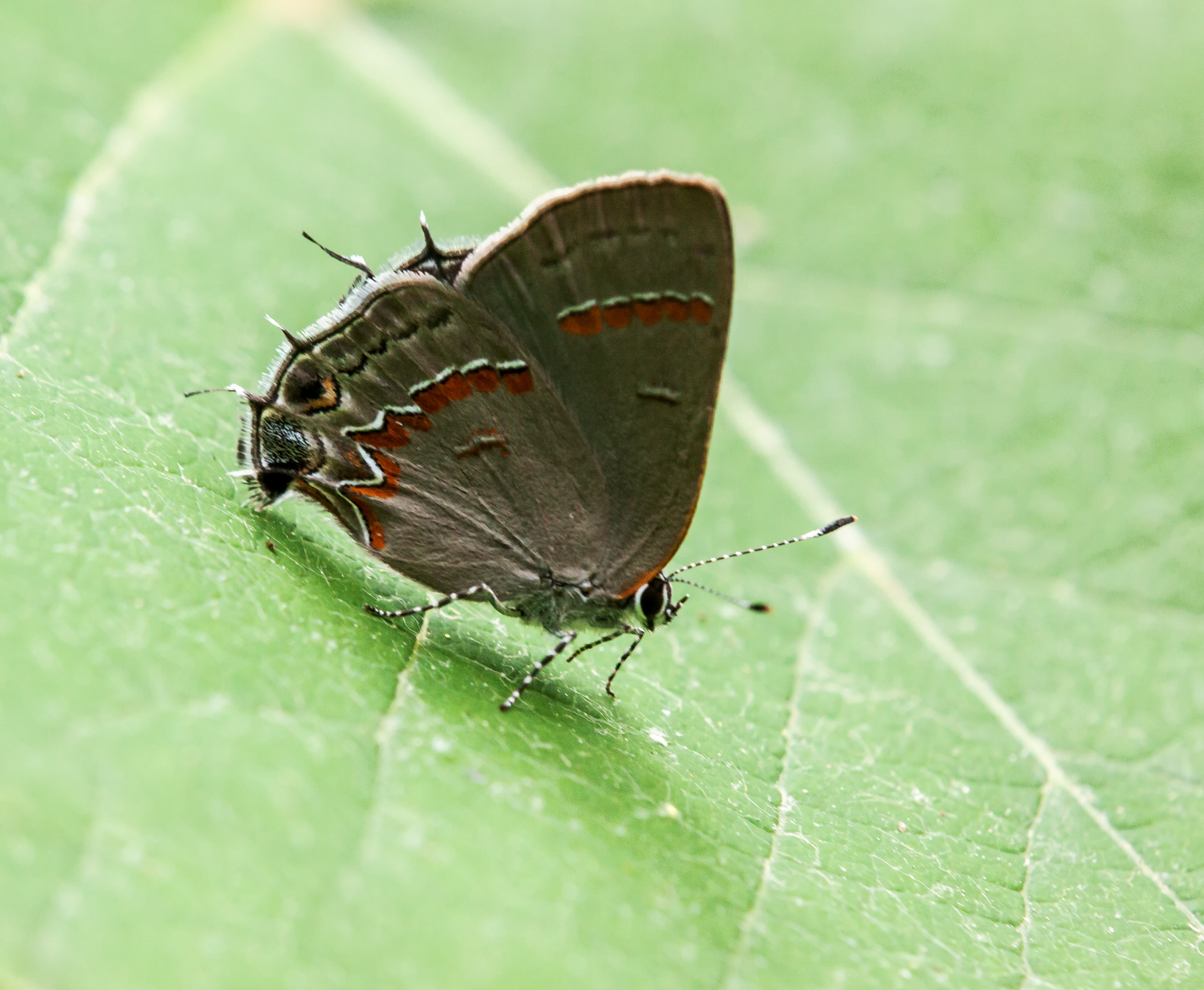
Yesterday I was thrilled to get a shot of this pretty Red-banded Hairstreak butterfly (Calycopis cecrops) at Occoquan Regional Park. These tiny butterflies are only about an inch (25mm) in length, so you really need a macro lens to get a close-enough shot that reveals all of the butterfly’s wonderful colors and patterns. It is also nice to be able to see the little “tails” protruding from the hind wings that I believe are responsible for the name “hairstreak.”


Red-banded Hairstreak

© Michael Q. Powell. All rights reserved.

Read Full Post »

Earlier this week I spotted this male Zabulon Skipper butterfly (Poanes zabulon) while I was exploring Occoquan Regional Park. I am not one hundred percent sure of my identification, given that there are hundreds of different species of skipper butterflies, but I am hoping that I am correct for the simple reason that I find the name “Zabulon” to be exceptionally cool. As some of you may know from the URL for my site, my middle initial is Q, which stands for Quentin, and I am irresistibly drawn to names that begin with infrequently used letters like Q, X, and Z.

In terms of the image itself, I really like the way that the warm orange tones of the butterfly stand out amidst the cooler shades of green in the foreground and in the background.

Zabulon Skipper

© Michael Q. Powell. All rights reserved.

Read Full Post »

Are you so used to the common beauty that surrounds you every day that you no longer see it? What does it take for you to stop and take notice and maybe even pull out a camera to photograph a subject?

Almost six years ago I read a blog posting by fellow photographer Lyle Krahn that talked of a concept called “stopping power” and that posting has stuck with me to this day. Here’s a portion of that posting that describes the concept, “I think every beautiful scene has stopping power. That’s my term for the ability of a scene to make a person stop hiking or driving in order to pull out a camera and make images. Did you ever wonder what makes you stop? Do you ever hear the music?”

I try to pay attention to even the most common subjects and when it comes to dragonflies, that means the aptly named Common Whitetail (Plathemis lydia). Common Whitetails are among the first dragonflies to appear in the spring and among the last to disappear in the autumn. You can find lots of Common Whitetails almost everywhere it seems.

On Tuesday at Occoquan Bay Regional Park I stopped and photographed some Common Whitetail dragonflies as I was searching for some more exotic dragonfly species. This early in the season the Common Whitetails seem to be hanging out at a distance from the water—later in the summer I tend to find them buzzing around ponds and swamps.

The first two shots below are of male Common Whitetails. Although mature males are white, when they are young they have brown bodies similar to those of females. However, males have different patterns on their wings and the second and third images show those differences and may help you to distinguish immature males from females.

So, what has “stopping power” for you? I encourage you to think about that question, to make an effort to lower your threshold, and to look for the uncommon beauty in common subjects.

Common Whitetail

Common Whitetail

Common Whitetail

© Michael Q. Powell. All rights reserved.

Read Full Post »

I try to do a blog posting almost every day, but I spent this weekend unplugged from the internet at a church retreat in the mountains of Virginia, so I missed a couple of days. When I first started blogging, I was a bit compulsive about it and worried that I would lose all of my followers if I did not post every single day. Now I have a more balanced approach and realize that it is not the end of the world if the clock strikes midnight and I have not posted something new.

Today I am featuring some Brown Spiketail dragonflies (Cordulegaster bilineata) that I spotted last week while exploring Occoquan Regional Park with my fellow dragonfly enthusiast and blogger Walter Sanford. He and I returned to a location where we had spotted this species last year and were delighted to see that members of this species had emerged on schedule. Like many other species that emerge in the early spring, Brown Spiketails have a limited flight period and are found in small numbers at a limited number of locations.

Walter and I discovered that it is helpful to search for these dragonflies together. Often one of us will flush the dragonfly and the other person can observe the direction and the spot to which the dragonfly has relocated. This is really important because, as you can see from the photos, Brown Spiketails perch at an angle or hang vertically from vegetation that is often low to the ground, which makes it difficult to spot them when they are stationary.

Be sure to check out Walter’s posting today of our encounter with the Brown Spiketails. Although he and I were shooting together, we use different camera gear and approaches and our respective images give you different perspective on the same subjects. We also craft our blog postings independently and the style and content of our individual postings tends to reflect our personalities and backgrounds—I have a liberal arts background and Walter has a background in science.

Brown Spiketail

Brown Spiketail

Brown Spiketail

© Michael Q. Powell. All rights reserved.

Read Full Post »

Shorebirds are always tough for me to identify—so many of them are similar in appearance. When I spotted this little bird on Wednesday at Occoquan Regional Park, I noticed that it was all alone. Half-jokingly, I thought to myself that maybe it is a Solitary Sandpiper (Tringa solitaria). When I later checked my bird identification guide I was shocked to discover that it actually is a Solitary Sandpiper.

According to the Cornell Lab of Ornithology, however, the name of the Solitary Sandpiper is not completely accurate—”While not truly solitary, it does not migrate in large flocks the way other shorebirds do.” On the same website I also learned the interesting fact of the world’s 85 sandpiper species, only the Solitary Sandpiper and the Green Sandpiper of Eurasia routinely lay eggs in tree nests instead of on the ground.

Solitary Sandpiper

Solitary Sandpiper

© Michael Q. Powell. All rights reserved.

Read Full Post »

I hope that the title did not lead to an expectation that you would find photos of tiny deer in this posting. It may have been a stretch to use that title, but I wanted to give a hint of the fact that I captured all of these images with my macro lens. In fact, the first two images are uncropped, which gives you an idea of how close I was to the deer.

Yesterday I set off for Occoquan Regional Park to search primarily for dragonflies and butterflies. I put my Tamron 180 mm macro lens on my camera, a lens which is my go-to lens for much of the spring and summer. Now I must confess that the reach of this macro lens is a bit longer than the average macro lens, which generally has a focal length of 100 mm or so, but it certainly would not be my first choice for wildlife photography.

I was sitting on a log taking a break when I heard some nearby noise in the underbrush. I stood up, expecting to see a scurrying squirrel, and suddenly was face-to face with a White-tailed Deer (Odocoileus virginianus). For a considerable amount of time the deer eyed me with curiosity before slowly moving away. As I watched the deer depart, I noticed another deer, one with amazingly long ears. As I prepared to photograph the second deer, the first one photobombed us, resulting in the third image.

This situation reinforced to me the importance of shooting with whatever camera or lens that I happen to have at hand. It may not be the optimal option, but it can often yield surprisingly good results.

Whiite-tailed Deer

White-tailed Deer

White-tailed Deer

© Michael Q. Powell. All rights reserved.


Read Full Post »

Yesterday was a wonderful day for searching for dragonflies at Occoquan Regional Park and among my finds was this beautiful female Painted Skimmer (Libellula semifasciata). This is the first one of the season for this species, which is relatively common compared to most of the early spring species. The patterns on the wing make this species stand out and definitely help in identifying.

I love the way that the different colors on this dragonfly work so well together and give this dragonfly a refined and rather sophisticated look. It is an additional bonus that those colors are mirrored by the background colors in this image.

Painted Skimmer

© Michael Q. Powell. All rights reserved.

Read Full Post »

I was a little surprised and quite happy this past weekend to spot a Pileated Woodpecker (Dryocopus pileatus) poking about on the ground at Occoquan Regional Park. Most of the time I have to settle for high-angle shots when I am lucky enough to spot one of these giant woodpeckers. I have been told that these woodpeckers regularly probe fallen trees, but this was a first for me.

After I inadvertently spooked the woodpecker, it flew to a nearby tree. The light was coming from the side and the front when I took the second shot and it made the woodpecker red crest look like it was on fire. Somehow it seemed appropriate, given that most redheads I have known have tended to be quite fiery.

Pileated Woodpecker

Pileated Woodpecker

© Michael Q. Powell. All rights reserved.

Read Full Post »

On Monday I was thrilled to get a shot of one of my favorite damselflies at Occoquan Regional Park, the beautifully colored Violet Dancer (Argia fumipennis violacea), a subspecies of the Variable Dancer damselfly (Argia fumipennis). I love the color combination of this tiny beauty, a spectacular shade of violet on its body and the wonderful blue accents. Sharp-eyed viewers may have noted that a photo of this same type of damselfly has been my banner image for quite some time.

Violet Dancer

© Michael Q. Powell. All rights reserved.

Read Full Post »

This shot from Monday is for Cindy Dyer, my photography mentor, who used to refer to me as her “grasshopper” and taught me some important lessons when I was just starting to get serious about my photography six years ago.

Folks of a certain age may recall that “grasshopper” was the nickname used by Master Po for his young student Kwai Chang Caine in the western martial arts television series Kung Fu in the 1970’s. The name is a reference to a wonderful scene in the pilot episode for the series in which the blind teacher helps to teach his new student that “seeing” requires more than the simple use of your eyes.

Here, from Wikipedia, is a snippet of dialogue with some of the wisdom of Master Po:

Master Po: Close your eyes. What do you hear?
Young Caine: I hear the water, I hear the birds.
Po: Do you hear your own heartbeat?
Caine: No.
Po: Do you hear the grasshopper which is at your feet?
Caine: Old man, how is it that you hear these things?
Po: Young man, how is it that you do not?

In case you have never heard of the Kung Fu television series or want to relive a moment from your past, here is a link to a short YouTube video of the above-referenced scene.

As a nature photographer, I think a lot about “seeing” as I seek a closer connection with the natural world and so many of its inhabitants. My observations have caused me to conclude that the pace of the natural world is different from that of my everyday life and that I consequently have to slow down in order to be in synch with it.

grasshopper

© Michael Q. Powell. All rights reserved.

Read Full Post »

Are you ever fully satisfied when you meet a goal? I think that many of us drawn to wildlife photograph are restless in our pursuit of newer and better images. We can celebrate our successes, but we tend to be self-critical. We are convinced that we can always improve our skills and our photos, that we need to keep pushing and pushing in a never ending quest for more interesting subjects or better conditions or sharper images .

In many ways, that was the case for me this past Monday, when fellow dragonfly enthusiast Walter Sanford and I scoured an area of Occoquan Regional Park for spiketail dragonflies. In a blog posting earlier this week I chronicled our long and ultimately successful search for the elusive Twin-spotted Spiketail. I was feeling a bit tired by the time we saw that dragonfly, but Walter had told me that an additional dragonfly species had been spotted in that same area, the Brown Spiketail dragonfly (Cordulegaster bilineata).

So we kept going and went looking again in an area that we had searched earlier in the day. Some say that the definition of insanity is repeating the same actions and expecting different results. If that’s true, I guess that I qualify as being more than a little crazy. It turned out that we were lucky, really lucky and had multiple chances that afternoon to photograph several male Brown Spiketails. Unlike the Twin-spotted Spiketails from earlier in the day that flew away and never returned, the Brown Spiketails would fly only a short distance away when spooked and it was relatively easy to track them visually to their new perches. Eventually we reached a point of satiation where we would not even take a shot of a dragonfly if it was even partially obscured by vegetation or was facing in the wrong direction. We hoped we would see a female of the species, but it turns out that all of the spiketails we saw that day were males.

The Brown Spiketail dragonflies seem to have a lighter-colored bodies than the Twin-spotted Spiketails (brown vs black) and has paler spots, but to my inexperienced eye they otherwise look pretty similar. I was happy to capture some relatively sharp images that you can see in even greater resolution by clicking on them. For even more detailed photos, check out Walter’s excellent images of our adventures in his blog posting today. He has mastered some techniques that allow him to capture an amazing amount of detail in his dragonfly shots.

Brown Spiketail

Brown Spiketail

Brown Spiketail

© Michael Q. Powell. All rights reserved.

Read Full Post »

When you go out to take photos, do you have specific goals in mind? I consider myself to be an opportunistic shooter—I like to walk around in the wild and photograph whatever happens to catch my eye.

This past Monday, though, I joined fellow dragonfly enthusiast and photographer Walter Sanford on a very targeted mission. We were going to search for some relatively uncommon dragonfly species called spiketails in a location where they had been recently seen. These species can be found only during a limited period of the spring and only at small forest streams or spring-fed seepages.

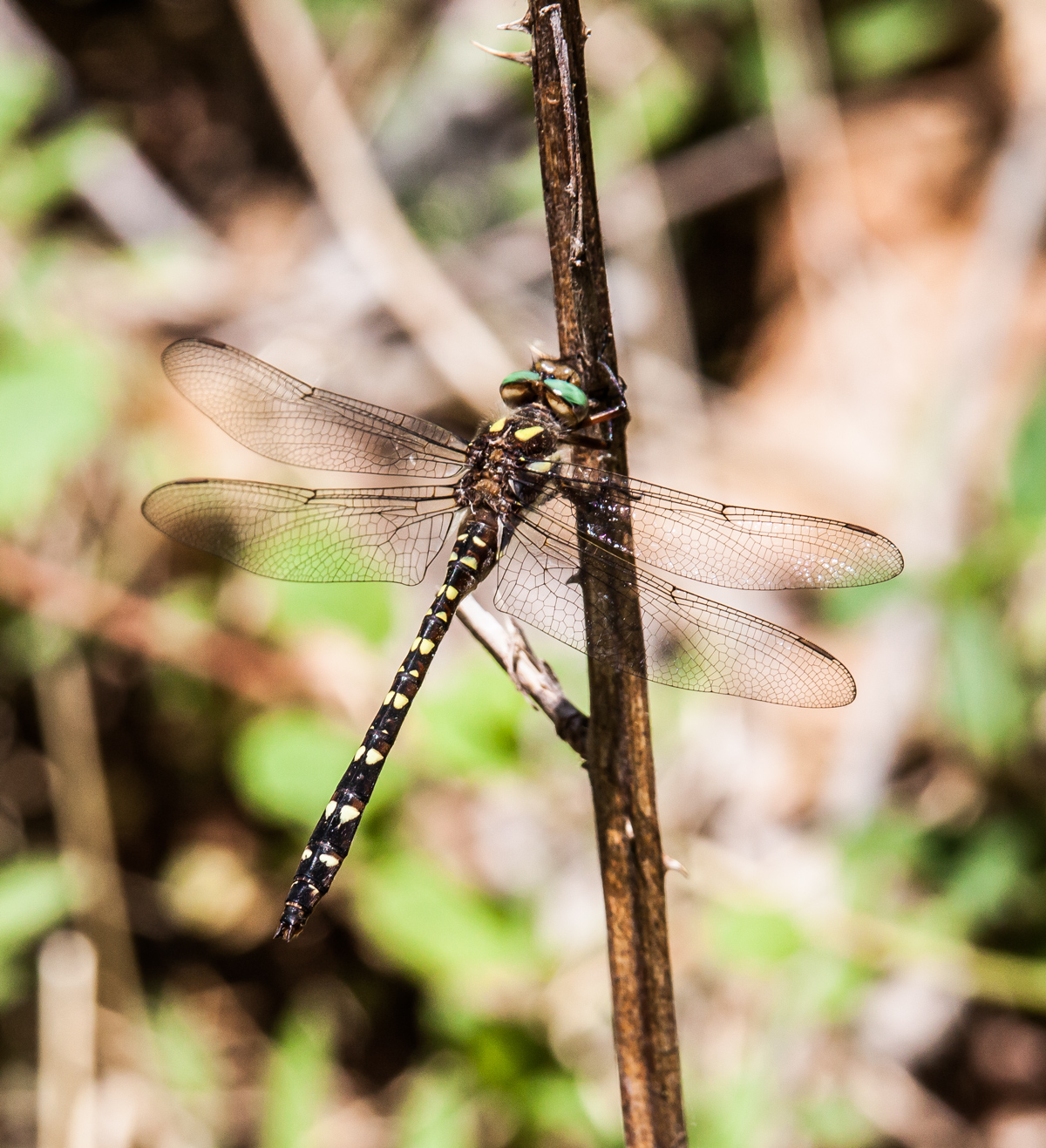
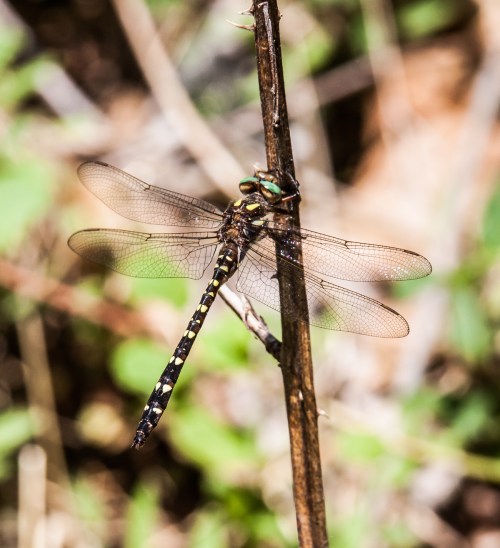
We were particularly interested in the Twin-spotted Spiketail (Cordulegaster maculata), a dragonfly that is less than 3 inches in length (76 mm) and usually hangs vertically or at an angle in vegetation close to the ground. As you can probably tell from my description, these dragonflies are tough to find. Walter and I have hunted together for dragonflies in the past and have found that it helps to work in pairs, so that if one flushes a dragonfly, the other person can sometimes track it to its new location.

We searched and searched for what seemed like hours and came up empty-handed. Just when it seemed like we might be getting ready to concede defeat, I spotted what I think was a Twin-spotted Spiketail. I called out to Walter and put my camera to my eye. Alas, the dragonfly flew away before I could get a shot. Previously he and I had a conversation about whether it was better to have seen none or to have seen one and not gotten a shot. I was now faced with the second case.

We figured that our odds were about one in a million of spotting another Twin-spotted Spiketail, but having seen one, we had a glimmer of hope and kept searching. Without intending to do so, we drifted apart, out of sight of each other. Suddenly I heard Walter’s voice calling to me, saying that he had spotted one. The basic problem was that I did not know where he was. I wrongly assumed that he was near a small stream, so I rushed downhill through the muck and the thorns, but didn’t see him. He called out again even more insistently and I realized that he was uphill from me. Apparently I am not good at determining directions on the basis of sounds.

I scrambled up the bank to him and he motioned to me to move around him on the left. About that time, the dragonfly that he was photographing took off and headed down the trail. Walter was about ready to give chase when I told him to stop—I had spotted what turned out to be a male Twin-spotted Spiketail at ankle-height just a few feet from where he was standing. Our patience and persistence ended up being rewarded and I was thrilled to be able to get some shots of this beautiful dragonfly, a species that I had never before encountered.

Long-time readers may recall that Walter and I are very different in our approaches to many things. Our photography gear is different; my background and education is in liberal arts and his is in science; and our personalities are quite dissimilar. Not surprisingly, our writing styles vary too. Several times in the past we have done companion blog postings after our adventures. Check out Walter’s blog post today for his perspective on our hunt for this elusive dragonfly and for his wonderful images.

As it turned out, our day of dragonfly hunting was not yet over, but that will the subject of a future blog posting.
Twin-spotted Spiketail

© Michael Q. Powell. All rights reserved.

Read Full Post »

« Newer Posts