Feeds:
Posts
Comments

Posts Tagged ‘Occoquan Regional Park’

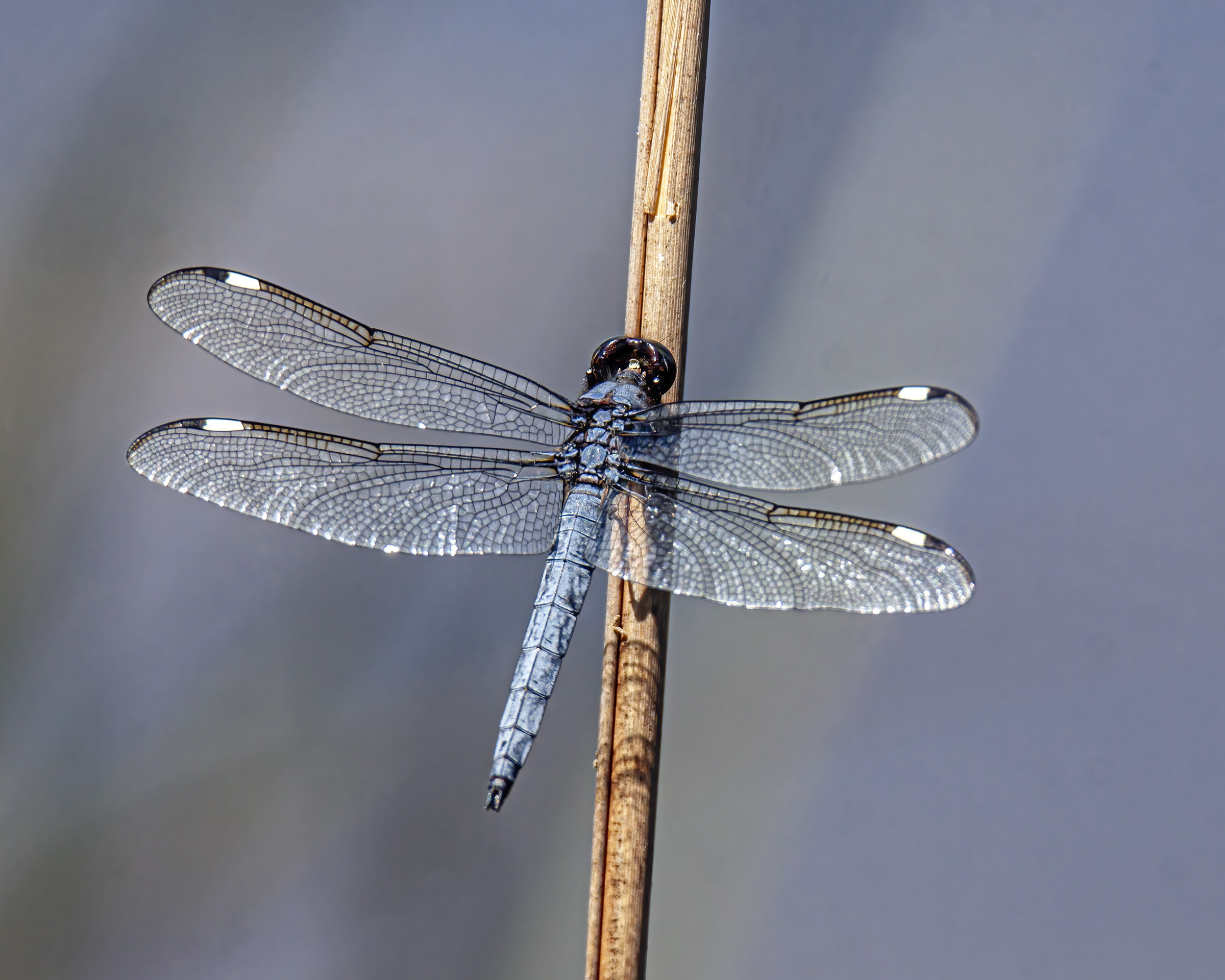
The clock is ticking as we move towards the end of the dragonfly season and I see a lot of mating dragonflies that appear to be driven by the biological imperative of ensuring the perpetuation of their species. Late in August I observed this pair of Blue Dasher dragonflies (Pachydiplax longipennis) at Occoquan Regional Park in the mating position that is sometimes referred to as “the wheel.”

When mating is completed, the female, the lower dragonfly in the photo, will may lay 500 or more eggs by flying low over the water usually near a heavily vegetated pond edge and repeatedly tapping her abdomen to the surface. Once the eggs hatch, the life cycle of a dragonfly larva begins as a nymph that live underwater and eat smaller aquatic insects. The nymphs, also referred to as naiads, live underwater for up to two years and shed their exoskeletons six or more times.

According to an article in Cambridge Day, “When a naiad is ready to metamorphose into an adult dragonfly, it swims to the surface at night. There, it lifts its head out of the water as its body adapts to breathing air, then climbs a plant stem out of the water, where its skin splits behind its head and the adult dragonfly emerges. The adult swallows air to plump up its body and pumps hemolymph, the bloodlike substance of insects, into its wings.”

For more information about the life cycle of Blue Dasher dragonflies, check out these postings at Life on CSG Pond and at Cambridge Day.

Blue Dasher

© Michael Q. Powell. All rights reserved.


Read Full Post »

I inadvertently spooked a Great Blue Heron (Aredea herodias) on Wednesday at Occoquan Regional Park and captured this first image as it flew up to a perch high in a nearby tree. It was really cool to see the heron’s impressive wingspan as it came in for a landing in the tree. The second image shows the Great Blue Heron as it surveyed its surroundings from its new perch.

When I was just starting out in wildlife photography, I remember being shocked the first time that I saw a Great Blue Heron in a tree. I somehow had assumed that they spent all of their time in the shallow water or at the edge of ponds. Little did I know at that time that Great Blue Herons build their nests in the trees and often spend their nights roosting in trees to protect themselves from potential predators.

Great Blue Heron

Great Blue Heron

© Michael Q. Powell. All rights reserved.


Read Full Post »

I love the abstract feel of this image that I captured last week at Occoquan Regional Park. The shapes and colors in the photo are much more important than the details of the subject, which I think is a Needham’s Skimmer dragonfly (Libellula needhami). From this angle, dragonflies often remind me of the biplanes of World War One, like the Sopwith Camel that was sometimes featured in Snoopy comic strips.

Photography allows for such a wide range of approaches to express myself creatively. I can be geeky and technical, as I usually am, striving to capture the minute details of my often tiny subjects or I can be as “artsy” as I choose, focusing on capturing and creating moods or feelings with the basic elements of light and darkness, of colors, lines, and shapes.

Professional photographer’s are sometimes advised to create a signature style and to stick with it. I am proudly an amateur, who captures images for love—the root word in “amateur”—and I defiantly refuse to stick to a single style. My photos and words help you to see the world through my eyes and hopefully my unbounded curiosity and enthusiasm about the world are evident in my postings. If you meet me in person, you’ll see that the “me” in my postings is not a social media persona—it is genuinely who I am.

Needham's Skimmer

© Michael Q. Powell. All rights reserved.
Read Full Post »

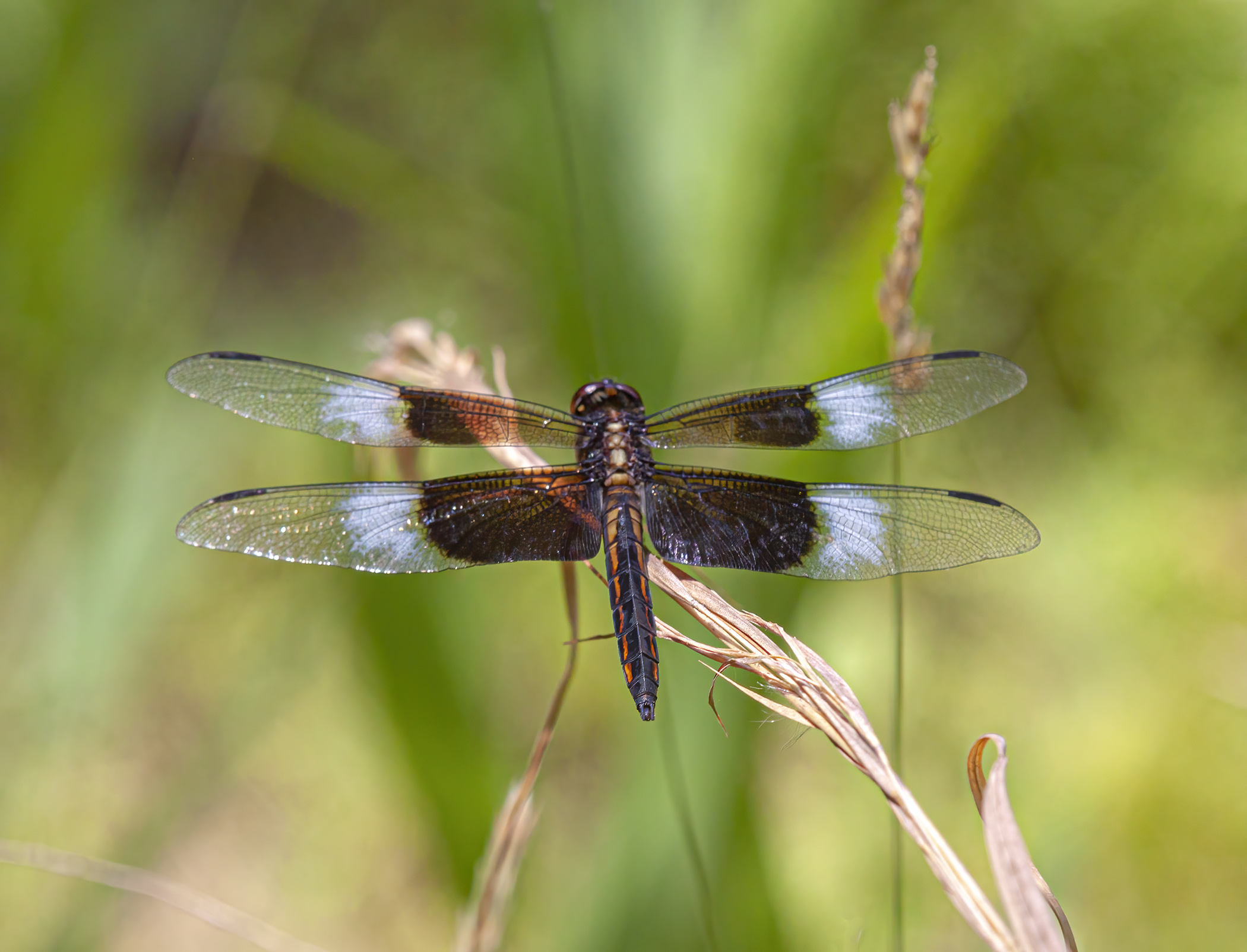
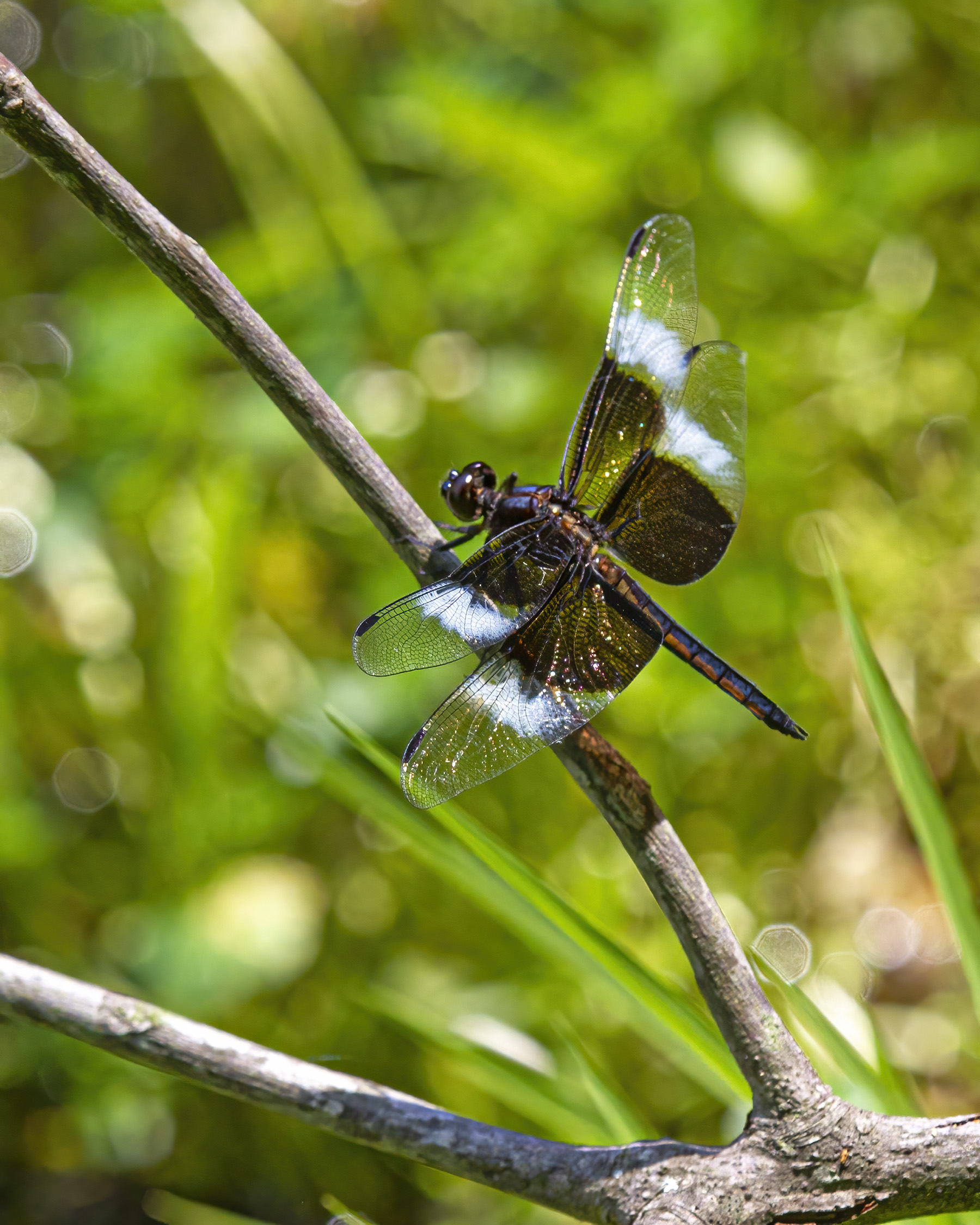
I love the distinctive wing markings on male Widow Skimmer dragonflies, one of only a few dragonfly species that I have encountered with both light and dark patches on their wings. I spotted this handsome male Widow Skimmer last week during a brief visit to Occoquan Regional Park in Lorton, Virginia.

One of the cool things about this dragonfly is that it looks almost like a butterfly when it is flying. With most dragonflies, the transparent wings seem to almost disappear when they are flying, but with the male Widow Skimmer, the wings are much more visible when the dragonfly is in motion.

Widow Skimmer

© Michael Q. Powell. All rights reserved.
Read Full Post »

I was excited to spot my first Monarch Butterfly (Danaus plexippus) of the season last Friday at Occoquan Regional Park in Lorton, Virginia. The milkweed was barely in bloom, but the Monarch nonetheless seemed to be really enjoying it.

I love the beauty of the Monarch, of course, but I am also very conscious of the fact that this species is considered to be endangered, threatened by the loss of habitat and by climate change. Some years I have not seen any Monarchs at all, so each sighting is special to me, reassuring me that Monarchs are continuing to survive.

As you can see, I attempted to get shots of the Monarch, the only one that I saw that day, from varying distances. When I first spotted the Monarch, I took several long distance shots like the third one below that show some of the habitat. Then I slowly moved forward, attempting to use the milkweed in my compositions.

It was a bit of a challenge to get good shots, because the butterfly was in almost constant motion, moving all around the little clumps of milkweed and changing its wing and body positions. I had to work quickly too, fully aware that the butterfly could fly off at any moment.

Monarch butterfly

Monarch butterfly

Monarch butterfly

© Michael Q. Powell. All rights reserved.


Read Full Post »

I just wanted to alert readers who may be used to me publishing a blog posting almost every day that I will be absent from this space for the rest of this week. A family emergency requires me to travel to Massachusetts and Maine and I will not have access to the internet for most of this time.

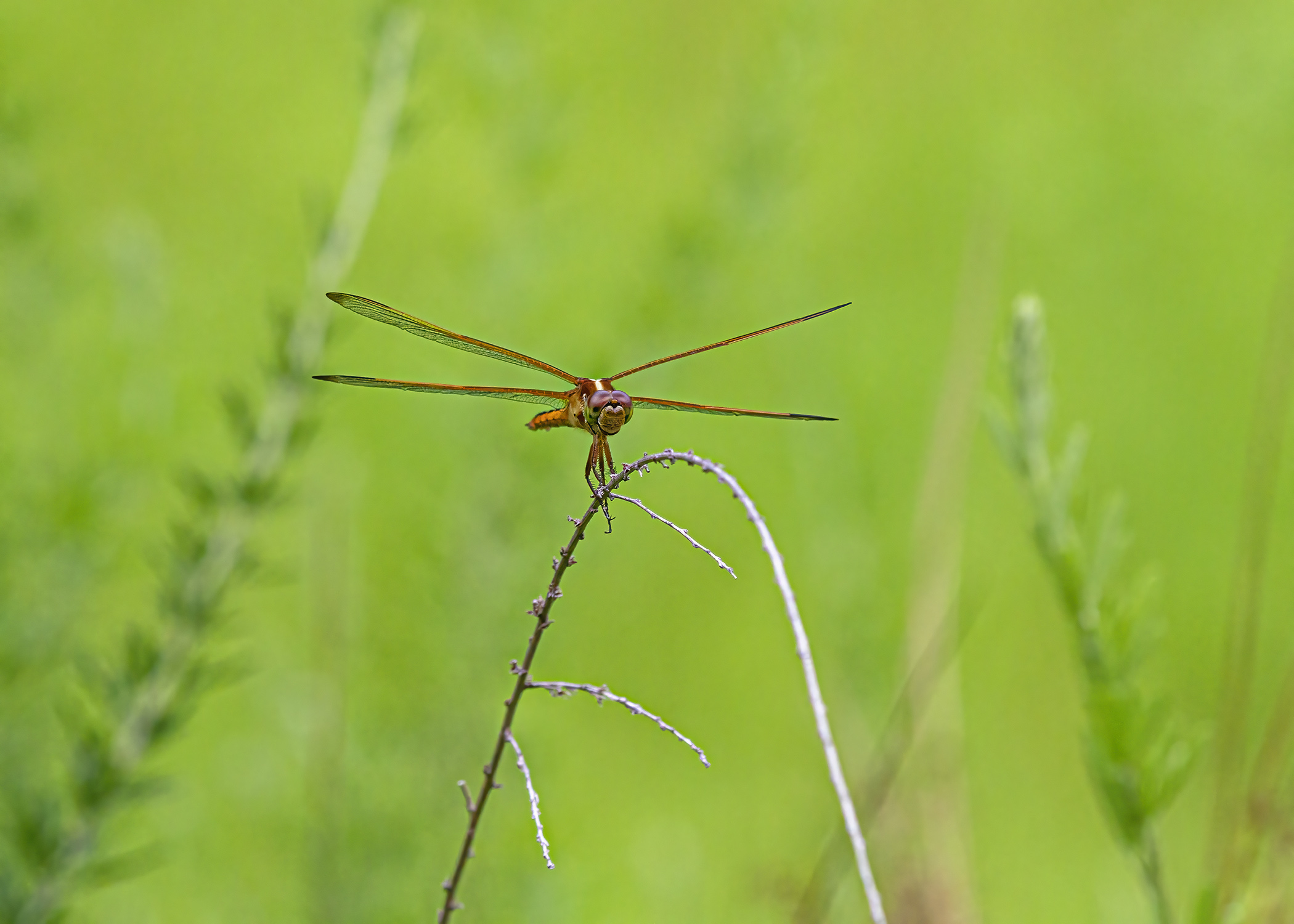
I decided though to leave you with a shot of a dragonfly facing away. While I was exploring Occoquan Regional Park earlier this month, I managed to get only a single angled view of this dragonfly before it flew away, but it was enough to confirm that it was my first Carolina Saddlebags dragonfly (Tramea carolina) of the season. Despite the odd angle, I was able to capture the patches on the hind wings that are thought to resemble “saddlebags” and its distinctive red color, so identification was not a problem.

I really like the colors and patterns of this shot, which has more of an “artsy” feel rather than a “scientific” one. Normally eye contact is desirable with a subject, but I look at that “rule” as more of a suggestion than a requirement.

Carolina Saddlebags

© Michael Q. Powell. All rights reserved.


Read Full Post »

Dragonflies and damselflies have rather limited lifespans after they emerge from the water and are transformed from aquatic nymphs into aerial acrobats. One of their biological imperatives is to perpetuate their species, so it is not unusual to see mating activity during this time of the year that is primetime for dragonflies and damselflies.

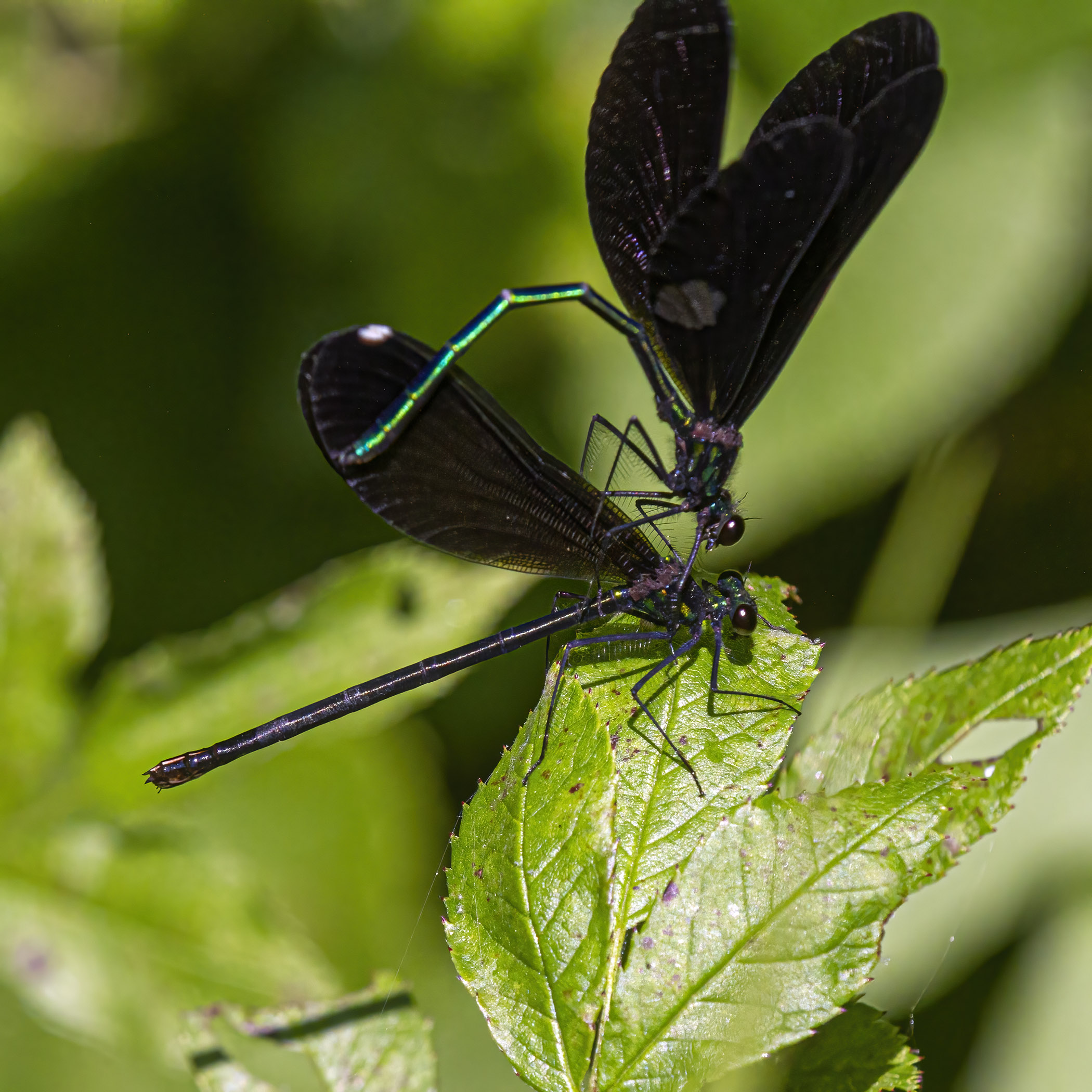
On a trip earlier this month to Occoquan Regional Park, I spotted this pair of Ebony Jewelwing damselflies (Calopteryx maculata) in their distinctive sidewards-heart mating position. I am really happy with this image because I was able to use my shooting angle and camera settings to keep the bodies of both damselflies in focus and achieve a blurry background that allows a viewer to focus on the damselflies without any visual distractions.

In case you are curious, the damselfly to the left is the female and the one with the shiny green body is the male. You can tell the genders from the mating position and from the little white patch on the wings that is present on female Ebony Jewelwings and not on the completely dark wings of the males


Ebony Jewelwing

© Michael Q. Powell. All rights reserved.

Read Full Post »

This handsome Common Green Darner dragonfly (Anax junius) does not have all of the colors of the rainbow, but it does have many of them and I love its mix of vibrant colors. The dragonfly was perched vertically really low in the vegetation when I spotted it during a recent to Occoquan Regional Park. I ended up sprawled almost flat on the ground to get this shot—my position would have made for an amusing photo, but fortunately no one else was around to capture that moment.

Mature male Common Green Darners have bright blue abdomens. The reddish pink color of this dragonfly’s abdomen suggest to me that it is an immature male. Early and late in the season, the abdomens of male Common Green Darners may appear purple. Common Green Darners have dark-colored platelets in their blood that rise to the surface when it is cold, darkening their abdomen color and attracting more sun. On bright, hot days, those dark platelets sink, and the abdomen turns bright blue again, now reflecting light.

Common Green Darner

© Michael Q. Powell. All rights reserved.

Read Full Post »

Last week I managed to capture a series of images of a hook-up between two Ebony Jewelwing damselflies (Calopteryx maculata). Initially I was focused on a female that was perched on a leaf, but then noticed a male who was circling around her. According to Wikipedia, “Calopteryx males will hover in front of a female with alternating fast and slow wingbeats; if she is receptive she will remain perched, otherwise she will fly off.” This female remained in place, so the male moved in, as you can see in the first three photos.

During mating, the male uses claspers at the tip of his abdomen to grasp the female behind her head tightly enough to resist the attempts by other males to dislodge him, a position sometimes called “tandem.” The male then flexes his abdomen to encourage the female to loop her abdomen round to interlock with him, forming the “wheel’ position,” the sidewards-heart position shown in the final photo.

I suppose that I could leave the description here, but the process that was taking place was so weird and fascinating that I thought I should explain what is going on. In order to keep from getting too graphic, I will borrow some language from Wikipedia.

“Mating in damselflies, as in dragonflies, is a complex, precisely choreographed process involving both indirect insemination and delayed fertilization….When he (the male) is ready to mate, he transfers a packet of sperm from his primary genital opening on segment 9, near the end of his abdomen, to his secondary genitalia on segments 2–3, near the base of his abdomen. The male then grasps the female by the head with the claspers at the end of his abdomen; the structure of the claspers varies between species, and may help to prevent interspecific mating… The female then curls her abdomen downwards and forwards under her body to pick up the sperm from the male’s secondary genitalia, while the male uses his “tail” claspers to grip the female behind the head: this distinctive posture is called the “heart” or “wheel.”

Wow! I think I will leave it at that. Suffice it to say that the process is complicated and the participants have to be incredibly flexible.

Ebony Jewelwing

Ebony Jewelwing

Ebony Jewelwing

Ebony Jewelwing

Ebony Jewelwing

Ebony Jewelwing

© Michael Q. Powell. All rights reserved.

Read Full Post »

I love the look of male Eastern Pondhawk dragonflies (Erythemis simplicicollis) when they are transitioning to adults. When they are juvenile, male Easter Pondhawks have emerald green thoraxes and black striped abdomen, like their female counterparts. Gradually the body coloration shifts to blue as they mature. I really like their appearance when, as was the case with these pondhawks that I photographed last week at Occoquan Regional Park, their bodies have beautiful shades of both green and blue.

In the second and third photos, you get a glimpse of the pondhawk’s beautiful eyes that are also a combination of blue and green. Although you can’t see it very well in these photos, Eastern Pondhawks of both genders have bright green faces, which helps to distinguish the male Eastern Pondhawks from a number of other dragonfly species that have blue bodies.

Eastern Pondhawk

Eastern Pondhawk

Eastern Pondhawk

© Michael Q. Powell. All rights reserved


Read Full Post »

Many summer dragonfly species are now emerging on the scene, like this immature male Widow Skimmer dragonfly (Libellula luctuosa) that I spotted last Tuesday at Occoquan Regional Park in Lorton, Virginia.

Anecdotally, someone thought that these dragonflies appeared to be draped in mourning crepe and that is the source of the “widow” in the name of the species. The Loudon Wildlife Conservancy website states that “This dragonfly got the “widow” name because, unlike most other dragonfly species where the male stays near the female after she lays the eggs, the male in this pair leaves her after the eggs have been laid.” Either explanation is plausible, though I have seen more references to the first explanation than the second one.

I was quite fortunate that the dragonfly chose a high perch that allowed me to separate it from the rest of the background. Quite a few of the dragonflies that I have photographed recently have perched on the ground or in dense vegetation and the backgrounds in those photos have been quite cluttered.

Widow Skimmer

Widow Skimmer

© Michael Q. Powell. All rights reserved

Read Full Post »

I was a bit surprised at the way that this Eastern Ratsnake (Pantherophis alleghaniensis) had poked its head up high to peer above the vegetation on 6 June at Occoquan Regional Park. It felt like one of the snake charmers that I used to see in movies when I was growing up, although as I recall those snakes tended to be cobras. For the record, I was not playing a flute nor was I trying to hypnotize the snake.

The snake seemed to be alert and inquisitive as it scanned its surroundings. Perhaps it was looking for potential prey. As you may be able to tell, I tried to get down as low as I could to take this photo. I tried to be as stealthy as I could and he snake did not move—it was either unaware of my presence or did not view me as a threat. When I departed, it was still in the same spot with its head and “neck” elevated.

Eastern Ratsnake

© Michael Q. Powell. All rights reserved.


Read Full Post »

Usually I see Gray Petaltail dragonflies (Tachopteryx thoreyi) perched vertically on tree trunks, but this one perched horizontally on a fallen branch and stared at me after landing momentarily on my shoulder on Tuesday at Occoquan Regional Park in Lorton, Virginia.

I really like to get eye-to-eye contact with dragonflies—somehow it makes the encounter more personal and intimate. One of the consequences of shooting from this angle, though, is that much of the body of the dragonfly will be out of focus. I am ok with that and in fact it tends to pull the viewer’s eyes towards those bits that are in focus, particularly the dragonfly’s wonderful compound eyes.  Gray Petaltail

© Michael Q. Powell. All rights reserved.


Read Full Post »

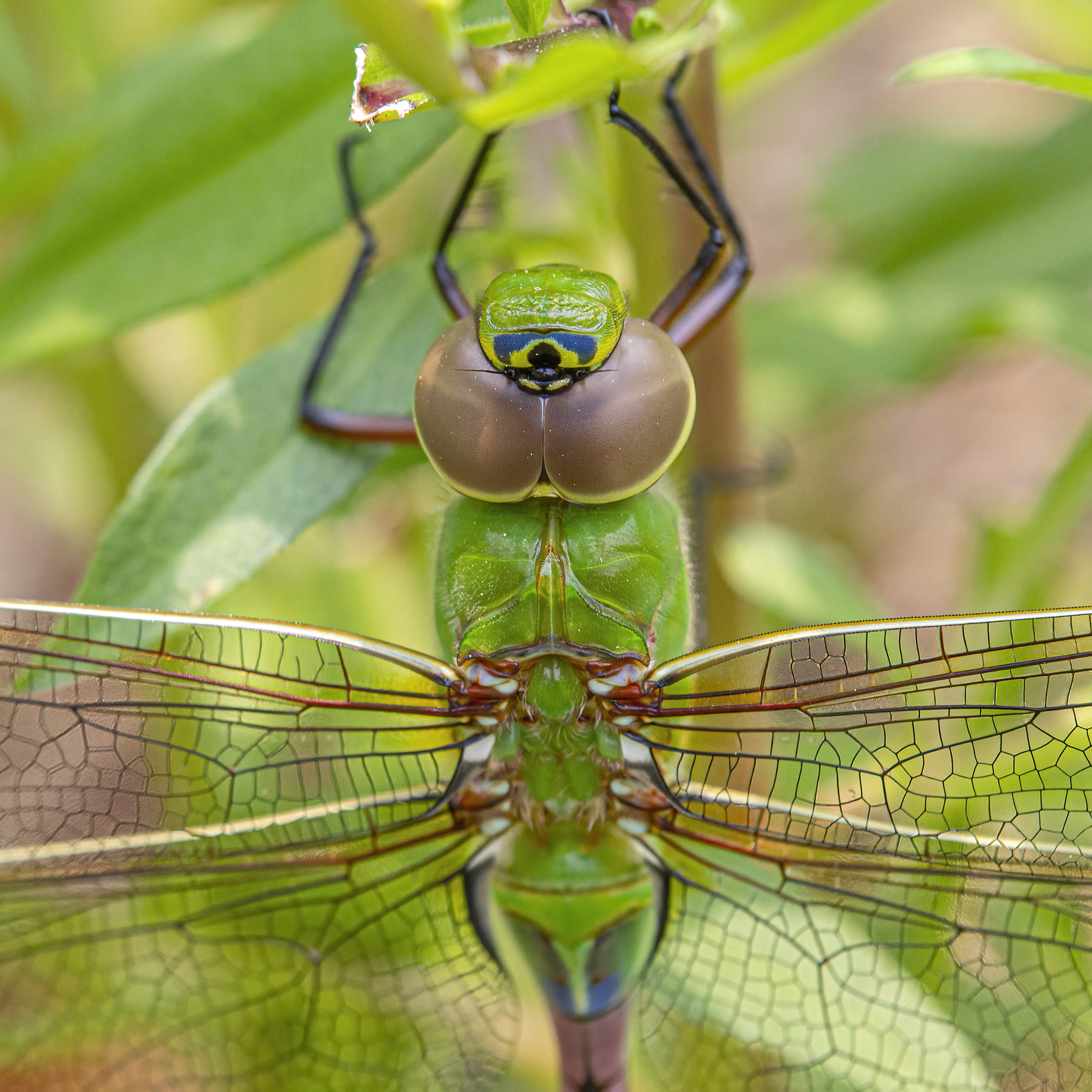
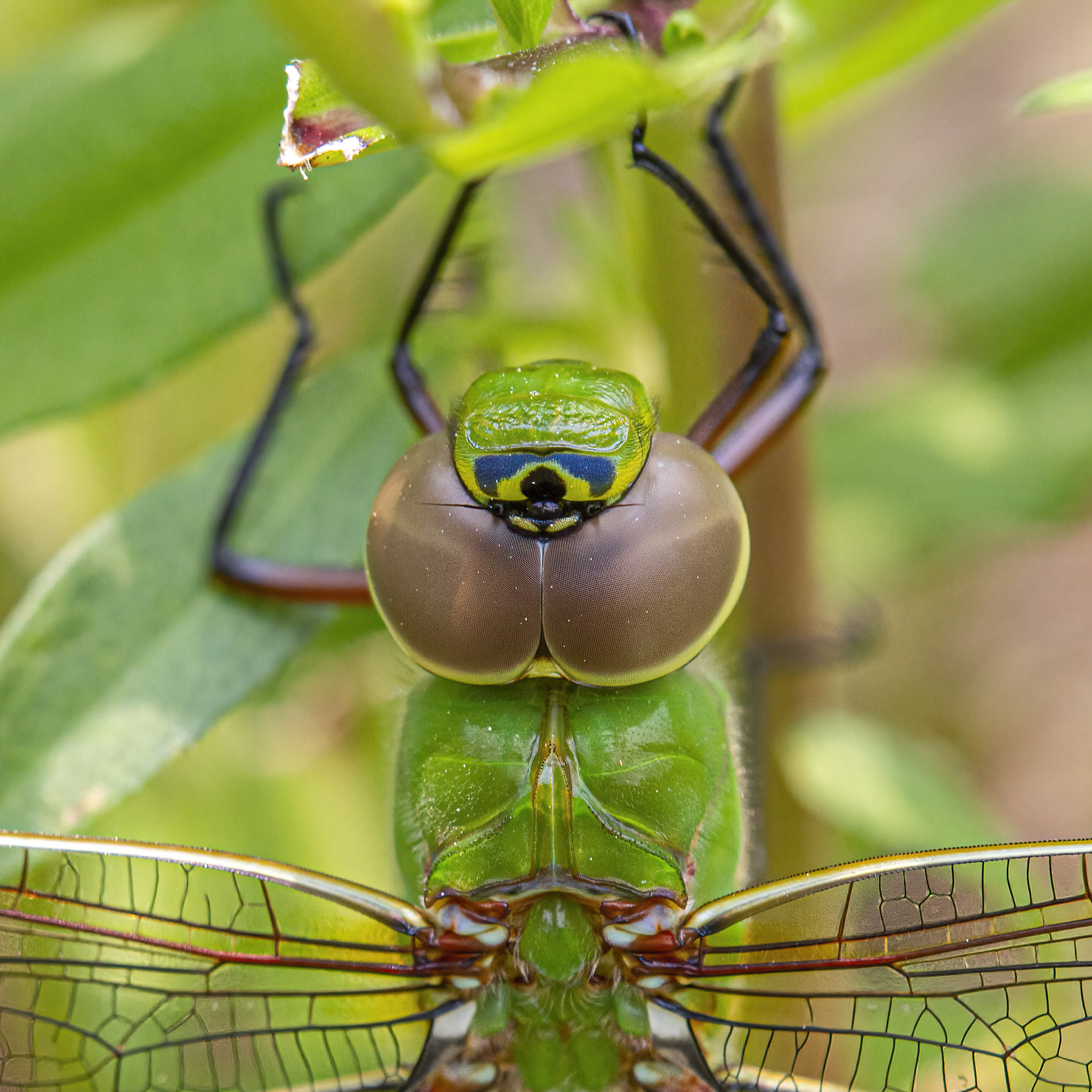
I am used to seeing Common Green Darner (Anax junius) dragonflies flying overhead, but on Tuesday I had the relatively rare chance to see one up close at Occoquan Regional Park. The Common Green Darner is a large, colorful dragonfly that is known for its long distance migratory flights. According to Wikipedia, “By attaching micro-radio transmitters to Common Green Darners, researchers have found them to be capable of migrating up to 140 kilometers in a day, though they typically cover less distance per day. ” Wow!

I spotted this dragonfly when I saw it fly to a perch in the vegetation just inches above the ground. I slowly made my way towards the vertically-perched Common Green Darner and surprisingly it did not move. I am not certain, but I had the impression that the dragonfly had newly emerged and was resting as its body parts dried out.

My 180mm macro lens gives you the impression that I was right on top of the dragonfly, but I was actually quite a bit farther away than it seems. After I took a few shots and moved away, the Common Green Darner remained in place. In fact, when I passed by the same area about twenty minutes later, it was still perched there.

I was thrilled by the amount of detail that I was able to capture. You can easily see the distinctive “bullseye” marking, for example, on the “face” of the dragonfly. The second image is a closer crop of the first image and it helps you to see some of the ommatidia, the thousands of faceted optical units that make up the dragonfly’s amazing compound eyes. You may want to click on the image to make it larger on your screen.

According to an on-line article called Dragonfly’s Eyes, “Dragonflies have very large eyes and have very good vision. Vision dominates their behaviour, including predation and looking for mates. The compound eye is made up of ommatidia which is a visual unit consisting of a lens system and a group of light sensitive cells. A large dragonfly may have up to 30,000 ommatidia in each compound eye. Each ommatidium collects one visual information, together form a mosaic image in the dragonfly’s brain. It is believed that the insects’ compound eyes are not as high resolution as vertebrate eyes. However, the dragonfly’s visual system is extremely sensitive to movement and it points in almost all direction and gives the 360 degree visual field.”

Common Green Darner

Common Green Darner

© Michael Q. Powell. All rights reserved.
Read Full Post »

I photographed this damselfly on last Wednesday at Occoquan Regional Park in Northern Virginia. The pattern of black and blue markings on the damselfly’s abdomen was unfamiliar to me. The closest I could come when comparing it with photos in my identification guide was a female Azure Bluet (Enallagma aspersum), but identification of bluet species can be tricky, since almost all of them are black and blue and you have to look really closely to distinguish one from another.

I posted the photo in a Facebook group dedicated to dragonflies and damselflies in Virginia and was a little shocked when one of the experts in the group confirmed my tentative identification. As far as I can recall, this is a new species for me, which makes this sighting even more special.

Azure Bluet damselfly

© Michael Q. Powell. All rights reserved.


Read Full Post »

I was delighted on Wednesday to spot my first Eastern Pondhawk (Erythemis simplicicollis) dragonflies of the season while I was exploring the trails at Occoquan Regional Park. As we progress into summer, this species will become quite abundant, but it is always a joy to spot these little beauties.

Females, like the ones in these photos, are bright green in color and have a banded abdomen. I did not see any males that day, but they start out with coloration similar to that of the females and then gradually transition to having a blue abdomen and a blue and green thorax. Both genders have green faces, which, along with their coloration, make them easy to identify.

I love the way that the green spring foliage matches the colors of an Eastern Pondhawk and provides a beautiful backdrop for them, as you can see in these photos.

I will be away in the mountains this weekend on a church retreat, so will probably not be posting for the next few days. I will have my camera with me, though, so you may see a few photos from my adventures there in upcoming blog postings.

Eastern Pondhawk

Eastern Pondhawk

© Michael Q. Powell. All rights reserved.


Read Full Post »

Yesterday I spotted my first Ebony Jewelwing damselfly (Calopteryx maculata) of the season while exploring at Occoquan Regional Park in Lorton, Virginia. As far as I know, this is the only damselfly in our area with completely dark wings, so it is a pretty easy species to identify.

Most of the time I spot Ebony Jewelwings in the shadowy vegetation along small streams, but this one was perched in the open. Perhaps it was enjoying the warmth of the spring sunshine.

I am not sure why the eyes of this damselfly appear to be red, because most of the time the eyes of male Ebony Jewelwings are darker. Perhaps the reddish coloration is a result of the angle of the light or maybe it is related to the age of the individual and will darken as he grows old.

Ebony Jewelwing

© Michael Q. Powell. All rights reserved.

Read Full Post »

I was extremely happy yesterday to encounter several Twin-spotted Spiketail dragonflies (Cordulegaster maculata) during a visit to Occoquan Regional Park, a county-run recreational park in Lorton, Virginia. In the past I have occasionally seen Twin-spotted Spiketails at this location and I went there specifically to look for this species—I was hopeful, but realistic in my expectations of finding this relatively uncommon dragonfly.

Spiketails are a small family of large black or brown dragonflies with similar bright yellow stripes on their thoraxes and species-specific makings on their abdomens. Females have a spike-like pseudo-ovipositor at the end of their abdomens that is responsible for the “spiketail” name.

When I first encountered a spiketail yesterday, it was flying in the air and I was not sure what kind of dragonfly it was. Fortunately I was able to see where it landed and when I got closer, I was ecstatic, because I could actually see the dragonfly’s “spike,” as you can see in the first photo.

There are several other spiketail species in our area, but the Twin-spotted Spiketail is the only one that is flying this early in the season. The flight season for most of the early season dragonflies lasts for only a month or so, so I try to spend as much time outdoors as I can during April and May to maximize my chances of seeing these uncommon species. As you can probably judge, from the first photo, Twin-spotted Spiketails are large, almost 3 inches (76 mm) in length. Although you can’t really seen the markings in the first photo, there are a paired yellow spots or rounded triangles along the length of the abdomen.

I decided to hang around the area where I spotted the first spiketail to see if others would fly by and my patience was rewarded. I was able to capture shot of several other Twin-spotted Spiketails as you can see in the second and third photos. Both of these spiketails are males, I believe, and therefore do not have the visible “spike.” In those photos, though, you get a pretty good view of the pattern of the paired spots, which is why the species is called “twin-spotted.”

This dragonfly season is starting out with a bang and I feel blessed to have photographed several uncommon species already. Temperatures today are forecast to rise to about 84 degrees (29 degrees C) and I plant to continue my search for beautiful and elusive aerial acrobats, like these Twin-spotted Spiketails.

Twin-spotted Spiketail

Twin-spotted Spiketail

Twin-spotted Spiketail

© Michael Q. Powell. All rights reserved.


Read Full Post »

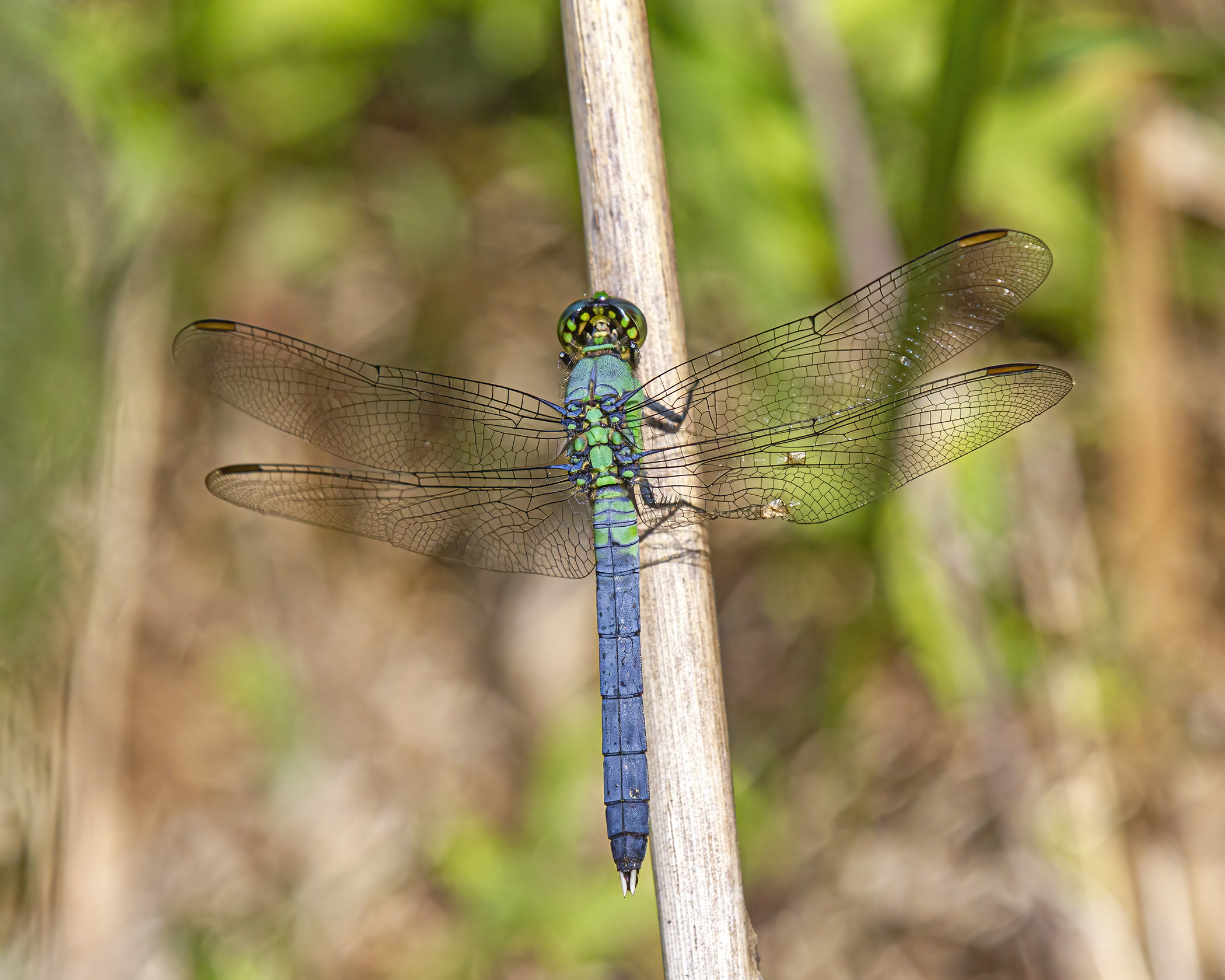
There are quite a few blue dragonflies where I live, so I can’t simply rely on color to tell them apart. Fortunately, it is very easy to identify a male Spangled Skimmer (Libellula cyanea), because it has a white spot beside a black spot on the outer leading edge of each wing—as far as I know, no other dragonfly in our area has multi-colored stigmata, the technical name for those spots.

The stigmata are not there for decoration, but serve an important role in the flight of dragonflies. I do not really understand the physics of flight, but have read that the stigmata are heavier than the adjoining cells and help to stabilize the vibrations of the wings.

I spotted these two mature male Spangled Skimmers during recent trips to Occoquan Regional Park. Earlier this year I saw some immature male Spangled Skimmers at the same location that were brown and yellow in coloration, just like the females of the species. (See my posting from 30 May 2022 entitled Spangled Skimmer dragonflies to see photos of an immature male and a female of this species.) Although the color of the males changes completely as they mature, the distinctive stigmata are present even when they are young.

Spangled Skimmer


Spangled Skimmer

© Michael Q. Powell. All rights reserved.
Read Full Post »

I was excited last Monday to spot this Halloween Pennant (Celithemis eponina), one of my favorite dragonflies, as I was exploring a small pond in Fairfax County. I especially love the beautiful patterns on its wings and the way that it perches on the very tip of flimsy vegetation, causing it to flutter in the slightest breeze, like a pennant.

Halloween Pennant

© Michael Q. Powell. All rights reserved.

Read Full Post »

It is a simple law of nature that all creatures have to eat and many of my subjects are carnivores. The question of whether a creature is predator or prey is often a relative one—today’s predator can easily become tomorrow’s prey.

I try not to get emotionally involved when I witness one creature feeding on another, but that is not always possible. For me it is somewhat jarring when I see one dragonfly eating another—it feels like cannibalism.

For some reason, most such encounters that I have witnessed have involved Eastern Pondhawk dragonflies (Erythemis simplicicollis). This species is not at that large or powerful, but seems particularly fierce. Some other dragonflies catch their prey and eat while they are flying, their version of “fast food,” so that may be why I don’t see dragonflies consuming other dragonflies very often.

In the first photo, a female Eastern Pondhawk was feasting on a male Calico Pennant dragonfly (Celithemis elisa) that it had just caught. As you can see, the dragonfly holds its prey in its long legs and begins by eating the head.

In the second photo, taken at a different location, another female Eastern Pondhawk was munching on an unidentifiable damselfly. Readers sometimes ask me about the differences between dragonflies and damselflies and this photo gives you a general idea of the relative size and shape of their bodies.

According to a fascinating posting called “What do Dragonflies Eat?” on The Infinite Spider website, “All adult dragonflies are insectivores, which means they eat insects they catch with their spiny hairy legs.  The insects are then held in a basket-like device while flying. They particularly delight in mosquitoes (30-100+ per day per dragonfly!) as well as other pesky flight bugs  such as flies, butterflies, bees, and even other dragonflies.”

Check out the posting that I referenced in the previous paragraph, if you dare, for details about how dragonflies actually eat. Here is a sneak preview, “The main thing to notice is that they have jaws that work side to side and that are shaped like wicked meat hooks, mandibles that go up and down and maxillae that act like a lower lip and hold food.” Yikes!

Eastern Pondhawk


Eastern Pondhawk

© Michael Q. Powell. All rights reserved.


Read Full Post »

I never know what will catch my eye when my camera is in my hand. On Monday, for example, I spotted these tiny, colorful flowers while hunting for dragonflies at Occoquan Regional Park. The blue one is a type of blue-eyed grass (g. Sisyrinchium), but I can’t identify the pretty pink one.

I am not a gardener, so I never learned to differentiate between flowers and weeds—they are all flowers to me. I find the names of plant species to be confusing at times. Blue-eyed grass, for example, is not actually a grass, but a perennial related to the iris, and it comes in multiple colors. Yikes!

The good news is that my lack of knowledge about plants does not keep me from enjoying fully the beauty of these tiny flowers. To borrow a line from Shakespeare, “What’s in a name? That which we call a rose, by any other name would smell as sweet.”

If you recognize the pink flower and can identify it, please let me know what it is. Ten years ago I could not identify a single dragonfly, but over time I have learned a lot about them. There is hope, therefore, that I will similarly expand my knowledge of flowers as I encounter and photograph them.

UPDATE: Thanks to Steve Gingold, I now know that the pink flower is a Deptford Pink (Dianthus armeria), a plant species native to Europe that is naturalized in much of North America. Be sure to check out Steve’s blog for lots of wonderful nature images and a wealth of information about plants, insects, and other aspects of nature, especially in Western New England, where he lives.


pink flower

blue-eyed grass

pink flower

© Michael Q. Powell. All rights reserved.


Read Full Post »

I love dragonflies with patterned wings and one of the coolest ones in our area is the male Widow Skimmer (Libellula luctuosa), which has a distinctive combination of one dark and one white blotch per wing. Eventually the immature male in the first photo will turn bluish in color, but for now he has the brown and yellow colors that he shares with the females. The females have only a single large blotch on each wing, so usually I can tell the genders apart.

When the male first emerges, however, the white blotches may be hard to see, so I have to look more closely at other aspects of the dragonfly’s body. I am pretty confident that the dragonfly in the second photo is a very young male Widow Skimmer.

It was really easy to track a male Widow Skimmer dragonfly in the air, because its colorful wings made it look almost like a butterfly. However, the dragonfly in the first photo was remarkably skittish and would perch only momentarily in between its patrols over the waters of the small pond that I visited on Monday. Eventually my patience paid off and I was able to get a shot, albeit from a relatively long distance away.

Widow Skimmer

Widow Skimmer

© Michael Q. Powell. All rights reserved.


Read Full Post »

When damselflies mate, it is often a very conspicuous event, easily recognized by the heart-shaped “wheel” formation of the mating couple. The male clasps the female by the back of her head and she curls her abdomen to pick up sperm from secondary genitalia at the base of the male’s abdomen. That’s about as graphic as I dare go in describing the process.

Yesterday I spotted a pair of mating Ebony Jewelwing damselflies (Calopteryx maculata) as I was exploring a stream in Fairfax County, Virginia, the county in which I live. Ebony Jewelwings are immediately identifiable, because they are the only damselflies in our area with dark wings. They can be found at a wide variety of running waters, especially at shaded forest streams, like the one where I found this couple.

Male Ebony Jewelwings have wings that are all black, while females have dark brown wings with conspicuous white pseudostigmas—the male is on the right in this photos. The body of the males is a metallic green with copper highlights—in certain lights, their bodies may look distinctly blue. Females seem to have a bit more color variation, though it is hard to tell their true color because of the reflected light from their shiny bodies.

Ebony Jewelwing

© Michael Q. Powell. All rights reserved.

Read Full Post »

I was tracking a Common Green Darner dragonfly (Anax junius) in my viewfinder yesterday at Occoquan Regional Park, when suddenly another dragonfly flew into the frame. The two dragonflies appeared to hook up in mid-air and I assumed that they were mating. When they landed in some nearby vegetation, however, I discovered that it was hunger and not lust that had brought them together. The Common Green Darner was having lunch with a Common Whitetail dragonfly (Plathemis lydia), and it was the main course.

Dragonflies feed on other live insects and they aren’t picky eaters—they will eat any insect they can catch, including other dragonflies. Midges and mosquitoes make up the bulk of their diet, but dragonflies also prey on flies, bees, beetles, moths, butterflies, and other flying insects. The larger the dragonfly, the larger the prey insect it can consume.

As you can see from the photo, Common Green Darners are quite large, with an overall length of approximately three inches (76 mm), while Common Whitetails are considerably smaller, with an overall length of approximately 1.7 inches (43 mm).

Common Green Darners are really powerful fliers too and are one of only a handful of dragonfly species that migrate. The adult Common Green Darners that I see this early in the season are likely to be migrants from locations further south. Kevin Munroe described their migration really well on the wonderful Dragonflies of Northern Virginia website:

“They emerge in the Southeast and fly north, arriving here late March thru May. After their long flight, they mate, lay eggs and die. Their young emerge in July and August. Congregating in large swarms, this second generation begins flying south in September. They lay eggs that fall, after arriving in their southern destinations, and die. When their young hatch in March, they fly back to N. VA and it starts again – a two generation migration.”

The Common Whitetail in the photo probably emerged only recently and may have been particularly vulnerable. Some may find this photo to be a little disturbing or a bit too graphic, but I think it shows the “circle of life” in nature. Yesterday the Common Green Darner was the predator, but tomorrow it could become the prey of a bird or some other creature higher up on the food chain—all creatures have to eat.


Common Green Darner

© Michael Q. Powell. All rights reserved.

Read Full Post »

Quite often the simplest of subjects can be incredibly beautiful, like these little white butterflies that I photographed last week. Many folks might dismiss these nondescript creatures as moths or simply ignore them. It really is worthwhile to slow down and look at them closely.

The butterfly in the first photo is a Cabbage White (Pieris rapae) that was feeding on a patch of what I believe is purple dead nettle. Although it looks like a macro shot, I captured the image at the 600mm end of my telephoto zoom lens.

I took the next two pictures with an actual macro lens, my trusty Tamron 180mm lens. The tiny Eastern Tailed-Blue butterfly (Cupido comyntas) has a wingspan of about an inch (25 mm) and I was thrilled to capture so much detail of its beauty, including the little “tails.”

Beauty is everywhere.

Cabbage White

Eastern Tailed-blue

Eastern Tailed-blue

© Michael Q. Powell. All rights reserved.
Read Full Post »

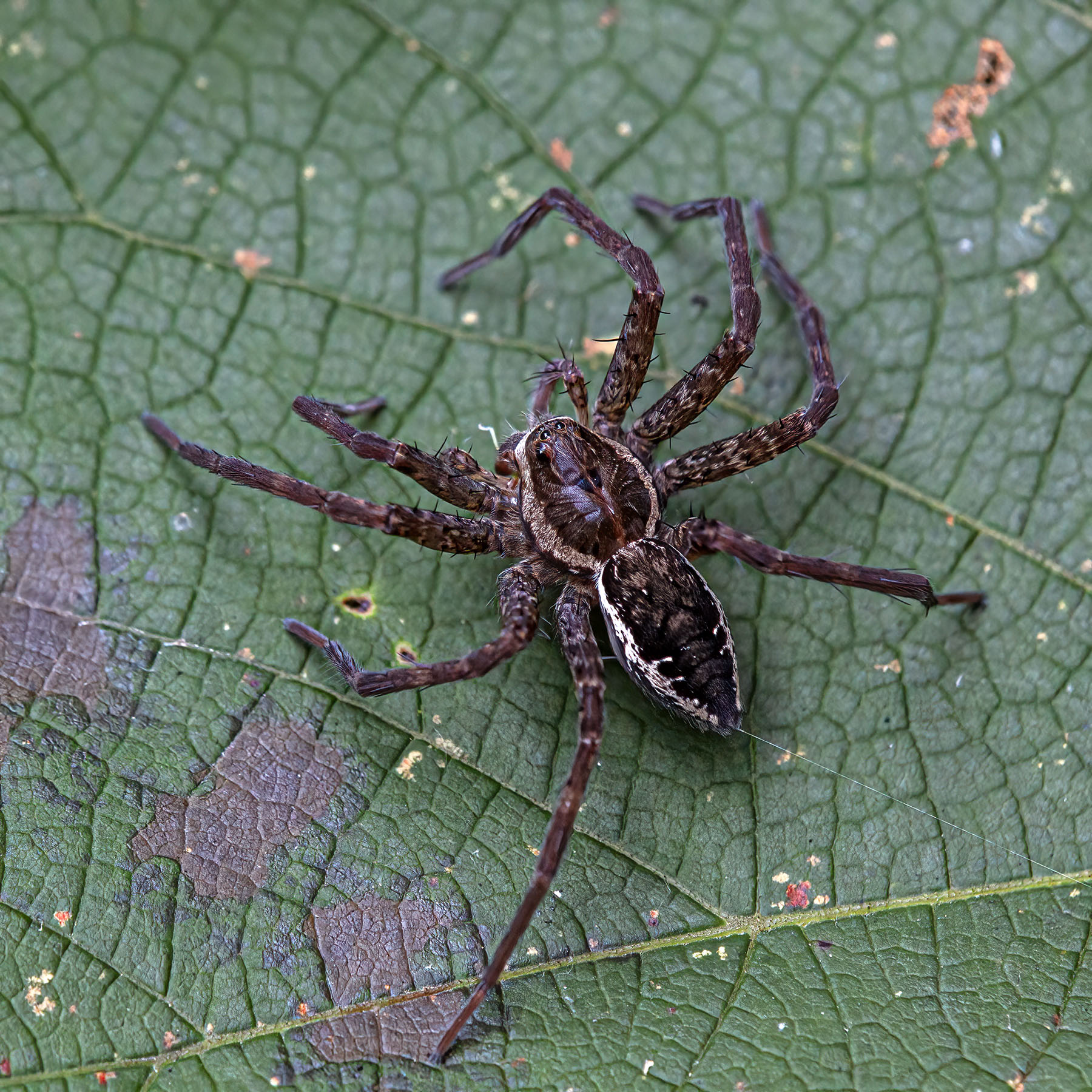
I spotted this large spider last Thursday at Occoquan Regional Park perched atop some leafy vegetation and watched as it captured a small moth that made the mistake of landing on the same leaf. The spider assumed a defiant pose when I started to photograph it—obviously it did not want to share its lunch with me—and I captured the first photo as I stared straight into its multiple eyes.

I initially thought that this was a fishing spider because of its large size and overall shape, but I am beginning to wonder if it might actually be a wolf spider. Most of the fishing spiders that I have seen have been in the water and this one was a foot (30 cm) in the air, although it was overhanging the edge of a small stream. I included a shot of its body that shows its markings, in case any of you are expert enough to identify its species.

I know that people have mixed reactions to spiders, but I encourage those of you who do not find them to be totally creepy to click on the first photo. Doing so will allow you so see some wonderful details of the spider, especially its eyes, and the remains of the hapless moth.

spider

spider

© Michael Q. Powell. All rights reserved.


Read Full Post »

I was thrilled to spot this cool-looking Crusader Moth last week during a visit to Occoquan Regional Park. The distinctive pattern on the wings of this moth, technically a Clymene Moth (Haploa clymene), brings to mind the shields used by knights during the Crusades.

Although the context is completely different, it somehow brought to mind the opening word of one of the hymns that I grew up singing at a small Baptist church in Massachusetts—”Onward Christian soldiers! Marching as to war, with the cross of Jesus going on before.” My personal beliefs grew more tolerant as I grew up and the words of that hymn today seem overly militaristic and strident, just as the cartoons of my childhood now seem incredibly violent.

Crusader Moth

© Michael Q. Powell. All rights reserved.


Read Full Post »

When Americans hear the word “spangled,” they are likely to think of our flag and our national anthem, especially this past weekend as we celebrated Independence Day. I think too of Spangled Skimmer dragonflies (Libellula cyanea), like this handsome male that I photographed this past Saturday in Fairfax County, Virginia. While the “spangles” in the Star-Spangled Banner refer to the stars on the flag, the “spangles” of this species refer to the little white patches, known as stigmas, on their wings.

Spangled Skimmer

© Michael Q. Powell. All rights reserved.

Read Full Post »

The ponds and marshes are alive with the sight of flying dragonflies. As the summer weather has grown increasingly hot and humid, the number of dragonflies has increased —we are probably nearing the peak of dragonfly activity.

One of the species that I encounter most frequently is the Eastern Pondhawk (Erythemis simplicicollis). When male Eastern Pondhawks are immature, they sport the emerald  coloration and striped abdomens of their female siblings, but as they get older they turn into a beautiful shade of blue that is a perfect complement to their bright green faces and bluish-green eyes.

I spotted these two adult male Eastern Pondhawks last Saturday during a visit to Occoquan Regional Park. Unlike some species that always perch in the same way, Eastern Pondhawks will perch in a variety of different ways almost anywhere. I selected these two photos today because I like the way that they show off the coloration of these handsome dragonflies.

Eastern Pondhawk


Eastern Pondhawk

© Michael Q. Powell. All rights reserved.


Read Full Post »

Sometimes the shadows are at least as interesting as the subject in my wildlife photos, as was the case with this Ebony Jewelwing damselfly (Calopteryx maculata) that I spotted last week while exploring a stream in Fairfax County. Initially the dragonfly was perched on the rock with its wings closed and I merely observed it. As soon as it flared its wings, though, I knew I had to take a shot and am pretty happy at the way that it turned out.

Ebony Jewelwing

© Michael Q. Powell. All rights reserved.


Read Full Post »

« Newer Posts - Older Posts »