Feeds:
Posts
Comments

Posts Tagged ‘Occoquan Bay National Wildlife Refuge’

Over the past week I have spotted Woodland Box Turtles (Terrapene carolina carolina) at two different locations in my local area. The red eyes of both turtles suggest that that they are males, though I have read that eye color is not always 100% accurate in determining the gender of a box turtle. The shell pattern for each box turtle is supposed to be unique, like a fingerprint, and you can definitely see differences in the patterns on the shells of these two turtles.

It is always a treat to spot one of these box turtles, because they are so cool-looking. Unlike many turtles, the box turtle is primarily terrestrial rather than aquatic, and most of the times that I have encountered them, they have been out in the open. According to the Virginia Department of Wildlife Resources (DWR), “The box turtle has a low reproductive rate and is long lived. It requires 10-20 years to reach sexual maturity. Box turtles may sometimes live to over 100 years.”

Virginia has special protections for this species. According to the DWR,  “it is illegal to keep one in your home in Virginia due to the significant number of wild caught animals found in captivity. This species is primarily threatened due to the thousands that are caught for the pet trade from the wild each year; although habitat fragmentation and urbanization also account for a fraction of the population’s drop of 32% over the last 100 years.”

Woodland Box Turtles

Woodland Box Turtle

© Michael Q. Powell. All rights reserved.


Read Full Post »

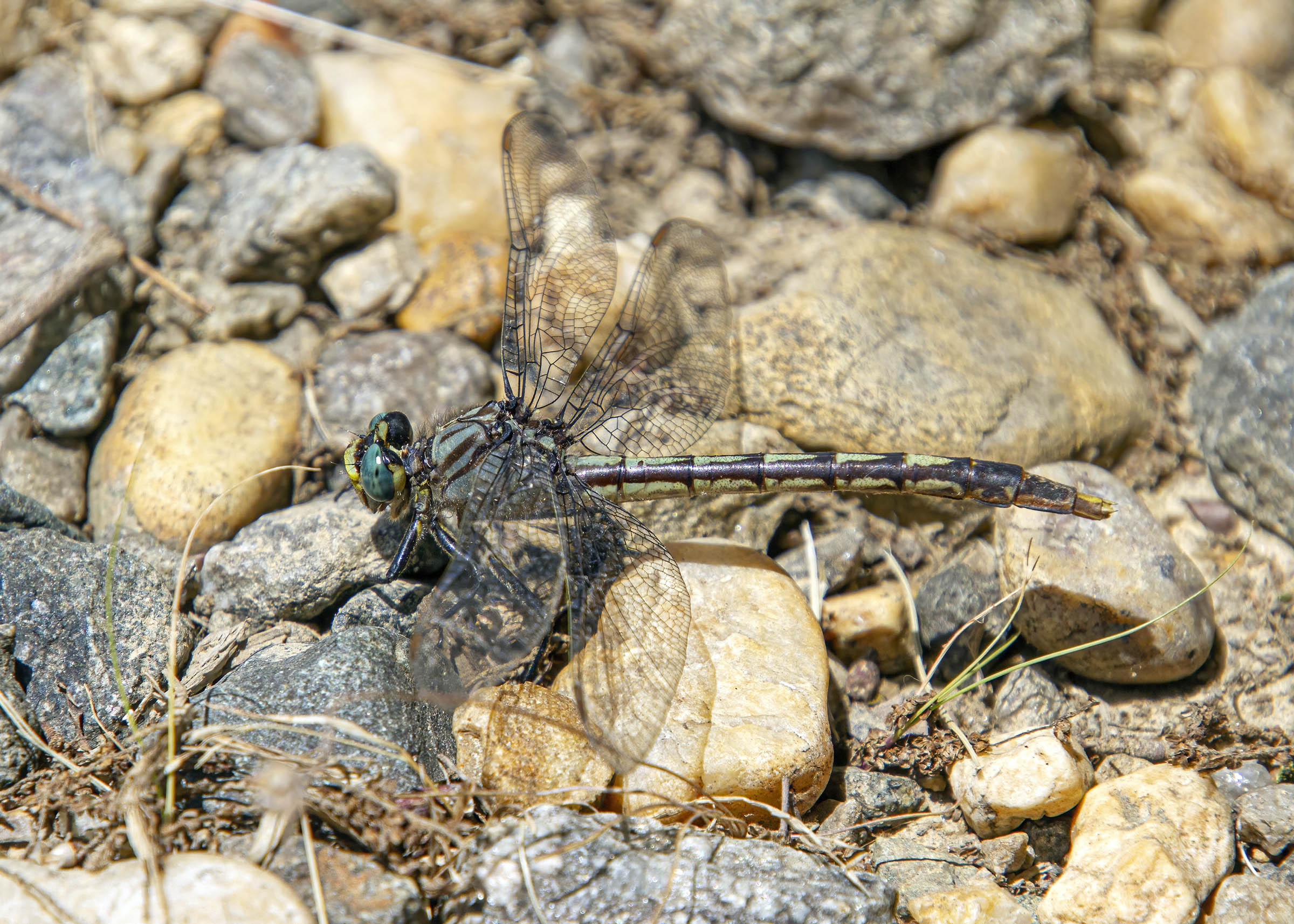
On Monday I finally spotted some mature male Calico Pennant dragonflies (Celithemis elisa) with red markings at Occoquan Bay National Wildlife Refuge. Heretofore all of the males that I had seen this year were immature and had yellow markings, like those of their female counterparts.

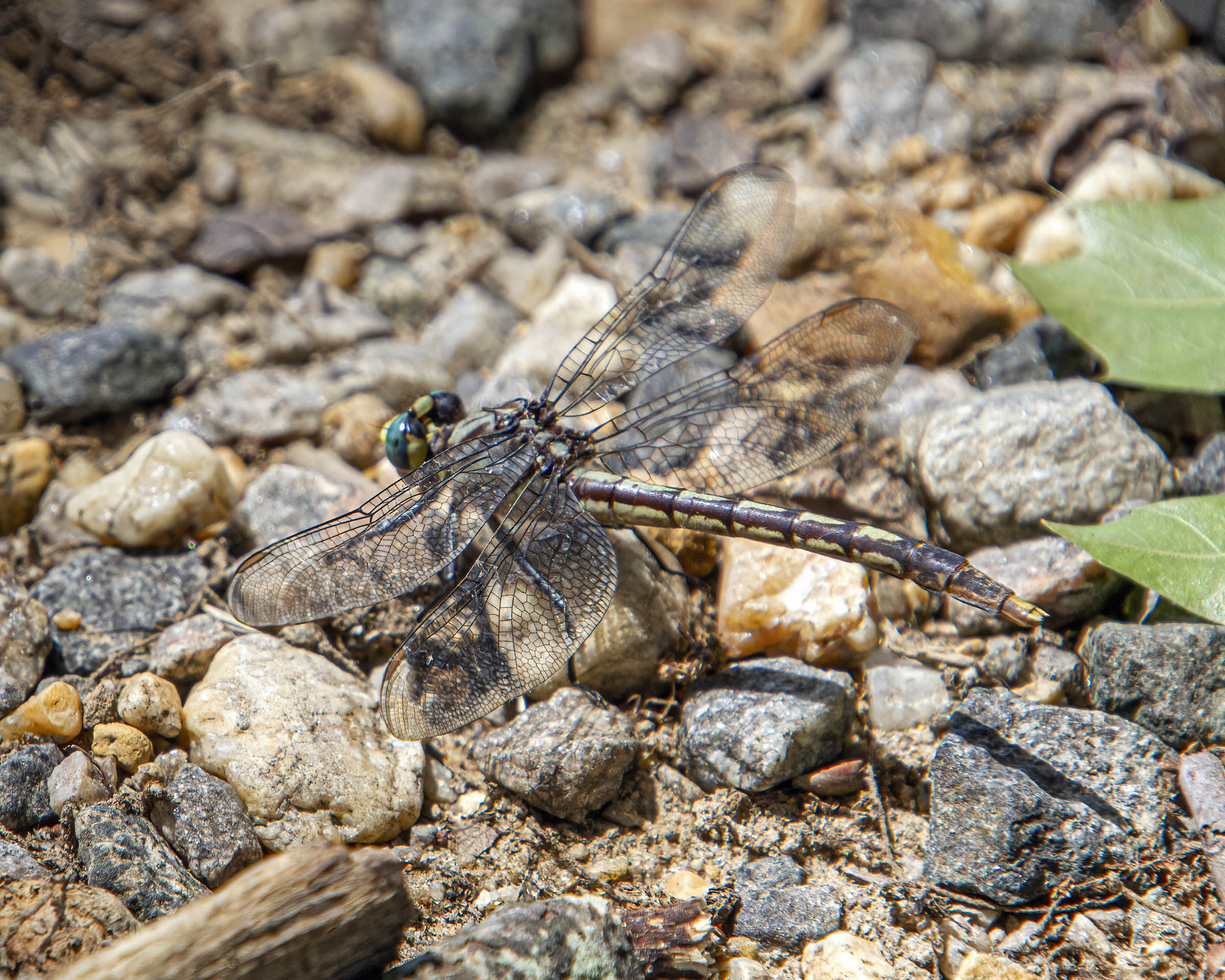
The first two photos show male Calico Pennants. I love the way that the red marking on the abdomen look like a series of tiny hearts. The dragonfly in the third photo is an immature male—you can tell that it is a male by looking at the shape of the tip of the abdomen (the “tail”).

For the sake of comparison, I have added a final photo of a female Calico Pennant from a posting I did in May 2020. You can readily see that the dragonflies in the last two photos are similar in coloration, but you have to look a bit closer at them to see that the wing patterns are slightly different and the shapes of the terminal appendages are quite different.

Most of us tend to rely on colors for identifying species of birds and insects, but I have learned over time that color is often not a reliable identification feature, especially for immature subjects, when the males and females are often similar in color and the color differentiation becomes apparent only when they mature.

Calico Pennant

Calico Pennant

Calico Pennant

Calico Pennant

© Michael Q. Powell. All rights reserved.

Read Full Post »

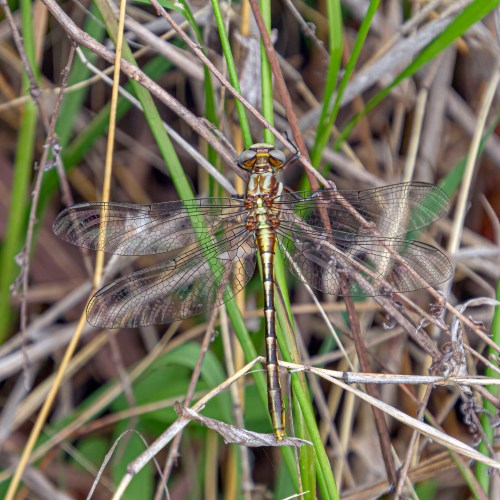
This dragonfly was perched on the ground on Monday at Occoquan Bay National Wildlife Refuge when I spotted it. I knew immediately that it was either a Lancet Clubtail (Phanogomphus exilis) or an Ashy Clubtail (Phanogomphus lividus), but these two species are so similar in appearance that it is tough for me to tell them apart.

I checked my identification guides and realized that I had to look at the dragonfly more closely and get a bit more geeky. The abdomen (the “tail”) of dragonflies  consists of ten segments traditionally numbered S1 through S10, starting from the point at which the thorax (the “chest”) meets the abdomen (S1) and going downward to the tip of the abdomen (S10).

The Dragonflies of Northern Virginia website notes that for Lancet Clubtails there is a “noticeable bright yellow flange on sides of S8 & S9 (male and female), while Ashy has almost no flange, and less bright yellow.” I knew about these differences, but couldn’t see them clearly enough when I was in the field.

The dragonfly was relatively cooperative and I was able to get a shot of it from almost directly overhead. The image is really cluttered, because of the vegetation, and  artistically is not a great photo, but it does provide the kind of details that are helpful for identification.

In the image I saw what appear to be yellow flanges on the sides of S8 and S9  and I could clearly see the appendages at the tip of the abdomen, which helps me identify the gender of the dragonfly. These elements suggested to me that it was a female Lancet Clubtail. I posted a photo in a Facebook group devoted to dragonflies and damselflies in Virginia and was delighted when one of the most experience members there agreed with my identification of this dragonfly.

I don’t expect most of my readers to delve this deeply into dragonfly anatomy, but I figured it might be interesting to learn about what some of the myriad considerations that swirl about in my mind as I seek to photograph and identify these beautiful little creatures. Sometimes I am successful in connecting the dots and coming to a conclusion, but at times the identities of my subjects remains a mystery.
Lancet Clubtail

© Michael Q. Powell. All rights reserved.


Read Full Post »

Most warblers nest either on the ground, in shrubs, or in trees, according to the Cornell Lab of Ornithology website, but the Prothonotary Warbler and the Lucy’s Warbler build their nests in holes in standing dead trees or may use nest boxes when available. On Monday I was delighted to spot a Prothonotary Warbler (Protonotaria citrea) at Occoquan Bay National Wildlife Refuge checking out a nest box from the outside and eventually from the inside too.

The nest box is old and may have a leaky roof, but the warbler seemed happy to have found it. The real estate market is tight in Northern Virginia right now and finding any place to live is difficult. After a short stay on the roof, the Prothonotary Warbler flew away and made an aerial approach from the front, perching at the entrance for a moment before entering the nest box.

I obviously could not see what was going on in the box, but periodically I could see flashes of yellow as the warbler moved about inside the box. Perhaps there are already eggs in the box. The warbler stayed inside the box for about five minutes before it poked its head out of the entrance and began to look around, as you can see in the final photo. I was hoping to capture a shot of the bird exiting the nest box, but it left more quickly and unexpectedly and I missed the shot.

I will be checking this spot out during my next visits to the wildlife refuge, hoping that I will be lucky enough to see some baby warblers.

Prothonotary Warbler

Prothonotary Warbler

Prothonotary Warbler

© Michael Q. Powell. All rights reserved.

Read Full Post »
This colorful bird was a long way away yesterday at Occoquan Bay National Wildlife Refuge and I assumed it was a Northern Cardinal, but I decided to photograph it anyways. When I was reviewing my photos, I was shocked to discover that it was an immature male Summer Tanager (Piranga rubra), a new species for me. Truth be told, I was not very certain what kind of bird it was, so I did some searching on-line and came up with the correct answer, as confirmed by some experts in a birding forum on Facebook.

I will take photos of anything that catches my eye, knowing that many of them will not be “keepers.” I will take photos of subjects that are really familiar and those that may be rare or unique. My general rule is to take a lot of photos, following what I call the Law of the Wild West, i.e. “Shoot first and ask questions later.”

Summer Tanager

© Michael Q. Powell. All rights reserved.

Read Full Post »
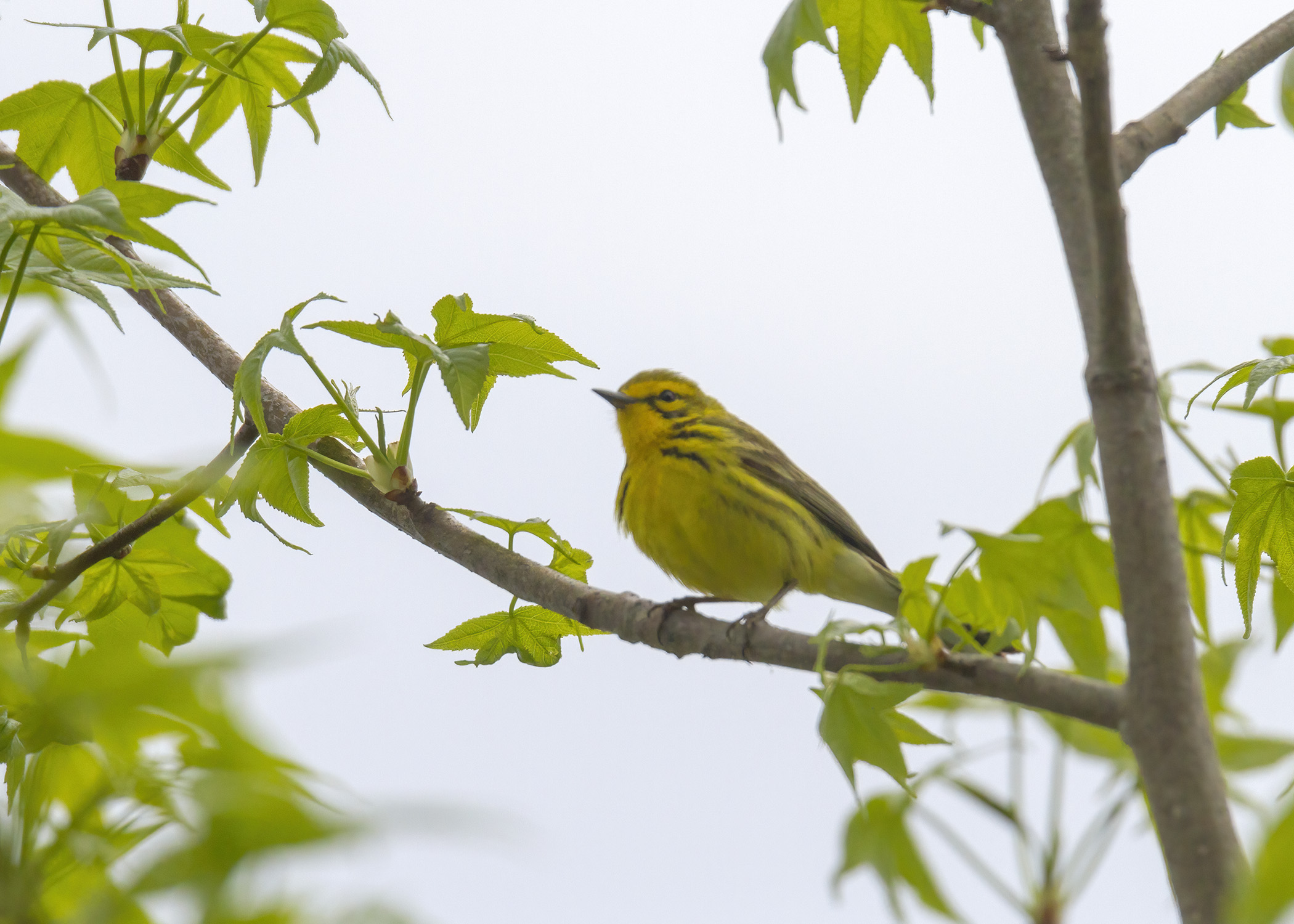
I don’t know how much longer the migrating warblers will be in my area, but this past few weeks I have been trying to get outside with my camera as often as I can, hoping to be able to photograph these colorful little birds.  On Tuesday I spotted a Prairie Warbler (Setophaga discolor) in the patient and patiently tracked it as it moved about.

The first photo was a bit of an anomaly, because the warbler momentarily gave me an unobstructed view when it jumped to a high branch. The second photo gives you a much better idea of the typical challenge I face, with the warbler barely showing itself from behind the wall of foliage. Fortunately, I reacted quick and got a shot that is one of my favorites of this warbler season, which has been my most successful one to date.

Prairie Warbler

Prairie Warbler

© Michael Q. Powell. All rights reserved.

Read Full Post »
On Wednesday I spotted a skink with a shockingly orange head while I was exploring Occoquan Bay National Wildlife Refuge. Why was the skink’s head so orange? During mating season, adult male skinks get swollen heads that turn bright orange-red in color. I am not sure what biological purpose the color change serves, but it sure is impressive.

I think that this is probably a Common Five-lined Skink (Plestiodon fasciatus), the most common skink species in my area. However, the Broad-headed Skink (Plestiodon laticeps) is similar in appearance and I am not very good at telling them apart. Whatever the case, the males in both species have orange heads during mating season.

Five-lined Skink

© Michael Q. Powell. All rights reserved.

Read Full Post »

This female Eastern Pondhawk dragonfly (Erythemis simplicicollis) blended in so well with the vegetation that I almost missed seeing her yesterday at Occoquan Bay National Wildlife Refuge. Eastern Pondhawks are one of the most commonly seen dragonflies in my area during the summer, but this is the first one that I have seen so far this year.

I love the beautiful emerald color of female Eastern Pondhawks (as well as immature males of the species). They are not particularly large as dragonflies go, but they are very fierce predators. Several times each season I stumble upon Eastern Pondhawks gnawing on damselflies or other dragonflies that they have caught. Yikes!

Eastern Pondhawk

© Michael Q. Powell. All rights reserved.


Read Full Post »

Prothonotary Warblers (Protonotaria citrea) are probably my favorite warblers. I just love their brilliant yellow plumage that seems to glow. Many warblers have touches of bright yellow, especially during the spring breeding season, but the Prothonotary Warbler outdoes them all and is almost completely covered in yellow.

I spotted this little beauty yesterday (1 May) at Occoquan Bay National Wildlife Refuge. I initially caught sight of the warbler as it was flitting about in the foliage. I would see flashes of yellow as it foraged, but could not get a clear look at it. All of the sudden the warbler flew across the trail and landed in a bush, momentarily give me a clear shot.

Quite often I strain my neck when trying to photograph warblers, a phenomenon that is colloquially called “warbler neck.” It is so common that the Audubon website has an article entitled, “A Birder’s Workout Guide for Preventing Warbler Neck.” I was very fortunate in this case, though, that the bird was perched below eye level, so I was able to capture a lot of detail without harming my neck, detail that is often hidden when I am shooting upwards at a sharp angle.

Prothonotary Warbler

© Michael Q. Powell. All rights reserved.

Read Full Post »

I spotted this spectacular Yellow-throated Warbler (Setophaga dominica) on Monday at Occoquan Bay National Wildlife Refuge as it perched amidst the hanging seed pods of what I believe is a sycamore tree. I love the round shape and texture of the seed pods and the warbler was much more in the open than he was when he was hidden amidst the foliage.

Yellow-throated Warbler

© Michael Q. Powell. All rights reserved.

Read Full Post »
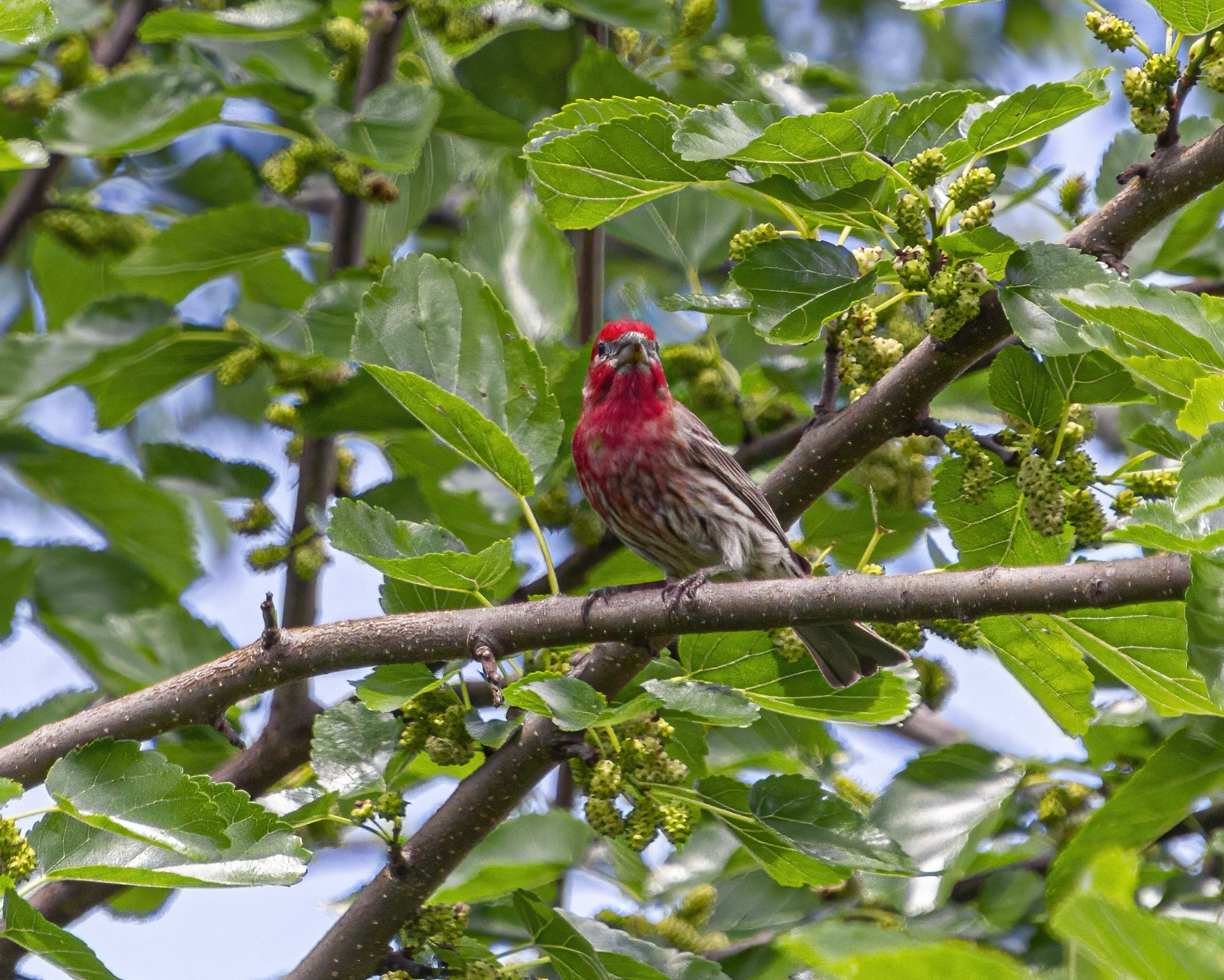
Yesterday I spotted several Indigo Buntings (Passerina cyanea) at Occoquan Bay National Wildlife Refuge. It is probably more accurate to note that I heard the buntings before I actually saw them. Unlike recent warblers that I have photographed that seem to hide behind the leaves while they sing their songs, Indigo Buntings like to fly to the top of the trees in order to be seen and heard.

I really like the basic description of this species on the Cornell Lab of Ornithology website:

“The all-blue male Indigo Bunting sings with cheerful gusto and looks like a scrap of sky with wings. Sometimes nicknamed “blue canaries,” these brilliantly colored yet common and widespread birds whistle their bouncy songs through the late spring and summer all over eastern North America. Look for Indigo Buntings in weedy fields and shrubby areas near trees, singing from dawn to dusk atop the tallest perch in sight or foraging for seeds and insects in low vegetation.”

The bird in the third photo has mottled feathers and may be in the process of molting, but I think that it is another Indigo Bunting. The only other species in our area at this time of year with equally brilliant blue feathers is the Blue Grosbeak. It is a little hard to tell, but it seems to me that the bill on the bird in this photo is too small for it to be a “grosbeak.” UPDATE: Some more experience birders in a Facebook group say that this Indigo Bunting is immature and/or in the process of molting, while others say this is a Blue Grosbeak.


Indigo Bunting

Indigo Bunting

Indigo Bunting


© Michael Q. Powell. All rights reserved.


Read Full Post »
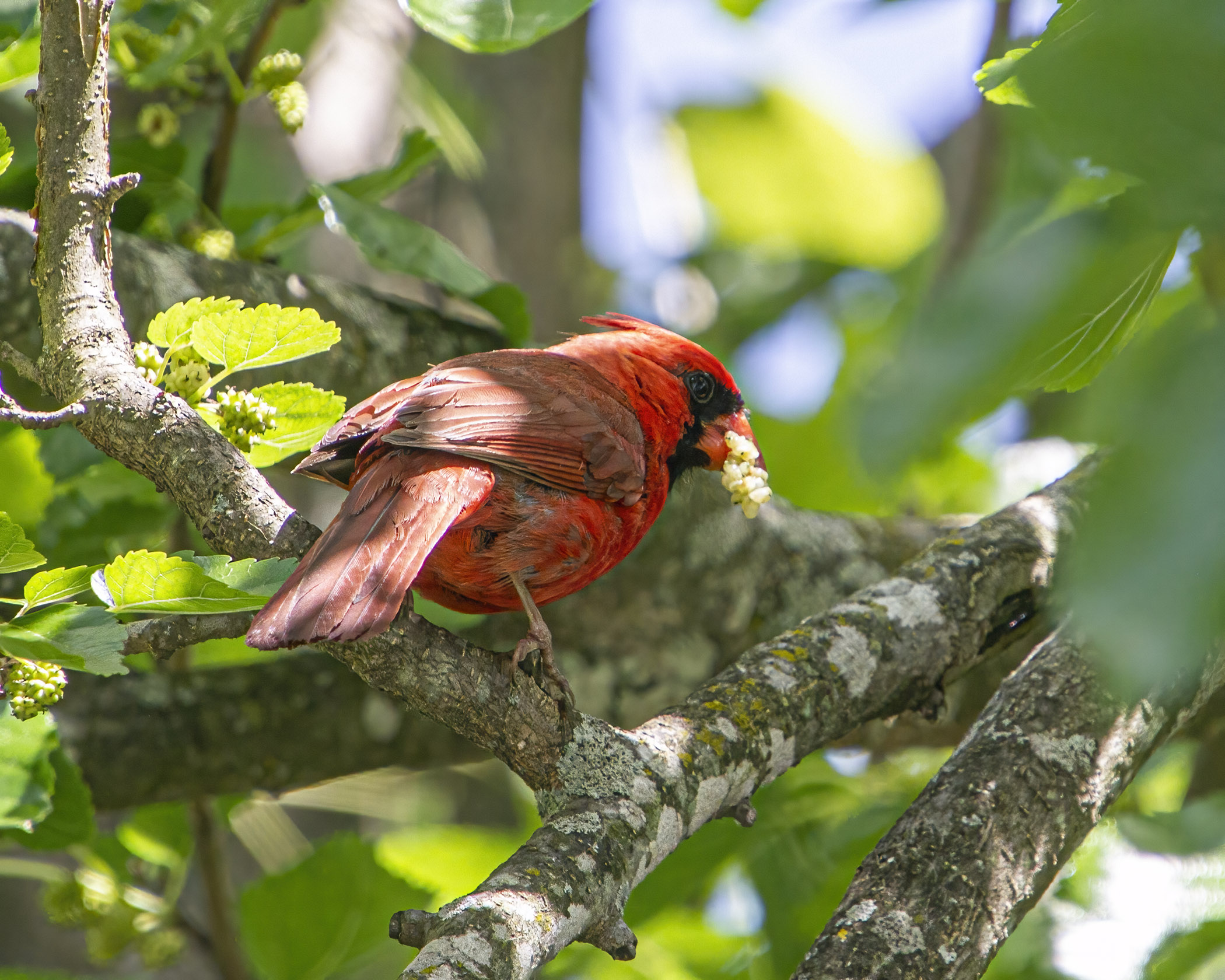
I don’t know if this Yellow-rumped Warbler (Setophaga coronata) that I spotted last week at Occoquan Bay National Wildlife Refuge was in a transitional plumage stage, but it looked awfully scraggly to me. The colors on the warbler’s face and body were mottled, but the yellow patches on its chest helped me to identify it as a Yellow-rumped Warbler.

I feel very fortunate when I am able to get any shots of a warbler. The trees are now covered in leaves and I can’t help but feel a bit of frustration when I can hear all kinds of birds singing, but can’t spot them. That’s the reality for a wildlife photographer—sometimes all I can do is watch, listen, and wait patiently, hoping that a subject will come into view.

Yellow-rumped Warbler

Yellow-rumped Warbler

© Michael Q. Powell. All rights reserved.

Read Full Post »

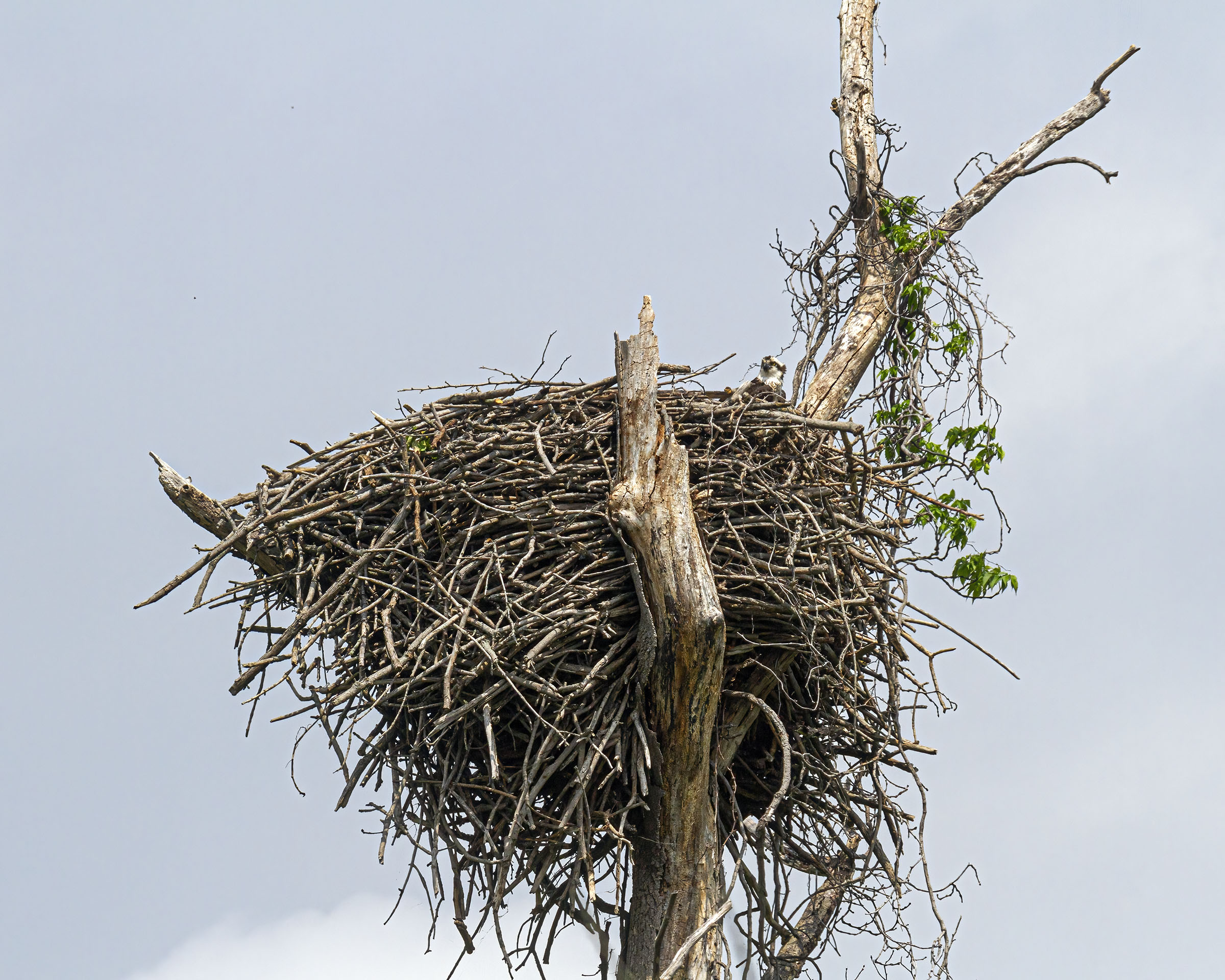
There is one extremely large eagle nest (plus one or two smaller ones) that I monitor each year at Occoquan Bay National Wildlife Refuge. Earlier this year I spotted a lot of eagle activity around that nest and I assumed that the eagles would be nesting in it.

However, recently both members of an eagle couple were spotted on the outside of the nest and ospreys began to display a lot of interest in the nest. I assume that means that the eagles were not successful in incubating eggs, but I do not know for sure what happened.

Last week I photographed an osprey in the nest and captured a few shots of it. The osprey looks absolutely tiny in the nest and the nest is far larger than the typical ones that osprey use.

I will continue to keep an eye on the nest and see if I eventually see some baby ospreys there. The big challenge is that the nest is so large and deep that osprey (or eagles) are not visible when they are sitting on eggs.

osprey


osprey

© Michael Q. Powell. All rights reserved.

Read Full Post »
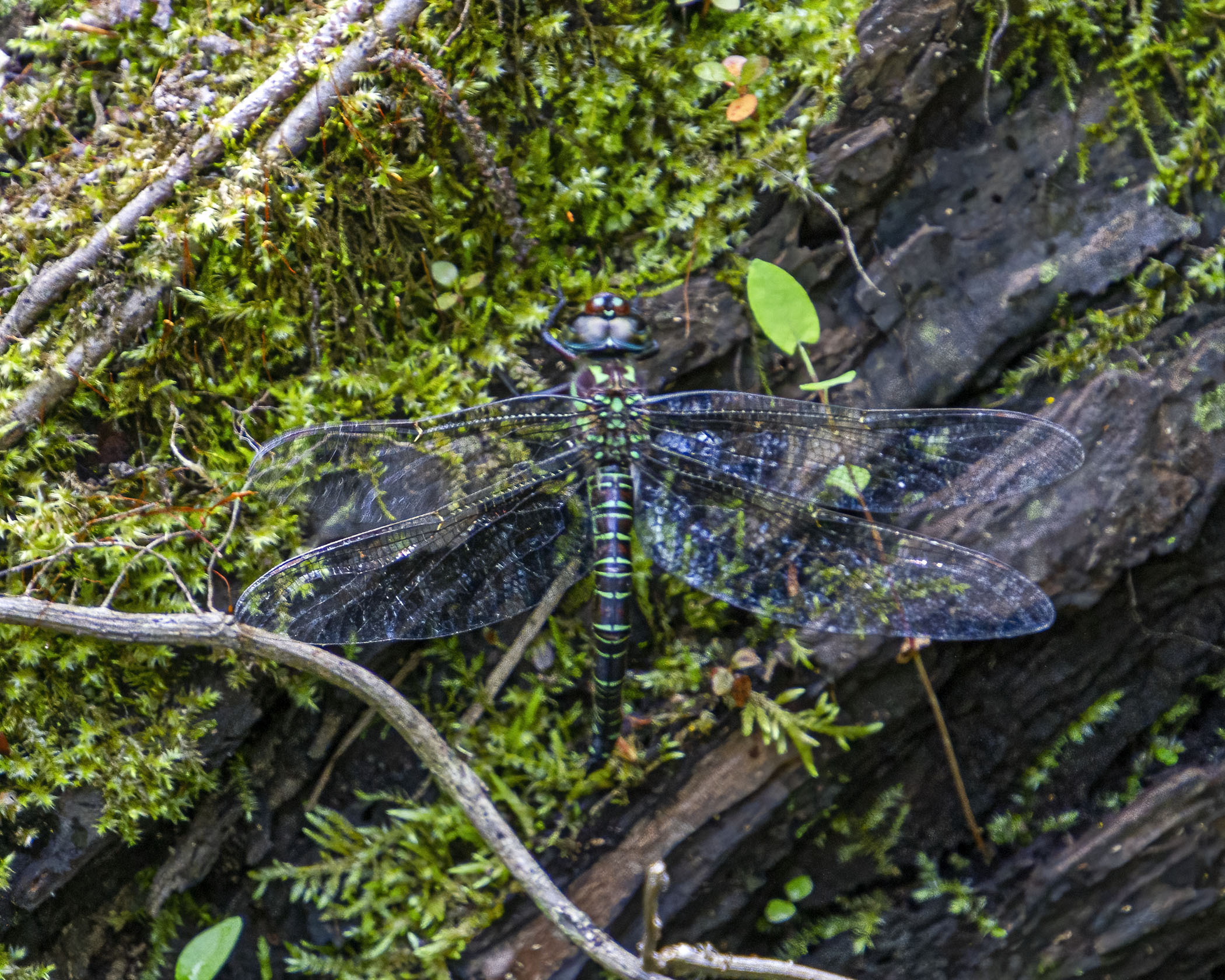
This male Prairie Warbler (Setophaga discolor) was signing loudly and proudly when I captured this image on Thursday at Occoquan Bay National Wildlife Refuge. I just love the way the little bird tilts back his head and sings with all of his might, seemingly putting his entire body into the effort.

Prairie Warbler

Prairie Warbler

© Michael Q. Powell. All rights reserved.

Read Full Post »

I was absolutely thrilled to capture some shots of this White-eyed Vireo (Vireo griseus) on Thursday at Occoquan Bay National Wildlife Refuge. It was a cloudy, overcast day and it seemed like the vireo was mostly in the shadows, which caused the first and last images to look a bit drab. Fortunately, though, I was able to catch the bird mid-song in the first shot, which definitely added some visual interest.

In many ways the second shot is my favorite of this set, even though the body of the vireo is partially blocked by the foliage. Somehow the colors in this image seem brighter and more true to life. In all of the shots, I really like the way that the light eyes of the subject pop, giving the vireo a very distinctive look.

White-eyed Vireo

White-eyed Vireo

White-eyed Vireo

© Michael Q. Powell. All rights reserved.

Read Full Post »

I spotted these cool-looking ducks last week in the waters off of Occoquan Bay National Wildlife Refuge. Some research and help for on-line experts helped me determine that these are Red-breasted Mergansers (Mergus serrator), a duck species that I do not see very often. I really like the spiky hairdos and long bills of these ducks that give them a distinctive punk vibe. I kept hoping that they would swim closer to shore, but, alas, they drifted farther and farther away, so I could not capture any close-up images.

Red-breasted Merganser

Red-breasted Merganser

© Michael Q. Powell. All rights reserved.

Read Full Post »

An Osprey (Pandion haliaetus) raised a wing as it flew by me on Monday at Occoquan Bay National Wildlife Refuge, displaying the fish that it had just caught. There are quite a few osprey at the refuge at this time of the year and it is not uncommon for me to see one clutching an osprey in its talons. However, it is rare that I am able to get a good look at the prey, because it is often hidden by the osprey’s wing movements.

Normally I attempt to capture shots of birds in flight with my longest lens, a Tamron 150-600mm. At this time of the year, though, I am just as likely to want to photograph butterflies and dragonflies as birds, so most of the time I keep my Tamron 18-400mm lens on my camera that lets me focus on a much closer subject. I sacrifice a bit of reach by using this lens, but, as you can see in the image of the osprey captured with this lens, it can produce good results even when fully extended. I encourage you to click on the image to see the feather details of the osprey and the details of the hapless fish too.

osprey

© Michael Q. Powell. All rights reserved.

Read Full Post »

One of the earliest dragonflies to appear in the spring in my area is the Blue Corporal (Ladona deplanata). Blue Corporals are relatively easy to identify because they have two stripes of their shoulders—two stripes is the traditional marking for the rank of corporal in the armed forces. When they first emerge, males and females have similar colorations, but the males turn blue as they mature.

The dragonfly in the first photo is an immature male Blue Corporal and was the first member of this species that I photographed on 10 April at Occoquan Bay National Wildlife Refuge. The shiny wings and pale markings suggest that this dragonfly was newly emerged. I believe that the dragonfly in the second photo is a female Blue Corporal, judging from her terminal appendages.

I usually try to get close-up shots of dragonflies, but when I can’t get near them, I am content to capture more “artsy” shots, like the final image below that shows a male Blue Corporal perched on some vegetation poking out of the shallow water of a pond.

Blue Corporal

Blue Corporal

Blue Corporal

© Michael Q. Powell. All rights reserved.


Read Full Post »

As many of you know, I keep an eye on several eagle nests at Occoquan Bay National Wildlife Refuge at this time of the year, waiting with hopeful expectation for the birth of new eaglets. In one nest that is relatively small, the adult Bald Eagle (Haliaeetus leucocephalus) is now sitting upright, rather than hunkering down over the eggs to keep them warm. I suspect that there is at least one eagle baby, but I have not yet seen any tiny eagle heads pop up over the edge of the nest.

I am not sure what’s happening with the much larger eagle nest. I had assumed that the eagles were sitting on eggs. However, on Tuesday I watched as an osprey perched on one of the trees supporting the nest and buzzed a nearby perched eagle. Several other photographers have reported seeing osprey actually sitting in the eagle nest.

As I observed the nesting area on Tuesday afternoon, two eagles in a tree overlooking the nest briefly engaged in what looked like mating behavior. Was an earlier nesting attempt unsuccessful? Are the eagles going to make another attempt to have babies this season?

It is a bit late in the year for the eagles to begin nesting, but I think there is still time for them to do so. Normally this process begins earlier in the year before the ospreys have returned, so there is no competition for the nest. Although there appears to be competition now, I would put my money on the eagles, which I believe are larger and stronger than the osprey.

I will continue to monitor the nesting situation. There may be more drama there this spring than in previous years.

Bald Eagle

© Michael Q. Powell. All rights reserved.


Read Full Post »
Each spring a lot of colorful warblers pass through our area on their northward migration. Most of them stay for only a short time, so it is a hit-or-miss proposition for me to find them. This is also the time of the year when the trees are budding, flowering and pushing out new leaves. All of this new growth is beautiful, but it makes it even harder for me to spot the little birds as they flit about, often at the tops of the trees.

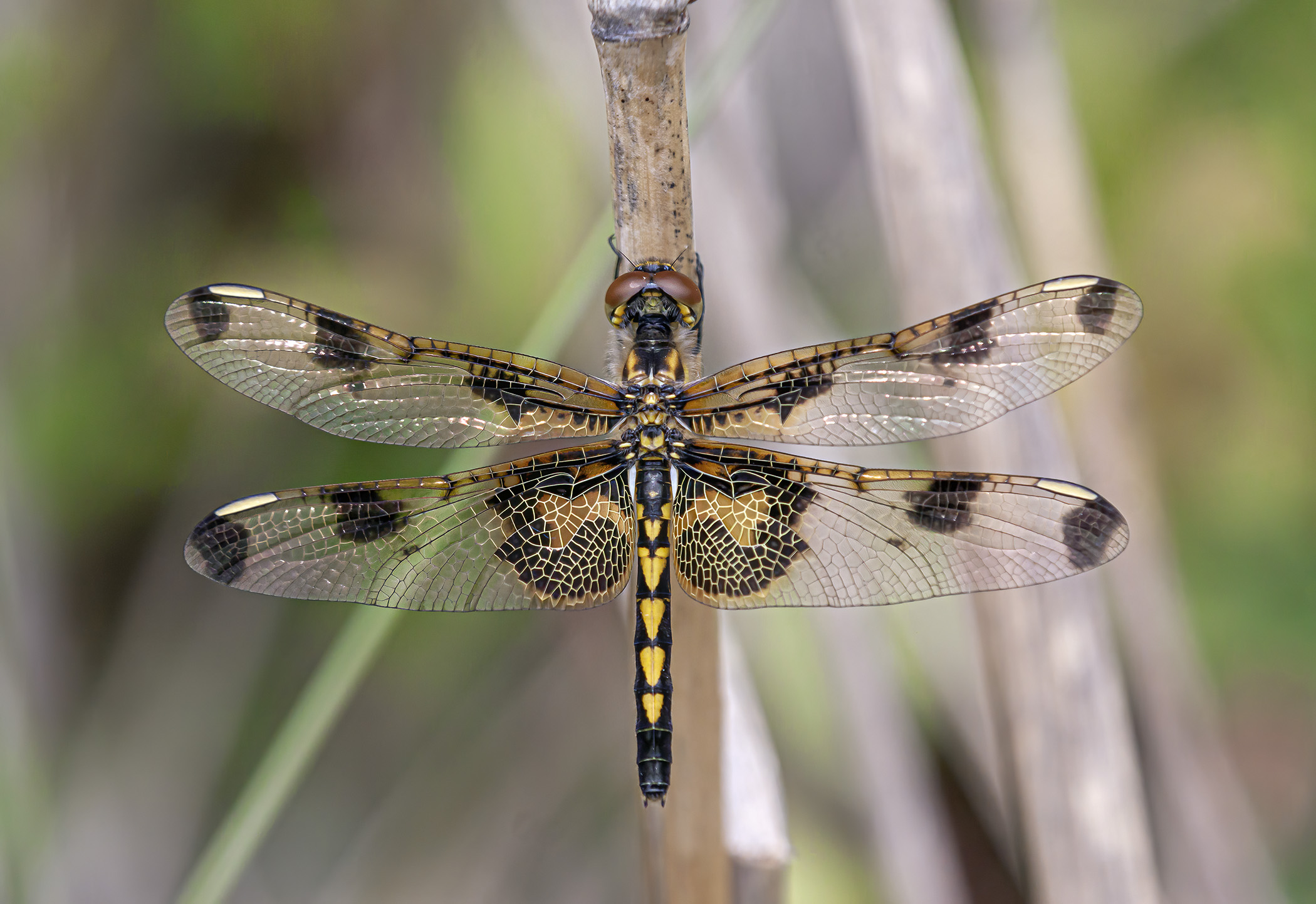
Yesterday I was thrilled to spot this Yellow-throated Warbler (Setophaga dominica) high in a distant tree at Occoquan Bay National Wildlife Refuge. Initially my view of the colorful little bird was blocked by the vegetation, but I bent, twisted, stretched, and leaned in all directions and was eventually was able to get a clear view of the warbler.

My eyes are really active during the spring as I look up to try to find birds and look down to search for dragonflies. I manage to observe lots of cool things, but suspect that there is so much more going on that I do not see or notice.

Yellow-throated Warbler

© Michael Q. Powell. All rights reserved.


Read Full Post »

I was excited yesterday to spot this cool-looking Horned Grebe (Podiceps auritus) in breeding plumage in the waters off of Occoquan Bay National Wildlife Refuge. In addition to the golden tufts that sometimes look like horns, this grebe has striking red eyes.

There were not very many birds on the water yesterday, only a few geese, cormorants, and scaups, so I was quite shocked when I saw the head of this Horned Grebe emerge from the water after a short dive. I hoped that the grebe would come a bit closer with each dive, but instead it seemed to get farther and farther away from me.

I suspect that the Horned Grebe was stopping over on a migration flight northward. Although I read that migrating grebes usually form small flocks when migrating, this one appeared to be by itself. I too like to travel alone.

Horned Grebe

© Michael Q. Powell. All rights reserved.

Read Full Post »

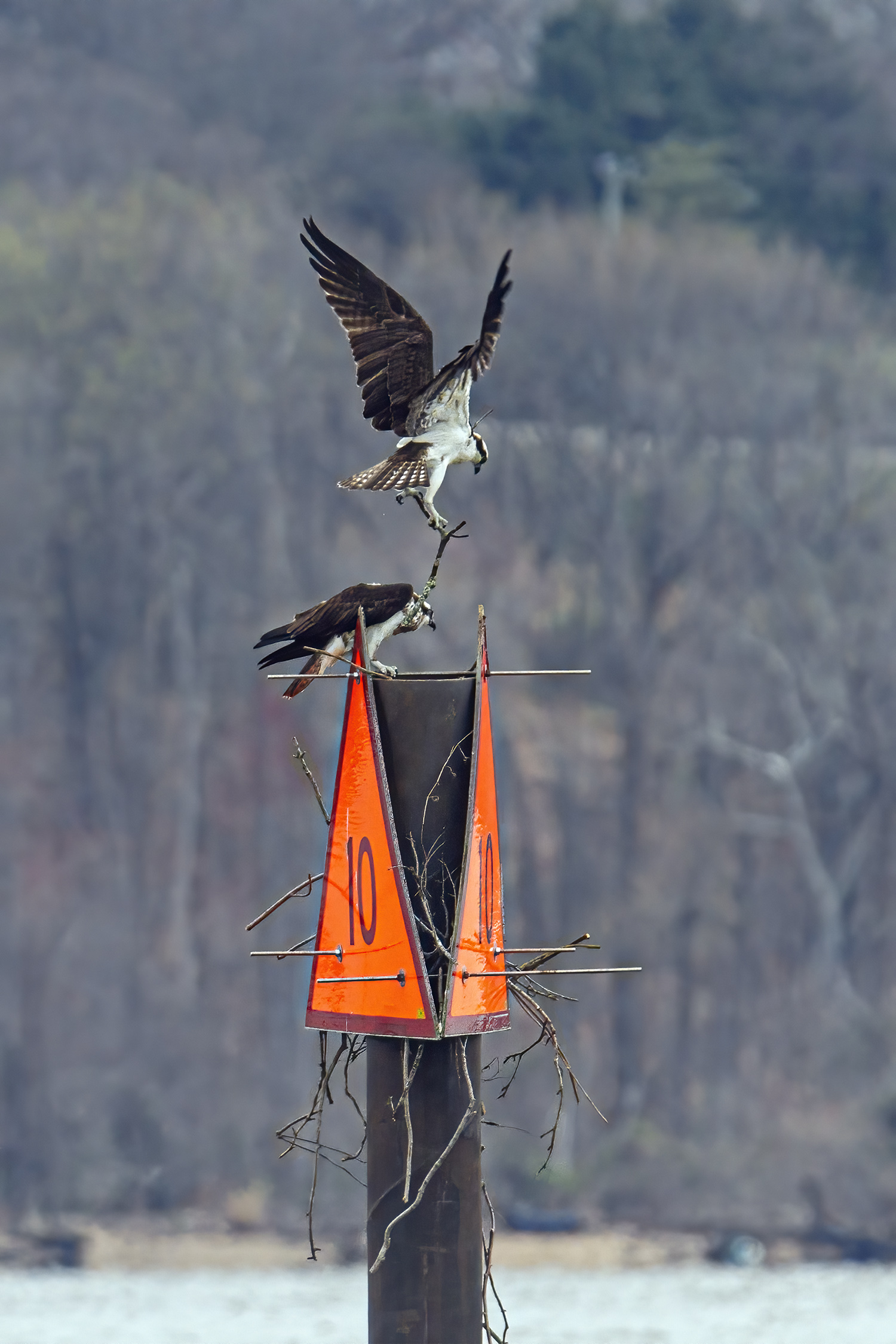
Real estate is at a premium in Northern Virginia, and new houses are jammed into the tiniest of spaces. Unfortunately, this channel marker did not appear to be quite big enough to support the nest of an osprey couple. During a recent visit to Occoquan Bay National Wildlife Refuge I watched the ospreys (Pandion haliaetus) carry a number of sticks to the marker as they unsuccessfully attempted to construct a nest—most of the sticks simply fell off the sides of the marker.

Osprey

Osprey

Osprey

Osprey

© Michael Q. Powell. All rights reserved.

Read Full Post »

This Bald Eagle (Haliaeetus leucocephalus) was partially hidden by tree branches when I first spotted during a recent visit to Occoquan Bay National Wildlife Refuge. I tried to move as stealthily as I could to try to get a clearer view of the eagle, but the eagle detected my presence. I captured this image as the eagle was preparing to take off. The eagle flew downwards from its perch and my view was completely obstructed, so I was not able to capture any in-flight shots of the eagle.

As you can see, many of the trees in my area have buds now. I think this tree might be a Sweet Gum tree, because I can see some of its distinctive spiky seed balls still hanging from the tree.

Bald Eagle

© Michael Q. Powell. All rights reserved.

Read Full Post »

It was cool, cloudy, and windy when I visited Occoquan Bay National Wildlife Refuge last Friday. I did not see any activity at the two eagle nests that I checked, but suspect that there was an eagle in each of them, hunkered down keeping the eggs warm.

I did encounter solitary adult eagles several times as I walked along the trails. Perhaps these Bald Eagles (Haliaeetus leucocephalus) were the mates of the eagles sitting in the nests. Whatever the case, these eagles looked to be hypervigilant and serious, keeping a close watch over the entire area. This eagle kept its head moving a lot, so I was happy when I managed to capture this profile shot as it perched in what I believe is a Tulip tree.

Bald Eagle

© Michael Q. Powell. All rights reserved.


Read Full Post »

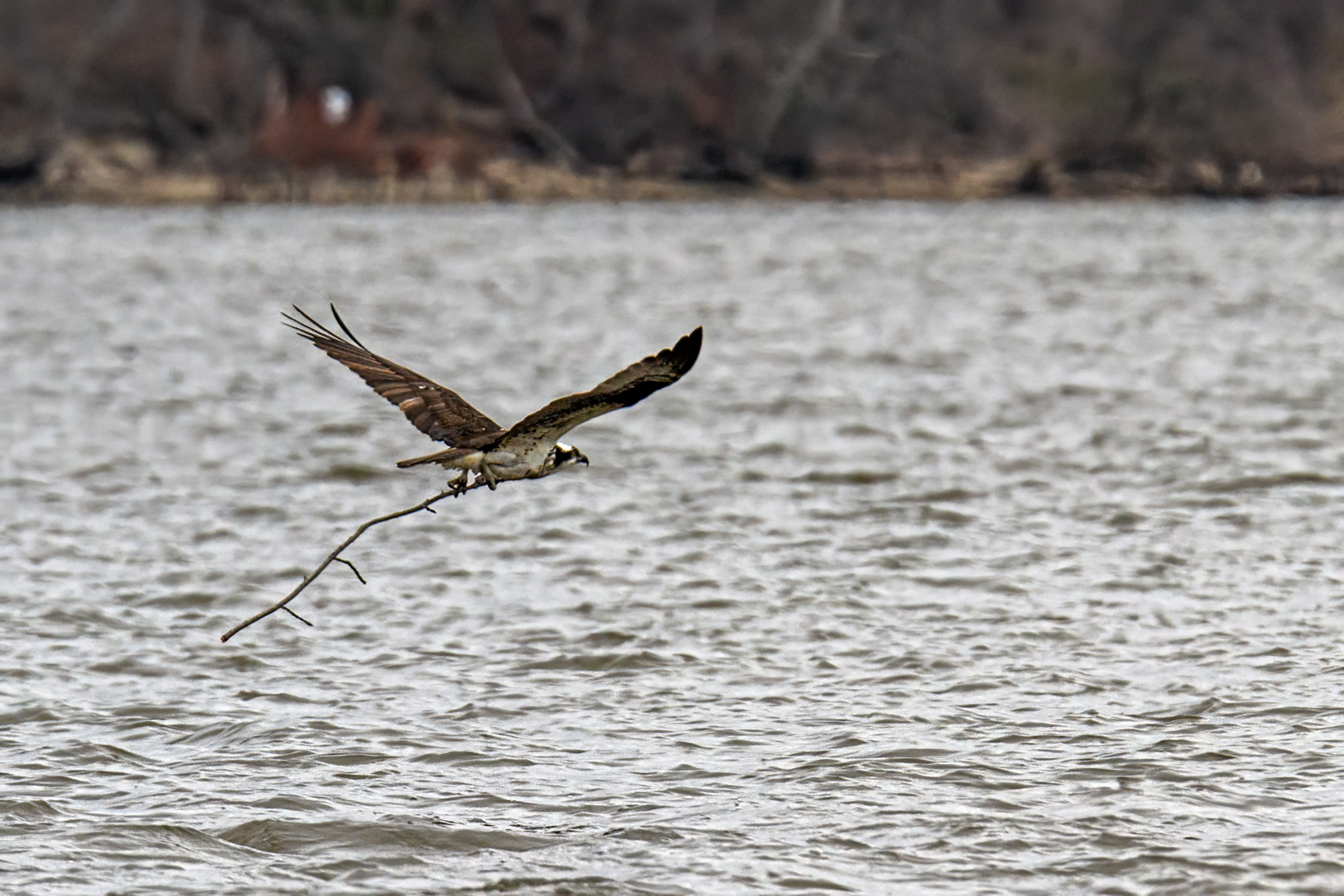
I was delighted on Friday to see that Ospreys (Pandion haliaetus) have returned to Occoquan Bay National Wildlife Refuge. Each autumn we bid farewell to the ospreys, which are also known as fish hawks or sea hawks, and each spring we greet their return.

Unlike eagles, which use large, well-constructed nests year after year, ospreys seem content to throw a bundle of sticks together and call it a nest. Many of these makeshift homes are blown down or fall apart during the winter, so a first priority for the returning ospreys is to construct nests.

During this visit I managed to capture several photos of ospreys overhead in flight with branch in their talons. As both photos show, ospreys often grab branches at one end, rather than in the middle where the weight would be better balanced. I am amazed by the ability of the ospreys to fly so well with those long trailing branches, though I suspect that the branches weigh a whole lot less that the fish that I hope to see them catch later in the season.

Osprey

osprey

© Michael Q. Powell. All rights reserved.


Read Full Post »

Yesterday I was thrilled to spot several Spring Azure butterflies (Celastrina ladon) at Occoquan Bay National Wildlife Refuge. This early-appearing butterfly is one of the tiniest butterflies in our area, with a wing span of about an inch (25 mm). Unlike Mourning Cloak butterflies—like the I featured last week in a blog posting—that overwinter as adults, Spring Azures overwinter in the pupal form, safe inside their chrysalis.

All of the Spring Azures that I saw yesterday were extremely skittish, spending most of their time in flight. Occasionally one would fly near the ground and come close to landing and then abruptly resume its flight. When they did land, the little butterflies almost disappeared into the abundant leaf litter and were tough to photograph.

Nature is coming alive as flowering trees begin to pop and new wildlife species reappear on the scene as we move deeper into March. It won’t be long before osprey, green herons, and great egrets return to our area and I hope to be seeing dragonflies within the next month. It is an exciting time of the year.

Spring Azure

© Michael Q. Powell. All rights reserved.


Read Full Post »

It won’t be long before basking turtles become a common sight, but they are still relatively rare in early March, when temperatures here dip down below the freezing level some nights. I spotted this Painted Turtle (Chrysemys picta) last Thursday at Occoquan Bay National Wildlife Refuge as it basked in the sun.

I was struck by the way the red markings on its neck stood out, even in the beautiful reflection on the surface of the small pond. Most turtles will try to find a horizontal perch to maximize exposure to the sunlight, but this turtle had to make do with with a steeply sloped spot. I could not see its claws, but I suspect that they were dug in to keep the turtle from sliding back into the water.

Painted Turtle

© Michael Q. Powell. All rights reserved.

Read Full Post »

Although it was sunny, the wind was kicking up quite a bit during my visit on Thursday to Occoquan Bay National Wildlife Refuge. Bird activity seemed lighter than usual. Perhaps the birds were all taking shelter from the wind,

At the far edge of a small pond, I spotted a Great Blue Heron (Ardea herodias) hunched over in a one-legged pose. The wind was whipping around the wispy feathers on the heron’s chest, head, and back. I encourage you to click on the photo to get a closer look at the heron’s “flyaway” feathers.

Have a wonderful weekend.

Great Blue Heron

© Michael Q. Powell. All rights reserved.

Read Full Post »

I was delighted yesterday (7 March) to spot this beautiful Mourning Cloak butterfly (Nymphalis antiopa) at Occoquan Bay National Wildlife Refuge, my first butterfly sighting of 2024. Mourning Cloaks, known as Camberwell Beauties in the Great Britain, overwinter as adults and are usually among the first butterflies to appear each spring.

Mourning Cloak butterflies, according to Wikipedia, have a lifespan of 11 to 12 months, one of the longest lifespans for any butterfly. As I noted, these butterflies spend spend the winters in us as adults, by “hiding away in cracks in rocks or holes in trees, and are able to shut down their bodies all winter long, effectively hibernating, in a manner known in insects as torpor,” according to the One Earth website.

Mourning Cloak butterflies have a distinctive look that some scientist thought looked like the traditional cloak worn in mourning. I was happy that I was able to capture the row of blue spots on the wings—another one of its identification features—in the photo of “my” butterfly.

The butterfly spent most of its time flying up and down, in and out of some trees. Eventually it perched for a moment on the ground and I was able to capture this image. It will be at least a few more weeks before I see my first dragonfly of the season, but I will soon begin to keep my eyes open for them. As many of you know, dragonflies are one of my favorite subjects to photograph and I look forward to the start of “dragonfly season” each year.

Mourning Cloak

© Michael Q. Powell. All rights reserved.


Read Full Post »

It is hard to anticipate when a Great Blue Heron (Ardea herodias) will strike. Herons have an amazing amount of patience and will often stand stationary for extended periods of time and then without much warning they will strike swiftly and violently.

Last week I was fortunate to be able to capture a sequence of shots of a heron in action at Occoquan Bay National Wildlife Refuge. I was amazed at how deeply the heron plunged its head, neck, and upper body into the water, creating quite a splash in doing so.

It seemed like the heron kept its head underwater for quite a while, but my sense of time is sometimes distorted in these kinds of situations. In any case, I impatiently waited for the heron to lift its head, anxious to see what it had caught. The heron slowly lifted its head and eventually it became clear that it had caught nothing but water. It may be my imagination, but I seem to see a mix of disbelief, dismay, and disgust in the heron’s expression in the final photo.

Undeterred, the heron returned to fishing and I moved on down the the trail, undoubtedly happier with my “catch” than the heron was with his.

Great Blue Heron

Great Blue Heron

Great Blue Heron

Great Blue Heron

Great Blue Heron

© Michael Q. Powell. All rights reserved.

Read Full Post »

I realized this morning that I do not photograph very many mammals. During the summers I tend to focus my attention on insects and during the winters I mostly photograph birds. Only occasionally will I spot some deer, opossums, hedgehogs, raccoons, or beavers.

There is one mammal, however, that I see all of the time—the Eastern Gray Squirrel (Sciurus carolinensis). Most of the time these squirrels are in motion, scrambling up and down the trees or running through the underbrush.

Last week at Occoquan Bay National Wildlife Refuge, I spotted a squirrel that was momentarily at rest and captured this image. I like the way that the coloration of the squirrel matches its surroundings. I am happy too that I was able to capture the different textures in the scene, including the fluffy tail of the squirrel, the roughness of the tree bark, and the relative smoothness of the branch on which the squirrel was perched.

Eastern Gray Squirrel

© Michael Q. Powell. All rights reserved.

Read Full Post »

« Newer Posts - Older Posts »