Feeds:
Posts
Comments

Posts Tagged ‘obelisk’

As I watched television coverage of the Olympic Games in Paris, I could not help but notice the numerous handstands in almost all of the gymnastic events for the men. There were handstands on the floor, on the rings, on the parallel bars, the high bar, and even on the pommel horse.

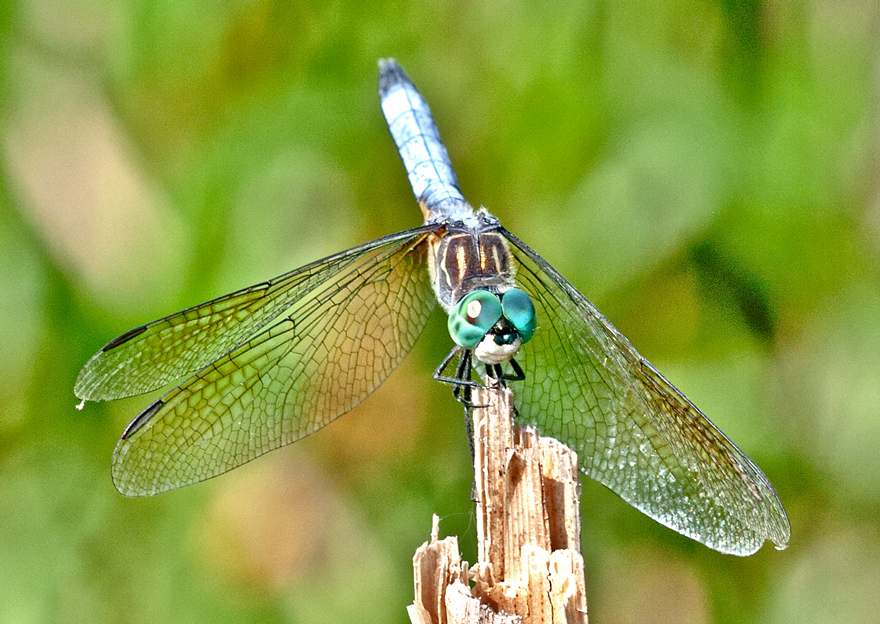
When I spotted this male Blue Dasher dragonfly (Pachydiplax longipennis) doing a handstand last Thursday at Jackson Miles Abbott Wetland Refuge, I immediately thought of those Olympic gymnasts.

This position is sometimes referred to as the “obelisk” pose for dragonflies. Many scientists believe that it is used as a form of thermoregulation to keep the body cooler by reducing the amount of surface exposure to direct sunlight. Several other dragonfly species use this pose, but I observe it most often with the male Blue Dasher dragonflies.

Blue Dasher

© Michael Q. Powell. All rights reserved.

Read Full Post »

Although Blue Dashers (Pachydiplax longipennis) are among the most common dragonflies in my area during the summer, they are very special to me. I remember visiting a photography show by my dear friend Cindy Dyer in 2012, I believe, and marveling at the photos that she had taken of Blue Dasher dragonflies. I decided that I wanted to be able to take photos like hers of these beautiful creatures.

I went out on numerous occasions and she taught me a lot about both the creative and technical sides of photography. She also served as a muse to me, encouraging me and gently pushing me along my path. She had a well-established blog and decided that I needed one too, so on 7 July 2012, she sat me down I created my blog. My first blog posting on the same day was entitled Blue Dasher dragonfly and it featured a male Blue Dasher dragonfly in the obelisk position, similar to the pose of the dragonfly in the final photo in today’s post. That’s one of the main reasons why Blue Dashers are so special to me.

I spotted these Blue Dashers, all of which are males, on Monday during a brief visit to Jackson Miles Abbott Wetland Refuge. Each of the three photos represents a different approach I used in attempting to capture the”feel” of my encounters with these dragonflies. The first image shows the details of colors and patterns of the body quite well. The second image gives you a sense of their environment. The final photo focuses on the obelisk pose that is believed to be a form of thermoregulation—by raising its abdomen the dragonfly reduces its exposure to the direct sunlight on hot days.

Some days I will post only a single photo, but most often I enjoy posting a small set of photos that complement each other and provide different perspectives on the living creatures that I love to photograph. Beauty is everywhere.


Blue Dasher

Blue Dasher

Blue Dasher

© Michael Q. Powell. All rights reserved.

Read Full Post »

What do you do to cope on a hot sunny day? Most of us stay indoors in an air-conditioned space, possibly with a cold beverage. Dragonflies do not have those options, so many of them assume a pose, often known as the obelisk posture, in an attempt to regulate their temperature by reducing exposure to the direct sunlight.

You may seen dragonflies in a handstand-like pose, looking like gymnasts in training—that is the obelisk posture. The dragonfly lifts its abdomen until its tip points to the sun, thereby minimizing the amount of surface area exposed to solar radiation. At noontime, the vertical position of the dragonfly’s body suggest an obelisk, which in my area immediately brings to mind the Washington Monument. According to Wikipedia, scientists have tested this phenomenon in a laboratory by heating Blue Dasher dragonflies with a lamp, which caused them to raise their abdomens and has been shown to be effective in stopping or slowly the rise in their body temperature.

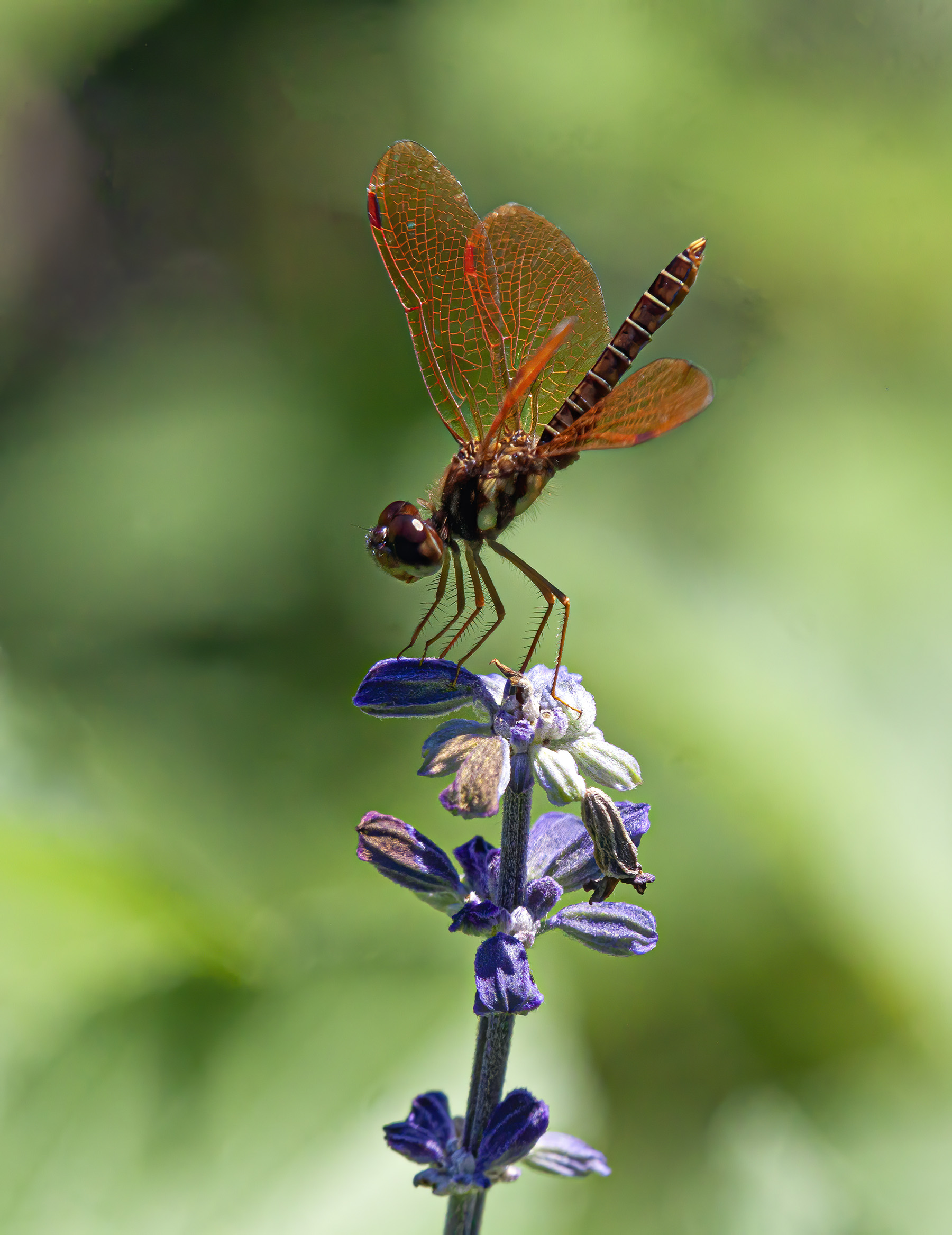
While visiting Green Spring Gardens last week on a hot humid day, I observed obelisking behavior in a male Blue Dasher (Pachydiplax longipennis) and a male Eastern Amberwing (Perithemis tenera). I have always been intrigued by this pose and would love to try it out to see if it works for thermoregulation in humans too. Alas, I lack both the upper-body strength and the lower body flexibility to make a go of it, so I’ll continue to be merely a spectator of these beautiful little acrobats.

Blue Dasher

Eastern Amberwing

© Michael Q. Powell. All rights reserved.


Read Full Post »

When you are staying in the center of Paris and walking almost everywhere, you don’t really need to plan to see cool things—they surround you all of the time. Late yesterday afternoon, as the sun was getting low on the horizon, I had to cross the Place de la Concorde to head towards home and captured this shot of the Luxor Obelisk in the center of the square.

As I was doing a little research on the obelisk, mostly relying on Wikipedia, I learned that it is a granite column, 75 feet (23 meters) high, including the base, and weighs over 276 tons (250 metric tons). Even today, transporting and erecting something this big would be an engineering challenge. Imagine what it was like trying to do so in 1833.

For some reason I thought the obelisk had been stolen, but the Archaeology Travel website provides the following details of the transaction.

“Initially both the obelisks from the Luxor Temple were promised to England. Following diplomatic negotiations they were both gifted to France by Pasha Muhammed Ali. In return,  King Louis Philippe gave the Pasha a large clock. The clock is still in place in the clock tower of the mosque at the summit of the Citadel of Cairo.”

The Wikipedia article referenced above wryly notes that after the obelisk had left Egypt, the large mechanical clock provided in exchange turned out to be faulty, probably because of damage during transport.  “The worthless clock still exists to this day in a clocktower in Egypt, and is still not working.”

Place de la Concorde

© Michael Q. Powell. All rights reserved.

Read Full Post »

Male Blue Dasher dragonflies (Pachydiplax longipennis) assume this handstand-like position, called the obelisk posture, when they feel threatened or want to minimize exposure to the sun. I was leaning a little closer than normal to this dragonfly, because I had a 100mm lens attached to the camera and not a longer zoom lens, so maybe that caused him to be a little alarmed. As the weather warms up and more dragonflies appear, I am sure that I will be getting a lot more shots of Blue Dashers, which were my favorite dragonflies to photograph last summer.

dasher1a_blog

© Michael Q. Powell. All rights reserved

Read Full Post »