Feeds:
Posts
Comments

Posts Tagged ‘Mourning Cloak’

Mourning Cloak butterflies (Nymphalis antiopa) are often one of the first butterflies that I see in early spring, because they overwinter with us as adults in a kind of hibernation. According to Wikipedia, Mourning Cloaks, known in Britain as the Camberwell Beauty, have a lifespan of 11 to 12 months, one of the longest lifespans for any butterfly.

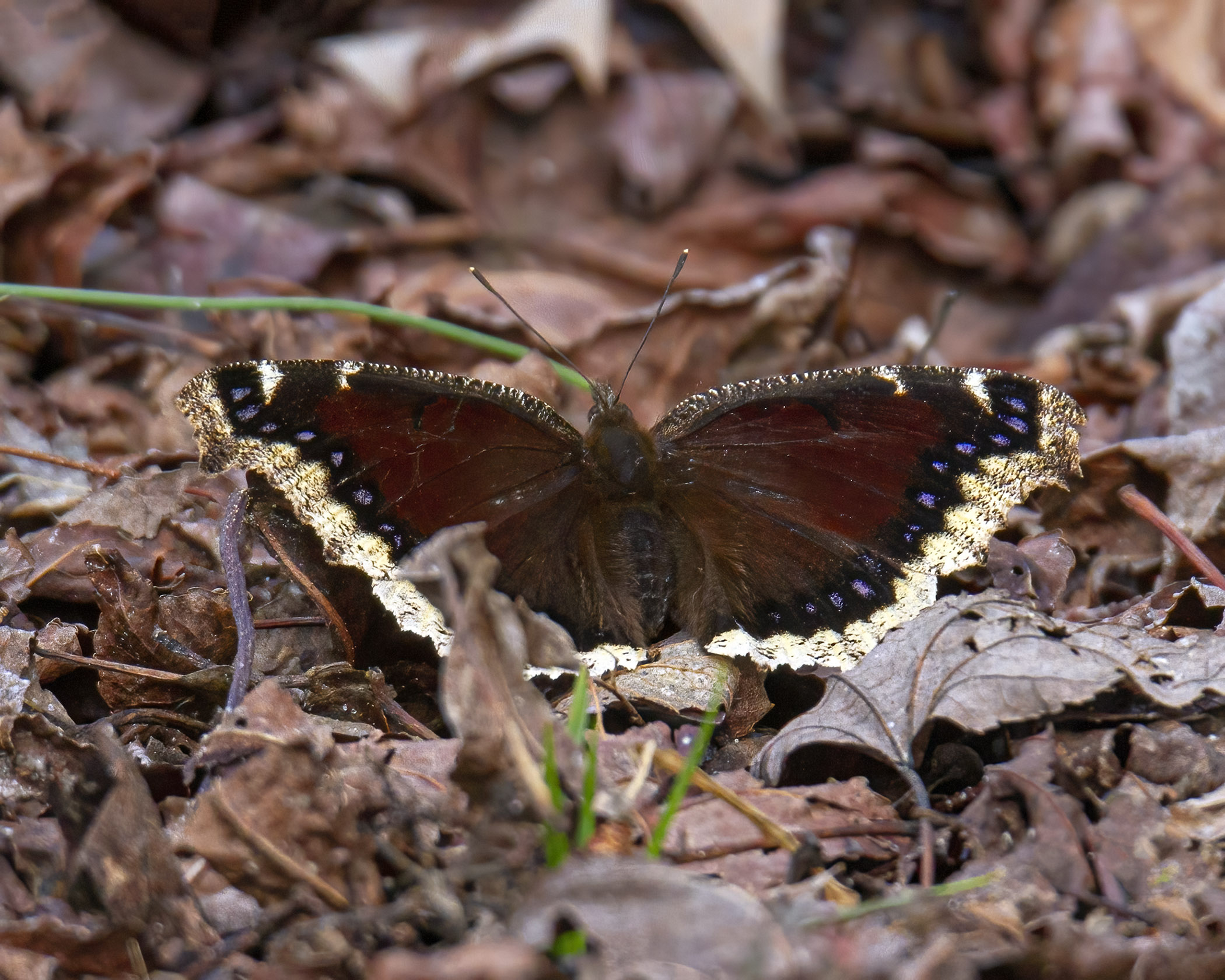
In the springtime, these butterflies mate and I suspect that the butterfly in the photo below that I spotted in early June at Occoquan Bay National Wildlife Refuge is part of the “new generation.” I don’t know a whole lot about the entire life cycle of the Mourning Cloak, but from what I have read, their lives include periods of activity followed by long periods of inactivity. During the summer, for example, they enter into a “dormant” stage, known as aestivation that is somewhat similar to hibernation, and then become active again in the autumn.

I love the markings of this beautiful butterfly and was thrilled when it held its wings open for a few seconds and let me see the stunning blue markings on its inner wings that stand out among the mostly subdued colors on its body.

Mourning Cloak butterfly

© Michael Q. Powell. All rights reserved.
Read Full Post »

I was delighted yesterday (7 March) to spot this beautiful Mourning Cloak butterfly (Nymphalis antiopa) at Occoquan Bay National Wildlife Refuge, my first butterfly sighting of 2024. Mourning Cloaks, known as Camberwell Beauties in the Great Britain, overwinter as adults and are usually among the first butterflies to appear each spring.

Mourning Cloak butterflies, according to Wikipedia, have a lifespan of 11 to 12 months, one of the longest lifespans for any butterfly. As I noted, these butterflies spend spend the winters in us as adults, by “hiding away in cracks in rocks or holes in trees, and are able to shut down their bodies all winter long, effectively hibernating, in a manner known in insects as torpor,” according to the One Earth website.

Mourning Cloak butterflies have a distinctive look that some scientist thought looked like the traditional cloak worn in mourning. I was happy that I was able to capture the row of blue spots on the wings—another one of its identification features—in the photo of “my” butterfly.

The butterfly spent most of its time flying up and down, in and out of some trees. Eventually it perched for a moment on the ground and I was able to capture this image. It will be at least a few more weeks before I see my first dragonfly of the season, but I will soon begin to keep my eyes open for them. As many of you know, dragonflies are one of my favorite subjects to photograph and I look forward to the start of “dragonfly season” each year.

Mourning Cloak

© Michael Q. Powell. All rights reserved.


Read Full Post »

I finally spotted my first butterflies of the spring. As I was walking down one of the trails at Occoquan Bay National Wildlife Refuge on Wednesday, a fellow photographer excitedly pointed out this Mourning Cloak (Nymphalis antiopa) butterfly that was sunning itself on the trail. Mourning Cloaks overwinter as adults and are usually one of the first species to appear in the spring. According to Wikipedia, “These butterflies have a lifespan of 11 to 12 months, one of the longest lifespans for any butterfly.”

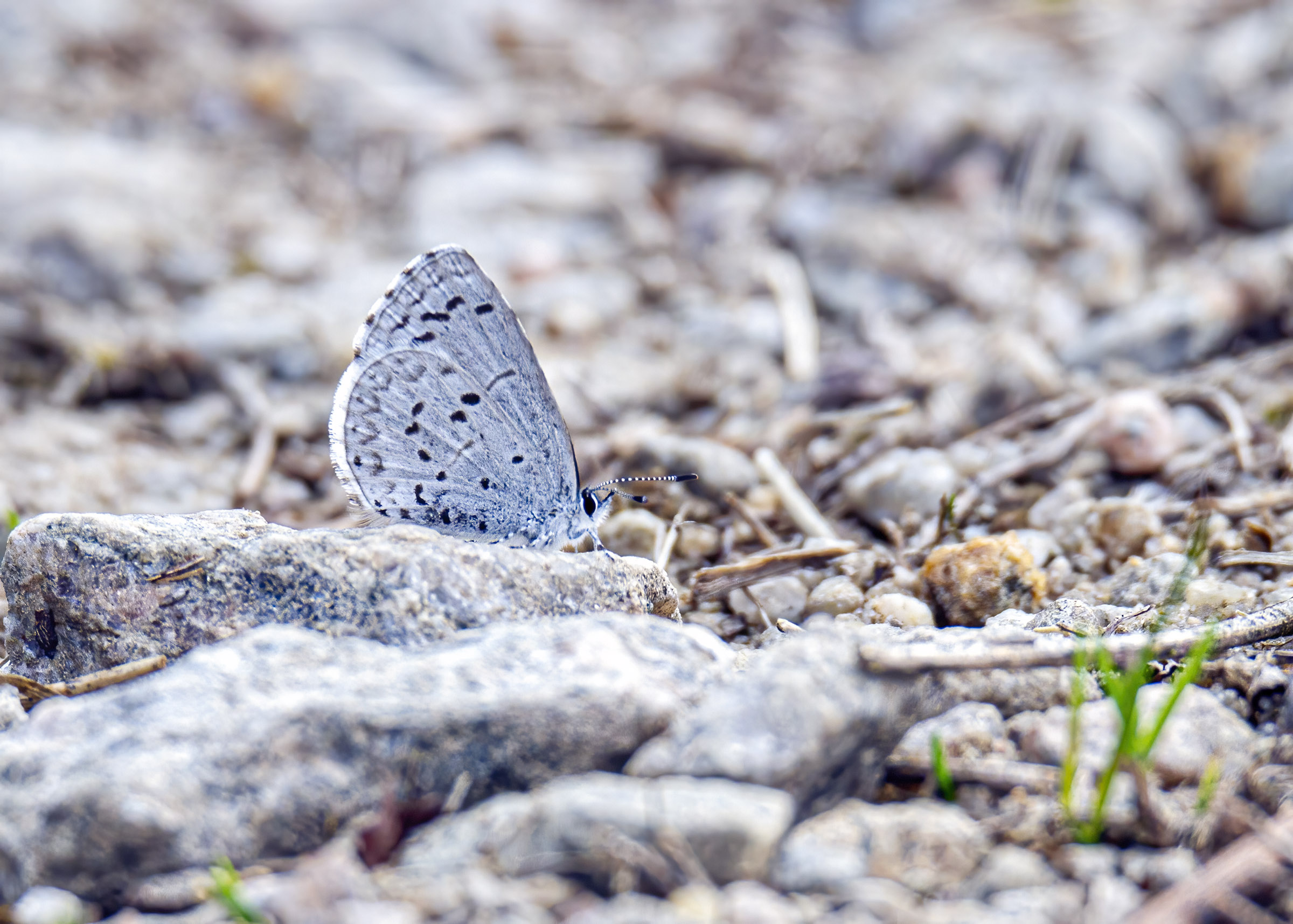
Later in the afternoon, I spotted a Spring Azure (Celastrina ladon) butterfly that was perched amidst the rocks on a gravely section of one of the trails. Spring Azure butterflies are very small—about one inch (25 mm) in size—and it was quite a challenge to get a shot of this one using the 150-600mm lens that was on my camera at that moment.

Yesterday I spotted an Eastern Tiger Swallowtail butterfly as I was searching for dragonflies at another location, but was unable to get a shot of it. I also briefly caught a glimpse of one dragonfly, but again was unable to get a shot. As the weather continues to warm, I’ll be out with my camera more often in search of these beautiful little creatures—it finally feels like spring is here.

Mourning Cloak

Spring Azure

© Michael Q. Powell. All rights reserved.
Read Full Post »

Life can be rough when you have fragile wings. I spotted this Mourning Cloak butterfly (Nymphalis antiopa) last Friday at Occoquan Regional Park and could not help but notice the significant damage to its wings. The damage might have actually happened last fall, given that this species overwinters with us as adults, awakens in the spring, and has a lifespan of 11-12 months, one of the longest lifespans for any butterfly.

As I poked about on the internet, I was intrigued to learn that this species is known as the Camberwell Beauty in the United Kingdom. I do not see Mourning Cloak butterflies very often—most of the time it is only when I am in a wooded area, rather than in a marsh or open field. When I do spot one, it is usually hyperactive and I rarely have the chance to capture an image.

The second photo below is the only other photo that I have managed to take of one this spring, and I took it from quite a distance away. Still, I like the way that it shows some of the butterfly’s habitat. I always have to remind myself of the value of these kind of environmental portraits—my normal tendency is to get close with either a macro or a telephoto lens and isolate the subject from its background.

Mourning Cloak

Mourning Cloak

© Michael Q. Powell. All rights reserved.

Read Full Post »

How long do butterflies live? According to most sources, Mourning Cloak butterflies (Nymphalis antiopa), which can live for 10-11 months, are thought to be the longest living butterflies in their range. I am always thrilled to see these darkly colored butterflies, which are known as “Camberwell beauties” in Great Britain, in the early spring and in the autumn.

Where are they the rest of the time? Mourning Cloaks spend part of the summer in aestivation, a hibernation-like state of inactivity to avoid the heat and lack of water. They are active in the fall, eating voraciously to fatten up and then overwinter as adults in another state of dormancy, often on the underside of fallen trees. In the spring, they reawaken to eat, mate, and die. In the north, there is often only a single brood annually, but in the south there may be two or more.

I spotted this butterfly on the first of October at Occoquan Bay National Wildlife Refuge. It looked to me like the butterfly was getting nutrients from the soil or possibly from animal droppings—unlike some butterflies, Mourning Cloaks do not rely on nectar from flowers as a primary source of nutrition.

Mourning Cloak

Mourning Cloak

© Michael Q. Powell. All rights reserved.


Read Full Post »

Yesterday at Occoquan Bay National Wildlife Refuge I finally spotted my first full-sized butterfly of the spring, which was, not surprisingly, a Mourning Cloak butterfly (Nymphalis antiopa). Unlike some other species that migrate, Mourning Cloak butterflies overwinter with us as adults in a hibernation-like state and awake to mate in the early spring. Generally, therefore, they are among the first butterflies to appear in the spring.

Mourning Cloak butterfly

© Michael Q. Powell. All rights reserved.


Read Full Post »

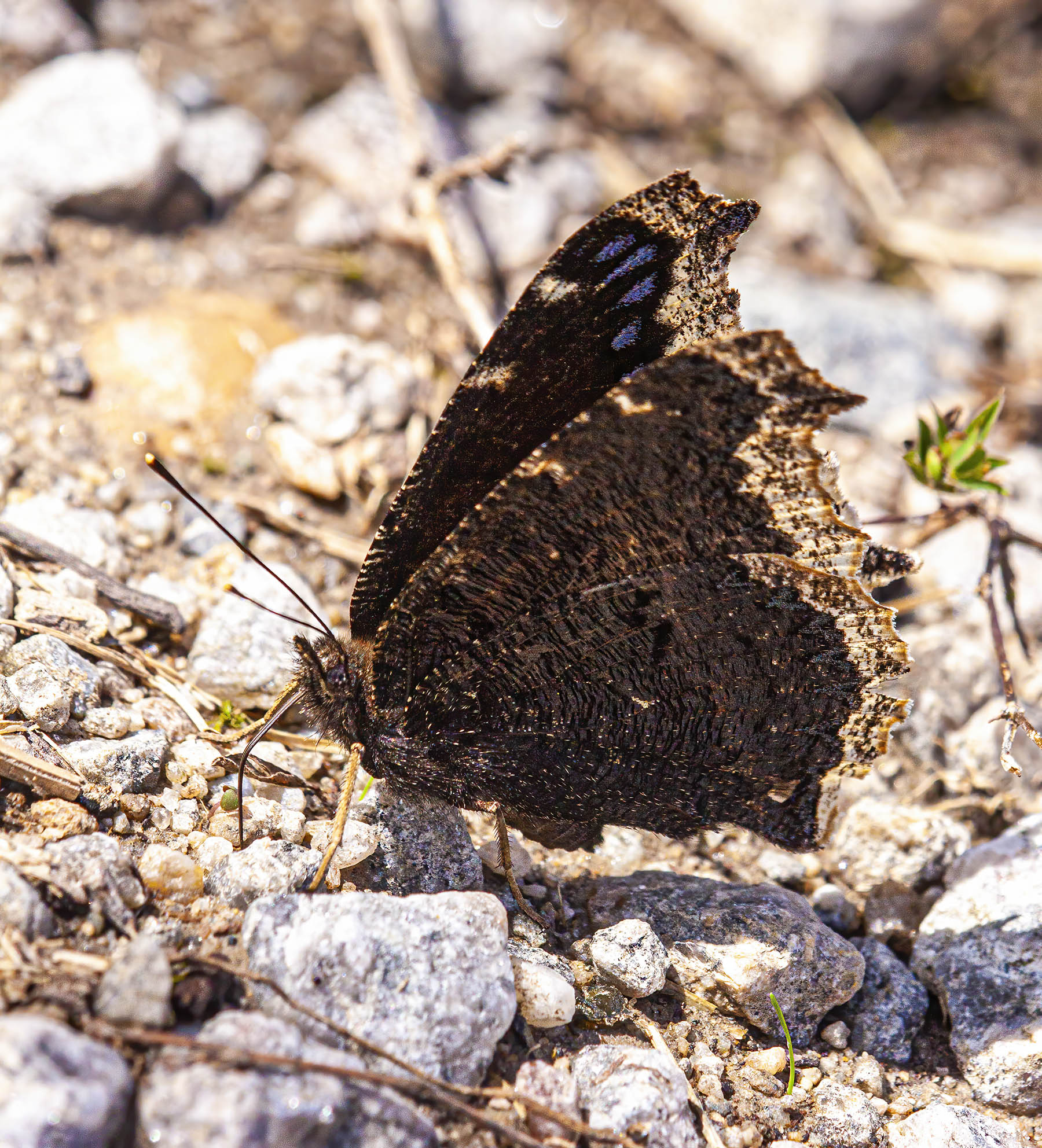
I spotted a beautiful Mourning Cloak butterfly (Nymphalis antiopa) this past weekend at Huntley Meadows Park and suspect that it recently emerged. I always thought of  Mourning Cloaks, which are apparently known as Camberwell Beauties in Great Britain, only as an early spring butterfly, because I knew that they overwinter with us as adults.

After doing a little research, I learned that the hardy winter survivors mate in the early spring and then die. The eggs turn into caterpillars that pupate and the new butterflies emerge in June or July. After briefly feeding, the butterflies will enter into a state of dormancy (called aestivation) for the summer. I must confess that I was not familiar with the word “aestivation” when I first ran across it and had to look it up. As far as I can tell, it’s the summer equivalent of hibernation. Last year I remember learning the word “brumation,” which is a hibernation-like state that helps turtles survive in the mud during the winter. Who knew there were so many hibernation-type states?

In the fall, the Mourning Cloak butterflies will go on a real feeding frenzy to store up energy for the long winter. It’s amazing to realize that these butterflies have a life span of 10 months, which is an eternity in the insect world.

Mourning Cloak

Michael Q. Powell. All rights reserved.
 

Read Full Post »