Feeds:
Posts
Comments

Posts Tagged ‘Meleagris gallopavo’

The trees are now covered with leaves, providing hiding places for the tiny songbirds that I can hear but cannot see. Fortunately, some birds are so big that it is hard to miss them, like this Wild Turkey (Meleagris gallopavo) that I spotted this past Wednesday at Occoquan Bay National Wildlife Refuge.

This turkey was slowly walking away from me and I captured this shot when he was in motion. I don’t think that a Wild Turkeys can balance themselves on a single leg when stationary, though perhaps there is a special kind of turkey yoga that enhances their balancing abilities.

Wild Turkey

© Michael Q. Powell. All rights reserved.

Read Full Post »

At this time of the year holiday preparations become intertwined at retail stores. I have already seen lots of displays for Halloween and suspect that I will see Christmas decorations for sale as well if I look a little harder. Indigenous Peoples Day and Thanksgiving Day are also part of this autumn blitz.

So I guess that it is not that surprising that I immediately thought of Thanksgiving Day when I spotted this Wild Turkey (Meleagris gallopavo) last week at Occoquan Bay National Wildlife Refuge. Turkeys are part of the lore of Thanksgiving and play a central role in the traditional feast, though commercial turkeys no longer bear much resemblance to their wild counterparts.

There are several flocks of wild turkeys at this wildlife refuge and I often encounter them foraging along the trails. When they see me, they usually move slowly into the undergrowth—I suspect that they have grown accustomed to the presence of humans, but do not want to interact with them most of the time. Strangely enough, that’s the same attitude that I display when I am out in the wild with my camera.

Wild Turkey

© Michael Q. Powell. All rights reserved.

Read Full Post »

As I was walking along a trail on Monday at Occoquan Bay National Wildlife Refuge, I happened to glance to my left  and was shocked to see that I was almost face-to-face with a Wild Turkey (Meleagris gallopavo). This turkey, along with several of his friends, was foraging in the underbrush and apparently had not heard me approaching. I immediately stopped in my tracks, fearful of scaring the turkeys away and contemplate my next steps.

Should I try to move into another position for a better shot? Should I zoom out and try capture the turkey’s entire body that was mostly hidden in the vegetation? The clock was ticking and I knew that the turkeys would soon sense my presence.

I had a pretty clear view of the turkey’s head from where I was standing, so I decided to go for a portrait close-up portrait shot. I carefully focused on the turkey’s eye and was happy to be able to capture quite a bit of detail in a profile shot when the turkey turned his head to the side.

In a funny way I felt almost like I was looking a mirror, because the turkey had a lot of wrinkles and hairs sprouting out of various parts of his head, features that have become increasingly noticeable for me as I have gotten older. When I was younger, I don’t think I realized how much hair would eventually be growing out of my nose and ears.

After I had grabbed a few shots, I move on quietly down the trail and the turkeys continued their foraging .

Wild Turkey

© Michael Q. Powell. All rights reserved.

Read Full Post »

Most of the time when I see Wild Turkeys (Meleagris gallopavo) at Occoquan Bay National Wildlife Refuge, they are in small groups, but when I spotted this one last Friday it was alone. Initially the turkey was slowly strolling down the trail ahead of me on which I was walking. Somehow, though, it sensed my presence and picked up its pace until it seemed to be trotting.

I captured this image mid-stride, as the turkey seemed to be looking over its shoulder to see if I was still there. The photo is relatively sharp, though if you look at the turkey’s right foot, you can see a bit of motion blur, which enhances the sense of movement.

Wild Turkey

© Michael Q. Powell. All rights reserved.

Read Full Post »

As I was leaving Occoquan Bay National Wildlife Refuge on Friday, I spotted this small band of Wild Turkeys (Meleagris gallopavo) foraging on the side of a small hill. I captured this image while I was seated in the driver’s seat of my car. I was stopped with my blinkers on and fortunately there was no other traffic. I like the way that the turkeys had spaced themselves out in a military-style patrolling formation.

Wild Turkeys

© Michael Q. Powell. All rights reserved.


Read Full Post »

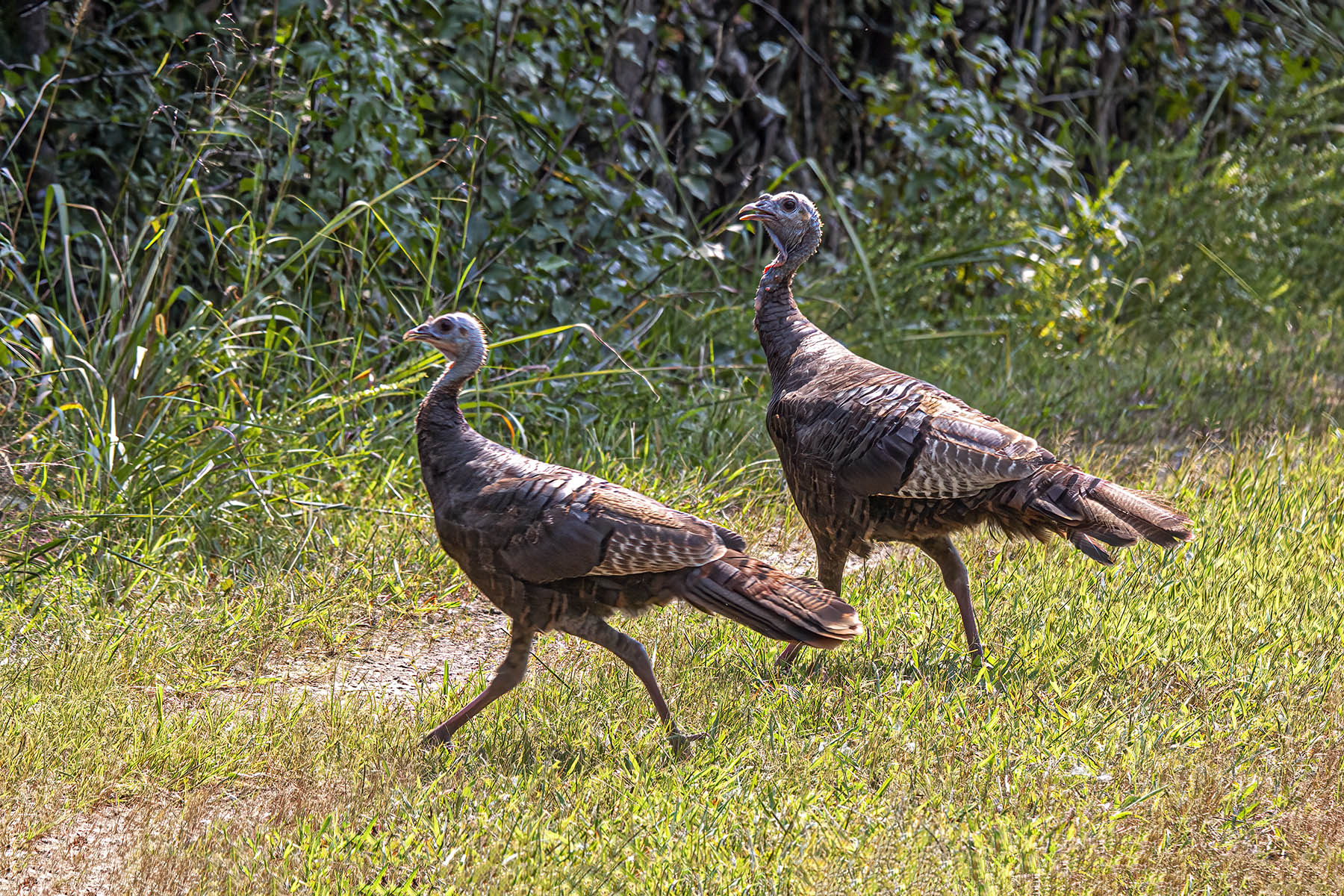
On Monday I spotted these two Wild Turkeys (Meleagris gallopavo) at Occoquan Bay National Wildlife Refuge as they climbed a small hill through some tall grass. They kept disappearing from view, but occasionally their heads would pop up and I was able to capture a few shots of them.

The bodies of the turkeys are partially hidden by the vegetation, but I really like the way that I was able to capture a sense of the habitat in which I saw the turkeys. Normally I spot turkeys in the open on the trails at this wildlife refuge, so it was cool to see them traveling “off-road.”

Wild Turkeys

Wild Turkeys

© Michael Q. Powell. All rights reserved.

Read Full Post »

As I was observing some Wild Turkeys (Meleagris gallopavo) last Thursday at Occoquan Bay National Wildlife Refuge, one of them suddenly decided to stretch a bit and flapped his wings. In the past I have seen a turkey extend its wings like this only when running away from me. In this case, though, the turkey went back to pecking on the ground and either was not aware of my presence or was simply not bothered by it.

Perhaps he was just trying to cool off on what was a really hot, humid day.

Wild Turkey


© Michael Q. Powell. All rights reserved.

Read Full Post »

Although it is fun to try to photograph migratory species passing through our area, I am equally content to photograph the local species that are present throughout the year, like Wild Turkeys and Eastern Cottontail Rabbits. This rather rotund Wild Turkey (Meleagris gallopavo) seemed to be dancing the hokey-pokey when I spotted it last Friday at Occoquan Bay National Wildlife Refuge. “You put your right leg in, you put your right leg out. You put your right leg in and you shake it all about…” For the record, I did not join in the dance.

Later that same day I encountered this cute little Eastern Cottontail Rabbit (Sylvilagus floridanus). The rabbit was quite tolerant on my presence and calmly chewed on the grass while I took its picture. For several years I cared for a pet rabbit, so rabbits have a special place in my heart.

Turkeys and rabbits are quite common at this refuge and at certain times of the day I am likely to encounter them. Generally they slowly move into the undergrowth as I approach. I don’t think they necessarily view me as a threat, but they probably do not want to take chances.

Wild Turkey

Eastern Cottontail

© Michael Q. Powell. All rights reserved.

Read Full Post »

On Thursday I was thrilled to capture this shot of a Wild Turkey (Meleagris gallopavo) as he waded across one of the small streams at Occoquan Bay National Wildlife Refuge. Out of the corner of my eye I had caught a glimpse of the another Wild Turkey that had opted to fly over the stream a moment earlier, so I was prepared when this turkey emerged from the woods and slowly made its way across the stream.

During his crossing, the turkey flapped his wings from time to maintain his balance and to generate a bit of extra momentum, I suspect. In the image below, the turkey had almost reached the far bank of the stream. I like the sense of movement in the shot that is heightened by the open wings, the forward lean of the body, and the “beard” hanging away from the body.

Wild Turkey

© Michael Q. Powell. All rights reserved.

Read Full Post »

Late on Monday afternoon I spotted this large male Wild Turkey (Meleagris gallopavo) at Occoquan Bay National Wildlife Refuge as he was foraging in the leaf litter. The turkey was very focused on scratching about in the fallen leaves and let me get so close to him that I was able to take this shot at 250mm on my zoom lens that extends to 600mm.

The light was already starting to fade—the sun set at 4:53 pm that day—and I know that my relatively old DSLR does not handle low light very well, so I did not want to raise the ISO beyond ISO 800, for fear of introducing an unacceptable amount of graininess. Instead, I captured this image with an exposure of 1/40 second, a really slow shutter speed. Even though I was using a monopod for stability, many of my shots were blurry, but this particular image ended up pretty sharp.

I love the way that I was able to capture so many details of the turkey’s feathers. From a distance, the main feathers look to be a solid dark color, but up-close, they show a lot of color variation and patterns. I was happy too that I was able to get a good view of the turkey’s “beard.” I’ve read that you can estimate the age of a turkey on the basis of the length of its beard, but I am not confident that I could figure that out—all I can say is that the turkey appeared to be a mature male to me.

Wild Turkey

© Michael Q. Powell. All rights reserved.


Read Full Post »

When I was visiting Theodore Roosevelt National Park in North Dakota last week, I did most of my wildlife photography while inside of my car. Surprisingly that included bird photography. In order to spot birds, I had to drive slowly, often at about 10 mph (16 kph), and listen very attentively. Fortunately, there were not many other people around in the early morning, so I was able to move about at my own pace.

The Wild Turkey (Meleagris gallopavo)in the first photo, did not make a sound, but was big enough for me to spot visually. I have photographed Wild Turkeys numerous times, always in a forested environments. I was therefore astonished to see on in a desert-like area of the park.

The bird in the second photos is a Lazuli Bunting (Passerina amoena), I believe. I spotted them several times, but most of the time they were out of range or were blocked by branches. I was fortunate to capture this one as it was singing.

The bird in the final photo was initially a bit of mystery for identification purposes. However, the speckled wings, dark body, and bright red eyes led me to conclude that it is probably a Spotted Towhee (Pipilo maculatus).

The birds in the last two photos are western birds that are not found in my home state of Virginia, so I am only semi-confident about my identifications. Please let me know if I have made a mistake in my efforts to figure out the species to which they belong.

Wild Turkey

Lazuli Bunting

Spotted Towhee

© Michael Q. Powell. All rights reserved.


Read Full Post »

Although there are quite a few Wild Turkeys (Meleagris gallopavo) at Occoquan Bay National Wildlife Refuge, they tend to pretty elusive and I never quite know when I will encounter one. I spotted two large turkeys on Monday and was happy to be able to snap off a few shots before they disappeared into the underbrush.

The “beard” of this turkey is quite impressive in its length, so it is most likely a mature male—as is the case with humans, most female wild turkeys do not have beards. A turkey’s beard grows throughout its life and can reach a length of over 12 inches (30 cm).

Apparently you can also tell the age of a male wild turkey by the size of its spurs, the pointy protrusions on the lower portion of a turkey’s legs. If you click on the second image, you can get a better look at this turkey’s spurs that are quite prominent, again signifying that this is a mature male, probably at least a couple of years old.

Wild Turkey

Wild Turkey

© Michael Q. Powell. All rights reserved.


Read Full Post »

I have been starting to see images of turkeys everywhere, but mostly they are cartoon-like figures in advertisements for Thanksgiving, which is only a month away. Last week I encountered a small flock of actual Wild Turkeys (Meleagris gallopavo) while I was walking along one of the trails at Occoquan Bay National Wildlife Refuge. I have seen turkeys at multiple locations within the refuge and suspect that there are a number of resident flocks there.

The turkeys slowly moved into the underbrush as soon as they became aware of my presence, but I did manage to capture a few shots of one of them. I especially like the pattern of light and shadows in the background of the first image that was caused by the sunlight filtering through the trees. I took these shots during the middle of the day and the sunlight was relatively harsh in open areas, as you can see in the second image. It is a fun challenge to balance the light to get a decent exposure in situations like this when the lighting is so mixed.

Wild Turkey

Wild Turkey

© Michael Q. Powell. All rights reserved.

Read Full Post »

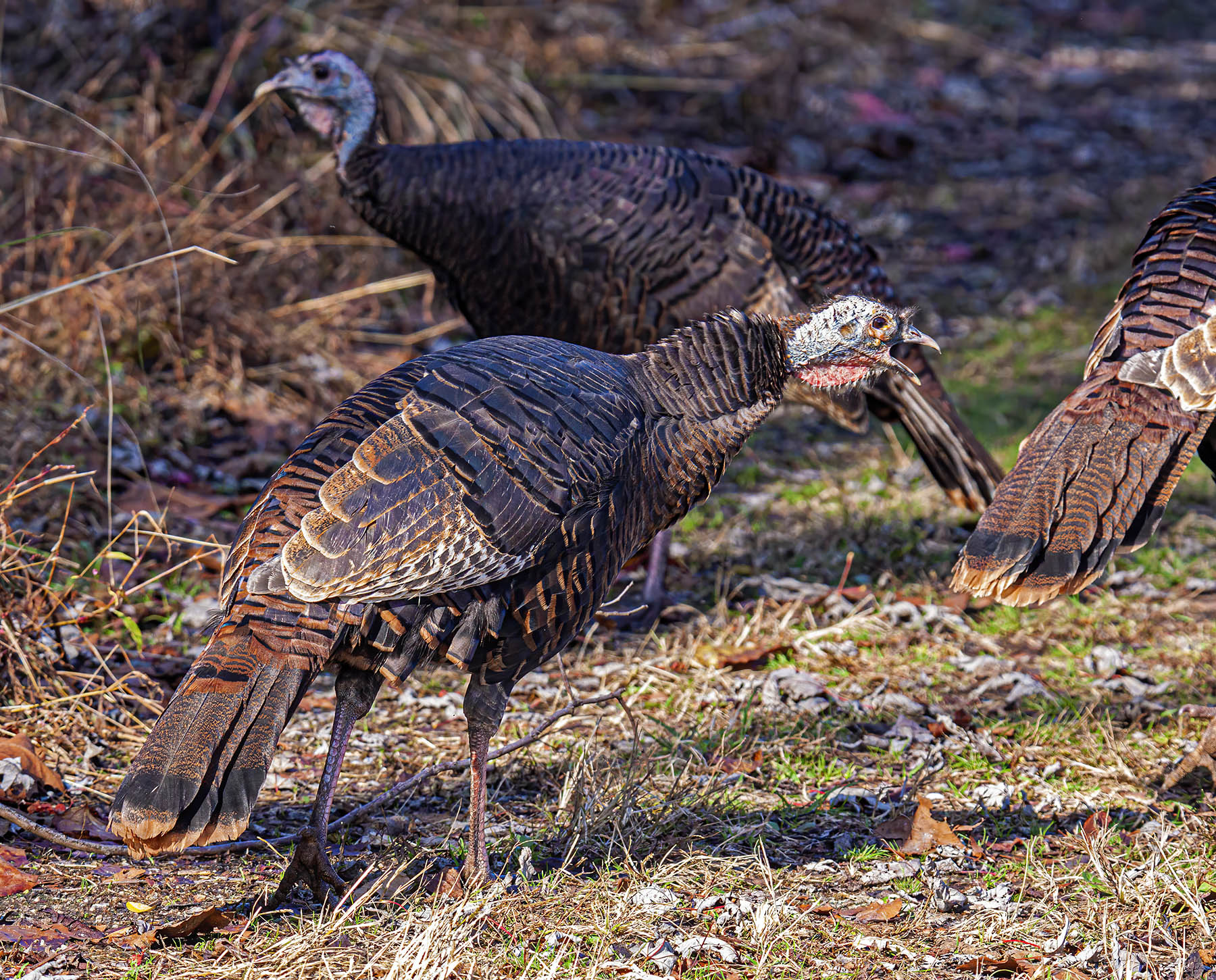
How do you tell the age of a Wild Turkey (Meleagris gallopavo)? Strangely enough, that was the first question that came into my mind when I encountered a small group of Wild Turkeys on Monday at Occoquan Bay National Wildlife Refuge. Many of the turkeys that I have spotted at this refuge over the year have been considerably larger than the members of this group that seemed mostly young to me.

I went searching on-line for an answer to my question. Most of the information that I could find seemed to be designed for hunters, who could measure the length of the spurs and the beard and carefully check the patterns of the feathers after they had “harvested” the bird.

I was more interested in trying to capture the distinctive way in which these turkeys were strutting as they moved slowly toward the underbrush after they had detected my presence. It is probably my imagination, but the open mouths of the the two turkeys in the second photo makes me think that they were carrying on a conversation as they were walking.

The beautiful shades of brown and the different patterns of the feathers of a wild turkey never fail to impress me. The warm coloration of these beautiful birds reminds me that autumn, which starts next week for those of us in the Northern Hemisphere, will soon be upon us.

As I was verifying the date for the Autumnal Equinox for this year on the Old Farmer’s Almanac website, I came across this Irish proverb that seemed appropriate, “Autumn days come quickly, like the running of a hound on the moor.”

Wild Turkey

Wild Turkey

Wild Turkey

© Michael Q. Powell. All rights reserved.

Read Full Post »

Although it has been almost a week since I last posted an image of a bird, let me reassure you that I have not given up on them. At this time of the year, however, my attention is divided and I am just as likely to be hunting for tiny subjects with my macro lens as I am to be scanning the increasing leafy trees through my long telephoto zoom lens. When I start walking (and I do a lot of walking), I have to decide which lens I will initially put on my camera and that will largely dictate where I will look for subjects.

On Thursday, I went back to Occoquan Bay National Wildlife Refuge to look for birds and was delighted to spot a small flock of Wild Turkeys (Meleagris gallopavo). Sometimes the turkeys that I see appear relatively small, but some of the members of this flock seemed enormous, like the one in the first photo. The turkeys were picking about at the edge of the trail on which I was walking and slowly made their way into the undergrowth as I approached. The motion was fast enough, though, that one of the turkey’s legs is blurred in the second photo.

I am hoping to be able to capture some images of springtime warblers and of baby eaglets, but the transition has already begun from mostly telephoto shots to mostly macro shots—it is part of my seasonal transition.

wild tukey

wild turkey

© Michael Q. Powell. All rights reserved.

Read Full Post »

I do not know about the reactions of the lady turkeys, but I was mighty impressed by the display of this male Wild Turkey (Meleagris gallopavo) early yesterday morning at Occoquan Bay National Wildlife Refuge. A lot of male birds go to great lengths to impress and attract females during the early spring, but this wild turkey’s presentation might take the prize for being so flamboyant and ostentatious. I guess he has truly embraced the motto, “Go big or go home.”

Wild Turkey

© Michael Q. Powell. All rights reserved.


Read Full Post »

A small flock of Wild Turkeys (Meleagris gallopavo) disappeared into the underbrush on Tuesday at Occoquan Bay National Wildlife Refuge, but I kept on eye on them and managed to get this first shot as one of them made its way through the dried stalks of vegetation.

Later that same day, I had another sighting of turkeys and captured a familiar view of a turkey hurrying across the road. I like the way that the second shot shows the turkey’s “beard,” the tuft that looks a bit like a miniature horsetail dangling from its breast.

Wild Turkey

© Michael Q. Powell. All rights reserved.

Read Full Post »

Wild Turkeys (Meleagris gallopavo) do not run very fast, but the panning technique that I used for the photo below blurred the background and makes it look like the turkey was moving really quickly. I really like the effect that I achieved, but I must confess that it was what Bob Ross might have called a “happy accident.”

My visit yesterday to Occoquan Bay National Wildlife Refuge was coming to a close when I spotted a turkey in the distance getting ready to cross the road. My camera was attached to a monopod and I immediately planted it into the ground and tried to track the turkey with my zoom lens extended to its full 600mm length.

I had no idea what the setting were on my camera—I was completely focused on trying to capture the moment. As it turned out, the shutter speed was way too slow to stop the action, only 1/50 of a second, so my subject is somewhat blurred. When you plan to pan, you deliberately set a slow shutter speed, normally between 1/30 and 1/125 of a second and I happened to be within that range. I was also moving the camera pretty smoothly as I tracked the big bird.

Luck and instinctive reactions helped me capture a fun, funky image that puts a huge smile on my face every time that I look at it. I hope that it does the same for you.


wild turkey

© Michael Q. Powell. All rights reserved.

Read Full Post »

I am not sure why this wild turkey (Meleagris gallopavo) decided to flash its feathers at me yesterday at Occoquan Bay National Wildlife Refuge, but it sure made for a fun photo. A fellow photographer spotted a small flock of turkeys foraging in a faraway field and we tried to track them as they made their way up a small slope at the edge of the field.

Most of the time the turkeys kept their heads down as they moved forward, scratching about in the dirt, as you can see in the final photo. I had to wait patiently, hopeful that one of them would raise its head briefly before they got too far away. I was thrilled when the turkey in the second shot stood still for a moment and almost ecstatic when it fanned and flashed its feathers as you saw in the featured first photo.

wild turkey

wild turkey

wild turkey

© Michael Q. Powell. All rights reserved.


Read Full Post »

If I wander the trails of Occoquan Bay National Wildlife Refuge for a long enough period of time, I am quite likely to encounter some Wild Turkeys (Meleagris gallopavo). I have seen them in almost all parts of the refuge and suspect that there are several flocks that reside there.

Last Monday I encountered a small flock that appeared to include a half-dozen or so turkeys. They were scratching about at the edge of one of the trails and did not seem to notice me as I slowly made my way forward. All of the sudden, one of the turkeys flapped its wings a little as if to sound an alarm, as you can see in the second image below. All of the turkeys started to move and slowly disappeared into the underbrush. I was thrilled to capture the first image as they were striding away.

Wild Turkey

Wild Turkey

© Michael Q. Powell. All rights reserved.

Read Full Post »

How often have you heard the platitude that you should cultivate an attitude of gratitude? Many of us will nod our head in agreement when we hear those words and then continue on in our self-centered lives, firm in our conviction that we are independent and self-sufficient, and that all that we have is the result of our own efforts. Wikipedia describes a platitude in these words, “A platitude is a trite, meaningless, or prosaic statement, often used as a thought-terminating cliché, aimed at quelling social, emotional, or cognitive unease. The statement may be true, but its meaning has been lost due to its excessive use.”

In the United States, one day a year is set aside to give thanks, Thanksgiving Day. Traditionally Americans will gather around a table and before they eat, each person will be asked to name one thing for which they are thankful. Some people find it difficult to be put in that position.

Why is it so tough to be thankful? Our society bombards us with messages that we should never be satisfied with what we have and should always want more—we can easily be trapped into focusing on what we do not have rather than on what we do have.

Last night at a Zoom church service I heard again the words of Scripture that reminds us to give thanks “in everything.” In everything? Yes, we should be thankful in absolutely everything. The experience of the last nine months has caused me to reexamine a lot of things that I had previously taken for granted. All of the sudden I was increasingly thankful for essential workers, for fellow citizens who wore masks and stayed at home, for the food that was present on the almost empty shelves at the grocery stores, for my relative good health, and for the roof over my head.

As many of you know, I have been blessed to be able to continue to find refuge in nature and to share my photos and experiences in this blog. I recently noticed that I have done a posting every single day so far this year. I really want to all of you for your overwhelming support and encouragement, which has been one of the few constant factors in my life as the world around me has swirled out of control.

Whether you are in the United States or not, I hope that today you will pause for a least a few moments and reflect on those people and things for which you are truly thankful. Have a safe and happy Thanksgiving Day 2020.

In case you are curious, I photographed this handsome Wild Turkey (Meleagris gallopavo) earlier this month at Occoquan Bay National Wildlife Refuge. Some people hunt wild turkeys, but the turkey that I will consume later today will be one that I purchased at the supermarket.

wild turkey

© Michael Q. Powell. All rights reserved.

Read Full Post »

On Friday I spotted a flock of Wild Turkeys (Meleagris gallopavo) at Occoquan Bay National Wildlife Refuge. At least one of them was not very happy—perhaps the turkey knew that Thanksgiving Day is fast approaching.

The turkeys were all clustered together, so it was impossible to isolate one for a cleaner shot. I was happy, though, to be able to capture the beautiful coloration and patterns of the turkeys’ feathers.

wild turkey

© Michael Q. Powell. All rights reserved.

Read Full Post »
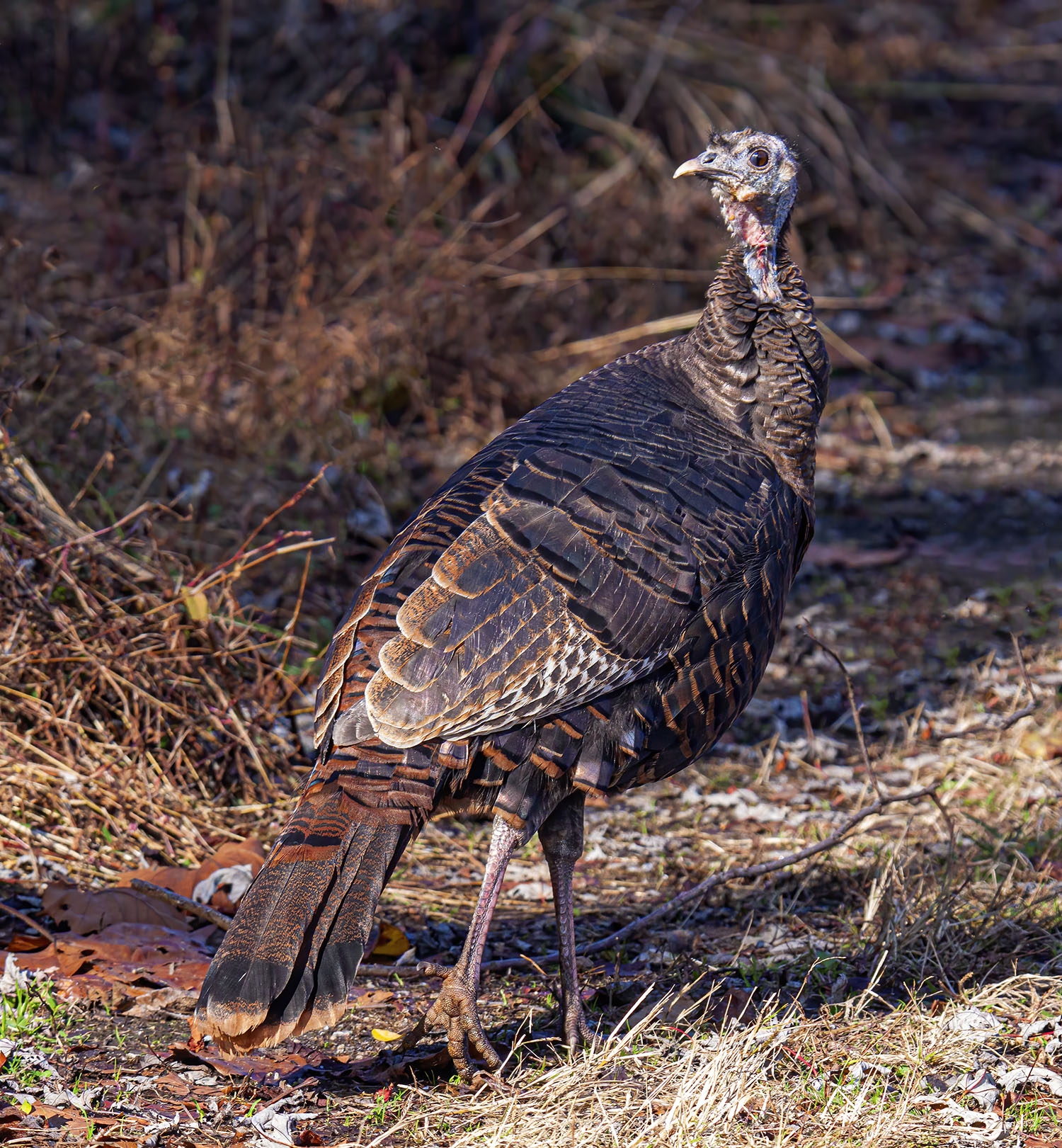
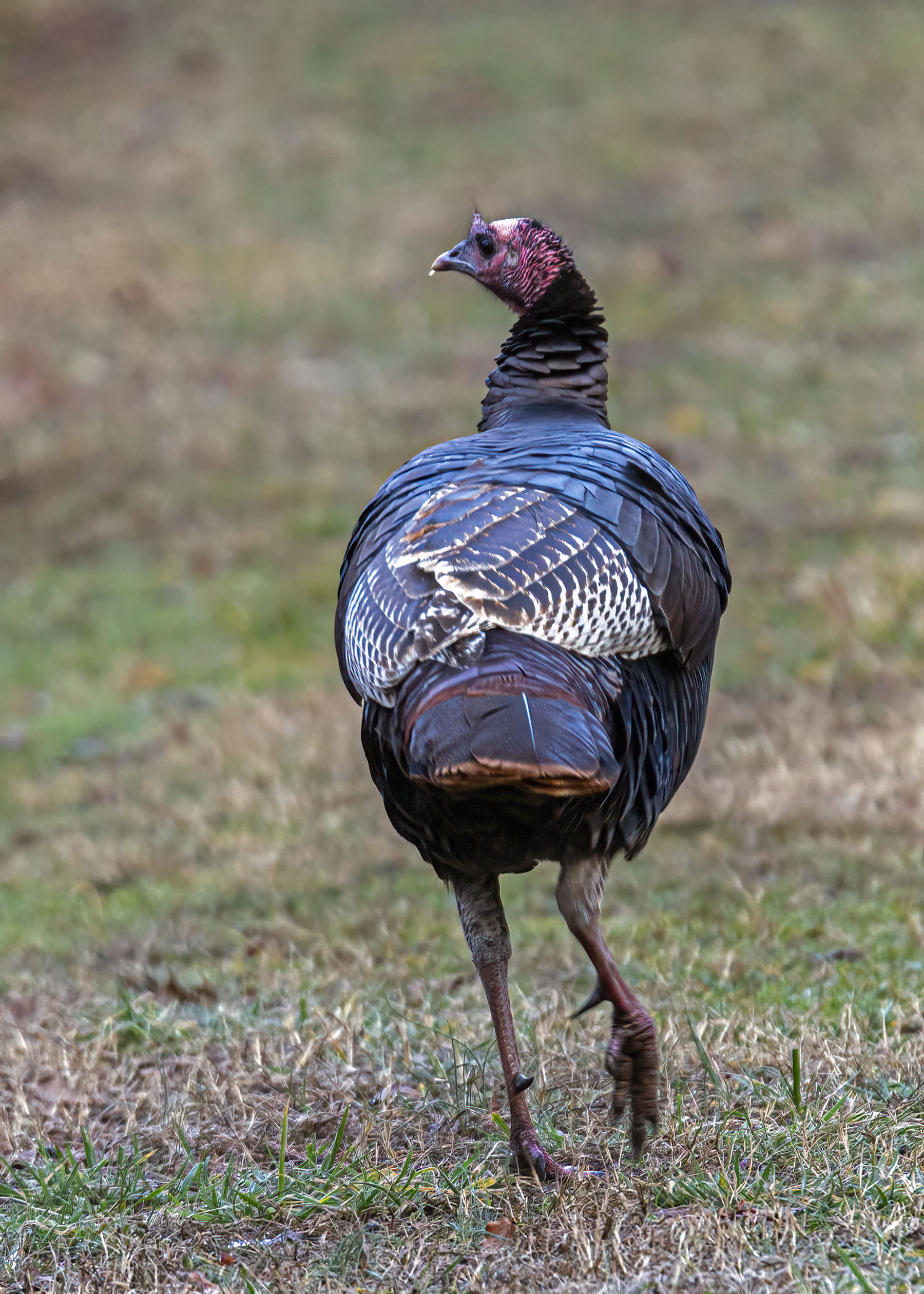
During my recent trips to Occoquan Bay National Wildlife Refuge I have been seeing a lot of Wild Turkeys (Meleagris gallopavo). Most of the time they have been in small groups, but occasionally I will run across one that seems to be alone or maybe simply separated temporarily from its group.

In the first photos, you will notice the long “beards” of two of the turkeys, which suggest that they are mature males. Generally flocks of turkeys are separated by gender and by age, so these may all be mature males, though the one on the left looks to be smaller than the other three, though that might simply be a factor of the viewing angle. The turkey in the second photo has a shorter “beard” and may be a jake, the term used for an immature male turkey.

It is interesting to watch wild turkeys. They seem slow and deliberate in all that they do, strutting and poking about for food. Even when they are spooked, they don’t accelerate quickly as most birds do, but instead they slowly fade into the underbrush.

Wild Turkey

Wild Turkey

© Michael Q. Powell. All rights reserved.


Read Full Post »

Wild Turkeys (Meleagris gallopavo) reacted in different ways yesterday at Occoquan Bay National Wildlife Refuge when they detected my presence. One turkey seemed to panic, put down its head, and sprinted to the other side, while the other calmly strode across the trail. Both reached the other side safely. Was this the turkey version of social distancing?

How do you react in the face of a perceived threat? These days, this question is not merely an academic one—it is part of our daily lives. I think we all experience moments of panic, but we can choose not to let those feelings overwhelm us. Stay safe and healthy within the limits imposed on you by the current crisis and be sure to take care of yourselves.

Wild Turkey

Wild Turkey

© Michael Q. Powell. All rights reserved.


Read Full Post »
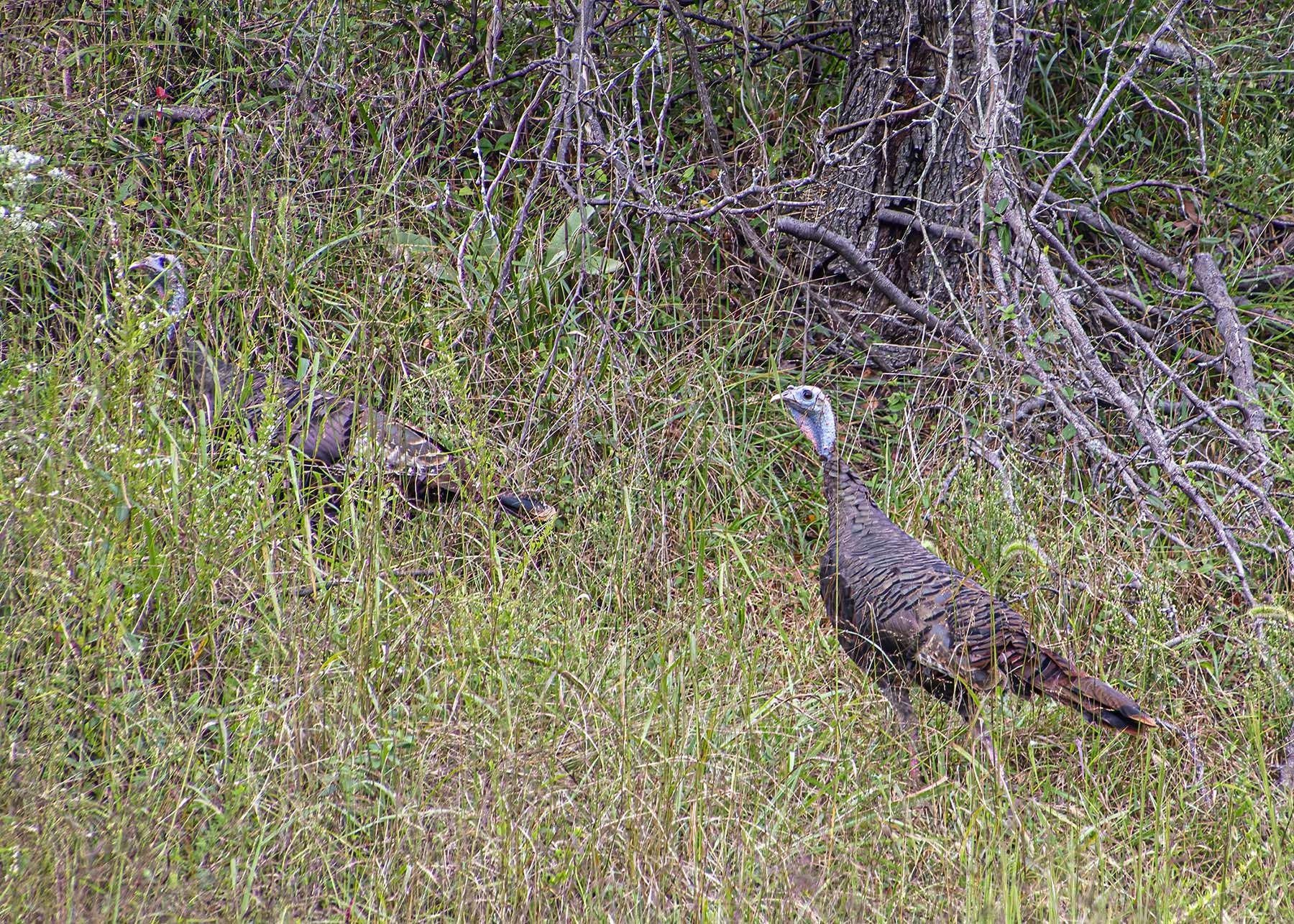
Most of the times when I see Wild Turkeys (Meleagris gallopavo) at Occoquan Bay National Wildlife Refuge, they are foraging in the open along one of the trails. As I approach, they usually disappear deep into the vegetation.

At this time of the year, though, I can see a lot farther into the woods than when there are leaves on the trees. Occasionally now I can get a glimpse of the turkeys moving about in the distance. I was happy to capture these head shots last week of one of the local turkeys as it popped in and out of view.

wild turkey

wild turkey

© Michael Q. Powell. All rights reserved.

Read Full Post »

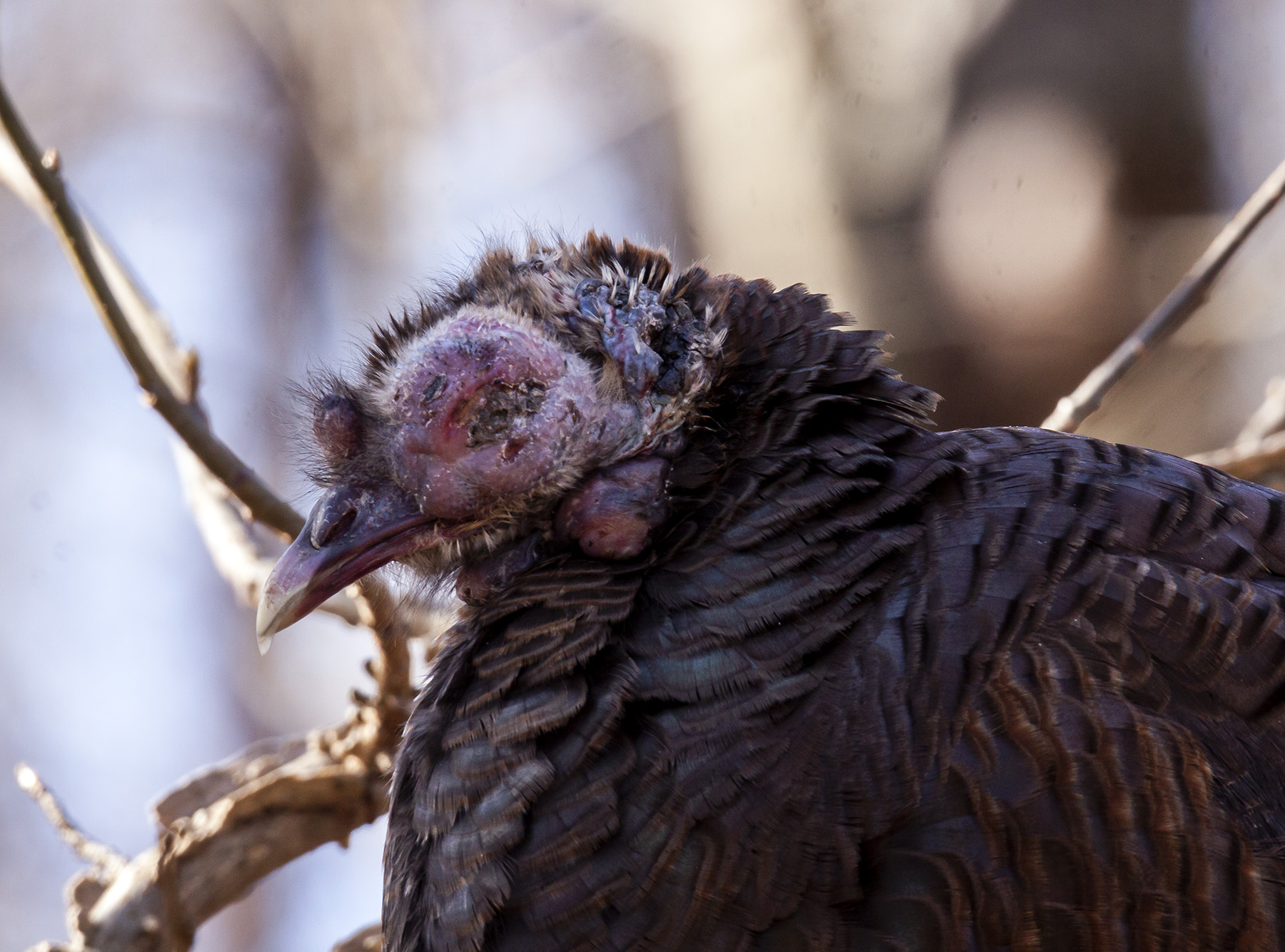
When I spotted this Wild Turkey (Meleagris gallopavo) roosting low in a tree at the edge of a trail last Thursday at Occoquan Bay National Wildlife Refuge, I was initially happy to be able to get a shot. As I got closer, though, I was saddened to see that the turkey appeared to be injured or more likely suffering from a disease.

I was initially alerted to the presence of a ranger who drove past me heading in the opposite direction in a truck. I was sure that the passing of the truck had spooked the turkey and was surprised to see that it was still there as I silently moved closer. I noted small movements by the turkey, so I could tell that it was alive, but the extent of the damage to its face made me wonder if it could see. I quickly took the first two shots and departed.

When I circled back an hour later, I could see that the turkey had changed positions, but was still perched in the tree. I could now see that the damage to the other side of its face was equally severe. I worry about the survivability of this injured/sick wild turkey.


Wild Turkey

Wild Turkey

Wild Turkey

© Michael Q. Powell. All rights reserved.

Read Full Post »

I accidentally spooked a small flock of wild turkeys (Meleagris gallopavo) on Thursday at Occoquan Bay National Wildlife Refuge and one of them flew up into a tree in the middle of a field. I waited patiently and captured these shots when the turkey finally flew out of the tree. As you probably have noticed, the images are not in chronological order—I decided to lead with the two shots in which the turkey is in the air, which I think are the most dramatic images, and finish with the shot in which the turkey was starting to take off.

I was shooting almost straight into the sun, which is why the turkey is mostly a silhouette and the images seem like they were shot in black and white.

wild turkey

wild turkey

wild turkey

© Michael Q. Powell. All rights reserved.

Read Full Post »
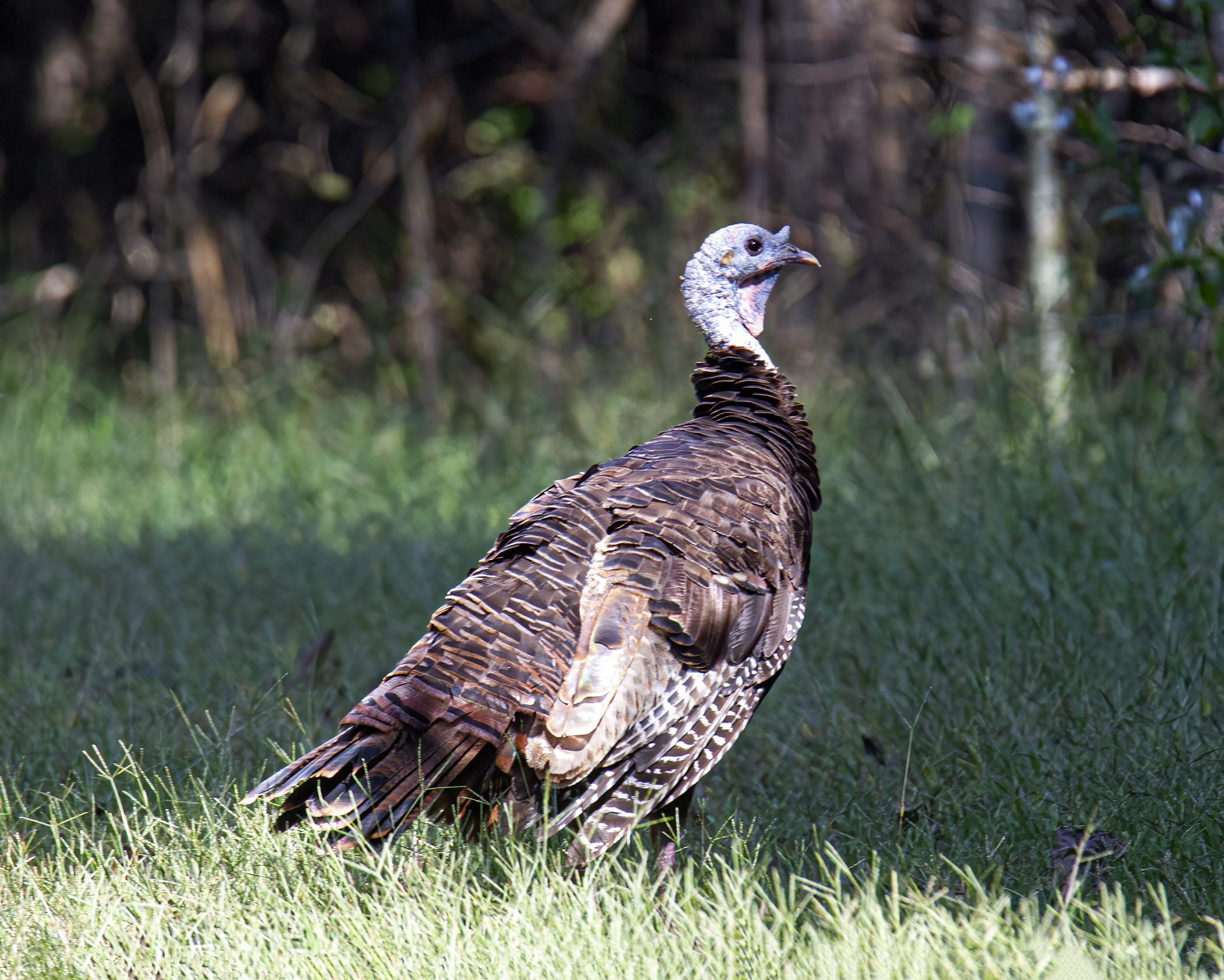
I do not know where the Wild Turkeys (Meleagris gallopavo) were hiding, but I don’t think that I spotted a single one all summer. All of the sudden they seem to be back and I have seen them repeatedly during my most recent visits to Occoquan Bay National Wildlife Refuge.

During most of my encounters, I have spotted them in the distance, pecking away at the side of the trail. Before I can get within camera range, they usually sense my presence and waddle into the undergrowth. I was fortunate, however, to capture a shot of this one turkey who had lingered in the open a bit longer than his compatriots.

Wild Turkey

© Michael Q. Powell. All rights reserved.

Read Full Post »

Yesterday I was thrilled to get a glimpse of this impressive-looking Wild Turkey (Meleagris gallopavo) at Occoquan Bay National Wildlife Refuge. I have seen Wild Turkeys at this refuge on numerous occasions, but this is one of the first images that I have been able to capture this spring.

I am always amazed when I come upon a male turkey displaying his feathers. I grew up in the suburbs of Boston and the only turkeys that I ever saw were those in the freezer at the supermarket, which did not look anything like this bird, and the cutout figures that we would pin to the wall to celebrate Thanksgiving. Somehow I always thought those cutouts were cartoonish caricatures—little did I know that wild turkeys actually look like those colorful figures.

wild turkey

© Michael Q. Powell. All rights reserved.

Read Full Post »

I spotted this large Wild Turkey (Meleagris gallopavo) strutting about at Occoquan Bay National Wildlife Refuge this past weekend with about a dozen of his close friends. It was hard to get a group shot, so I focused instead on the largest turkey in the group and captured this image.

Wild Turkey

© Michael Q. Powell. All rights reserved.

Read Full Post »

The vegetation at Occoquan Bay National Wildlife Refuge was so high recently that these two foraging wild turkeys (Meleagris gallopavo) disappeared from view each time they leaned forward. It was like a game trying to figure out where they would pop up next. I played the game for for quite some time before I was able to capture them both in a single frame with their eyes visible—in most of the other shots the turkeys were looking away from me.

wild turkeys

© Michael Q. Powell. All rights reserved.


Read Full Post »

Older Posts »