Feeds:
Posts
Comments

Posts Tagged ‘male Eastern Pondhawk’

When male Eastern Pondhawk dragonflies (Erythemis simplicicollis) are very young, they have green bodies with dark banding on the abdomen, just like their female counterparts. Over time male Eastern Pondhawks are gradually transformed into a duller shade of blue and finally a powdery bluish-grey.

From an aesthetic point of view, my favorite stage of development is when they are young males and their thoraxes are a beautiful shade of green that contrasts wonderfully with their blue abdomens. Eastern Pondhawks of both genders have cool-looking green faces that help to distinguish them immediately from other dragonfly species.

I spotted this Eastern Pondhawk during a recent visit to Jackson Miles Abbott Wetland Refuge, a small refuge that belongs to a nearby military installation. It is not a contiguous part of that installation, however, and is open to the public. The composition of this shot is quite simple, but I like the way that the Y-shape of the forked branch helps to divide up the frame and lead the viewer’s eyes to the main subject.

Eastern Pondhawk

© Michael Q. Powell. All rights reserved.
Read Full Post »

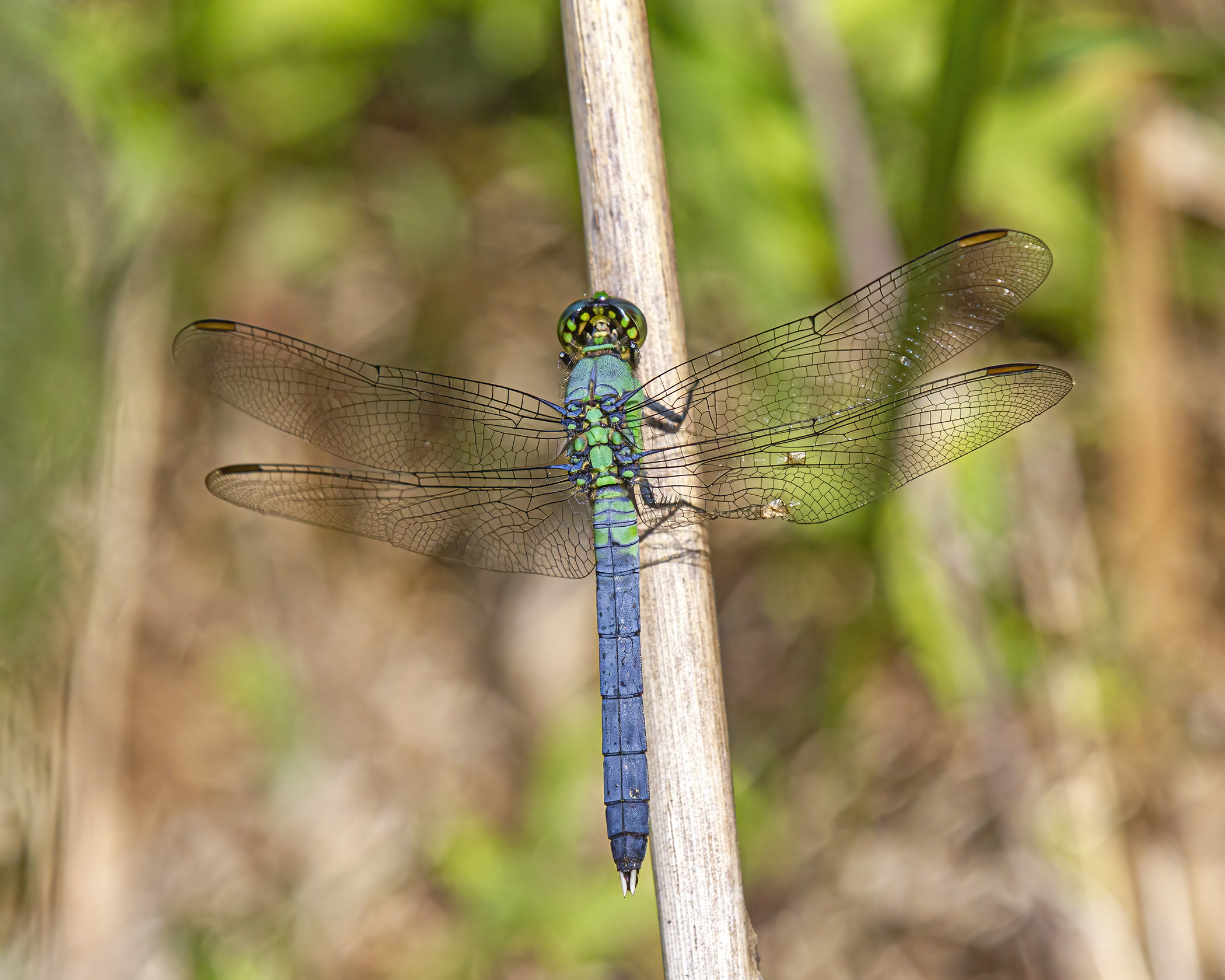
I love the look of male Eastern Pondhawk dragonflies (Erythemis simplicicollis) when they are transitioning to adults. When they are juvenile, male Easter Pondhawks have emerald green thoraxes and black striped abdomen, like their female counterparts. Gradually the body coloration shifts to blue as they mature. I really like their appearance when, as was the case with these pondhawks that I photographed last week at Occoquan Regional Park, their bodies have beautiful shades of both green and blue.

In the second and third photos, you get a glimpse of the pondhawk’s beautiful eyes that are also a combination of blue and green. Although you can’t see it very well in these photos, Eastern Pondhawks of both genders have bright green faces, which helps to distinguish the male Eastern Pondhawks from a number of other dragonfly species that have blue bodies.

Eastern Pondhawk

Eastern Pondhawk

Eastern Pondhawk

© Michael Q. Powell. All rights reserved


Read Full Post »

I love the cool tones of this image of a male Eastern Pondhawk dragonfly (Erythemis simplicicollis) that I photographed last week at Occoquan Regional Park—the green of the vegetation seemed a perfect complement to the colors of this handsome dragonfly. In most dragonfly species the male stands out more than the female, but with the Eastern Pondhawk, it is the female who is more often in the spotlight with her emerald green thorax and the black striped abdomen, as some of you may recall from my posting last week entitled First Eastern Pondhawk of 2021.

A male Eastern Pondhawk starts out with the same bright green coloration as the female, but over the course of his adult life the green is gradually transformed into a duller shade of blue and finally a powdery bluish-grey. A number of other dragonflies have a similar shade of blue on their bodies, but it is fairly easy to identify male Eastern Pondhawks because they, like the females, have bright green faces and their terminal appendages at the tip of their abdomens (the “tail”) are white in color.

Eastern Pondhawk

© Michael Q. Powell. All rights reserved.

Read Full Post »

Normally a dragonfly’s abdomen is straight. Occasionally, though, I encounter one with an abdomen that has a noticeable curve, like this male Eastern Pondhawk dragonfly (Erythemis simplicicollis) that I spotted yesterday at Jackson Miles Abbott Wetland Refuge. (For those of you not familiar with dragonfly anatomy, the upper portion of the body is the thorax and the lower two-thirds is the abdomen.)

I suspect that the curvature was the result of a problem that occurred when the dragonfly was first emerging. It does not seem to have any effect on his ability to fly or to catch prey, but it might pose a problem when he attempts to mate.

Eastern Pondhawk

© Michael Q. Powell. All rights reserved.

Read Full Post »

Frequent viewers of this blog have probably noticed that I am doing a little series of postings featuring common dragonflies that at first glance might look similar. Today’s “star” is a mature male Eastern Pondhawk (Erythemis simplicicollis). Like several other dragonflies in recent postings, the Eastern Pondhawk has a primarily blue body, but several characteristics make it possible to distinguish this species from others.

Both the male and female Eastern Pondhawks have green faces and the male has distinctive white terminal appendages, i.e. those little protrusions at the end of the abdomen (the “tail). Dragonfly specialists spend a lot of time focusing on those appendages, because immature males often have the same coloration as females. In this case, an immature male Eastern Pondhawk would be green with black bands on the abdomen. For the sake of comparison, I am including a photo I took on the same day of a female Eastern Pondhawk. If you compare the tips of the “tails” of the male and the female, you should be able to see the anatomical differences between the genders.

Although it doesn’t help in identifying them, I can’t help but note that Eastern Pondhawks are voracious predators. I think that I have captured more photos of Eastern Pondhawks feeding on other insects that of any other species. When I captured this image last week, I had no idea that the dragonfly was devouring a damselfly. If you click on the image to enlarge it and look just to the left of the dragonfly’s head, you will notice a set of small wings. As you look more closely, you can see the damselfly’s body hanging vertically just below the dragonfly’s head. Yikes!

Eastern Pondhawk

Eastern Ponndhawk


© Michael Q. Powell. All rights reserved.

Read Full Post »

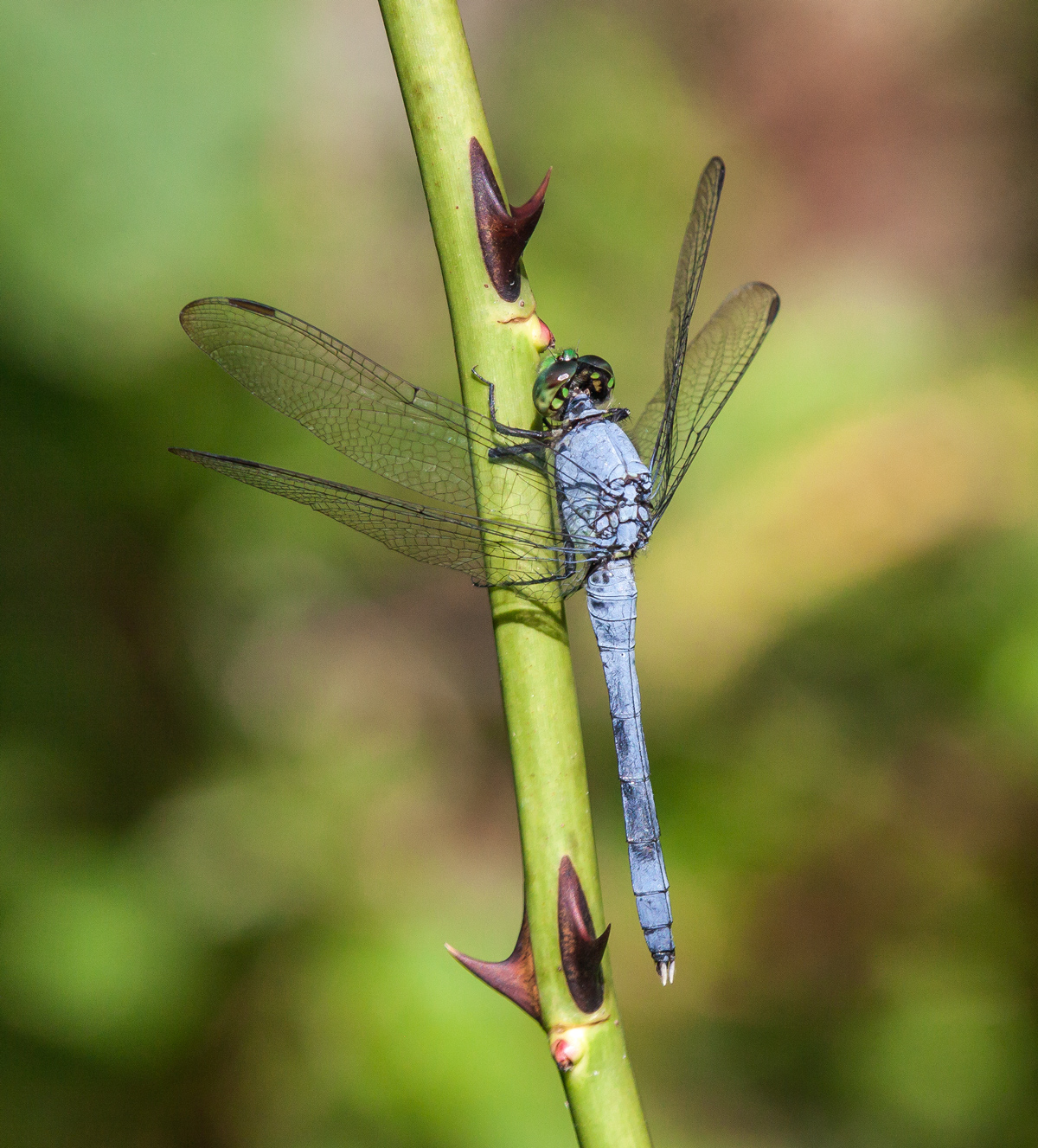
I don’t know about you, but if I were an insect with large, fragile wings, I think that I would avoid perching on vegetation with large thorns. This male Eastern Pondhawk dragonfly (Erythemis simplicicollis), however, is obviously bolder and more skilled than I am. With precision flying skills matching the parking abilities of an inner city driver, he has managed to squeeze into a space that seems barely large enough to accommodate him.

Pointless perching—that seems to be the point.

Eastern Pondhawk

© Michael Q. Powell. All rights reserved


Read Full Post »

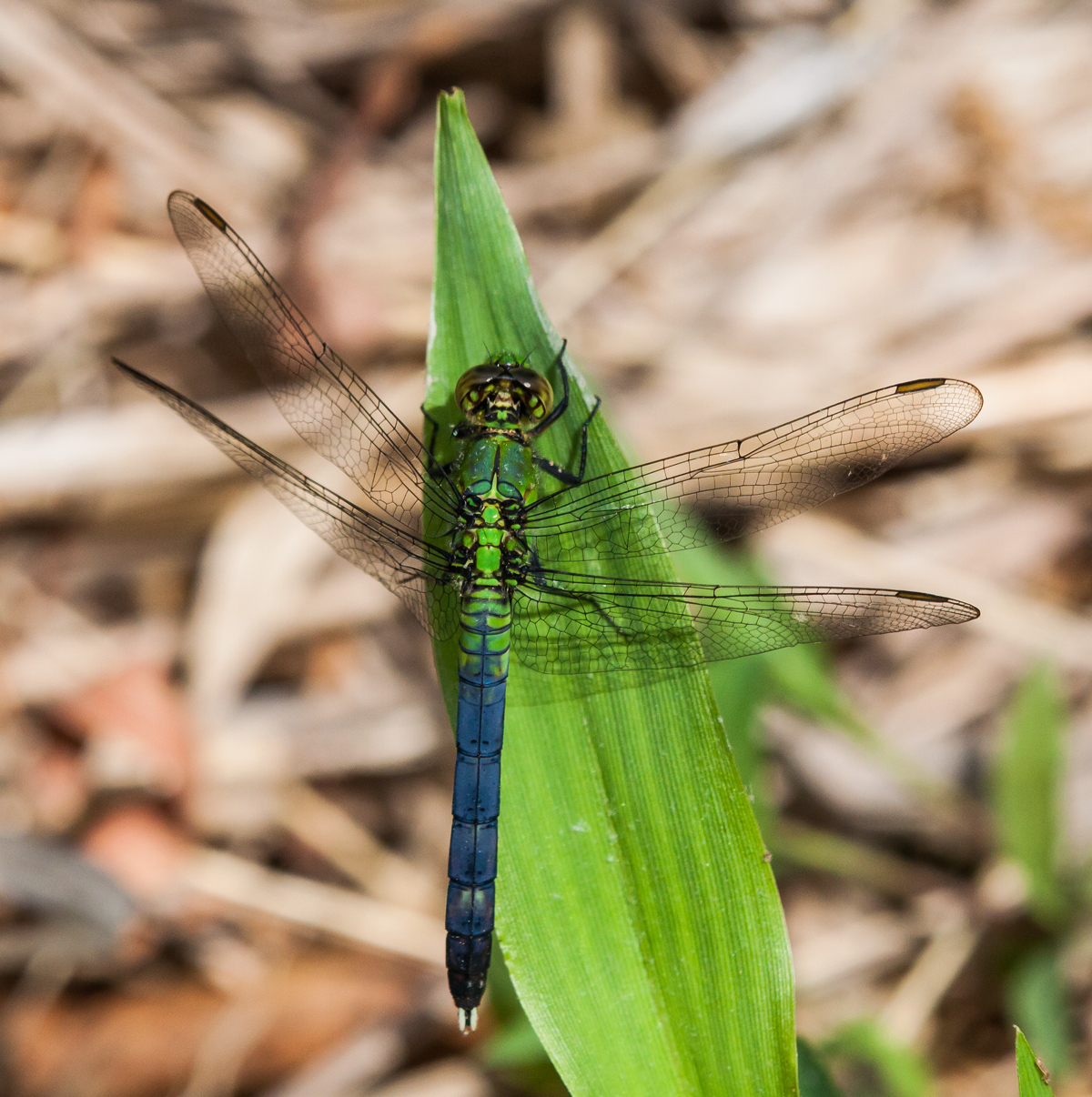
Male Eastern Pondhawk dragonflies (Erythemis simplicicollis) start out with the same bright green coloration and bold black and white stripes as the female that I featured in a posting earlier this week. Over time the males turn a fairly nondescript blue and are outshone by their female counterparts.

On Monday, I was fortunate to capture this image of a male Eastern Pondhawk in a transitional  stage, with beautiful two-toned shades of green and blue. I was thrilled when it perched on a green plant, which helps to draw the viewer’s eye to the dragonfly in a background of dried-up fallen leaves.

Eastern Pondhawk

© Michael Q. Powell. All rights reserved

Read Full Post »