Feeds:
Posts
Comments

Posts Tagged ‘Kingstowne’

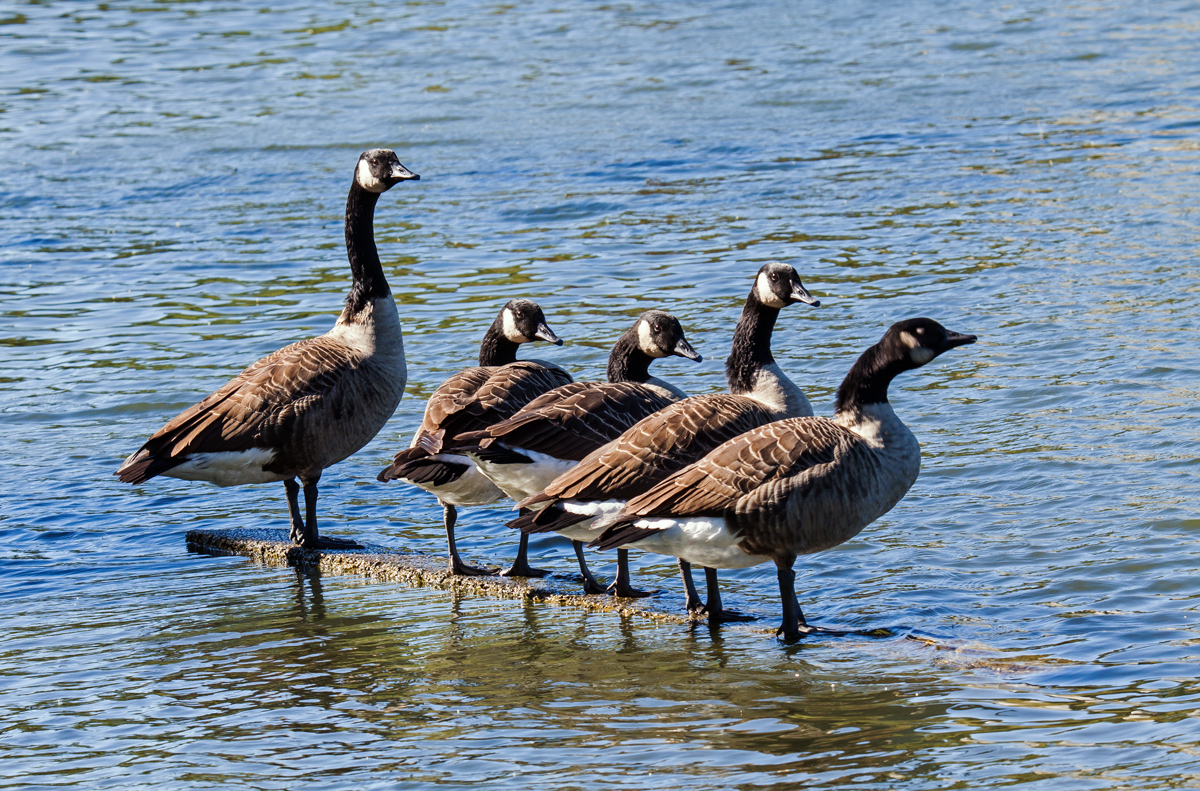
Have you ever tried to shoot a group portrait? You get everyone lined up and facing the camera, but there is always one uncooperative subject. That was certainly the case with these Canada Geese (Branta canadensis) at a little suburban pond on Monday. The gaggle of geese was preening and cleaning themselves all in a row on a on a concrete bar sticking out of the water.

Canada Geese

© Michael Q. Powell. All rights reserved.

Read Full Post »

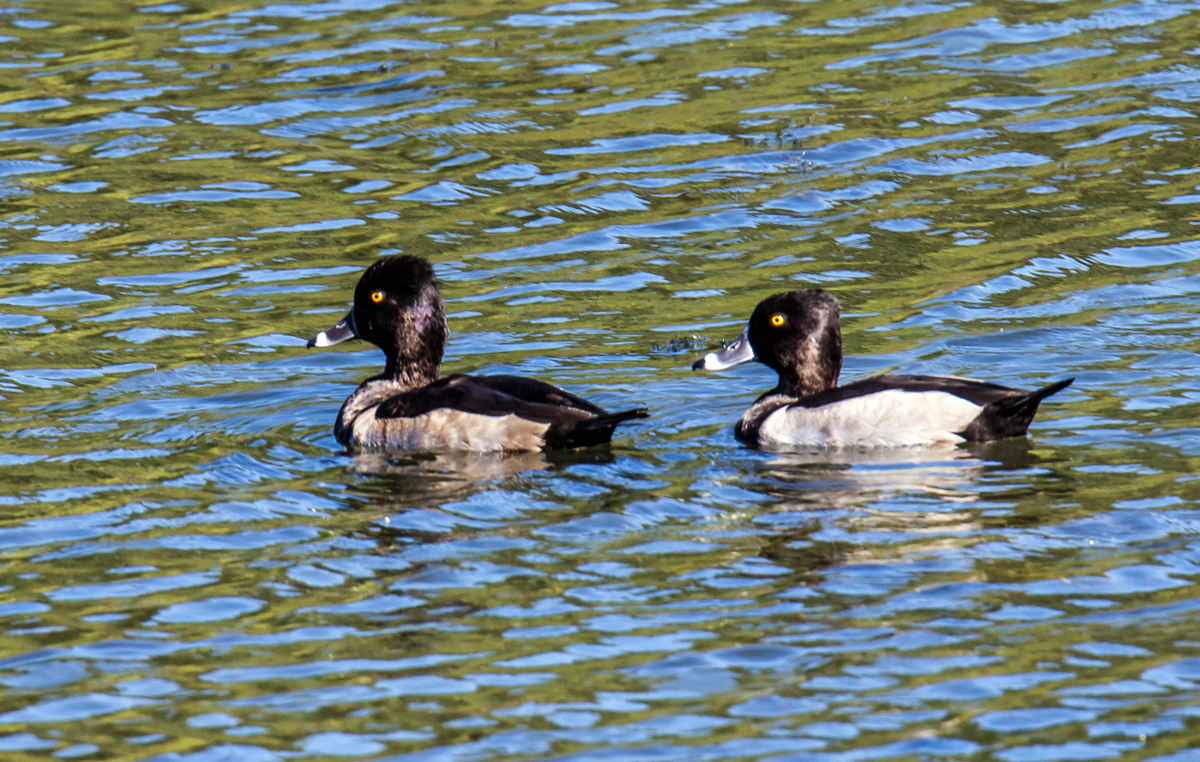
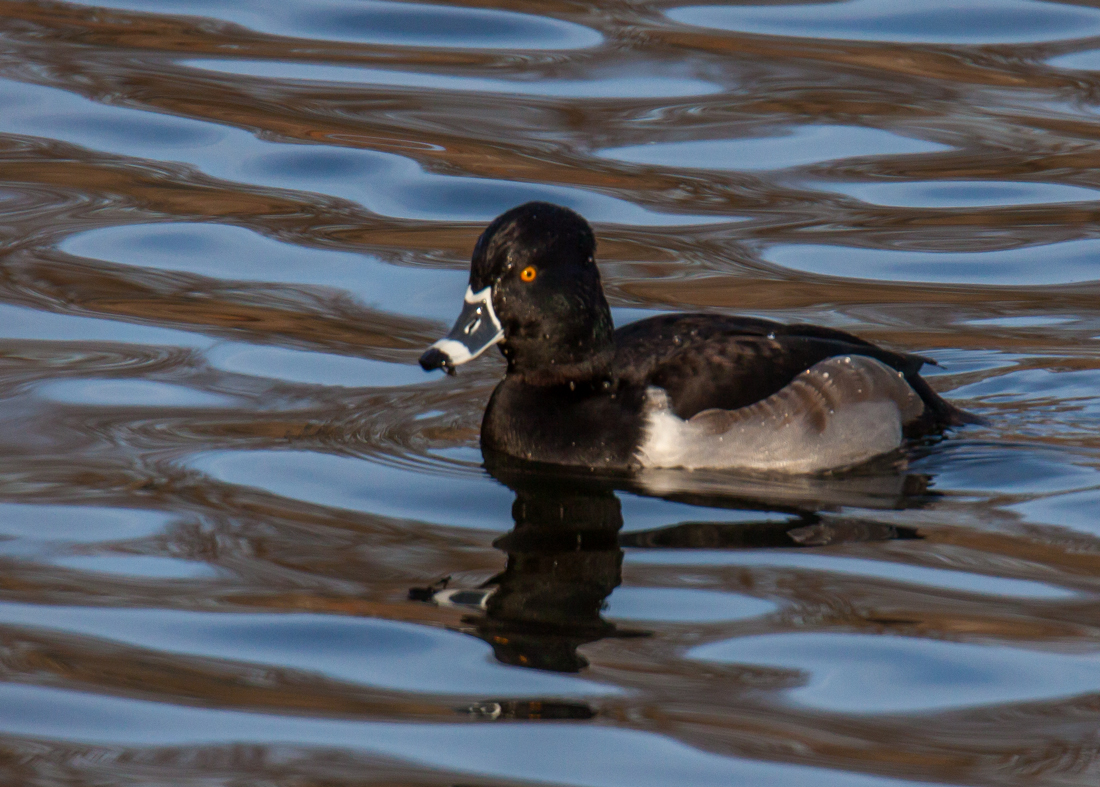
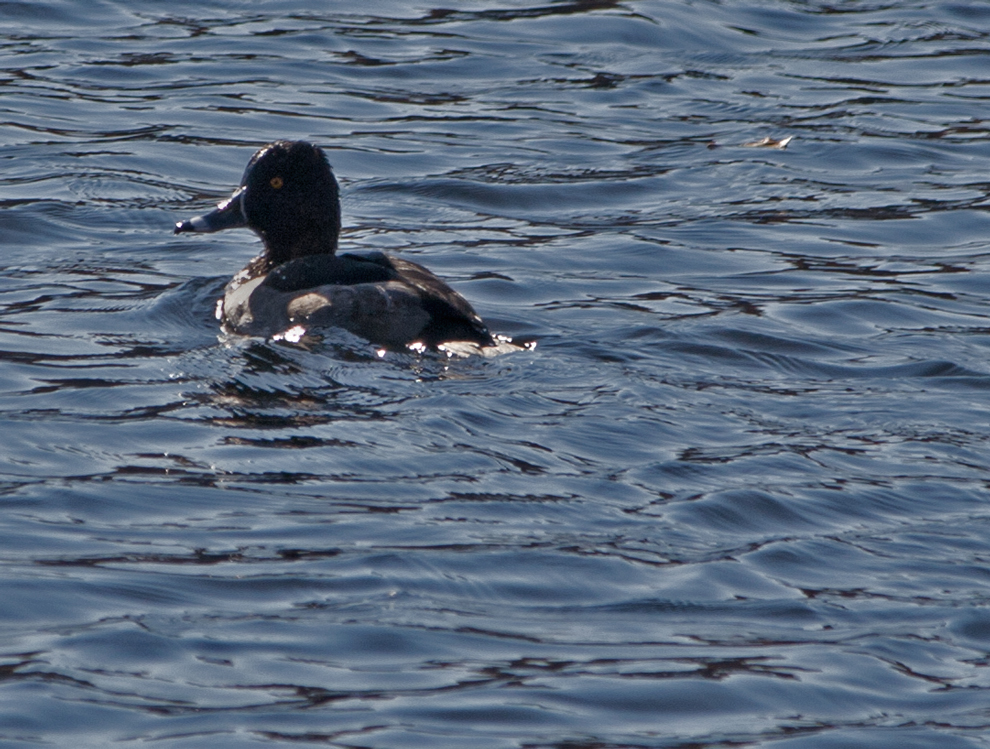
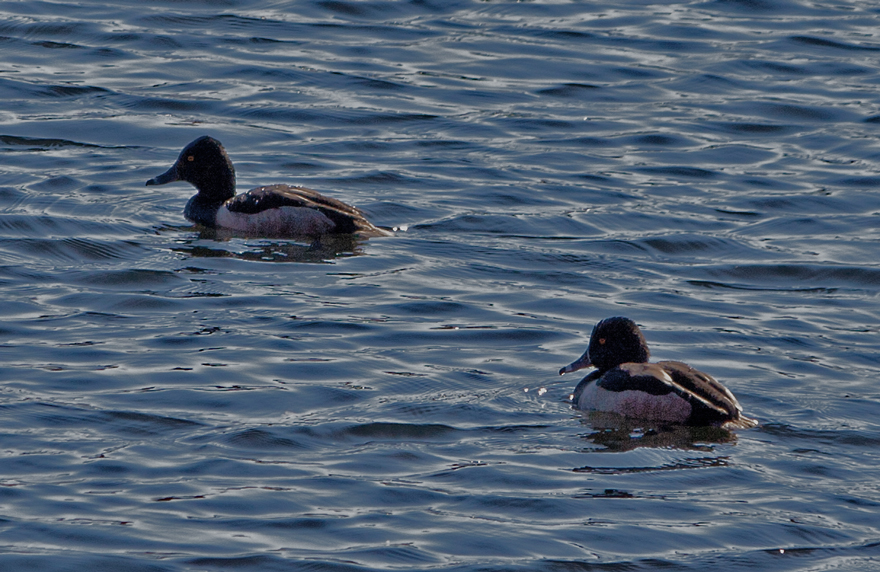
As we move deeper into fall we will be seeing more and more migrating birds in Northern Virginia, where I live . Some will just be passing through the area, but others will probably overwinter here, like these Ring-necked ducks (Aythya collaris) that I spotted yesterday at a small suburban pond less than a mile from my townhouse.

Unlike most of the ducks that I see, Ring-necked ducks are diving ducks, not dabbling ducks. As a consequence, they spend most of the time in the middle of the pond, making them a bit tough to photograph. Fortunately the sun was shining brightly yesterday, so that I was able to capture the ducks’ golden eyes even when shooting at a distance.

Ring-necked duck


© Michael Q. Powell. All rights reserved.

Read Full Post »

Many of the mallards and Canada Geese were resting on the ice on the mostly frozen little pond near where I live, but the Ring-necked ducks all remained in the water the entire time that I watched them. How are the able to tolerated the frigid waters that must be just above the freezing point?

Whenever I moved toward the shore of the pond, the Ring-necked ducks (Aythya collaris) would all turn their backs on me and swim away, which complicated my efforts at taking photos of them. However, the edge of the ice limited somewhat their ability to distance themselves from me and I was able to capture some images of them, including this one of a male Ring-necked duck.

As is most often the case, you can’t see the chestnut-colored ring around the bird’s neck—I probably would have named it the Ring-billed duck and occasionally make the mistake of using that improper, but more logical name for this beautiful little duck.

Ring-necked duck

© Michael Q. Powell. All rights reserved.


Read Full Post »

When you hang around with a gaggle of your closest friends, it’s hard to find moments of privacy or solitude. This Canada Goose seemed pensive as he walked alone on the ice, far away from the other geese that were clustered together near the unfrozen area of the pond.

Canada Goose

Read Full Post »

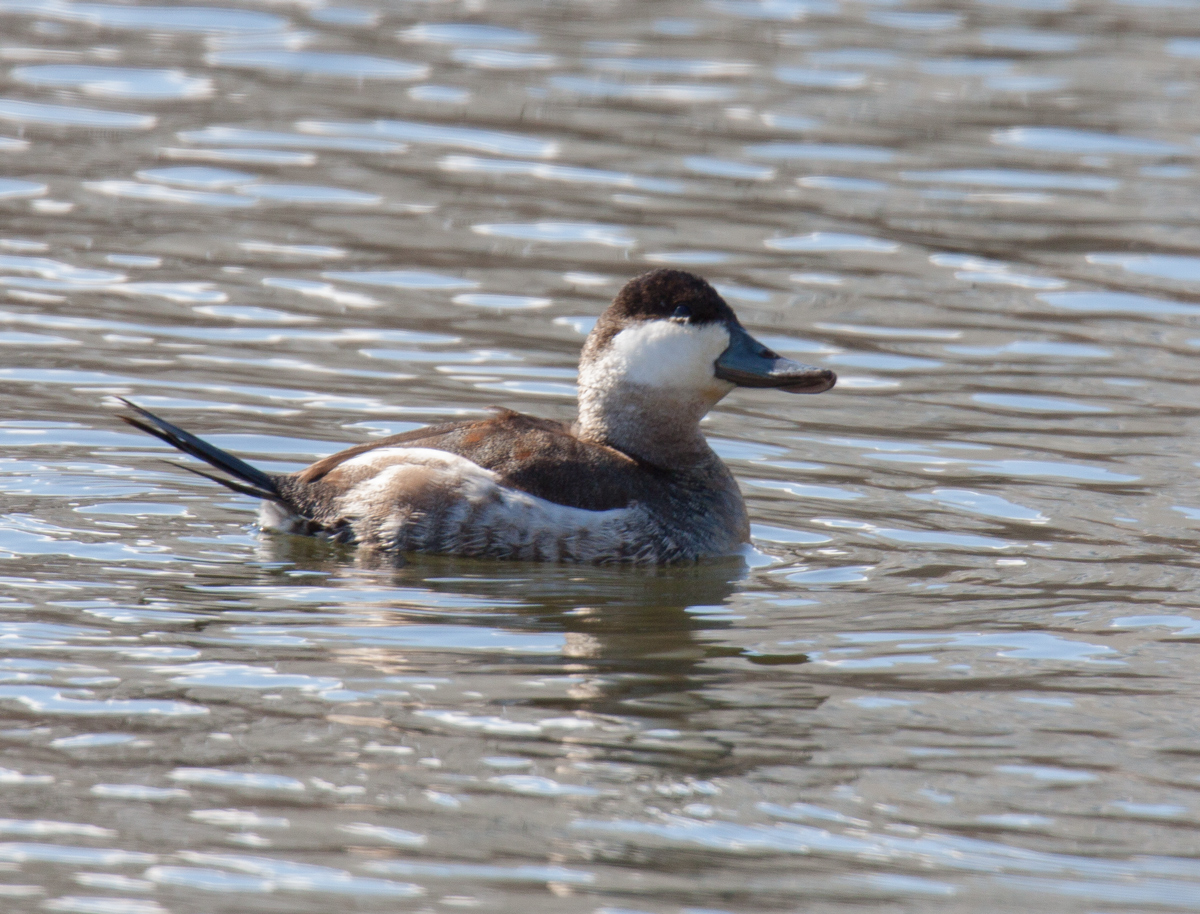
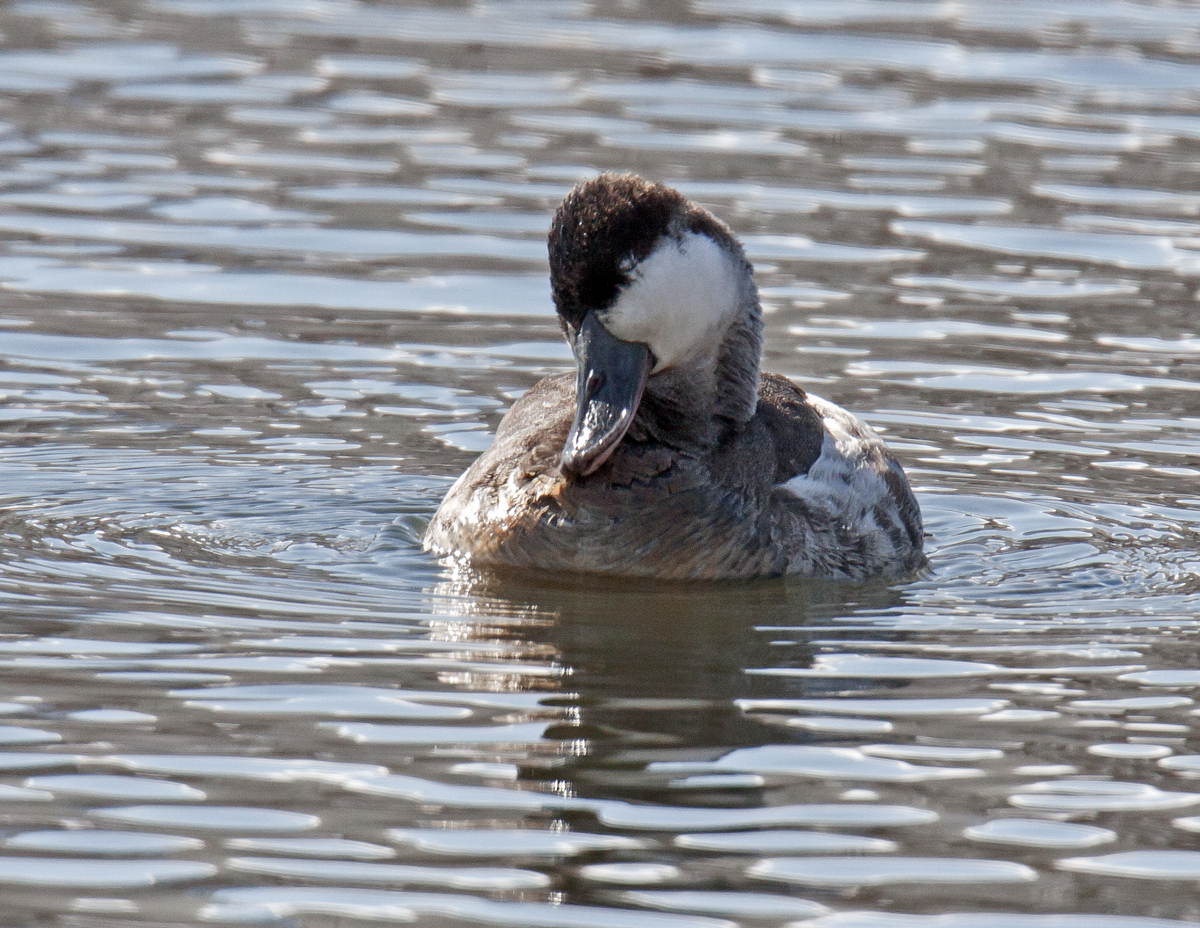
As I was scanning a group of Ring-necked Ducks and Canada Geese earlier this week, I noticed a pair of ducks that looked different, very different from the others. Their colors were unusual, but what really set them apart was their tails that stood almost straight up. I think that I encountered ones like this once before, but I couldn’t remember what species they were.

Fortunately I got some decent shots and was able to find them in my identification guide when I returned home—they turned out to be a pair of Ruddy Ducks (Oxyura jamaicensis). The light was bright and producing a lot of glare off of the water and ice and I didn’t managed to get any good shots of the female, but here are a few images of the male.

Ruddy Duck

Ruddy Duck

© Michael Q. Powell. All rights reserved.


Read Full Post »

Do you ever wake up and feel the need for a drink of water? That was apparently the case for this Canada Goose (Branta canadensis), who was sleeping one-footed on the ice. Fortunately a small amount of water had pooled on the surface of the ice and the goose was able to lean down and get a few sips of water.

A few seconds later, the goose stuck its head back under its wing and drifted off to sleep.

Canada Goose

© Michael Q. Powell. All rights reserved.


Read Full Post »

The suburban retention pond near where I live has almost frozen over, but there are still a few ducks and geese, huddled together in the open areas of unfrozen water. Many of them appeared to be sleeping, with their bills tucked under one of their wings, but this male Ring-necked duck (Aythya collaris) seemed to be keeping his golden eye on me as he struggled to stay warm.Ring-necked duckRing-necked duck

© Michael Q. Powell. All rights reserved.

Read Full Post »

I will sometimes see other birds open their wings and stretch them out for a moment, but the Double-crested Cormorant (Phalacrocorax auritus) is the only bird that I have observed that leaves its wings open for an extended period of time.

Initially I was confused when I heard the cormorant had to dry out its wings because they got waterlogged. How does a waterbird survive if its wings are not waterproof?

The Cornell Lab of Ornithology, my favorite website for information about birds, provides the following explanation of this phenomenon:

“They have less preen oil than other birds, so their feathers can get soaked rather than shedding water like a duck’s. Though this seems like a problem for a bird that spends its life in water, wet feathers probably make it easier for cormorants to hunt underwater with agility and speed.”

Double-crested Cormorant

© Michael Q. Powell. All rights reserved.

Read Full Post »

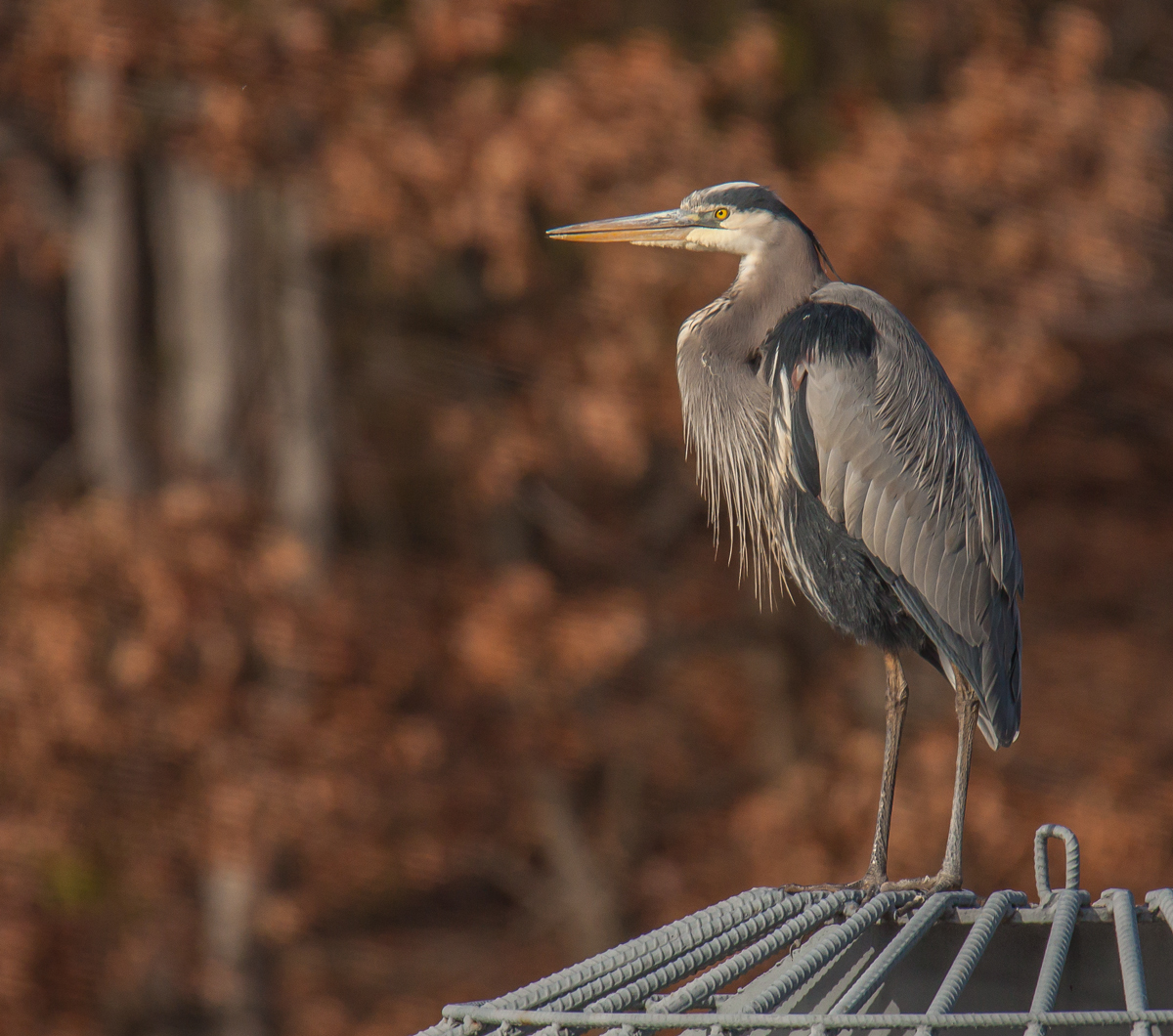
As you contemplate the promises and possibilities of the new year that has just begun, are you more like the pensive Great Blue Heron in the first image or the intensely focused heron in the second photo? (For the record, the Great Blue Heron (Ardea herodias) in both photos is actually the same one that I photographed last weekend at a local water retention pond.)

I’m more like the first heron—I am full of optimism and hope, but don’t have specific plans or resolutions.

Best wishes to all of you for a healthy, prosperous, and blessed new year.

Great Blue Heron

Great Blue Heron

© Michael Q. Powell. All rights reserved.


Read Full Post »

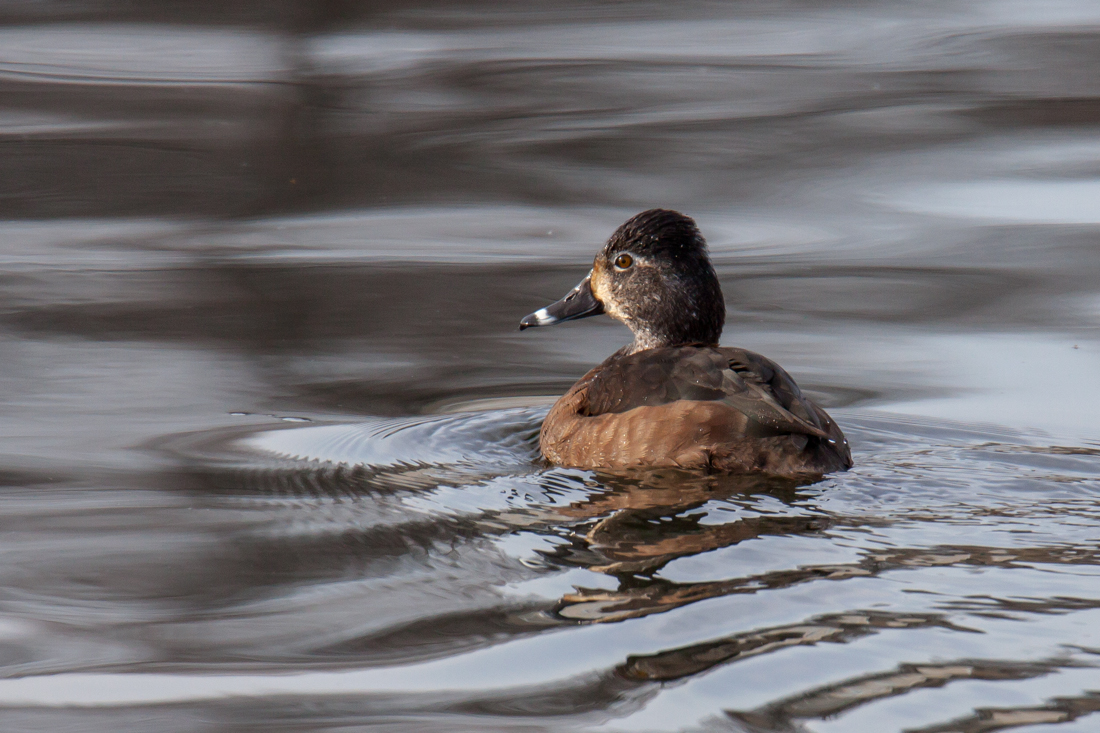
Although the rings on the bills of the Ring-necked Ducks (Aythya collaris) are very distinctive, it is their beautiful eyes that really draw me in, whether it be the startlingly yellow eyes of the male or the more subtle brown eyes of the female.

I never see these ducks in the ponds of my local marshland park, but each winter over the past few years, I have seen them in a small water retention pond in the middle of a suburban townhouse community near where I live.

Ring-necked DuckRing-necked DuckRing-necked Duck

© Michael Q. Powell. All rights reserved.


Read Full Post »

As I gazed out into the center of a small, man-made pond, I spotted gulls and geese and a few ducks. Suddenly a small bird swam into view that I couldn’t identify. It looked a bit like a duck, but the bill seemed to be very different.

I’m stepping out into the unknown by speculating that this might be a Pied-billed Grebe (Podilymbus podiceps), although it doesn’t quite match any photos that in my identification guide or that I could find on-line. I wonder if it is a juvenile bird. I would welcome a clarification, correction, or confirmation from more experienced birders. Thanks in advance for your assistance.

As you can tell, it was a bright, sunny day when I took this shot this past weekend, a welcome respite from the gray days of winter. Alas, it is cloudy again today, with rain forecast for much of the day.

Grebe

© Michael Q. Powell. All rights reserved.

Read Full Post »

Double-crested Cormorants (Phalacrocorax auritus) are strange-looking waterbirds that sit really low in the water. I’ve seen them from time to time, but until yesterday, when I saw this one at a small suburban retention pond, I never knew that they have striking blue eyes.

One of the other unusual things about this bird is that they spend a good amount of time outside of the water drying out their wings. Despite being a diving bird, the cormorant’s feathers do not shed water as well as a duck’s, for example, and they can get soaked pretty quickly.

I took some photos of the cormorant drying its wings that I will post later, but I wanted to post the image of the cormorant resting on one leg, because it shows off the blue eyes (and I like the reflection).

Double-crested Cormorant

Double-crested Cormorant

© Michael Q. Powell. All rights reserved.

Read Full Post »

Have you ever watched ducks taking off from the water? Some of them seem to rise up almost straight out of the water, while others, like this Ring-necked Duck (Aythya collaris), like to get a running start, bouncing across the surface of the water.

bouncing_takeoff_blog

© Michael Q. Powell. All rights reserved.

Read Full Post »

It won’t be long before my bird photos have the colorless backgrounds characteristic of winter, so I am photographing as many birds as I can find with autumn colors in the background, like this House Sparrow (Passer domesticus) that I observed last Sunday. As I noted in a posting last month, these birds are non-native (introduced from the Old World) and sometimes crowd out native birds. Still, I find them to be beautiful, especially when they pose like this. This pose is one of my favorites, when I get to look down the tail toward the head turned to the side.

house_sparrow_autumn_blog© Michael Q. Powell. All rights reserved.

Read Full Post »

The autumn colors may be fading fast, but the remaining leaves still provided a colorful background for this Northern Mockingbird (Mimus polyglottos) this past weekend.

Normally mockingbirds sing all of the time, but this one was curiously silent the entire time as I moved around at pretty close range, trying to get the best possible background for the shots. From time to time, the mockingbird would turn its head, almost like it was striking new poses for me. This was my favorite pose, a serious portrait in profile in which the mockingbird looks unusually stern.

mockingbird_autumn

© Michael Q. Powell. All rights reserved.

Read Full Post »

Blue Jays are usually very loud and obnoxious, but this one flew by me without a sound.  When I looked at the photos, it was pretty clear why I had heard only the sounds of silence—the Blue Jay (Cyanocitta cristata) had apparently discovered an all-you-can-eat buffet and decided to stuff its mouth.  I suspect that the Blue Jay was going to cache the food, which seems to include acorns, and go back for more.

bluejay_mouthful_blogbluejay2_mouthful_blog

© Michael Q. Powell. All rights reserved.

Read Full Post »

As I was going through some of my bird photos, I realized that a majority of them feature the male of the species. The males tend to be more loud and flashy, so I guess it’s not surprising that they draw my attention much of the time. The female often has a more delicate beauty and coloration, as is the case with this female Ring-necked duck (Aythya collaris) that I photographed recently.

I added an image of a male Ring-necked duck that I photographed the same day to allow you to make your own comparison and judgments. It may be a cliché, but it is nonetheless true that beauty is in the eye of the beholder.

ring-necked_female_blogring-necked_male_blog

© Michael Q. Powell. All rights reserved.

Read Full Post »

I felt like this Great Blue Heron (Ardea herodias) was modeling for me when it climbed out of the water onto a narrow slab of concrete and struck a pose. It was unusual for me to see a stationary heron out of the water—usually when I see them out of the water, they are flying. The blue waters make it look like I shot this in some exotic, tropical location, but I took this photo only a mile or so from where I live, at a small suburban pond surrounded by townhouses on one side and a well-travelled road on the other side.

heron_out_of_waterblog

© Michael Q. Powell. All rights reserved.

Read Full Post »

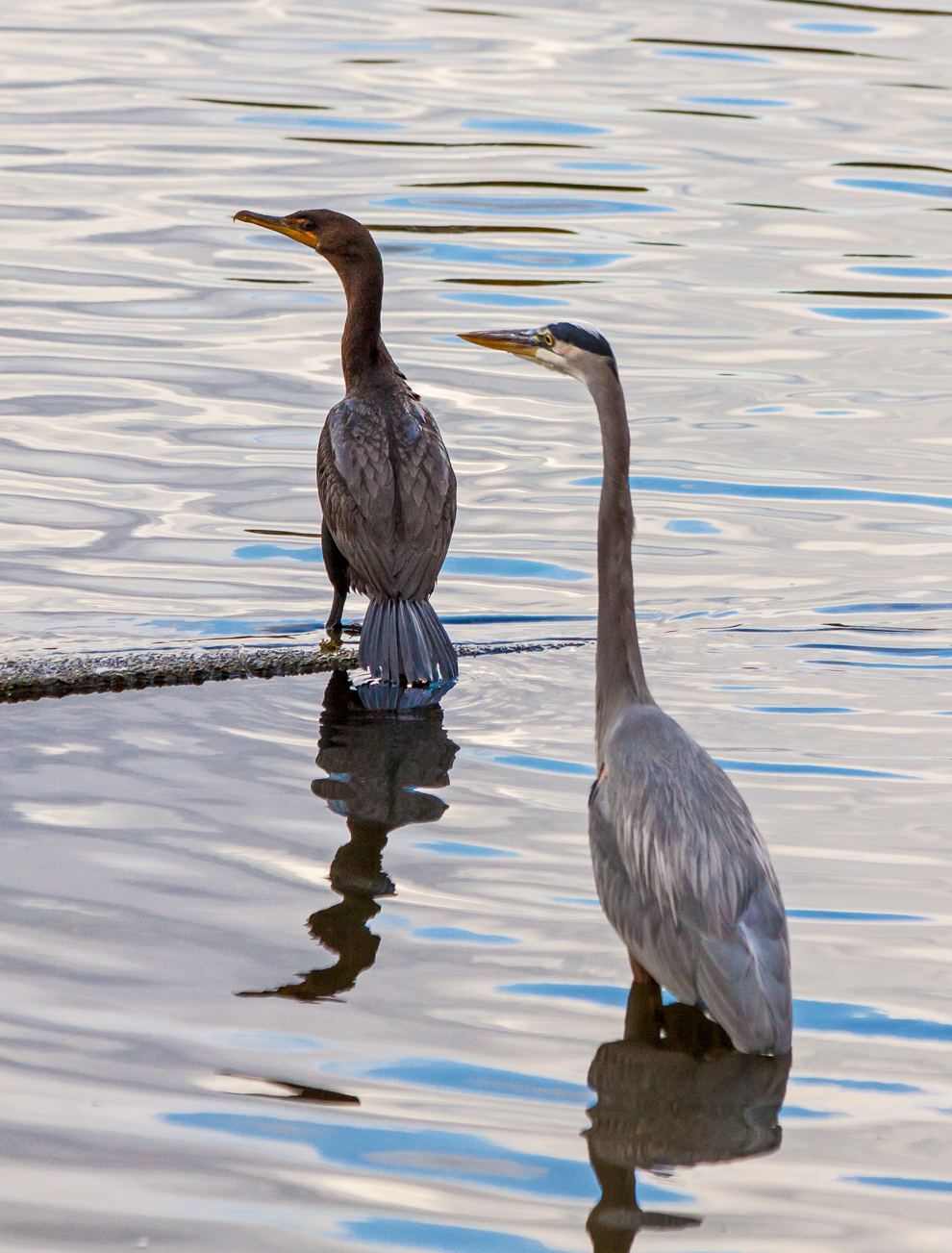
Who knew that the man-made pond in a nearby suburban neighborhood would be a favorite spot for juvenile birds to hang out together?  That’s what it looked like when I spotted an immature Double-crested Cormorant (Phalacrocorax auritus) and an immature Great Blue Heron (Ardea herodias) together, both with their heads turned in profile, probably checking out some cute little female goose.

Actually, I couldn’t immediately identify the cormorant, though it was obvious that it was neither a duck or a goose. The way that it swam with its long neck extended and its bill pointed in the air, however, was distinctive enough to make it easy to find in my identification guide.

I like the way that these two birds posed for me, with the cormorant perched on a narrow concrete slab to compensate for the heron’s greater height and the synchronized head positions. I have seen this young heron hanging around the pond before (it’s the same heron that I featured in the Crouching heron posting this morning), but I don’t think that I have seen a cormorant there before. Usually there are only geese and occasionally some ducks, like the small flock of Ring-necked ducks that are there right now.

cormorant_heron_blog

© Michael Q. Powell. All rights reserved.

Read Full Post »

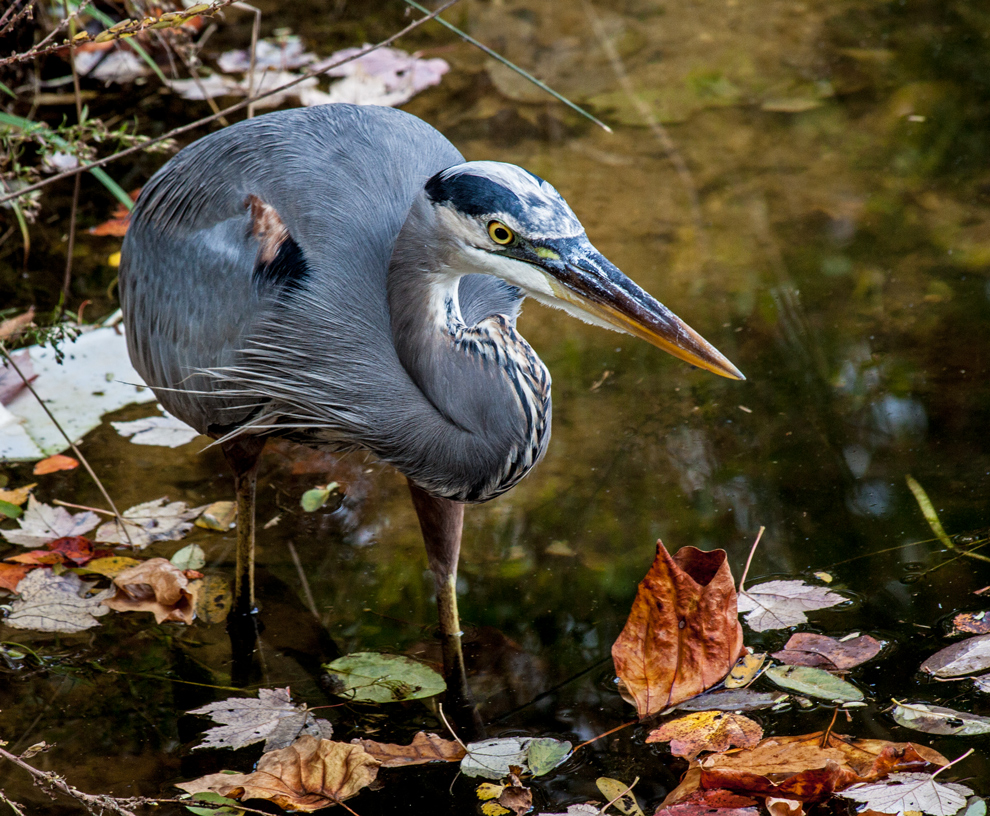
Saturday, I went out with fellow photographer Cindy Dyer to take photographs of the fall foliage and we stopped at a little suburban pond, where I managed to get this close-up shot of a Great Blue Heron (Ardea herodias) crouching at the edge of the water. If you want to see some awesome shots of the fall colors in Northern Virginia, check out Cindy’s blog—she was quicker than I was in posting her shots.

I was able to get this downward-looking angle for the image because I was on a small bridge that is part of a walking path around the pond. The heron was focused on trying to catch prey, though he didn’t seem to be having too much success. Judging from its relatively small size and inexperience fishing, I suspect that this might be a juvenile heron.

I took a number of other shots of the heron that I will probably post, including an encounter with what I think is a juvenile cormorant. Stay tuned.

heron_crouching_blog

© Michael Q. Powell. All rights reserved.

Read Full Post »

The bright fall colors of the trees at the pond’s edge were reflected beautifully in the water and I waited until the Great Blue Heron (Ardea herodias) moved into those reflections to capture this shot.

The effects of the light on the water remind me a little of some of the paintings of Monet, one of my favorite artists. Normally when I am photographing birds, I do my best to fill the frame with them, but in this case the context was actually more important to me than the apparent subject.

heron_fall_light_blog

© Michael Q. Powell. All rights reserved.

Read Full Post »

Migrating birds are starting to arrive in my area, including a few Ring-necked ducks (Aythya collaris) that I observed last week in a man-made pond in a nearby suburban housing area. The water in my local marsh tends to be too shallow for these diving ducks, but this pond seems to suit them pretty well.

The ducks tend to stay near the center of the pond, which makes them a little challenging to photograph. These shots were taken from a distance, but they let you see some of the beautiful details of the male Ring-necked duck, including the pattern on his bill and his beautiful golden eyes.

If I have the good luck that I had last year, I look forward to seeing and photographing another half-dozen species of ducks in the coming months.

ring-necked_duck2_blog

ring-necked_duck1_blog

© Michael Q. Powell. All rights reserved.

Read Full Post »

When I first saw this bird, I knew that it was a sparrow, but couldn’t identify it. I was baffled when I went to my Peterson Field Guide to Birds of North America, because I couldn’t find the sparrow. I went back and forth through the 14 pages covering sparrows, examining carefully the text and illustrations, but none of the species looked like this bird.

I was beginning to doubt my identification skills, so I kept looking through the field guide, desperately hoping to find the bird. On the very last page of the section of the guide with information on bird species, just before all of the range maps, I stumbled across a small section called Old World Sparrows and found the bird—it’s a House Sparrow (Passer domesticus).

Apparently Old World sparrows are non-native (as their name suggests) and are of a different family from all of the other sparrows that I have observed. The Cornell Lab of Ornithology website indicates that House Sparrows were introduced from Europe in 1851 and that they are common in places with houses, because the birds seem to prefer to nest in manmade structures, like the eaves of buildings, more than natural nesting sites. I took these photos at a little manmade lake that is partially surrounded by houses, rather than at the marsh where I do a lot of my shooting, which may explain why I have never noticed this type of sparrow before.

little_bird1_blog

© Michael Q. Powell. All rights reserved.

Read Full Post »

It’s a little ironic that I took these photos of a Ring-necked Duck (Aythya collaris), some of my best duck photos, in a man-made pond in my neighborhood, rather than in a more natural setting. I have never seen any Ring-necked Ducks at my marshland park—perhaps the water is not deep enough for these diving ducks—but found them in a very suburban setting.

The light was bright on the day when I watched some of these ducks diving and resurfacing every couple of minutes. The glare was pretty intense on some of my initial photos and I didn’t like the way they turned out.

However, there is a walking trail all of the way around the pond, so I went off in search of a better lighting situation.  When I reached an area of open shade, I encountered this duck near the shore. Unlike his fellow ducks, he seemed to be relaxing and was remarkably cooperative in letting me take his portrait.

If you are like most people, you may wonder why this duck is not called a ring-billed duck, because there doesn’t seem to be any ring around his neck. According to the Cornell Lab of Ornithology, the bird’s name refers to the hard-to-see chestnut collar on its black neck, which apparently jumped out to the nineteenth century biologists that described the species using dead specimens.

ring_neck2_blogring_neck1_blog

© Michael Q. Powell. All rights reserved

Read Full Post »
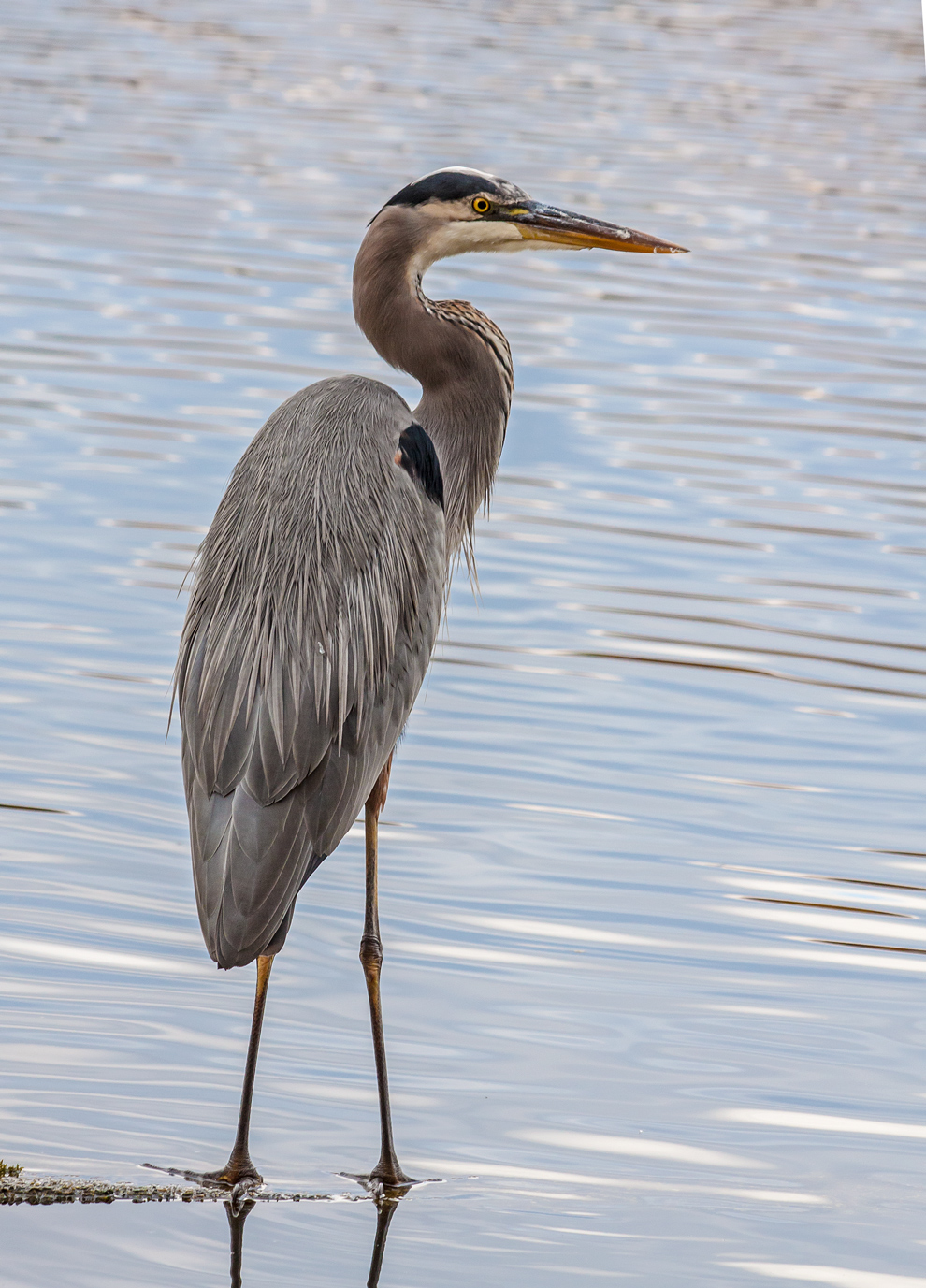
Late this afternoon, I was at a nearby suburban pond and noticed a Great Blue Heron (Ardea herodias) on the opposite bank. He was in a shaded area, where the water was calm and the reflections were beautiful. I was a bit too far away for a close-up shot, but couldn’t get any closer because of the bushes and underbrush that kept me from the water’s edge. Nevertheless, I was able to get some images that I like, including this one. I decided not to crop too closely to the heron in order to retain some of the bushes and their reflections that add a lot to the photo.

Heron in the shade (click for higher resolution)

© Michael Q. Powell. All rights reserved.

Read Full Post »

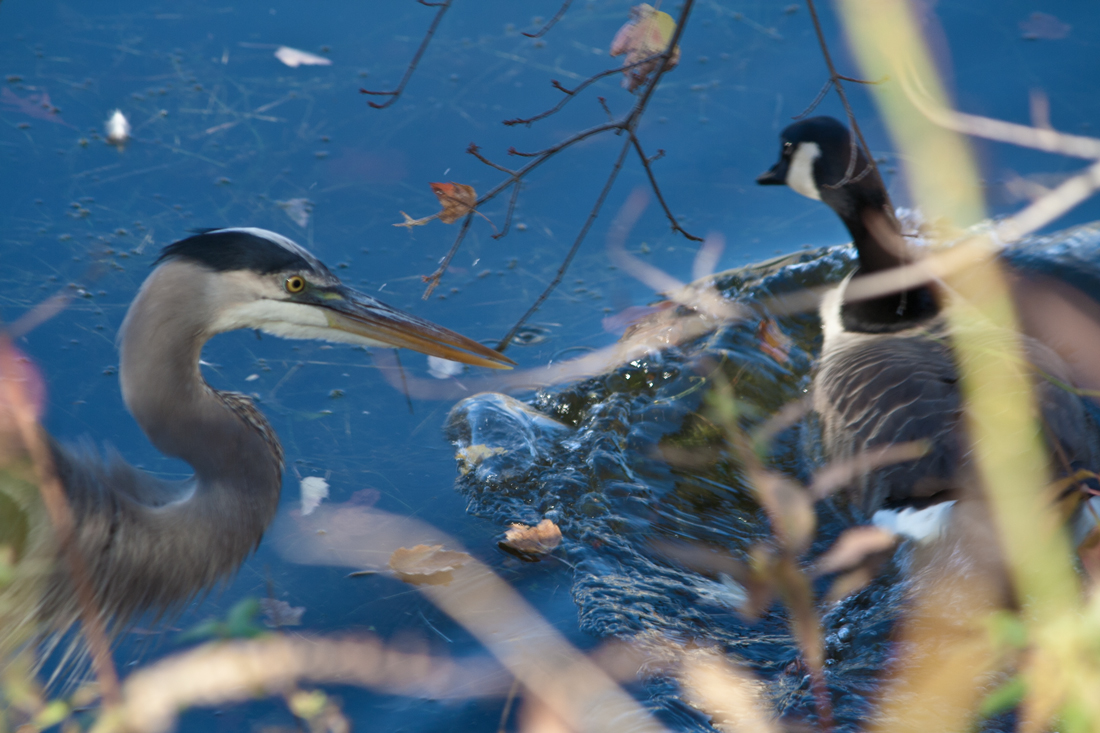
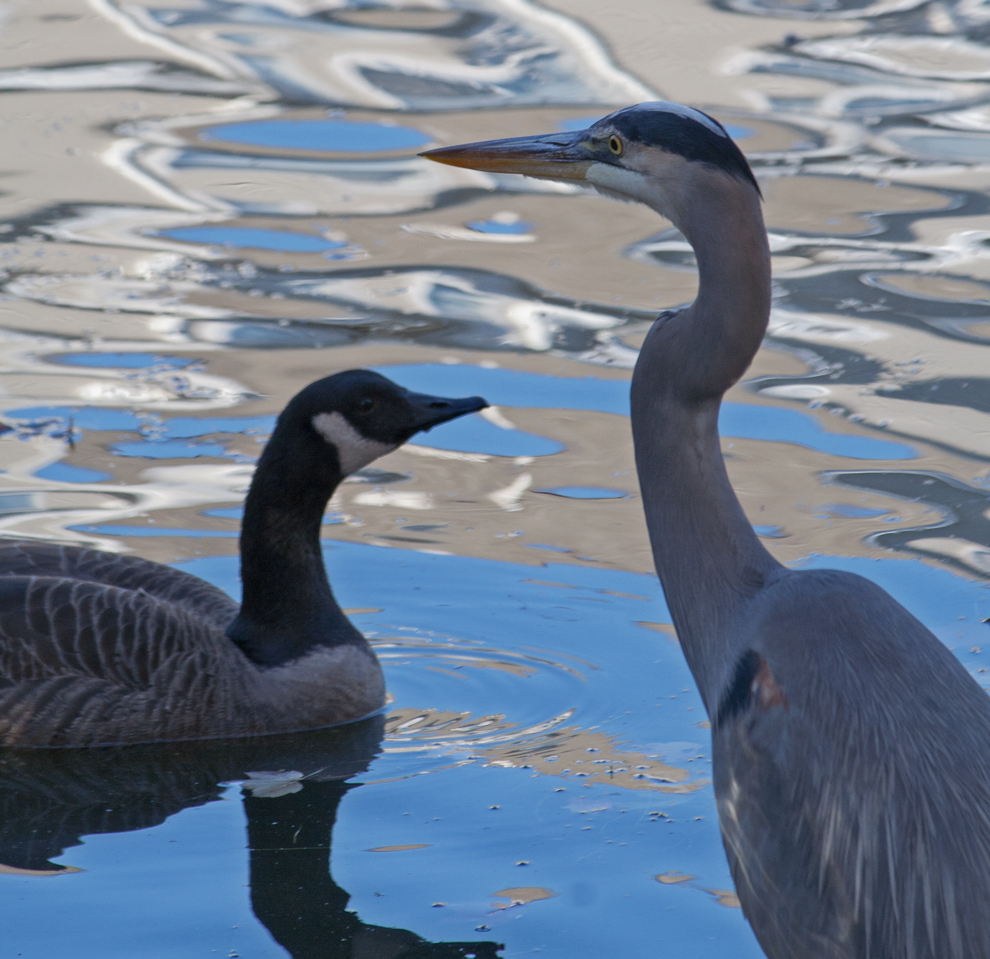
It is always interesting for me to see two species interact—you never quite know what will happen. Last Sunday, I was in the bushes in a local suburban pond area, pretty close to a Great Blue Heron (Ardea herodias). He seemed to be willing to tolerate my presence, though there were a lot of bushes that kept me from getting a clear shot. I photographed several encounters between the heron and Canada Geese (Branta canadensis) that live semi-permanently at the pond.

I took the first photo just after the heron made a threatening gesture with his beak at a goose that must have invade his personal space. The goose appears to have gotten the message and looks to be exiting the area. At the time of the shot, the sun was bright and was reflecting off the water, somehow turning it almost turquoise in color. The branches of the bush get in the way a little, but don’t detract too much from the charm of the photo. The whole effect is to make the image look almost as much like an illustration as a photograph.

“I need my personal space.”

The second photo is much less action oriented and is a study in contrasts. The goose seems to be looking at the heron with wonderment and curiosity, while the heron seems to be cool and disinterested. The background reminds me a little of a psychedelic image from the 1960’s.

“How did you grow to be so tall?”

© Michael Q. Powell. All rights reserved.

Read Full Post »

I photographed a lot of ducks last weekend and have already posted photos of Mallard and Hooded Merganser. As I was going over my photos, I realized that I had a third kind of duck, though I was not immediately sure about its identity. Fortunately they have very distinctively colored bills and yellow eyes, so I was able to identify them as Ring-necked ducks (Aythya collaris). As I watched them, I noticed too that they are diving ducks, rather than the dabbling ducks that I am more used to seeing. I don’t know how long they can hold their breath, but it seemed like they stayed underwater a long time.

The light was a bit harsh when I took these photos, but hopefully they are clear enough for you to see and appreciate the beauty of this duck, a type that I had never before encountered.

Ring-necked duck

Ring-necked ducks in early November

© Michael Q. Powell. All rights reserved.

Read Full Post »

Yesterday afternoon, I took some photos of a Great Blue Heron (Ardea herodias) in the little pond in my suburban neighborhood. He seemed amazing mellow and content to relax in the shade. Consequently, he was pretty tolerant of my presence and that of the nearby Canada Geese. Here’s a sneak preview of the shoot, an image that captures the heron with the reflections of the remaining fall foliage.

Fall reflection of a Great Blue Heron

© Michael Q. Powell. All rights reserved.

Read Full Post »
Here’s one last photo of the geese from last weekend, possibly my favorite shot. I like the fact that it shows geese in action—the geese look like they are having a race across the water, though I think they had just landed and were slowing down. The colorful fall foliage and its reflection in the water add interest too. Somehow the picture works well for me as an autumn landscape. (Be sure to click on it to see a higher resolution view.)

Geese racing in the fall

© Michael Q. Powell. All rights reserved.

Read Full Post »
Last week I encountered Canada geese twice. The first time was when a few migrating ones made a brief stop at a local marsh. The second time was at a suburban pond where the geese seem to be semi-permanent residents. I had a great time observing and photographing the geese in the latter venue and have a couple of photos this morning of geese dipping their heads into the water. I couldn’t tell for sure if they were grabbing for  plants underwater, drinking, or doing something else. Often they would submerge just their heads and blow bubbles in the water and then, as in the second photo, just let the water dribble out of their mouths.

Synchronized swimming geese

Dripping, dipping goose

© Michael Q. Powell. All rights reserved.

Read Full Post »
This morning, we continue to assess the damage from Hurricane Sandy here in the Washington, D.C. area, mainly downed trees and flooded roads. Perhaps we can draw inspiration from these geese, who are engaging in a rarely seen version of t’ai chi, seeking to achieve balance. This ancient martial art can be practiced on land or in the water—the water variant is especially appropriate for a time of reflection.

T’ai chi goose

Water t’ai chi—a reflective pose

© Michael Q. Powell. All rights reserved.

Read Full Post »

« Newer Posts - Older Posts »