Feeds:
Posts
Comments

Posts Tagged ‘Huntley Meadows Park’

The bright green leaves of the plants in the marsh have faded and most of the colors are more subdued than in early summer. Against that muted backdrop, I was surprised to come across a brightly colored caterpillar this past weekend. It looks a bit like the Cattail Caterpillar (Simyra insularis) that I photographed and described earlier this year, although the spiky red tufts are more extreme on this caterpillar. I think I can detect the prominent black and white pattern that was so visible in the image that I posted previously.

This is the first year that I have paid close attention to the cyclical changes in plants, animals, birds, and insects. I am excited to see what new species will come into my field of vision as we move through the fall.

UPDATE: I did a little more research and now think that this caterpillar is actually a Smeared Dagger Moth caterpillar (Acronicta oblinita).

Colorful caterpillar in late September

© Michael Q. Powell. All rights reserved.

Read Full Post »

Basking in the warmth and light of the fall sun, turtles of all sizes were perched on the logs and other chunks of wood in the muddy waters of a local marsh pond. I was struck by the attitude of this red-eared slider turtle (Trachemys scripta elegans), whose stiff-necked and imperious pose seemed almost aristocratic. He had gained this prime piece of real estate by crawling over one of his fellow turtles and was now standing on that turtle’s back to provide himself better access to the sun.

I have to admit that he is beautiful and I suspect that he would be the first to tell me so if he could speak.

Red-eared slider turtle basking in the sun

© Michael Q. Powell. All rights reserved.

Read Full Post »

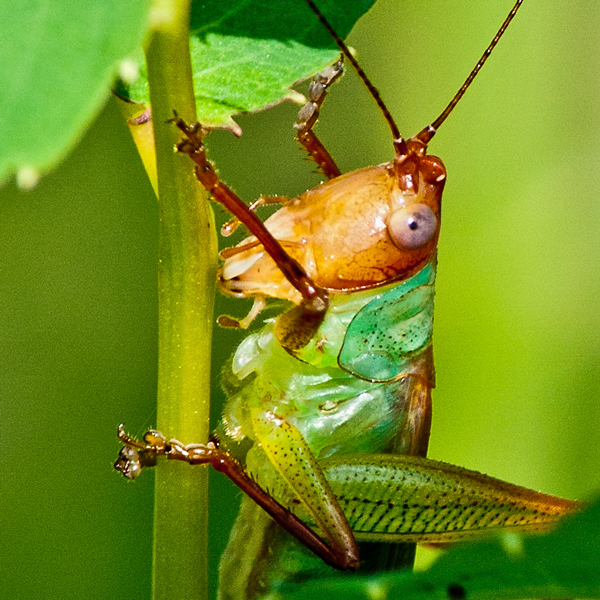
I still can’t get over the striking blue eyes of a Handsome Meadow Katydid (Orchelimum pulchellum), so I am posting a shot from yesterday that highlights that feature (and my apologies to Frank Sinatra for borrowing the title of his 1973 album for this post).

The katydid almost seemed to be looking right up at me, perhaps wondering why I am disturbing him. I find the details of his feet to be utterly fascinating and I’ve made sure that you can see some of the many neon-like colors of his body.

Check out some of my other postings if this is your first encounter with this gorgeous katydid. You’re almost certain to fall in love with him too.

Ol’ Blue Eyes (Handsome Meadow Katydid)

© Michael Q. Powell. All rights reserved.

Read Full Post »

As the sun dropped lower and lower in the sky yesterday, I was struck by the way in which the light caused the cattails to glow. Many of the cattails had already burst into masses of cottony fibers and the backlighting showed them in wonderful detail and texture.

I tried to capture this beauty, but it was difficult shooting directly into the sun and I ended up with all kinds of light artifacts. Because I was mostly interested in the effects of the light, I decided to experiment this morning and converted one of the photos into black and white and played around with it (probably too much).

I think I need to read up some more on how to convert images to black and white and how to tweak them, but for now I’ll continue to enjoy the process of experimentation. I might stumble onto something really good.

Backlit cattails in the marsh

© Michael Q. Powell. All rights reserved.

Read Full Post »

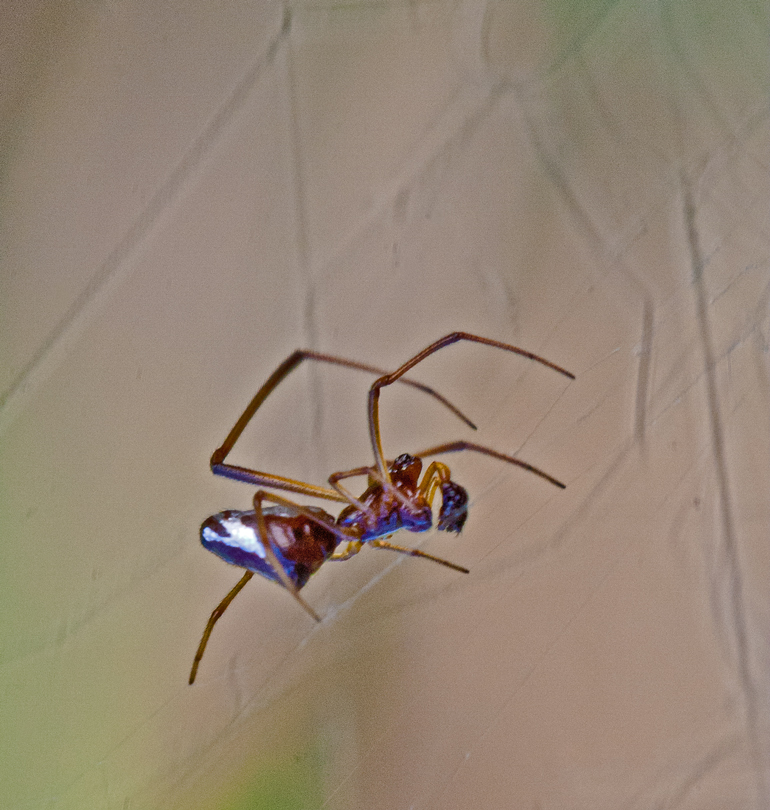
Last week I did a posting entitled “Kleptoparasitic Spider that talked of the little spiders that hang around a larger spider’s web and steal or feed on the prey captured by the other spider. Today I managed to take a much clearer shot of one such spider. I am pretty sure the little spider below is of the genus Argyrodes, which are also known as dewdrop spiders.

The spider was positioned in such a way that I was able to get close enough to use my 100mm macro lens, although there was not really enough room for me to shoot with a tripod. I was able to close down only to F10 because I was shooting handheld and wanted to have a shutter speed of 1/200 sec, so depth of field suffered a little. I have found that depth of field is a problem with spiders most of the time because of the length and positioning of their legs.

This spider was really tiny and I am happy that I was able to get this good a photo of it. The portions of the web that are visible help to add an interesting geometric pattern to the background, which I think enhances the image.

Dewdrop spider (genus Agyrodes)

© Michael Q. Powell. All rights reserved.

Read Full Post »

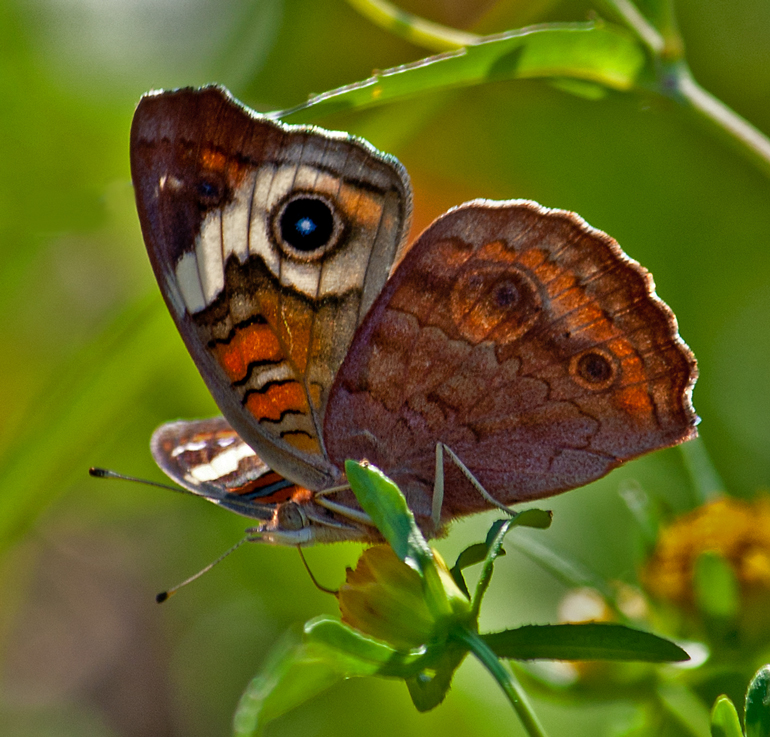
Yesterday was a common day for finding subjects to photograph. I already posted a photo of a Common Whitetail dragonfly. Here’s a photo of the Common Buckeye butterfly (Junonia coenia).

A month ago I featured the Common Buckeye in a posting after my first encounter with this type of butterfly. Yesterday I was shooting in the middle of the day and there was more sunlight that I would have liked when. However, I managed to get a shot of the butterfly in which the sun is shining through one of its wings, highlighting the beauty of those wings. There are still some harsh shadows in the photo and the colors are not as saturated as they would have been with more diffused light, but I find that the colors and patterns of this butterfly make it uncommonly beautiful.

Common Buckeye butterfly in mid-September

© Michael Q. Powell. All rights reserved.

Read Full Post »

Blue Dasher dragonflies seem to have disappeared from my local marshland, but I was happy today to see that the Common Whitetail dragonflies (Plathemis lydia) are still around. They are not as elegant and colorful as some other dragonflies and are somewhat stubby and drab (and, in fact, are called “common”). My portrait below shows, however, that they possess their own special beauty.

Common Whitetail dragonfly in mid-September

© Michael Q. Powell. All rights reserved.

Read Full Post »

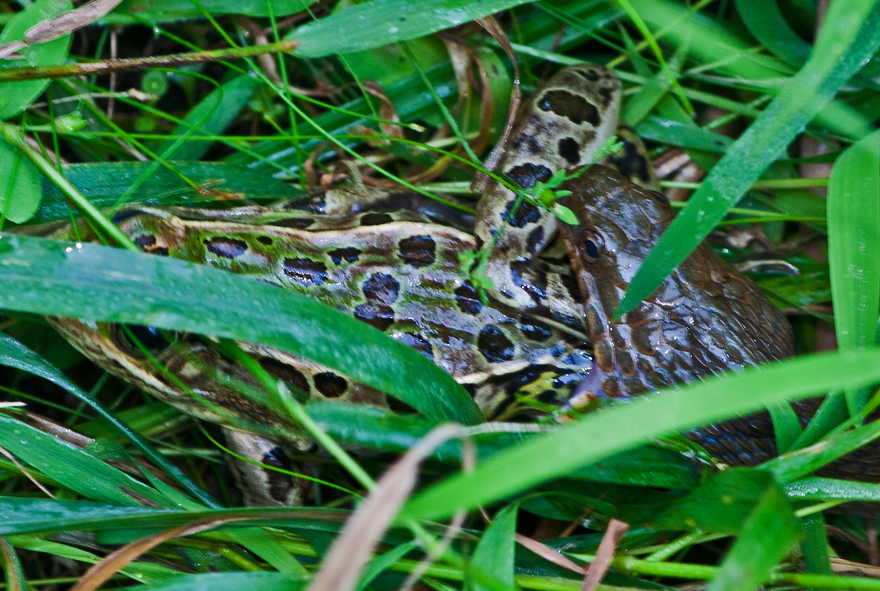
Walking along a boardwalk in the center of a marsh, I suddenly heard a sound that I had never heard before, a strange and eerie squeak. I had no idea of the source of the sound, but a man who was walking by with his family pointed it out to me. It was a frog that had been captured by a snake and was slowly being swallowed whole.

I leaned over the edge of the boardwalk and tried to take some shots of this terrifying spectacle, but there was too much grass between me and the two protagonists in this drama for me to get a really clear shot. The shot below shows the snake working to get past the frog’s hind legs. As you can see, the snake is swallowing the frog beginning with the legs. In a previous post, I showed a green heron swallowing a frog. The heron slid the frog down his throat in a single gulp beginning with the head. The process with the snake was more protracted and therefore more gruesome.

Eventually it was over. I continued on with my day, feeling a mixture of awe and horror for what I had just witnessed.

Frog being swallowed by a snake (click for higher resolution)

© Michael Q. Powell. All rights reserved.

Read Full Post »

My day began with a brightly colored Monarch butterfly in a field of flowers and is ending with the more subdued colors of an Appalachian Brown butterfly (Lethe appalachia) perched on a tree. Together they provide us with some sense of the diversity of the coloration and habitats of butterflies. (I confess that I am not certain of the identification of the brown butterfly, because there are a number of species that are pretty similar.)

Perhaps you like to stand out from the crowd and the gaudy colors of the Monarch are more your style.  Maybe you prefer to blend in a little better like the Appalachian Brown and find its colors and patterns to be more refined and dignified.

Whatever your taste, there is almost certainly a butterfly that fits you and I encourage to join me in chasing the butterflies through the woods, the gardens, and the meadows.

Appalachian Brown butterfly in early September

© Michael Q. Powell. All rights reserved.

Read Full Post »

Growing up in New England, I used to love this time of the year, when the fall foliage featured brilliant displays of red, orange, and yellow. I now live outside of Washington, D.C. and somehow the colors don’t seem as intense (and the colors change a lot later in the fall season). Sometimes, it seems that we simply fade to brown.

I was thrilled earlier this week to find relief from the fading fall colors when a flash of bright orange grabbed my attention. Somehow I thought it was too late in the season and that the weather was too cool for butterflies, but I was wrong. A Monarch butterfly, in all of his brilliant glory, was busily at work, flitting from flower to flower.

This fall I probably will not see the amazing oranges and yellow leaves of my childhood memories. The presence of  those same fall colors in the wings of a butterfly, however, help to trigger those memories. Isn’t it amazing how certain sights, sounds, colors, or smells can transport us back to a different time and a different place?

Monarch butterfly in mid-September

© Michael Q. Powell. All rights reserved.

Read Full Post »

Recently I have become fascinated with spiders, and in particular the Black and Yellow Garden Orbweaver spiders (Argiope aurantia). I’ve spent an amazing amount of time observing them and their webs. Already I have posted photos of the spiders themselves, their webs, and several types of prey that they have captured and wrapped in silk.

This past Monday I observed what I think was a spider actually feeding on a victim that I can’t quite identify. For some reason I used to think that spiders ate solid food, but now I understand that they have a mostly liquid diet. According to an article at earthlife.net, the mouth parts of these spiders have a serrated edge to cut into the prey and a filtering edge covered in fine hairs that prevents solid particles from entering the spider’s mouth. This filtering system is so fine that only particles smaller than 1 micron (0.001 of a mm) can pass through. The spider’s venom has enzymes which can help liquify the insides of a victim and the spider may also excrete digestive juices onto the victim. Spiders then have a sucking stomach that helps them ingest the liquids.

Argiope aurantia feeding on captured prey

Sharp-eyed viewers will notice that I rotated the image 90 degrees counterclockwise to make it easier to see what is going on. Note the positions of some of the spider’s legs as she cradles her victim. If you click on the image, you will get a higher-resolution view of the spider. My apologies if I have been too graphic in describing this spider’s digestive process.

© Michael Q. Powell. All rights reserved.

Read Full Post »

It’s only a grasshopper, not an exotic insect, but I really like the way that his portrait turned out.

The grasshopper’s pose suggests that he is ready for action and his slightly cocked head helps to give him personality. I was able to get sufficient depth of field and sharpness by using an F8 aperture, ISO 200,  and 1/200 sec and by moving in a bit from the far end of my telephoto zoom (I was at 229mm of a 55-250mm lens). Both the foreground and the background are simple and are made up of a minimum of colors, mostly green and brown. The day was mostly cloudy, so the shadows are soft.

All these elements seemed to work in harmony and I was able to produce this nice, open-air portrait of a grasshopper.

Grasshopper portrait (click for a higher-resolution view)

© Michael Q. Powell. All rights reserved.

Read Full Post »

Birds were out this past Monday and once again I went through the mostly frustrating process of trying to get some shots. I managed to get this unintentionally soft-focused image that I like. The angle of the shot is strange and the bird seems almost distorted, possibly because of the way in which he is sticking out his neck, but I love the blue markings on the wings. The blue color, in fact, helped me to identify the bird as most likely a Cerulean Warbler (Setophaga cerulea) for it turns out that there are not that many blue-colored birds.

UPDATE: Joel Eagle has corrected my false identification. It’s a Nuthatch, not a Cerulean Warbler. The name may not be as cool-sounding, but the bird is still as beautiful. Check out Joel’s blog “Pops & Mojo Photos” for some wonderful insect photos (and birds too).

Nuthatch

© Michael Q. Powell. All rights reserved.

Read Full Post »

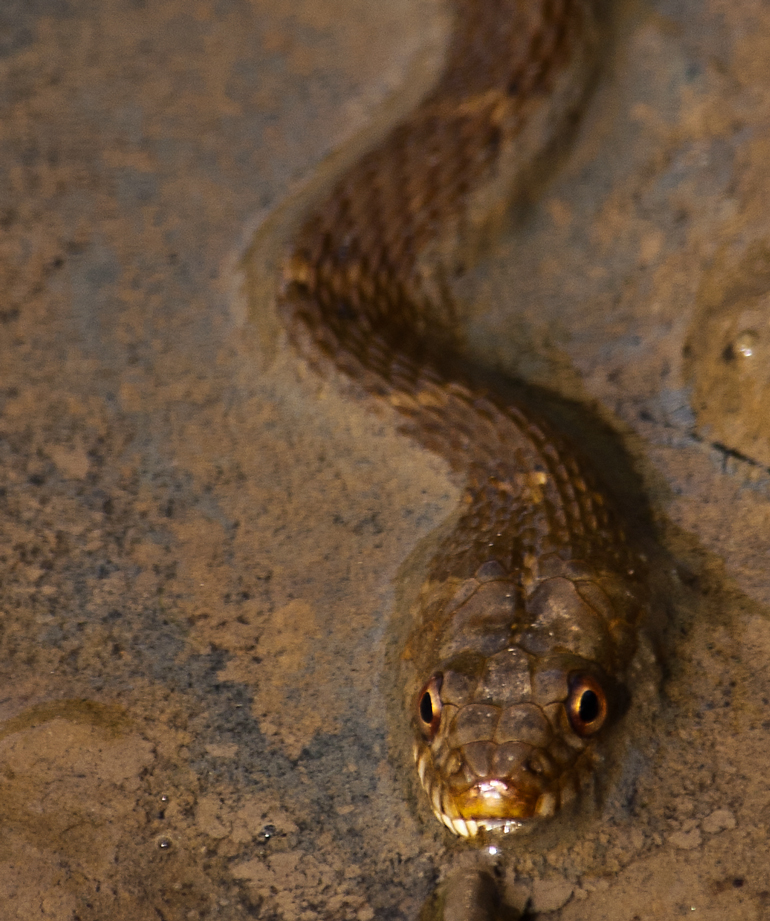
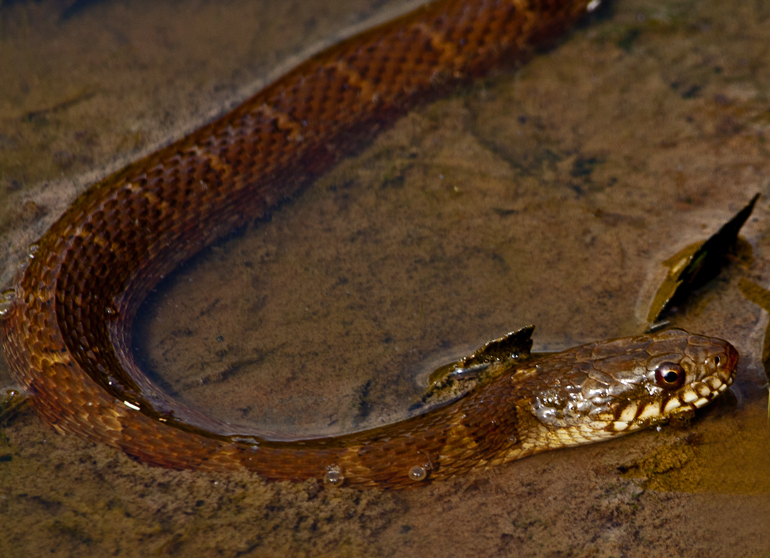
Throughout this dry summer, the water level in the marsh area of Huntley Meadows Park has continued to drop. I was shocked to see how low the levels were today. In an area where the water had previously been deep enough to support large snapping turtles (an open area outside of a beaver lodge), I now saw snakes, at least four or five of them. They were swimming in the shallow water and even burrowing into the soft mud in search of food. I am pretty sure they were all Northern Water snakes (Nerodia sipedon), a fairly large, non-venomous snake.
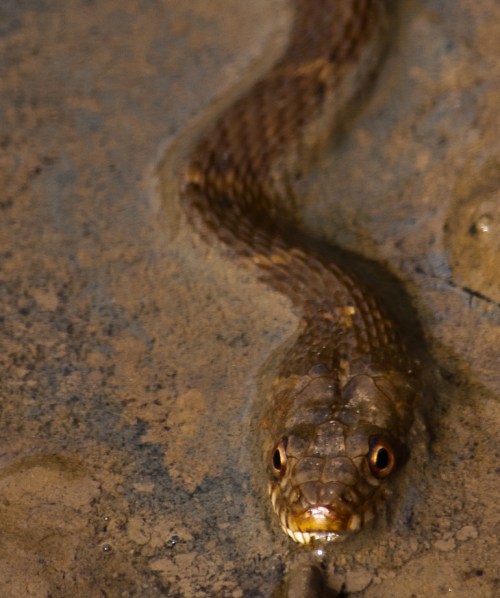
Face-to-face with a Northern Water snake

As I was watching the snakes, a couple came by and they said that they sometimes like to pick up these kind of snakes, examine them, and then release them. In passing, they mentioned that the snakes will bite hard and will release musk when handled. I don’t know why they thought I wanted to play with the snakes (trust me, I had no such desire), but they warned me not to be surprised if the bite wound bled a lot. According to the Wikipedia article on Northern Water snakes, the snake’s saliva contains a mild anticoagulant.
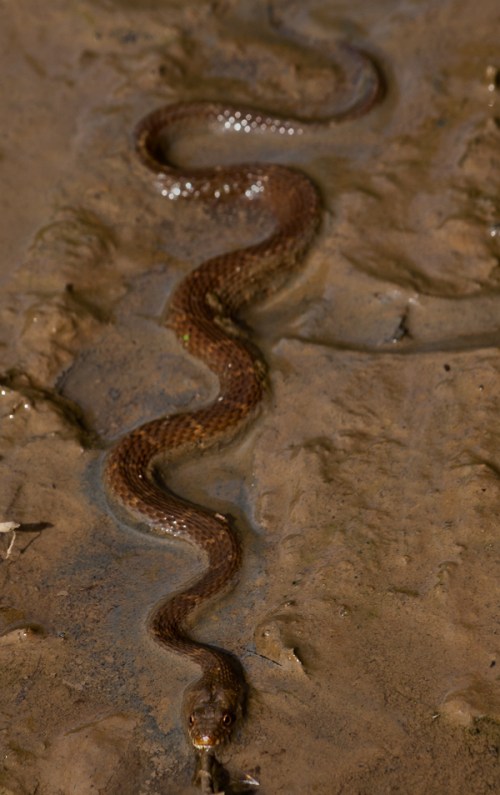
Northern Water snake, full-body shot

I did not see the snakes catch any prey, but the Wikipedia article states that during the day they hunt among plants at the water’s edge, looking for small fish, frogs, worms, leeches, crayfish, salamanders, birds, and small mammals. At night, they concentrate on minnows and other small fish sleeping in shallow water.
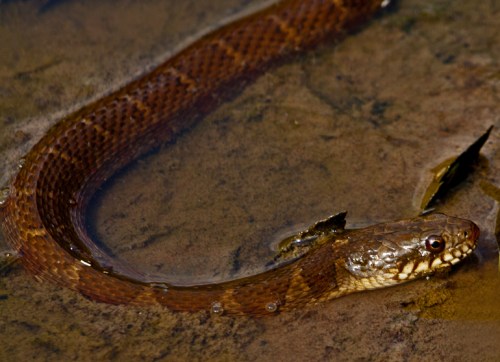
Northern Water snake focusing on a potential prey

One other interesting fact about the Northern Water snake is that—unlike many other snakes—they do not lay eggs. According to one academic article, the mother carries the eggs inside her body for three to five months and, on average, gives birth to 26 babies, each about 7-9 inches long. Once they are born, the babies are on their own; the mother does not care for them at all.

© Michael Q. Powell. All rights reserved.

Read Full Post »

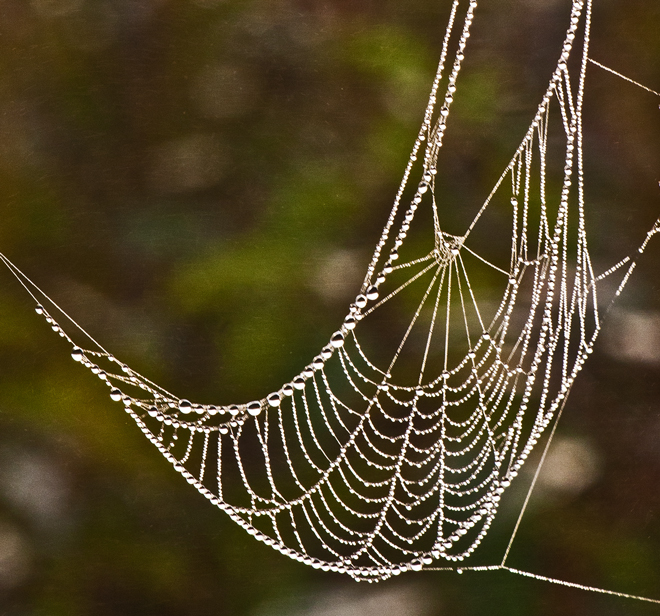
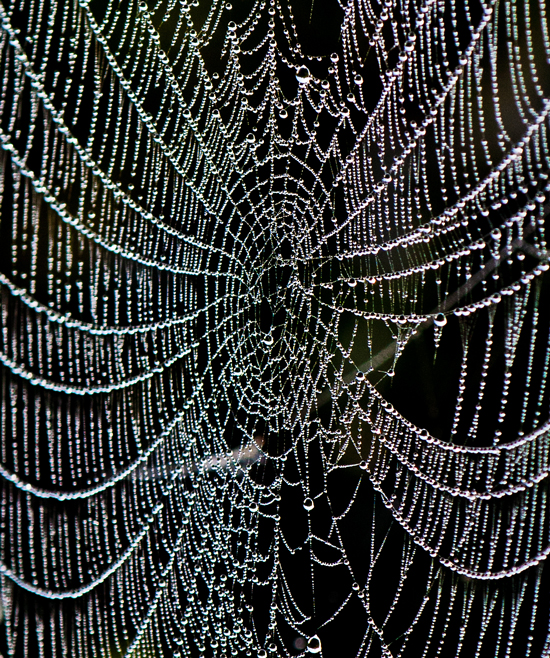
I’ve already posted some photos of spider webs from last Friday morning when I visited Huntley Meadows Park. When I looked over the photos again today, however, I realized I have some more pretty good ones. Once again I am struck by the complexity and the diversity of the webs. Some have primarily straight lines and others have mostly curves. Some are large and intricate, others are smaller and simpler.

All of them are breathtakingly beautiful to me.

A view from a jail cell (not really, but it almost looks like that)

An unusually-shaped spider web

An incomplete spider web

Scallop-curved web

© Michael Q. Powell. All rights reserved.

Read Full Post »

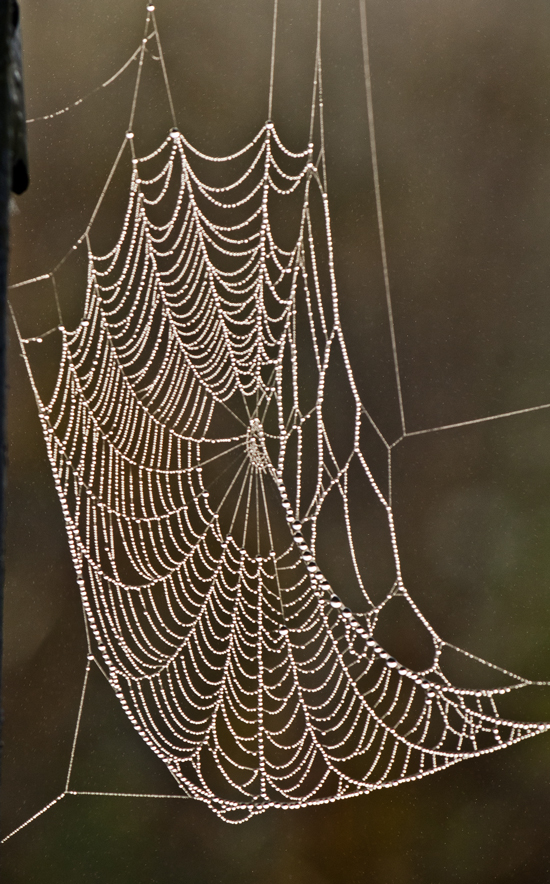
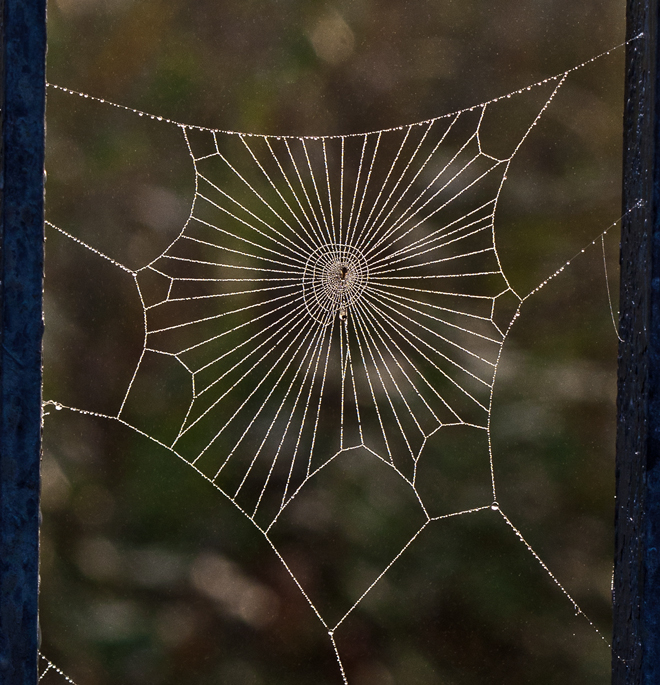
Yesterday morning I was out early with my camera and managed to capture photos of some amazing spider webs at Huntley Meadows Park. There was moisture in the air, so some of them have beautiful droplets of water. All of them, though, are incredible in their geometric complexity, in the skill of the craftsmanship, and in their individuality.

Spiders webs are incredible.

Circular spider web

Spider web between two railings

Spider web with dew

© Michael Q. Powell. All rights reserved.

Read Full Post »

I’m amazed at the size and intricacy of the webs of the Yellow Garden Orbweaver spiders (Argiope aurantia) whenever I see them at Huntley Meadows Park here in Alexandria, VA. This past weekend I had a chance to see how effective these webs are when a bee flew into the web of a spider that I was observing.

Previously I posted some photos of these spider with prey (a grasshopper and a cicada) that had been captured earlier and wrapped up in silk, but I didn’t really understand how the spider accomplished this. In this case, as soon as the bee touched the web, the spider moved quickly from the center of the web and in a few seconds had wrapped up its newest victim. I was so fascinated by what was happening in front of my eyes that my reaction time was delayed and I missed photographing those initial actions. However, I stayed and observed (and photographed) the spider’s subsequent actions.

The first photo below shows the spider as she is wrapping up the wrapping up of the bee. It’s a little hard to believe that the long package is just a bee, but I’m pretty sure that’s all that there is inside. (With all three photos, you can click on them and get a somewhat higher resolution view.) After the bee had finished, she left the package at the periphery of the web and returned to the center of the web, where she usually resides, probably hoping for another victim.

After several minutes wait, she returned to the bee and and began to transport it to the center of the web. In the photo below, you can see how she held the wrapped-up bee with some of her legs as she crawled along the strands of the web. The zigzag portion of the web is part of the path that leads to the center.

Once she was back in the center, it looks like she was preparing to eat her newly captured meal. I really like the varied positions of her legs in this photo as she holds on to her prey.

You may have noticed the blurry contours of another, smaller spider in the upper portion of the final photo. There were two small spiders hanging around the web and they seemed to be fighting with one another. I tried to capture that dynamic and will post a photo if I find one that is clear enough. I suspect that one of them may have been the mate of the female spider. Bugguide notes that the male of this species is considerably smaller than the female. Not counting legs, the male is usually 5-6 mm in size and the female is 14-25mm. I am not sure who the “other guy” was. Maybe he’s another male competing for the affections of this “lovely” lady. Any ideas?

© Michael Q. Powell. All rights reserved.

Read Full Post »

I have become hyper-attentive now when I walk through gardens, woods, and marshes. I have started to slow down and am more aware of my surroundings. A few months ago, for example, I would not have noticed this grasshopper climbing up the stalk of a plant. Now I can look with wonder at yet another fascinating creature, and my life is enriched by the experience.

Climbing Grasshopper

© Michael Q. Powell. All rights reserved.

Read Full Post »
Huntley Meadows Park is made up of 1,425 acres of forests, meadows, and fresh-waters wetlands and has become one of my favorite places to take photos of a wide variety of wildlife. What is most remarkable for me, though, is the fact that it is located in the midst of a heavily populated suburban area of Washington, D.C., only a few miles from where I live. I am clearly not the only one who enjoys being there. On any given day I am likely to be greeted by groups of giggling boys and girls or smaller, more sedate groups of adults, many with binoculars or cameras with very long telephoto lenses. The park’s website notes that it is a favorite location for bird spotting, with over 200 species having been identified there.

Monday was an especially beautiful day. The coolness of the fall mornings has definitely arrived and we were treated to brilliant blue skies, a relative rarity here. While at Huntley Meadows, I decided to try to capture a view of some of the elements of the park, including part of the half-mile long boardwalk that zigzags through the marshland.

Huntley Meadows Park in early September

© Michael Q. Powell. All rights reserved.

Read Full Post »
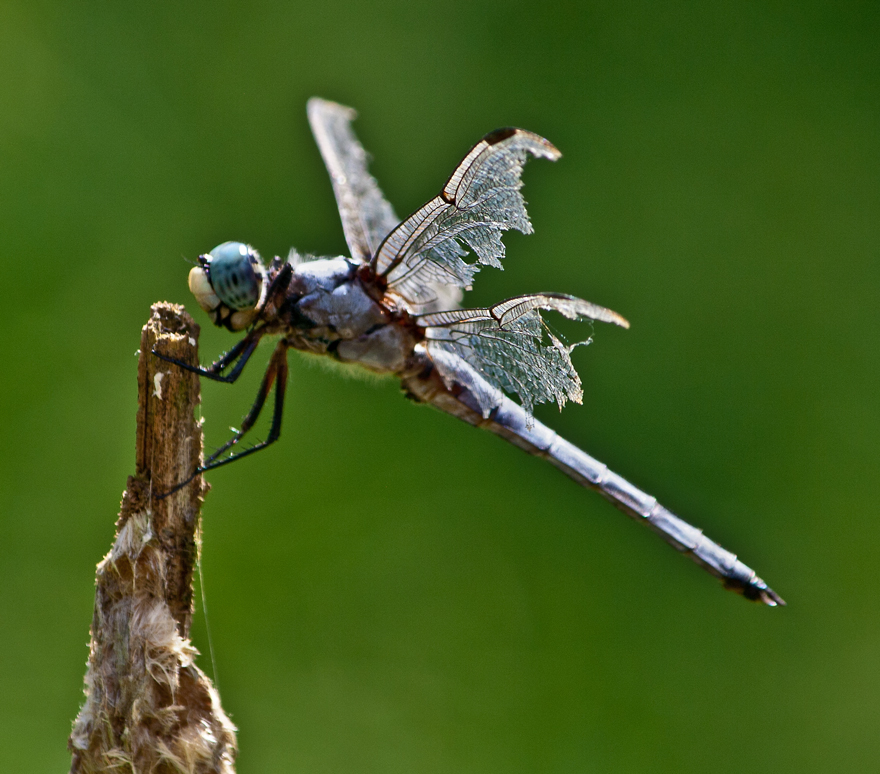
I don’t know if this Blue Dasher dragonfly is long in the tooth (do dragonflies have teeth?) or has simply had a tough life. How do you tell the age of a dragonfly? In any case, his wings are tattered and torn to such a degree that it is surprising that he can still fly. Yet I seem to detect a smile on his face, a reflection of contentment. (Yes, I know, I am guilty of anthropomorphism.)

Tattered wings,but still able to fly

I have been thinking about aging ever since Sunday when I read a wonderful column in the Washington Post by John Kelly entitled “You can learn a lot about growing old from a dog.” Kelly describes how the accelerated aging process of his dog has made him more conscious of the fact that he too is growing old. I recommend the article to all, but want to highlight the final paragraph of the column. Kelly concludes:

“Aging is unknown territory for each of us, despite the fact that humans have been doing it forever. I think there are worse ways to spend your final years than napping next to someone you love, dreaming of what was and what still might be.”

I doubt that this dragonfly will end his final days in peace and contentment like Kelly’s dog, but it is my fervent hope that we can accept the infirmities of growing old with grace and patience, and can focus—as this dragonfly appears to be doing—on the things that we are still able to do, on contributions that can make this world a better place.

© Michael Q. Powell. All rights reserved.

Read Full Post »

This morning I captured this photo of a bullfrog. I was able—with gyrations that would have been hilarious to a spectator—to get almost low enough to look him eye-to-eye. I was happy also to get a reflection of the frog with a considerable amount of detail. As I was reviewing the images on my computer, I noticed the bubbles under his chin (do frogs have chins?), a delightful detail that adds a sense of whimsy to the frog. Blowing bubbles is something that I always associate with being a child, and I remember how much fun it was to blow bubbles in my drink with a straw or to blow soap bubbles with one of those little wands.

Perhaps this bullfrog was blowing bubbles in the water, remembering too when he was little, presumably in a post-tadpole phase.

Bullfrog with bubble (click for higher resolution)

© Michael Q. Powell. All rights reserved.

Read Full Post »
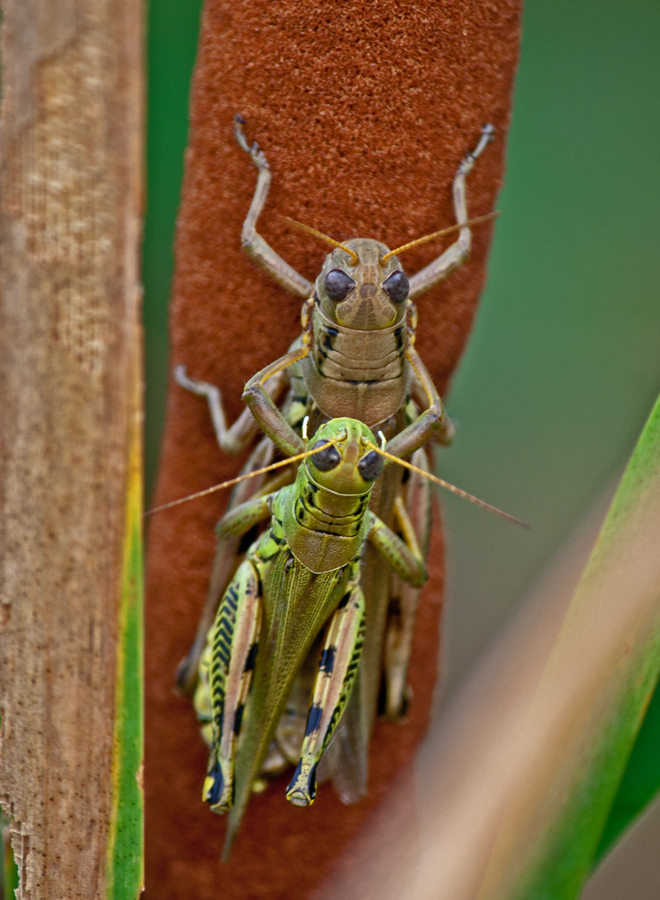
This morning as I was walking through the marsh area of Huntley Meadows Park, I happened to catch sight of this pair of grasshoppers. With any other kind of vegetation the grasshoppers would have been camouflaged, but that was certainly not the case against the backdrop of a cattail.

I was struck by the differentiation in color between the male and the female—it reminded me of my time in the Army, when there were different camouflage patterns for woodlands and for the desert.

Mating grasshoppers

© Michael Q. Powell. All rights reserved.

Read Full Post »

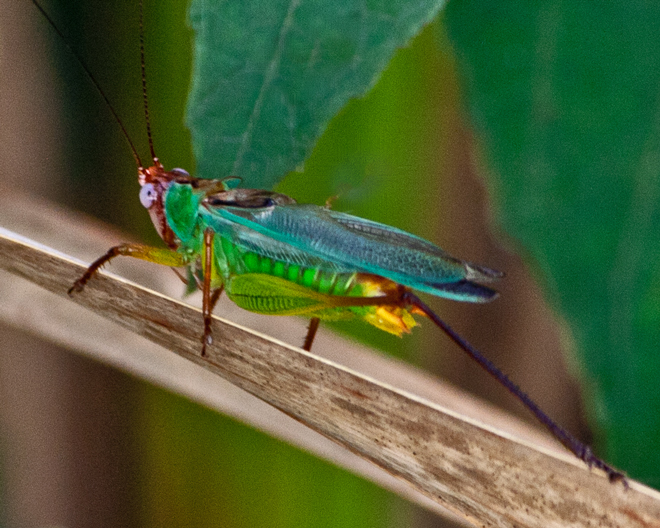
Early this morning I went out with my camera and I was happy to spot again the very colorful grasshoppers known as Handsome Meadow Katydids (Orchelimum pulchellum). As was the case the first time I spotted these neon-colored insects, I was at Huntley Meadows Parks in Alexandria, VA. I had a little trouble getting clear shots of the entire bodies of the katydids, but I managed to capture some good close-up shots of their faces. I especially like the first shot, taken looking down at him as he was munching on a leaf.

I continue to be amazed at the katydid’s vivid colors and blue eyes. Wow!

Handsome Meadow Katydid Munching on a Leaf

Close-up Shot of Handsome Meadow Katydid

Body Shot of Handsome Meadow Katydid

© Michael Q. Powell. All rights reserved.

Read Full Post »

This morning as I was walking along the boardwalk that runs through the marsh in Huntley Meadows Park, I happened to glance down into the muddy water and was surprised to see something that looked like a cross between a starfish and a spider. I always though that spiders lived in trees and on other types of vegetation, but today I learned that there are also spiders that hunt for their prey in the water.

This spider is from the Dolomedes family, probably a six-spotted fishing spider (Dolomedes triton). According to the Wikipedia article, they are often seen with their legs sprawled out by the water while they are waiting for prey (which is what this one seems to be doing). They eat other invertebrates, tadpoles and occasionally small fish (and the female may also eat male fishing spiders if she has already mated). According to fcps.edu, these spiders can walk on the surface water and can stay underwater for 30 minutes. Not surprisingly, they don’t make webs.

This has been quite the day for unusual insects, beginning with a neon-colored grasshopper and ending with a fishing spider. I can’t wait to see what’s next.

Fishing Spider Waiting for Prey (click for higher resolution)

© Michael Q. Powell. All rights reserved.

Read Full Post »

The water level in the marsh at Huntley Meadow Gardens here in Alexandria, VA has been getting lower and lower as the summer has progressed. I suspect that the situation had made it more difficult for some of the inhabitants to find food and may have increased competition for the available food.

Previously I posted photos of a Great Blue Heron catching a fish in the remaining water of the pond of the marsh. Last week I had the chance to watch a series of confrontations between a Great Blue Heron and a snapping turtle. It seemed to start when the  heron grabbed a fish out of the water just as the turtle was approaching him. I had the impression that the turtle might have been pursuing that same fish. The snapping turtle made a series of aggressive runs at the heron, getting really close to the heron’s legs. I have seen pictures on-line of a snapping turtle pulling down a Great Blue Heron, so I waited with fear and anticipation to see what would happen. The heron left the water this time without any bodily injury. (I have some photos of this initial confrontation that I might post later, but their quality is not as good as those of the second round of confrontations.)

The heron eventually went back into the water and it wasn’t long before the snapping turtle came at him again. (I could almost hear the music of the movie “Jaws” in my head as the turtle made a run at the heron.) Like a matador side-stepping a charging bull, the heron awkwardly avoided the turtle who was approaching him faster than I’ve ever seen a turtle move. The heron then turned his back on the turtle and started walking away, perhaps feeling the hot breath of the turtle who continued to pursue him. Finally, the heron took to the air, deciding that he had had enough of the persistent turtle.

I managed to capture the highlights of the confrontation with my camera. I continue to marvel at the wonders of nature as I observe new creatures and see familiar ones act and interact in new ways.

Snapping turtle approaches Great Blue Heron

Great Blue Heron steps to the side as snapping turtle gets aggressive

Great Blue Heron walks away with snapping turtle in pursuit

Great Blue Heron decides to leave his problems behind

© Michael Q. Powell. All rights reserved.

Read Full Post »

I just got back from shooting and couldn’t wait to post a photo of one of the coolest looking insects that I have ever seen. It appears to be be part of the grasshopper family, but its bright colors and blue eyes really made it stand out as I was walking through the marsh at Huntley Meadows Park this morning. I’m sure I’ll be able to identify him eventually, but want to share him now. Sometimes folks need a little extra pick-me-up on Fridays.

UPDATE: I am pretty sure he is a Handsome Meadow Katydid (Orchelimum pulchellum). I found a photo in BugGuide that looks quite a bit like this one.

© Michael Q. Powell. All rights reserved.

Read Full Post »

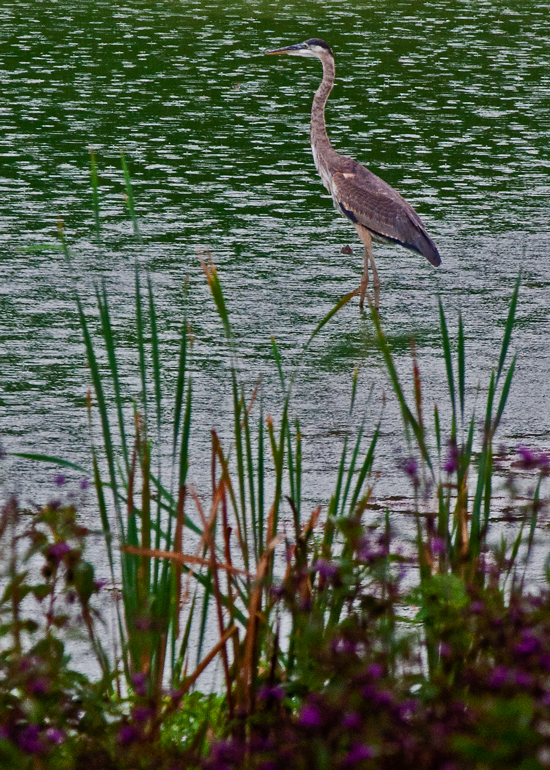
I love to shoot in the rain. This past weekend the weather was threatening, but I went to Huntley Meadows Park anyway and was happy to see both a Great Blue heron and a green heron. It was already sprinkling a little when I started to take some photos of this little green heron and I had my umbrella out. I like the effect of the raindrops on the surface of the water. The light was interesting too and the heron cast a reddish, blurry reflection in the water.

Green heron in the rain

The weather started to worsen as I headed toward the location where I previously had seen a Great Blue heron. That area has a two-tiered observation area and I knew the lower level is partially sheltered from the rain. I arrived just in time as the rain started to come down really hard. The first photo of the Great Blue heron shows him standing in the water as the rain pours down. It didn’t seem to bother him at all. The quality of the photo is not that great (the light was bad and I upped the ISO), but I like the effect. The second photo shows the same area as the downpour is ending and the water appears as a very vivid green and looks almost tropical.

Great Blue heron in the driving rain

Great Blue heron as the rain tapers off

The rain may not be the time to take perfect photos, but I personally like the look that it gives to some of the photos that I shoot.

© Michael Q. Powell. All rights reserved.

Read Full Post »
This weekend a fellow photographer (Christy T.) pointed out some really interesting looking spiders while we were at Huntley Meadows Park in Alexandria, VA. They were very colorful and big (at least they seemed really big, especially when looking through a telephoto lens). I had walked by the area where they were located (and there were probably at least ten of them), but had not noticed them until she prompted me to look more closely.

The spider (Argiope aurantia) goes by many different names including Black and Yellow Argiope, Yellow Garden Orbweaver, Writing Spider, and Yellow Garden Spider, according to BugGuide. These spiders had large webs with a very distinctive zigzag pattern in the center, which I learned from Wikipedia is called a stabilimentum. (I’m still going through my shots from yesterday when I returned to visit the spiders and may post a shot showing the zigzag pattern in a later post). Nobody seems to know for sure why they make that zigzag pattern, perhaps for camouflage or to attract prey.

One of the other really cool things about this spider is that it oscillates the web really vigorously when it feels threatened. My fellow photographer demonstrated this when she touched a web with a tripod’s leg (she did not want to get any closer). It was amazing to see the elasticity of the web as the spider moved—it reminded me of a slingshot being pulled back.

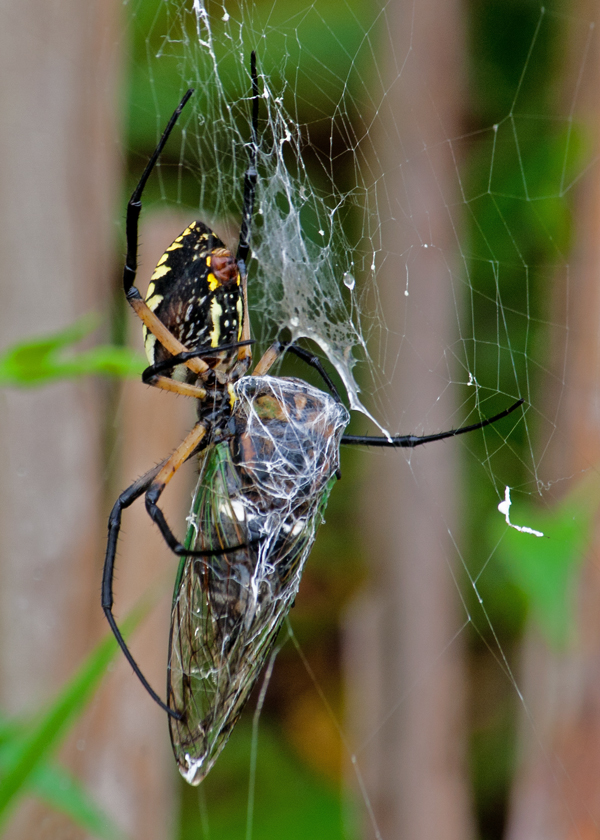
These spiders seem to catch some pretty big prey. There were grasshoppers in some of the webs and in the photo below the spider has captured a cicada. The Wikipedia article notes that the spider kills the prey by injecting its venom and then wraps it in a cocoon of silk for later consumption (typically 1–4 hours later). I think the spider in the photo may be in the process of wrapping up the cicada.

I continue to be amazed by the fascinating things that are in front of me that I have never seen before. It’s clear to me that my photographic journey is causing me to see the world differently, more attentively. That’s a good thing.

© Michael Q. Powell. All rights reserved.

Read Full Post »

Rain was gently falling as I observed a Great Blue Heron at Huntley Meadows Park, a marshland in Alexandria, VA. I was surprised to see how the open water area had shrunk to just a small pool over the past couple of months, presumably because of the lack of rain.

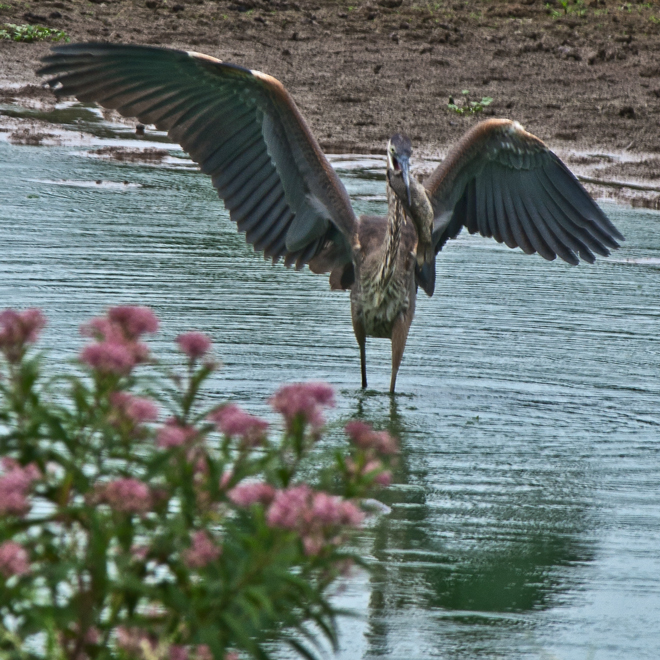
Nonetheless, there was a heron in the middle of that pool, seemingly intent on catching a fish. I was not at all convinced that there were any fish in such a small body of water, but the heron soon proved me wrong. He extended his neck and made a strike into the water and came up with a fish. As he brought the fish out of the water, he opened his wings widely (as the second photo shows), perhaps to counterbalance the weight of the fish. The heron’s wingspan was definitely impressive. He kept his wings partially extended as he moved the fish around in his mouth (as you can see in the first photo) and then swallowed the fish whole.

My photos are not technically great, but they did capture the moment pretty well.  I am thankful that I once again had the privilege to watch such a beautiful creature in action.

Great Blue Heron positions fish prior to swallowing it

Great Blue Heron opens his wings as he pulls a fish out of the water

© Michael Q. Powell. All rights reserved.

Read Full Post »
Some days it seems like anything that catches my eye is a potentially viable subject. This was the case last Friday when I was walking in a marsh in a local park and came upon this snake. Much of his body was concealed, but the upper body was exposed enough for me to attempt a head-and-shoulders portrait. Oh, wait a minute, I guess a snake does not really have shoulders, so I guess I was attempting a head-and-neck portrait.

The snake was beautiful in his own way, with wonderfully textured skin and stunning gold accents around his eyes. I thought he was probably a garter snake, but after a bit of research I am now convinced he is an Eastern Ribbon snake (Thamnophis sauritus), not a Common Garter snake (Thamnophis sirtalis). If you are at all interested in the differences, there is a wonderful article entitled “Telling Garter Snakes and Ribbon Snakes Apart” at http://www.gartersnake.info (yes, that’s the actual web address).

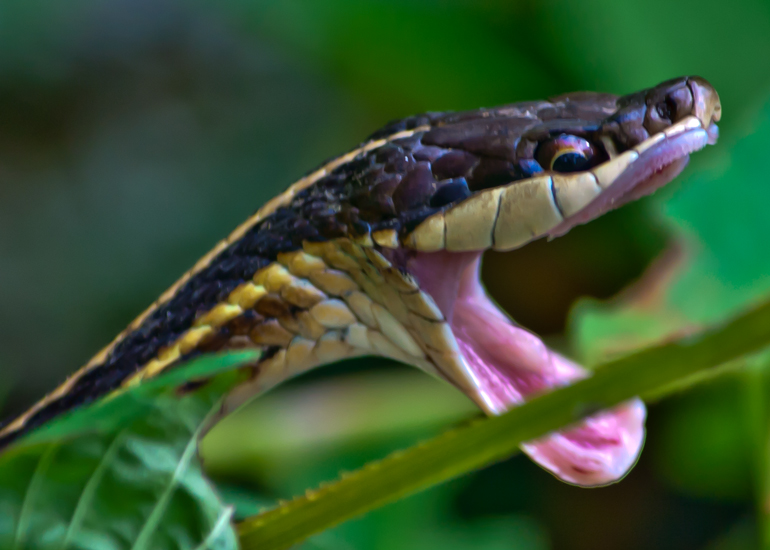
As I was admiring his beauty, he may have decided to remind me that he is a predator as suddenly he opened his mouth wide, really wide. I was looking through the lens at him and the effect was magnified because his head filled a good portion of the frame of the viewfinder. My first thought was that he was sizing me up as a potential snack. I had the presence of mind to snap a picture before his mouth snapped shut. A vine covers part of his mouth in the photo, but I decided to include it to show you how wide his mouth really is.

Now I understand how he is able to do things like swallow frogs whole. I’m glad I’m a lot bigger than a frog.

Eastern Ribbon Snake Posing for Portrait

Eastern Ribbon Snake Sizing Me Up

© Michael Q. Powell. All rights reserved.

Read Full Post »

This past weekend seems to have been my heron weekend. I posted some photos of a great blue heron that I saw on Saturday. However, I realize that hadn’t yet gone through all of my photos from Friday, which included this shot of a green heron perched on the dead limb of a tree.

The tree was overlooking a muddy pond and I couldn’t tell if the green heron was just resting or whether he was preparing to hunt for prey. The situation afforded me an unobstructed view of the green heron and I quickly started taking some shots, suspecting (as turned out to be the case) that my luck would not hold for long. The green heron soon jumped from his perch and moved farther away into some undergrowth when he focused his attention on the water.

I was totally fascinated and watched him from a distance for quite a while. Several times he “alerted” by extending his neck and leaning toward the water, but I didn’t managed to see him catch anything.

This image captures some of  of the green heron’s gorgeous colors. I especially like the chestnut color around his neck and the intensity of the yellow of his eyes.

© Michael Q. Powell. All rights reserved.

Read Full Post »
« Newer Posts - Older Posts »