Female Eastern Tiger Swallowtail butterfly (Papilio glaucus) photographed today at Green Spring Gardens, Alexandria, Virginia.

© Michael Q. Powell. All rights reserved.
Posted in Bugs, Flowers, Insects, Macro Photography, Nature, Photography, wildlife, tagged back-lit, Canon 55-250mm zoom lens, Canon Rebel XT, Eastern Tiger Swallowtail butterfly, flowers, green spring gardens, nature, sky, swallowtail butterfly on August 3, 2012| 2 Comments »
Female Eastern Tiger Swallowtail butterfly (Papilio glaucus) photographed today at Green Spring Gardens, Alexandria, Virginia.
© Michael Q. Powell. All rights reserved.
Posted in Bugs, Flowers, Gardening, Insects, Macro Photography, Nature, Photography, wildlife, tagged ant, bee, canon 18-55mm lens, Canon Rebel XT, flowers, green spring gardens, hover fly, insects, orange poppy, poppy on August 3, 2012| 9 Comments »
Do you ever get in the mood for a single color? This evening I am in an orange mood. (As a disclaimer I should mention that I drive an orange car, so orange plays a larger role in my daily life than it probably does for most others.) To scratch that itch, I decided to post some photos from late May of an orange poppy and some of the insects that visited it.
May was the month when I first started getting more serious about photography and these photos were an early indication to me that I was improving. I still enjoy looking at them, remembering some of the early twists and turns of the photography journey on which I have embarked.
As I think back, I feel like I was just learning to walk. Now I can walk with much greater confidence. I look forward to being able to run.
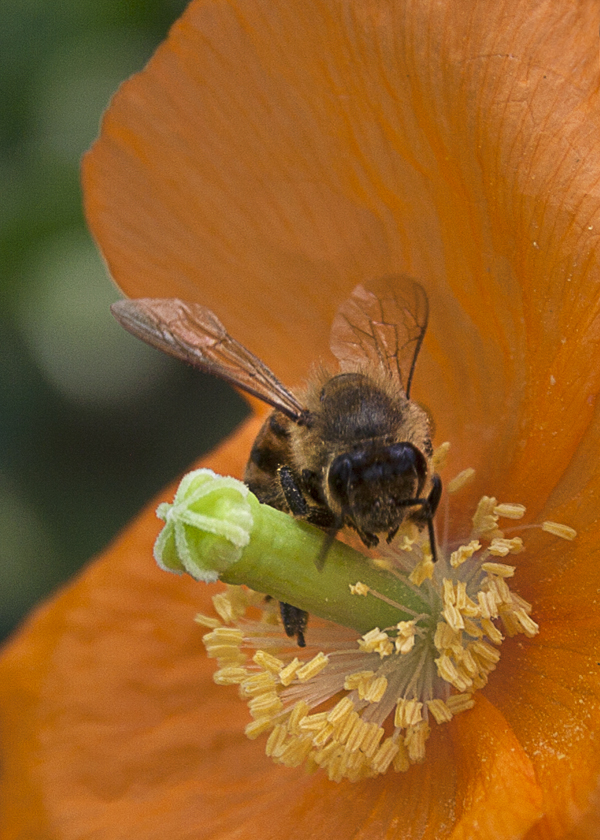
Visiting bee

Visiting hoverfly (flower fly)

Visiting ant
© Michael Q. Powell. All rights reserved.
Posted in Bugs, Flowers, Gardening, Insects, Macro Photography, Nature, Photography, tagged bug, Canon 100mm macro lens, Canon Rebel XT, Cosmopepla lintneriana, green spring gardens, insect, Twice-stabbed Stink Bug, Wee Harlequin Bug on July 23, 2012| 1 Comment »
Let me begin with a disclaimer—no actual stabbing of bugs took place in the making of this posting. Believe it or not, this bug really is called the Twice-stabbed Stink Bug (Cosmopepla lintneriana). Why? The namer of bugs (whoever that is) decided the two red spots on the bug’s back look like stab wounds.
Yesterday I spotted this little bug while photographing with my friend and photo mentor Cindy Dyer. Cindy has a wonderful posting with a sharper photo of this specific bug and some fun information about him, including the fact that he is also known as the Wee Harlequin Bug. For additional information on the bug, check out his page at Bugguide.
I like the overall effect of this photo, acknowledging that it is far from perfect technically. I’m looking forward to improving my skills as I practice and learn new techniques.

© Michael Q. Powell. All rights reserved.
Posted in Bugs, Flowers, Gardening, Insects, Nature, Photography, tagged butterfly, Canon 100mm macro lens, Canon 55-250mm zoom lens, Canon Rebel XT, Eastern Tiger Swallowtail butterfly, green spring gardens, swallowtail butterfly on July 21, 2012| 4 Comments »
I haven’t seen too many butterflies yet this season so I was happy yesterday to encounter several Eastern Tiger Swallowtail (Papilio glaucus) butterflies at a local garden. The few that I have seen during the past few weeks have been pretty damaged but the male I photographed was in great condition. The female had some damage to one of her “tails” but otherwise was almost perfect.
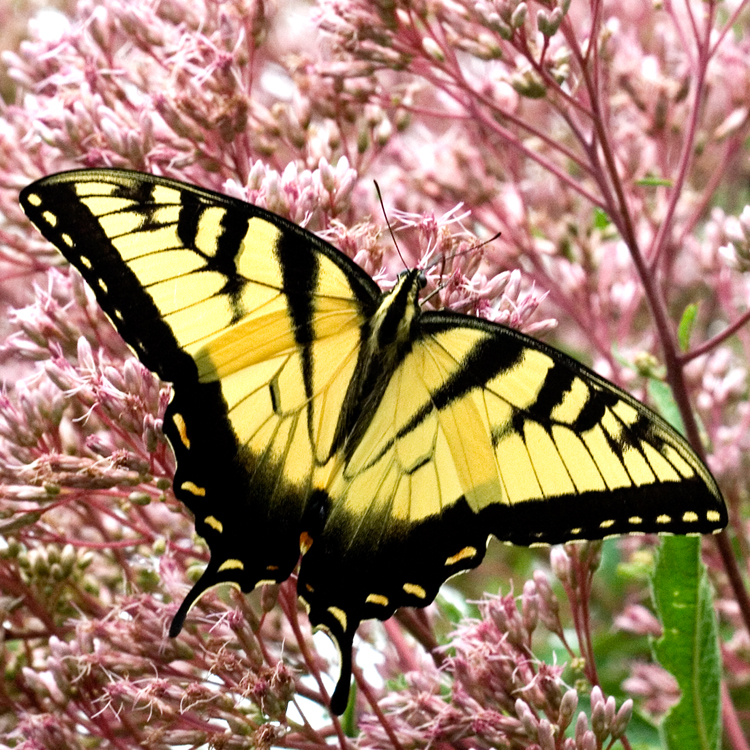
Eastern Tiger Swallowtail male in perfect condition

Eastern Tiger Swallowtail female with damaged tail
© Michael Q. Powell. All rights reserved.
Posted in Bugs, Flowers, Insects, Macro Photography, Nature, Photography, tagged bee, Canon 100mm macro lens, Canon Rebel XT, flower, green spring gardens, hibiscus, insects, rain, red, shelter on July 21, 2012| 2 Comments »
What do bees do when it’s raining? I never really gave the question much thought until this morning when I saw a really cool photo by the unUrban Studio showing a bee seeking shelter in an orchid in an early morning rain. In an earlier post today I showed a bee clinging to the underside of a leaf for protection from the rain.
During a walk in the light rain this afternoon I was pleased to also discover the bee shown below, sheltered inside of a red hibiscus flower. He appeared to be completely protected and may have been napping. As you can probably tell, I had to lighten the image a little to reveal the bee more clearly. This caused the sky, which was light already, to go totally white and produced an effect that I really like.
I enjoy walking in the rain and sometimes carry my camera under an umbrella if it is not raining too hard. From now on I’ll make a point of peeking into flowers and under leaves to discover more secret hiding places of the bees.
 © Michael Q. Powell. All rights reserved.
Posted in Bugs, Flowers, Insects, Macro Photography, Nature, Photography, tagged bee, Canon 100mm macro lens, Canon Rebel XT, green spring gardens, hiding, leaf, rain on July 20, 2012| Leave a Comment »
What do bees do when it’s raining? I never really gave the question much thought until this morning when I saw a really cool photo by the unUrban Studio showing a bee seeking shelter in an orchid in an early morning rain.
When I took a walk in the light rain earlier this afternoon I decided to look carefully to see if I too could find bees hiding from the rain. Much to my surprise I found the bee shown below, clinging to the underside of a leaf. Apparently it protects him pretty well, though you can see a couple of drops of water on his lower body. The moisture also seems to have caused his hair to frizz a little.
I remember when I too had hair that frizzed when it was humid but those days, alas, are long gone (as is my hair).

© Michael Q. Powell. All rights reserved.
Posted in Flowers, Gardening, Humor, Nature, Photography, Reptiles, tagged brown water snake, Canon 55-250mm zoom lens, Canon Rebel XT, cottonmouth, green spring gardens, lotus, lotus bud, lotus flowers, lotus seed pods, nature, Nerodia taxispilota, peace, reptile, snake, tranquillity, water, water moccasin, wild on July 17, 2012| 11 Comments »
One evening this past week I was photographing lotus flowers at a local pond in a quasi-meditative state, enjoying the calm after a thunderstorm had passed.

The life cycle of the lotus, from bud to flower to seed pod
Suddenly a woman screamed out in my direction, “Snake, there’s a snake right behind you.” My first reaction was one of disbelief, because I was standing on a flat rock partially surrounded by water that was flowing rapidly between two man-made ponds. All at once I saw the submerged snake swimming strongly against the current. Then to my surprise the snake lifted his head out of the water.
My next reaction was to spring into action to take his picture. My camera was already on my tripod and I swung it around and snapped a couple of shots without having time to adjust my exposure or shutter speed. The image below is far from perfect but it gives you an idea of the cascading water and the snake poking his head above the surface.

Swimming snake lifts its head above water
After that brief photographic opportunity I returned to my peaceful pursuit of the lotus flower.

Sidewards-facing lotus (a variation of the lotus position)
It was only much later that I wondered whether I had encountered a poisonous snake. An article entitled “Snake Mistake” by Christine Ennulat in Virginia Living helps readers distinguish between the harmless brown water snake (Nerodia taxispilata) and the venomous water moccasin (Agkistrodon piscivorus). I am pretty confident the snake I saw was “only” a brown water snake.
Maybe I will react more quickly the next time someone tells me there is a snake right behind me. I might even get a better photograph!
© Michael Q. Powell. All rights reserved.
Posted in Birds, Gardening, Nature, Photography, tagged birds, blue herons, Butorides virescens, Canon 55-250mm zoom lens, Canon Rebel XT, cornell lab of ornithology, fishing, green heron, green spring gardens, heron, nature, nature photography, ornithology, outdoors, photography, wading birds, white herons on July 16, 2012| 7 Comments »
Stereotypes of a heron’s appearance
This past weekend I visited a pond at a local garden and encountered this interesting bird. He looked a little like a heron but had a totally different body type—he was shorter and squatter than the herons I was used to seeing. I have photographed blue herons and white herons and have a mental picture of what a heron looks like. They are tall and slender and posses a fashion model’s elegance. Could this really be a heron?

Surveying the situation
Playing and posing like a child
I was alone with the bird for quite some time for the gardens were deserted after a thunderstorm. The beautiful bird, later identified as a juvenile green heron, seemed to be unusually willing to remain as I attempted to photograph him. At times he even seemed to be posing for me. Like a child he was enjoying himself, running around and playing in the water. He definitely was not intent on adult-type tasks such as catching food.
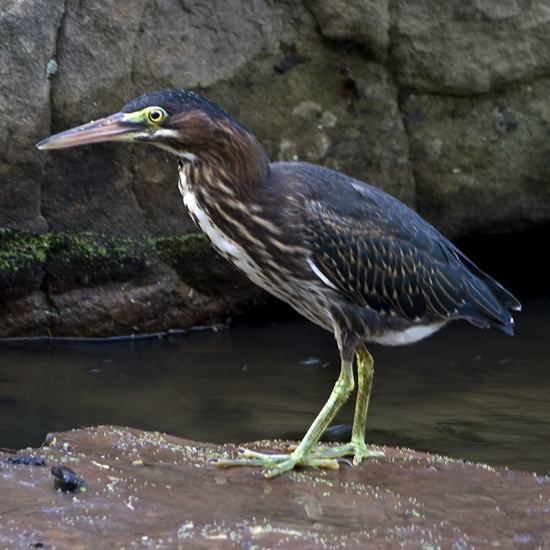
Full body shot. Don’t I have great legs?

Is this enough of a smile for you?
It’s a green heron
I am pretty confident that this bird is a green heron (Butorides virescens). Wikipedia helped me determine that he is a juvenile because of the brown-and-white streaked feathers on his breast and the greenish-yellow webbed feet. (The adult green heron has a darker bill and a more pronounced chestnut-colored neck and breast.) NatureWorks has some summary information if you want to quickly learn about green herons.

This grass feels really good on my bare feet.
A tool-using bird
My favorite website for information on the green heron, however, belongs to the Cornell Lab of Ornithology, which includes range maps and audio files. It also noted the following truly amazing fact about green herons, “The Green Heron is one of the few tool-using birds. It commonly drops bait onto the surface of the water and grabs the small fish that are attracted. It uses a variety of baits and lures, including crusts of bread, insects, earthworms, twigs, or feathers.”

Ready for my close-up
Maybe the green heron should have its own reality television show, “Fishing With a Green Heron-Choosing the Right Bait. You Don’t Even Need a Hook”
© Michael Q. Powell. All rights reserved.
Posted in Flowers, Gardening, Nature, Photography, poetry, tagged beauty, calm, Canon 55-250mm zoom lens, Canon Rebel XT, change, flowers, green spring gardens, loss, lotus, lotus flowers, peace, rain, raindrops, serenity on July 16, 2012| 2 Comments »
The world seems changed after the rain. The falling rain stripped some of the delicate petals from this lotus flower but left behind a glistening trail of water.
From the perspective of beauty it seems like an equitable trade—the transformed flower still takes my breath away.
© Michael Q. Powell. All rights reserved.

Posted in Nature, Photography, Reptiles, tagged Canon 55-250mm zoom lens, Canon Rebel XT, green spring gardens, nature, nature photography, reptile, snapping turtle, turtle on July 15, 2012| 2 Comments »
After some thunderstorms yesterday evening I went a local garden with a pond (Green Spring Gardens) and encountered this very large snapping turtle (at least that is what I think he is). He was just lying there on the grass.
I started creeping up on him with one eye in the viewfinder and the other on him. I was pretty cautious because previously I had read what Wikipedia says about snapping turtles, “Common snappers are noted for their belligerent disposition when out of the water, their powerful beak-like jaws, and their highly mobile head and neck.” There were a few blades of grass in front of part of his face and I would have liked to remove them to improve the shot, but there was no way I was going to risk my fingers for a mere photo.
I decided to share this medium range shot because it shows the mud and dried grass that made up his “camouflage.” It reminds me a little of the ghillie suits that snipers wear to blend in with nature. Eventually I hope to do another blog posting showing the progression of my shots as I got closer and closer to him, ending up with shots in which his face alone fills the frame.
Stay tuned for coming attractions!
© Michael Q. Powell. All rights reserved.

Posted in Gardening, Insects, Macro Photography, Photography, tagged bug, Canon 100mm macro lens, Canon Rebel XT, close-up, green spring gardens, insects, milkweed, nature, plants, red, red milkweed beetles on July 13, 2012| Leave a Comment »
Focus on the eyes! That’s one of the first tips that I was given to improve my shots and I tried to follow that advice when photographing this red milkweed beetle. (One of my earlier blogs chronicled my obsession with these little creatures.)
I like the way the antennae turned out in this photo. They remind me of a Texas longhorn steer’s horns which, according to Wikipedia, can extend to 7 feet (2.1 meters) tip to tip.
Can you imagine a red milkweed beetle with an equivalent antenna span?
© Michael Q. Powell. All rights reserved

Posted in Gardening, Insects, Macro Photography, Photography, tagged arachnid, Canon 100mm macro lens, Canon Rebel XT, eyes, green spring gardens, harvestman, insect, macro, nature, opiliones, spider on July 13, 2012| 8 Comments »
What’s a harvestman?
a. A man who harvests. like a farmer or a migrant worker;
b. A pocket electronic device made by International Harvester (like a Walkman or Discman);
c. An insect related to a spider; or
d. Spiderman’s adversary in the new Spiderman movie
Until earlier this week I might have responded with selection “a” if I had been posed this question—it is the most obvious answer. I would have been wrong. The correct answer is “c.”
As I was finishing up a photo shoot in a local garden one of my friends excitedly pointed to a bush and exclaimed, “There’s your first harvestman.” I did not have a clue what she was talking about. All I could really see in the bush was a bunch of long legs connected to a body. (My friend Cindy D. has some photos of the entire body of a harvestman in one of her blog postings in case you are not familiar with this insect.)
I shot some photos anyways and when I looked at them on my computer I was shocked. There appeared to be two eyes on a stalk in the middle of the insect’s back, with the eyes looking sidewards in completely opposite directions. Could they really be eyes?
Here is one of my photos of the harvestman. It is not a technically perfect photo but it gives you a pretty clear view of the unusual eyes of this strange insect. If you want to learn more, check out this page, which is full of fascination factoids and photos.
© Michael Q. Powell. All rights reserved

Posted in Gardening, Insects, Macro Photography, Photography, tagged beetles, canon 18-55mm lens, Canon Rebel XT, gardening, green spring gardens, insect photography, macro photography, milkweed, nature, nature photography, photography, red, red milkweed beetles on July 11, 2012| 9 Comments »
Do you find yourself being drawn back inexorably to photographing the same subjects over and over again?
Last month my friend and mentor Cindy D. “outed” me in a wonderful posting on her blog. She confessed that “we’ve become a little obsessed with photographing Red milkweed beetles (Tetraopes tetraophthalmus).” (She also published some interesting facts about the beetles in another blog posting.) She’s right, of course, in her assessment of me, but I might quibble with her on one point. Is it possible to be only a “little” obsessed?
What are the symptoms of my obsession? After work today, in between thunder and rain storms, I rushed to Green Spring Gardens to take some photos. I shot a few flowers but I couldn’t resist the pull of the milkweed plants. I know exactly where they are located in the gardens and I know if I look hard enough on the milkweed plants I will find the cute little beetles.
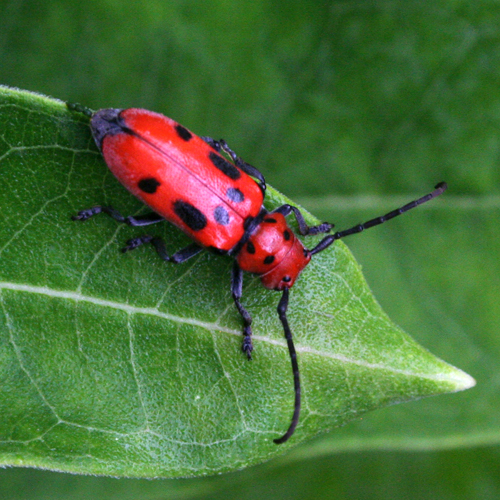
By the time I found my beloved beetles the light was starting to fade. How bad was the light? Despite shooting at ISO 800, I needed exposures around 1/5 of a second at F11. Fortunately the beetles were willing to pose and I had my tripod with me. I managed to get a few nice shots with beautiful color saturation in the late day, overcast light. Here is one photo (out of many) of the object of my obsession—a red milkweed beetle.
Is there a twelve-step program for people with this problem?
© Michael Q. Powell. All rights reserved
Posted in Gardening, Macro Photography, Photography, tagged Canon 100mm macro lens, Canon Rebel XT, flowers, gardening, green spring gardens, rain, red flower on July 9, 2012| 2 Comments »
The heat wave in the Washington DC area has finally broken. Many of us last night were awakened by the loud, cannon-like sound of thunder and the softer, more gentle sound of falling rain. This morning the skies were overcast and the ground was still wet, a likely source of frustration for commuters but a blessing for photographers.
I set off in the morning with a couple of friends for Green Spring Gardens, a county-run historic park in Alexandria, Virginia. The colors of the flowers today seemed to be extraordinarily vivid and saturated. There also were beads of water on many of the plants and flowers, creating wonderful reflections and adding additional interest.
I do not know for sure what kind of flower I captured in this photo, perhaps a hibiscus. Its color and texture caught my eye today. I probably would have passed by it yesterday without stopping. Today, however, its beauty was enhanced, enhanced by the effects of the storm.
© Michael Q. Powell. All rights reserved

 Mike Powell