Feeds:
Posts
Comments

Posts Tagged ‘eagle’

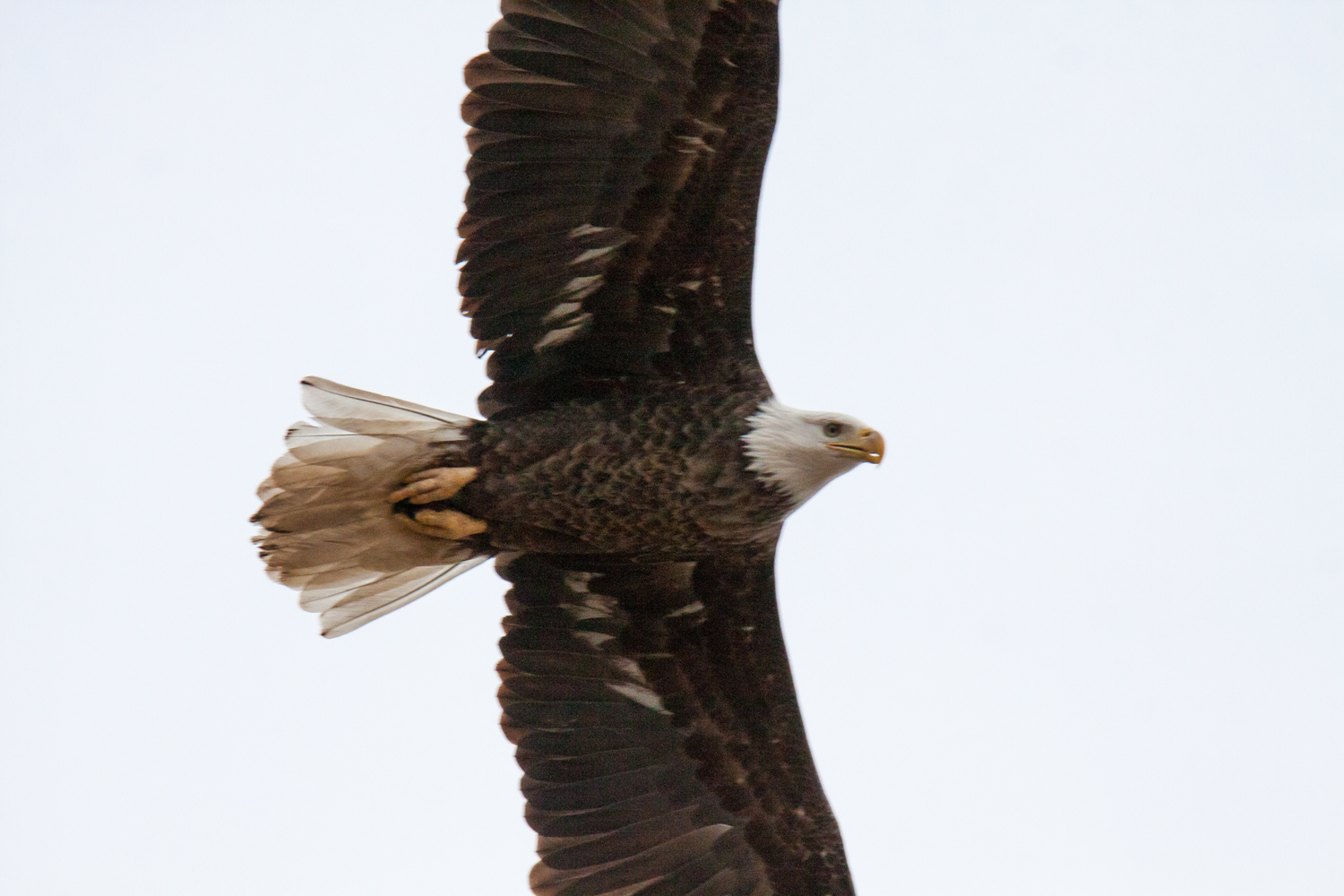
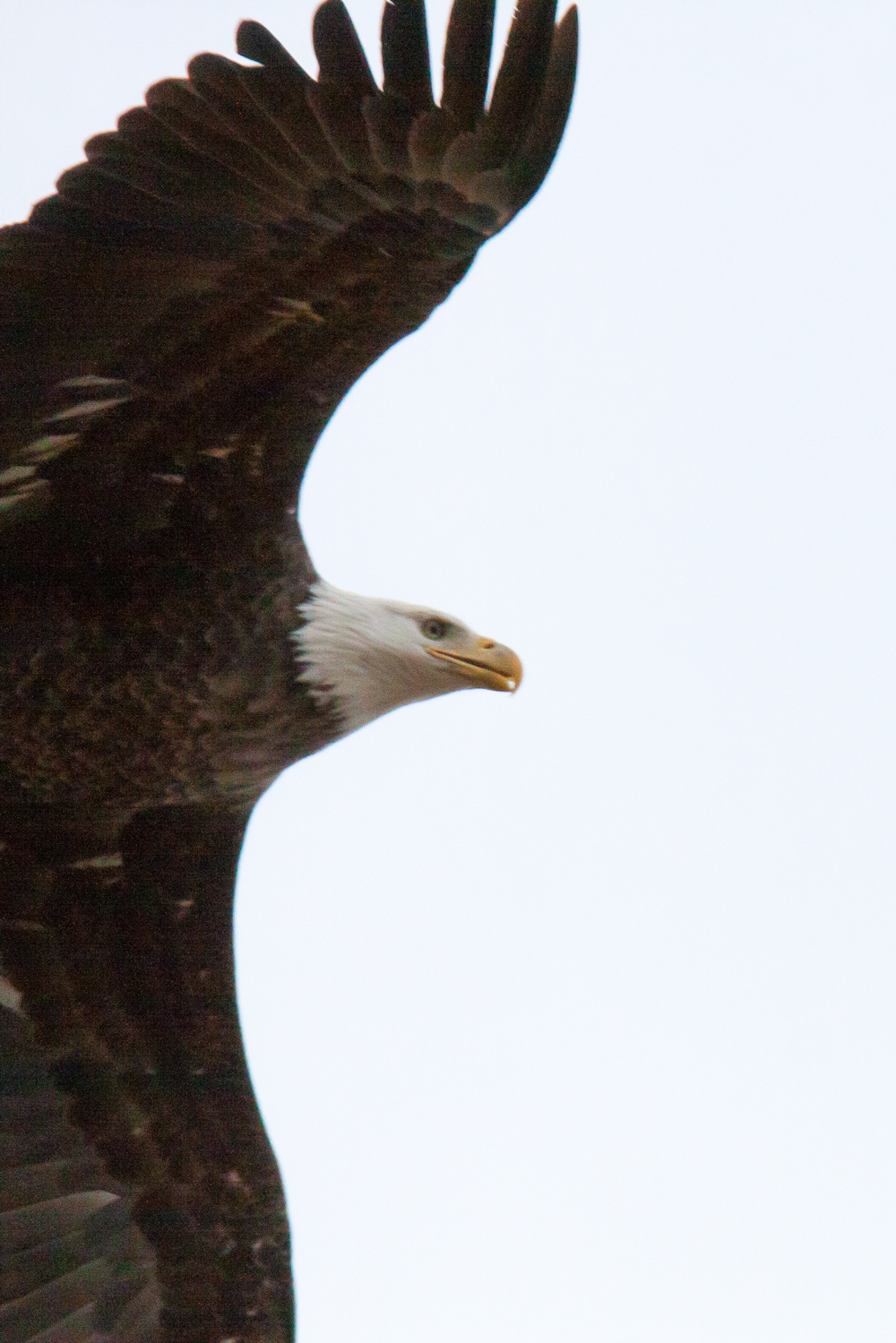
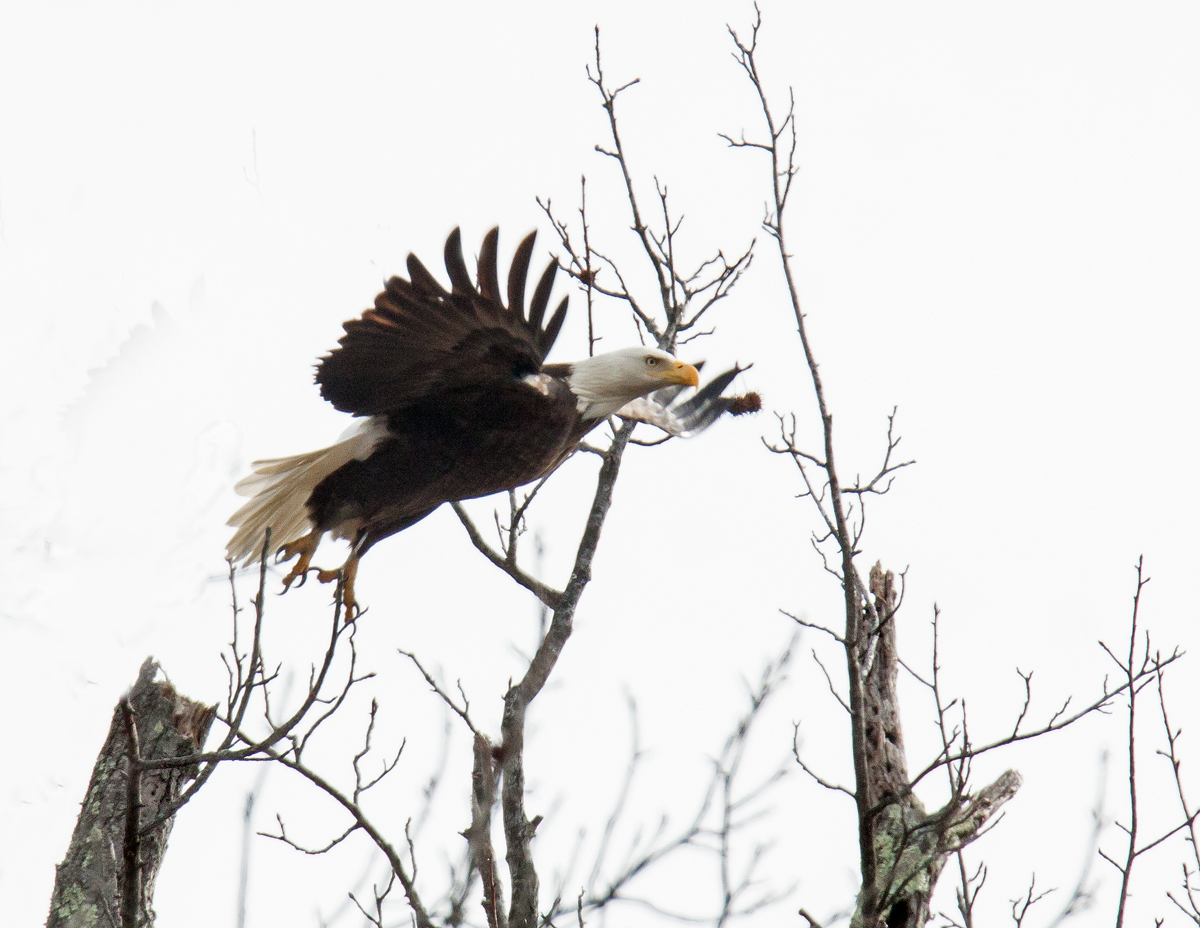
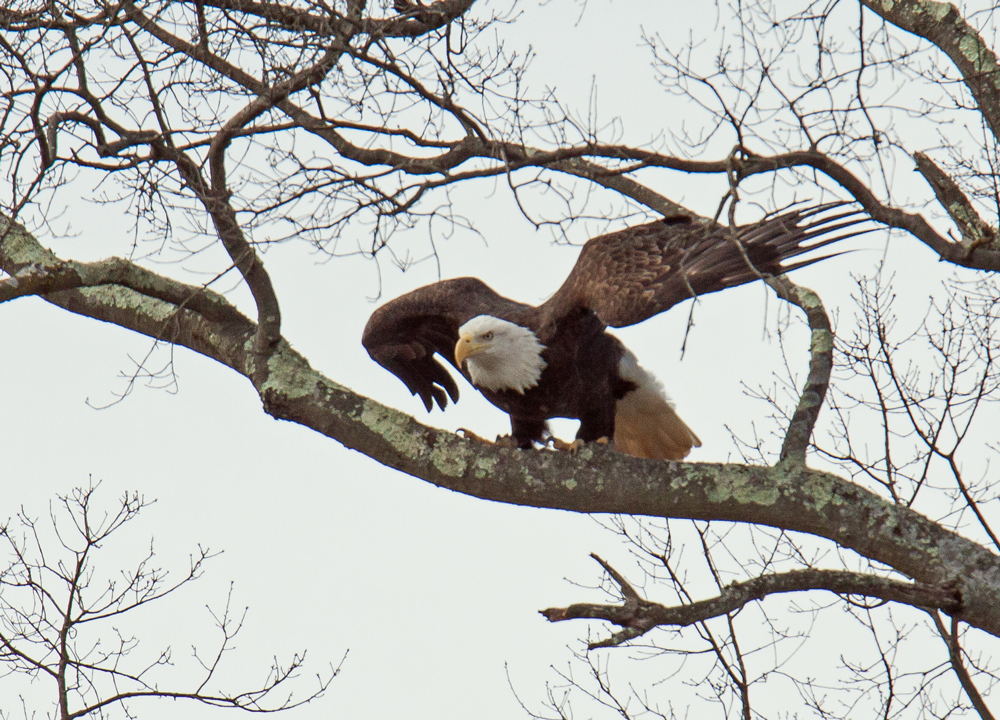
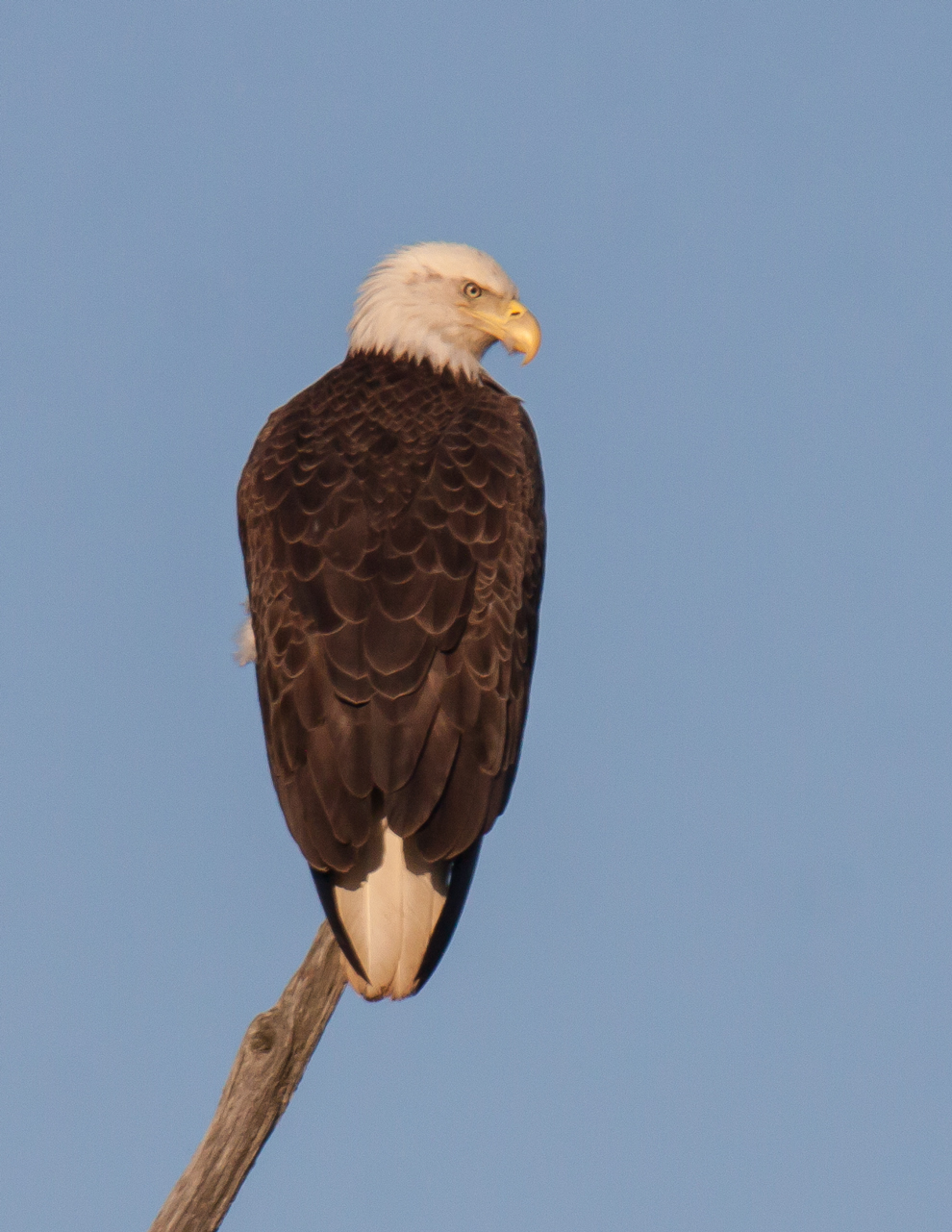
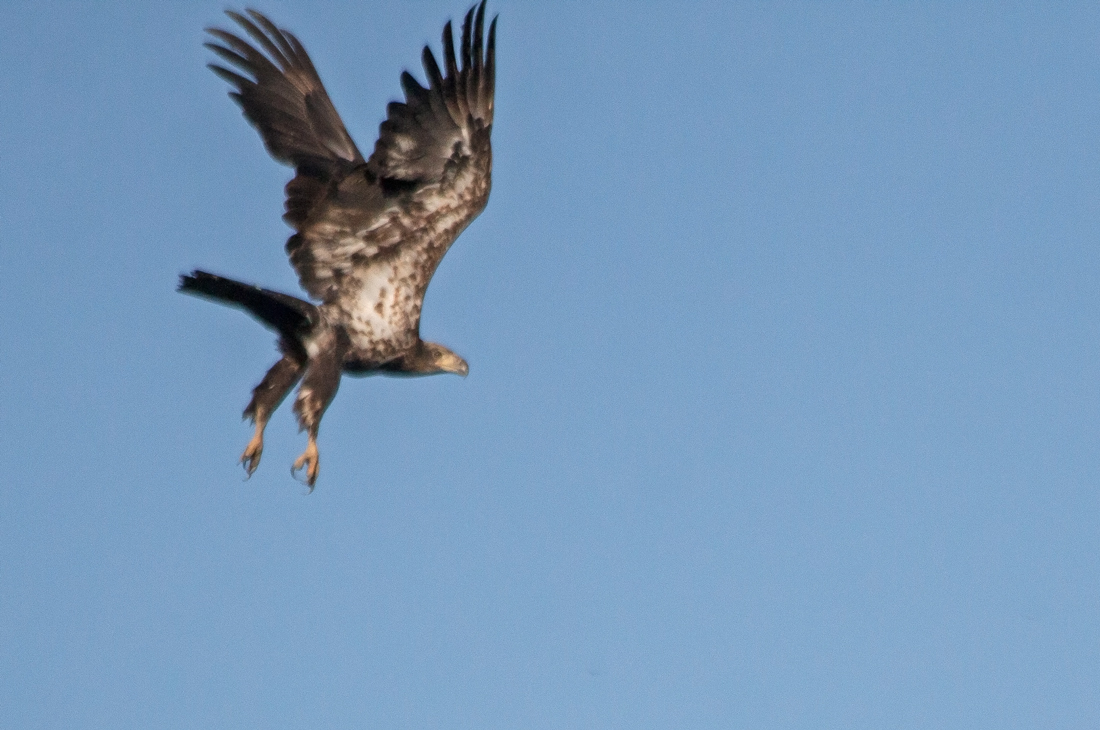
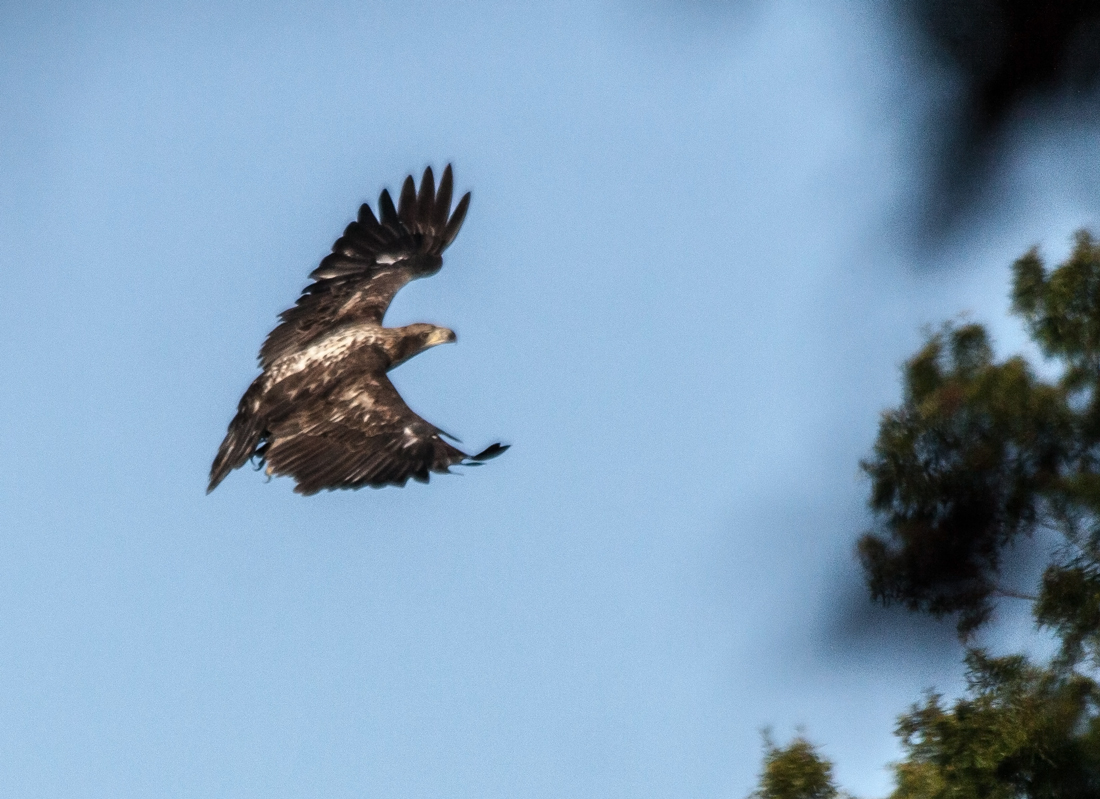
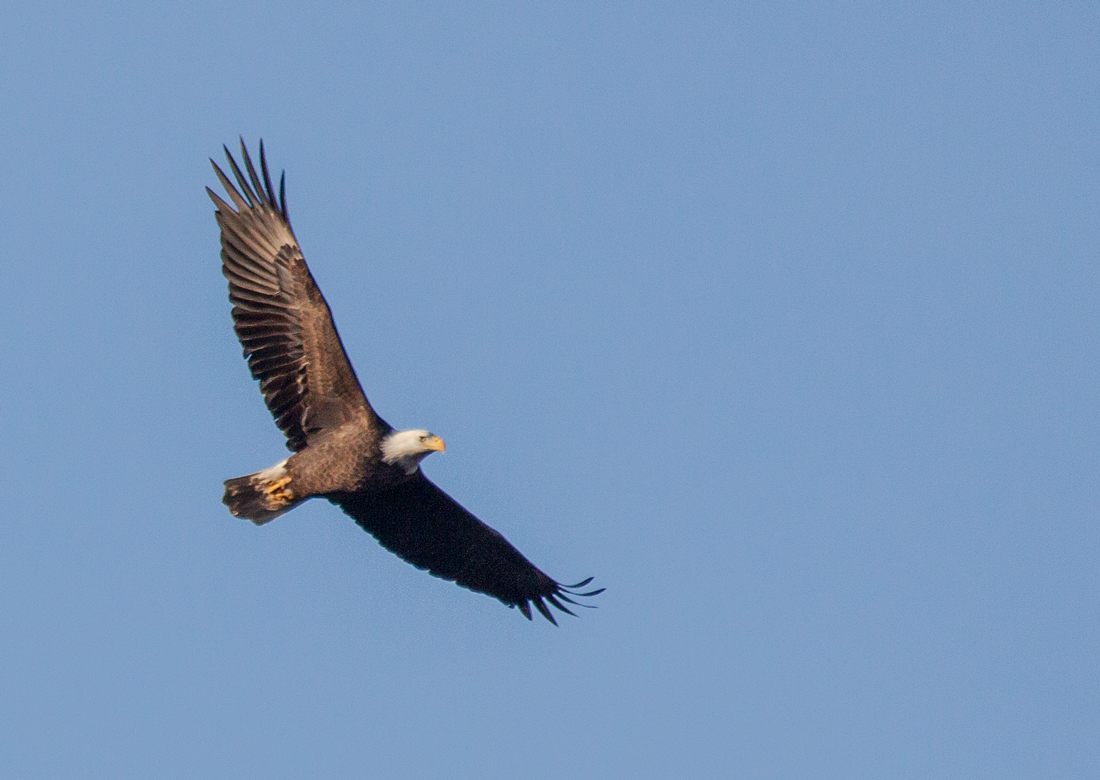
It’s tough to sneak up on eagles. Their eyesight is so sharp and their reactions so quick that it is a real challenge to spot them before they spot you and take to the air. Yesterday, though, this Bald Eagle (Haliaeetus leucocephalus) at Occoquan Bay National Wildlife Refuge looked right at me and yet remained in place for a little while before finally taking off.

I had spotted the Bald Eagle from a pretty good distance away and had been slowly moving closer to it. There were a lot of branches between me and the eagle, so it was virtually impossible to get an unobstructed shot.

I tried to move mostly when the eagle was looking away, but I am confident that it detected me and stared right at me, as you can see in the first image. The eagle seemed to contemplate the situation for a few moments and turned its head toward the water. Eventually the eagle decided to depart and took off, giving me a wonderful view of the underside of its white tail feathers.

Bald Eagle

Bald Eagle

Bald Eagle

© Michael Q. Powell. All rights reserved.


Read Full Post »

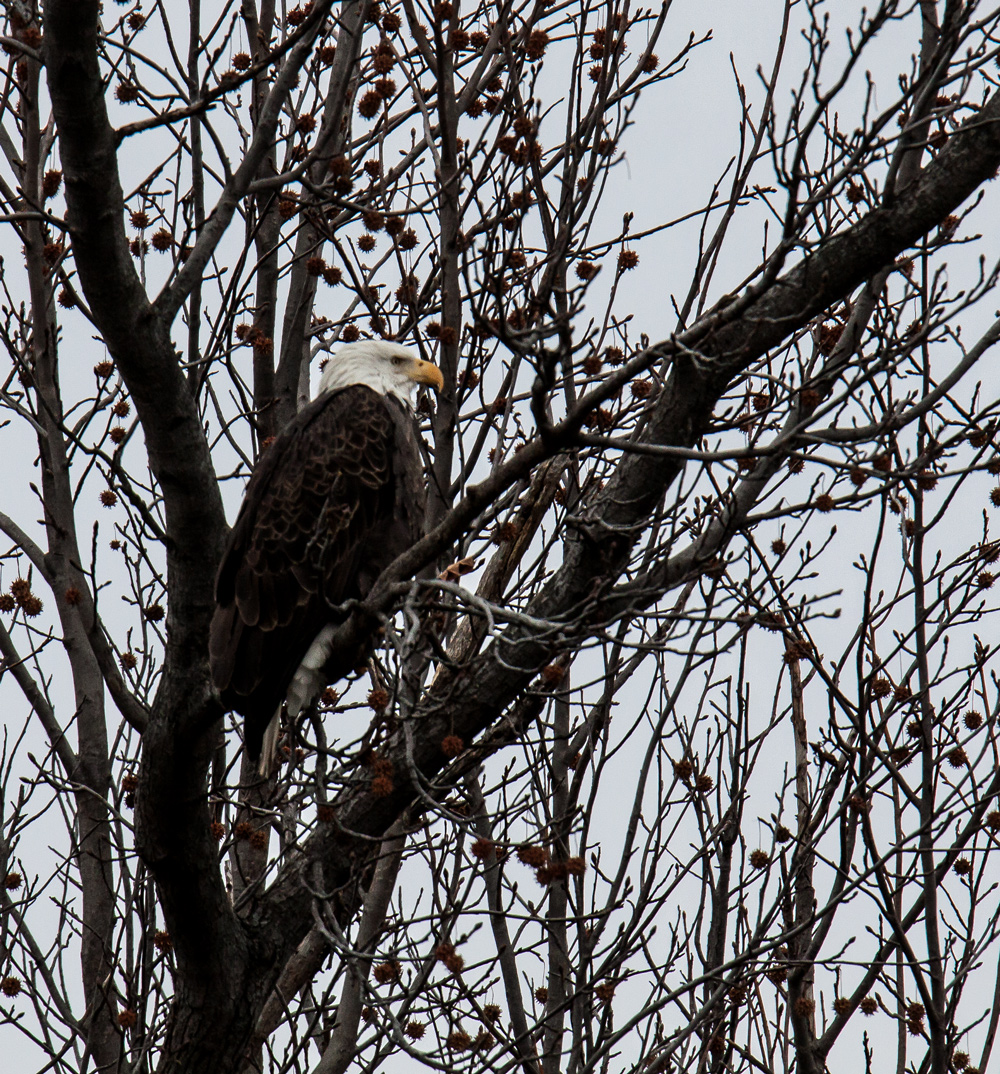
When they are perched in the open or at the end of bare branches, Bald Eagles are not hard to spot. When they are hidden deeper in the trees, though, it can be a real challenge to see them, like this Bald Eagle (Haliaeetus leucocephalus) that I came upon on 8 December at Occoquan Bay National Wildlife Refuge.

Bald Eagle

© Michael Q. Powell. All rights reserved.

Read Full Post »

Seeing one Bald Eagle (Haliaeetus leucocephalus) is pretty exciting, but seeing two together is even more awesome. I spotted these two eagles on Monday morning at Occoquan Bay National Wildlife Refuge.

At a certain location within the refuge there is a tall pole, which resembles a telephone pole, with a wooden platform. I am not sure of its purpose, but several times in the past I have seen a bald eagle perching on it. I have tried several times to get shots of the eagle, but have generally been unsuccessful, because of the height of the pole and the fact that I cannot get close to it.

When I spotted an eagle there yesterday morning, I decided to give it another shot, hoping that my monopod would help me to get a sharp enough shot to survive a severe crop. As my eye was pressed to the viewfinder taking some shots, imagine my surprise when another bald eagle entered the frame and landed next to the first one. They perched together for a little while and then the larger of the two, which I later learned is the female, began to embrace the other, eventually using her beak to give what looked like a kind of massage. What was going on?

Thanks to some experienced birders in a Facebook group, I learned that the breeding season for eagles in our area begins in early December and that this is likely a bonded pair. I also discovered that the pecking that I observed, as seen in the second photo below, is almost certainly a kind of courting behavior.

I think that there may be several pairs of bald eagles at this wildlife refuge, so I will keep my eyes open for more of this kind of behavior and for more photographic opportunities.

Bald Eagle

Bald Eagle

© Michael Q. Powell. All rights reserved.


Read Full Post »

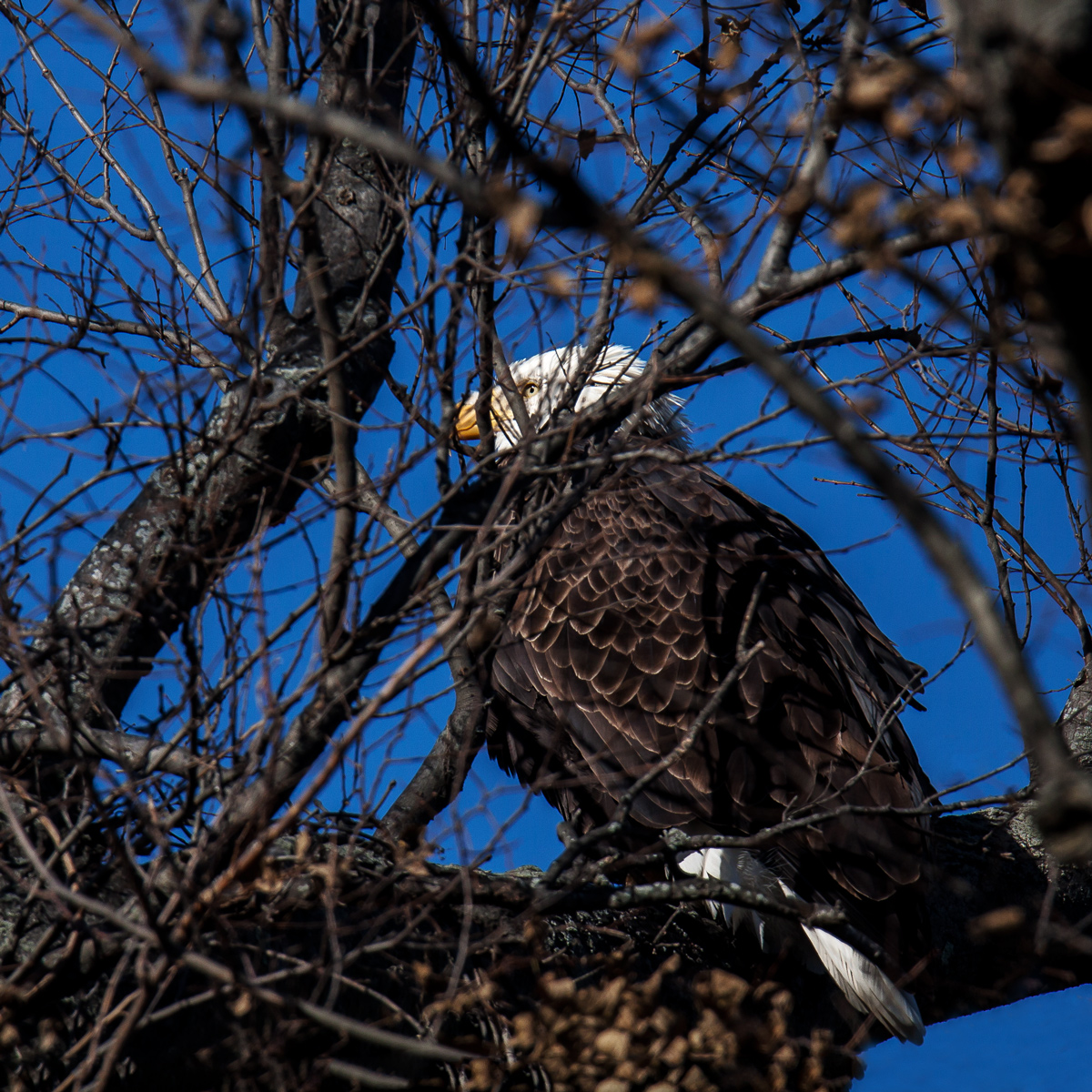
It’s almost impossible to sneak up on a Bald Eagle (Haliaeetus leucocephalus), but that didn’t stop me from attempting to do so this past Friday afternoon at Occoquan Bay National Wildlife Refuge. I was walking along a trail that runs to parallel to the water when I spotted the unmistakable white head of a Bald Eagle. The eagle was partially hidden in a mass of branches and was facing away from me, so I moved forward with as much stealth as I could manage.

When I reached a point where I was shooting up at a rather steep angle, I stopped and waited, hoping the eagle would turn its head to the side and offer me a glimpse of its eyes. Eventually that happened and I shifted from side to side in a desperate attempt to capture an unobstructed view of its eye. Clearly this is not the best shot of a Bald Eagle that I have ever captured, but I do like the pose and the details in its feathers. Besides, it’s a Bald Eagle, a subject that never fails to excite me.

Bald Eagle

© Michael Q. Powell. All rights reserved.
Read Full Post »

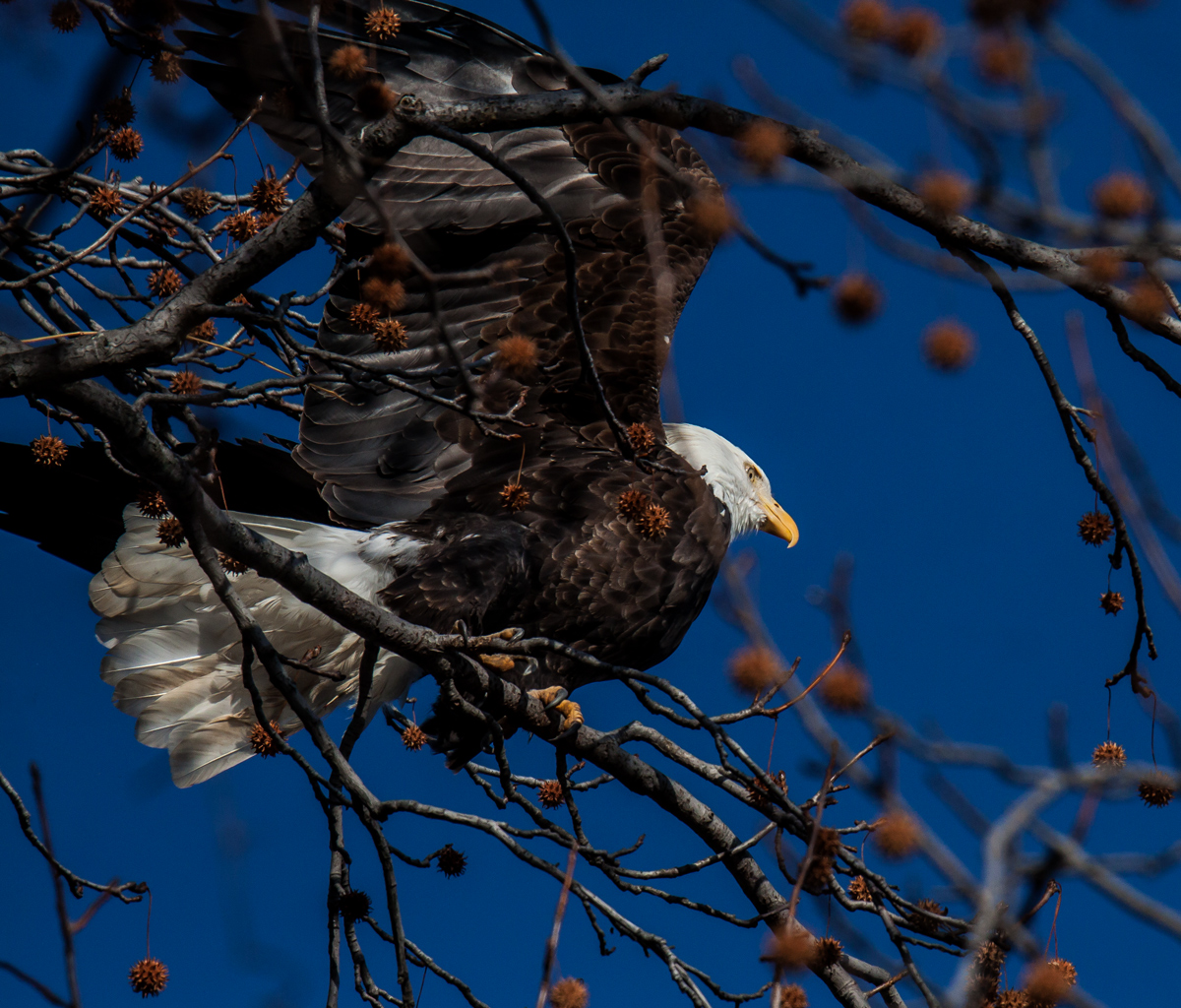
Without fail I will try to get a shot of a Bald Eagle (Haliaeetus leucocephalus) every time that I see one, assuming that I am able to react quickly enough. This past Friday as I wandered about at Occoquan Bay National Wildlife Refuge, I was excited to see Bald Eagles multiple times and to get some shots.

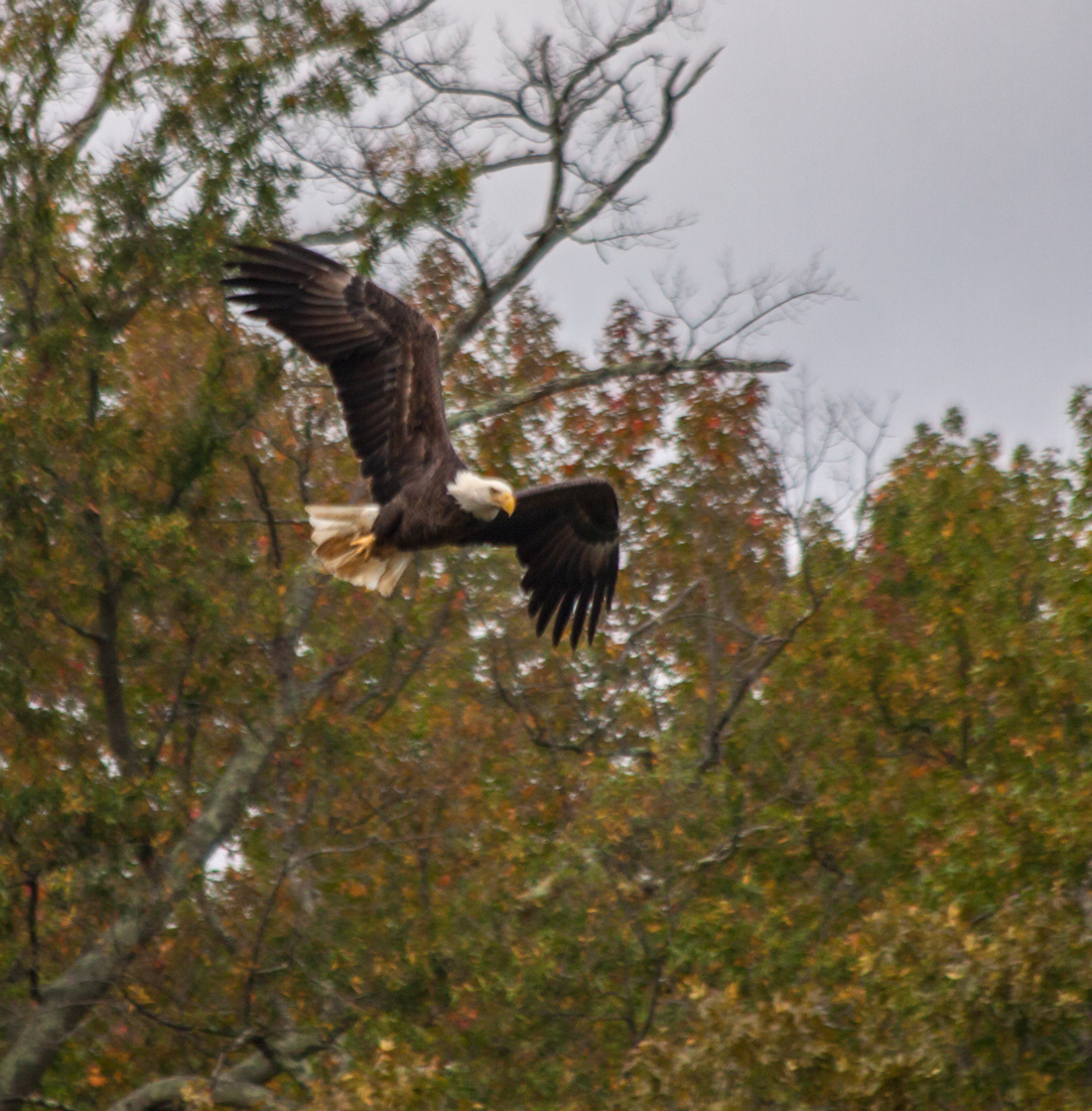
Here are a few favorites from that day. In one case, the eagle was perched on an exposed branch and I was able to get photograph from below it was it taking off. In the second case, the eagle seemed almost buried inside the branches of a tree. It’s difficult to be camouflaged, however, when you have a bright white head. I was able to photograph this one too as it was taking off. Initially I was hesitant about posting the third shot, but I really like the detail in the tail and talons that I captured as the eagle was pushing off, so I decided to include the image.

As I have said multiple times, any day that I see a Bald Eagle is a good day and the response in the past from viewers has reassured me that I am not oversaturating my blog with shots of eagles.

Bald Eagle

Bald Eagle

Bald Eagle

© Michael Q. Powell. All rights reserved.

Read Full Post »

As I turned the corner of a trail at Occoquan Bay National Wildlife Refuge on Monday, I spotted a large bird perched high in a tree. It didn’t immediately fly away, so I figured it wasn’t an eagle. Zooming in, I realized I was wrong—it was a Bald Eagle (Haliaeetus leucocephalus) facing in the opposite direction.

I got lots of photos of the back of the eagle’s head, but decided that I wouldn’t share any of them. I knew that eventually the eagle would turn its head and tried to get ready. I snapped off a few photos, including the first one below, when the eagle turned its head and surveyed the area.

I don’t know if it was the noise of the shutter or if it detected motion, but the eagle spotted me and I was able to capture the second shot as it was preparing to take flight. I was thrilled, because this was the closest encounter that I had had with a bald eagle in a long time.

I continued down the trail and a short while later made a turn onto another trail. As I glanced to my left, I saw a perched eagle. I don’t know if it was the same one that I had just observed, but I managed to snap off a few more shots, including the third shot below. I like the way that I was able to capture a bit of the feel of autumn with the red leaves.

Bald Eagle

Bald Eagle

Bald Eagle

© Michael Q. Powell. All rights reserved.

Read Full Post »

One of my fellow photographers keeps posting such awesome photos of the birds of Fort Washington Park, a historic fort on the Potomac River in Maryland, that I decided to make a visit there yesterday. Upon arrival, I quickly realized that I did not know exactly where in the park I would be most likely to find wildlife, so I wandered around somewhat aimlessly for most of my time there.

I had been at the park once before and had seen a bald eagle that time, so my eyes looked mostly upwards as I scanned the trees and the sky. Several times I focused my camera on a shape in the trees and was disappointed that it was only a misshapen branch or a clump of leaves. Finally, though, I spotted a Bald Eagle (Haliaeetus leucocephalus) high in the trees.

Sometimes bald eagles will perch on branches somewhat in the open, but this one was buried among the branches. This photo show my initial view of the eagle as I looked through my lens zoomed all the way out to 600mm.

Bald Eagle

Focusing on eagle was somewhat of a challenge because of all of the branches, but as this blow-up of a part of the image above shows, I was able to capture some pretty good detail.

Bald Eagle

I tried to be stealthy as I moved a bit closer, but the eagle detected my presence and immediately took off. Initially the eagle flew behind the trees, but I managed to acquire my target and capture a number of image before the eagle disappeared in the distance. The lighting was not the greatest and I had to crop the images a good deal, but I am really pleased that I managed to get some relatively sharp views of the eagle’s head.

I am pretty sure that eagles will show up in my blog again in the upcoming months, though not with quite the regularity with which they have appeared recently.

Bald Eagle

Bald Eagle


© Michael Q. Powell. All rights reserved.
Read Full Post »

Is it possible to post too many photos of Bald Eagles (Haliaeetus leucocephalus)? I don’t think so. Here’s a shot of one I saw yesterday flying in the distance at Huntley Meadows Park. It was a nice bonus that we had sunshine and blue skies after a series of dreary, overcast days, even though it was still pretty cold outside.

I see Bald Eagles, including juvenile ones, often enough at the park that I frequently wonder if there is a nest hidden somewhere the park. I have wandered through some pretty remote areas of the park, but so far have been unsuccessful in locating a nesting site.

Bald Eagle

Bald Eagle

© Michael Q. Powell. All rights reserved.

Read Full Post »

The sky was pretty overcast early Friday morning at Huntley Meadows Park and the light was limited, so I had to crank up my ISO to 1600. My long telephoto zoom lens works best when there is good light, so I was thrilled that I somehow managed to capture some identifiable shots of this Bald Eagle (Haliaeetus leucocephalus) as it circled around me before flying away.

Any day I see a bald eagle is a wonderful day.

Bald Eagle

Bald Eagle

Bald Eagle

© Michael Q. Powell. All rights reserved.

Read Full Post »

Recently I posted a photo of a Bald Eagle (Haliaeetus leucocephalus) arriving at a perch with talons extended. Here’s what the same eagle looked like when it eventually left the perch. I love sense of power that the eagle is able to convey when it extends its mighty wings. (The second photo, taken a split-second before the first one, shows the eagle as it was preparing to take off,)

Note that the eagle has a band around his left leg. I wonder how many of the eagles I see at Huntley Meadows Park are banded. I can recall only one other time when I could see a band, but must admit that most of my eagle shots do not have enough detail to be able to tell if a band is present.

Bald Eagle

eagle2_5Mar_blog

© Michael Q. Powell. All rights reserved.

Read Full Post »

A Bald Eagle (Haliaeetus leucocephalus) was preparing to land in a tree yesterday morning at Huntley Meadows Park and had its talons fully extended. With perfect form, the eagle was able to stick and hold the landing.

The judges all gave the eagle a perfect score of 10 for the routine.

Bald Eagle

© Michael Q. Powell. All rights reserved.

Read Full Post »

My heartbeat definitely accelerates when a Bald Eagle (Haliaeetus leucocephalus) flaps its wings and heads straight in my direction, as one did again this past Monday morning. I don’t know why the eagle chose to fly toward me, since I am pretty sure that it was aware of my presence and could have flown away. Perhaps the eagle was simply curious and wanted to check me out.

Eventually the eagle did pull up and fly past me, without getting as close as it might seem from the images. Some readers have asked me if I was near an eagle nest when I posted similar photos in the past. I have seen eagles multiple times in the same general location and suspect there might be a nest nearby, but so far have not located one.

Bald Eagle

Bald Eagle

Bald Eagle

© Michael Q. Powell. All rights reserved.


Read Full Post »

I didn’t see where this Bald Eagle (Haliaeetus leucocephalus) came from early yesterday morning at Huntley Meadows Park, but suddenly it was overhead at a relatively low altitude. I zoomed back a bit on my telephoto lens, but the eagle still more than filled the frame. At that close range, tracking was difficult and I had trouble keeping the eagle in the viewfinder (I think adrenaline might have been a factor too).

Incredibly, the first shot is an uncropped image. It was shot handheld at 483mm on my crop sensor Canon 50D camera with my trusty Tamron 150-600mm lens. The lighting was not that great, so I was shooting at ISO 1600, which resulted in a somewhat grainy image.

The second shot is one in which I got a bit ahead of the eagle in tracking it and chopped off its body. I liked the eagle’s expression so I cropped off the wide expanse of white sky to the right, turning the image from landscape mode to portrait mode, but otherwise left the framing untouched.

If someone had told me before yesterday that I could fill the frame of an image with a bald eagle in flight, I almost certainly would have laughed at them. Reality continues to amaze me.


Bald Eagle

Bald Eagle

© Michael Q. Powell. All rights reserved.

Read Full Post »

No matter how slowly and silently I move, a Bald Eagle (Haliaeetus leucocephalus) seems to sense my presence very quickly and immediately takes to the air. It’s really not that surprising, given the eagle’s amazingly keen eyesight that lets it spot prey from a long distance away.

Last weekend I spotted this Bald Eagle when it was perched atop a broken-off tree. Most of the previous times the stationary eagles that I have seen have been sitting on branches. When they took off, they seemed to push off of the branch a bit to gain some forward momentum.

In this case, the eagle appeared to initially push in an upward direction to gain a little height before flapping its powerful wings. Here are a few shots that show some of the stages of the takeoff process.


Bald Eagle

Bald Eagle

Bald Eagle

© Michael Q. Powell. All rights reserved.

Read Full Post »

I usually miss the takeoff sequence of a Bald Eagle, because the eagle spots me before I see it, but this weekend I managed to capture a series of shots of one such takeoff.

My first indication of an eagle’s presence is often when I see it flying away. Several times this past weekend, however, I spotted a Bald Eagle (Haliaeetus leucocephalus) perched in the trees at Huntley Meadows Park and I was able to observe the eagle for at least a few minutes at a time.

In the case of these images, I was looking across a beaver pond at the eagle as it perched in the trees. In the first couple of shots, the eagle seemed to getting a little agitated and is lifting its feet and flexing its wings. Then he assumed a position that reminds me of the start of a speed skating race or a sprint, with a flexed wing ready to propel the eagle forward. Finally the eagle pushed off from the tree and descended a little with talons extended before leveling off and flying away.

Some of the time it seems an eagle just springs into motion and ignores most of the items on its pre-flight checklist as it prepares for takeoff. Other times, like this one, it follows the established procedures and waited for flight clearance from the tower.

Bald Eagle

Bald Eagle

Bald Eagle

Bald Eagle

Bald Eagle

Michael Q. Powell. All rights reserved.

Read Full Post »

Yesterday was a great day for me photographing Bald Eagles (Haliaeetus leucocephalus) at Huntley Meadows Park. I took this photo later in the day than the more close-up shots that I posted earlier. I can’t tell if it is the same eagle, but it too appears to have a band on its right foot.

I really like the way that the dynamic position of the eagle’s wings conveys a sense of the power of this majestic creature. There is a kind of dramatic tension in the pose that captivates me.

Bald Eagle

Michael Q. Powell. All rights reserved.

Read Full Post »

Another eagle? I know that I posted some eagle photos a few days ago, but normally when I see a Bald Eagle (Haliaeetus leucocephalus), it is flying in the distance. Yesterday at Huntley Meadows Park, however, one flew almost directly over me while I was on the boardwalk.

This different perspective allowed me to get some shots that are much more detailed than usual, showing, among other things, the eagle’s tail feathers and fully-extended wings. The wingspan of this magnificent bird is amazing.

Bald Eagle

Bald Eagle

Bald EagleMichael Q. Powell. All rights reserved.

Read Full Post »

This past Monday was a wonderful day for eagles. In addition to the young eagle whose photos I posted earlier, I also managed to capture these images of a mature Bald Eagle (Haliaeetus leucocephalus) perched on a dead tree in the marsh.

Bald Eagle

Bald Eagle

© Michael Q. Powell. All rights reserved.


Read Full Post »

I was late in reacting when the Bald Eagle (Haliaeetus leucocephalus) took off from its perch and I was pretty sure that I had not gotten any decent shots of its departure. Consequently, I skimmed quickly through the shots during my initial review and none of them jumped out at me.

After I had done this morning’s posting, I had a few minutes before I had to depart for work and decided to review the images again. I was surprised to find this shot of the young eagle in flight, shortly after he had pushed off from the tree. It’s reasonably sharp and the wings are in a decent position, so I decided to post the photo as a complement to the first image that showed the eagle completing a difficult landing.

Bald Eagle

© Michael Q. Powell. All rights reserved.

Read Full Post »

I tend to take the majority of my wildlife photographs within a few miles of my home in Northern Virginia, but yesterday I boldly decided to cross the Potomac River and venture into Maryland in search of Bald Eagles. One of my fellow photographers has repeatedly posted beautiful photos of eagles at Fort Washington Park and I wanted to see if I too could find them.

Fort Washington is a historic park, now run by the National Park Service, that was built to defend the river approach to Washington D.C. almost two hundred years ago. The park is a bigger than I expected and I wandered up and down walking paths, wondering where I might find the eagles. I spent a lot of time near the water, but eventually decided to climb to the higher ground, where the artillery positions were located.

As I was about to enter the fort, I glanced over at a tree in the distance and saw the shape of a large bird—it was a Bald Eagle (Haliaeetus leucocephalus). As luck would have it, it started to rain as I started to take some photos, but I managed to get a few relatively clear shots. I had to climb down one hill and up another to get closer to the tree and the eagle flew off before I could get any closer shots.

I don’t know if that tree is a favorite perching spot for the eagles, which I saw soaring at a distance a bit later in the day, but I’m confident that I will return to this location, hopefully when the weather is a bit more hospitable, to search again for a bald eagle.

Bald Eagle

Bald Eagle

© Michael Q. Powell. All rights reserved.

Read Full Post »

I received an update from the Animal Control Officer who rescued the Bald Eagle (Haliaeetus leucocephalus) featured in yesterday’s posting and the prognosis looks positive.

The eagle had a low heart rate, according to the attending veterinarian, likely from pesticide poisoning, and they treated it with atropine. The eagle, an 8 pound (3.6 kg) female, also had a dislocated joint in one wing, which is treatable as well. It is likely they will be able to release her after some rehabilitation at a specialized facility in southern VA, which I assume is The Wildlife Center of Virginia in Waynesboro, Virginia.

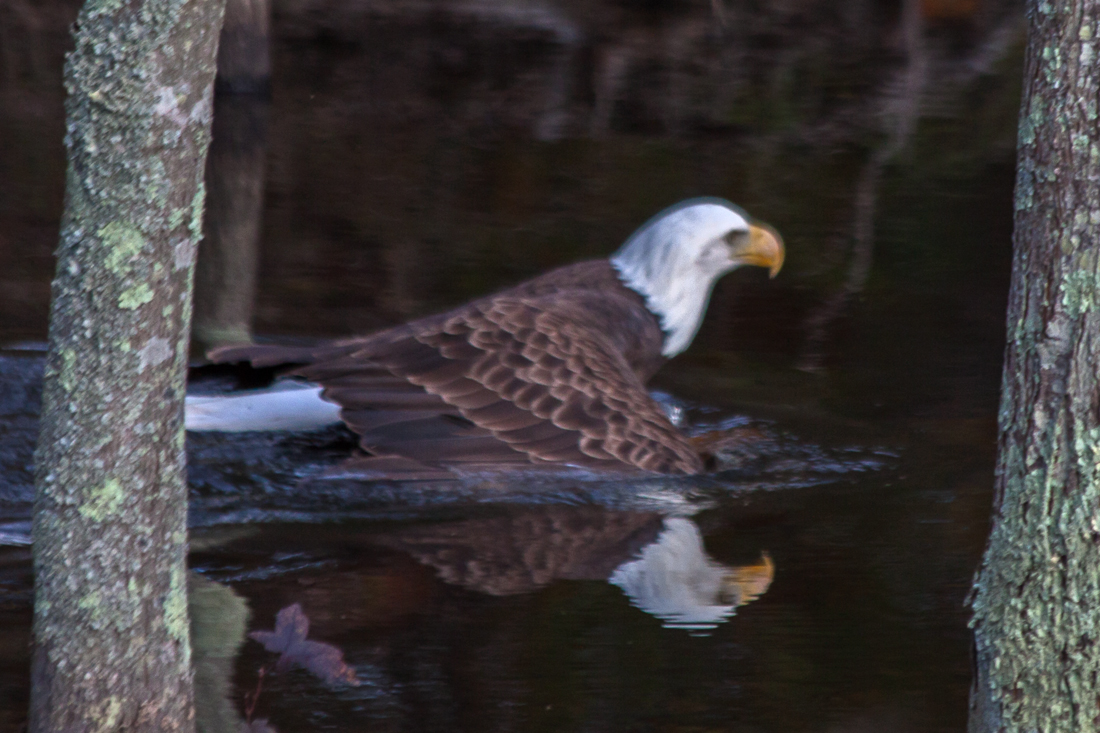
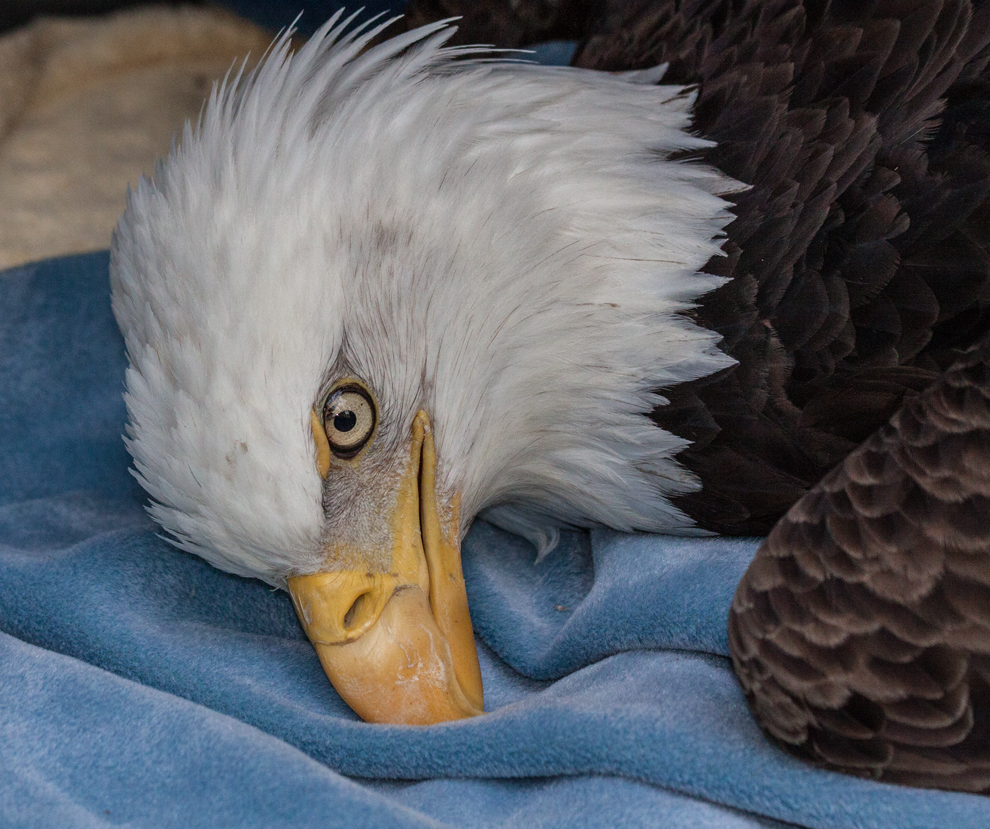
I took the first photo when the eagle was trying to swim away while being rescued. The image is not quite as sharp as the photos from yesterday, but I just love the reflection of the eagle in the water as it struggles to swim. This was in a wooded area of Huntley Meadows Park, my favorite venue for photography, that is now flooded as part of a wetland restoration project. The second photo shows the eagle as it was when I first came upon it, perched on a pile of brush, unable to fly away.

Bald Eagle

Bald Eagle

© Michael Q. Powell. All rights reserved.

Read Full Post »

Would you be willing to chase an injured adult Bald Eagle (Haliaeetus leucocephalus) with nothing more than a blanket in your hands? Yesterday, I was privileged to observe a very brave officer of the Fairfax County Animal Control Services capture an injured eagle at my local marshland park.

The eagle was perched on a brush pile in a flooded forest area of the marsh. From time to time it would hop to a new position, but did not seem able to fly away. Several parkgoers had alerted the park authorities of the situation and I came upon the situation shortly before the animal control officer arrived.

When the officer began to chase it, the eagle hopped away and then tried to swim away, stopping for a moment to look in my direction from behind a tree. Eventually, when an unidentified parkgoer helped to block a potential exit route for the eagle, the officer was able to capture the eagle.

As the officer was carrying the eagle, wrapped up in a blanket, to a small vehicle, I circled around on the path as fast as I could, hoping to get a closer look at the eagle. The officer was accommodating and briefly unwrapped the blanket and I got an amazing close-up look at this majestic bird. She was also willing to pose for me and I took a photo that I sent to her to help her remember her amazing actions.

I managed to get a final look at the eagle after it had been transferred to the animal control vehicle. The officer unwrapped the eagle so that the man who had assisted in the rescue could get a look at it. The eagle seemed to have settled down a bit and appeared to be resting comfortably. It was impossible to determine the cause and the extent of the eagle’s injuries, but the officer assured me that the county has excellent rehabilitation facilities for injured raptors. If I am able to get progress reports on the eagle’s recovery, I’ll be sure to keep you all informed.

Bald Eagle

Bald EagleBald Eagle rescueBald Eagle rescueBald Eagle rescue

© Michael Q. Powell. All rights reserved.

Read Full Post »

This morning I spotted a Bald Eagle (Haliaeetus leucocephalus) in a tree a my local marshland park, not far from where I had previously seen one. Once again, the eagle reacted more quickly than I did and took off before I was completely ready. This time, however, I was able to more quickly track the flying eagle and got a better shot than last time. I’m still not fully satisfied with the sharpness of this image, but I continue to believe that any day that I see an eagle is a great day.

Bald Eagle at Huntely Meadows Park

© Michael Q. Powell. All rights reserved.


Read Full Post »

Can you react faster than an eagle can? Yesterday, I was getting ready to step out of the brush that surrounds one of the ponds at my local marsh, when I spotted a large dark shape in a dead tree that overlooks the water. I suspected that it might be a Bald Eagle (Haliaeetus leucocephalus), since I had seen eagles perched on this tree a couple of times in the past.

As I stepped forward and was starting to bring my camera to my eye, a juvenile Bald Eagle took off. The eagle flew upwards so quickly that I had trouble finding it and keeping it in my viewfinder, as you can see in my first shot. I got a few more shots as I tracked the eagle’s flight, but in most of them, the eagle’s head is obscured by its outstretched wings. Just before the eagle flew behind the trees in the distance, I got a reasonably clear shot, the second image below.

What did I learn? If an eagle spots me at the same time that I spot him, his reaction times are going to be quicker than mine. Someone I’m going to have to figure out a way to be more stealthy and more ready the next time I find myself in a situation like this. That will be my challenge this autumn as I start to take more shots of birds as the insect population gradually decreases.

eagle1_blog_sepeagle2_blog_sep© Michael Q. Powell. All rights reserved.

Read Full Post »

Some subjects are so awe-inspiring that I get excited just seeing them, even if they are too far away for a good photo—like this Bald Eagle (Haliaeetus leucocephalus) that I saw Monday at my local marsh. The eagle seemed to sense my presence and took off before I could get closer, but I managed to capture an image of its final preparations for takeoff from the branch.

eagle_takeoff1_blogWhen I am walking through the woods at this time of the year, I have to keep my eyes in constant motion. Leaves are still sparse enough on the trees that I am still able to spot some birds in the trees.  However, insects are starting to appear too, so I have to scan the leaves and branches on the ground for these little creatures.

On early Monday morning, as I looked through a break in the trees, I caught sight of a large bird in the distance, sitting on the end of a branch. I immediately stopped, having learned from experience that even a single step forward would be likely to spook the bird. The light was not great, but the shape suggested to me that it was probably a bald eagle.

The eagle looked around for a few seconds and then took off. At that moment, I was absolutely certain that it was a bald eagle. I was not so certain that I had captured any useable images, but I was content just to have experienced the sight of that majestic bird in flight.

eagle_takeoff2_blog

© Michael Q. Powell. All rights reserved

Read Full Post »

Early yesterday morning, I was so focused on a Great Blue Heron that I spotted high in a tree that I didn’t even notice that there was a Bald Eagle in an adjacent tree until it took off almost right in front of me. Nearby, a female Belted Kingfisher loudly announced her presence with her unmistakable rattling call.

The sky was covered with heavy clouds and the forecast called for thunderstorms, which meant that lighting conditions were less than optimal for taking photos in a wooded area. Still, it felt great to be outdoors on the trails after a week of constrained activity thanks to our recent snowstorm.

I hadn’t seen a live Great Blue Heron (Ardea herodias) at my local marsh in quite some time, so I was excited when I caught sight of the heron, perched on broken-off tree at the edge of one of the marshy fields. The heron was almost a silhouette against the sky, but its shape is very easy to recognize when you see it in profile.

heron_early_blog

As I was creeping forward to get a clearer shot, I was startled when a large bird flew right across my field of view—I knew almost immediately that it was a Bald Eagle (Haliaeetus leucocephalus), although it too was mostly a shadowy silhouette as I viewed it through the branches of the trees. I was able to react quickly enough to get off a few shots before the eagle flew out of sight.

eagle_early_blog

A short distance away, a female Belted Kingfisher (Megaceryle alcyon) was perched on the trunk of a rotted tree, intently staring down at the shallow water of the marsh, looking for prey. That water prevented me from getting closer to her, but I did manage to capture her distinctive pose through the branches.

kingfisher_early_blog

I am an early bird by habit and it was great to be outdoors in the “wilds” of my suburban marsh to see what other early birds I could find.

© Michael Q. Powell. All rights reserved

Read Full Post »

My heartbeat accelerates every time I see a Bald Eagle (Haliaeetus leucocephalus), a combination of patriotism and awe at the power and beauty of this majestic bird.

Normally the eagles are soaring high in the sky, making it almost impossible for me to get a decent shot. Last Saturday, though, one of them seem to be hunting and circled around me a couple of times at a somewhat lower altitude, which allowed me to get some shots of the eagle in different flight positions.

I took these shots from the same spot at my marshland park where I recently saw an otter, a fox, and a raccoon. If only the park would let me pitch a tent in there.

eagle3_blog

© Michael Q. Powell. All rights reserved

Read Full Post »

On a day devoted in the United States to the brave men and women who are serving and have served in out armed forces, it seemed appropriate that I was able to get some shots of a Bald Eagle (Haliaeetus leucocephalus), our national bird.

For a short time early yesterday morning, this eagle circled over me at my local marsh park and then flew off to a distant tree, where its white head was still visible, but was out of range of my camera.

I’m still working on my techniques for photographing birds in flight and this eagle reminded me of the importance of light in trying to get a decent shot. As the bird circled and changed its wing positions, various parts of the body would come in an out of the light and in about half of my shots, the eagle’s head is in the shadows. When the eagle’s head was in the light, however, the brilliant white color often caused the details to blow out.

The final reminder of this experience is a familiar one for anyone who has attempted to photograph birds—I need a longer telephoto lens.

eagle3_11Nov_blogeagle2_11Nov_blogeagle_11Nov_blog

© Michael Q. Powell. All rights reserved.

Read Full Post »

Whenever I see large birds soaring in the sky, I will try to get photos of them. Often the birds turn out to be vultures, but this weekend I managed to get this shot of a Bald Eagle (Haliaeetus leucocephalus). Any day when I can get a shot of an eagle is a successful day of photography.

The bald eagle was far away and my zoom lens maxed out at 300mm, but the resulting image is still recognizable, especially if you  look at it in higher resolution. As I get more experienced with birds, I am starting to look at features like the position of the wings, which, in this case, immediately make this bird recognizable as a bald eagle. I am very much in awe of experienced birders who can identify a bird quickly and accurately from the shape of its bill, the markings on its wings, or even its call. I am pretty confident that I will never reach those levels of expertise.

There are lots of signs of the changing season—for me, it’s the switchover from a macro lens to a telephoto as the default lens on my camera when walking around in a natural environment and birds start to replace insects as my primary subjects.

eagle1_blog

© Michael Q. Powell. All rights reserved

Read Full Post »

Yesterday I was observing ducks, geese, and gulls in one of the ponds at my local marshland, when suddenly they all took to the air. It seemed to me that something had spooked them and I quickly scanned the ground area and the water and found nothing. When I turned my eyes to the sky, however, I discovered a relatively large bird flying  across my field of vision in the distance

The day was dark and gray and rain clouds covered the sky, so the lighting was not very good. The poor lighting and the fact that the bird was so far away made it tough for me to lock on the focus of the camera, so I was able to snap off only a couple of shots before the bird disappeared completely in the distance.

The flight of the bird did not look like that of the vultures that I have photographed, so I thought that perhaps I had photographed a hawk, though it was hard to know for sure from the image on the little LCD screen of my camera. When I viewed the images on my computer, I was thrilled to discover that I had finally photographed a Bald Eagle (Haliaeetus leucocephalus). Maybe it’s because of the symbolism attached with the bald eagle—all I know is that I felt really happy with my discovery.

These two images are not really that clear and I hope to get better ones in the future. In many ways, I am continuing what I recognize as a pattern in my shooting. The first time I capture a new subject, I am so excited that I will share the image, irrespective of its quality. The second time, the quality of the image normally increases dramatically.

eagle2_blogeagle1_blog

© Michael Q. Powell. All rights reserved

Read Full Post »

« Newer Posts