Feeds:
Posts
Comments

Posts Tagged ‘dragonfly in flight’

You know that summer is coming to a close when the dragonflies that were in constant flight earlier in the season seem to be resting more often, like this Black Saddlebags dragonfly (Tramea lacerata) that one of my fellow photographers, Walter Sanford, pointed out this past weekend at my local marsh. This dragonfly kept flying back and forth between two perches that were tantalizingly just out of the range of the 180mm lens that I had on my camera. I didn’t dare to take the time to change my lens, knowing that the dragonfly would almost certainly fly away at the most inopportune moment, so I ended up cropping a lot, especially in the first image.

The only shots that I could get of Saddlebags dragonflies earlier in the summer were in-flight shots and I have already posted some shots of a Black Saddlebags in the air. I realized, though, that I had not posted an image of its more colorful counterpart, the Carolina Saddlebags (Tramea carolina) that I photographed during a visit to Lewis Ginter Botanical Gardens in Richmond, Virginia. I took that shot (the third one below) from a pretty long distance, but was able to achieve focus and capture some of the wonderful details of this beautiful red dragonfly.

Black Saddlebags dragonflyBlack Saddlebags dragonfly

Carolina Saddlebags dragonfly

© Michael Q. Powell. All rights reserved.

Read Full Post »

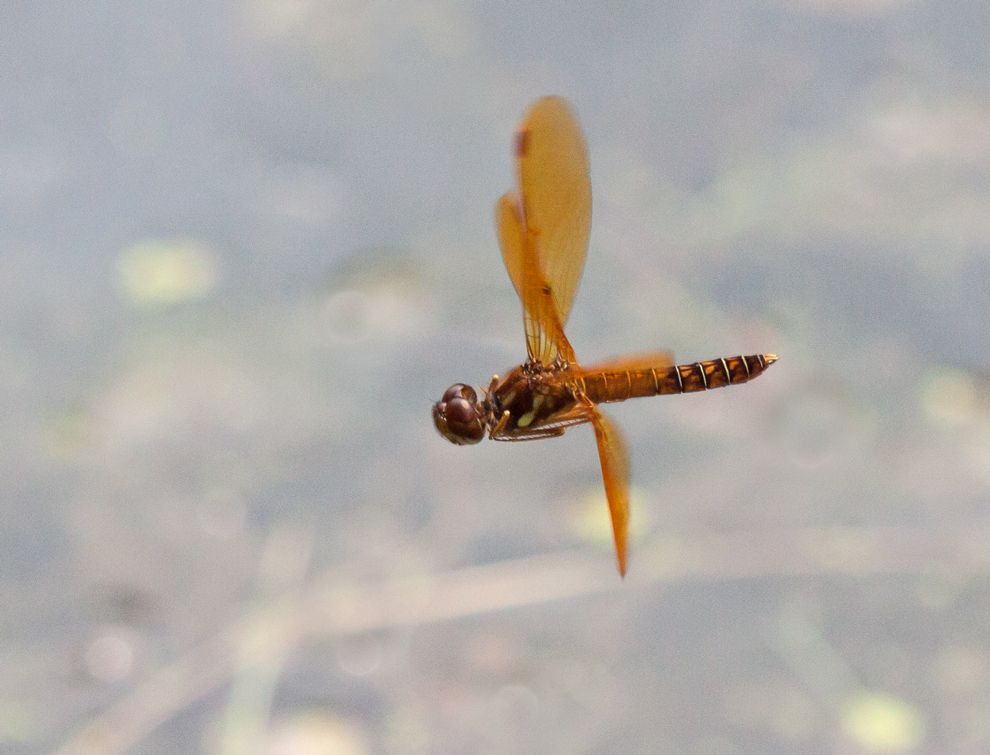
Photographing any dragonfly in flight is a real challenge, but this past weekend I spent time chasing after some of the smallest ones, the Eastern Amberwing dragonflies (Perithemis tenera). According to Bugguide, these dragonflies are typically 21-24mm in length, which is less than one inch, with a wingspan of maybe two inches or so.

amb2_fly_blog

There were lots of male Eastern Amberwings buzzing around the edges of a small pond at Green Spring Gardens, one of the local gardens that I like to visit. They were within range of the 180mm macro lens that I was using, but focusing and tracking were my biggest problems. The dragonflies did tend to hover a bit, which helped a little, but it was tough to get them in focus when focusing manually and almost impossible to do so with auto-focus.

I took a lot of shots and was happy that I managed to get some in decent focus, though I did have to crop the images. As I was preparing this posting, I noticed that I spent some time a year ago attempting to photograph the same dragonfly species. I think the results this year are marginally better, but you can make your own call by clicking on this link to the posting from July 2013.

amb4_fly_blogamb5_fly_blog amb3_fly_blog

amb1_fly_blog

© Michael Q. Powell. All rights reserved

Read Full Post »

Do you want to learn patience? If so, try photographing dragonflies in flight, those speedy little flyers that patrol the edge of a pond without ever seeming to need a rest.

Several readers commented that I must have lots of patience after they saw the photos of dragonflies and damselflies that I recently posted. Comparatively speaking, however, it is a whole lot easier to photograph these insects when they are perched on a stationary object than when they are in constant motion.

My fellow blogger and photographer, Walter Sanford, a true dragonfly stalker, emphasized to me recently that many of the early spring dragonflies are found only in limited locations for very short periods of time. (Check out his blog for lots of wonderful shots of dragonflies and other wildlife creatures.) I decided to return to Hidden Pond Nature Center, a county-run park in Springfield, Virginia that is only a few miles from where I live. Last year I spotted a few common dragonflies there, and it seemed to be a good place to broaden my search for spring dragonflies.

Sure enough, I caught sight of a few dragonflies, flying low over the surface of the small pond. They seemed to have fairly well defined patrol areas and tended to move about in large, lazy circles. I tried tracking several of them using my camera’s autofocus, but that proved to be impossible, so I switched to manual focusing, which was merely difficult.

I took a few breaks to get some shots of the more cooperative damselflies, but persisted in my quixotic efforts to capture the dragonflies in flight. Over the course of a couple of hours, I managed to fewer than a dozen images that are more or less in focus. I think that my subjects for this shoot might be Common Baskettail dragonflies (Epitheca cynosura), but I’m not very confident in that identification.

My adventures with dragonflies (and wildlife photography in general) continue teach important lessons about the value of patience and persistence.


flying5_blog

flying4_blogflying3_blogflying2_blogflying1_blog

© Michael Q. Powell. All rights reserved.


Read Full Post »

Spring is here and I am once again chasing dragonflies, on a quest to capture images of these beautiful insects. Common Green Darners (Anax junius) rarely seem to perch, so I was forced to try to photograph them in flight.

This early in the spring, there aren’t yet a lot of dragonflies, so my patience was tested as I waited for one to fly by. I tried a lot of different approaches and the one that worked best on this day was to focus manually, which is a bit of a challenge at 300mm when the subject is moving pretty fast.

I hope I’ll get some better shots later this season—this is my best one so far.

dragonfly_flight_blog

© Michael Q. Powell. All rights reserved

Read Full Post »

Yesterday at my local marsh, I noticed some large dragonflies flying over the cattails and realized that it was migrating season for Green Darner dragonflies (Anax junius). I don’t usually think of dragonflies as migratory creatures, but I recall from early spring that Green Darner dragonflies spend their winters in the south and migrate north in the spring (or at least their offspring fly north).

Green Darners are pretty big dragonflies, with bodies up to 3 inches (75mm), so I decided to try to photograph one in mid-flight. Another photographer and I spent almost an hour trying to track and photograph the dragonflies. Unlike other times, when I photographed dragonflies when they were hovering, I was attempting to capture these dragonflies as they were flying at a normal speed, which greatly complicated the task.

I knew that there was no way that I could isolate a flying dragonfly against the green plants of the marsh, so I concentrated on the dragonflies in areas in which I would have the sky as a backdrop. I used my 180mm macro lens and would try to follow a dragonfly in the viewfinder and track it, hoping it would fly close enough for me to attempt a shot. As I was tracking the dragonfly, I would focus manually. Needless to say, my success rate was really low, but I am happy that I managed to get the shot below of what I believe to be a female Green Darner. My fellow photographer, who was using a 70-200 telephoto zoom lens used a different approach and pre-focused on an area and took a shot when a dragonfly entered that capture zone.

It was a beautiful, sunny fall day and I enjoyed this challenge, which gave me a greater appreciation for the aerial skills of dragonflies—they are really tough to track. This practice, though, should help me later in the fall when I start to take more photographs of birds.

flying_dragonfly_blog

© Michael Q. Powell. All rights reserved.

Read Full Post »

As summer fades, I have been seeing fewer and fewer dragonflies, so I decided to attempt some in-flight shots and managed to capture these images of a female Great Blue Skimmer dragonfly (Libellula vibrans).

Photographing dragonflies in flight is one of my toughest photographic challenges, but I have learned a few tricks about capturing these kinds of shots. One way is to find a favorite perch of a dragonfly and try to photograph the dragonfly arriving and departing from that perch, given that dragonflies often return to the same perches. That was not the approach that I used this time.

The approach I used is to capture the dragonfly while it is hovering and is therefore in the same spot for a few seconds. I  watched as two blue skimmers mated quickly and I knew that I had a target of opportunity, because the female would soon deposit the eggs in the water. She hovered in the air and then dipped her tail end down to the water to deposit some eggs and returned to the hover position and repeated the process. It was during this process that I got these shots.

I am always struck by the beautiful blue eyes of the Great Blue Skimmer, particularly in the female. The male is all blue, so his eyes don’t provide the same visual contrast as the drabber colored body of the female.

The dwindling dragonfly population is yet another sign of the changing of the seasons—it won’t be long before I begin to focus my camera lens more frequently on birds than on insects, but I am not giving up on my insects quite yet.

skimmer_air2_blogskimmer_air_blog

© Michael Q. Powell. All rights reserved.
Read Full Post »

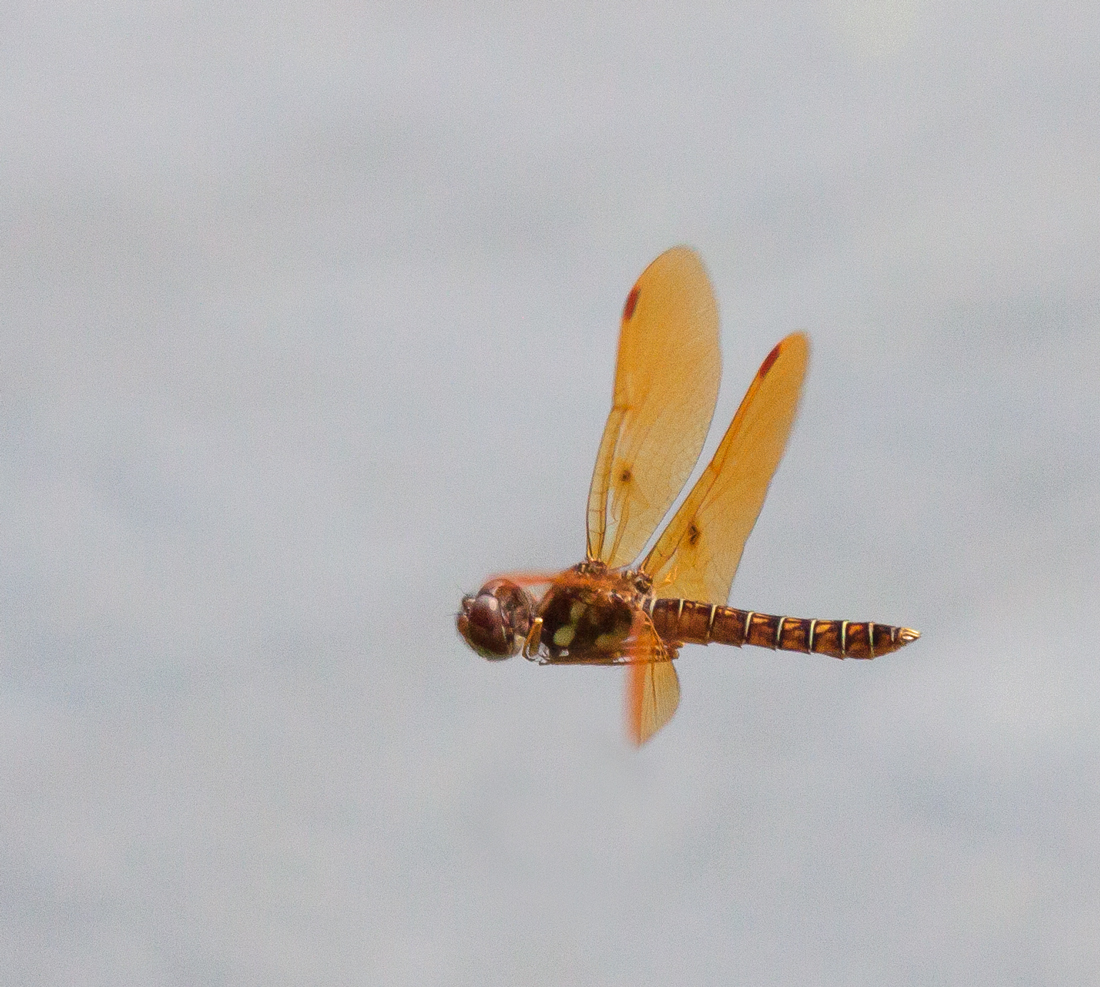
It’s tough enough to try to photograph any dragonfly in flight, but this past weekend I chased after some of the smallest ones, the Eastern Amberwing dragonflies (Perithemis tenera).

According to Bugguide, these dragonflies are typically 21-24mm in length, which is less than one inch. There were lots of Eastern Amberwings buzzing around the edges of a small pond at one of the local gardens that I like to visit. They were within range of the 100mm macro lens that I was using, but focusing was my big problem. Even though they tended to hover a bit, it was tough to get them in focus when focusing manually and impossible to do so with auto-focus.

The amber wings of this dragonfly are distinctive and I was happy to get some images that showcase the wings. The shots are not quite as sharp as they might have been if I had captured the dragonflies perched, but they seemed to be in constant motion and never posed for me. Focusing manually is still an adventure for me when the subject is moving, but it is a fun challenge.

amber1_blog

amber2_blog

© Michael Q. Powell. All rights reserved

Read Full Post »

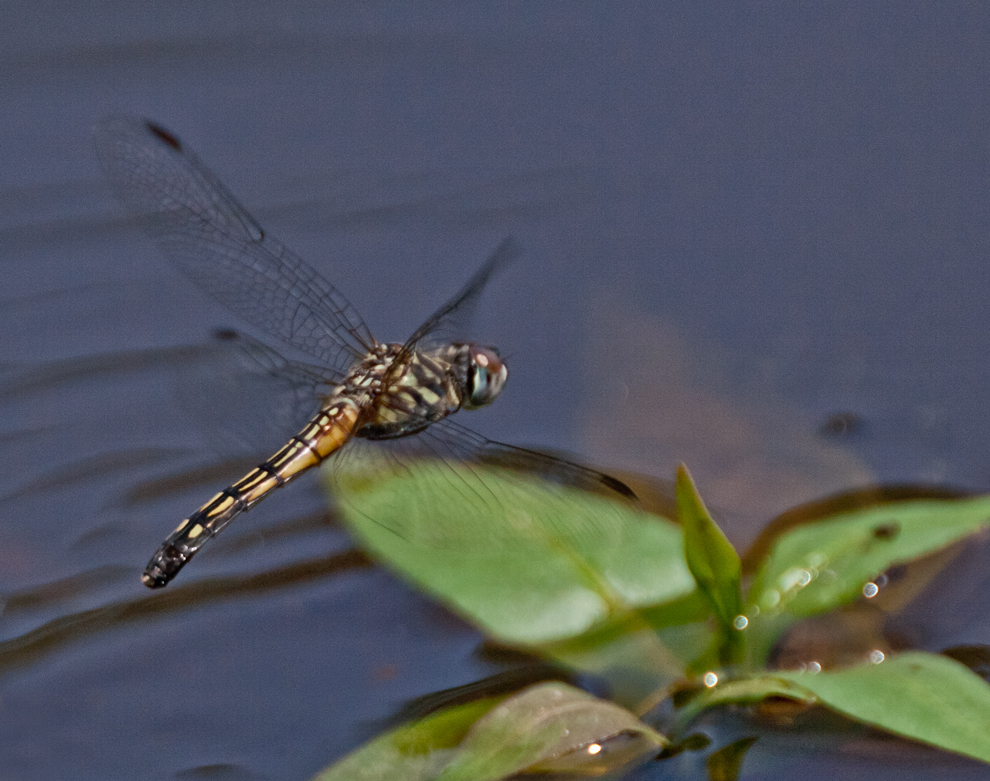
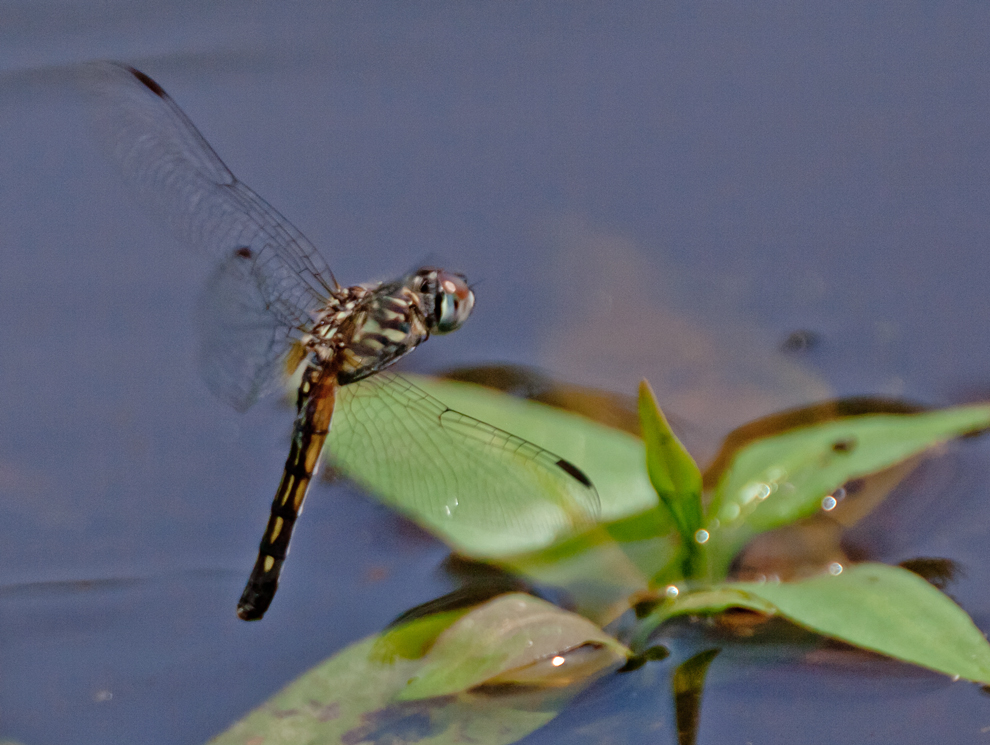
How can you photographing a dragonfly while it is flying? As we have moved into dragonfly season, I have been thinking a lot about that question and earlier this week, I had some success in getting images of a female Blue Dasher dragonfly that I believe was ovipositing.

female_dasher2_blog

Last year, I was content to photograph perched dragonflies (and still love to do so) and occasionally would capture one as it was leaving a perch. This year I am challenging myself and am actively seeking out opportunities to follow dragonflies with my lens and, if possible, to catch them in motion. They are so agile in flight, that the challenge is somewhat daunting. I have experimented with auto focusing and manual focusing. I have tried pre-focusing on an area and waiting and hoping a dragonfly would fly into it. I have had my best luck so far when I can catch the dragonfly as it is hovering.

This female Blue Dasher dragonfly (Pachydiplax longipennis) approached this little clump of vegetation several times and would begin to hover. Then she would bend her tail forward and move it rapidly back-and-forth for a few seconds, which I think meant that she was laying eggs.

female_dasher1_blog

I am definitely not an expert on dragonfly behavior and may be totally wrong about what she was doing. However, from a purely photographic point of view, this offered my best chance of getting some shots of this dragonfly in flight. As I recall, I got my best shots when focusing manually and snapping as many shots as I could when it looked like things were coming into focus.

female_dasher3_blog

The Blue Dasher female (and you’ve probably noticed that the females of this species are not blue, despite their name) flew away and returned several times, but eventually was done with her business. I am continuing to observe the different species of dragonflies and hope to identify the types of behavior they exhibit that will maximize the chance of me getting some more shots like these ones.

Michael Q. Powell. All rights reserved

Read Full Post »

« Newer Posts