Feeds:
Posts
Comments

Posts Tagged ‘dragonflies in flight’

A small group of Common Green Darner dragonflies (Anax junius) was active on Monday at Occoquan Regional Park, including a couple that, after mating, was depositing eggs in the floating vegetation. The male (the one with the blue abdomen) holds onto the female while she does the actual work and then they fly off together still attached in the “tandem” position to another patch of vegetation.

Common Green Darners are a migratory species and I suspect that these particular dragonflies were part of that migration. Most people are aware of the migratory pattern of Monarch butterflies, but are unaware of the fact that Common Green Darners follow a similar pattern. The Science News website provides a good overview of that migration.

“At least three generations make up the annual migration of common green darner dragonflies. The first generation emerges in the southern United States, Mexico and the Caribbean starting around February and flies north. There, those insects lay eggs and die, giving rise to a second generation that migrates south until late October. (Some in that second generation don’t fly south until the next year, after overwintering as nymphs.) A third generation, hatched in the south, overwinters there before laying eggs that will start the entire process over again.”

I was quite fortunate that the patches of vegetation where the dragonflies were depositing the eggs were relatively close to the edge of the pond, so I was able to capture the shots of the dragonflies in action. The second shot was one that I snapped as the couple zoomed by—long-time readers of my blog know that I love to try to capture images of dragonflies while they are flying.

The final image shows one a male Common Green Darner that was flying all around the small pond, searching for food or a mate (or maybe both). It is a fun challenge to try to track and photograph a dragonfly in flight and I felt a little rusty after spending the winter photographing birds. I was therefore quite thrilled when this shot turned out so well. Some newer mirrorless cameras have tracking systems that lock focus on moving subjects, but my trusty Canon 7D DSLR has 2009 technology, so it is a little trickier for me to get shots in—it is definitely a “hands-on” process.

Common Green Darner

Common Green Darner

Common Green Darner

Common Green Darner

© Michael Q. Powell. All rights reserved.

Read Full Post »

Dragonflies were flying overhead at several locations at Occoquan Bay National Wildlife Refuge on Thursday, including a Common Green Darner (Anax junius), multiple Black Saddlebags (Tramea lacerata), and at least one Wandering Glider (Pantala flavescens). The Wandering Glider, alas, was elusive and I could not get an in-flight shot of it, but I did manage to get a shot of a Common Green Darner (1st photo) and a Black Saddlebags (2nd photo).

All three of these dragonfly species are migratory species. Migrating dragonflies will often fly in mixed swarms that are large enough that they are sometimes picked up by weather radars. For more details about this phenomenon, check out this September 2019 article in the Washington Post entitled “Weather radar is picking up swarms of dragonflies from the Midwest to the Mid-Atlantic.”

Common Green Darner

Black Saddlebags

© Michael Q. Powell. All rights reserved.

Read Full Post »

On Monday I spent several hours at Jackson Miles Abbott Wetland Refuge, focusing my attention primarily on trying to capture shots of Prince Baskettail dragonflies (Epitheca cynosura) in flight. There appeared to be several of them patrolling over the waters of the small pond and I managed to find some good vantage points that gave me unobstructed views of them as they passed by.

One of the locations where I spotted a Prince Baskettail included some lily pads and I decided to try to include them in the shots to give a sense of the environment. The downside of this approach, though, was that it made it even harder to keep my camera’s focus on the dragonfly—the camera kept trying to focus on the background. I was persistent, however, and managed to get a few good shots, as you can see in the first three images below.

I took the final image at a different spot where there were no lily pads. This shot is undoubtedly the sharpest one of today’s photos. Although you can’t see much of the environment in the image, the ripples in the water do add some visual interest.

I couldn’t help but notice that the dragonfly in the final photo had its legs in a lower position than normally—generally a Prince Baskettail flies with its legs held tightly against its thorax to present the most aerodynamic profile. I know that some dragonfly species catch prey on the fly with their legs extended like a basket and wonder if that was what this dragonfly was attempting to do.

Prince Baskettail

Prince Baskettail

Prince Baskettail

Prince Baskettail

© Michael Q. Powell. All rights reserved.


Read Full Post »

Yesterday I visited Jackson Miles Abbott Wetland Refuge and spent a lot of my time there trying to get shots of dragonflies in flight. The dragonflies were not very cooperative and kept their distance most of the time, but eventually I managed to get a few decent shots. What was especially cool was that I captured images of dragonflies from three different families—Skimmer, Darner, and Emerald.

The first photo shows a Banded Pennant (Celithemis fasciata), a Skimmer, as he was flying toward me. Banded Pennants are pretty small at about 1.3 inches (33 mm) in length, so I was pretty thrilled to capture this shot as he was flying toward me. This was actually the first time that I had seen a Banded Skimmer this season.

The second photo shows a Cyrano Darner (Nasiaeschna pentacantha). Despite the fact that I took the shot from a long distance away, you can still see the prominent “nose” that is supposedly reminiscent of the long nose of literary character Cyrano de Bergerac.

The last two photos show Prince Baskettails (Epitheca cynosura) that are members of the Emerald family. Prince Baskettails, which are about 2.9 inches (74 mm) are quite easy to identify, because they are the only large dragonfly in our area with patterned wings. I had more opportunities with this species that with the others, because several Prince Baskettails were flying repetitive patrols only various parts of the pond and passed by me multiple times. Although it is a little easier to focus on a dragonfly in flight when the background is clear, I think it is even cooler when I manage to include reflections in the water in a photo, as was the case with the reflections of the branches in the final photo.

Banded Pennant

Cyrano Darner

Prince Baskettail

Prince Baskettail

© Michael Q. Powell. All rights reserved.


Read Full Post »

On Monday I was thrilled to spot this Prince Baskettail dragonfly (Epitheca cynosura) flying patrols over the small pond at Jackson Miles Abbott Wetland Refuge. Previously I had spotted Common Baskettails doing the same thing at this location—see my recent posting Common Baskettails in flight—but they seem to have been supplanted by the Prince Baskettails. How do you tell them apart? Although they are both part of the Emerald family, only Prince Baskettails have patterned wings, as you can see in these photos.

I really like the description of this species on the Dragonflies of Northern Virginia website:

“This sleek, elegant dragonfly could in fact be called King Baskettail, as it is the largest member of the Emerald family. There are seven families of dragonflies in the US–Emeralds are known for their glowing green eyes (hence the family name), and their endless, acrobatic flight. Like other members of this family, Prince Baskettails rarely land and can spend many hours in ceaseless flight. Look for this powerful flier making long, repeated, low patrols over open water habitats such as lakes, ponds, canals, and sluggish river sections.”

As a result of the repeated patrols, I was able to track the dragonfly as it flew by me and capture these images. The dragonfly did not get really close to the bank on which I was standing, so my autofocus would not detect my subject and I had to resort to focusing manually. I am pretty happy with the results and I encourage you to click on the images to see the beautiful markings on the body of this Prince Baskettail dragonfly.

Prince Baskettail

Prince Baskettail

Prince Baskettail

© Michael Q. Powell. All rights reserved.

Read Full Post »

On Wednesday I spotted a small group of a half-dozen of so Common Green Darner dragonflies (Anax junius) patrolling over a large field at Occoquan Bay National Wildlife Refuge. Common Green Darners are one of few species of dragonflies that migrate. Perhaps the ones that I saw are preparing to migrate from the local area or are just stopping off on their journey southward.

It is a fun challenge to point your camera toward the sky and to try and capture photos of these colorful dragonflies as they zoom overhead. The first image is the sharpest image that I was able to capture and it provides a good look at the dragonfly. In many ways, though, I am even happier with the second and third image that include some vegetation and help to provide some context to the shots.

The migration cycle of the Common Green Darner involves three generations. I highly recommend a research article entitled “Tracking dragons: stable isotopes reveal the annual cycle of a long-distance migratory insect” that was published in 2018 in the journal Biology Letters that explains the migration cycle and has some fascinating maps and diagrams. Despite the geeky-sounding title, it is actually quite easy to read and understand.

Here is an extract from the abstract for the article, in case you do not want to read the entire article:

“Using stable-hydrogen isotope analysis of 852 wing samples from eight countries spanning 140 years, combined with 21 years of citizen science data, we determined the full annual cycle of a large migratory dragonfly, the common green darner (Anax junius). We demonstrate that darners undertake complex long-distance annual migrations governed largely by temperature that involve at least three generations. In spring, the first generation makes a long-distance northbound movement (further than 650 km) from southern to northern range limits, lays eggs and dies. A second generation emerges and returns south (further than 680 km), where they lay eggs and die. Finally, a third resident generation emerges, reproducing locally and giving rise to the cohort that migrates north the following spring. Since migration timing and nymph development are highly dependent on temperature, continued climate change could lead to fundamental changes in the biology for this and similar migratory insects.”

Wow!

Common Green Darner

Common Green Darner

Common Green Darner

© Michael Q. Powell. All rights reserved.

Read Full Post »

I have been playing around with video again and made a little YouTube video about some of my challenges in trying to photograph dragonflies in flight. I tried to combine some video footage captured when I was out in the field (the second shot below is a still extracted from the video) with some of my still images that you may have already seen in past blog postings. I did a voiceover with the still photos that provides some information about my camera settings and techniques as well as commentary about the location where I was shooting. The first image is the thumbnail for the video, which I included to give you an indication in the Reader about the content.

I embedded the video link at the end of this posting that you can click directly if you are viewing directly from my blog. After I posted a video this way in the past, I learned that those folks who receive the blog in their e-mail are not able to see the embedded video. If that is the case for you, here is a link that you can click that will take you to the YouTube video. The video is about eight minutes long, but I think you will find it enjoyable and informative.

I shared the video directly with one of my subscribers, Jet Eliot, who commented, “I absolutely loved your video, Mike. Your enthusiasm and expertise for dragonflies comes through beautifully. I like how upbeat you are about photographing dragonflies, and encouraging. Your voice is rich, vocabulary lovely, and diction is smooth. A complete joy to watch–I’m still smiling.” Be sure to check out her wonderful blog Jet Eliot–Travel and Wildlife Adventures for her weekly essays, photos, and anecdotes on lively, interesting places and creatures that she has befriended all over the world.

YouTube_thumbnail

In the Field

© Michael Q. Powell. All rights reserved.

Read Full Post »

I never realized how much the face of a Russet-tipped Clubtail dragonfly (Stylurus plagiatus) looks like the face of a human—the one in the first photo appears to have a nose, a chin, and even lips. The dragonfly was flying over the pond at Jackson Miles Abbott Wetland Refuge this past Wednesday and I watched it land in the goldenrod at the edge of the water, where I was able to capture the image.

When the Russet-tipped Clubtail was flying, it stayed in the center of the pond and did not come near to the shore, which made it tough for me to capture an in-flight shot. I was thrilled when I managed to capture a long distance shot of the dragonfly and its cool, distorted reflection in the water, as you can see in the second photo below.

As I was walking around the small pond, I inadvertently flushed another Russet-tipped Clubtail and it flew into a tree. I could see where it was perched, but the lighting was tricky, because I was shooting almost directly into the sun. I liked the interplay of the light and shadows on the leaves of the tree and the way that sunlight illuminated the “tail” (which is technically the abdomen) of the dragonfly, which made for a nice environmental portrait.

Generally I consider myself lucky if I have a single encounter with a dragonfly like this, so it felt amazing to have multiple encounters with the Russet-tipped Clubtails and multiple chances to capture some beautiful images.

Russet-tipped Clubtail

Russet-tipped Clubtail

Russet-tipped Clubtail

© Michael Q. Powell. All rights reserved.

Read Full Post »

I was a little surprised on Wednesday to see a Prince Baskettail dragonfly (Epitheca princeps) flying over the pond at Jackson Miles Abbott Wetland Refuge—I thought they were all gone by now. There were not too many other dragonflies around, so I concentrated on trying to capture in-flight shots of this elusive dragonfly that I never saw perch.

Photographing dragonflies while they are flying is a huge challenge for both my skill and my patience. I had a general idea of the area in which this dragonfly was flying as he flew repeatedly over a patch of lily pads. However, his specific flight path varied a lot and he often changed directions without warning.

Most of my photos were blurry or did not contain my subject, but I eventually managed to get a few decent shots of the Prince Baskettail. The first one is the sharpest, but it does not give you much of a sense of the environment in which the dragonfly was flying. The second shot has a bit of blur, but I really like the background pattern of the water of the pond. The dragonfly was flying away from me when I took the final photo, but I like the way that the image shows the pond vegetation and the tiny perched Eastern Amberwing dragonfly in the foreground was a nice bonus.

Prince Baskettail

Prince Baskettail

Prince Baskettail

© Michael Q. Powell. All rights reserved.


Read Full Post »

I was hoping on Tuesday that this male Common Green Darner dragonfly (Anax junius) at Occoquan Bay National Wildlife Refuge would land, but his stamina was impressive and I had to content myself with a couple of shots as he zoomed by overhead.

I missed focus on most of my shot attempts, but the first shot below turned out pretty well—I encourage you to click on the image to see some of the beautiful colors and details of this dragonfly.

Tracking the dragonfly visually and keeping it in the viewfinder is a real challenge. I was intrigued to see that my camera more or less held onto focus in the second shot, despite the fact that the dragonfly had flown closer to the foliage.

Common Green Darner

Common Green Darner

© Michael Q. Powell. All rights reserved.

Read Full Post »

Eastern Amberwings (Perithemis tenera) are very small dragonflies, with an overall length of no more than one inch (25 mm). Males of this species are easy to identify because of their amber-colored wings. Males are quite common and I ofter see them buzzing around the edges of the ponds that I visit. Females have brown patches on their clearer wings and often hunt far from the water, so I do not see them very often.

Despite their small size, Eastern Amberwings are one of the easiest dragonflies to photograph in flight. They often hover low, close to the water surface near the shore, which gives me a fighting chance to focus on them. It requires a steady hand and quick reactions, but the first two images show the kind of results you can get. The second shot is a little quirky, but I like the way that it shows two male Amberwings passing each other, flying in opposite directions.

The final shot is an “artsy” shot of a perched Amberwing. The dragonfly was flying among the lotus flowers last Wednesday at Green Spring Gardens and perched for a moment on a lotus leaf that had not yet unfurled. I tried to compose the image so that the viewer gets a sense of the habitat, which gives the shot a completely different feel from the first two photos in which the subjects are completely separated from their environment.

Eastern Amberwing

Eastern Amberwing

Eastern Amberwing

© Michael Q. Powell. All rights reserved.

Read Full Post »

It is fairly uncommon for me to see a Cyrano Darner dragonfly (Nasiaeschna pentacantha), so when I do, I try my best to get a shot of it. The problem, though, is that they always seem to be patrolling over the water far from the shore and rarely seem to perch.

Last Wednesday I spotted this Cyrano Darner flying around a heavily vegetated area, which made it even tougher to focus on the dragonfly. I was thrilled to be able to get a recognizable shot of the dragonfly, though the background is so cluttered that you may have to look hard to see it in the first image. The second image is a little less sharp, but gives you a clearer view of the dragonfly.

In case you are curious, the species is named for its long, protruding, greenish forehead that is somewhat reminiscent of the long nose of literary character Cyrano de Bergerac. This is the only species that I have encountered where the “nose” helps me to identify it—most of the time I focus on other parts of a dragonfly’s anatomy.

Cyrano Darner

Cyrano Darner

© Michael Q. Powell. All rights reserved.


Read Full Post »

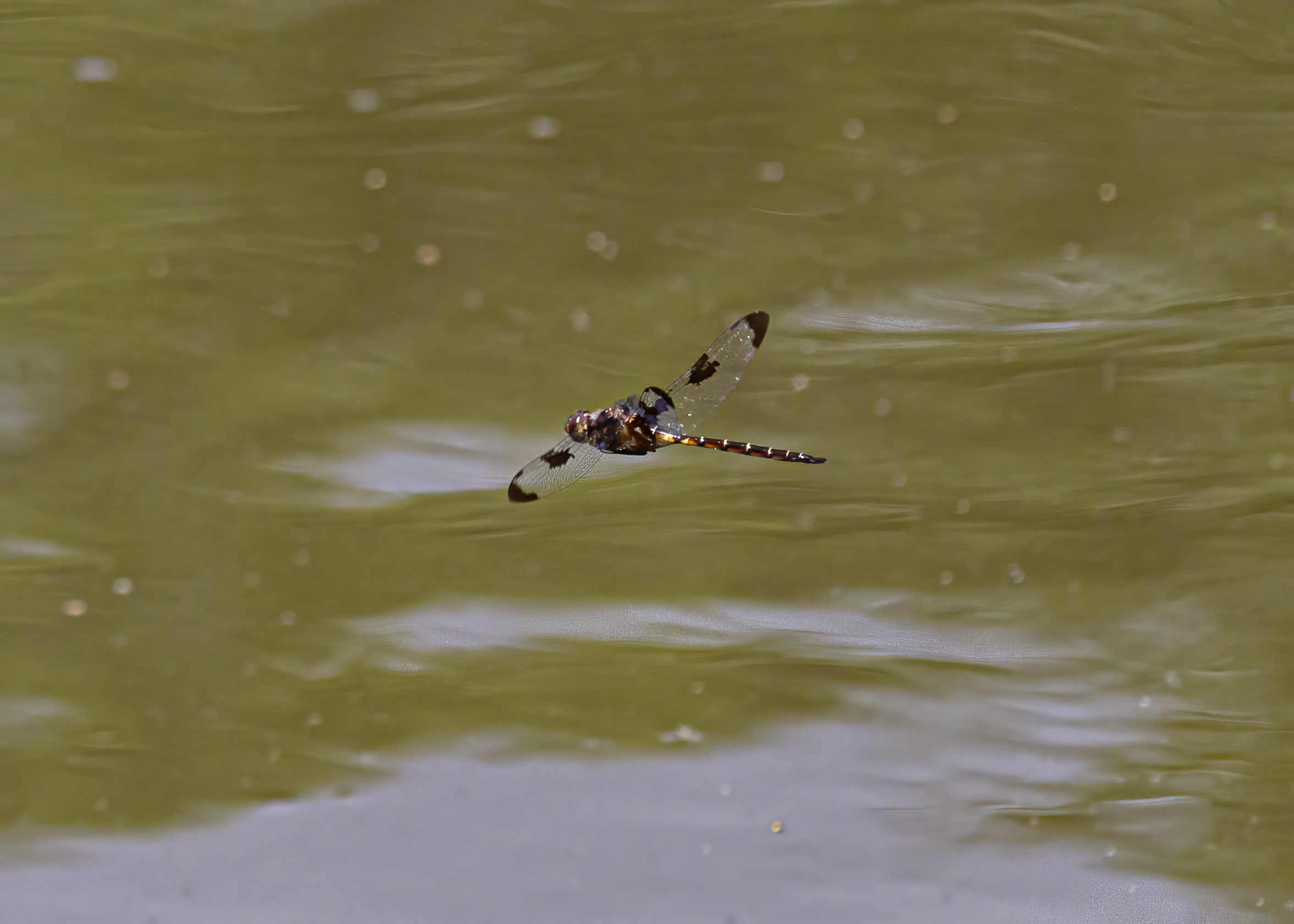
It was hard to miss the bright red body and distinctive brown patches on the wings of this Carolina Saddlebags dragonfly (Tramea carolina) on Friday at Jackson Miles Abbott Wetland Refuge. Unlike many of the dragonflies that I try to photograph in flight, the Carolina Saddlebags did not follow any predictable patrolling pattern. Sometimes it would fly in the air above my head; sometimes it would zoom down and fly low over the water; and sometimes it would fly at about waist level near one of the fishing platforms at the edge of the pond.

Carolina Saddlebags are strong fliers—they are one of the dragonfly species that migrate—and I rarely see one perch, so I had lots of chances to attempt to get shots. Carolina Saddlebags are only about 2 inches (50 mm) in length, which makes it a bit of a challenge to keep one in the viewfinder as I track it through the air.

I was not able to capture any close-up shots of the flying dragonfly, but I am particularly happy with the blurred backgrounds in this images that serve as a nice contrast to the dragonfly. The dragonfly itself is sufficiently in focus that you can see the patches on the wings and other wonderful details, such as the way the dragonfly folds up its legs while flying.

As I have noted before, it is a fun challenge to try to capture images of a dragonfly in flight, a good test of both my skills and my patience.

Carolina Saddlebags

Carolina Saddlebags

Carolina Saddlebags

© Michael Q. Powell. All rights reserved.
 

Read Full Post »

Male dragonflies are often territorial and spend a lot of their time chasing off intruders, like these rival male Eastern Amberwing dragonflies (Perithemis tenera) that I spotted earlier this month at Jackson Miles Abbott Wetland Refuge. Although Eastern Amberwing dragonflies are quite small (one inch (25 mm) or less in length), they tend to hover a bit when they are flying, which makes them a little easier to photograph in flight than most other dragonfly species.

Eastern Amberwing

© Michael Q. Powell. All rights reserved.

Read Full Post »

Normally when I think of saddlebags, I think of cowboys and the Pony Express, but there is also a species of skimmer dragonflies known as Black Saddlebags (Tramea lacerata). Someone obviously thought the dark patches on the hind wings looked like saddlebags.

Unlike many of the dragonflies that I often observe, Black Saddlebag dragonflies like to fly high in the air (and not low over the water) and some of them even migrate. I was alerted to their presence at my local marsh by a recent posting by a local dragonfly expert and fellow photographer Walter Sanford, so yesterday I kept one eye to the sky yesterday as I searched for subjects to photograph.

Black Saddlebags flew over me several times and I was fortunate to get some shots of one of them in flight. It might have been nice to have used a longer lens than the 100mm macro lens that I had on my camera at the time, but the shots turned out pretty well nonetheless. The first image is the sharpest image, but I like the entire sequence of the three images and the way in which they convey a sense of the environment in which I was shooting.

saddlebags1_blog The fi

saddlebags2_blogsaddlebags3_blog

© Michael Q. Powell. All rights reserved

Read Full Post »