Feeds:
Posts
Comments

Posts Tagged ‘Double-crested Cormorant’

Double-crested Cormorants (Phalacrocorax auritus) are strange-looking waterbirds that sit really low in the water. I’ve seen them from time to time, but until yesterday, when I saw this one at a small suburban retention pond, I never knew that they have striking blue eyes.

One of the other unusual things about this bird is that they spend a good amount of time outside of the water drying out their wings. Despite being a diving bird, the cormorant’s feathers do not shed water as well as a duck’s, for example, and they can get soaked pretty quickly.

I took some photos of the cormorant drying its wings that I will post later, but I wanted to post the image of the cormorant resting on one leg, because it shows off the blue eyes (and I like the reflection).

Double-crested Cormorant

Double-crested Cormorant

© Michael Q. Powell. All rights reserved.

Read Full Post »

As I slowly made my way through the tall grass on the lake shore, my eyes were focused on the low-hanging branches where I had seen a Belted Kingfisher earlier in the day. Suddenly the water exploded at my feet.

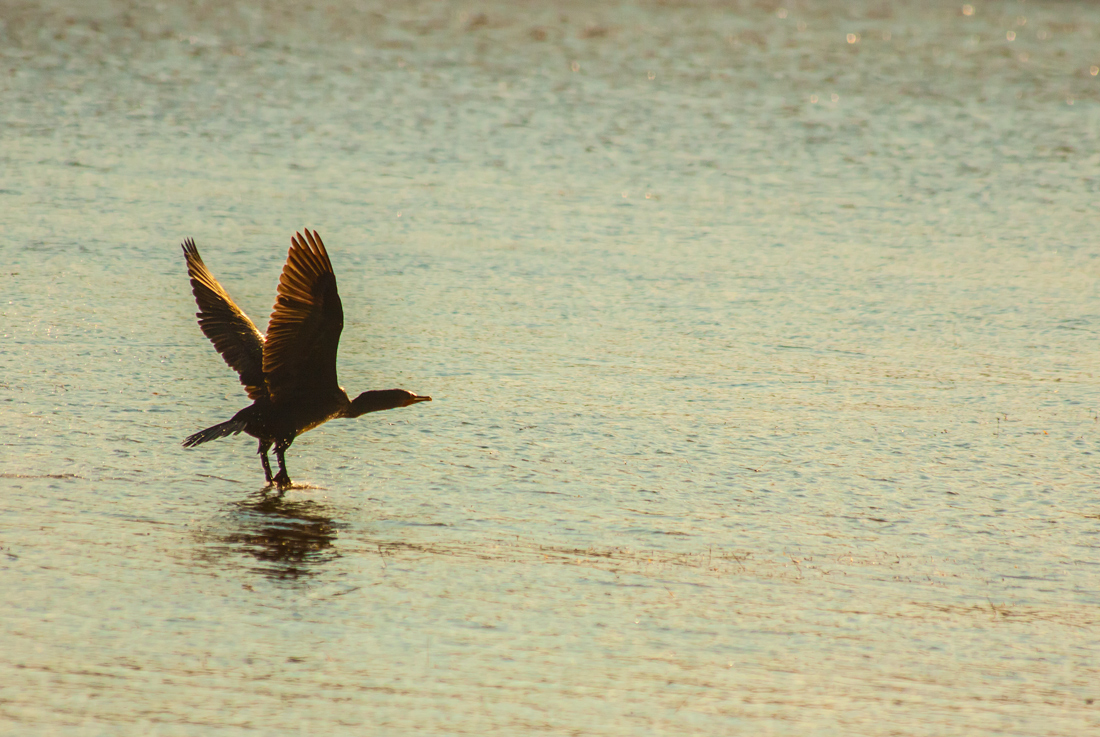
I was startled and so was the Double-crested Cormorant (Phalacrocorax auritus) that scrambled into action and started moving across the surface of the water. The cormorant had apparently been resting or feeding at the water’s edge and had not heard me approach. It was interesting to see the cormorant move—it rose up a bit and seemed to walk across the water and then settled back into the water once it was a good distance away from me.

The action happened so quickly and in an unexpected location that I initially had trouble framing my shots. This is my favorite of the ones in which I managed to get the entire cormorant in the frame. I especially like the details that you can see on the wings. As I was working on the image, it was interesting to note that there are almost no colors in the shot, except for the bird’s bill. When I adjusted the hue and saturation, for example, almost nothing changed.

Double-crested Cormorant

© Michael Q. Powell. All rights reserved.
Read Full Post »

Two weeks ago I didn’t even realize that we had Double-crested Cormorants (Phalacrocorax auritus) in this area and now I can find quite a number of them on the Potomac River. It’s a little difficult to tell from the range maps in my bird guide if the cormorants are migrating through this area of if they may choose to winter here.

The more I observe these birds, the stranger they appear. The Cornell Lab of Ornithology described them this way—”The gangly Double-crested Cormorant is a prehistoric-looking, matte-black fishing bird with yellow-orange facial skin. Though they look like a combination of a goose and a loon, they are relatives of frigatebirds and boobies and are a common sight around fresh and salt water across North America.”

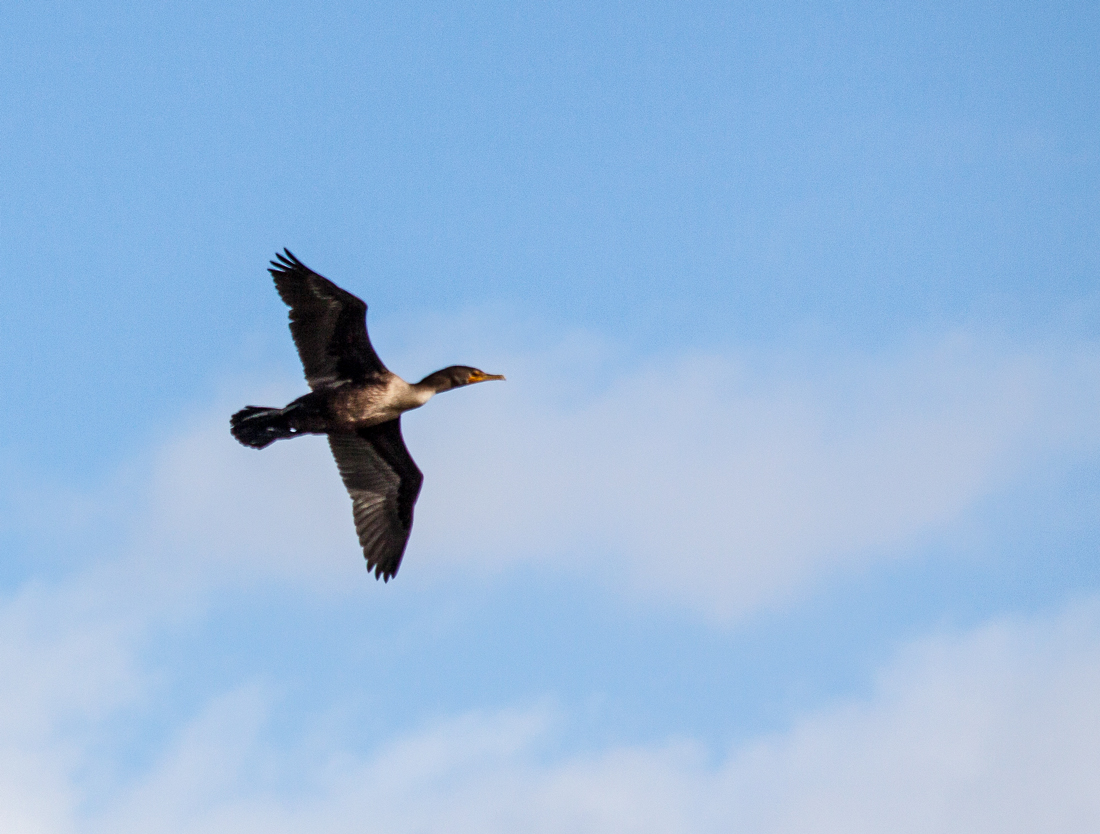
I am still working on getting some shots of the cormorants in the water, but as a start, here are a couple of images of a cormorant in the air. I took the first one before I knew that it was a cormorant—I have a habit of trying to capture anything in flight that is remotely in range. The second one shows a cormorant as he is taking off from the water after some bounding steps across the surface as he gained speed. The location of the light caused much of the cormorant’s body to be in the shadows, but did illuminate the details of some of its feathers.

cormorant_flying1_blogcormorant_liftoff_blog

© Michael Q. Powell. All rights reserved.
Read Full Post »

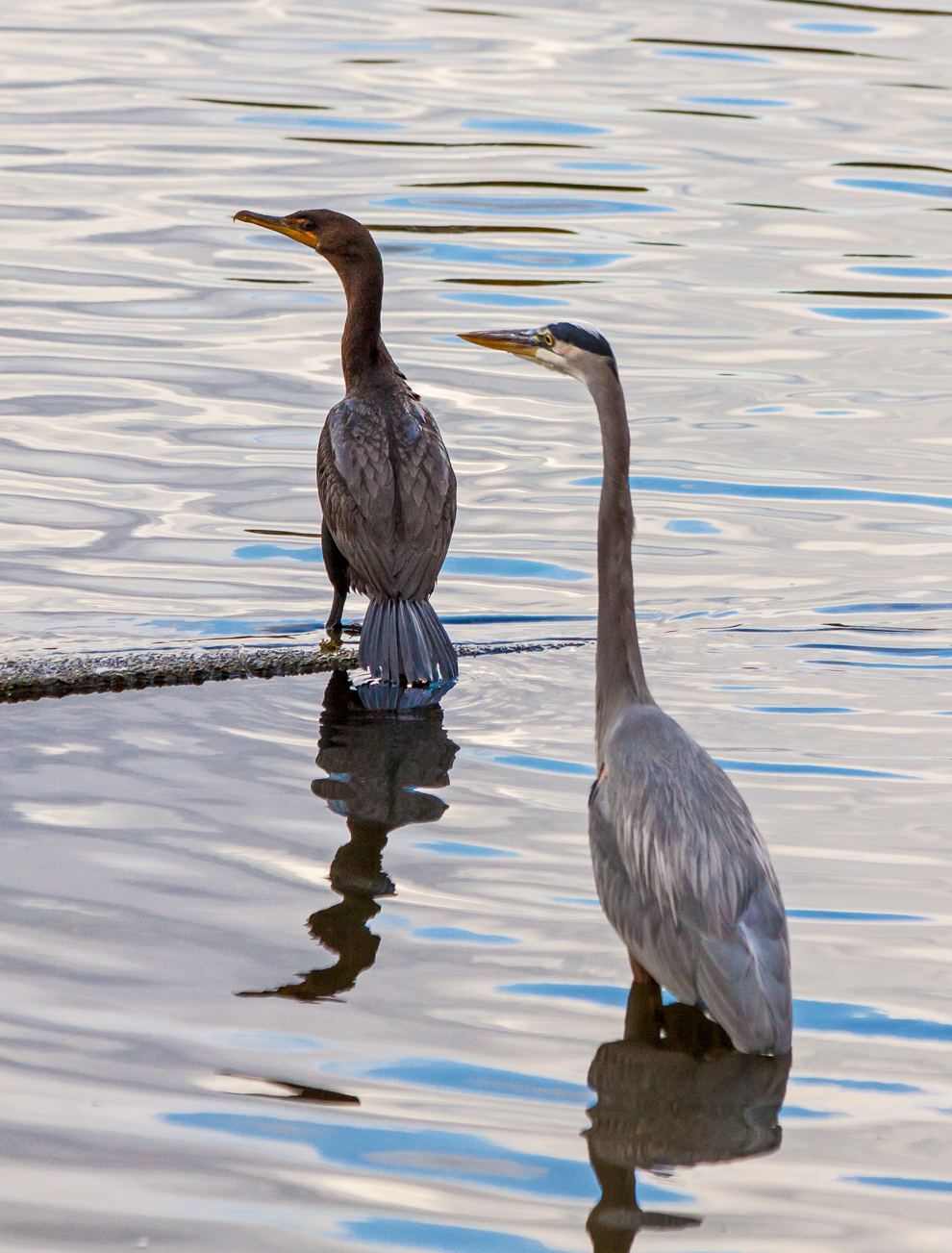
Who knew that the man-made pond in a nearby suburban neighborhood would be a favorite spot for juvenile birds to hang out together?  That’s what it looked like when I spotted an immature Double-crested Cormorant (Phalacrocorax auritus) and an immature Great Blue Heron (Ardea herodias) together, both with their heads turned in profile, probably checking out some cute little female goose.

Actually, I couldn’t immediately identify the cormorant, though it was obvious that it was neither a duck or a goose. The way that it swam with its long neck extended and its bill pointed in the air, however, was distinctive enough to make it easy to find in my identification guide.

I like the way that these two birds posed for me, with the cormorant perched on a narrow concrete slab to compensate for the heron’s greater height and the synchronized head positions. I have seen this young heron hanging around the pond before (it’s the same heron that I featured in the Crouching heron posting this morning), but I don’t think that I have seen a cormorant there before. Usually there are only geese and occasionally some ducks, like the small flock of Ring-necked ducks that are there right now.

cormorant_heron_blog

© Michael Q. Powell. All rights reserved.
Read Full Post »

« Newer Posts