Feeds:
Posts
Comments

Posts Tagged ‘daddy longlegs’

Most flowers have blooms at the end of their stems or at least in places above their leaves. Each spring, however, I encounter Mayapples (Podophyllum peltatum), a strange plant that seems to work in a totally different way. Mayapple plants grow in colonies from a single root and stems put out large umbrella-shaped leaves, with usually only a single large leaf per stem. These stems do not produce any flower or fruit.

A few stems, though, produce a pair or more leaves and a single white blossom appears at the juncture point where the stem branches off. If you don’t know that the blooms are there, it is easy to miss them, because the large leaves hide them from view.

Last week during a trip to Accotink Bay Wildlife Refuge I checked out several large patches of Mayapples that I had seen in previous years. I think I might have been a little late in the season, but eventually I found a Mayapple plant with a flower that was clearly past its prime. As you can see in the first photo, a harvestman, known colloquially as a daddy longlegs, was camped out on the flower, waiting perhaps for potential prey. For the second photo, I zoomed out a bit to show the unusual location of the flower on the Mayapple plant and the habitat in which these plants grow.

As many of you know, I focus mostly on wildlife creatures in my photography, but my almost insatiable sense of curiosity draws me to anything weird and wonderful that catches my eyes, like Mayapples in bloom.

Mayapple

Mayapple

© Michael Q. Powell. All rights reserved.
 

Read Full Post »

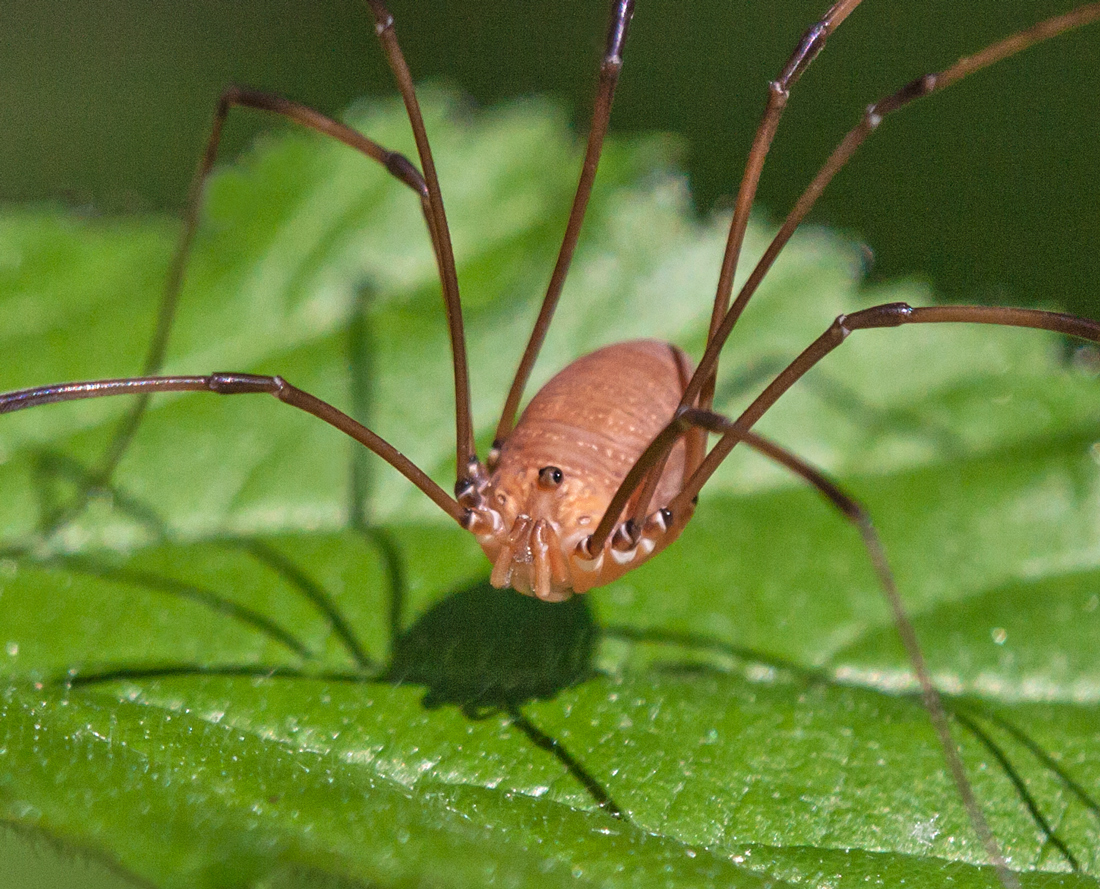
Daddy longlegs have a single pair of eyes, oriented sideways, in the middle of their heads and it’s a little disconcerting to peer through a macro lens and see one of these eyes looking toward you. Daddy longlegs (also known as harvestmen) belong to the arachnid family, but are not spiders. Harvestmen make up the order Opiliones and, according to Wikipedia, there may be as many as ten thousand species of harvestmen worldwide, with over 6500 already discovered.

I cropped the first shot of the harvestman to allow you to see the eyes better, but it doesn’t really give you a sense of the length of the legs. The second shot, which is actually a less-cropped version of the first one, shows you more of the legs. I did crop out the ends of the outermost legs, though, to keep the body from looking too small.


daddy1A_june_blogdaddy1_june_blog

© Michael Q. Powell. All rights reserved.

Read Full Post »

As I was going over my images from the last few weeks, I came across this image of a daddy longlegs (also known as a harvestman) that I really like, in part because of the way that the photo shows its eyes.

Previously I posted  what I had characterized as an artistic shot of this arachnid that showed mostly its bottom side. In this shot, the harvestman had turned toward the camera and the eyes, which grow on a stalk in the middle of its back are visible.

They are a huge contrast with the eyes of a jumping spider that I featured recently in a posting, which had multiple sets of large eyes.  

daddy2_blog

Michael Q. Powell. All rights reserved

Read Full Post »

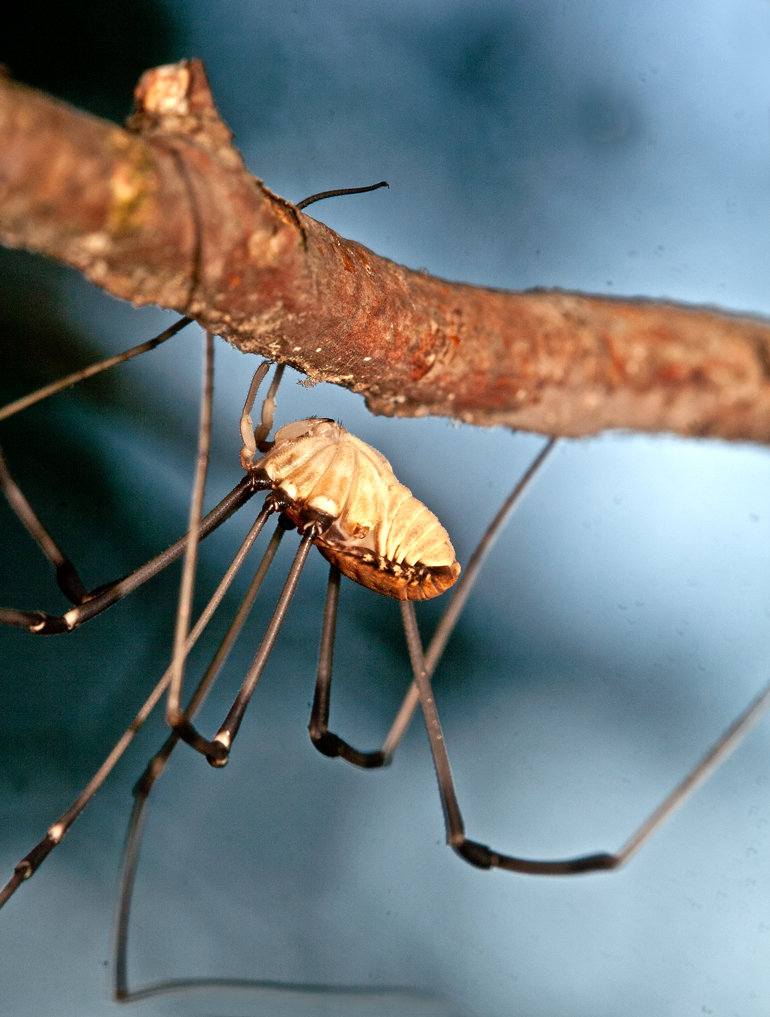
Can a photo of a daddy longlegs (also known as a harvestman) be artistic?

Ordinarily, I would emphatically respond in the negative, but somehow this macro shot that I took of a daddy longlegs, suspended upside down from a branch, came out with a cool, creative vibe to it. I like the way the legs are placed, the way the light is hitting its body, and the way the branch is in focus only in the center area.

I ran across this daddy longlegs as I was walking through the woods and I took the time to set up my tripod and use my 100mm macro lens to get this shot. The daddy longlegs was amazingly tolerant of my efforts and remained in place the whole time, even when I experimented with the use of my pop-up flash.

daddy1a_blog

Michael Q. Powell. All rights reserved

Read Full Post »

It was raining a little yesterday when I encountered my first harvestman (order Opiliones) of the spring, which explains the drops of water that you may notice on some on its legs.

Growing up, I was accustomed to calling them daddy longlegs and thought they were a kind of spider. Last year, I learned that harvestman in fact are not spiders, even though they do belong to the class of arachnids—harvestmen are in the order Opiliones and spiders are in the order Araneae.

I shot this image with my 55-250mm telephoto zoom, which meant that I couldn’t get in super close to the harvestman. However, I did manage to get at least part of all of his legs in the shot, which was not the case last year when I photographed one with my macro lens—there is an unavoidable tendency to want to get close whenever I put the macro lens on my camera.

Daddy1_blog

Michael Q. Powell. All rights reserved

Read Full Post »

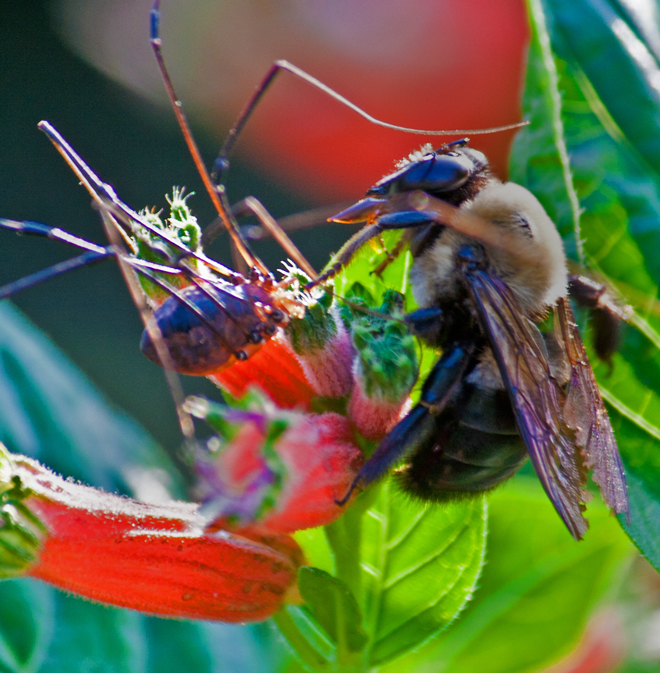
I am always fascinated whenever I happen to capture two different insects in a single image, especially when they appear to be interacting. A bee flew onto a flowering plant and appears to be having a conversation with a daddy longlegs (aka harvestman) that was already there. Does one of them look at the other as a potential prey? Are they sharing information? Is one asking the other out on a date?

Can you hear me now?

Insect interaction

© Michael Q. Powell. All rights reserved.

Read Full Post »

When I came upon this scene this afternoon I couldn’t help but think of some blog posts that I had read recently. Steven Schwartzman had a beautiful artistic image of a damselfly caught in a spider’s web entitled “Three Orbs, Three Colors.”  Daniel Proud had a wonderfully informative Four part series on Harvestmen (Daddy Longlegs) in late July that included colorful images of different harvestmen. Both of those bloggers caused me to be much more attentive today as I took in my surroundings during a nature walk at a local marsh.

I managed to capture an image of the spider moving in on his captured prey, a daddy longlegs, that had become stuck in the spider’s web.  Some may find the photo to be a little disturbing, but to me it is a simple fact of natural life.

Shortly after taking this photo, I moved in a little closer and must have disturbed the web. The spider quickly climbed up the web and took refuge inside the curled-up leaf. I waited for quite some time but the spider did not reappear.

I think the daddylongs was still alive when I left him, but his prospects do not appear to be good.

Caught in the web

© Michael Q. Powell. All rights reserved.
Read Full Post »