Feeds:
Posts
Comments

Posts Tagged ‘Common Whitetail’

Generally I like to photograph wildlife subjects in a natural environment. When this female Common Whitetail dragonfly (Plathemis lydia) landed on a metal sprinkler cover, though, I couldn’t help but like the contrast between the natural subject and the industrial background.

Common Whitetail dragonfly

© Michael Q. Powell. All rights reserved.

Read Full Post »

As we move deeper into spring, dragonfly nymphs are emerging from the water and starting their transformed lives as acrobatic flyers. This past weekend I spotted some young male Common Whitetail dragonflies (Plathemis lydia) in different stages of development.

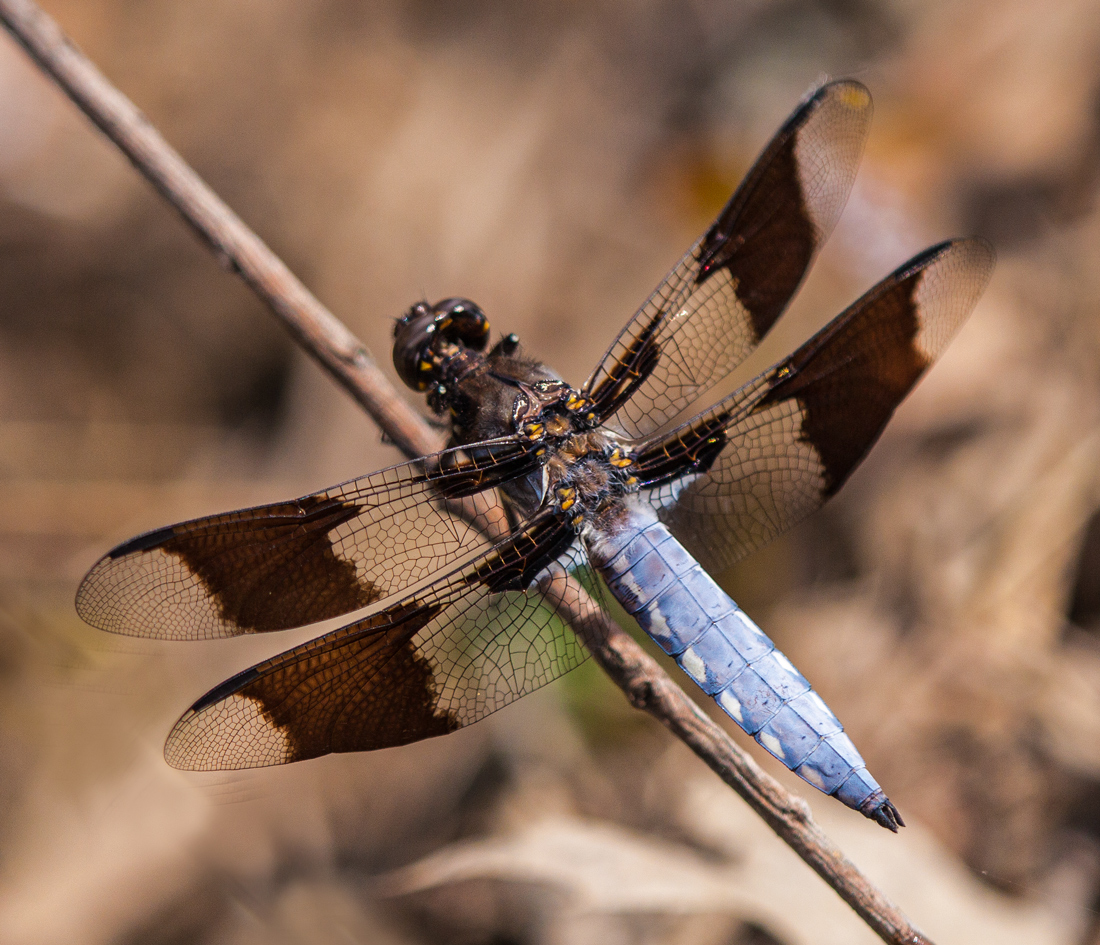
Not surprisingly, adult male Common Whitetail dragonflies have white tails—it seems like most species are named after the characteristics of the male. Check out one of my postings from last year to see what a mature adult male looks like. When they first emerge, however, the males have the same body colors and patterns as the females. Fortunately, it’s easy to tell them apart, because the wing patterns are different in the male and female whitetails. (For more information about these dragonflies, take a look at the pages at bugguide.net.)

The dragonfly in the first shot is well on his way to becoming an adult and was bold enough to be flying over the water. The one in the second shot is younger, and seemed to content to remain in the vegetation at a distance from the open water.

A "tween" male--the abdomen is beginning to turn blue, but the adolescent body pattern still shows

A “tween” male–the abdomen is beginning to turn blue, but the adolescent body pattern still shows

An immature male, with the body pattern of a female and the wing pattern of an adult male

An immature male, with the body pattern of a female and the wing pattern of an adult male

© Michael Q. Powell. All rights reserved.

Read Full Post »

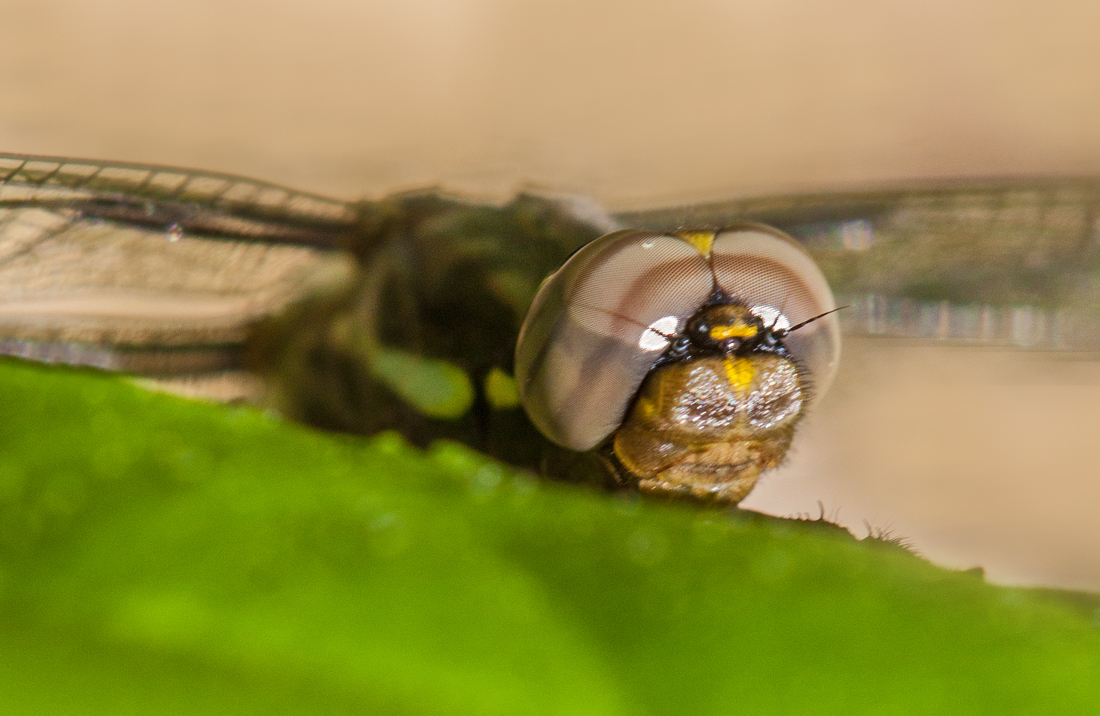
Yesterday, I seemed to be particularly fascinated by insect eyes and did a posting on a fly, whose compound eyes were pretty amazing. However, dragonflies have the largest compound eyes of any insect and I was thrilled to be able to capture this face-to-face shot of a Common Whitetail dragonfly (Plathemis lydia), peering right at me over the edge of a leaf.

A dragonfly’s eyes can have as many as 30,000 facets, known as ommatidia, that contain light-sensitive proteins, according to an article in ScienceBlogs. Although, humans also have these kind of proteins, called opsins, we have only three (red, green, and blue), whereas a dragonfly has four or five, giving it the capability to see colors beyond human visual capabilities. A dragonfly’s eyes also wrap around its head, giving it an incredible field of view. For more information and a more scientific explanation, check out a posting entitled “Super-predators” that Sue did last June in her Backyard Biology blog.

I took this shot in a wooded grassy area adjacent to a pond. It seems that the Common Whitetail dragonflies are hanging out there early in the season and not too many of them are patrolling over the water, as I commonly saw them do last summer. The fact that the dragonfly was not perched on a branch coming out of the water proved to and advantage as I was able to approach pretty closely to it in order to take this shot.

dragonfly_eyes_blog

© Michael Q. Powell. All rights reserved

Read Full Post »

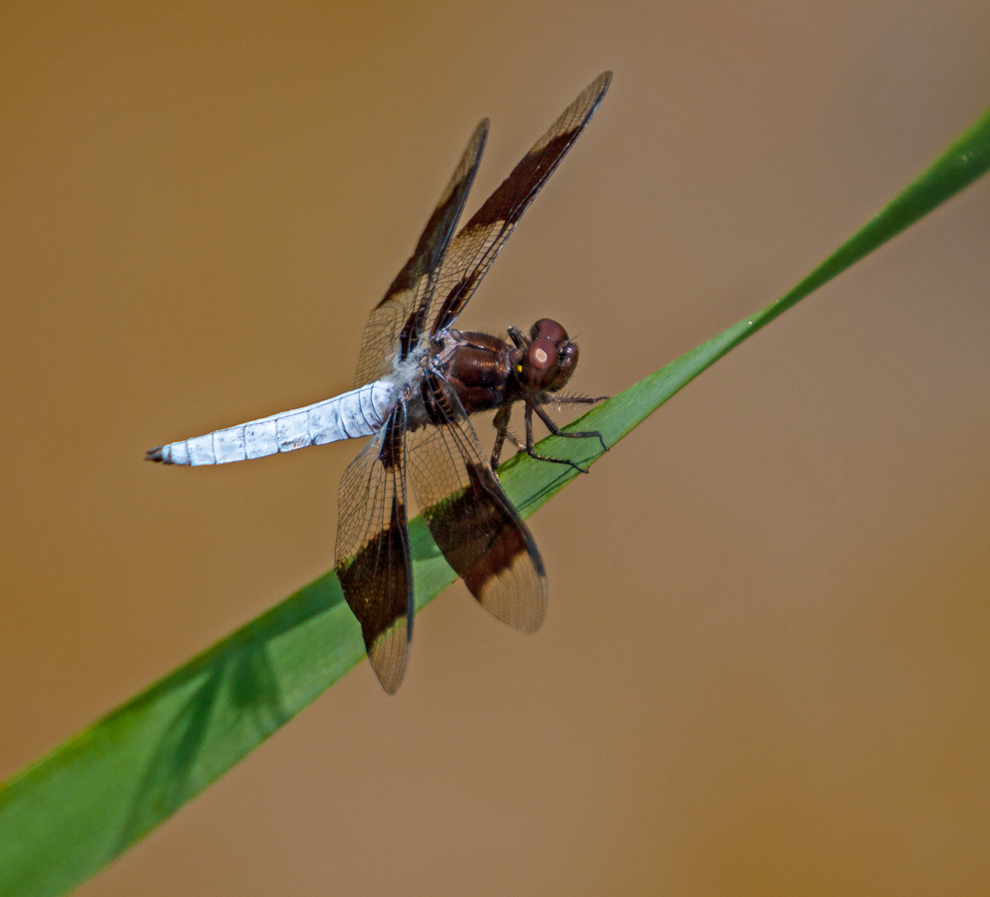
Some of my favorite images are almost minimalist in their approach, like this shot of a male Common Whitetail dragonfly (Plathemis lydia).

The composition is simple, the color palette is limited, and there is a pretty good amount of negative space. The subject is not unique and unusual—its name even indicates that it is “common.”

I managed to capture some of the details of the dragonfly, though, like the “hairs” on the legs (click on the image to see a higher resolution view), though the image is not super sharp. The shadow of the wings on the green leaf adds an additional touch of visual interest to the image.

The photo is not spectacular and showy, but I find a real beauty in its quiet simplicity.

whitetail_A_blog

© Michael Q. Powell. All rights reserved

Read Full Post »
« Newer Posts