Feeds:
Posts
Comments

Posts Tagged ‘Celithemis fasciata’

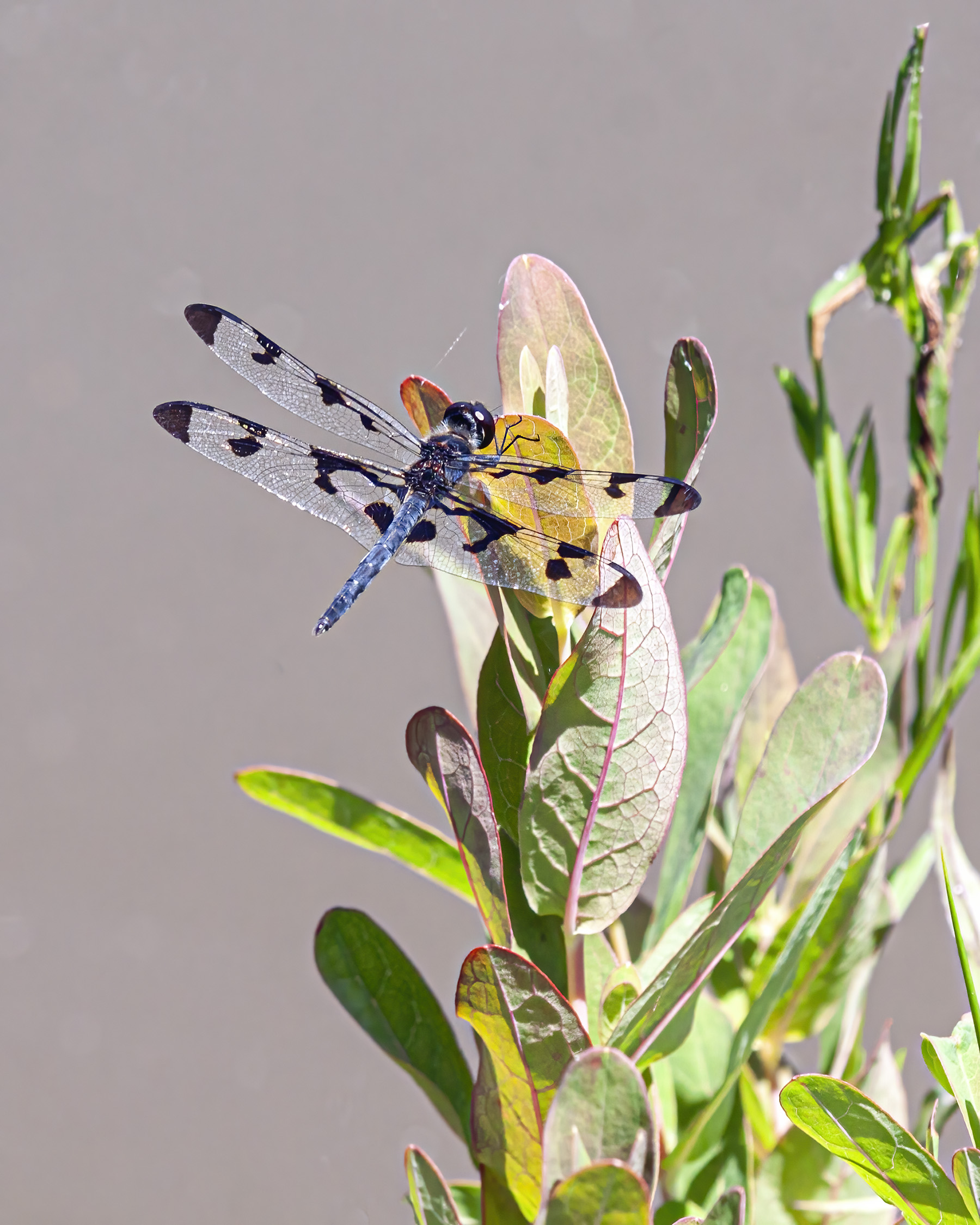
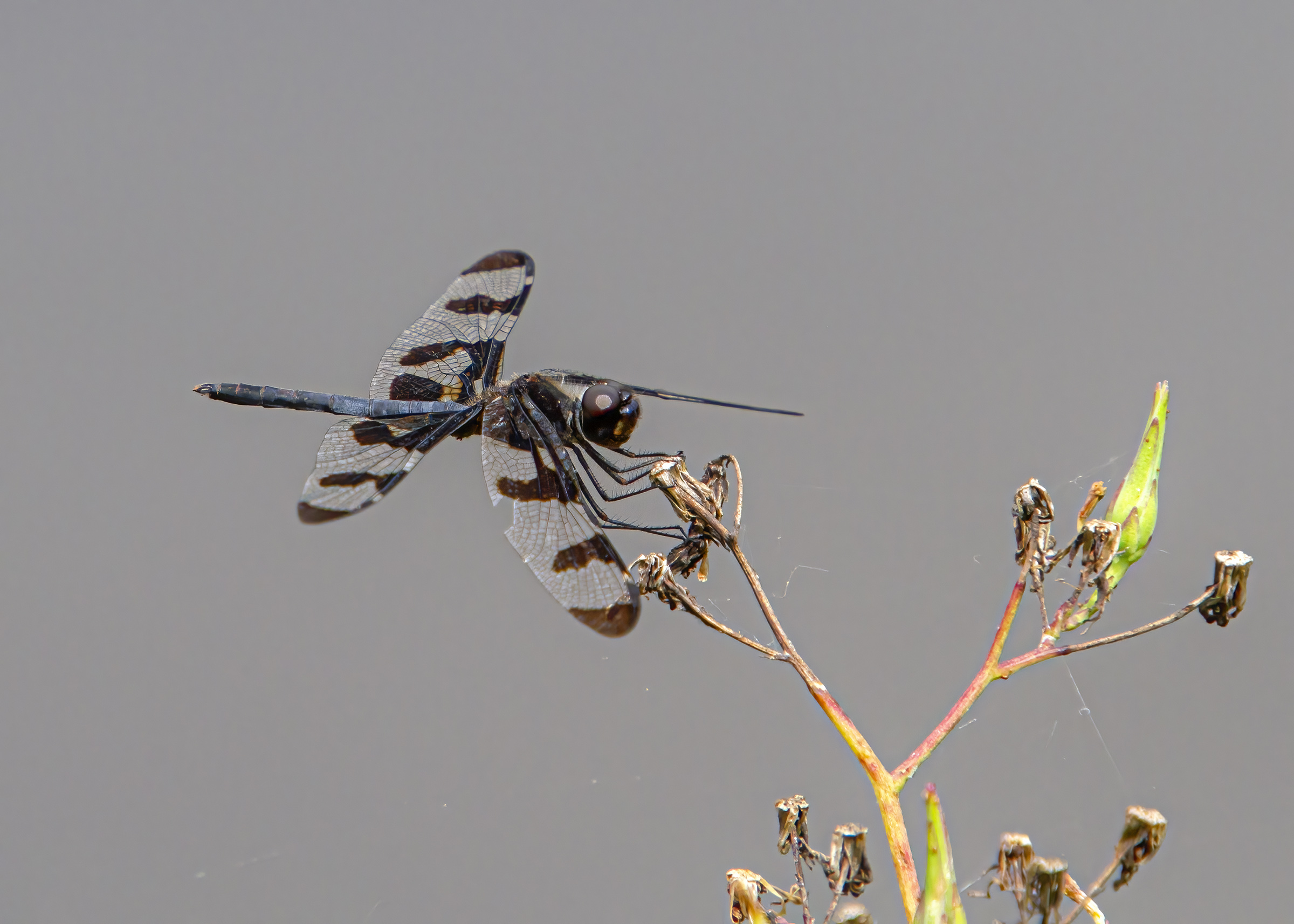
During a short visit to Jackson Miles Abbott Wetland Refuge last Friday I spotted my first Banded Pennant dragonfly (Celithemis fasciata) of the year. Pennant dragonflies like this one often perch precariously on the very tips of vegetation, which causes them to flap about in even the slightest of breezes, like a pennant.

Banded Pennants are somewhat uncommon and in some years I have not seen a single one, so I was happy to encounter this handsome male, the only one I saw all day. As you can see in all of the photos below, the dragonfly’s upper left wing did not seem to straighten out as much as the other three wings. From what I could see, though, the dragonfly was able to fly quite well despite this injury or deformity.

Banded Pennant

Banded Pennant

Banded Pennant

© Michael Q. Powell. All rights reserved.

Read Full Post »

I was intrigued by the varying wing positions of this Banded Pennant dragonfly (Celithemis fasciata) that I spotted last week at Jackson Miles Abbott Wetland Refuge. There was a bit of a breeze and this little dragonfly was doing its best to hold on to the vegetation by adjusting its wings.

Although each wing can function independently from the others, it appeared that the dragonfly mostly moved them in pairs. I was particularly struck in the first photo by the way that the front wings of the Banded Pennant were tilted forward, while its back wings were held flat horizontally.

Banded Pennant

Banded Pennant

Banded Pennant

© Michael Q. Powell. All rights reserved.


Read Full Post »

There is only one local location where I have found Banded Pennant dragonflies (Celithemis fasciata) in the past and in some years I have not seen a single one there. I was hopeful that I would see some on Thursday when I returned to Jackson Miles Abbott Wetland Refuge and my hopes were rewarded. Not only did I spot several Banded Pennants, but they were cooperative in choosing some photogenic perching locations for me.

Like other pennant dragonflies, Banded Pennants like to perch on the very tips of vegetation, which causes them to flap around a bit in the slightest breeze, like a pennant. I love the patterned wings of Banded Pennants, which cause them to stand out from several other small blue dragonflies that I saw that day. As you can see from the photos, the Banded Pennants mostly perched on plants overhanging the water or on vegetation growing out of the water.

At the last minute I decided to add the final photo, despite the fact that the dragonfly occupies only a small part of the frame. I really like the reflections of the plants in the water and did not want to zoom in and lose them. I also like the way that the image shows a Banded Pennant zooming low over the water in between the plants. If you look closely you can see the way that the dragonfly has tucked in its legs in order to be a bit more aerodynamic when flying.

Banded Pennant

Banded Pennant

Banded Pennant

Banded Pennant

© Michael Q. Powell. All rights reserved.


Read Full Post »

Yesterday I visited Jackson Miles Abbott Wetland Refuge and spent a lot of my time there trying to get shots of dragonflies in flight. The dragonflies were not very cooperative and kept their distance most of the time, but eventually I managed to get a few decent shots. What was especially cool was that I captured images of dragonflies from three different families—Skimmer, Darner, and Emerald.

The first photo shows a Banded Pennant (Celithemis fasciata), a Skimmer, as he was flying toward me. Banded Pennants are pretty small at about 1.3 inches (33 mm) in length, so I was pretty thrilled to capture this shot as he was flying toward me. This was actually the first time that I had seen a Banded Skimmer this season.

The second photo shows a Cyrano Darner (Nasiaeschna pentacantha). Despite the fact that I took the shot from a long distance away, you can still see the prominent “nose” that is supposedly reminiscent of the long nose of literary character Cyrano de Bergerac.

The last two photos show Prince Baskettails (Epitheca cynosura) that are members of the Emerald family. Prince Baskettails, which are about 2.9 inches (74 mm) are quite easy to identify, because they are the only large dragonfly in our area with patterned wings. I had more opportunities with this species that with the others, because several Prince Baskettails were flying repetitive patrols only various parts of the pond and passed by me multiple times. Although it is a little easier to focus on a dragonfly in flight when the background is clear, I think it is even cooler when I manage to include reflections in the water in a photo, as was the case with the reflections of the branches in the final photo.

Banded Pennant

Cyrano Darner

Prince Baskettail

Prince Baskettail

© Michael Q. Powell. All rights reserved.


Read Full Post »
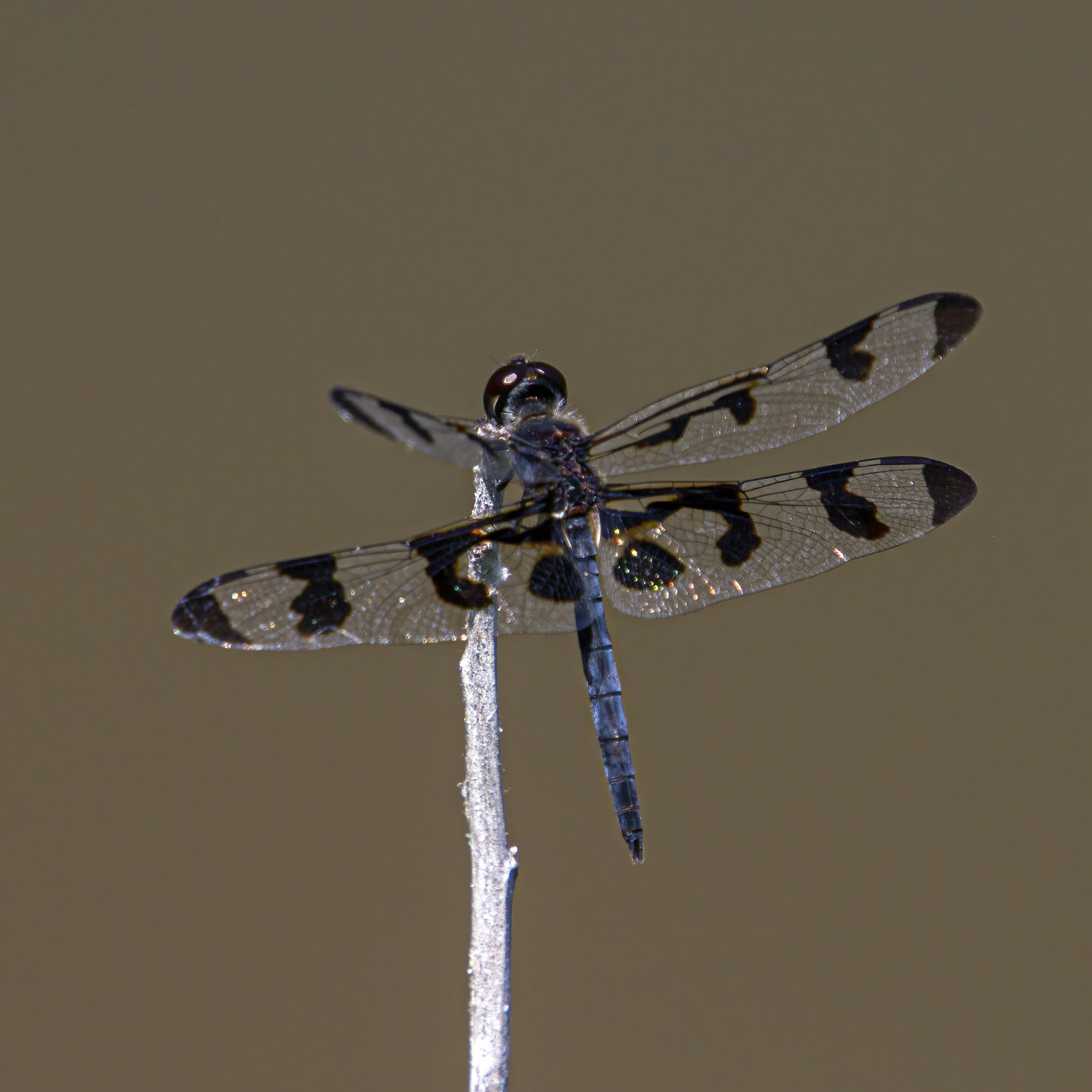
I was thrilled on Wednesday to spot some Banded Pennant dragonflies (Celithemis fasciata) at Jackson Miles Abbott Wetland Refuge. Earlier this season I photographed Calico Pennants and a Halloween Pennant and it is nice to capture images of another “pennant” species with patterned wings. This is the only local spot where I have reliably seen them in the past, and in some years I have not see a single one.

Adult male Banded Pennants are blue, like so many other dragonflies, but the distinctive pattern on their wings make them easy to distinguish from the others. They may be easy to identify, but they are small in size—about 1.3 inches (34 mm) in length—and perch in vegetation right at the edge of the water, so you have to look carefully to spot them.

I was fortunate to have multiple opportunities to photograph Banded Pennants that day. The colorful little dragonflies would make short forays over the deeper waters of the pond, but would sometimes would return to the same clumps of vegetation. The banks of the pond are pretty steep in many spots, so I had to really pay attention as I leaned over the edge to capture some of these images, but I managed to stay dry.

Have a wonderful weekend.

Banded Pennant

Banded Pennant

Banded Pennant

© Michael Q. Powell. All rights reserved.

Read Full Post »

Most of the time the photos in my postings were taking during a single trip to a particular location, but today I decided to mix things up a little. There is really nothing that links these three photos together, except perhaps the fact that they are all simple graphic images.

The first image shows a Banded Pennant dragonfly (Celithemis fasciata) perched on a curved piece of vegetation. Some Facebook viewers stated that they thought of the golden arches of McDonald’s, while others thought of the enormous Gateway Arch in St. Louis. I had no such thoughts and simply liked the curved shape of the vegetation as well as the rest of the compositional elements in the shot.

The second image shows a Cabbage White butterfly (Pieris rapae) with proboscis extended as it feeds on a plant that I think is Queen Anne’s Lace. I really like the minimal range of colors in the image and the way that the veins of the butterfly mirror the structure of the plant.

The final image is perhaps the most simple and the most abstract. A damselfly was perched on a leaf just above eye-level, its shape clearly evident in the shadow that it was casting. I was seized with an irresistible impulse to photograph the semi-hidden insect. If you click on the image, you will discover that one of the damselfly’s eyes was curiously peering over the edge of the leave and one tiny foot was sticking out too.

Banded Pennnant

Cabbage White

damselfly

© Michael Q. Powell. All rights reserved.


Read Full Post »
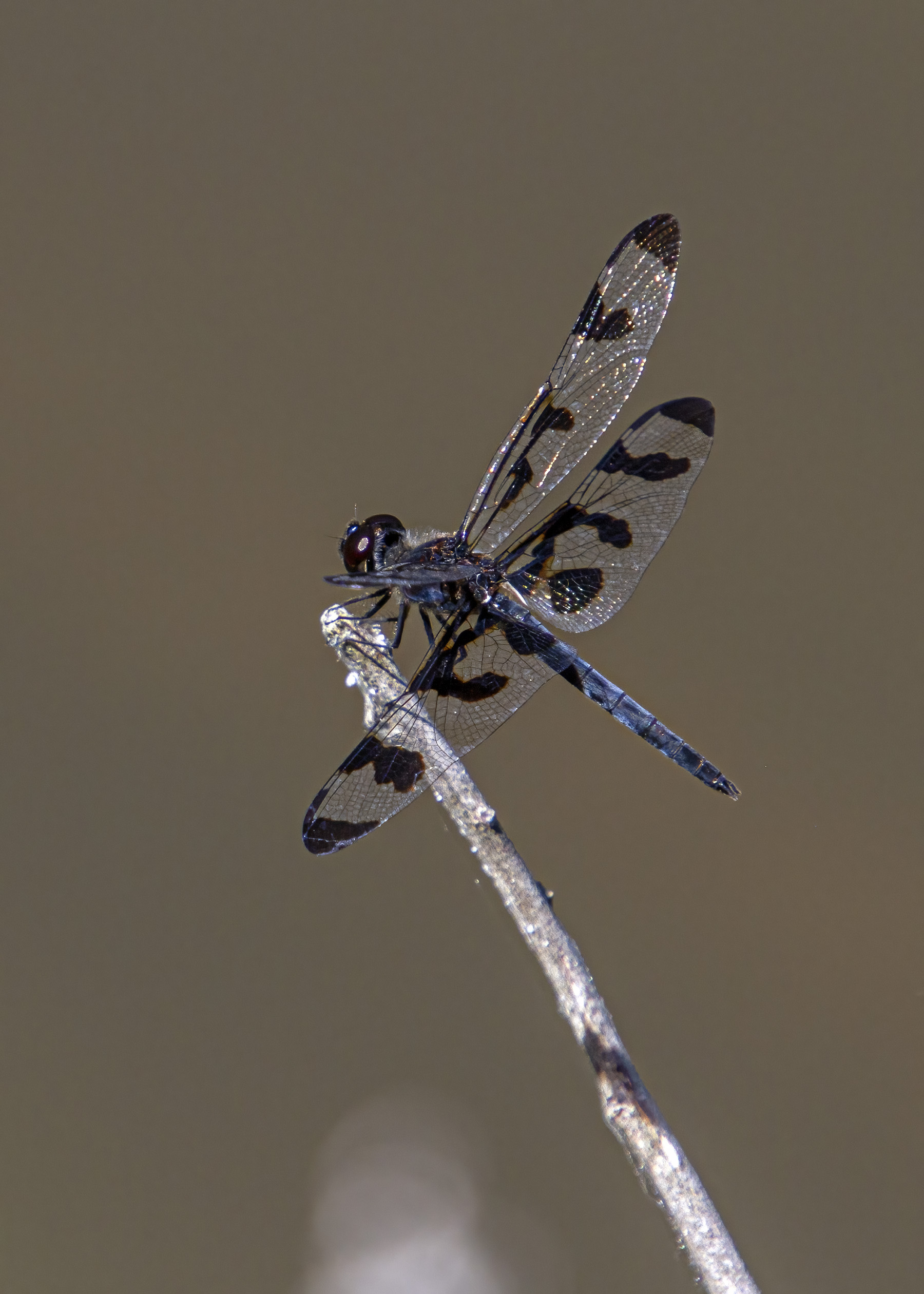
I was excited to spot some Banded Pennant dragonflies (Celithemis fasciata) yesterday at Jackson Miles Abbott Wetland Refuge. It has been a few years since I last saw them at this location, the only local spot where I had reliably seen them in the past, and I was afraid that they were gone forever.

Like so many dragonflies that I see, adult male Banded Pennants are blue, but the distinctive pattern on their wings make them easy to distinguish from the others. However, they are small in size—about 1.3 inches (34 mm) in length—and perch in vegetation right at the edge of the water, so you have to look carefully to spot them. Most of the time Banded Pennants, like other pennant dragonflies, perch on the very tip of grasses and other stalks of vegetation, where they are easily blown about and flap like pennants in the slightest breeze, which can make them a challenge to photograph.

The third image shows the pose in which I photograph pennant dragonflies most frequently. I was delighted, therefore, when one Banded Pennant chose a more photogenic perch and I was able to capture the colorful first image.

Banded Pennant

Banded Pennant

Banded Pennant

© Michael Q. Powell. All rights reserved.

Read Full Post »
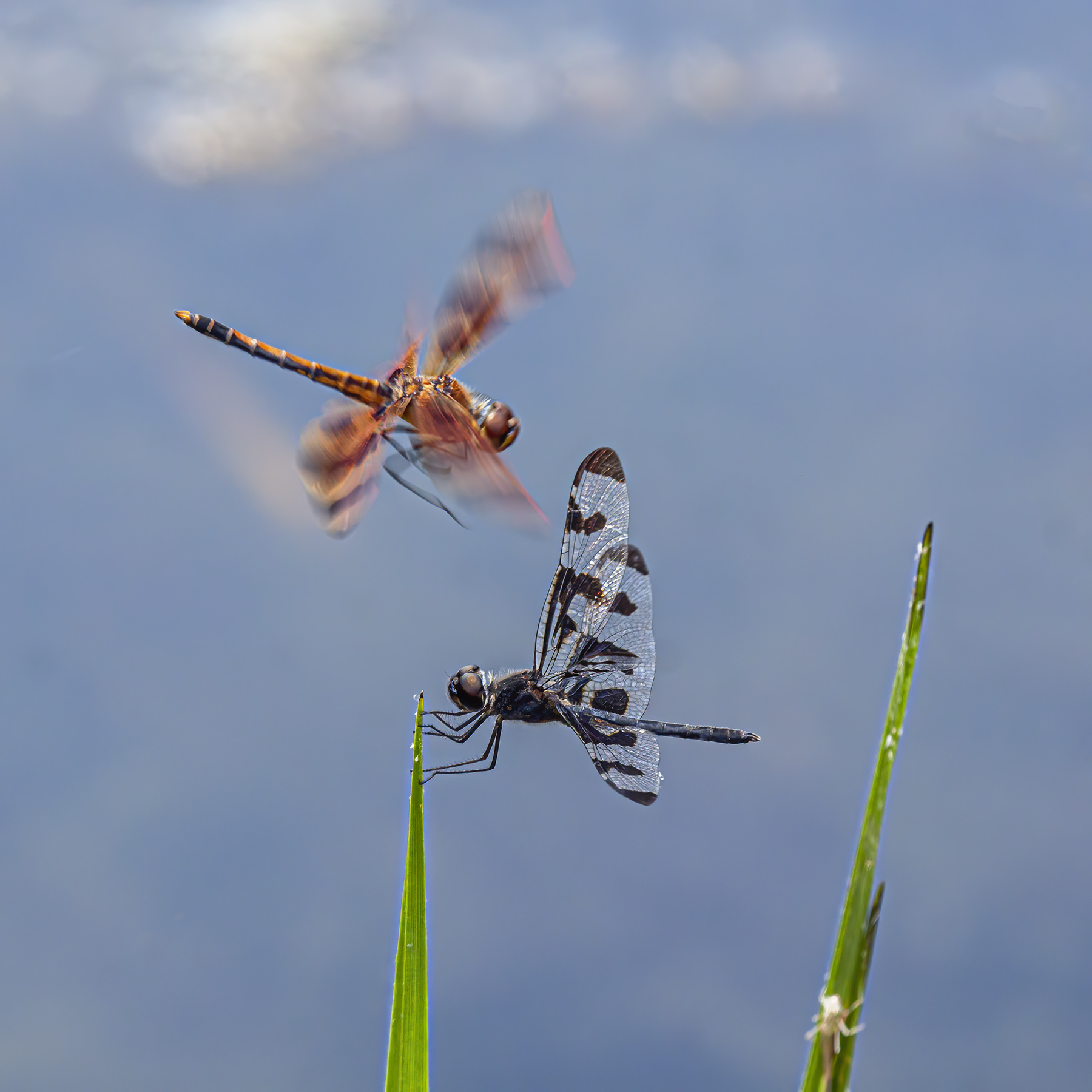
Perhaps it was a territorial dispute, but whatever the reason, a male Halloween Pennant dragonfly (Celithemis eponina) came screaming in determined to dislodge a perched male Banded Pennant dragonfly (Celithemis fasciata) on Thursday at Meadowlark Botanical Gardens and achieved his goal. A few moments earlier I had spotted the two dragonflies perched in a moment of peaceful co-existence (with appropriate social distancing), but that moment of tranquility did not last very long.

Can’t we all just get along and live in harmony with one another?

Halloween Pennant and Banded Pennant

Halloween Pennant and Banded Pennant

© Michael Q. Powell. All rights reserved.


Read Full Post »

Emerging is a dangerous experience for dragonflies and doubly so when they do it in the rain. As the water-dwelling nymph is transformed into a beautiful aerial acrobat, it is very vulnerable to predators and weather. Initially the wings are extremely fragile and it takes some time for them to harden enough to permit flying.

On Monday, it was drizzling when I spotted this female Banded Pennant dragonfly (Celithemis fasciata) at a small pond in Northern Virginia. Its metamorphosis is almost complete and I am optimistic that it managed to weather the storm and survive its transformation. If you double click on the image, you can see it in higher resolution and see some of the wonderful details and patterns of its body and wings, as well as some drops of rain.

In case you are curious about a dragonfly’s magical metamorphosis, I was able to observe entire process two years ago with a Common Sanddragon dragonfly and documented it in a series of 15 photos in a blog posting entitled Metamorphosis of a dragonfly. The images are pretty intense and utterly amazing—I encourage you to check them out.

Banded Pennant

© Michael Q. Powell. All rights reserved.

Read Full Post »

During a quick trip to Jackson Miles Abbott Wetlands Refuge at Fort Belvoir, Virginia last weekend, I was thrilled to see that the spectacularly patterned Banded Pennant dragonflies are still around. This is the only location that I visit regularly where I have spotted this dragonfly species and I am never quite sure when an encounter will be the last one of the season.

As I was looking over the two shots that I chose to use with this posting, I realized that they represent two different approaches that I use when photographing dragonflies. Ideally I will try to position myself so that the camera’s sensor is parallel with the dragonfly’s wings and most of the dragonfly will be in focus. That was the case with the second shot and it really highlights the beautiful pattern of the wings. However, the image seems a bit too static for my taste. I prefer the first shot, in part because the pose is more dynamic and the direct eye contact with the dragonfly draws me in.

Banded Pennant

Banded Pennant

© Michael Q. Powell. All rights reserved.

Read Full Post »

Yesterday I spotted my first Banded Pennant dragonfly (Celithemis fasciata) of the season at Jackson Miles Abbott Wetlands Refuge at Fort Belvoir, Virginia. I love the beautiful blue color of its body and its boldly patterned wings. The males of this species seem to like to show off a bit by perching on the very tip of vegetation, which is both a blessing and a curse. It is a blessing because the dragonflies are easier to spot than those that perch low in the vegetation. It is a curse, however, because the slightest breeze causes the dragonflies to oscillate madly, making it tougher to get sharp shots of them.

Banded Pennant


Banded Pennant

© Michael Q. Powell. All rights reserved.

Read Full Post »

One of the highlights for me of a short visit yesterday to Meadowlark Botanical Gardens in Vienna, Virginia was spotting this spectacular dragonfly, which I think is a female Banded Pennant (Celithemis fasciata).

Earlier this summer, I spotted a male Banded Pennant, whose body was blue, but the coloration of this one suggests to me that it is a female. The dragonfly was perched on the highest branches of a small tree, which allowed me to isolate it against the beautiful blue sky. You may notice that the branches are different in the two photos—the dragonfly flew away a few times, but returned to the same tree a short time later.

CORRECTION: My initial identification was incorrect. My local dragonfly expert, Walter Sanford, with whom I neglected to consult in advance, provided a correct identification. This is a female Halloween Pennant (Celithemis eponina), not a Banded Pennant.


Banded Pennant

Banded Pennant

© Michael Q. Powell. All rights reserved.

Read Full Post »

Yesterday I made a trip to Jackson Miles Abbot Wetlands Refuge at Fort Belvoir, a local military base, and was thrilled to see a Banded Pennant dragonfly (Celethemis fasciata), a cool-looking species that fellow photographer Walter Sanford spotted at that location on 24 July. (Check out his posting of that encounter to see some more shots of a Banded Pennant.)

Like other pennant dragonflies, such as the Halloween Pennant that I photographed earlier this summer, the Banded Pennant likes to perch at the very tip of tall grass and other vegetation. A pennant dragonfly is sometimes easier to spot than those species that perch lower, but the slightest breeze sets the dragonfly in motion and makes it more difficult to photograph.

I spotted only a single Banded Pennant yesterday, but managed to get a number of shots before it flew away, though most of them were from pretty much the same angle. As I looked over the images, I couldn’t decide which was the most effective way to present the dragonfly. Was it better to maximize the size of the dragonfly by cropping it a square or to emphasize the height of the vegetation by using a vertical format?

In the end, I didn’t choose, but instead presented a shot in each of the two formats? Do you have a preference for one over the other?


Banded Pennant

Banded Pennant

© Michael Q. Powell. All rights reserved.

Read Full Post »