Feeds:
Posts
Comments

Posts Tagged ‘Canon SX50’

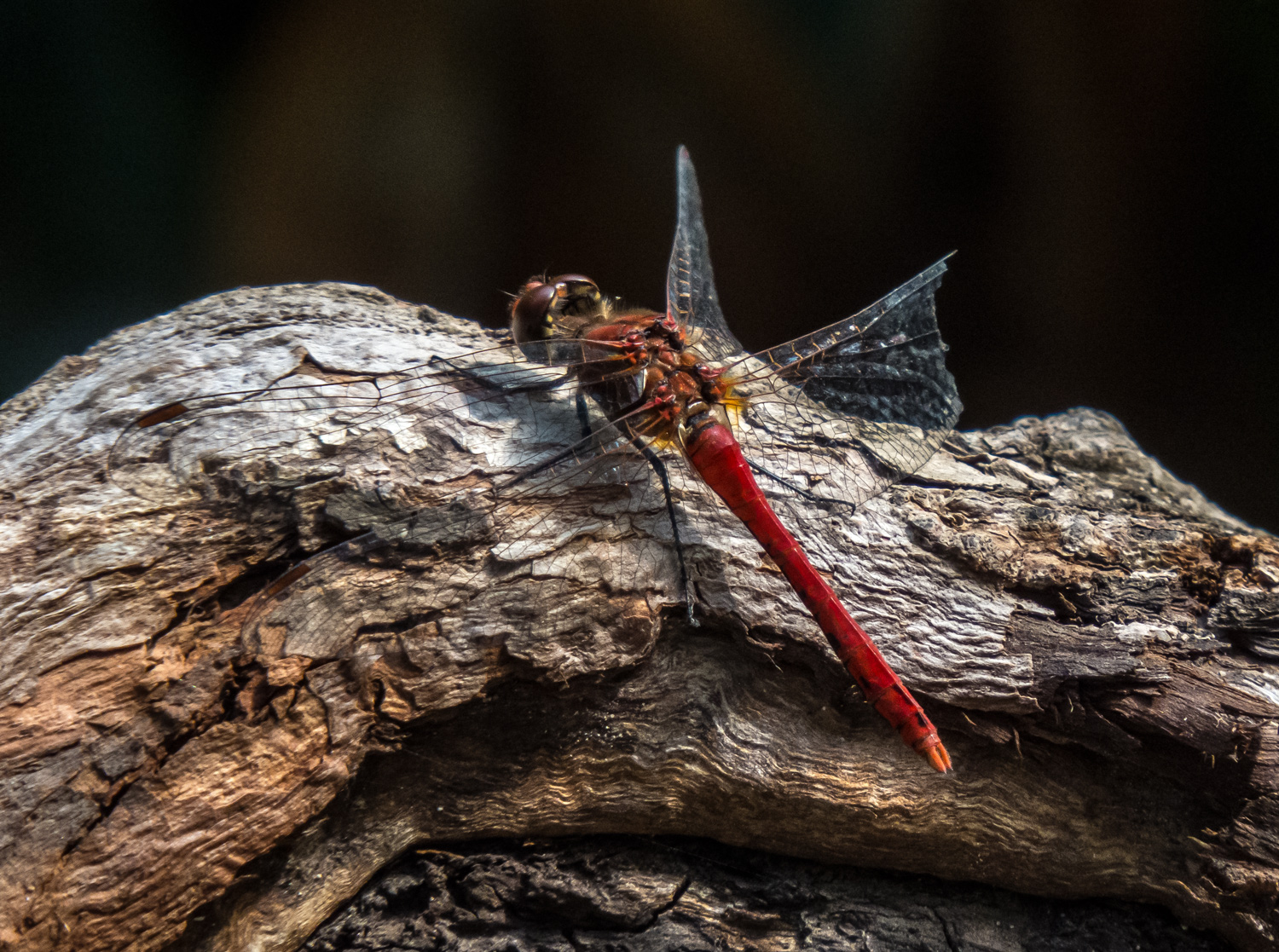
Its colors are not quite as ostentatious as those of the Migrant Hawker dragonfly that I featured yesterday, but the bright red bodies of what I believe are Common Darter dragonflies (Sympetrum striolatum) made them equally hard to miss at the botanical garden in Brussels, Belgium. The colors of these beautiful little dragonflies remind me of those of the Autumn Meadowhawk (Sympetrum vicinum), a species that I see quite often in my home area of Northern Virginia and the shared Latin genus name of Sympetrum indicates their relationship.

I was able to photograph male Common Darters perched in several different spots and I particularly like the way that the fiery red of their bodies contrasts with the cooler green of the backgrounds.

Common Darter

Common Darter

Common Darter

© Michael Q. Powell. All rights reserved


Read Full Post »

Last year when visiting Brussels, Belgium in early September, I was excited to discover dragonflies at the botanical garden in the center of the city. I headed back to the same location on Sunday right after checking into my hotel to see if I could find some dragonflies there this year.

As soon as I arrived at the small pond at the botanical garden, I was thrilled to see a number of large, colorful dragonflies flying about. Although they spent most of their time flying patrols over the water, occasionally one of the dragonflies would perch on the vegetation at water’s edge, which allowed me to capture some images of them.

I absolutely love the beautiful colors and patterns of these dragonflies, which I believe are Migrant Hawker dragonflies (Aeshna mixta). I am definitely not an expert on European dragonflies, however, and there are a number of other hawker species that are somewhat similar in appearance. In North America, there are dragonflies of this same Aeshna genus, which are usually referred to as mosaic darners, but I don’t think that this particular species can be found on the other side of the Atlantic.

Migrant Hawker

Migrant Hawker

Migrant Hawker

© Michael Q. Powell. All rights reserved


Read Full Post »

It is great to see that at least a few colorful Calico Pennant dragonflies (Celithemis elisa) are still around. I photographed this handsome male last Friday as he perched at water’s edge at the small pond at Occoquan Bay National Wildlife Refuge.

Summer is slowly slipping away. Some species of dragonflies are already gone for the year and others will soon follow suit. A few species have yet to appear, so all of the news is not bad. Still, as kids return to school and the daylight hours become noticeably shorter, it’s hard not to have the feeling that the lazy days of summer are coming to a close.

Autumn is my favorite season for a number of different reasons, but I am not quite ready to give up on summer. So I’ll keep sweating and searching, seeking to capture the summer beauty that still surrounds us. Like this dragonfly, I’m still holding on.

calico pennant

© Michael Q. Powell. All rights reserved

Read Full Post »

This little buck seemed more curious than fearful when he spotted me on Monday at Occoquan Bay National Wildlife Refuge. He continued to forage in a marshy area for a while before he finally disappeared from sight.

I know that we have a herd of White-tailed Deer (Odocoileus virginianus) on the wildlife refuge, though I see deer only on rare occasions. This little deer seemed to be alone and I was really struck by the shape of his antlers. It looks to me like they might be his first set of antlers, though I confess to knowing almost nothing about the stages of development of a deer.  The shape of the antlers reminds me of photos that I have seen of several species of antelope in Africa.

white-tailed deer

© Michael Q. Powell. All rights reserved

Read Full Post »

The vegetation at Occoquan Bay National Wildlife Refuge was so high recently that these two foraging wild turkeys (Meleagris gallopavo) disappeared from view each time they leaned forward. It was like a game trying to figure out where they would pop up next. I played the game for for quite some time before I was able to capture them both in a single frame with their eyes visible—in most of the other shots the turkeys were looking away from me.

wild turkeys

© Michael Q. Powell. All rights reserved.


Read Full Post »

Unlike those that construct elaborate webs, some spiders instead perch at the shore with extended legs and sense prey through vibrations on the surface of the water. When the prey is detected, the spider runs across the top of the water, prompting some to call it the “Jesus spider.”

I spotted this cool-looking Six-spotted Fishing Spider (Dolomedes triton) in the shallow water of a pond this past Monday at Occoquan Bay National Wildlife Refuge.

Six-spotted Fishing Spider

© Michael Q. Powell. All rights reserved.

Read Full Post »

It was wonderful to travel to Meadowlark Botanical Gardens in nearby Vienna, Virginia with some friends this past weekend. Although I really enjoy going back repeatedly to familiar spots, sometimes it’s nice to move outside of the “box” and see something different, or at least in a different environment.

One of my favorite subjects of our little photo trip was this delightful Green Heron (Butorides virescens) that I spotted at one of the small ponds at the park. Green Herons are a lot lower to the ground than Great Blue Herons and are often difficult to find. I was lucky to see this one from a distance as I was circling the pond and managed to carefully creep close enough to have a low shooting angle and an unobstructed view.

green heron

© Michael Q. Powell. All rights reserved.

Read Full Post »

This past Monday I spotted this Wild Turkey (Meleagris gallopavo) at Occoquan Bay National Wildlife Refuge as it basked in the warmth of the early morning sunlight. Earlier this year I would see turkeys regularly as I walked the trails at the wildlife refuge, but the last couple of months such sightings have been rare.

wild turkey

© Michael Q. Powell. All rights reserved.

Read Full Post »

At this time of the year it’s tough for me to photograph birds—often when I spot them, they are mostly hidden in the foliage. This hawk, however, cooperated by perching out in the open this past Saturday at Jackson Miles Abbott Wetland Refuge. I was uncertain about the identification, so I checked with the experts in several Facebook birding groups and they indicated that this is an immature Cooper’s Hawk (Accipiter cooperii).

Cooper’s Hawks belong to the group of hawks called accipiters, also known as bird hawks. Accipiters have short rounded wings and a long tail and are better adapted to hunting in the woodlands that most other hawks.

Cooper's Hawk

© Michael Q. Powell. All rights reserved.

Read Full Post »

Normally when I see a Common Green Darner dragonfly (Anax junius) it is patrolling in the air and it is mostly a greenish blur. This past Friday, however, I was fortunate enough to spot one on the ground, nestled low in the vegetation at Occoquan Bay National Wildlife Refuge. At this closer distance I was able to marvel at all of the wonderful colors of this beautiful dragonfly.

Be sure to click on the images to see the details of this dragonfly at higher resolution.  Did you notice the blue color near the tip of its “nose?”

Common Green Darner

Common Green Darner

© Michael Q. Powell. All rights reserved.


Read Full Post »

Eastern Amberwings (Perithemis tenera) are the smallest dragonflies in our area. You can often find males buzzing around at the water’s edge, but females are harder to spot because they hang out in vegetation away from the water. I was thrilled therefore to see a beautiful female this past Friday at Occoquan Bay National Wildlife Refuge in some beautiful morning sunlight.

I decided to give a male Eastern Amberwing dragonfly equal billing in this post, because I really like the way that the shadows and the reflections make it look like he has an elongated body and extra sets of wings.

Eastern Amberwing

Eastern Amberwing

© Michael Q. Powell. All rights reserved.

Read Full Post »

Yesterday as I was exploring Riverbend Park in Great Falls, Virginia, I encountered several damselflies that were new to me. When you spend as much time as I do  searching for insects to photograph, you develop a sense of what is “normal” and I am able to decide almost immediately whether a subject is a familiar one or not. Those of you who know my work are aware that familiarity with a subject is not a criterion for photographing it—I am just as likely to take a shot of a common subject as a rare one.

As I looked though my reference books and material on line, I was able to determine that I had captured images of both the male and the female American Rubyspot damselfly (Hetaerina americana). One of the experts in a Facebook dragonfly forum pointed out the dragonfly in the first photo below is an immature male, which helps to explain why the red spot for which the species is named is not yet prominent.

I won’t go into the details of damselfly anatomy, but if you compare the dragonflies in the two photos, you can see some of the gender differences that often help in identification. The very tip of the abdomen, the part of the body that many folks refer to as the “tail,” is quite different for the male and the female. There is also some color differentiation. Alas, these are general rules that don’t apply in all cases, so I am often confounded when trying to identify the species of a given subject.

It is really cool that I continue to encounter new species. Part of the reason for that, I suspect, is that I am exploring some new locations. More importantly, though, my observational skills have improved dramatically over time and I am seeing things that I might not have noticed several years ago.

American Rubyspot

American Rubyspot

© Michael Q. Powell. All rights reserved.

Read Full Post »

Anyone who has ever gone fishing has a story of “the one that got away.” This Northern Water Snake (Nerodia sipedon) wanted to make sure that it did not have such a story to tell and dragged its prey onto dry land. Then the snake faced the challenge of figuring out how to swallow the large fish. The snake twisted and turned and contorted its body and head as it gradually ingested the fish. When the fish was part way down its throat, the snake appeared to push up against a log for additional leverage.

I captured a sequence of shots that speak for themselves, so I will not bother to explain each of them. Like me, you will probably feel a kind of macabre mixture of horror and fascination as you view them.

snake versus fish

snake versus fish

snake versus fish

snake versus fish


snake versus fish

snake versus fish

snake versus fish

snake versus fish

© Michael Q. Powell. All rights reserved.


Read Full Post »

As I was exploring the edge of the Potomac River yesterday at Riverbend Park, I flushed a fairly large dragonfly. Rather than fly away, it perched in a nearby tree, just above eye level. I suspected that I had interrupted a meal and that it wanted to enjoy its prey in peace.

The dragonfly was in the shade and the light was filtering in from in front of me, so the shadows made it hard to tell exactly what was going on. I fired away anyways, hoping that I would be able to salvage the images afterwards.

It turns out that the dragonfly is a Black-shouldered Spinyleg (Dromogomphus spinosus). You definitely can see the large spines on the dragonfly’s back legs, which help in capturing and holding prey, and you can sort of see the black shoulders. As I suspected, there was a prey–the dragonfly had captured some kind of damselfly.

I decided to try a couple of different techniques to try to capture a usable image. In the first shot, I used software to adjust the exposure levels and remove some of the shadows, which had the side effect of brightening the entire image and blowing out some of the detail in the background. As a result, the leaves also look a little washed out. In the second shot, I used my camera’s pop-up flash to help eliminate some of the shadows. The resulting image retains a bit more of the full range of tonal values, but may still be a little too dark. Neither image is perfect, but wildlife photography is so often about making compromises.

Black-shouldered Spinyleg

Black-shouldered Spinyleg

© Michael Q. Powell. All rights reserved.

Read Full Post »

I tend to be more of a dog person than a cat person. Cats have always been somewhat mysterious creatures to me, a bit wild and uncontrollable. Nonetheless, I am usually the go-to person to watch her three cats when my neighbor and fellow photographer Cindy Dyer goes out of town.

This past weekend I watched and fed the three male cats and, as is usually the case, I attempted to take some photos of them. Cindy often manages to capture them in wonderful candid moments, but it was hard for me to get them to cooperate. I am not used to shooting indoors with limited light, so that was an additional challenge. I learned pretty quickly that the 180mm macro lens that I happened to have on my camera is not optimal for this task—it was tough to get far enough away to capture the cats’ major facial features.

Eventually I was able to capture a portrait of each of them. Queso, the orange cat who was rescued in the bushes outside of a Mexican restaurant, is the youngest one; Pixel is the one with the pixelated hair who loves to roll over to have his tummy scratched; and Lobo, the gray lone wolf of the pack, fixed me with a fierce stare when he finally let me take his picture.

I should be back to my more typical wildlife shots tomorrow in case any of you were concerned that I had abandoned my butterflies and dragonflies. I enjoy the challenge of a different set of subjects and I must admit that it was nice to shoot in the coolness of the air-conditioned indoors rather than in the hot, humid summer weather we have been experiencing.

.

Queso

Pixel

Lobo

© Michael Q. Powell. All rights reserved.

Read Full Post »

While they have been out of town, I have been watering the flowers in my neighbors’ garden and watching (and feeding) their three cats. The garden was planted by my photography mentor, Cindy Dyer, who always selects particularly photogenic species. She asked me document some of the flowers as they bloomed in case she does not return in time to see them herself.

Yesterday I was particularly struck by the beauty of the different lilies that are now blooming. Some of them probably qualify as day lilies, but there is another cool variety that has blooms that face downward. The big star of the show, though, is undoubtedly an enormous cream-colored lily that just opened and is the one that is featured in the first photo.

Many of you know that I am generally in ceaseless pursuit of animate subjects, but it is good to periodically stop and take the time to smell the lilies.

lily

lily

lily

© Michael Q. Powell. All rights reserved.


Read Full Post »

Water lilies are now blooming at Occoquan Bay National Wildlife Refuge, which recently has become my favorite place to explore with my camera.  Yesterday I could see lots of them in a distant pond that was not accessible. I was happy, though, to be able to capture this image of one that was just within range of my zoom lens.

Water lilies are so exquisite that a single bloom is sufficient to fill me with a sense of beauty and tranquility. Is it any wonder that water lilies were the main focus of Monet’s artistic production during the last thirty years of his life?

water lily

© Michael Q. Powell. All rights reserved.

Read Full Post »

Technically speaking, “great” is not a part of the name of the Green Heron (Butorides virescens), but I would argue that this diminutive bundle of personality is just as deserving of the honor as the more common Great Blue Heron.

I was thrilled to see my first Green Heron in quite some time on Saturday at Occoquan Bay National Wildlife Refuge. The little heron was perched on some vegetation growing out of the marshy, duckweed-covered water as it took a break from fishing to do a bit of preening. While the heron was grooming itself, it often had its head tucked out of view, so I had to wait for quite some time to capture this pose, a pose that highlights the beautiful colors and patterns of this great Green Heron

Green Heron

© Michael Q. Powell. All rights reserved.

Read Full Post »

On Friday I kept encountering dragonflies that were clearly different from any I had seen before. There is a family of dragonflies known as “clubtails” in which the ends of their abdomens (the “tail”) are enlarged. I have seen a number of different members of this family, but none of them had as large a “club” as the ones that I spotted repeatedly as I explored Riverbend Park along the Potomac River.

I suspected and eventually was able to confirm that these are Cobra Clubtails (Gomphurus vastus). Isn’t that a cool name for a dragonfly—someone obviously thought that the “clubtail” looked like a cobra’s hood.

The Cobra Clubtails perched on the rocks and in the vegetation along the water’s edge and I was able to capture images of several of them. I am leading with a photo that provides a good look at the “clubtail,” though I tend to be drawn more to photos like final one in which you get to look into the eyes of the dragonfly.

This is probably the closest I want to be to staring into the eyes of a cobra.


Cobra Clubtail

Cobra Clubtail

Cobra Clubtail

© Michael Q. Powell. All rights reserved.

Read Full Post »

As I was exploring Riverbend Park yesterday, I looked out into the Potomac River and spotted a Great Blue Heron (Ardea herodias) standing on a small, rocky island in the middle of the river. Although I see Great Blue Herons pretty regularly, I invariably stop to observe them. This heron seemed to be particularly cheerful and appeared to have a smile of its face or maybe it was singing to greet the new day.

Great Blue Heron

© Michael Q. Powell. All rights reserved.


Read Full Post »

Carolina Saddlebags dragonflies (Tramea carolina) bounce about as they fly, which makes them look a bit like butterflies as they move through the air. It is easy to spot their bright red bodies and prominent rear wing patches, but it is a challenge to photograph them, because they don’t perch very often.

I was fortunate on Monday to see one land high in a nearby tree and was able to capture this view of the underside of its wings. The vegetation was far enough away that it blurred out nicely, drawing the eye of viewers to this modest portrait of a beautiful little dragonfly.

Carolina Saddlebags

© Michael Q. Powell. All rights reserved.

Read Full Post »

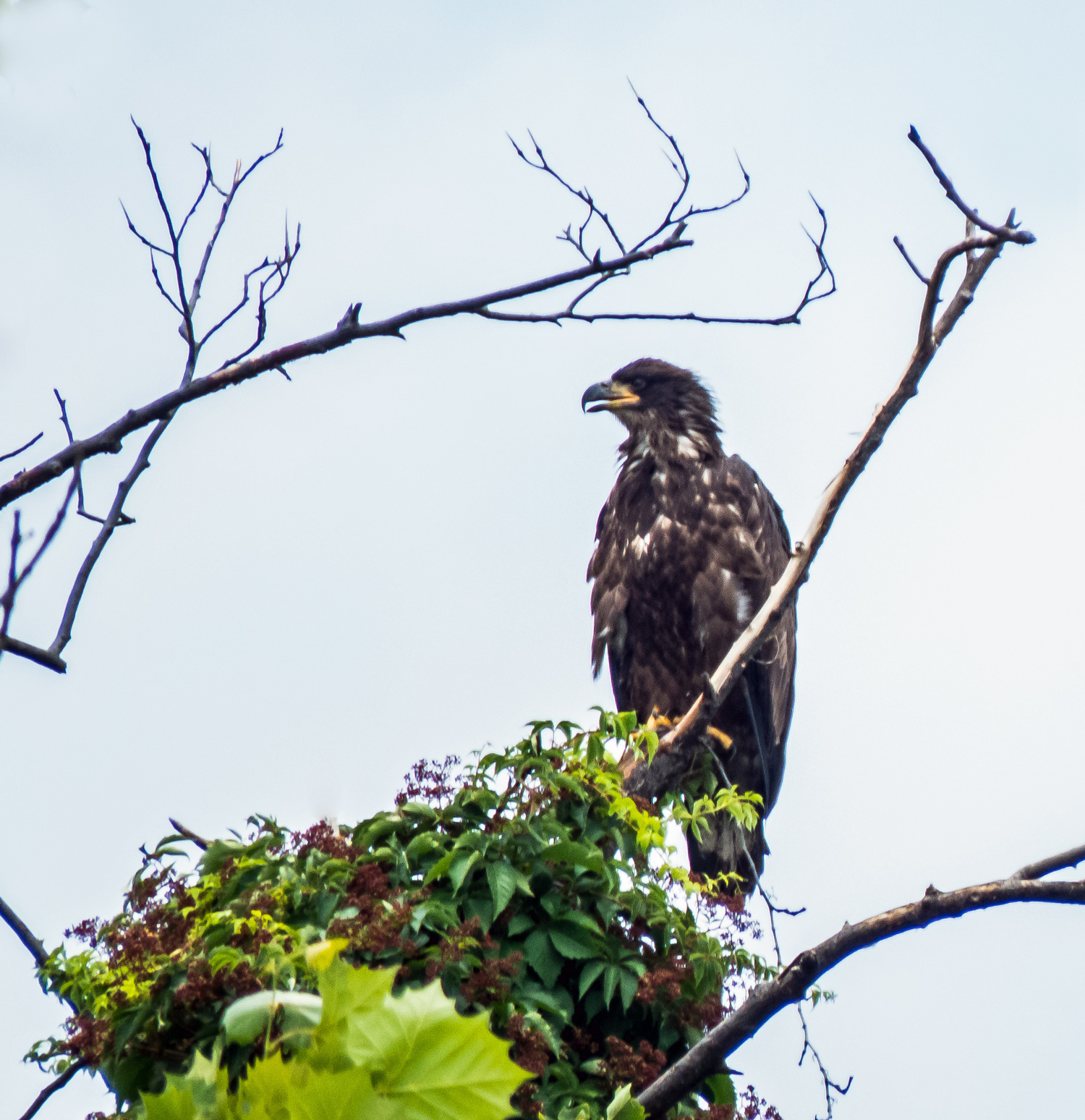
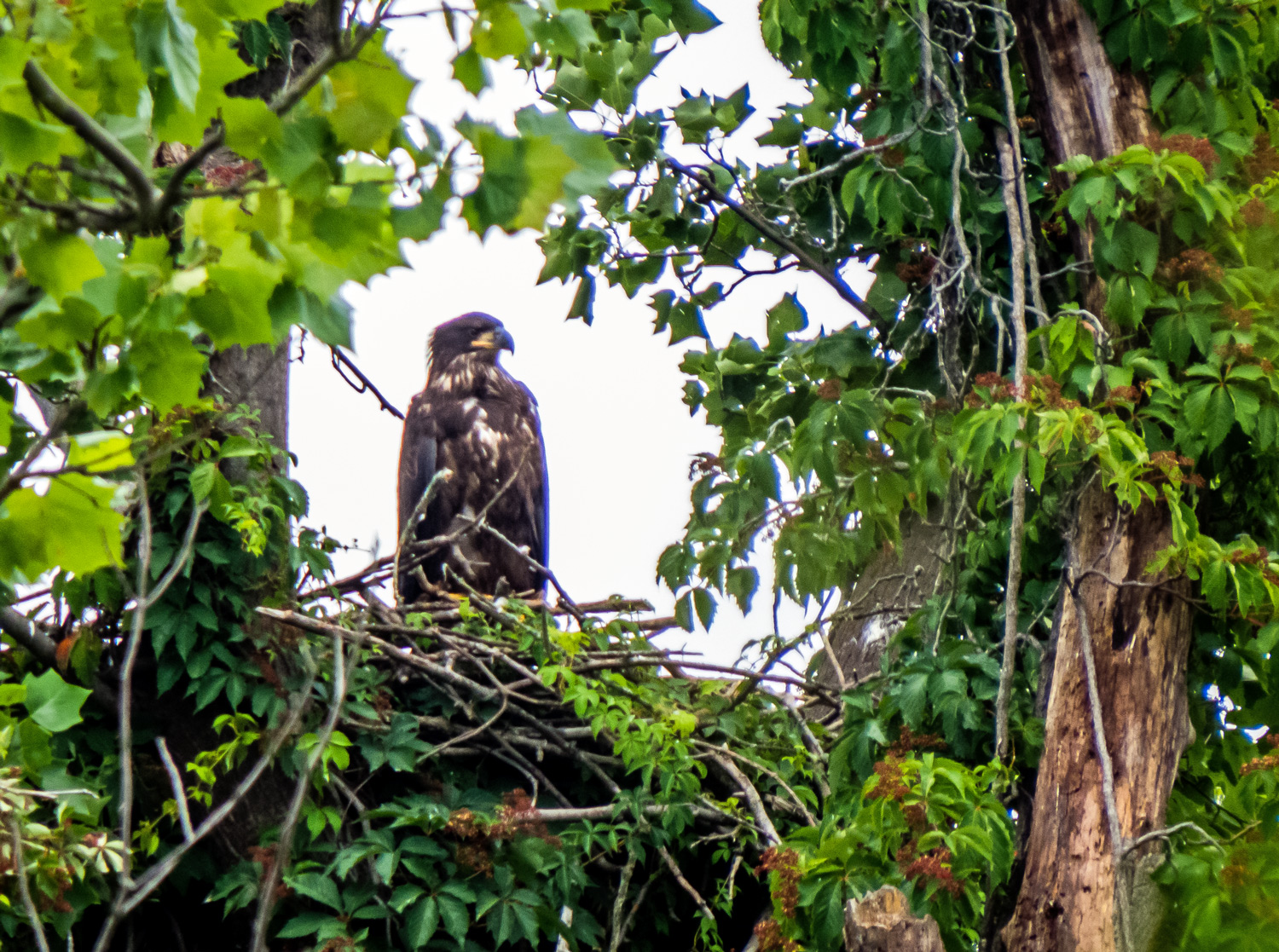
Even from a distance it is easy to see that the eaglets in one of nests at Occoquan Bay National Wildlife Refuge are no longer babies. When I saw them this past weekend, one of them was still hanging around in the nest, but the other had ventured out to a higher limb. I am posting an image of each of the two eaglets as well as a shot that shows their relative positions. As you can see, there are now a lot of leaves on the trees and I suspect that most folks walking by on the trail are not even aware of the presence of the nest.

The little eagles are still mostly brown in color—it will take almost five years for them to acquire the white feathers on their heads and on their tails that we associate with adult Bald Eagles (Haliaeetus leucocephalus).

Bald Eagle

Bald Eagle

Bald Eagle

© Michael Q. Powell. All rights reserved.

Read Full Post »

Have you ever watched sprinters prepare for the start of a race? They get into their starting blocks and lean forward, ready to push off at the sound of the gun. Well, that’s what some scientist had in his mind when he first saw today’s dragonfly, the Swift Setwing (Dythemis velox). The forward tilting of the wings is very distinctive and makes this dragonfly easy to identify.

This is mostly a southern dragonfly and I was thrilled when I spotted one two years ago, the first time that a Swift Setwing had been documented in my county. Since then I have looked forward to finding them each year at Jackson Miles Abbott Wetland Refuge, where they appear to have established themselves.

Last weekend I spotted my first Swift Setwing of the season and I was able to capture these images.

Swift Setwing

Swift Setwing

© Michael Q. Powell. All rights reserved.

Read Full Post »

As I was working on a post earlier today about an unusually colored damselfly, the Citrine Forktail damselfly, I realized that I had not posted any photos of the beautifully colored ones that I saw during my trip to Brussels earlier this month. They were not yellow in color, but instead were a bright red. The first ones that I saw were a couple in the tandem position that is used for mating and also, for some species, when depositing eggs. A few days later I spotted a singleton damselfly perched on some vegetation.

I don’t think that I have seen any red damselflies in Northern Virginia, so I had to do some research. What I discovered is that these damselflies have the very unexciting name of Large Red Damselflies (Pyrrhosoma nymphula). The name seems to fit, but it strikes me that the scientist must have been tired or was otherwise feeling uncreative when he came named the species. This particular species is mainly a European one with some populations in Northern Africa and Western Asia, according to Wikipedia, so I am not at all likely to spot one on my frequent photowalks here.

Large Red Damselfly

Large Red Damselfly

© Michael Q. Powell. All rights reserved.

Read Full Post »

Summer officially starts today and if you are like many people, your summer plans may include a trip to the beach. I tend to associate dragonflies with marshes and ponds, but a few dragonflies also like sandy beaches. It’s not too likely that you will encounter them at an ocean beach, but if you spread out your towel at the sandy edge of a stream, perhaps you might see a Common Sanddragon (Progomphus obscurus).

Common Sanddragons like to perch flat on the sand and transform themselves from water-dwelling nymphs to dragonflies in the open on the sand, rather than attaching themselves to vegetation as do many other dragonfly species. (If you want to see that amazing metamorphosis documented in a series of photos, check out this blog posting, Metamorphosis of a dragonfly, from two years ago.)

I have begun to recognize the kind of habitat that Common Sanddragons prefer and spotted my first one of the year last weekend on the banks of a small stream in Northern Virginia that I was exploring. That dragonfly is featured in the first two photos below. The very next day, I spotted some more Common Sanddragons at a stream in a local park where I had seen them in previous years. The third photo, which gives you a good view of the body of a Common Sanddragon, is from the second day.

This little series of shots illustrates one of the basic dilemmas that I face when photographing dragonflies. Should I try to capture a bit of the personality of this little creatures, which usually means direct eye contact, or should I try to give the clearest possible view of the entire body of the dragonfly, which usually means a side view? Fortunately, I am sometimes able to get both types of shots, but I am instinctively drawn more to shots like the second one below than to ones like the third image.

Common Sanddragon

Common Sanddragon

Common Sanddragon

© Michael Q. Powell. All rights reserved.


Read Full Post »

What’s your strategy for beating the heat? One of the favorite approaches here in the Washington D.C. area is to stay indoors with the air conditioning cranked up. For a wildlife photographer, though, that is not really an option. My subjects manage to survive in the heat of the day and I need to be other there if I want to photograph them.

Birds seem to be most active early in the day and late in the day, when temperatures are usually coolest, but many dragonflies seem to thrive in bright, direct sunlight. How do they do it? How do they regulate their body temperatures?

If you have ever observed dragonflies on a hot summer day, you may have seen some of them perching in a hand-stand like position, like an Olympic gymnast. This is often referred to as the obelisk posture. The abdomen is raised to minimize the surface area exposed to the sun and when the sun is close to directly overhead, the vertical alignment of the dragonfly’s body suggests an obelisk, like the Washington Monument that I see every time that I venture into the city.

Here are a couple of shots of a Lancet Clubtail dragonfly (Gomphus exilis) that I spotted this past Monday at Jackson Miles Wetland Refuge, only a few miles from where I live. Unlike some clubtail dragonflies, like the Dragonhunter that I featured recently, the Lancet Clubtail is pretty small, about 1.7 inches (43 mm) in length. What I find to be particularly stunning about this dragonfly are its deep blue eyes, which seemed to draw me in.

Initially the dragonfly had its abdomen at an angle, but gradually it kept raising it higher until it ended up in an almost perfect obelisk pose. If I were a judge at the Olympics, I would give this dragonfly a perfect score of 10.

Lancet Clubtail

Lancet Clubtail

© Michael Q. Powell. All rights reserved.

Read Full Post »

Perhaps you are conservative in your style and find most dragonflies to be too flashy and colorful for you. If that’s the case, I have a dragonfly for you, the Gray Petaltail (Tachopteryx thoreyi). This large dragonfly is almost monochromatic—its eyes and body are colored in shades of gray and black. When it is perched vertically against the bark of a tree, this dragonfly almost disappears.

This species seems to like to perch on people, especially those wearing gray clothes. It happened to me a few times, but, alas, I was not able to get a shot to document it. I am pretty flexible, but I couldn’t figure out a way to take a photo when Gray Petaltails landed on my shoulder and on my chest.

The Gray Petaltail is so unusual and distinctive that it has its own genus. The Dragonflies of Northern Virginia website described the species in these words: “Our oldest and most primitive dragonfly, species almost identical to petaltails flew alongside dinosaurs during the Jurassic period.” Wow!

Gray Petaltails are uncommon, in part because they are found only in very specific habitats. In order to locate them, you need to find a small, shallow, sun-lit forest seep that is clean and flowing. It’s not likely that you will just stumble upon one of these cool dragonflies. It helps to have a friend who knows where they can be found. In my case, that was fellow blogger and dragonfly fanatic Walter Sanford. Check out his blog for wonderful images and information on Gray Petaltails and lots of other dragonflies.

Gray Petaltail

Gray Petaltail

Gray Petaltail

© Michael Q. Powell. All rights reserved.


Read Full Post »

Sometimes I feel like I am living in a mythical world, in an endless pursuit of dragons, dragonflies that is. I am hoping to capture them, but my weapon of choice is not a sword, but a camera and I am seeking only to capture their images. “Mike the Dragonhunter”—I like the sound of that nickname.

Actually, there is a dragonfly that is called a Dragonhunter (Hagenius brevistylus). As its name suggests, this monster of the dragonfly world specializes in hunting and consuming other dragonflies. Dragonhunters are huge, about 3.3 inches (84 mm) in length.  The male Dragonhunter’s clubtail is so large than it hangs down when it is perched and its powerful legs are so long that it looks awkward when it is perching.

Previously, I had seen a Dragonhunter only one time and it was from a distance. I had dreamed of encountering one at closer range for years. Imagine my surprise on Friday when one zoomed by and perched right in front of me when I was exploring a small pond. I stood still in absolute amazement and think I even forgot to breath—I was afraid to make any sudden moves for fear of scaring off the Dragonhunter.

I had a 180 mm macro lens attached to my camera and often it does not let me get close enough to a skittish dragonfly to get a shot. In this case, though, it was a perfect choice and I was able to get some detailed shots from where I was standing. In the shots below, there was only a minor cropping of the image. Wow! It’s almost a dream to fill the frame with a dragonfly.

I was totally psyched after this encounter. Little did I realize that I would encounter two more Dragonhunters that same day, but they will be subjects for other blog postings some time soon.


dragonhunter

dragonhunter

© Michael Q. Powell. All rights reserved.


Read Full Post »
Do you have rainbows and unicorns in your life? Despite all of the recent rain, I haven’t seen a rainbow in a long time, but I did spot a unicorn last Saturday at Occoquan Bay National Wildlife Refuge, this beautiful Unicorn Clubtail dragonfly (Arigomphus villosipes).

It’s a little hard to tell from these shots, but Unicorn Clubtails have a little “horn” between their eyes that gives rise to the species’ common name. (If you want a view of the “horn,” check out this posting that I did in 2017.)

There is always a certain tension between isolating your subject in a photo and showing it in its natural surroundings. It’s a whole lot easier to focus on the perched dragonfly in the first image below, but I love the color and the texture of the green leaves in the second image and don’t find them to be distracting. Sometimes in life you have to choose and make an either/or decision, but I think that it is often best to leave the options open and let the viewers decide which images they prefer.

Unicorn Clubtail

Unicorn Clubtail

© Michael Q. Powell. All rights reserved.


Read Full Post »

So many dragonflies…so little time. Although I have returned from my recent trip to Brussels, Belgium, I still have photos to share of dragonflies that I saw while I was there. I guess that I consider the species that I observed to be “exotic” and special because they were new to me, though many of them are probably quite common in Brussels.

The dragonfly species that I am featuring today is the Black-tailed Skimmer (Orthetrum cancellatum). When I first spotted these dragonflies at the  étang Tenreuken (Tenreuken Pond). I was struck by their resemblance to the Blue Dasher (Pachydiplax longipennis), a very common dragonfly where I live. The Blue Dasher is particularly special to me because it was the subject of my very first blog posting in July 2012. (For reference purposes, this will be posting number 2740.)

As I watched the Black-tailed Skimmers, I noticed some differences compared to the Blue Dashers. The bodies of the Black-tailed Skimmers appeared to be larger and broader; their eyes seemed greener; and they seemed to spend more time perching flat on the ground rather than on the tips of vegetation.

I thought about posting only the first image, my favorite, because it has a kind of artistic appeal to me. I like the low angle that I chose and the vegetation growing in the foreground out of what appears to be a rock, but is actually the deteriorated wood of a piling at the edge of the water. Ultimately I decided to share some additional shots that give you a more complete view of this beautiful “new” dragonfly species.

UPDATE: A sharp-eyed viewer from the United Kingdom noted that the dragonfly in the second photo appears to be a different species than the ones in the other photos. I did some additional checking and agree with him that it is probably a male Scarce Chaser (Libellula fulva), not a Black-tailed Skimmer. Thanks for the help, blhphotoblog, and others should check out his wonderful blog Butterflies to Dragsters for some wonderful photos.

Black-tailed Skimmer

Black-tailed Skimmer

Black-tailed Skimmer

© Michael Q. Powell. All rights reserved.


Read Full Post »

Emerging is a dangerous experience for dragonflies and doubly so when they do it in the rain. As the water-dwelling nymph is transformed into a beautiful aerial acrobat, it is very vulnerable to predators and weather. Initially the wings are extremely fragile and it takes some time for them to harden enough to permit flying.

On Monday, it was drizzling when I spotted this female Banded Pennant dragonfly (Celithemis fasciata) at a small pond in Northern Virginia. Its metamorphosis is almost complete and I am optimistic that it managed to weather the storm and survive its transformation. If you double click on the image, you can see it in higher resolution and see some of the wonderful details and patterns of its body and wings, as well as some drops of rain.

In case you are curious about a dragonfly’s magical metamorphosis, I was able to observe entire process two years ago with a Common Sanddragon dragonfly and documented it in a series of 15 photos in a blog posting entitled Metamorphosis of a dragonfly. The images are pretty intense and utterly amazing—I encourage you to check them out.

Banded Pennant

© Michael Q. Powell. All rights reserved.

Read Full Post »

« Newer Posts - Older Posts »