Feeds:
Posts
Comments

Posts Tagged ‘Canon 7D’

Early spring wildflowers, like the Virginia Spring Beauty (Claytonia virginica), are an important source of food for a host of small bees and other insects. Many insects gather pollen from these flowers and in doing so help to pollinate the plants. One species, the Spring Beauty Miner Bee (Andrena erigeniae), is so specialized that it reportedly feeds only on this ephemeral flower.

According to the Bug of the Week website that featured this species in an article, “Using jaws and legs the female bees excavates a gallery in the soil, leaving a small pile of dirt near the entrance hole. This gallery can be as long as 15 centimeters and contain numerous lateral brood chambers. During the daytime she forages for pollen on flowers of spring beauties, which apparently are the sole source of food for her brood. Pollen from these blossoms is formed into balls and placed into brood chambers…As brood chambers are built and provisioned with pollen, the bee deposits a single egg on a pollen cake. During spring and early summer developing larvae consume the pollen, and later in summer they will form pupa. By late autumn development of the adult is complete and winter is spent in the adult stage within the brood chambers. Newly minted adults emerge each spring coincident with the appearance of spring beauty’s’ blossoms.” Wow!

On Monday I was fortunate to capture a shot of a Spring Beauty Miner Bee in action gathering pollen. If you look closely at the image, you will see how the tiny bee has collected pollen on its back legs.

Last year I posted an image of a Cuckoo Bee on the same kind of flower. That bee does not collect pollen. Instead it enters the nests of a host and lay eggs there, stealing resources that the host has already collected. From what I understand the cuckoo bee waits for the miner bee to leave its burrow and then lays its egg there. The offspring of the cuckoo bee eats the pollen in the burrow and then eats the larva of the miner bee. Yikes!

Spring Beauty Miner Bee

© Michael Q. Powell. All rights reserved.


Read Full Post »

As I was walking along a creek on Monday at Prince William Forest Park, several tiny frogs unexpectedly jumped out of my way. I was able to visually track one of those frogs and saw where it landed. After a single leap, the frog froze in place and I was able to slowly maneuver myself into position to capture this image.

I am pretty sure that this is a Northern Cricket Frog (Acris crepitans). A bit later in the season, I will be able to hear the cricket frog’s distinctive call, which sounds to me like two marbles being clicked together, but the frogs that I encountered that day were silent.

According to the Virginia Department of Wildlife Resources, the Northern Cricket Frog is one of the smallest frogs in Virginia, ranging from .87 inches to 1.14 inches (22-29 mm) in length. Their typical life span is four to twelve months, though sometimes they can live as long as three years. Cricket frogs hatch from their eggs in 29-90 days between July and August and metamorphosize into adults in late summer. In early autumn, the frogs burrow into the soil to hibernate until spring comes.

I was quite pleased with the amount of detail that I was able to capture in this image, from the bumpy warts of the frog’s back to the stripes on its tiny toes. My Tamron 18-400mm lens is quite versatile and is capable of providing macro-like capability in certain circumstances. I encourage you to click on this image to get a better look at the tiny cricket frog.

Northern Cricket Frog

© Michael Q. Powell. All rights reserved.

Read Full Post »

I went on a pretty long hike yesterday in Prince William Forest Park—just over 18,000 steps (7.1 miles or 11 km) according to my iPhone—and was delighted to spot this beautiful Eastern Tiger Swallowtail butterfly (Papilio glaucus), my first of the season.

When I first spotted the butterfly, it appeared to be sucking moisture and minerals from the wet soil, as you can see in the first photo. The butterfly flew to a nearby location and resumed its efforts and I was able to maneuver around to get the second image that shows the markings of the butterfly a bit better.

Personally I prefer the first photo that is more dynamic and gives a better sense of the activity of the butterfly. From a purely scientific perspective, the second one might be preferable because it shows more of the butterfly’s identification features. I am more of an artist than a scientist, though, so capturing all of the details with clinical precision is not as important to me.


Eastern Tiger Swallowtail

Eastern Tiger Swallowtail

© Michael Q. Powell. All rights reserved.

Read Full Post »

It was cool, cloudy, and windy when I visited Occoquan Bay National Wildlife Refuge last Friday. I did not see any activity at the two eagle nests that I checked, but suspect that there was an eagle in each of them, hunkered down keeping the eggs warm.

I did encounter solitary adult eagles several times as I walked along the trails. Perhaps these Bald Eagles (Haliaeetus leucocephalus) were the mates of the eagles sitting in the nests. Whatever the case, these eagles looked to be hypervigilant and serious, keeping a close watch over the entire area. This eagle kept its head moving a lot, so I was happy when I managed to capture this profile shot as it perched in what I believe is a Tulip tree.

Bald Eagle

© Michael Q. Powell. All rights reserved.


Read Full Post »

I spent several hours yesterday morning helping to prepare palms and flowers for today’s Palm Sunday services at St. Martin de Porres Episcopal Church in Alexandria, Virginia, my home church. We made a lot of crosses from the palms (and I braided some too), but there are plenty left to wave this morning. We will begin our services outdoors with the Liturgy of the Palms and then the congregation will process into the church singing “All Glory, Laud, and Honor” as they wave their palm fronds.

I made this little arrangement when I returned home yesterday with a cross that I had folded, two braided lengths of palms, and a leftover camellia.

Happy Palm Sunday to all those who are celebrating today as we begin Holy Week.

Palm Sunday

© Michael Q. Powell. All rights reserved.

Read Full Post »

I was delighted on Friday to see that Ospreys (Pandion haliaetus) have returned to Occoquan Bay National Wildlife Refuge. Each autumn we bid farewell to the ospreys, which are also known as fish hawks or sea hawks, and each spring we greet their return.

Unlike eagles, which use large, well-constructed nests year after year, ospreys seem content to throw a bundle of sticks together and call it a nest. Many of these makeshift homes are blown down or fall apart during the winter, so a first priority for the returning ospreys is to construct nests.

During this visit I managed to capture several photos of ospreys overhead in flight with branch in their talons. As both photos show, ospreys often grab branches at one end, rather than in the middle where the weight would be better balanced. I am amazed by the ability of the ospreys to fly so well with those long trailing branches, though I suspect that the branches weigh a whole lot less that the fish that I hope to see them catch later in the season.

Osprey

osprey

© Michael Q. Powell. All rights reserved.


Read Full Post »

Raindrops on tulips are one of my favorite things. I photographed these different varieties of colorful tulips today in the garden of my dear friend and fellow photographer Cindy Dyer during a break in the rain.

I love spring flowers.

tulip

Lady Jane tulip

tulip

© Michael Q. Powell. All rights reserved.


Read Full Post »

I love the shape of Grape Hyacinths (g. Muscari), one of the early-appearing flowers that I look forward to each spring. The names of species sometimes do not match their appearances, but in this case the name fits perfectly—the little flowers do indeed look like a bunch of grapes.

Our recent weather has been windy, which makes it challenging to go out hunting for wildlife to photograph, because most of my potential subjects use common sense and seek shelter from the wind. As a result, I have resorted to visiting the garden of my dear friend Cindy Dyer and photographing her flowers, like this Grape Hyacinth that I spotted earlier this week.

I used a macro lens to get really close to the tiny flower to capture details, but the wind made it tough to get a sharp shot—as you get closer to a subject, the effect of any movement of the camera or the subject is magnified. On the whole, though, I like this modest portrait of one of my favorite spring flower.

Grape Hyacinth

© Michael Q. Powell. All rights reserved.

Read Full Post »

As many of you know, I do not have a garden of my own. My dear friend and photography mentor Cindy Dyer, however, lives close to me and loves to plant photogenic flowers. At this time of the year I really enjoy passing by her garden to see what has popped up.

I was delighted yesterday to see a beautiful red tulip in bloom in the middle of the garden in front of her townhouse. There was only a single tulip blooming in the midst of some hellebore plants, but it was not hard to spot. I don’t know much about tulip varieties, but think that this might be a Lady Jane tulip (Tulipa clusiana var. ‘Lady Jane‘)—I recall Cindy mentioning this variety in previous years.

I thought I would be photographing flowers close up, so I had a 60mm macro lens on my camera. This tulip, alas, was farther away than I would have liked and I did not want to step on any vegetation to get closer or to get a better angle.

I contented myself with a few shots to record this beautiful flower, my first tulip of this spring (with many more to come).

UPDATE: My memory failed me. Cindy let me know that the Lady Jane tulip is pink and white and not red like this one. I should probably have checked with her before I posted the images.

tulip

tulip

© Michael Q. Powell. All rights reserved.


Read Full Post »

Most of the time when I go out with my camera, I am focused on taking pictures. I have a general idea of which subjects I want to photograph and choose locations where I am likely to encounter them.

Sometimes, though, I am much less goal-oriented and I will visit a place primarily to experience nature. Oh, I will have my camera with me, but I am likely to take significantly fewer photos and to log a lot more steps in between photos. Usually I will have my Tamron 18-400mm lens on my camera that provides me with the greatest flexibility in capturing both wide-angle and telephoto shots.

That was certainly the case last week when I visited Prince William Forest Park, a wildlife area administered by the National Park Service. I did not see a lot of wildlife and the images that I capture tended to focus on the landscape. The first photo shows you one of the larger trails in the park that is wide enough for a vehicle and is used as an emergency route. Most of the other trails in the park are narrow and winding and accessible only on foot.

The second photos shows one of the dams along Quantico Creek. I really like the step-like shape of this dam. As you can see, some logs have accumulated along the top of the dam. They do not interfere much with the flow of the water, however, so I am not sure if the park authorities will eventually remove them.

My iPhone records my steps and I noticed recently that I tend to log the most steps each year in April, when spring is in full bloom. Last year, for example, I averaged over 6500 steps a day over the entire month of April versus an average step count of about 4000 steps for the whole year. I feel a kind of resurgence in energy in the spring, a sense of new life after the long gray days of winter.

Prince William Forest Park

Prince William Forest Park

© Michael Q. Powell. All rights reserved.

Read Full Post »

Our recent warm weather has brought out a whole lot of little creatures. As I was hiking about in Prince William Forest Park last week, I notice a spot of bright red moving about on a rock at the edge of a small creek. When I looked at it more closely, it had a shape that made it look like a tiny red spider.

I did some initial searches when I returned home to see if I could identify the spider. I could not find an exact match, but I think this might be a spider mite (or some kind of mite) rather than an actual spider. If I understand it right, mites and spiders belong to the same family of arachnids, though I might have this wrong.

spider mite

© Michael Q. Powell. All rights reserved.

Read Full Post »

When the weather is sunny, turtles at local ponds often bask in the sun in large groups. Sometimes the turtles are packed in so tightly that it looks like a mall parking lot at Christmas time. The turtles seem to have no concept of “personal space and often are leaning against each other.

I spotted a few turtles on Wednesday at Prince William Forest Park and was struck by the fact that all seemed to have chosen solitude over solidarity—they were perched by themselves.

The first one, a small Painted Turtle (Chrysemys picta) was perched on a small log in the shallow part of a marshy area. I really like the limited color palette of this image, made up of mostly earth tone. If you look carefully, though, you can spot a few red markings on the turtle’s neck.

The second turtle, a much larger Painted Turtle, had crawled entirely out of the water and appeared to be napping on dry land. The greenery in this image gives it a much more lively feel than the first image and the bright red markings on the turtle’s neck are much easier to see.

Like these two turtles, I tend to avoid crowds and like to be myself when I am pursuing my photography. Go with the crowd? No, I will leave that to others.

Painted Turtle

Painted Turtle

© Michael Q. Powell. All rights reserved.

Read Full Post »
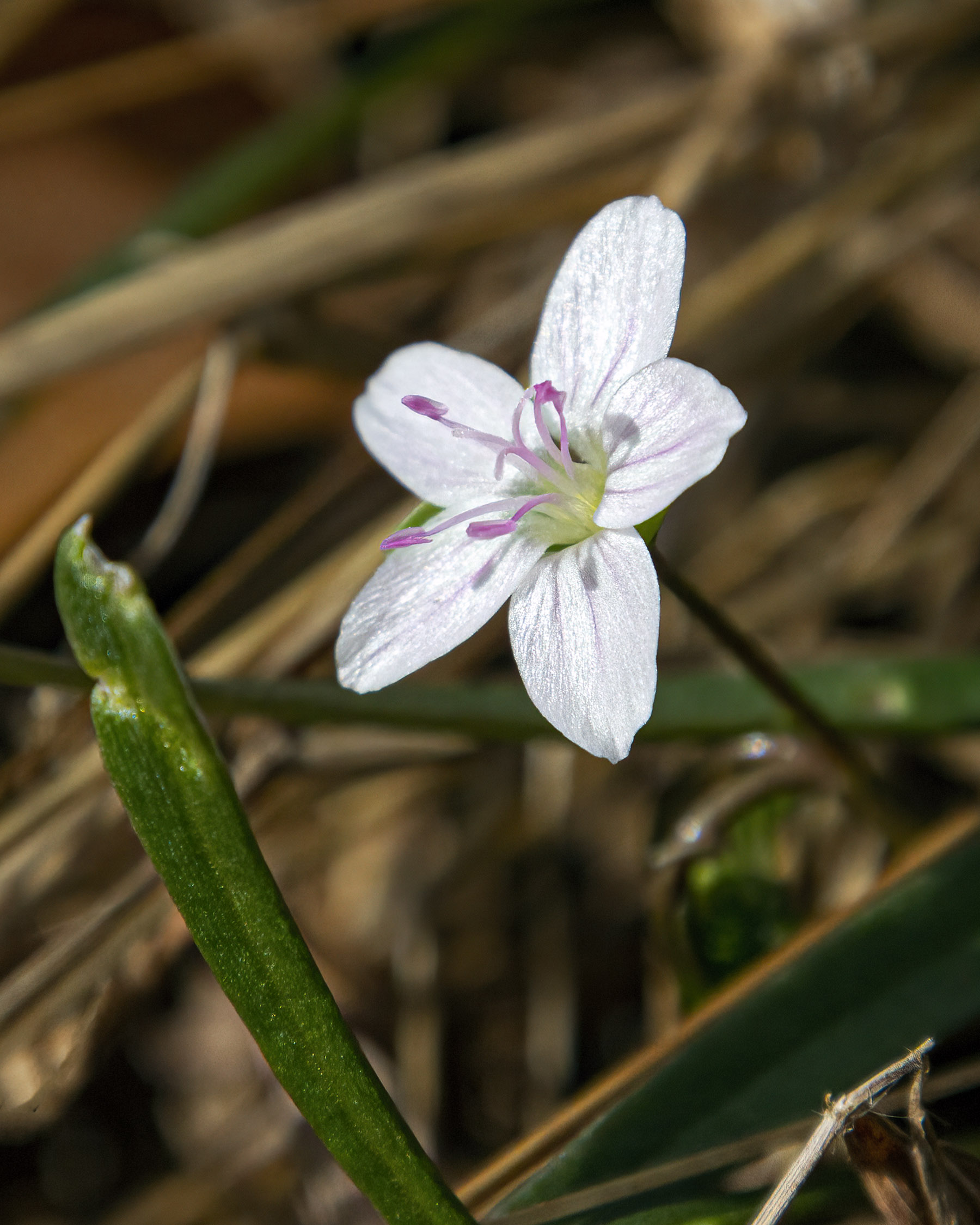
For a brief period in the spring, the forest floor is carpeted with wildflowers. It is still a little early for most of the wildflowers to appear but on Wednesday I spotted a few early blooming ones during a hike in Prince William Forest Park in Northern Virginia.

The little wild flower in the first photo is the appropriately named Virginia Spring Beauty (Claytonia virginica). I love the pops of pink in this flower, especially the stamens. According to Wikipedia, “The individual flowers bloom for three days, although the five stamens on each flower are only active for a single day.” Yikes! I guess the Spring Beauties qualify as being “ephemeral.”

The flower in the second photo is often referred to as a Quaker Lady Bluet (Houstonia caerulea)—it is also known as the Azure Bluet. Later in the spring I am certain to encounter large clusters of this cool little flower, but on this occasion there were only a few of them. I love the simple geometric pattern of the petals that someone decided resembled the traditional hats worn by Quaker ladies.

Virginia Spring Beauty

Quaker Lady Bluet

© Michael Q. Powell. All rights reserved.

Read Full Post »

Yesterday I went on a hike at Prince William Forest Park, the largest protected natural area in the Washington D.C. area at over 13,000 acres (53 square kilometers), that is located about 27 miles (43 km) from my home. Unlike the wildlife refuge that I usually visit, which is on a coastal plain, Prince William Forest Park, as its name suggests, is heavily wooded and it is quite hilly. I love to walk along the many creeks and streams that crisscross the park—the sound of the flowing water always has a therapeutic effect on me.

I was thrilled to spot this beautiful Question Mark butterfly (Polygonia interrogationis) as it perched on some leaves in a marshy area adjacent to one of the creeks. I could not tell for sure, but it looked like this butterfly was sipping water, possibly gathering nutrients from the soil. Question Mark butterflies and their punctuation “cousins,” the Eastern Commas, overwinter as adults, so they are among the earliest appearing butterflies in the spring.

Question Mark and Eastern Comma butterflies are quite similar in appearance. When the wings are fully open, as in the photo below, you can see a brown dash near the top of the upper wings that is not present on the wings of Eastern Comma butterflies.

Question Mark butterfly

© Michael Q. Powell. All rights reserved.

Read Full Post »

Yesterday I was thrilled to spot several Spring Azure butterflies (Celastrina ladon) at Occoquan Bay National Wildlife Refuge. This early-appearing butterfly is one of the tiniest butterflies in our area, with a wing span of about an inch (25 mm). Unlike Mourning Cloak butterflies—like the I featured last week in a blog posting—that overwinter as adults, Spring Azures overwinter in the pupal form, safe inside their chrysalis.

All of the Spring Azures that I saw yesterday were extremely skittish, spending most of their time in flight. Occasionally one would fly near the ground and come close to landing and then abruptly resume its flight. When they did land, the little butterflies almost disappeared into the abundant leaf litter and were tough to photograph.

Nature is coming alive as flowering trees begin to pop and new wildlife species reappear on the scene as we move deeper into March. It won’t be long before osprey, green herons, and great egrets return to our area and I hope to be seeing dragonflies within the next month. It is an exciting time of the year.

Spring Azure

© Michael Q. Powell. All rights reserved.


Read Full Post »

It won’t be long before basking turtles become a common sight, but they are still relatively rare in early March, when temperatures here dip down below the freezing level some nights. I spotted this Painted Turtle (Chrysemys picta) last Thursday at Occoquan Bay National Wildlife Refuge as it basked in the sun.

I was struck by the way the red markings on its neck stood out, even in the beautiful reflection on the surface of the small pond. Most turtles will try to find a horizontal perch to maximize exposure to the sunlight, but this turtle had to make do with with a steeply sloped spot. I could not see its claws, but I suspect that they were dug in to keep the turtle from sliding back into the water.

Painted Turtle

© Michael Q. Powell. All rights reserved.

Read Full Post »

Although it was sunny, the wind was kicking up quite a bit during my visit on Thursday to Occoquan Bay National Wildlife Refuge. Bird activity seemed lighter than usual. Perhaps the birds were all taking shelter from the wind,

At the far edge of a small pond, I spotted a Great Blue Heron (Ardea herodias) hunched over in a one-legged pose. The wind was whipping around the wispy feathers on the heron’s chest, head, and back. I encourage you to click on the photo to get a closer look at the heron’s “flyaway” feathers.

Have a wonderful weekend.

Great Blue Heron

© Michael Q. Powell. All rights reserved.

Read Full Post »
I was delighted yesterday (7 March) to spot this beautiful Mourning Cloak butterfly (Nymphalis antiopa) at Occoquan Bay National Wildlife Refuge, my first butterfly sighting of 2024. Mourning Cloaks, known as Camberwell Beauties in the Great Britain, overwinter as adults and are usually among the first butterflies to appear each spring.

Mourning Cloak butterflies, according to Wikipedia, have a lifespan of 11 to 12 months, one of the longest lifespans for any butterfly. As I noted, these butterflies spend spend the winters in us as adults, by “hiding away in cracks in rocks or holes in trees, and are able to shut down their bodies all winter long, effectively hibernating, in a manner known in insects as torpor,” according to the One Earth website.

Mourning Cloak butterflies have a distinctive look that some scientist thought looked like the traditional cloak worn in mourning. I was happy that I was able to capture the row of blue spots on the wings—another one of its identification features—in the photo of “my” butterfly.

The butterfly spent most of its time flying up and down, in and out of some trees. Eventually it perched for a moment on the ground and I was able to capture this image. It will be at least a few more weeks before I see my first dragonfly of the season, but I will soon begin to keep my eyes open for them. As many of you know, dragonflies are one of my favorite subjects to photograph and I look forward to the start of “dragonfly season” each year.

Mourning Cloak

© Michael Q. Powell. All rights reserved.


Read Full Post »

It is hard to anticipate when a Great Blue Heron (Ardea herodias) will strike. Herons have an amazing amount of patience and will often stand stationary for extended periods of time and then without much warning they will strike swiftly and violently.

Last week I was fortunate to be able to capture a sequence of shots of a heron in action at Occoquan Bay National Wildlife Refuge. I was amazed at how deeply the heron plunged its head, neck, and upper body into the water, creating quite a splash in doing so.

It seemed like the heron kept its head underwater for quite a while, but my sense of time is sometimes distorted in these kinds of situations. In any case, I impatiently waited for the heron to lift its head, anxious to see what it had caught. The heron slowly lifted its head and eventually it became clear that it had caught nothing but water. It may be my imagination, but I seem to see a mix of disbelief, dismay, and disgust in the heron’s expression in the final photo.

Undeterred, the heron returned to fishing and I moved on down the the trail, undoubtedly happier with my “catch” than the heron was with his.

Great Blue Heron

Great Blue Heron

Great Blue Heron

Great Blue Heron

Great Blue Heron

© Michael Q. Powell. All rights reserved.

Read Full Post »

I realized this morning that I do not photograph very many mammals. During the summers I tend to focus my attention on insects and during the winters I mostly photograph birds. Only occasionally will I spot some deer, opossums, hedgehogs, raccoons, or beavers.

There is one mammal, however, that I see all of the time—the Eastern Gray Squirrel (Sciurus carolinensis). Most of the time these squirrels are in motion, scrambling up and down the trees or running through the underbrush.

Last week at Occoquan Bay National Wildlife Refuge, I spotted a squirrel that was momentarily at rest and captured this image. I like the way that the coloration of the squirrel matches its surroundings. I am happy too that I was able to capture the different textures in the scene, including the fluffy tail of the squirrel, the roughness of the tree bark, and the relative smoothness of the branch on which the squirrel was perched.

Eastern Gray Squirrel

© Michael Q. Powell. All rights reserved.

Read Full Post »

It is always cool to capture an image with multiple birds of the same species, especially when they are at different stages of development. This past Monday at Occoquan Bay National Wildlife Refuge I spotted two Bald Eagles (Haliaeetus leucocephalus) perched next to each other in some distant trees.

The larger eagle on the left was clearly an adult, with a white head and yellow beak. This eagle had its head raised and was calling out loudly. In similar circumstances in the past, it appeared to me that one member of a couple was calling out to its mate. I am not at all sure if that was the case this time.

The eagle on the right is quite a bit smaller than the adult. I cannot see all of its markings, but I would guess that it is about two to three years old—it takes almost five years for a bald eagle to mature.

Was this younger eagle related to the adult? Perhaps it was a parent-child relationship. For some reason I imagined a teenager that had left home to live on its own and then decided that it wanted or needed to move back in with its parents.


Bald Eagle

© Michael Q. Powell. All rights reserved.

Read Full Post »

Can turtles smile? It is probably physiologically impossible for a turtle to smile, but this Eastern Painted Turtle (Chrysemys picta picta) seemed to be doing its best as it posed for me Monday at Occoquan Bay National Wildlife Refuge. Some of our nights are still dipping below the freezing level, but the days seem to be getting progressively warmer.

Most of the turtles are probably still spending the majority of their time in the mud at the bottom of the ponds, but a few adventurous ones have started to come to the surface to bask in the warmth of the sun on sunny days.

Eastern Painted Turtle

© Michael Q. Powell. All rights reserved.

Read Full Post »

As I was walking along a trail on Monday at Occoquan Bay National Wildlife Refuge, I happened to glance to my left  and was shocked to see that I was almost face-to-face with a Wild Turkey (Meleagris gallopavo). This turkey, along with several of his friends, was foraging in the underbrush and apparently had not heard me approaching. I immediately stopped in my tracks, fearful of scaring the turkeys away and contemplate my next steps.

Should I try to move into another position for a better shot? Should I zoom out and try capture the turkey’s entire body that was mostly hidden in the vegetation? The clock was ticking and I knew that the turkeys would soon sense my presence.

I had a pretty clear view of the turkey’s head from where I was standing, so I decided to go for a portrait close-up portrait shot. I carefully focused on the turkey’s eye and was happy to be able to capture quite a bit of detail in a profile shot when the turkey turned his head to the side.

In a funny way I felt almost like I was looking a mirror, because the turkey had a lot of wrinkles and hairs sprouting out of various parts of his head, features that have become increasingly noticeable for me as I have gotten older. When I was younger, I don’t think I realized how much hair would eventually be growing out of my nose and ears.

After I had grabbed a few shots, I move on quietly down the trail and the turkeys continued their foraging .

Wild Turkey

© Michael Q. Powell. All rights reserved.

Read Full Post »

The tide was going out on Monday when I spotted a Great Blue Heron (Ardea herodias) in the shallow waters off of Occoquan Bay National Wildlife Refuge. The heron was walking slowly, stopping periodically as it scanned the water, patiently searching for prey. I decided to stop, wait, and watch the heron.

I know from long experience that herons are very patient—it is hard to remain constantly alert for extended periods of time, hoping to anticipate the moment when the heron will strike.

On this occasion, I was able to capture some of the action when the heron plunged its head into the water. Time seemed to slow down as I waited to see what, if anything, the heron had caught. As you can see in the first photo, the heron’s catch was a modestly-sized fish. The heron flipped its head to the side to reposition the fish—herons swallow fish headfirst in a single gulp. The final photo shows the fish’s final repositioning in the heron’s long bill. A split second later the heron tilted it bill upward and the fish disappeared from sight.

As I looked a these three photos, I was struck by the way that the heron’s long head feathers moved around as it twisted and turned its head. That little detailo revived distant memories of the 1970’s when I had long hair—I remember flipping my head from time to time to keep the hair out of my eyes.

Great Blue Heron

Great Blue Heron

Great Blue Heron

© Michael Q. Powell. All rights reserved.


Read Full Post »

Yesterday was a beautiful day, with blue skies and temperatures soaring above 60 degrees (16 degrees C). I visited Occoquan Bay National Wildlife Refuge and was thrilled to have multiple sightings of Bald Eagles (Haliaeetus leucocephalus).

One eagle seemed particularly vigilant, keeping careful watch over the entire area. Initially the eagle was mostly hidden from view by the heavy vegetation, but eventually I found a visual tunnel that gave me a mostly unobstructed view of the majestic eagle.

Photographing bald eagles can be quite challenging—the extreme contrast between the bright white heads and the dark bodies means that I have to choose the exposure for the image carefully to avoid blowing out the highlights in the head or losing the details of the body in the shadows.

Bald Eagle

© Michael Q. Powell. All rights reserved.

Read Full Post »
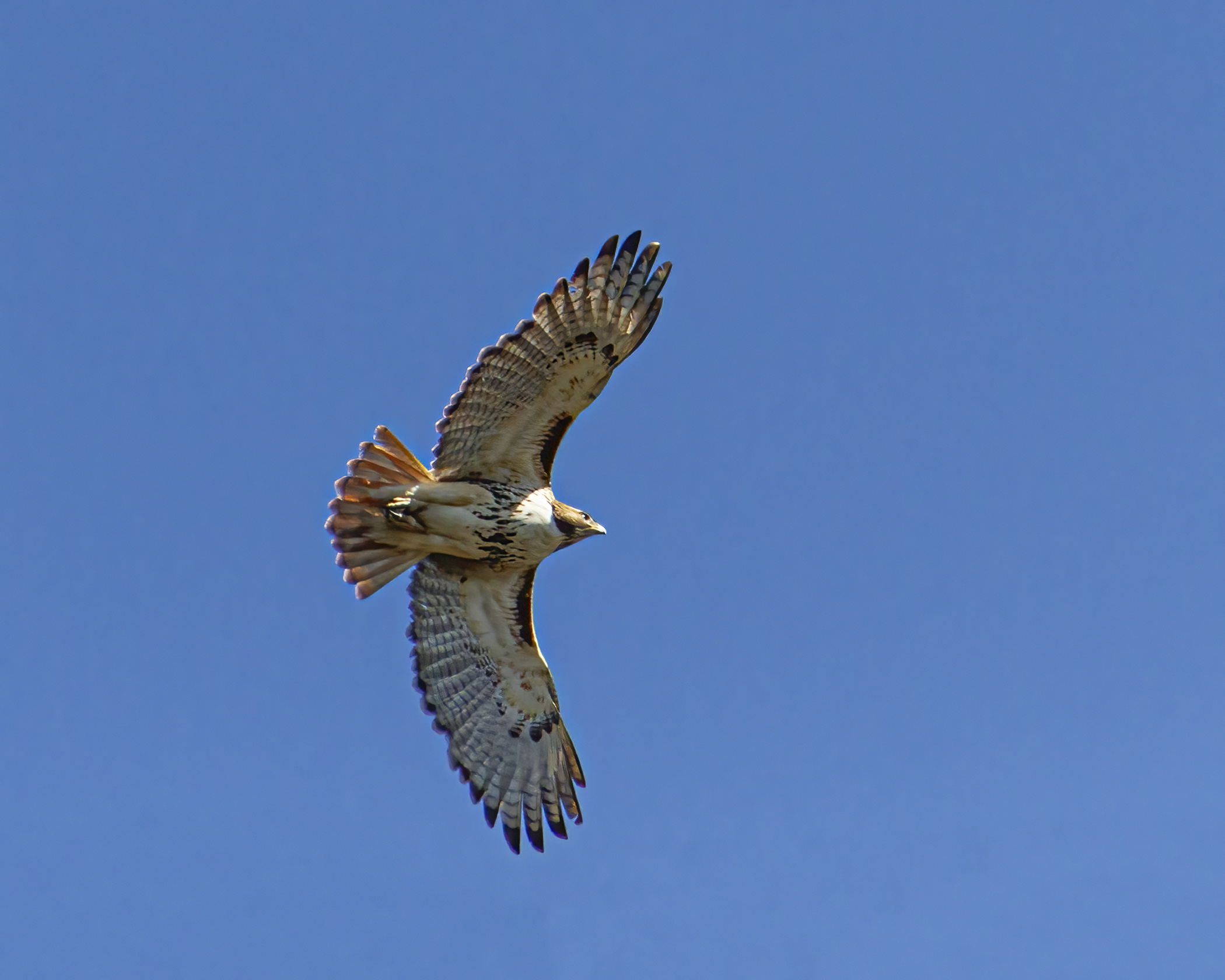
The last few days I have been really busy and have not had a chance to get out very much with my camera to capture new images. I went over the shots from my visit to Occoquan Bay National Wildlife Refuge and decided to post some more shots of the subadult Bald Eagle (Haliaeetus leucocephalus) that I photographed as it flew about, twisting and turning in the air above my head.

Previously I posted a shot of the eagle with outstretched wings (the 20 February posting was called Eagle Gyration). Today’s posting shows the same eagle in a number of other positions. I am always intrigued by the way that birds use their wings and tails in combination to move in the desired direction. Eagles make flying seem so effortless.Bald Eagle

Bald Eagle

Bald Eagle

© Michael Q. Powell. All rights reserved.

Read Full Post »
The waterside trails at Occoquan Bay National Wildlife Refuge are often flooded by tidal surges and littered with debris when the waters recede. Some of the debris, like driftwood, snail shells, and clumps of vegetation is natural, but much of it is manmade.

During a recent visit to the refuge, I was shocked to spot a different kind of shel than I am used to seeing—there were multiple used shotgun shells at one location. In some earlier postings I have noted that there are multiple duck blinds in the waters off of the wildlife refuge and during certain seasons I have seen and heard duck hunters using these blinds.

I assume that these shells floated in or were carried in by the tide from one of those duck blinds. (Do used shotgun shells float?) Hunting is definitely not permitted on the grounds of the refuge, with the exception of several days a year when the refuge is closed and deer hunting, which is part of the “deer management program,” is permitted. I am not a hunter, but recognize that there is an overabundance of white-tailed deer in our area that poses a threat to both humans on the roads and to the deer themselves, who may struggle to find food.

I tried to capture these images of the shell as artfully as possible, but the juxtaposition of the natural and manmade elements in the photos is nonetheless jarring for me, considering what the shells were designed to do.

shotgun shells

shotgun shells

© Michael Q. Powell. All rights reserved.


Read Full Post »

How good is your balance? This morning I was reading an article in AARP magazine about measuring your fitness level and one of the tests was a one-legged balance test. I tested myself and was able to hold the pose for only a few seconds. Yikes!

A Great Blue Heron (Ardea herodias) that I spotted on Monday at Occoquan Bay National Wildlife Refuge would have aced the test. The heron seemed to be perfectly stable as it relaxed in an open area adjacent to a small pond while standing on a single leg. It was a cold morning and I suspect that the heron’s other leg was tucked under its feathers to conserve body heat.

As I get older, I have become more conscious of the need for balance in all areas of my life. When I worked for the federal government a lot of lip service was given to the importance of “work-life balance,” but the sad reality was that few of my co-workers achieved that sense of balance—most of us, myself included, tended to be workaholics. Retirement has provided me a lot more freedom to use my time in a way that attempts to balance my physical, mental, spiritual, relational, and creative needs. It’s a constant juggling act, but I’m working on it.

In the meantime, I think I would do well to emulate the Great Blue Heron and practice my one-legged pose some more.

Great Blue Heron

© Michael Q. Powell. All rights reserved.


Read Full Post »

When I watched a Bald Eagle (Haliaeetus leucocephalus) fly into a nest on Monday at Occoquan Bay National Wildlife Refuge, I was not sure if it was occupied. We have reached the time of the year when the eagles at this refuge begin to sit on their eggs, but I did not know if the process had begun at this small nest that was used for the first time last year. As you can see in the first photo, the nest is only about as wide as the eagle’s outstretched wings.

After the eagle had landed and settled down, the body of a second eagle appeared from within the nest. I never did get a good look at the second eagle, because it kept its head down as it made some adjustments in the nest while the newly arrived eagle waited patiently to take over nest responsibilities.

One eagle flew away and the remaining one sank lower from view as it spread its body to cover the eggs. The nest is quite shallow, though, so I could still see the top of the eagle’s head most of the time. Occasionally the eagle would raise its head a little and I was able to capture a few shots like the final one here in which the eagle was looking up into the sky, wondering perhaps when its mate would return to the nest.

Bald Eagle

Bald Eagle

Bald Eagle

© Michael Q. Powell. All rights reserved.

Read Full Post »
I raised my camera to my eye when I spotted a Carolina Chickadee (Poecile carolinensis) extracting seeds from spiky Sweet Gum balls on Monday at Occoquan Bay National Wildlife Refuge. As I pressed the shutter release, the chickadee took off and I captured this fun photo of the departing little bird.

I really like the way the head is tilted upward and how the tiny claws are still extended. Most of all, though, I love the way that I was able to capture the feather details in the extended wing.

Sometimes it is better to be lucky than good—this was definitely not the shot that I thought I was taking.

Carolina Chickadee

© Michael Q. Powell. All rights reserved.


Read Full Post »

It takes about five years for a Bald Eagle (Haliaeetus leucocephalus) to develop into adulthood and acquire the bright white heads and tails that we generally associate with this species. When they are young, the eagles have dark feathers and beaks and during the intermediate years their feathers have a mottled appearance.

Yesterday I watched a subadult eagle flying about in the skies over Occoquan Bay National Wildlife Refuge. Judging from its coloration, I’d guess that it was about three to four years old.

The eagle put on quite an aerial show for me, twisting and turning in an amazing display of aerial prowess. I was particularly impressed by the way that the eagle would stretch wide its wings and flare its tail as it changed directions, as you can see in the photo below.

When an eagle or any other raptor is moving about like that, it is quite a challenge to track it and keep it within the frame. Suffice it to say, I have quite a few shots in which the eagle is partially cut off at the edge of the frame or occasionally is completely absent from the photo.

Bald Eagle

© Michael Q. Powell. All rights reserved.

Read Full Post »

« Newer Posts - Older Posts »