Feeds:
Posts
Comments

Posts Tagged ‘Canon 55-250mm zoom lens’

The length and small size of damselflies make then a challenge for me to photograph clearly. Moreover, it is my experience that they rarely choose to land in places where I can isolate them against an uncluttered background. Yesterday I was fortunate when this Bluet damselfly perched near the end of an interesting budded branch overhanging the water and I managed to get a shot that I like.

Bluets are a whole group of damselflies of the genus Enallagma that often are very difficult to identify down to the species level, so I don’t feel back that I can’t decide whether or not this is an Atlantic bluet or an American bluet or some other kind. Apparently the only way to tell them apart is to capture them and examine them with a magnifying glass. In my case, I am not sure a magnifying glass would help.

I am thinking of buying a guide to dragonflies and damselflies that I can study during the winter so that I’ll be better prepared next year to identify more correctly some of the subjects that I shoot (and I love to photograph dragonflies and damselflies, challenges notwithstanding.

Bluet damselfly in mid-September

© Michael Q. Powell. All rights reserved.

Read Full Post »

Blue Dasher dragonflies seem to have disappeared from my local marshland, but I was happy today to see that the Common Whitetail dragonflies (Plathemis lydia) are still around. They are not as elegant and colorful as some other dragonflies and are somewhat stubby and drab (and, in fact, are called “common”). My portrait below shows, however, that they possess their own special beauty.

Common Whitetail dragonfly in mid-September

© Michael Q. Powell. All rights reserved.
Read Full Post »

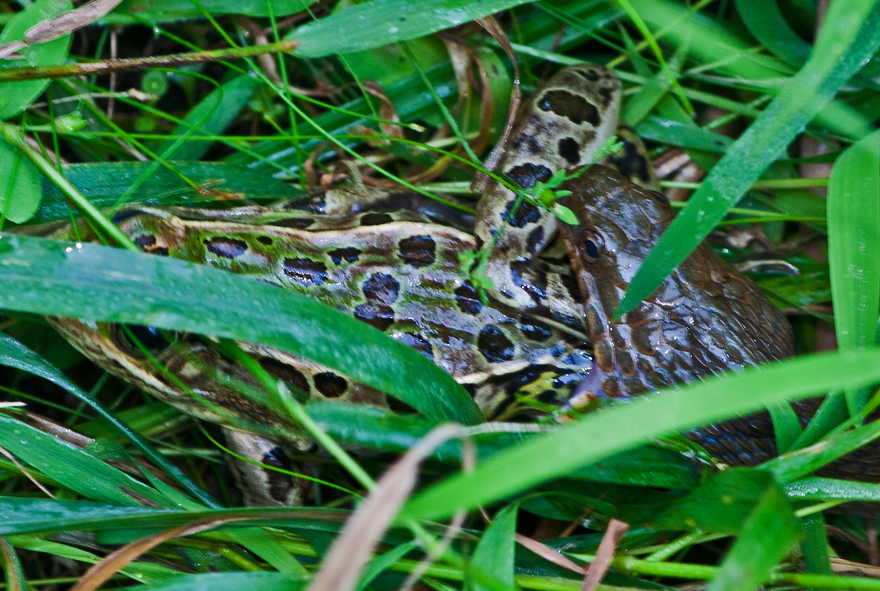
Walking along a boardwalk in the center of a marsh, I suddenly heard a sound that I had never heard before, a strange and eerie squeak. I had no idea of the source of the sound, but a man who was walking by with his family pointed it out to me. It was a frog that had been captured by a snake and was slowly being swallowed whole.

I leaned over the edge of the boardwalk and tried to take some shots of this terrifying spectacle, but there was too much grass between me and the two protagonists in this drama for me to get a really clear shot. The shot below shows the snake working to get past the frog’s hind legs. As you can see, the snake is swallowing the frog beginning with the legs. In a previous post, I showed a green heron swallowing a frog. The heron slid the frog down his throat in a single gulp beginning with the head. The process with the snake was more protracted and therefore more gruesome.

Eventually it was over. I continued on with my day, feeling a mixture of awe and horror for what I had just witnessed.

Frog being swallowed by a snake (click for higher resolution)

© Michael Q. Powell. All rights reserved.

Read Full Post »

I was at a local garden when I happened to hear this bird singing. My bird identification skills are so weak at this point that I won’t even hazard a guess about what kind of bird he is (I seem to be wrong more than I am right, with the exception of really common birds like robins and cardinals). His song was pleasant, however, and his brown eyes were captivating. He was perched up high enough that the sky provided a clear background and the green leaves and bright red berries added some interest and color in the foreground, although they partially hide his body. I like the way the shot turned out and it required only a minimum amount of cropping.

I finally managed to get a decent bird image in relatively good focus. What happened? I’m learning that I need plenty of light with the camera and lenses that I have to get an optimal image and I need to avoid the extreme end of my telephoto zoom and aperture range too.  Most of all, I need to be really lucky.

© Michael Q. Powell. All rights reserved.

Read Full Post »

My day began with a brightly colored Monarch butterfly in a field of flowers and is ending with the more subdued colors of an Appalachian Brown butterfly (Lethe appalachia) perched on a tree. Together they provide us with some sense of the diversity of the coloration and habitats of butterflies. (I confess that I am not certain of the identification of the brown butterfly, because there are a number of species that are pretty similar.)

Perhaps you like to stand out from the crowd and the gaudy colors of the Monarch are more your style.  Maybe you prefer to blend in a little better like the Appalachian Brown and find its colors and patterns to be more refined and dignified.

Whatever your taste, there is almost certainly a butterfly that fits you and I encourage to join me in chasing the butterflies through the woods, the gardens, and the meadows.

Appalachian Brown butterfly in early September

© Michael Q. Powell. All rights reserved.

Read Full Post »

Growing up in New England, I used to love this time of the year, when the fall foliage featured brilliant displays of red, orange, and yellow. I now live outside of Washington, D.C. and somehow the colors don’t seem as intense (and the colors change a lot later in the fall season). Sometimes, it seems that we simply fade to brown.

I was thrilled earlier this week to find relief from the fading fall colors when a flash of bright orange grabbed my attention. Somehow I thought it was too late in the season and that the weather was too cool for butterflies, but I was wrong. A Monarch butterfly, in all of his brilliant glory, was busily at work, flitting from flower to flower.

This fall I probably will not see the amazing oranges and yellow leaves of my childhood memories. The presence of  those same fall colors in the wings of a butterfly, however, help to trigger those memories. Isn’t it amazing how certain sights, sounds, colors, or smells can transport us back to a different time and a different place?

Monarch butterfly in mid-September

© Michael Q. Powell. All rights reserved.

Read Full Post »

Recently I have become fascinated with spiders, and in particular the Black and Yellow Garden Orbweaver spiders (Argiope aurantia). I’ve spent an amazing amount of time observing them and their webs. Already I have posted photos of the spiders themselves, their webs, and several types of prey that they have captured and wrapped in silk.

This past Monday I observed what I think was a spider actually feeding on a victim that I can’t quite identify. For some reason I used to think that spiders ate solid food, but now I understand that they have a mostly liquid diet. According to an article at earthlife.net, the mouth parts of these spiders have a serrated edge to cut into the prey and a filtering edge covered in fine hairs that prevents solid particles from entering the spider’s mouth. This filtering system is so fine that only particles smaller than 1 micron (0.001 of a mm) can pass through. The spider’s venom has enzymes which can help liquify the insides of a victim and the spider may also excrete digestive juices onto the victim. Spiders then have a sucking stomach that helps them ingest the liquids.

Argiope aurantia feeding on captured prey

Sharp-eyed viewers will notice that I rotated the image 90 degrees counterclockwise to make it easier to see what is going on. Note the positions of some of the spider’s legs as she cradles her victim. If you click on the image, you will get a higher-resolution view of the spider. My apologies if I have been too graphic in describing this spider’s digestive process.

© Michael Q. Powell. All rights reserved.

Read Full Post »

It’s only a grasshopper, not an exotic insect, but I really like the way that his portrait turned out.

The grasshopper’s pose suggests that he is ready for action and his slightly cocked head helps to give him personality. I was able to get sufficient depth of field and sharpness by using an F8 aperture, ISO 200,  and 1/200 sec and by moving in a bit from the far end of my telephoto zoom (I was at 229mm of a 55-250mm lens). Both the foreground and the background are simple and are made up of a minimum of colors, mostly green and brown. The day was mostly cloudy, so the shadows are soft.

All these elements seemed to work in harmony and I was able to produce this nice, open-air portrait of a grasshopper.

Grasshopper portrait (click for a higher-resolution view)

© Michael Q. Powell. All rights reserved.

Read Full Post »

Birds were out this past Monday and once again I went through the mostly frustrating process of trying to get some shots. I managed to get this unintentionally soft-focused image that I like. The angle of the shot is strange and the bird seems almost distorted, possibly because of the way in which he is sticking out his neck, but I love the blue markings on the wings. The blue color, in fact, helped me to identify the bird as most likely a Cerulean Warbler (Setophaga cerulea) for it turns out that there are not that many blue-colored birds.

UPDATE: Joel Eagle has corrected my false identification. It’s a Nuthatch, not a Cerulean Warbler. The name may not be as cool-sounding, but the bird is still as beautiful. Check out Joel’s blog “Pops & Mojo Photos” for some wonderful insect photos (and birds too).

Nuthatch

© Michael Q. Powell. All rights reserved.
Read Full Post »

The weathermen say that is is going to rain almost all day today. That is good news, because we have had a really dry summer. It means, however, that the colors of the day are more likely to be drab and subdued.

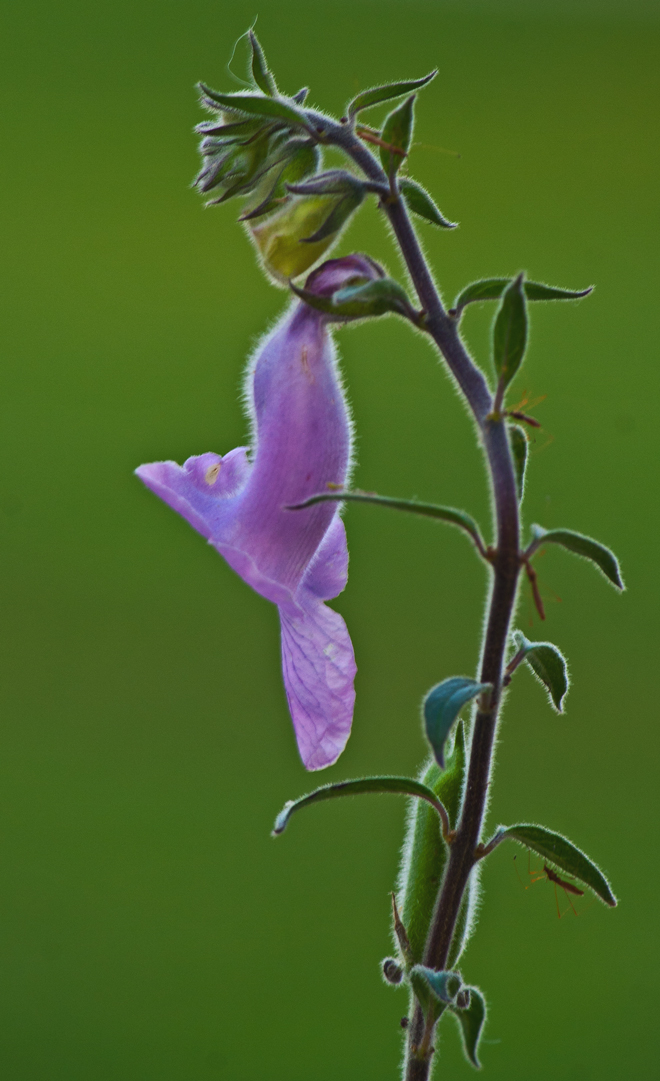
This weekend I visited Green Spring Gardens, a county-run, historical park, and was excited to see that new flowers are blooming as we move into fall. It is well-documented that I have trouble identifying my photographic subjects and flowers are no exception. I don’t know the name of this pink flower that I photographed, but I like the way the image turned out. The composition is simple and graphic and the fuzz on the leaves and the blossom cause them to glow a little.

It is my hope that this dash of pink will help to counteract the blues that sometimes creep in on rainy days. The Carpenters were not necessarily correct when they sang, “Rainy days and Mondays always get me down.”

Pink flower

© Michael Q. Powell. All rights reserved.
Read Full Post »

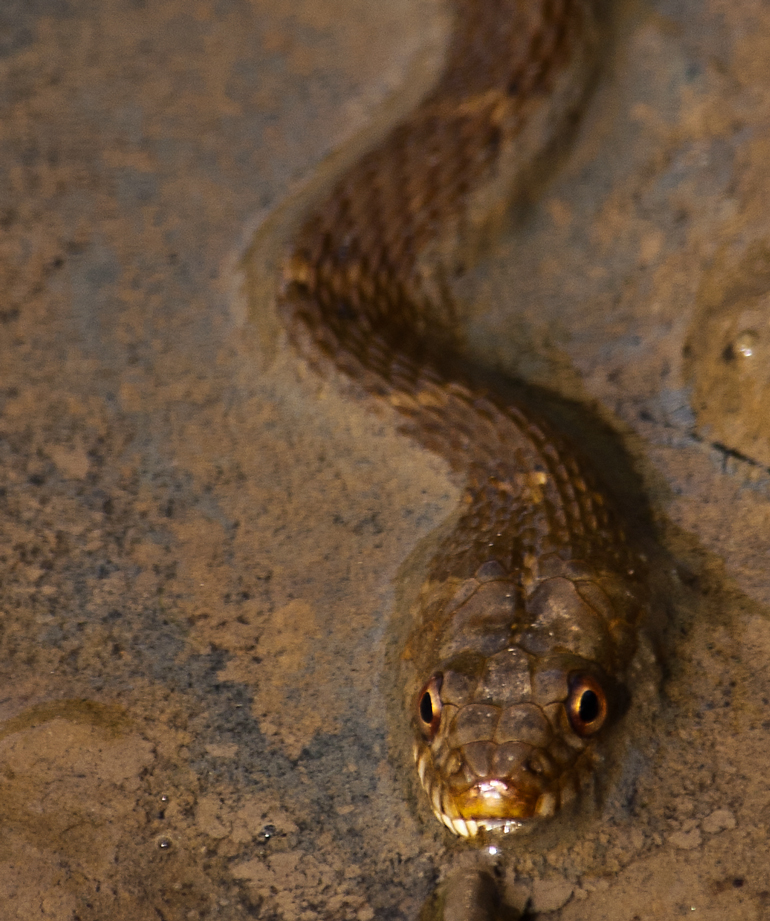
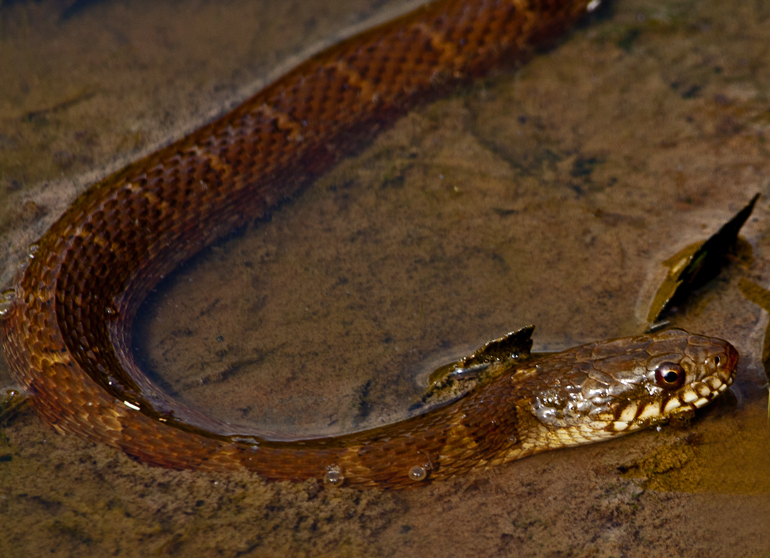
Throughout this dry summer, the water level in the marsh area of Huntley Meadows Park has continued to drop. I was shocked to see how low the levels were today. In an area where the water had previously been deep enough to support large snapping turtles (an open area outside of a beaver lodge), I now saw snakes, at least four or five of them. They were swimming in the shallow water and even burrowing into the soft mud in search of food. I am pretty sure they were all Northern Water snakes (Nerodia sipedon), a fairly large, non-venomous snake.

Face-to-face with a Northern Water snake

As I was watching the snakes, a couple came by and they said that they sometimes like to pick up these kind of snakes, examine them, and then release them. In passing, they mentioned that the snakes will bite hard and will release musk when handled. I don’t know why they thought I wanted to play with the snakes (trust me, I had no such desire), but they warned me not to be surprised if the bite wound bled a lot. According to the Wikipedia article on Northern Water snakes, the snake’s saliva contains a mild anticoagulant.

Northern Water snake, full-body shot

I did not see the snakes catch any prey, but the Wikipedia article states that during the day they hunt among plants at the water’s edge, looking for small fish, frogs, worms, leeches, crayfish, salamanders, birds, and small mammals. At night, they concentrate on minnows and other small fish sleeping in shallow water.

Northern Water snake focusing on a potential prey

One other interesting fact about the Northern Water snake is that—unlike many other snakes—they do not lay eggs. According to one academic article, the mother carries the eggs inside her body for three to five months and, on average, gives birth to 26 babies, each about 7-9 inches long. Once they are born, the babies are on their own; the mother does not care for them at all.

© Michael Q. Powell. All rights reserved.

Read Full Post »

If you ever get invited to dinner by a Monarch caterpillar, you know what will be on the menu—milkweed. Monarch caterpillars consume amazing quantities of milkweed (and nothing else), growing over 2,000 times their original mass during this 14-day phase of their lives, according to Rick Steinau.

Almost everything you read emphasizes that milkweed is toxic to humans (and to animals), but scienceviews.com notes that native peoples all over the United States and southern Canada used milkweed for fiber, food, and medicine. The article warns that milkweed may be toxic “when taken internally without sufficient preparation.” It is especially fascinating to read of the medicinal uses of the plant. It was used to treat backaches and bee stings, to induce postpartum milk flow, and to deal with a variety of stomach problems. The Meskwaki tribe, according to the article cited above, even used milkweed as a contraceptive, that worked by producing temporary sterility.

Milkweed, however, contains cardiac glycosides that are poisonous to humans and livestock, but also may account for its medicinal effect.  Symptoms of poisoning by the cardiac glycosides include dullness, weakness, bloating, inability to stand or walk, high body temperature, rapid and weak pulse, difficulty breathing, dilated pupils, spasms, and coma. (It sounds a lot like being in love!)

I don’t care how well Monarch caterpillars can prepare milkweed, if they invite me over for dinner, I think I’ll probably refrain from eating and just watch them eat (as I did this past weekend). I love Monarch butterflies in all their forms. Nevertheless, I would take my cue from the artist Meat Loaf, who sang, “I would do anything for love, but I won’t do that.”

Monarch caterpillar feeding on milkweed

© Michael Q. Powell. All rights reserved.
Read Full Post »

The weather is getting cooler and it’s getting darker earlier, but it’s nice to see that there are still lots of insects around to photograph. Here’s a recent shot of a bee, still busily at work in mid-September.

Bee in mid-September

© Michael Q. Powell. All rights reserved.

Read Full Post »

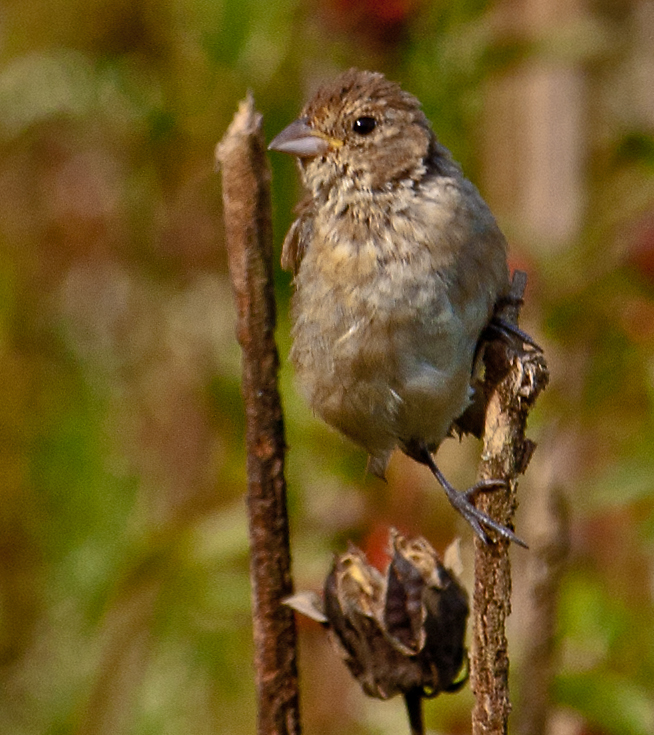
Do you ever take a photo and like the way the background turns out so much that the primary subject becomes of secondary importance?

I mentioned in an earlier post the difficulty I have in photographing birds. This was a shot from the same day I photographed the cardinal. I’m not really sure what kind of bird this is, but I like the fact that I got a relatively clear shot of the bird. More than that, though, I like the impressionist look of the background.

Can anyone identify this bird?

Unidentified bird

© Michael Q. Powell. All rights reserved.

Read Full Post »

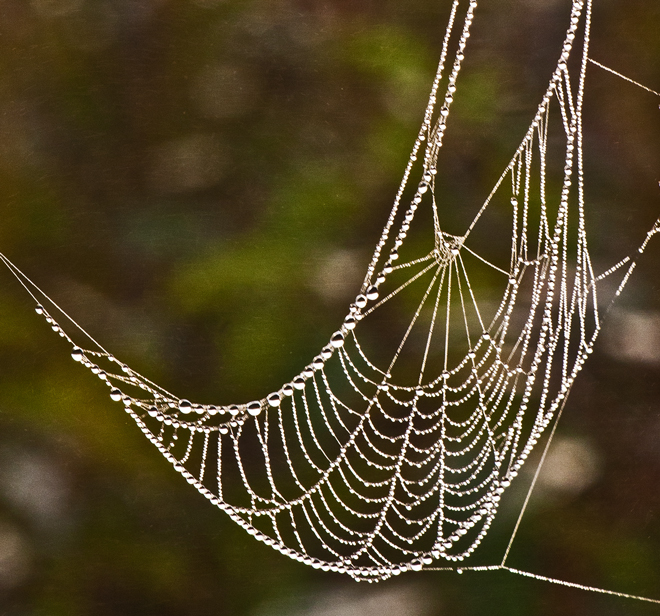
I’ve already posted some photos of spider webs from last Friday morning when I visited Huntley Meadows Park. When I looked over the photos again today, however, I realized I have some more pretty good ones. Once again I am struck by the complexity and the diversity of the webs. Some have primarily straight lines and others have mostly curves. Some are large and intricate, others are smaller and simpler.

All of them are breathtakingly beautiful to me.

A view from a jail cell (not really, but it almost looks like that)

An unusually-shaped spider web

An incomplete spider web

Scallop-curved web

© Michael Q. Powell. All rights reserved.
Read Full Post »

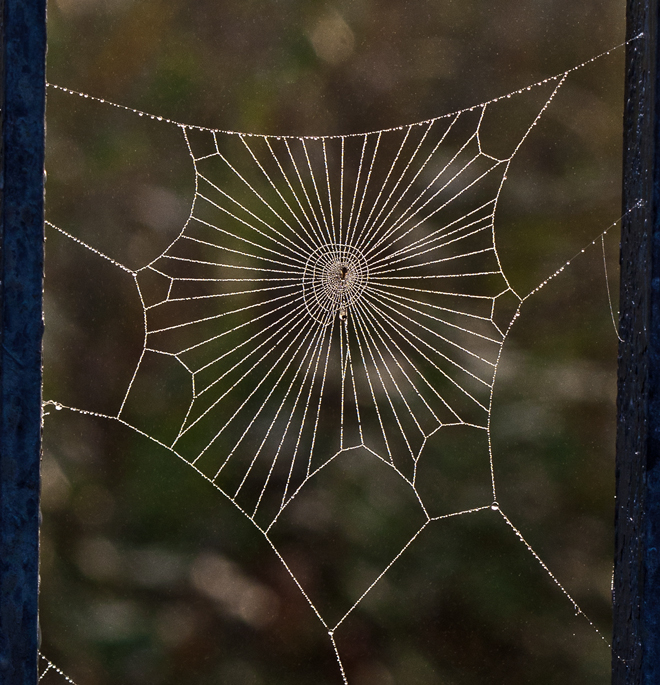
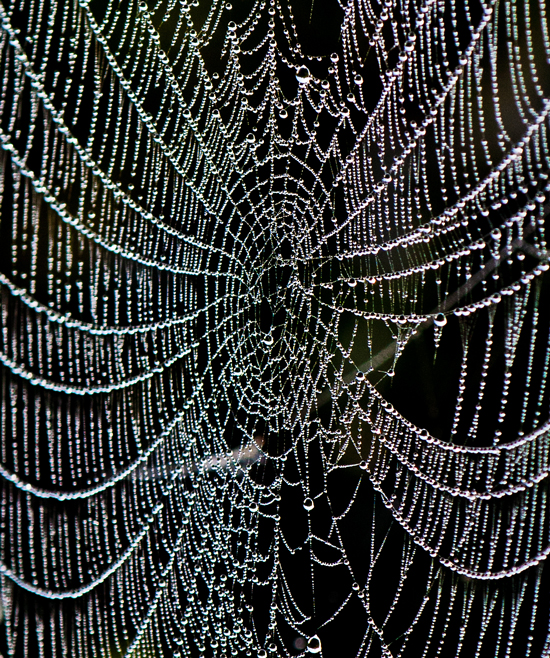
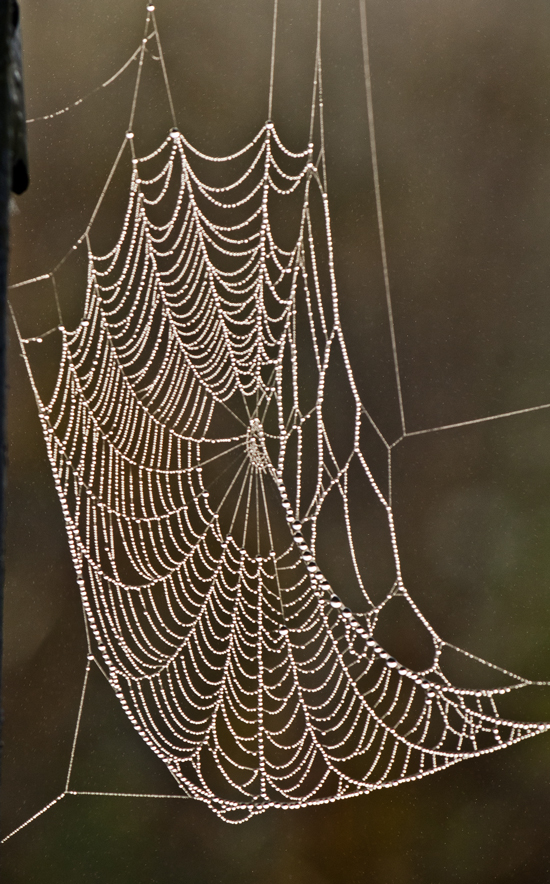
Yesterday morning I was out early with my camera and managed to capture photos of some amazing spider webs at Huntley Meadows Park. There was moisture in the air, so some of them have beautiful droplets of water. All of them, though, are incredible in their geometric complexity, in the skill of the craftsmanship, and in their individuality.

Spiders webs are incredible.

Circular spider web

Spider web between two railings

Spider web with dew

© Michael Q. Powell. All rights reserved.

Read Full Post »

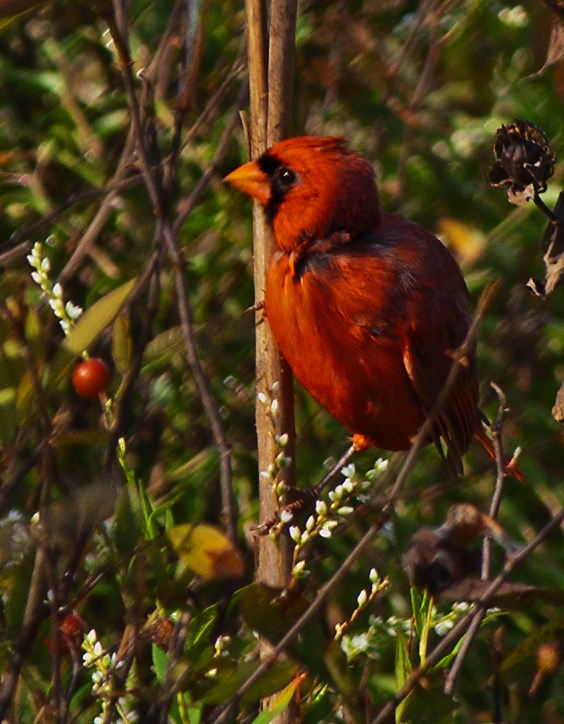
I have even greater respect for photographers who can capture clear images of birds after my experiences today. Previously I had shot a few photos of birds, but primarily in a garden setting. Today I tried to photograph some bright red birds that I think are Northern Cardinals in a meadow with lots of vegetation. Even though these birds are much bigger than the insects that I often photograph, they seemed to spook a lot easier and rarely placed themselves within the limits of my lenses. I think that I understand now why dedicated bird photographer need those huge lenses that I see them carrying. It also proved impossible for me to isolate the background (and foreground), which was often cluttered and blocked a clear view of the bird.

This is the best image I managed of the cardinal. The focus is not perfect and I had to do a mega-crop, but I like the overall look of the image and there is a clear view of the face.

Cardinal

© Michael Q. Powell. All rights reserved.
Read Full Post »

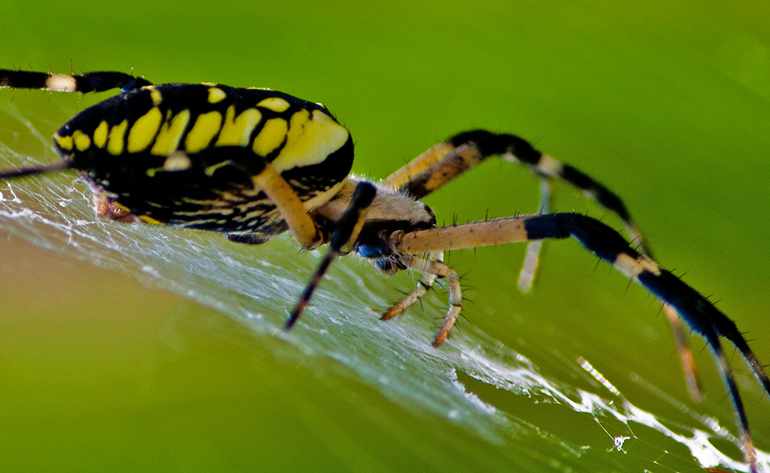
As I was going through some photos this morning I realized that I have a lot of photos of the Yellow Garden Orbweaver spider (Argiope aurantia). I have posted quite a few photos, but most have shown the spider with a prey. I came across an image of the spider by herself and started playing with it in Photoshop Elements. This first image is the result of my experimentation—it is cropped and rotated and focuses on only part of the subject. I think it is a little more dramatic thank the original image. (You can get a higher resolution view of all of the images if you click on them.)

Creeping spider

You can see below the original image after a minor crop. I remember when I took the shot that I had to twist my body around to get the desired angle of view of the spider in the center of her web, waiting patiently for prey. This morning I initially liked the image a lot and was going to post it, but then decided to rotate it 90 degrees to see what it looked like.

Side view of spider

After the rotation, it looked like the image below. It seems to me that by simply shifting the plane of view, the spider appears like more of a predator, like she is more aggressively stalking her prey rather than waiting for it to arrive. I keep going back and forth in trying to decided if I like this image more than the cropped image that I started with. What do you think? Which of the three images do you like most?

Creeping spider (full body)

© Michael Q. Powell. All rights reserved.
Read Full Post »

Why does this damselfly have its wings in an open position? That was the question that popped into my mind when I first spotted this pretty little damselfly. As far as I knew, damselflies folded their wings together when they were at rest. A little research on the internet showed that there is a family of damselflies called Lestidae (more commonly known as Spreadwings) that hold their wings at an angle from their body when they are at rest.

I decided to show the same photo in two different ways. The first image is a cropped close-up and it lets you seem the facial expression and some additional details of the body, including the drops of water on the chest and legs. As you can see, one of the disadvantages of wings that are spread is that depth of field is a problem. The second view is the image more or less as I composed it in the view finder. It shows how really long and skinny the tails are for this type of damselfly. I think that this may be a Southern Spreadwing (Lestes australis), but I am not certain of the identification because there are other varieties that look similar.

Close-up shot of spreadwing damselfly

Full-body shot of spreadwing damselfly

© Michael Q. Powell. All rights reserved.
Read Full Post »

I’m amazed at the size and intricacy of the webs of the Yellow Garden Orbweaver spiders (Argiope aurantia) whenever I see them at Huntley Meadows Park here in Alexandria, VA. This past weekend I had a chance to see how effective these webs are when a bee flew into the web of a spider that I was observing.

Previously I posted some photos of these spider with prey (a grasshopper and a cicada) that had been captured earlier and wrapped up in silk, but I didn’t really understand how the spider accomplished this. In this case, as soon as the bee touched the web, the spider moved quickly from the center of the web and in a few seconds had wrapped up its newest victim. I was so fascinated by what was happening in front of my eyes that my reaction time was delayed and I missed photographing those initial actions. However, I stayed and observed (and photographed) the spider’s subsequent actions.

The first photo below shows the spider as she is wrapping up the wrapping up of the bee. It’s a little hard to believe that the long package is just a bee, but I’m pretty sure that’s all that there is inside. (With all three photos, you can click on them and get a somewhat higher resolution view.) After the bee had finished, she left the package at the periphery of the web and returned to the center of the web, where she usually resides, probably hoping for another victim.

After several minutes wait, she returned to the bee and and began to transport it to the center of the web. In the photo below, you can see how she held the wrapped-up bee with some of her legs as she crawled along the strands of the web. The zigzag portion of the web is part of the path that leads to the center.

Once she was back in the center, it looks like she was preparing to eat her newly captured meal. I really like the varied positions of her legs in this photo as she holds on to her prey.

You may have noticed the blurry contours of another, smaller spider in the upper portion of the final photo. There were two small spiders hanging around the web and they seemed to be fighting with one another. I tried to capture that dynamic and will post a photo if I find one that is clear enough. I suspect that one of them may have been the mate of the female spider. Bugguide notes that the male of this species is considerably smaller than the female. Not counting legs, the male is usually 5-6 mm in size and the female is 14-25mm. I am not sure who the “other guy” was. Maybe he’s another male competing for the affections of this “lovely” lady. Any ideas?

© Michael Q. Powell. All rights reserved.

Read Full Post »

I have become hyper-attentive now when I walk through gardens, woods, and marshes. I have started to slow down and am more aware of my surroundings. A few months ago, for example, I would not have noticed this grasshopper climbing up the stalk of a plant. Now I can look with wonder at yet another fascinating creature, and my life is enriched by the experience.

Climbing Grasshopper

© Michael Q. Powell. All rights reserved.

Read Full Post »

Huntley Meadows Park is made up of 1,425 acres of forests, meadows, and fresh-waters wetlands and has become one of my favorite places to take photos of a wide variety of wildlife. What is most remarkable for me, though, is the fact that it is located in the midst of a heavily populated suburban area of Washington, D.C., only a few miles from where I live. I am clearly not the only one who enjoys being there. On any given day I am likely to be greeted by groups of giggling boys and girls or smaller, more sedate groups of adults, many with binoculars or cameras with very long telephoto lenses. The park’s website notes that it is a favorite location for bird spotting, with over 200 species having been identified there.

Monday was an especially beautiful day. The coolness of the fall mornings has definitely arrived and we were treated to brilliant blue skies, a relative rarity here. While at Huntley Meadows, I decided to try to capture a view of some of the elements of the park, including part of the half-mile long boardwalk that zigzags through the marshland.

Huntley Meadows Park in early September

© Michael Q. Powell. All rights reserved.
Read Full Post »

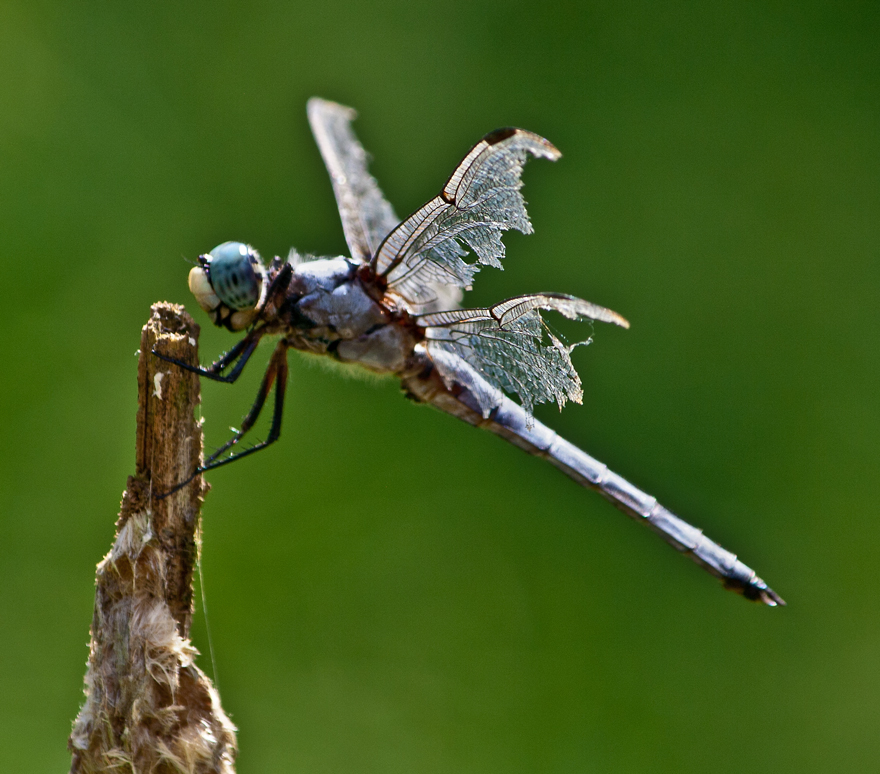
I don’t know if this Blue Dasher dragonfly is long in the tooth (do dragonflies have teeth?) or has simply had a tough life. How do you tell the age of a dragonfly? In any case, his wings are tattered and torn to such a degree that it is surprising that he can still fly. Yet I seem to detect a smile on his face, a reflection of contentment. (Yes, I know, I am guilty of anthropomorphism.)

Tattered wings,but still able to fly

I have been thinking about aging ever since Sunday when I read a wonderful column in the Washington Post by John Kelly entitled “You can learn a lot about growing old from a dog.” Kelly describes how the accelerated aging process of his dog has made him more conscious of the fact that he too is growing old. I recommend the article to all, but want to highlight the final paragraph of the column. Kelly concludes:

“Aging is unknown territory for each of us, despite the fact that humans have been doing it forever. I think there are worse ways to spend your final years than napping next to someone you love, dreaming of what was and what still might be.”

I doubt that this dragonfly will end his final days in peace and contentment like Kelly’s dog, but it is my fervent hope that we can accept the infirmities of growing old with grace and patience, and can focus—as this dragonfly appears to be doing—on the things that we are still able to do, on contributions that can make this world a better place.

© Michael Q. Powell. All rights reserved.
Read Full Post »

I love examining milkweed plants, because I always find interesting insects there to photograph. Yesterday I spotted a tiny caterpillar on a milkweed leaf that I was pretty sure was a Monarch butterfly-to-be (Danaus plexippus). The colored stripes were very similar to the one whose photo I previously posted, but this one was significantly smaller.

I decided to do some research on the life cycle of the Monarch to try to find out why this caterpillar was so small. The website butterflybushes.com has a wonderful article on the development of the Monarch. I learned that the larva is so small when it hatches that it can barely be seen, but it then consumes its body weight in milkweed leaves daily (Don’t try that at home!). During the 9-14 day larval stage, the caterpillar sheds its skin five times. Obviously this little guy is in a much earlier stage of development than the previous one, who was probably about ready to move to the pupal stage.

Here are a couple of shots of the little Monarch caterpillar that I took with my Canon 100mm macro lens.

Tiny Monarch caterpillar at rest

Tiny Monarch caterpillar eating milkweed

© Michael Q. Powell. All rights reserved.
Read Full Post »

This morning I captured this photo of a bullfrog. I was able—with gyrations that would have been hilarious to a spectator—to get almost low enough to look him eye-to-eye. I was happy also to get a reflection of the frog with a considerable amount of detail. As I was reviewing the images on my computer, I noticed the bubbles under his chin (do frogs have chins?), a delightful detail that adds a sense of whimsy to the frog. Blowing bubbles is something that I always associate with being a child, and I remember how much fun it was to blow bubbles in my drink with a straw or to blow soap bubbles with one of those little wands.

Perhaps this bullfrog was blowing bubbles in the water, remembering too when he was little, presumably in a post-tadpole phase.

Bullfrog with bubble (click for higher resolution)

© Michael Q. Powell. All rights reserved.

Read Full Post »

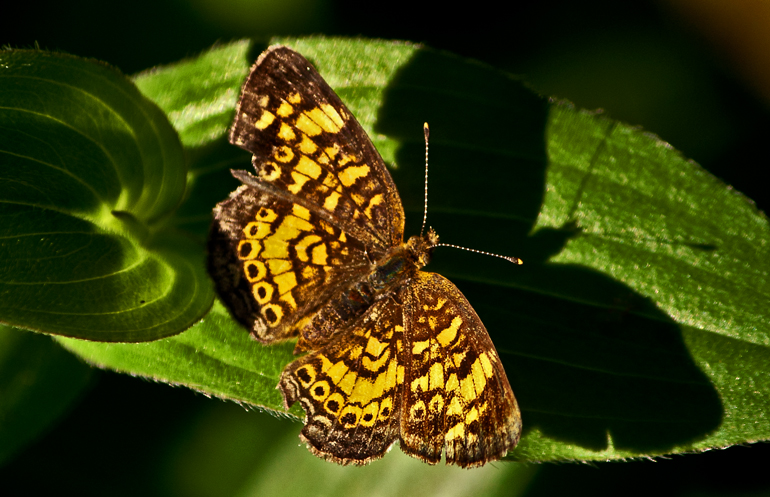
The sunlight was pretty bright late this afternoon, casting dark shadows everywhere, and I was not at all confident that I would get any decent shots. A butterfly flew into view in a partially shaded area, where he perched on a leaf. He was pretty cooperative as he kept his wings open as I made a few adjustments to my camera.

I like the interplay of light and shadows in the image below, even if the colors are somewhat muted and some of the highlights are a little blown out. I probably should admit that I love shadows almost all of the time—me and my shadows.

Butterfly shadow (click for higher resolution)

© Michael Q. Powell. All rights reserved.

Read Full Post »

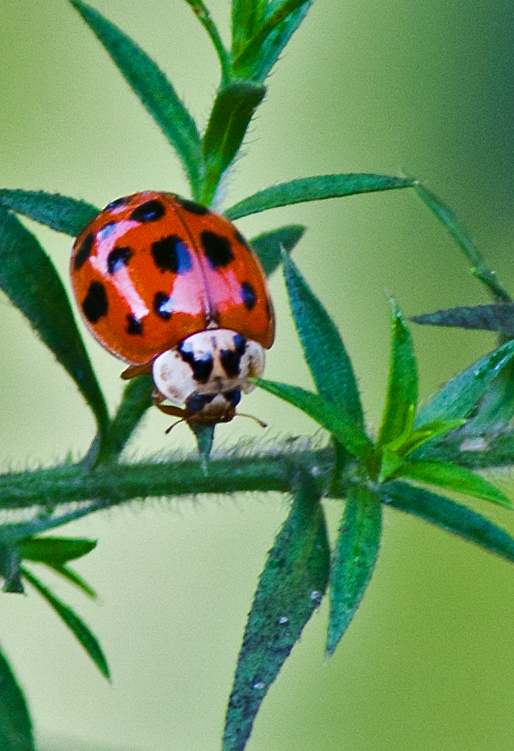
There is something about a ladybug that makes me smile. I don’t know if ladybugs trigger happy memories of my childhood, or if the bold patterns and bright colors simply appeal to my aesthetic sensibility. All I know is that I am happy when I encounter them and I am thrilled when I manage to capture their beauty in an image.

My photography mentor, Cindy Dyer, used to comment that a photo expedition was not a success for me if it did not include ladybug shots. By that modest standard, my photo shoot on Friday afternoon—just hours after a 8-hour transatlantic flight—was a definite success.

Sunday Lady

© Michael Q. Powell. All rights reserved.

Read Full Post »

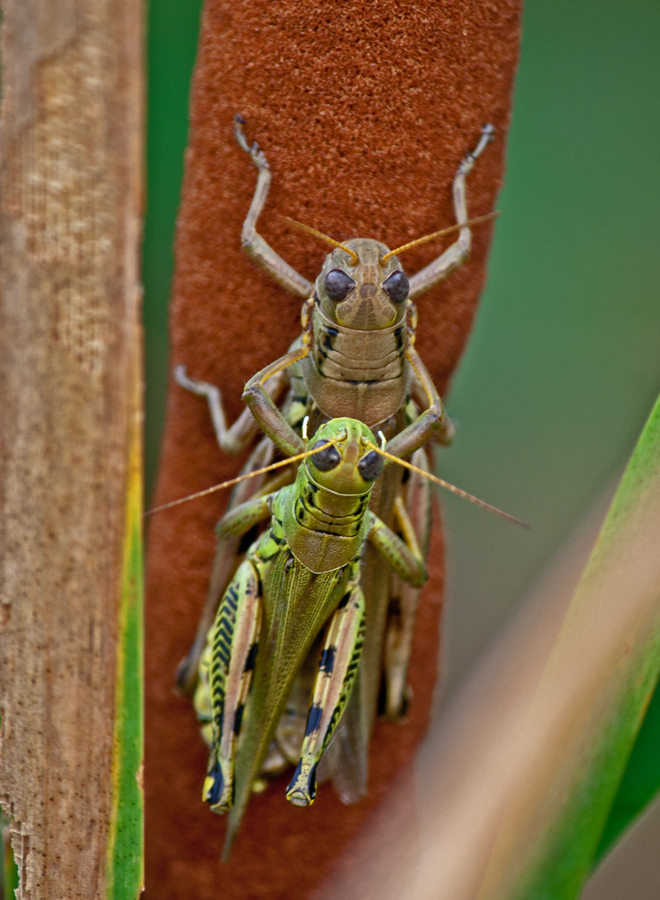
This morning as I was walking through the marsh area of Huntley Meadows Park, I happened to catch sight of this pair of grasshoppers. With any other kind of vegetation the grasshoppers would have been camouflaged, but that was certainly not the case against the backdrop of a cattail.

I was struck by the differentiation in color between the male and the female—it reminded me of my time in the Army, when there were different camouflage patterns for woodlands and for the desert.

Mating grasshoppers

© Michael Q. Powell. All rights reserved.

Read Full Post »

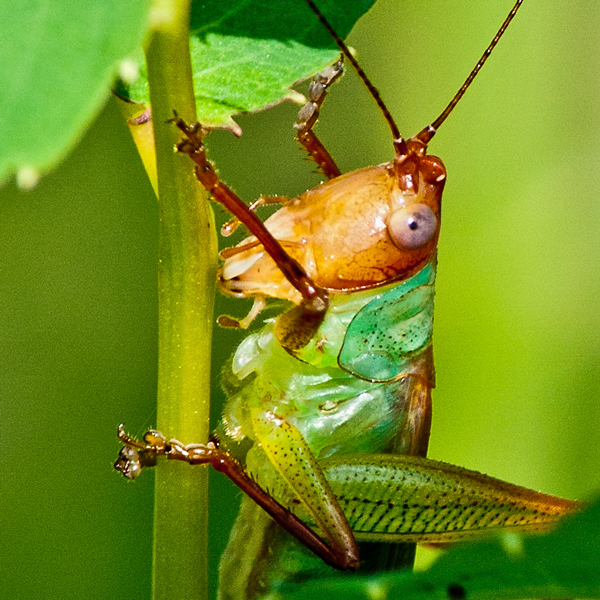
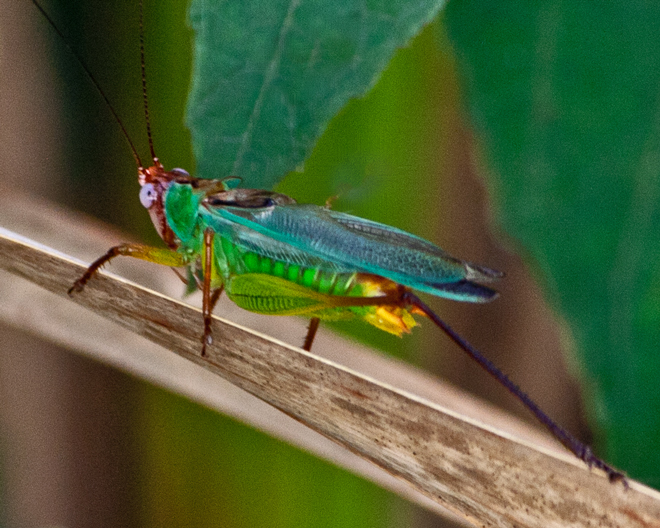
Early this morning I went out with my camera and I was happy to spot again the very colorful grasshoppers known as Handsome Meadow Katydids (Orchelimum pulchellum). As was the case the first time I spotted these neon-colored insects, I was at Huntley Meadows Parks in Alexandria, VA. I had a little trouble getting clear shots of the entire bodies of the katydids, but I managed to capture some good close-up shots of their faces. I especially like the first shot, taken looking down at him as he was munching on a leaf.

I continue to be amazed at the katydid’s vivid colors and blue eyes. Wow!

Handsome Meadow Katydid Munching on a Leaf

Close-up Shot of Handsome Meadow Katydid

Body Shot of Handsome Meadow Katydid

© Michael Q. Powell. All rights reserved.

Read Full Post »

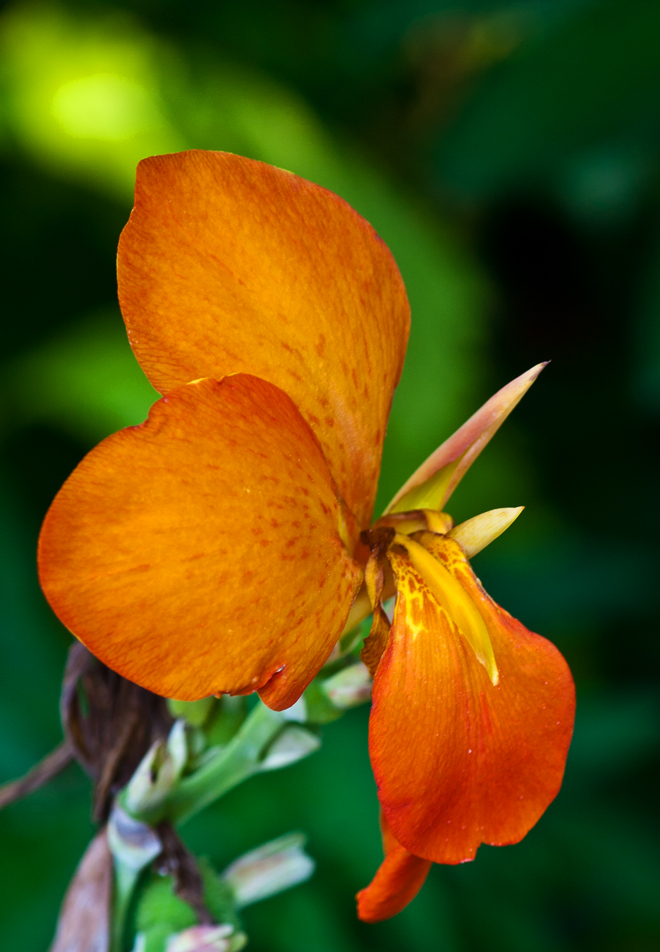
A solitary orange flower caught my eye. Its vivid color and asymmetrically arranged petals drew me in closer. Sometimes beauty is that simple.

Simply orange

© Michael Q. Powell. All rights reserved.

Read Full Post »

It felt good to have my Canon DSLR back in my hands after a week-long trip with only a point-and-shoot camera. After I arrived home from the airport this afternoon, I grabbed my camera and headed off to Green Spring Gardens, a local garden that is one of my favorite places to shoot.

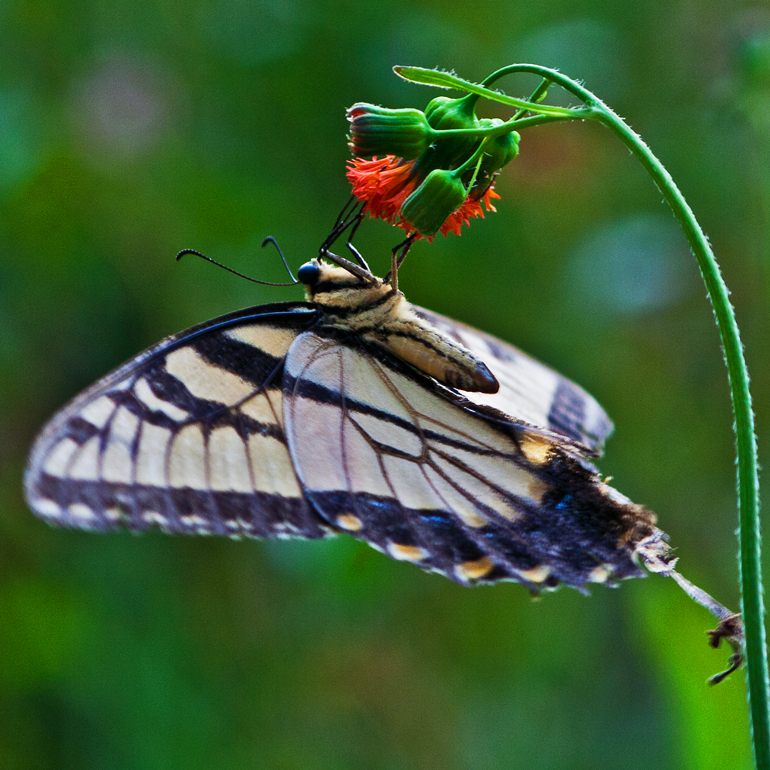
There were only some diehard flowers blooming, but there were quite a number of Eastern Swallowtail butterflies. I watched (and chased) several of them, but the one you see below was my favorite. He attacked this flower from below repeatedly, seemingly defying gravity. It just was not clear to me how he was able to suspend himself in mid-air like that. He must have been hanging on with his feet, though he seemed to be moving them constantly.

Eastern Tiger Swallowtail butterfly defying gravity

© Michael Q. Powell. All rights reserved.

Read Full Post »

« Newer Posts - Older Posts »