Feeds:
Posts
Comments

Posts Tagged ‘Calidris minutilla’

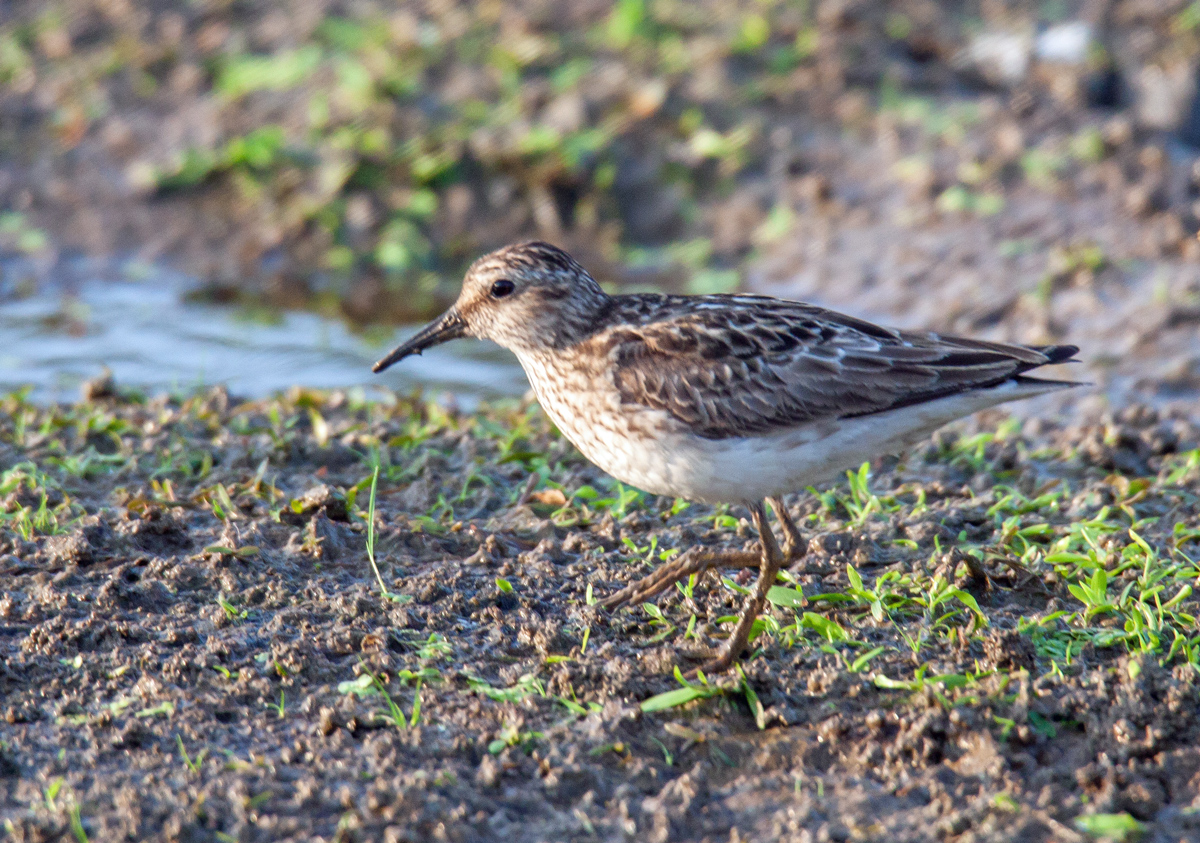
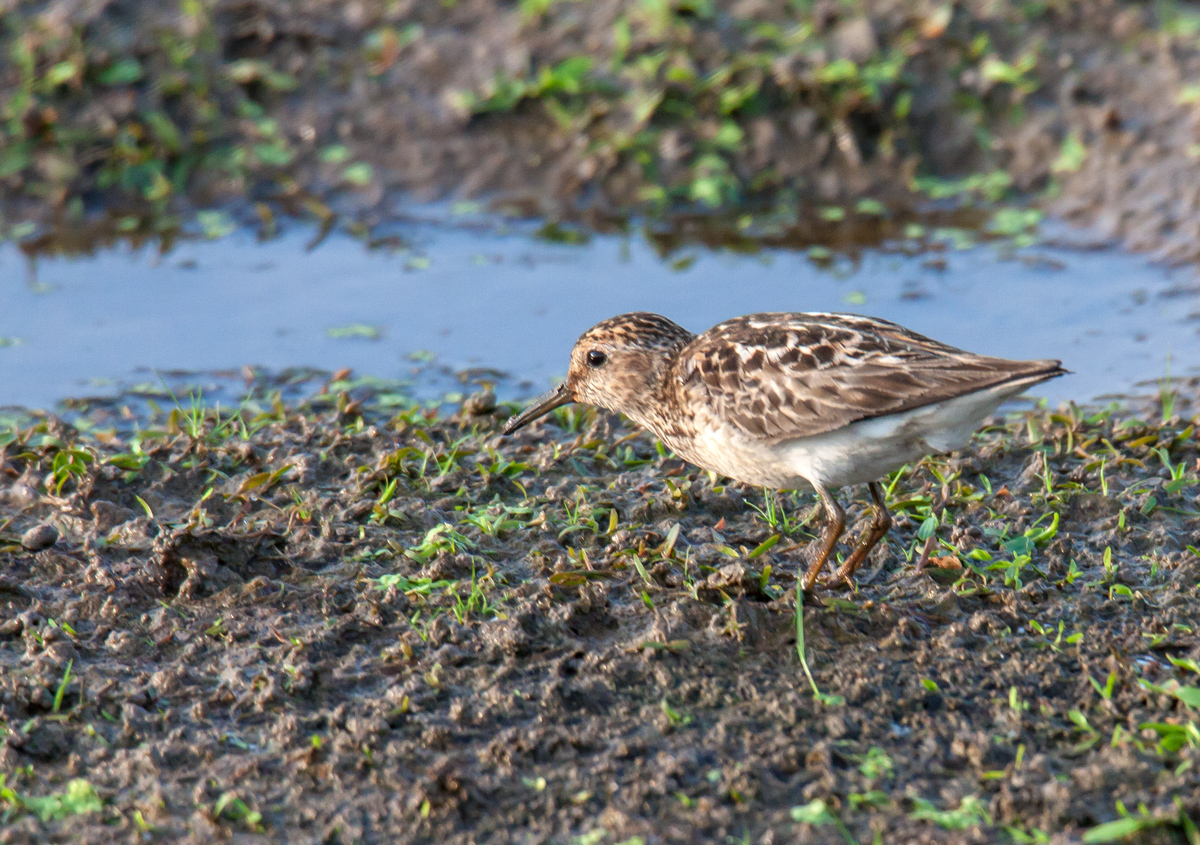
It’s probably good for the ego to have “great” in your name, like Great Blue Herons and Great Egrets. Hopefully this little bird’s self-esteem is not damaged by being called a Least Sandpiper (Calidris minutilla). I spotted this diminutive beauty last week at Huntley Meadows Park before the start of all of the recent rain. The extremely dry weather had made the water very shallow in some portions of the marsh and had attracted tiny shore birds like this one.

Least Sandpiper

© Michael Q. Powell. All rights reserved.

Read Full Post »

A group of small birds was foraging in the shallow waters of a stream and I approached them quietly, hoping to get close enough to isolate one of them with my camera. They seemed to be in constant motion and I followed them, waiting and hoping. Finally they stopped for a moment and I crouched low and took this shot of what I believe to be a Least Sandpiper (Calidris minutilla).

I thought about cropping the image a little so that the bird would not be quite as centered, but I decided that I like the ripples in the left corner too much to cut them off. What you see in this posting, therefore, is the framing as the image came out of the camera.

Least Sandpiper

© Michael Q. Powell. All rights reserved.

Read Full Post »

I can’t help but wonder if Least Sandpipers (Calidris minutilla) suffer from an inferiority complex, surrounded as they are by “Great” Blue Herons and “Great” Egrets.

Early Saturday morning, I spotted a small flock of these tiny birds at my local marsh in an area where the water levels were really low, revealing a muddy area with shallow pools of water that seemed perfect for these little wading birds. According to the Cornell Lab of Ornithology website, the Least Sandpiper is the smallest shorebird in the world, weighing in at about one ounce (28 grams) and measuring five to six inches long (13-15 cm).

I suspect that these Least Sandpipers are in the process of migration, probably eventually heading further south. At this time of the year we start to see all kinds of unusual birds that make brief stops at my local marshland on their way to more distant destinations.

Least Sandpiper

Least Sandpiper

Least Sandpiper

© Michael Q. Powell. All rights reserved

Read Full Post »

This tiny shorebird cooperated for me by posing on the boardwalk, allowing me to determine that it is a Least Sandpiper (Calidris minutilla), the smallest shorebird in the world.

Shorebirds are notoriously hard to identify, because so many of them are similar in coloration and relative size is a tough measure when a bird is not in a group. For small sandpipers, the color of the  legs is one of the key distinguishing characteristics. In this case, the yellow legs help to identify it as a Least Sandpiper and not a Western or Semipalmated Sandpiper, which have black legs. I am definitely no expert on this subject (and have no clue what Semipalmated means), but the articles on the Cornell Lab of Ornithology website are full of fascinating information about birds.

Eventually the sandpiper jumped into the water, but remained close to the shore, as if it knew that I wanted to get a few shots before it flew away. I can’t overemphasize how small this bird is at about 6 inches (15 cm), especially compared to something like a Greater Yellowlegs at 14 inches (36 cm), so I was glad it was not immediately spooked by my presence.

As someone who pays a lot of attention to grammar, I must confess that I find the name of this bird a little troubling. There seems to be be a missing adjective to go with the superlative “least.” However, I have given up trying to understand the reasoning behind the names of birds—the names are a hodgepodge of approaches, certainly not a scientific method.

The correctness of the name is the least of my worries when trying to photograph these small birds.

least2a_blogleast1a_blog

Michael Q. Powell. All rights reserved

Read Full Post »