Feeds:
Posts
Comments

Posts Tagged ‘butterfly’

I was really surprised today when I saw the the familiar shape and color of a female Eastern Tiger Swallowtail butterfly (Papilio glaucus). Somehow I had expected to see them much later in the spring.

Normally I like to try to get photos of these beautiful butterflies perched on colorful flowers, but there are no colorful flowers yet in the marsh. Unfortunately, the butterfly that I was able to photograph decided to perch on the decomposing carcass of a snapping turtle (as you can see in the first photo). Most of my other shots were at least partially obscured by the grass.

Gradually the cast of characters is coming together that will probably play leading  roles in my blog postings in the upcoming months, the birds and beasts, and the reptiles and amphibians, not to mention the plants and flowers. I can hardly wait.

swallowtail1_blogswallowtail2_blog

Michael Q. Powell. All rights reserved

Read Full Post »

I was going over some photos from earlier this month and came across these photos of a Monarch butterfly. I remember how excited I was when I shot them and decided to share a few of them. Early in the summer I took lots of photos of swallowtails, but I longed to photograph a Monarch butterfly. The first few that I saw flew away before I could raise my camera. Eventually, I managed to get some decent shots, but my pulse still quickens whenever I see a Monarch. Other insects may be cool or interesting or unusual, but for me there is nothing that really matches the beauty and elegance of a Monarch butterfly.

© Michael Q. Powell. All rights reserved.

Read Full Post »

We continue to fade to brown, with only muted color changes as the leaves begin to fall from the tree. As if to compensate for the lack of spectacular foliage, brightly colored flowers are still blooming. I managed to get some shots of equally colorful insects interacting with yellow flowers. When I see Monarch butterflies (Danaus plexxipus), they are usually in the midst of blooming flowers, but I was surprised to also see a shiny red ladybug near the center of a yellow flower.

Monarch butterfly on yellow flower

Ladybug on yellow flower

© Michael Q. Powell. All rights reserved.

Read Full Post »

As we move deeper into autumn, I expect to find the colors orange and yellow only in the fall foliage or an occasional sunset. Yesterday, I was surprised to see this orange-and-yellow butterfly flitting from flower to flower, seemingly oblivious to the changing seasons. Doesn’t he know it’s almost October? Is it eternally spring for a butterfly?

Butterfly in late September

© Michael Q. Powell. All rights reserved.

Read Full Post »

Growing up in New England, I used to love this time of the year, when the fall foliage featured brilliant displays of red, orange, and yellow. I now live outside of Washington, D.C. and somehow the colors don’t seem as intense (and the colors change a lot later in the fall season). Sometimes, it seems that we simply fade to brown.

I was thrilled earlier this week to find relief from the fading fall colors when a flash of bright orange grabbed my attention. Somehow I thought it was too late in the season and that the weather was too cool for butterflies, but I was wrong. A Monarch butterfly, in all of his brilliant glory, was busily at work, flitting from flower to flower.

This fall I probably will not see the amazing oranges and yellow leaves of my childhood memories. The presence of  those same fall colors in the wings of a butterfly, however, help to trigger those memories. Isn’t it amazing how certain sights, sounds, colors, or smells can transport us back to a different time and a different place?

Monarch butterfly in mid-September

© Michael Q. Powell. All rights reserved.

Read Full Post »

The sunlight was pretty bright late this afternoon, casting dark shadows everywhere, and I was not at all confident that I would get any decent shots. A butterfly flew into view in a partially shaded area, where he perched on a leaf. He was pretty cooperative as he kept his wings open as I made a few adjustments to my camera.

I like the interplay of light and shadows in the image below, even if the colors are somewhat muted and some of the highlights are a little blown out. I probably should admit that I love shadows almost all of the time—me and my shadows.

Butterfly shadow (click for higher resolution)

© Michael Q. Powell. All rights reserved.

Read Full Post »

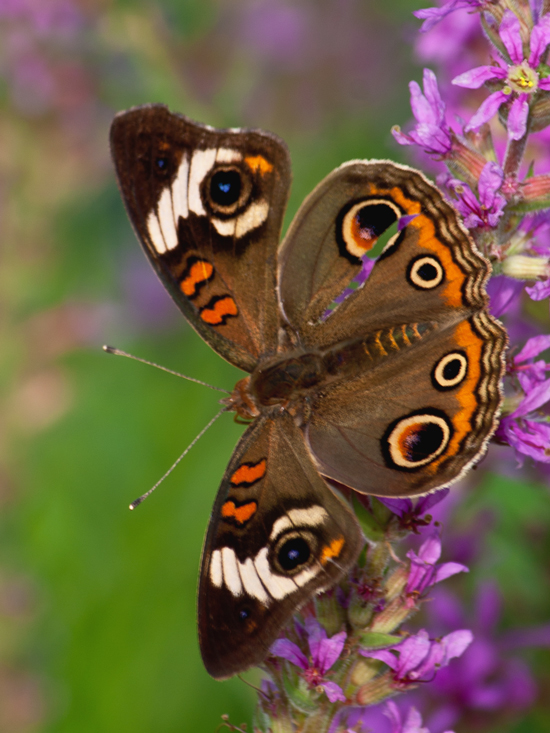
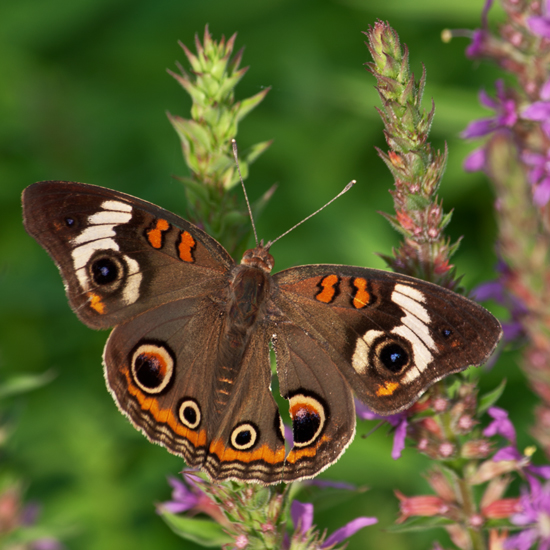
I continue to be mystified by the names of the insects that I photograph. Yesterday I spotted this very striking butterfly that I later learned is called the Common Buckeye butterfly (Junonia coenia).  What makes it common? If it’s so common, why have I never seen one before? The vivid colors and prominent eyespots make it anything but common to me.

Common Buckeye butterfly

Here’s another view of the butterfly. The internal tear in the wing makes it clear that it is the same specimen. If you want to learn more about the Common Buckeye, check out this article on the BugGuide website, which is rapidly becoming one of my favorite places to browse and research.

Common Buckeye butterfly

One interesting fact about the Common Buckeye is that it was featured on a 24-cent US postage stamp in 2006. If you want to see what the stamp looks like, visit the Arago website. Arago, named after François Arago, a 19th century French scientist and friend of James Smithson, is a resource of the Smithsonian National Postal Museum.

One of the nice things about living in the Washington, D.C. area is having access to the Smithsonian Museums, most of which have free admission.

© Michael Q. Powell. All rights reserved.

Read Full Post »

Have you ever gone through your photos so quickly that you missed your best shot?

Earlier this week I was really excited because I had finally gotten some shots of Monarch butterflies and I posted a number of photos of them. As I looked over my photos from Monday again this evening, I saw a shot that surprised me. It surprised me because it was really good and it surprised me because I missed it the first time.

Other than using unsharp mask, this is the image that came out of my camera without any cropping at all. (Naturally I downsized the resolution for the blog.) I like the composition, I like the focus, and I like the background.

It doesn’t take much to make me happy.

Monarch butterfly (click for higher resolution)

© Michael Q. Powell. All rights reserved.

Read Full Post »

Here’s a shot from this past Monday of a Clouded Sulphur butterfly (Colias philodice) at Green Spring Gardens in Alexandria, VA.

Clouded Sulphur butterfly

© Michael Q. Powell. All rights reserved.

Read Full Post »

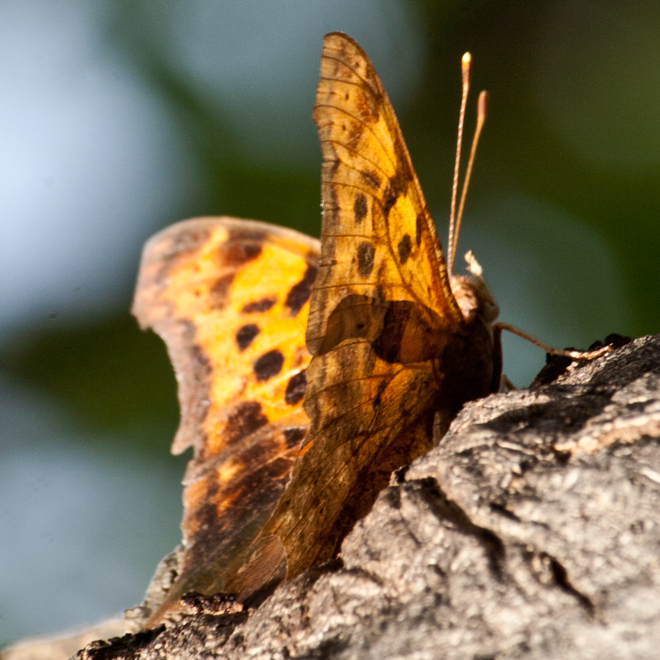
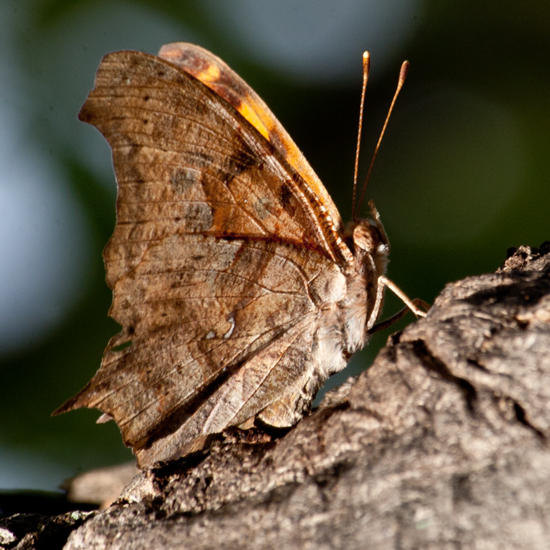
Back and forth I went as I tried to answer a simple question, “Comma or question mark?” You’re probably imagining that I was caught in some kind of punctuation dilemma, but that was not the case. No, I was not stuck in some special hell reserved for grammarians and editors, nor was I sweating out a standardized English test. Instead, I was trying to make a decision on the identity of this unusual looking butterfly that I encountered this past weekend.

Comma or Question Mark?

The colors of this butterfly almost perfectly matched the tree on which he was perched, facing downward in a way that almost perfectly camouflaged him. I rotated the image for the ease of viewers, hoping they will avoid the sore neck that I got as I turned my head trying to make out the details of the butterfly. In addition to the unusual color, the shape of this butterfly was pretty distinctive. What kind was he? As I was pondering that question, the butterfly—who had flown away and returned—opened his wings a little and I got a glimpse of the brilliant orange concealed inside his drab exterior.
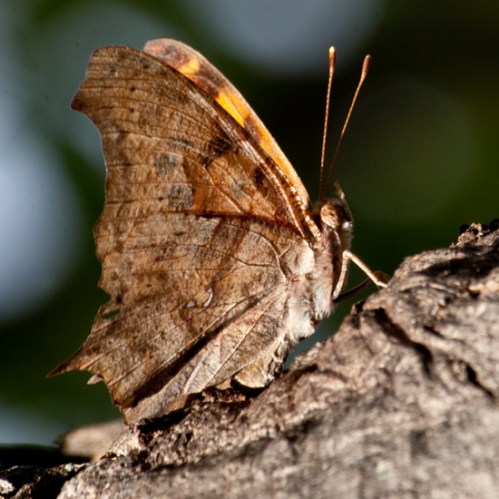
A glimpse of orange

As he slowly opened his wings, more of more of the inside of his wings was revealed. The light shining through his wings made the colors glow like those of a back-lit stained glass window.
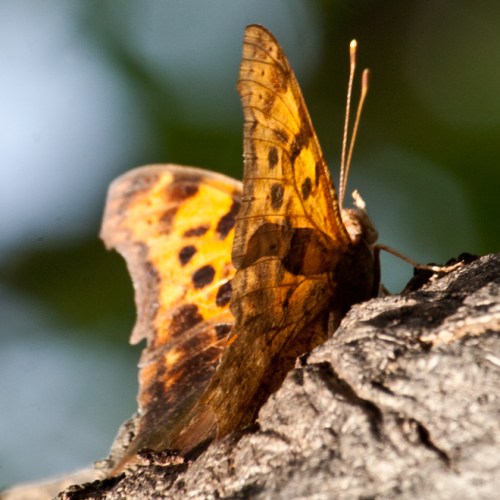
Back-lit wings

The butterfly flew away again, but amazingly returned once more and treated me to a full view of his open wings—his breathtaking beauty was revealed in full.

Beauty revealed

He sure was beautiful, but I wanted to know his name. Previously I had read about a butterfly called the Eastern Comma butterfly (Polygonia comma) and I had a vague recollection that he looked like this one. Wikipedia’s article on the Eastern Comma also helped explain why he was on a tree rather than some beautiful flower, like most of the butterflies that I have encountered. “This butterfly seldom visits flowers, but rather feeds on sap, rotting fruit, salts and minerals from puddling, and dung.”

I was still not sure of his identity, so I continued to search for clues. It turns out that there are two butterflies with similar shapes and colors. One is the Eastern Comma and the other is the Question Mark (Polygonia interrogationis), really. I feel like I am in some kind of Abbott and Costello style routine akin to their famous “Who’s on first?” routine. (Here’s a You Tube link to the classic routine if you are not familiar with it. It is definitely worth watching.)

The key to distinguishing the two is the shape of the little white markings on the wings and whether the markings are in two parts or one. If you think back to punctuation, you can probably guess that the one in two parts is the question mark and the unitary one is the comma. The website Gardens With Wings has an article with side by side photos of the two butterflies in case I have confused you.

So, which one did I photograph? I think I saw at least two different butterflies, but the one in the initial two photos and the one below all seem to have the white marking in two parts, which make them Question Mark butterflies (Polygonia interrogationis).

Question Mark butterfly

To be honest, though, the marking looks more like a semicolon than a question mark. Why isn’t there a Semicolon Butterfly?

© Michael Q. Powell. All rights reserved.

Read Full Post »
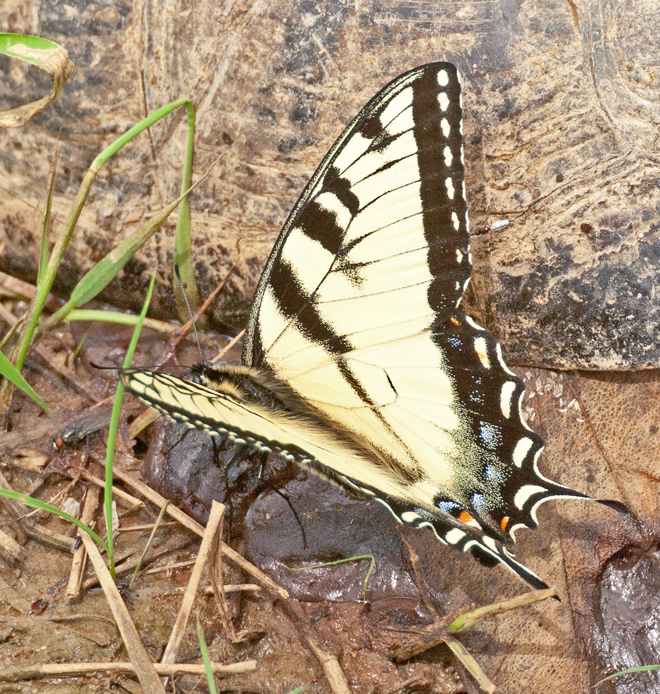
All this summer I have been waiting and hoping that I would have a chance to see lots of Monarch butterflies (Danaus plexippus). There is something so classically beautiful about the Monarch, from the white-dotted body to the gorgeous orange and black. So far this summer I had seen only an occasional Monarch.

Today, however, my wishes finally came true and I saw quite a few Monarch butterflies at Green Spring Gardens in Alexandria, VA. That does not necessarily mean that I had an easy time getting good shots of the Monarch, because the Monarchs today did not seem to like to linger very long on a flower. Consequently, more of my shots were rushed than I would have preferred.

Here is an assortment of my shots from today. None of them is spectacular, but I nonetheless am pleased I was able to capture some of the majesty of the Monarch in my images.

© Michael Q. Powell. All rights reserved.

Read Full Post »

I took this shot of a Red Admiral butterfly (Vanessa atalanta) at Green Spring Gardens in Alexandria, VA on 17 August 2012. It was a little surprising to me that the butterfly chose such a shriveled up, dead leaf as the place to stop, rather than a flower or bush. In a lot of ways, though, I like the simpler setting. It allows me to focus on the beauty of the butterfly without any competing attention from a colorful flower.

The colors and patterns of the Red Admiral butterfly would look good on a necktie. The colors are bright, but not gaudy, and the abstract patterns convey a sense of sophistication.

Red Admiral butterfly (Vanessa atalanta)

© Michael Q. Powell. All rights reserved.

Read Full Post »

Almost everywhere that I have seen flowers the last few weeks I have seen skippers. One of the few varieties that I can identify is the Silver-spotted Skipper butterfly (Epargyreus clarus) which I feature in my first photo.

Silver-spotted Skipper

Many of the other skippers, however, look almost the same to me. Wikipedia says that there are more 3500 recognized species of skippers, so I don’t feel too bad about my identification difficulties. Here’s a photo of one of the 3499 non-Silver-spotted Skippers on a sunflower.

Unidentified skipper on a sunflower

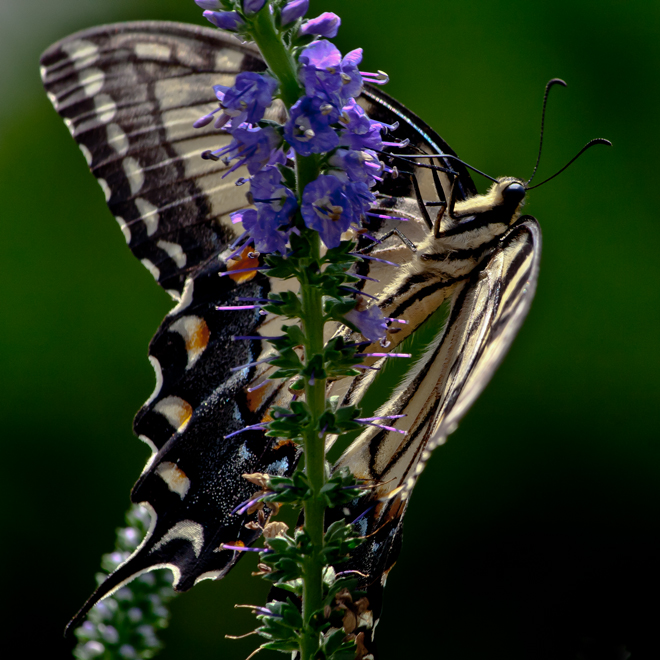
This must be the season for the Eastern Tiger Swallowtail (Papilio glaucus), because I see them almost everywhere too. I’ve posted lots of photos of swallowtails recently, but I figure that the bright color of the swallowtails will complement the more muted tones of the skippers. Besides, the different lighting and angles of the shots makes them very different photos for me, even when the subject is the same.

Male Eastern Tiger Swallowtail against the sky

Looking downward at a female Eastern Tiger Swallowtail

© Michael Q. Powell. All rights reserved.

Read Full Post »

Prior to this past weekend I had never seen an American Painted Lady butterfly (Vanessa virginiensis) and now it seems like they are everywhere, if you define “everywhere” as two separate locations within a few days.

Previously I posted a photo of the American Painted Lady butterfly in beautiful soft light in a shot taken from the side. On Sunday, just as I was getting ready to leave Meadowlark Botanical Gardens in Vienna, Virginia, I saw a flash of color and realized that it was a beautiful butterfly. Upon closer examination I recognized the now familiar coloration of the American Painted Lady.

She settled onto a plant and seemed to pose for me, as though she could put aside the normal activities of feeding for a moment. The late afternoon light was behind her and was still bright, causing some of the highlights to be blown out. However, the light also gave her a glow, partially illuminated her wings, and highlighted her reddish hair. The angle of he shot provides an unusual, but pleasing, view of this butterfly.

The shot may not be perfect, but you can’t help but admire the beauty of this American Painted Lady.

The lady is a redhead

© Michael Q. Powell. All rights reserved.

Read Full Post »

The angle of the lighting and the unusual framing of this photograph of a female Eastern Tiger Swallowtail butterfly (Papilio glaucus) set it apart from other photos I have taken of the same species. (See my postings from 8 August and 21 July for other shots of the Eastern Tiger Swallowtail.)

The light is uneven and there are areas that are not sharp, but I like the overall effect of the photograph.

Click on the image to see more details.

© Michael Q. Powell. All rights reserved.

Read Full Post »

Today I photographed an American Painted Lady butterfly (Vanessa virginiensis), which is also know as an American Lady.

At first I thought it was a Painted Lady butterfly (Vanessa cardui), a type that I had previously photographed (see my posting from 3 August). A closer examination and some internet research showed it was not the same butterfly.  You can find more information in Wikipedia but the easiest identification features for me were the eyespots on the ventral side—the American Painted Lady has two large eyespots and the Painted Lady has four smaller ones.

I learned a good lesson today too about the need to carry a camera with me as often as possible. I took this photo at the outdoor sales area at a local Home Depot store.

American Painted Lady butterfly (Vanessa virginiensis)

© Michael Q. Powell. All rights reserved.

Read Full Post »

Usually my photos are realistic, almost hyper-realistic in their macro details. Sometimes, though, I get excited by a portion of an image and the patterns and lines contained therein.

Yesterday I took some close-ups of a male Eastern Tiger Swallowtail butterfly. Thanks to my telephoto lens the butterfly more than filled the frame. After a bit of tweaking I ended up with an image that is almost abstract, with lots of interesting lines and shapes. You can still tell that it is a butterfly and a flower, but it has a different feel than my other butterfly shots.

I find it fun to try something completely different from time to time.

© Michael Q. Powell. All rights reserved.

Read Full Post »
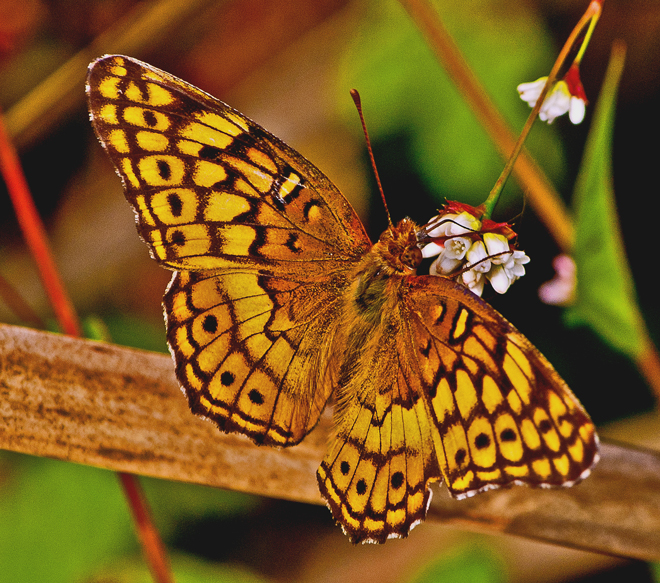
One of the coolest things about female Eastern Tiger Swallowtail butterflies (Papilio glaucus) is that they come in two distinctly different colors, black and yellow. According to Wikipedia, that characteristic makes them dimorphic. I’m no scientist, so I had to do some research  to see what “dimorphic” means. If I understand it right, it means that there are two different phenotypes (called morphs) that exist in the same population of a species and they have to be in the same habitat at the same time to qualify.

I was thrilled yesterday to observe and photograph both variants at a local garden. The yellow ones resemble the male, although the male is only yellow and black and has no additional orange and blue markings. I have seen a lot of the yellow female swallowtails this summer. The black swallowtails, which have black bodies as well as black wings, seem to be more rare, or at least I have seen them only rarely this summer.

Which one is more beautiful? I’ll leave that call to each of you.

black_swallowtail1_6x8blog

Female Eastern Tiger Swallowtail butterfly (black variant) UPDATE in 2020: I think that I misidentified this as an Eastern Tiger Swallowtail and now think it might be a Black Swallowtail, though the angle keeps me from being sure about the identification

© Michael Q. Powell. All rights reserved.

Read Full Post »

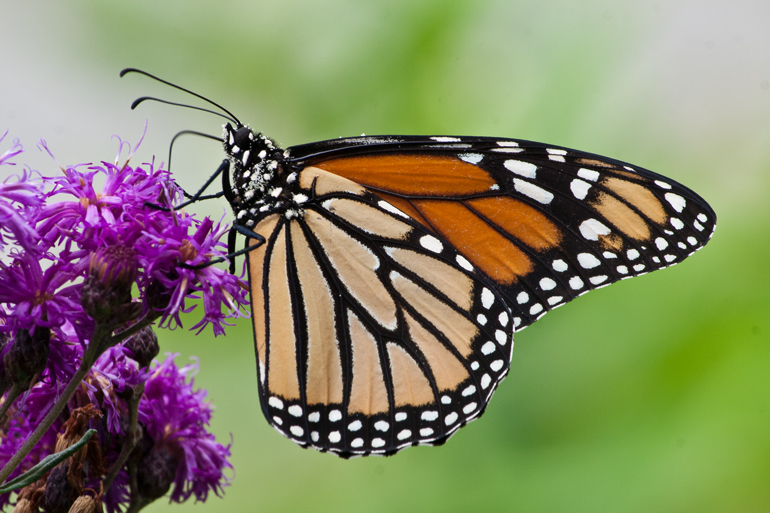
Monarch butterfly (Danaus plexippus) feeding on a marigold flower at Green Spring Gardens, Alexandria, VA on 6 August 2012.

Click on the photo for greater color and clarity

© Michael Q. Powell. All rights reserved.

Read Full Post »
Is it really possible to find inspiration and motivation in an insect?

Take a really close look at this photo of an male Eastern Tiger Swallowtail butterfly (Papilio glaucus).

Do you see the delicate beauty of his colors and shapes or are your eyes drawn immediately to his infirmity? His wings are virtually shredded and there is a large portion of one of them missing.

Somehow, despite all of those limitations, he can still fly. He can defy gravity and the laws of aerodynamics.

I don’t know how he does it, but he is able to overcome adversity.  Some of the lyrics of the song “Defying Gravity” from the musical “Wicked” come into my head as I think about it.

“I’m through accepting limits ’cause someone says they’re so. Some things I cannot change but til I try I’ll never know….I’d sooner buy defying gravity. Kiss me goodbye I’m defying gravity and you can’t pull me down.”

Inspiration and motivation can come from many places, I would posit, even from insects.

Take these broken wings and learn to fly…

© Michael Q. Powell. All rights reserved.

Read Full Post »
Painted Lady butterfly (Vanessa cardui) photographed today at Green Spring Gardens, Alexandria, Virginia.

© Michael Q. Powell. All rights reserved.

Read Full Post »
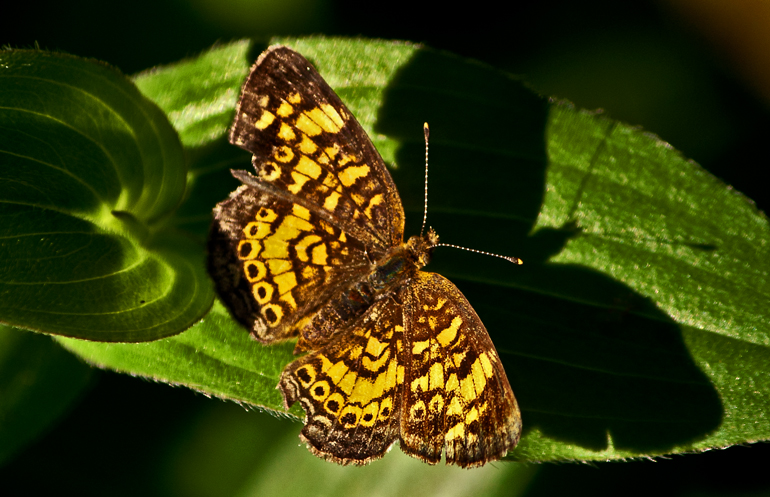
This butterfly looks so drab until he opens his wings and reveals his hidden beauty. It was there all the time but we couldn’t see it.

I haven’t been able to identify this butterfly that I photographed this past weekend in a meadow in Massachusetts but like the way the shot turned out.

UPDATE: I am now pretty sure this butterfly is a Common Wood Nymph (Cercyonis pegala).  Check out the Butterflies and Moths of North America website for additional details.

How much beauty do we miss each day because we fail to see past the ordinary exteriors of things (and people) in our lives and neglect to look more deeply?

© Michael Q. Powell. All rights reserved.

Read Full Post »
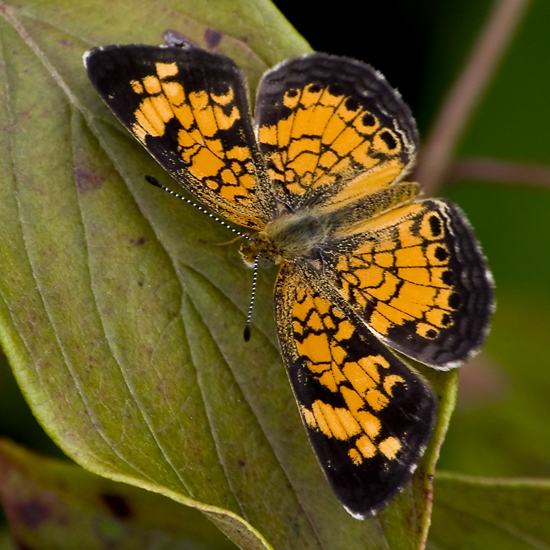
Here are a couple of shots of a Pearl Crescent butterfly (Phyciodes tharos) that I took yesterday at Huntley Meadows Park in Alexandria, Virginia. The Gardens With Wings website cautions that the Pearl Crescent resembles several other butterflies and the patterns of Pearl Crescent butterflies are variable, according to Wikipedia. I apologize in advance, therefore, if I have misidentified this butterfly, but I think we can all agree that he is amazingly beautiful.

© Michael Q. Powell. All rights reserved.

Read Full Post »

It’s pretty cool to photograph big, gaudy butterflies but today I photographed the smallest butterfly I’ve ever seen. I was shooting photos with my mentor Cindy D. and her husband when Cindy spotted this little guy. He seemed too small to make a good photo and they needed to leave.

Undeterred I lay on my stomach and got as close as my lens would permit me (I did not have time to switch to my macro lens and had to make do with the 18-55mm kit lens that happened to be on the camera). To give you an idea of his size, note that he is perched on a single clover flower.

I’m pretty happy with the result and hope eventually to figure out what kind of butterfly he is. For now, though, I am content to have gotten this shot.

Image

Tiny butterfly on a clover flower

© Michael Q. Powell. All rights reserved.

Read Full Post »

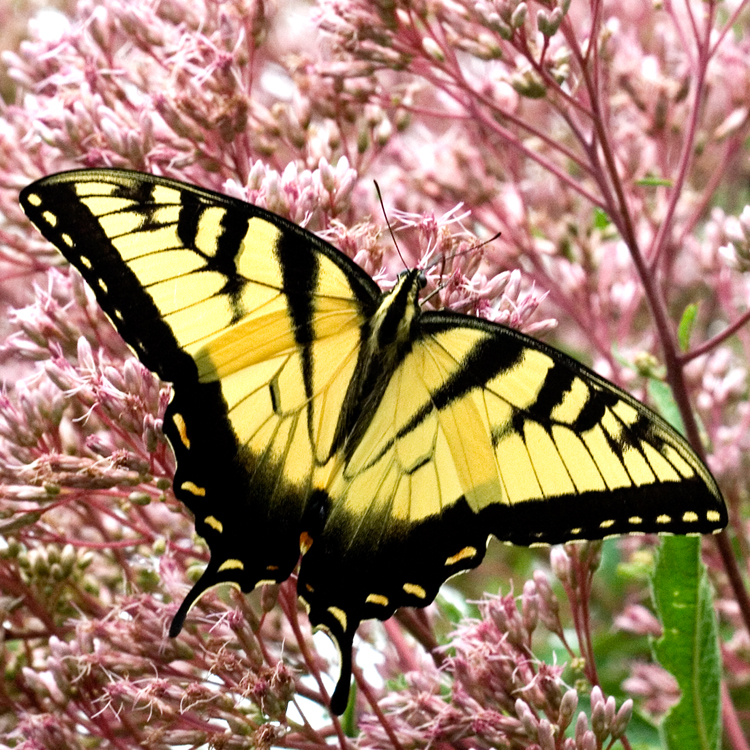
I haven’t seen too many butterflies yet this season so I was happy yesterday to encounter several Eastern Tiger Swallowtail (Papilio glaucus) butterflies at a local garden. The few that I have seen during the past few weeks have been pretty damaged but the male I photographed was in great condition. The female had some damage to one of her “tails” but otherwise was almost perfect.

Eastern Tiger Swallowtail male in perfect condition

Eastern Tiger Swallowtail female with damaged tail

© Michael Q. Powell. All rights reserved.

Read Full Post »
« Newer Posts